Theses
Thesis/Dissertation Collections
2004
Modeling of probe-and-drogue part of an in-flight
refueling system
Jie Yan
Follow this and additional works at:
http://scholarworks.rit.edu/theses
This Thesis is brought to you for free and open access by the Thesis/Dissertation Collections at RIT Scholar Works. It has been accepted for inclusion in Theses by an authorized administrator of RIT Scholar Works. For more information, please [email protected].
Recommended Citation
By
Jie Van
A Thesis Submitted in Partial Fulfillment of the
Requirement for the
Master of Science
In
Mechanical Engineering
Approved by:
Dr. Agamemnon L. Crassidis
Department of Mechanical Engineering
Dr. Kochersberger, Kevin
Department of Mechanical Engineering
Dr. Kozak, Jeffrey
Department of Mechanical Engineering
Dr. Edward C. Hensel
Department Head of Mechanical Engineering
Agamemnon Crassidis
(Thesis Advisor)
Kevin Kochersberger
Jeffrey Kozak
Title of thesis or dissertation:
Name of author: Degree:
Program: College:
Modeling of Probe-and-Drogue Part of an In-flight Refueling System
Jie Yan
Master of Science
Mechanical Engineering
The Kate Gleason College of Engineering
I understand that I must submit a print copy of my thesis or dissertation to the RIT
Archives, per current RIT guidelines for the completion of my degree. I hereby grant to the Rochester Institute of Technology and its agents the non-exclusive license to archive and make accessible my thesis or dissertation in whole or in part in all forms of media in perpetuity. I retain all other ownership rights to the copyright of the thesis or dissertation. I also retain the right to use in future works (such as articles or books) all or part of this thesis or dissertation.
Print Reproduction Permission Granted:
I, Jie Yan. hereby grant permission to the Rochester Institute of Technology to reproduce my print thesis or dissertation in whole or in part. Any reproduction will not be for commercial use or profit.
Jie Van
S-/If//
mother,
my
Thanks
alot for
Dr.
Agamemnon
L.
Crassidis,
Inthis work, afiniteelementmodelof an in-flightaircraftrefuelingsystemis developed.
The model is a first attempt to describe the dynamics of a probe-and-drogue refueling
systemcommonly usedby Navyaircraft. The purpose ofthis workis todevelopamodel of the drogue system tobe able to study control and sensor system requirements for an autonomous refueling system. This work is intended as a first introduction to an
automated in-flight refueling system with special concentration on the modeling of a
probe-and-drogue in-flight refuelingsystem foraircrafts. An understanding of whatis an
in-flight refueling system and its significance and influence to the advancement of a
aircraft is first presented. The main character of the system, such as mass, stiffness, damping effect is found from visual observation of an actual drogue system. While
changing these parameters, the responses with different outside forces added on the
1) Abstract
2) TableofContents
3) Abbreviationand
4) ListofFigure
5) ListofTable
1
2
3
4
5
Chapter1 Introductionofin-flight refuelingsystem 6
1. What is in-flight refuelingsystem
2. Historyand achievements ofin-flight refuelingsystem
3. Differenttypesofin-flight refuelingsystem
Chapter 2 Theory offiniteelement 23
Chapter 3 Theoryof mathematicalmodel 32
Chapter4 Creationofmathematical model 42
Chapter 5 Discussionand conclusions 75
Chapter6 Reference 92
RAF:
FRL:
RCAF:
BSAA:
FR Inc.:
SAC:
TAC:
NATO:
gpm:
nm:
knot:
Ke:
Me:
M:
K:
C:
E:
i
-Row,j
-column
Royal AirForce, UK,Farnborough
FlightRefuelingLimited
Royal Canadian Air Force
BritishSouth American Airways
FlightRefueling,Incorporated-FRL American subsidiary
Strategic Air Command
TacticalAir Command
North AtlanticTreatyOrganization
gallon per minute
nauticalmile, lnm=6,080 feet
nmperhour
stiffness matrices oftheelement
mass matrixoftheelement
massmatrixofthemathematical modal
stiff matrix ofthemathematical modal
dampingmatrix ofthemathematical modal
Figure 2.1 Beamelements 27
Figure 2.2 Stiffness for beamelement 28
Figure 2.3 Positivesense ofbeam displacement 29
Chapter3
Figure 3.1 Simplificationof probe-and-drogue 32
Figure 3.2 Uniformtwobeamelements
Chapter 4
33
Figure 4. 1 Modeloffree vibration 42
Figure4.2Forcingfunction fora singlebeamelement 43 Figure 4.3 Beamelementsfor free vibration model 45
Figure 4.4Gravityon thebeam 46
Figure 4.5 Gravityonbeamanddrogue 48
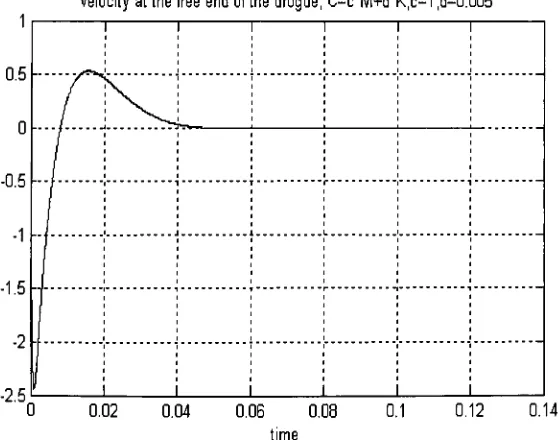
Figure 4.6 Displacementatthefreeend ofthedrogue,c=l,d=0.001 52 Figure 4.7Velocityatthefreeendofthedrogue,c=l, d=0.001 52 Figure4.8 Displacementatthefreeendofthe drogue,c=l,d=0.002 53 Figure4.9 Velocityatthefreeendofthedrogue,c=l, d=0.002 54 Figure 4.10 Displacementatthefreeend ofthe drogue,c=l, d=0.005 55 Figure 4.11 Velocityatthe freeend ofthedrogue,c=l, d=0.005 55 Figure 4.12 Displacementatthefreeend ofthe droguewithgravity, c=l, d=0.001 56 Figure4.13 Velocityatthefreeend ofthedroguewithgravity, c=l,d=0.001 57 Figure 4.14 Displacementatthefreeendofthedroguewithgravity, c=l, d=0.002 57 Figure 4.15 Velocity atthefreeend ofthedroguewithgravity, c=l, d=0.002 58 Figure4. 16 Displacementatthefreeend ofthe droguewith gravity, c=l,d=0.005 58 Figure4.17Velocityatthefreeend ofthedroguewith gravity, c=l,d=0.005 59
Figure 4.21 Displacementatthefree end ofthedrogue withoutsideforces,d=0.001 69 Figure4.22Velocityatthefreeend ofthedroguewithoutsideforces,d=0.001 69 Figure 4.23 Displacementatthefreeendofthedrogue with outsideforces, d=0.002 70 Figure 4.24 Velocityatthefreeend ofthedroguewithoutside forces,d=0.002 70 Figure 4.25 Displacementatthe freeendofthedrogue withoutsideforces, d=0.005 71 Figure4.26Velocityatthefreeend ofthedroguewith outsideforces,d=0.005 71
Chapter 5
Figure 5.1 Displacementatthefreedendofthedrogue, c=0.5 d=0.0005 79
Figure 5.2 Displacementatthefreedend ofthedrogue, c=0.5 d=0.001 79
Figure 5.3 Displacementatthefreedend ofthedrogue, c= 1 d=0.001 80
Figure 5.4 Displacements at each node 81
Figure5.5 ComparisonofImpulseresponse athighfrequencydomain 83 Figure5.6ComparisonofImpulseresponse atlow frequencydomain 84 Figure 5.7 Comparisonofsystemresponse withdifferentmass 88 Figure 5.8 Comparisonof systemresponse withdifferentmass 89
ListofTable
Table4. lUniformtwobeamelements 46
Table 4.2 Matrices offreevibration 47
Table4.3 47
Table 4.4 61
Table 4.5 61
Table4.6 64
What is in-flight refueling
Fuel is required in all aircraft. It's aheavy energy source that consumes space. Fighters
like the F-16 trade fuel capacity for performance and payload. For short-range air
defense, the tradeoff is optimal. However, to fly long distances, designers resort to
auxiliary fueltanks in various configurations. With rareexceptions, pilots would choose notto carry auxiliary fuel tanks incombat,whetherfor air-to-air orfor tactical missions. The auxiliary tanks increase fuel consumption, reduce ordinance payloads and tend to
reducetopspeedoftheaircraft. Dropping thetanksbeforecombat solvestheseproblems, but the practice is wasteful and involves other compromises. Even with extra tanks, a
fighter can't cross vast oceans by the most direct route without running dry. The only
practical answeris topickupextrafuel alongtheway.
Day or night, good weather or bad, in-flight refueling keeps military aircraft in the air,
extending their endurance, range, andpayload and vastly increasing their effectiveness. When duty calls at the far reaches of the globe, in-flight refueling allows a rapid
achievedthefirstrealin-flight refuelingthrough adangling-hosemethod. Severalmonths
later, another attempt was made. Where aborder-to-border nonstop flight of 1,280 miles
demonstrated how an airplane with a normal range of 275 miles could have its range quadrupled.
What became themuch-publicizedQuestion Markoperation wentforwardwith aFokker C-2A tri-motor, a high-wing monoplane of 10,935 pounds, modified into the receiver.
Two 150-gallon tanks installed in its cabin supplemented its two 96-gallon wing tanks. After fuel was received into the cabin tanks it had to be pumped by hand to the wing tanks, from where it gravitated to theengines. In addition, there was a45-gallon reserve
tankfor engine oil. A hatch was cut intheplane's roofto receive therefueling hose and othermaterials. On each side ofitsfuselage,theFokkerwaspaintedwithalarge question markintended toprovoke wonder at how long the airplane could remain airborne. Two Douglas C-l single-engine transports, 6,445-pound biplanes, were transformed into tankersby installingtwo 150-gallontanksfor offloading and arefueling hosethat passed through ahatchcutinthe floor. Inthecourse oftheoperation on 1929, thetankers made
forty-three takeoffs and landings. Crews of tankers flew forty-three sorties, twelve of
them at night. Altogether, they delivered 5,660 gallons of fuel (33,960 pounds), 245
gallons of engineoil (1,838 pounds delivered in forty-nine five-galloncans),andstorage batteries, spare parts, tools, food, clothing, mail, and congratulatory telegrams. The Question Mark operation was predicated on its potential military utility. This
achievement promptedmanypilots to attemptin-flight refuelingto establishlong during
flyingrecord. InJuly 1930,therecord was647.5 hours,nearly 27 days intheair.
was only a trifle betterthan ninety miles per hour, and over a distance of 1,000 miles,
most of this speed was lost at fuel stops. But within ten years, aero engine power
quadrupled, which brought more powerful and long-range airplanes, such as Douglas DC-1 andMartin B-10 bomber. So with theelements ofthe modern airplane making it
possible to build increasing range into an airplane, people felt no need for the
complication ofin-flightrefueling.
During theWorld WarU, aircraft withlarge internal fuel capacity alleviatedthe needfor
aerial refueling. Atthattime,in-flight refuelingsystemshadsevere drawbacks.However,
changes took place after the Japanese attack on Pearl Harbor brought the United States
into World War II, many Americans desperately wanted to bomb Japan. The most forward U.S. base forsuch an action was Wake Island, 1,983 miles fromTokyo, butthe Japanese preempted its use on December 22, 1941, when they overwhelmed its small
garrison of U.S. Marines. In Washington, Imperial Airways'
use of in-flight refueling
was recalled. The U.S. effort to develop an in-flight refueling capability went forward,
although slowly.
It was Sir Alan Cobham andFlight Refueling Limited (FRL) the company he founded in 1934 broughtgreat changesto thein-flightrefueling. With World War JJended,FRL's
services were more acceptedthan before. Six surplus Lancasterbombers were obtained
and transformed into tankers and receivers. Each Lancaster tanker would deliver 2,830
U.S. gallons (16,980 pounds). During the winter of 1946-47, an intensive series of
demonstration flights was flown in association with British South American Airways (BSAA). These were all-weather, day-and-night operations, and involved distant interceptions that used radar and transponders. Unlike the prewar refueling that were daylightvisualflightrulesoperations inwhichtankerandreceiver wererarelyoutofone
another's sight. The object was to simulate mid-ocean rendezvous. FRL used its
nothing extraordinary abouttheoperation.
On Jun 26, 1946, the War Department's Army-Navy Aeronautical Bd agreed
unanimouslythat the nm andtheknot be adopted asstandardunitsofdistanceand speed. With aviation then "going global"
this made sense; it brought aviation into
correspondence with geodesic measurementsfirmlyin place sincethe eighteenth century.
An nm is the length of one minute of the arc of a meridian at the Equator, that is, a
nominal 6,080 feet. A knot is simplya rate of speed: one nm perhour. Thedistance from
Goose Bay, Labrador, the northeastern most air base in North America, to Moscow is
3,106 nm; the distance from New York City to Moscow is 4,037 nm; and the distance from ChicagotoMoscow is 4,303 nm.
As relations between the United States and the Soviet Union deteriorated after World
War II, U.S. Army Air Forces'
leaders started measuring distances between North
America and such points in the USSR as Magnitogorsk, Novosibirsk, Omsk, and
Sverdlosk. They foundthem to be more than a few nautical miles (nm) too fartofly. A
means of rangeextensionbecameurgent.
In 1948, Air Force contacted with FRL, getting two sets of FRL's in-flight refueling hardware, manufacturing rights toFRL's system and a contract withFRL to produce an additionalfortyrefuelingsets.
In 1940s, the design of some very big airplanes appeared, such as Boeing B-52 and
ConvairB-36,B-52was a six-engine turboprop, with aweightashigh as490,000pounds
and a greatrange 10,860 nm,nearly halfthe globe's circumference attheequator, while
"carrying fuel to consume fuel". But if applied in-flight refueling system, the range
reduction would be accepted, andeverything else startedto fall into place. The airplane
wasreducedtosomethingreasonable around300,000pounds.
The bombardment committee emphatically concluded that the development of in-flight
refueling should be the Air Force's top priority, not only for the B-52 of the distant
future,but alsofor existing B-29sandthenewB-50s thenenteringtheinventory.
Besides FRL, the other contributor ofin-flight refueling system is Boeing. While FRL's
"looped hose"
system dominated the in-flight refueling and its "probe and
drogue"
system was underdeveloping, Boeing invented its "Boeing boom", another widely used
refueling system. Then in 1958 more and more B-29s were ordered to be modifiedinto
boomtankers,andbecame KB-29Ps. AllofthenewB-50wastobe boomreceivers.
Another significance of 1948, twenty-five years after the world's first aerial refueling,
was the creation of the world's first in-flight refueling unit, the 43d Air Refueling
Squadron atDavis-MonthanAFB, Arizona, andthe509th atWalkerAFB, Roswell,New
Mexico. At the same time, FRL created an American subsidiary Flight Refueling,
Incorporated,knownasFRInc.
On March, 1949, thanks tofour in-flight refueling using FRL's looped-hose system on a
KB-29M, the first nonstop flight around the world was made by a B-50 named "lucky
ladyJJ" after an unremarkable ninety-fourhours andoneminuteflight.
Promotedbyworldflight,attheend of 1949,SAC hadsixrefuelingsquadrons andbythe
end of 1950,thereweretwelvesquadrons withKB-29Ms.
In the fallof 1950, the first in-flight refueling of ajet bombertookplace between a
KB-29Pand aNorth AmericanREM15C assigned to the91st StrategicReconnaissance Wing.
techniques and procedures, including the first night refueling and instrument weather refueling. By 1951, SAC had twenty squadrons with a mix ofKB-29Ms andKB-29Ps, but also two with new BoeingKC-97s. The next yearit hadtwenty refueling squadrons with 318tankers. In 1952,SACplannersforthefirsttime incorporated dependenceonin
flight refueling intotheir warplans, andby 1953, SAC had almost thirtysquadrons with 502 tankers,most of which were new KC-97s. Attheend of 1954, SAC's refueling fleet had grown to thirty-two squadrons with 683 tankers, with an average of twenty-one
airplanes per squadron.
In 1950s, while cold war gothot, refueling became vital. In 1951, during Korea war, the
world's firstcombat missionusing in-flight refueling was executed. This refuelingoftip tanks to achieve range extension grew beyond occasional operations with probe-tanked
F-80s andRF-80s into Project HIGH TIDE, in which the three squadrons ofthe 136th Fighter-Bomber Wingwere equipped with probe tanks. SAC released ten KB-29Ms for
this operation. HIGH TIDE's objective was an operational test of large tactical units,
using in-flight refueling. The project had three phases: training the three squadrons in a series of small exercises, deploying them in combat air patrol missions over northern Japan,anddeployingthemincombatagainsttargetsin North Korea.
The U.S. Air Forceconcludedfrom HIGH TIDE that, althoughtherefueling oftip tanks
was a successful adhocoperation,itwasonly anemergencysubstituteforareceiver with
a single-point refueling system. Otherwise, there was no question about in-flight refuelingbeingofvalueto theTactical Air Command(TAC)andtotheaterairforces.
From 1948, with the assistance of in-flight refueling, flight crossing pacific became
With the development of in-flight refueling, more demands were submitted to make
refuelingmore efficient and secure. Although thenew B-47 bomberwas a good sight, it also created problems.
The aircraft was not wholly compatible with SAC's slower and altitude-limited
piston-engine tankers. Fully loaded at its 175,000-pound takeoff weight, a KC-97G was hard
puttoreach an altitude of20,000 feet. ButaB-47's cruisingaltitude was35,000 feet. For its refueling, a B-^17 had to descend to the KC-97's altitude and start refueling around
18,000feet. Whilethe tankergot lighter,theB^47 becameheavier, requiringmore speed
to stay in the air than a KC-97's engine could match. The result was the "toboggan"
maneuverin which both airplanes entered a shallow dive, a risky descent for two very large airplanes joined by a refueling boom. Two airplanes each weighing more than
150,000 pounds joined by forty-plus feet of ostensibly rigid tubing do not constitute a
flying machine. Refuelingcould end as low as 12,000 feet, after which the B^17 hadto
climbbackto its cruisingaltitude and consume as much as50percentofthefuel it had justtaken on board. Clearly, theonly remedy was aturbojet tanker thatcould deliver its
offloads at altitudes that turbojet receivers found congenial. On June 1953, KC-97s fulfilledthemissiontorefuelB-47s intheair.
Then with the debut ofB-52, new problem appeared. A KC-97 could servetwo B-47s,
givingeach a minimum of26,500pounds offuel (22.6percentof aB-47's full load),but
a B-52B's tank required 243,000pounds to fill it, and a KC-97's total offload (53,000
lbs), was only 21 percent of this. In other words, to achieve approximately the same
delivery given to two B^17s, a minimum of one KC-97 was required for each B-52B.
However, a B-52's fuel consumption was greater than aB-47's, andtwo KC-97s were
necessary to serve one of the eight-engine giants. Additionally, there remained the incompatibility between turbojet and piston-engine equipment. This not only required
basing the slow tankers about 1,000 nm ahead of their receivers and establishing a
KC-97s toguaranteeoneB-52B a minimum26 percent refueling. A tankerlargerthan a
KC-97, one with turbine engines that could cruise at the receiver's speed and altitude
wasclearlyneeded.
The solution wasBoeing's KC-135, onethe most widely usedtanker now. A KC-135A
couldlift 31,200 gallons ofJP4 (202,800pounds of aviationjet fuel)16,848 gallons in
wingtanks, 12,178 gallonsin fuselagetanksbelowthecargodeck, and2,174gallons ina
tankonthe tail cone's upperdeck. Inpractice, weightlimitations dictatedabout5percent
lessthan that.Thefuel in its below-decktanks alone was enoughtorefueltwoB^17Es to
33 percent and oneB-52Bto32.5percent.
A KC-135's below-deck fuel tanks,upper-deck and tail cone tanks, plus its center-wing
tank, allowed it to replenish 57 percent of one B-52B's fuel, or 29 percent of two
B-52Bs'
fuel. Thetankerdidthatat thebomber's operatingaltitude andcomfortablywithin
itsspeed envelope. Anewrefueling boomandpumpingsystemdelivered JP4toreceivers
atarateof900gpm.
At the end of 1961, the number of SAC tankers peaked at 1,095: 651 KC-97s and 444
KC-135s. This was an "air
force"
unto itself. In addition, the Tactical Air Command
operated about 130 Boeing KB-50 tankers. The grand total was approximately 1,225
large, multiengine airplanes, all devoted to aerial refueling. The following year, at the
timeoftheCuban MissileCrisis, SAC'stankersincluded503 KC-97s and515 KC-135s,
1,018 airplanes fewertotal aircraft,butmorejet KC-135s.
In 1949, North American the AJ-ls became theNavy's first in-flight tankers. Later
AJ-ls were displaced by improved AJ-2s. After 1956, the AJ-2s were displaced by the
Douglas A3D, an airplane weighing 82,000pounds and with acombatradius of900nm.
The best aerial tanker the Navyever hadwas a modification oftheDouglas A3D attack
In 1953,to relievetheNavy's carrier space problem,Douglas developedtheD-704
self-contained
"buddy"
refuelingunit an external store thatheld 300 gallonsoffuel, a hose-reel unit, its own pumping system, and was self-powered by a generator turned by ram
air. At first glance, the unit could be mistaken for an external fuel tank, but was
distinguishedbythepropellerin itsnosethatturnedits generator.The D-704becamethe
"granddaddy"
of allbuddystores.
Operation HIGH TIDE in Korea proved the overture to the Tactical Air Command's
adoption of aerial refueling. TAC worked out a system for F-lOlCs to operate in pairs. One airplane carried a
"dial-a-yield"
nuclear weapon (ten to seventy kilotons), and the
other carried abuddy-packtorefuelthebomber, whosenormalradiusof690nmcouldbe
extended to 900 nm. TAC submitted the idea of "every fighter a tanker; every fighter a bomber".
While Air Force focusedon BoeingB-47,the Britishdevelopedthreebombers of similar weight and performance capabilities, each powered by four turbojets, the so-called
"V"
bombers the Vickers Valiant, a 140,000-pound airplane of rather conservative design;
the delta-wing Avro Vulcan, weighing 220,000 pounds; and the Handley Page Victor, 216,000 pounds. All had performances similar to the B-47. Later, Valiant and Victor were modified to tanker respectively. The first Victor tankers had two-point refueling,
with an FRL hose-and-drogue unit beneatheach wing. After 1965, later Victors had an additional unit installed beneath their fuselages, thus making them three-point tankers. Initially created as bombers, the Victor tankers already had probes for receiving; once
converted; they couldboth give and receive. This double-duty outfitting permittedrelay
refueling in which twoor more tankers couldaccompany areceiverto give it maximum range, withthetankerstopping off one another. Some yearslater, theVulcans, too, were
convertedfrom bomberstotankers, andtheyalso hadthatdouble-endedcapability. Much later in 1981, the U.S. Air Force first exploited the versatility of the tanker-receiverby
In 1960s, during warin SoutheastAsia, in-flight refueling tanker, especially KC-135 did
greatachievements. Byrule ofthumb since 1915,the internal fuel ofany fighterplane at
any point in time is something less than 25 percent of its nominal maximum takeoff
weight. Arequirement formore fuel involves strapping on external fuel tanks. Ifthat is notenough,in-flight refueling isnecessary.
In asagaof aerialrefueling,this KC-135 replenishedtwo NavyKA-3 tankers,twoNavy F-8s, and two F-4s returning from the strike, in addition to its F-104s. While it was
pumping fueltoone oftheKA-3s, theF-8 fighters came onthe scene, desperatefor fuel. The KA-3reeled outits hose forthem. Forafew minutes,aK-135 wasrefuelinga
KA-3, which atthe same time was refueling F-8s a tri-levelrefueling. Without the service from this obliging KC-135, the Navy airplanes probably would not have reached their
carrier.
And it was in this war, a KC-135 crew receivedproper credit: the Mackay Trophy, an
awarddating backto 1912 andgiven forthe mostextraordinary aerial flight ofthe year; this wasthefirsttimeatankercrewhadbeen sohonored.
Another extraordinaryworkofin-flight refuelingtankerwas savingleakingfighters.
KC-135s occasionally flew leaking fighter planes back to their bases attached to their
refueling booms, meanwhile pumping enough fuel to keep the fighter's engine barely running. The KA-3s didthe same forNavy fighters and attacked planes, leading them at
theends oftheirrefueling hoses.
In the course ofthe war, KC-135 tankers flew 194,687 sorties, averaging 21,631 sorties per year.Theyexecuted 813,378 in-flightrefueling, an average of90,375 peryear, 7,531
permonth, 251 perday. Total flyingtimewas 911,364hours, an averageof 10,126 hours
annually, 8,438 hours each month. In total, they delivered almost 1.4 billion gallons of
Atthe sametime,theapplication ofin-flight refuelingtohelicopterenhancedits rescuing capabilitygreatly. From itsinception,the helicopterwas aseverelyrange-limitedaircraft. The Sikorsky R-4, the first operational helicopter of the U.S. military, was a charming little machine of2,020 pounds that hadan operatingradius of sixty statute miles. In any
vehicle thatlifts its own weightdirectlyoffthe earth, weightis worsethancritical it is everything. Fuel isrange,but fuel quicklyaddsuptolots of weight.
Nonetheless, military aviators, fromthe very beginning of rotary wing aviation, viewed thehelicopter as aninstrument torescue people from predicaments with difficultaccess. From thefirstcovertU.S. intervention inthe affairs ofSouth VietnamandLaos in 1962, downed airmen needed rescue. This meant helicopters, and the effort quickly grew to
morethanjustrescue. Itmeant dashingin tosnatchthese airmen outfromundertheguns
of the enemy, being shot at, and shooting back. These circumstances generated requirements forrangeextensionand anexpandedloitertime.Helicopter advocatesfaced
thesame problem as theirAircraft andWeapons Boardcounterpartsin 1947: eitherbuild
a ridiculously large and hopelessly conspicuous flying machine, or go to in-flight
refueling.
On December 1965, a CH-3 helicopter and a KC-130 tanker made success in the first
experiment. In that moment, not only had airrescue operations been revolutionized, but alsohadthegeneral scope ofhelicopteroperations.
In the course ofthe war, the helicopters and crews ofthe AirRescue Service picked up 3,383. It is doubtful that score would have been whatit was without in-flight refueling
extending the range and expanding the endurance, which was necessary for so many successful executions ofthe mission. The U.S. Navy, Marines, andCoast Guard quickly adoptedin-flight refueling for helicopters built forrescue workand special missions.
Ever since then, in-flight refueling nearly appeared in every major war involved USA.
itneeded an airliftcapability independentofthosebases, oneitcoulddeployunilaterally. In-flight refueling was the solution. All the while, calls for in-flight refueling services
were increasing. Since then KC-10 appeared, a tanker even more capable than KC-135, proving US's refuelingcapability.
The KC-10 is a 590,000-pound aircraft with atotal capacity of 365,000 pounds offuel (56,153 gallons),61 percent ofits takeoff weight, theoretically,all deliverable. A wholly
newboom of McDonnell-Douglas design andits pumping system can delivermore than
1,000gallons per minute. The KC-10A is airrefuelable, makingpossiblerange extension
byrelay, refuelingbya series oftankers. Additionally, someKC-lOs have beenequipped with wing-tip refueling pods with FRL hose-reel systems, thereby making the KC-10A the Air Force's first two-system tanker (boomandhose), andits first three-point tanker sincetheKB-50s were retiredin 1965.
In 1991, during forty-three-day operation of DESERT STORM, one of the most
interesting things was on any given day 18 percent of the airplanes in the air almost
one-fifth oftheforce was tankers.Thetankerswere"first in andlastout".
1.3 Differenttypesofin-flight refuelingsystem
1) Dangle- and- grab
system,thefirsteffort ofin-flight refuelingsystem,
On June 27, 1923, at an altitude of about 500 feet aboveRockwell Fieldon San Diego's North Island, a hose linked two U.S.Army Air Service airplanes, and one airplane
refueledtheother. While onlyseventy-five gallons of gasoline weretransferred, theevent
is memorable because it was afirst. Airplanes were de HavillandDH-4Bs, single-engine biplanes of4,600 pounds. 1st Lt. Virgil Hinepiloted the tanker; 1st Lt. Frank W. Seifert
occupied the rear cockpit and handledthe fueling hose. Capt. Lowell H. Smith flew the
receiver while 1st Lt. John Paul Richter handledtherefueling fromtherear cockpit.The
refueling system consisted of a fifty-foot length of rubber hose, trailed from the tanker,
with amanually operatedquick-closing valve at each end. The process is best described
intermsof"you dangleit;I'll grab
it."
Ever since then, several attempts were made to demonstratethe practical application for
in-flight refueling, and people began to realize how an airplane could have its range
quadrupled. However, after the first fatal accident happened on November 18, 1923, when an airplane was wrecked and a pilot killed while trying to demonstrate in-flight
refuelingduringan airshow, theexperimentswere dismissedasstunts.
Peoplehadrealizedthatdangleand grabtechnique wasprimitive,clumsyanddangerous.
It was necessary to develop a technique for the fueling hookup that did not demand
unusualflyingskill.
2) Looped hosesystem
The situation lastedtill L. R. Atcherly worked out his own in-flight refueling system
-the looped hose system. During in-flight refueling there is a cruising airplane and a
maneuvering airplane. Ordinarily, the tanker cruised while the receiver maneuvered to
grabthe hose. Atcherlyreversed thatorder of work andput almost the whole burden of
the operation on the tanker, whose crew would inevitably have more experience with
tankerandthereceivertrailingcables with grapnels attheirends. Whiletrailing itscable, the receiverflew astraight course, andthe tanker crossed its trackfrom behind, trailing its cable across the receiver's cable until the two grapnels connected. With the two
airplanes nowjoinedby theircables andflying side-by-side, awinch aboardthe receiver
pulledin itscable andalong withitthe tanker'scable. The refueling hosewasattachedto theother end ofthetanker's cable and winchedintothe receiver, where itwasmade fast to a fueling connection. With the two aircraftjoined by a huge bight of hose some 300 feetlong,the tankerclimbedtoa position slightly higherthan the receivertoputagravity headonthe offload,valveswereopened, andrefueling began.
When refueling was finished, the receiver disconnected thehose andthe tankerreeledit in, but the two airplanes remainedjoined by the cables of the original connection. The tanker thenturned away,breakinga weaklink inthecable connection.
Sir Alan Cobhem brought great changes to thein-flight refueling system. In spite ofthe failure happened before, Cobham was convinced that in-flight refueling had a practical
future. Well aware that the dangle-and-grab fueling system had no future, by mid-1938 Cobham and the company he founded Fight Refueling Limited (FRL) had a workable system, which came tobe known as the "loopedhose." Although it was quite similarto what Atcherly had worked out in the early 1930s. FRL's distinct contribution was the invention and development of the small but vital fittings and hose connections that
transformed in-flight refueling from stunts and experiments to rational flight operations thatcouldbeperformed routinely.
And later, the idea of single-pintrefueling was introduced. Before 1948, airplanes were refueledmuchlikeautomobiles,exceptthatbigairplanes hadmore thanonefueltank. At
an airfield, a fuel truck's hose was moved from gas tank to gas tank, the filler caps
usually locatedon awing's upper surfaceandthefuel flowedby gravity. Itwas slow and
be at a single point on the airplane into an integrated and well-vented fuel system, and accomplishedunderpressure.
3) Boeingboom
The cumbersome looped-hose system clearly had its limitations, and the Air Force had askedBoeingtoinvestigate alternatives. Theresult was the"Boeing boom". In 1948,the
Boeing Companybegan testingthe "Boeingboom" system,consistingof alarge-diameter pipe connectedto the rear of aB-29 andfittedwith small wings atthe end. An operator, sitting in the tailofthetankeraircraft, controlled theboomto "fly"to areceptaclein the
receiver.The boomwas loweredand
"flown"
to aconnector on thereceiver aircraft.This allowedfuel transfers totakeplace athigherspeedsand, moreimportantly, allowed more
thansix times as muchfuel to flow perminute.FRL's looped-hose system hadan inside diameter of only 2.5 inches and did well to deliver 1 10 gallons per minute (gpm). As most mathematicians and all plumbers know, if the diameter of pipe is doubled, its capacity is quadrupled. With aninside diameter offour inches and a powerful pumping
system,theearly-modelBoeingboom delivered 700gallon per minute.
Another important development was the "single-point refueling system"
on receiver
aircraft, which allowed all of an airplane's several fuel tanks to berefilled from a single spotinsteadoffrommultiple nozzles aroundtheairplane.
4) Probe- and- drogue
system
As early as 1939, FRL's looped hose provided a workablein-flight refueling system for large, multiengine airplanes, but its adaptation to fighter planes in which there was no crew toconnectthehose wasclearly impossible. Locked intotheideaofdoingsomething with a hose, FRL soon hit upon what became known as the probe-and-drogue system, whereby a small plane was equippedwith a probe thatcouldbe pluggedinto adrogue at
-shaped drogue, a basket that resembles an oversized shuttlecock. The drogue stabilizes
the trailing hose and provides a lead into the connector at the end of the hose. The
receiver aircraft is fitted with a probe that extends out from the side ofthe fuselage or
fromtheleadingedge ofthewing.Thepilot guidestheprobe intothedrogue tomakethe
connection.
On April 1949, the firsttest was given. Air Force flew four B-29s and a pair ofF-84Es
to England for FRL's modification. Two B-29s were given probes that jutted out
conspicuously from the upper curve of the nose of their fuselages, making them
receivers; theseaircraft became known as
"unicorns."
AthirdB-29 was modified with a
singlehose-reelunitin itsfuselageandwithhose-reelunitsinpods,one on eachwing tip,
enabling ittorefuel threefighters in a single contact. It wasdesignatedthe YKB-29T;its
three-hose capability led to its being called the "Triple Nipple." The two F-84Es were
fittedwith single-point
fuelingsystems.
Later, the idea of using the new probe- and
-drogue system to refuel only the external
drop tanksofthe fighters was introduced. Areceiverprobe andits valve were welded on
theinsideforwardcurvature of an externaldroptank. Insteadoffillingtheinternaltanks,
the receiver pilot simply filled his wing tanks. For straight-wing F-80s and F-84Es,
which had wing-tip tanks,subsequentoperations were.
The capacities of the external tanks varied from 160 to 260 gallons (1,040-1,690 lbs),
andthe movement generated bya half-ton offuel suddenly placed atthe wing tip could
make an airplane uncontrollable. To avoid making the airplane unstable in theroll axis,
refuelingthewing-tiptanks of an F-80or anF-84E involvedthreefuelingcontacts. The
receiver pilot filled his left tank half full, disconnected from the drogue, and connected
with his right tank. When it overflowed, he disconnected that tank and reconnected his
half-full left tank, filling it to an overflow. With both wing tanks full, he flew away to
5) Boom-drogue
-adapterrefuelingsystem
Many hailed probe-and-drogue refueling as the system of the future. It was simpler, cheaper, and it weighed less than aBoeingboom. It imposed less aerodynamic drag on
the tanker and did not require a skilled operator. But there were also some problems. Probe-and-drogue involvedalotofrubber, a material thatcouldbecomeunreliablein the
-60F temperatures above30,000 feet. Furthermore it seemed abit toomuchto expect a tiredpilot ofthesluggish mass of a200,000-poundairplanetochasethrough 180degrees
of his vision aheadto put a probe into the small, dancing target of a drogue's refueling basket. Finally, the optimum transfer capacity of a probe-and-drogue system was only 250 gallons perminute, compared withthe Boeingboom's 700 gpm. On theotherhand, the receptacle for boom refueling couldbe placed anywhere on the upper surface ofthe
receiver. It couldbeon the fuselage behindthe canopyor on theleading edge oftheleft wing. The best position was eventually determined to be outside the pilot's vision, allowingthepilottoconcentrate onthereceiver's position relativetothe tanker.
As a result, pilots of small maneuverable airplanes liked probe-and- drogue; those who flewbigairplanes preferredtheboom.
In 1959, theboom's incompatibility with probe-equipped airplanes was resolved with a
boom-drogue-adapter aflexible "tassel" fitted to the end of theboom with a basket at its end to receive a probe. However, when a boom tanker had an adapter attached, it
could not servereceiversfittedwithaboomreceptacle.
In 1962, new modifications appeared.Use KB-50 as anexample, in addition tohose-reel
unit in the tanker's tail there was on in a pod at each wing tip. Each hose-reel unit deployed seventy-five feet of hose. While pumping to three receivers at the same time,
Chapter2 Theoryoffiniteelement
2.1 Introductionoffiniteelement
The finite element method is a numerical analysis technique for obtaining approximate
solutions to a wide variety of engineering problems. Although originally developed to
study stresses in complex airframe structures, it has since been extended and appliedto
the broad field of continuum mechanics. Because of its diversity and flexibility as an analysistool,it is receivingmuchattention in engineeringschools andin industry.
In reality, either the geometry or some other feature of the problem is irregular or
"arbitrary". Analytical solutions to problems seldom exist. One possible solution is to
makesimplifying assumptions-toignorethedifficulties
andreducetheproblemtone that
can be handled. Sometimes this procedure works; but more often than not, it leads to
seriousinaccuraciesor erroneous results. Now, as computers arewidelyavailable, a more
viable alternative is to retain the complexities of the problem and find an approximate
numerical solution.
One ofthe most widely used numerical analysis methods is finite element method. The
finite element method envisions the solution regions as built up of many small inter
connected sub-regions or elements. A finite element model of a problem gives a
piecewise approximation to the governing equations. The basic premise of the finite
element methodis thata solutionregion can be analyticallymodeledor approximatedby
replacing it with an assemblage of discrete elements. Since these elements can be put
2.2 Theoryoffiniteelement method
In a continuum problem of any dimension the field variable (whether it is pressure,
temperature, displacement, stress or some other quantity) possesses infinitely many
values because it is a function of each generic point in the body or solution region.
Consequently, the problem is one with an infinite number of unknowns. The finite
element discretization procedure reduce the problem to one of a finite number of
unknowns by dividing the solution region into elements andby expressing the unknown
field variable in terms of assumed approximating function with each element. The
approximatingfunctions (interpolationfunctions)aredefined intermsofthevalues ofthe
field variables at specified points called nodes. Nodes usually lay on the element
boundaries where adjacent elements are connected. In addition to boundary nodes, an
elementmayalsohave afew interiornodes.Thenodal values ofthefieldvariable andthe
interpolation functions for the elements completely define the behavior of the field
variable within theelements. Forthe finite elementrepresentationof a problemthenodal
values ofthe field variable become the unknowns. Once these unknowns are found, the
interpolationfunctions definethefieldvariablethroughouttheassemblageofelements.
Clearly, the nature of the solution and the degree of approximation depend not only on
the size andnumberoftheelements usedbutalsoon the interpolationfunctions selected.
However, the functions can't be chose, because certain compatibility conditions should
be satisfied. Often functions are chosen so that the field variable or its derivatives are
continuous acrossadjoiningelementboundaries.
Another very important feature of finite element method is the ability to formulate
solutions for individual elements before putting them together to represent the entire
problem. This means, we could reduce a complex problem by considering a series of
greatlysimplified problems. Forexample, ifwe are treating a problem instress analysis,
we find the force-displacement or stiffness characteristics of each individual element
first, and then assemble the elements to find the stiffness of the whole structure,
Although using the finite element method, we could approach the formulation of
properties ofindividual elements in differentways; the solutionofa continuum problem
bythefiniteelement method alwaysfollows anorderly step-by-stepprocess asblow:
1. Discretizethecontinuum
This isthefirst stepto dividethe continuum or solutionregion intoelements. Duringthis
process, a variety of element shapes may be used, anddifferent element shapesmay be
employedinthesame solutionregion.
2. Select interpolation functions
In this step, we should assign nodes to each element and then choose the interpolation
function to represent the variation of the field variable over the element. The field
variable may be a scalar, a vector, or a higher-order tensor. Often, polynomials are
selected as interpolation functions forthe fieldvariablebecausethey areeasytointegrate
anddifferentiate. The degree ofthepolynomial chosen depends on the number of nodes
assigned to the elements, the nature and number of unknowns at each node, and certain
continuity requirements imposed at the nodes and along the element boundaries. The
magnitude of the field variable as well as the magnitude of its derivatives may be the
unknownsatthenodes.
3. Findtheelementproperties
Once thefinite elementmodel has been established, which means once theelements and
their interpolation functions have been selected, we are ready to determine the matrix
equationsexpressingtheproperties oftheindividualelements.
4. Assemblytheelementpropertiestoobtainthesystem equations
To findtheproperties oftheoverall systemmodeledbythenetwork of elements we must
"assemble"
all the element properties. In other word, we combine the matrix equations
the equations for an individual element except they contain many more terms because
theyincludeallnodes.
The basis fortheassembly procedure stems from thefactthat at anode, where elements
are interconnected, the value of the field variable is the same for each element sharing
thatnode. Auniquefeatureofthefiniteelement methodisthatassemblyoftheindividual
element equations generates thesystem equations.
5. Imposetheboundaryconditions
Before the system equations areready for solution they must be modified to account for
the boundaryconditions oftheproblem. At this stage we impose known nodal values of
thedependentvariables or nodal loads.
6. Solvethesystem equations
The assembly process gives a set of simultaneous equations that we solve to obtain the
unknown nodal values of the problem. If the problem describes steady or equilibrium
behavior then we must solve a set of linear or nonlinear algebraic equations. If the
problemis unsteady, the nodal unknowns are afunctionoftime, and we must solveaset
2.3 Theapplicationoffiniteelement methodto thecase
Inthecaseofthe in-flight refuelingsystem, the systemisconsists of along flexiblesteel
hose with an attached drogue at the end. The hose is more than fifty feet long and the
outsidediameter is approximately 2.5- 3 inches.
Comparing thelength ofthehoseto the
diameter, the diameter is small so that we simulate the probe-and-drogue system as a
flexible beamand createthemathematicalmodel as abeamsystem. Accordingto thefirst
step of finite element method, we could discretize the continuum beam system into elements and analyzethebeamelementfirst.
Describebeamelementasbelow:
1
h
w
_
t
Figure 2.1 Beamelements
/:
w:
h:
E:
I:
lengthofbeamelement
width ofbeamelement
heightofbeamelement
Young'smodulus
1 3
moment ofinertia,I= wh
12
First, the parameters of a beam element, stiffness matrices and mass matrices are
developed. Generally, the relative axial displacements will be small compared to the
lateral displacementsofthebeamelement and canbeassumedtobezero.
Fl,ul
Ml,91
L
F2,u2
)
M2,G2p 12EI <
r= ru1
r= pu1
M=iiLei
F=^ei
Figure 2.2 Stiffness for beamelement
The local coordinates for the beam element are the lateral displacements and rotation at
the two ends. Each end will have a lateral displacement and a rotation, resulting in four
coordinates, ui, 0i forthefirstendandU2,02forthe secondend. Thedisplacementcanbe
cpl(x)
91=1
^
cp2(x)1
u2=l cp3(x)
cp4(x)
Figure 2.3 Positivesense ofbeam displacement
The 4X4 stiffness matrix oftheelementisgivenby:
Ke =
EI
12 6/ -12 6/
6/ 4l2 -61
2/2
-12 -61 12 -61
61 2/2 -61
Forthe development of the general equation ofthebeam, which is a cubic polynomial,
thedeflection isexpressedintheform
U(X) =
P1+P2+
P3CJ2+P4CJ3
Where
X
= andPi =constants
/
Differentiatingyields theslope equation
Z0(x)=
P2+2P3+3P42
Theboundaryconditions are
, = 0 at x = 0 and , = 1 at x = /; the
boundary equations can be expressed by the
followingmatrixequation:
Ml
101
W2
Wi
10 0 0
0 10 0
1111
0 12 3
Pi
P2
P3
P4
Ifweexpress parametersP_bydisplacements,theequationbecomes:
Pi P2 P3 P4 1 0 0 0 1 0 -2 3 1 -2 0 0 u\ Wi U2 102 2 1-21
Set ui(x) = 1,9i (x) = 0,
u2(x) = 0,02 (x) =0, weobtain a
groupof constantsP;to define
shapefunctionofq>i(x);
P, =1,P2=0,P3=
-3,P4=2;
Thensetui(x)=0,0i (x)= 1,
u2(x)=0,02 (x)=0todefine<p2(x),get
Pi =0,P2=/,P3=
-2Z,P4=Z;
Thensetm(x)=0,0i (x)=0,
u2(x) = 1, 02 (x)=0todefine<p3(x),get
Pi =
Thensetui(x)=0,0i (x)=0,
u2(x)=0,02 (x)= 1todefine(p4(x), get
P! =0,P2=0,P3=
-/,P4=/;
Therefore,thefollowingshapefunctionsarederived:
cpi(x) = 1
3^+2^
(P2(x) =/^-2Z^2+Z^3
(p3(x)= 3^2-2^3
(p4(x)=
Considering the displacement in general to be the superposition of the four shape
functions,i.e.,
y(x)=(piui + (p20i+
(p3u2+ (p402
= q)lql+ (p2q2 + cp3q3 + (p4q4
The kinetic energy
1 * 2
1 *
T=
Jy
mdx = X<7 qj
j
(piCpmdx2 2 i
1
= X X m,y
qiqj
1 i ;
in which the generalized mass m^forms the elements ofmass matrix. The my is defined
as
mij =
J0
(pttpimdxThus,themassmatrixoftheelementis a 4X4matrix
156 22Z 54
22/ 4/2
13/
54 13/ 156 -22/
-13/ -22/
4/2 Me
= ml
Chapter3 Theoryofmathematicalmodel
3.1 Theoryof mathematical model
The goal of modeling a probe-and-drogue in-flight refueling system is to analyze the
motion oftheprobe-and-drogue part ofthe system, and understandthe movements, then developa systemforautonomousin-flightrefueling.
As discussed in the chapter 2, comparing the diameter of the pipe to the length, the
diameter is small,so theprobe-and-drogue part oftherefuelingsystem canbetreated as a
long and thin flexible steel cantileverbeam. The end ofthe beam is rigidlyconnectedto
the tanker,andthepipe will actlike abeam withmoments and lateralforces actingatthe
joints. The relative axial displacements will be very small compared to the lateral
displacements, which couldbeassumedtobezero.
The figure below displaysthesimplifiedmodel ofthe probe-and-drogue system.
Hose
Drogue
Figure 3.1simplificationof probe anddrogue
L: thelengthofthebeam
W: width ofthebeam
H: heightofthebeam
I: areamoment ofinertia= WH
12
In the finite element method, the continuum beam system is discretized into several
elements to analyze thebeam elementfirst. The assembly ofthe system matrix is found
by superimposing the preceding element matrices. For example, consider a 2-element
VA
c
)
c
Figure 3.2 Uniformtwo-beamelements
Elementa andelementbareidenticalelements exceptforthedisplacementvector.
Elementa: Element b:
ul
02
u3 ul
01
u2
02 03
Wesuperimposethepreceding matrix of
"a"
withmatrix
"b"
to obtain the following6 X
Elementa
Elementb
ul
81
u2
92
u3
93
Forexample, ifthere are twobeam elements, then the stiffness andmass matrices ofthe
systemis shown asbelow:
iffness matrix
"12 6/ -12 6/
6/ 4/2
-61
2/2
EI
-12 -61 12+12 -61+61 -12 6/
=
Y
6/2/2
-61+61
4/2+4/2 -61
2/2
-12 -6/ 12 -61
6/ 2/2
-61 Al2
12 6/ -12 6/ 0 0
6/ 4/2 -61
2Z2
0 0
FJ -12 -61 24 0 -12 6/
6/ 2/2
0 8/2 -61 2/2
0 0 -12 -6/ 12 -61
0 0 6/ 2/2
Massmatrb
"156 22/ 54 -13/
22/ 4/2
13/
ml 54
13/ 156+156 -22/+22/ 54 -13/
M=
420 -13/
-22/+22/ 4/2+4/2
13/
54 13/ 156 -22/
-13/ -22/
4/2
ml
420
156 22/ 54 -13/
22/ 4/2 54 13/ -13/ 0 0 0 0 13/ 312 0 0 8/2 54 13/ -13/ 0 0 0 0 54 -13/ 13/ 156 -22/ -22/ 4/2 _
If there are more than two elements, an extension of the matrix in the same manner is
made.Theoverall stiffness and mass matrices ofthe system canthenbe developed.
3.2 Theequation ofmotion
A second-order equationofasystem with viscousdamping andarbitraryexcitationFcan
bepresentedinmatrixformas:
[m]x+[c]x+[k]x =
[f]
where
[M]:
[K]:
[C]:
mass matrix ofthesystem
stiffness matrix ofthe system
[M] and[K] aredeterminedbythecharacter ofthesystem.
3.2.1 Freevibration oftheun-damped system
We first discuss free vibration of the un-damped system, the equation of motion expressed abovebecomes:
[m]x+[k]k =o
Ifwepre-multiplytheequationbyM"1, we getthefollowingterms: M_1M=I (unit
matrix)
M_1K=A (asystem
matrix)
And
IX+AX =0
The system matrix A defines the dynamic properties of the system. Assuming harmonic
motion
X=-AX and A=co2,we get [A-Al][X]=0,
Thenthecharacteristic equation ofthesystemis thedeterminantequatedto zero,or
[M_1K Al] = [A-/l/] =0
the rootsX_ areeigenvalues, and thenatural frequencies ofthe system are determinedby
therelationship
Ai=
co2
If substitute Xinto the characteristic equation, we obtain the corresponding eigenvector
X,andit ispossibletomakeXorthogonal.
3.2.2 ModalmatrixP
Inthe discussion above, the eigenvalues andeigenvectors ofthe system were developed.
For each eigenvalue, a corresponding eigenvector exists. The modal matrix for an n
degree-of-freedomsystemmayappear as
P=
In which,eachXnis acolumnorthogonal vector andcorrespondingtoa systemmode.
ThetransposeofPis
P' =
[X1X2....Xn]'
Ifweformtheproduct ofP'MPandP'KP, diagonal matrices asbelowaredeveloped:
P'MP = [XiXz.^Xd'tM] [XiX2....XJ
"Ml 0 "
0 M2
in which, the off-diagonal terms are zero because of the orthogonal property, and the
diagonal termsarethegeneralized massM_.
Similarly,forstiffness matrixK,
P'KP = [XjXz...Xn]'[K] [XxXj....XJ
~K\ 0
"
0 K2
inwhich, thediagonalterms arethegeneralizedstiffnessK..
Ifwe divide each column ofP bythe square root ofgeneralized mass M_, we obtain the
weighted modal matrixP. The diagonal matrix developed from the weighted modal
matrix resultsintheunit matrix
P'M P =1
Since M^K. =Xi
, the stiffness matrix treatedby the weighted modal matrix becomes a
diagonalmatrixoftheeigenvalues
'Ai 0
P'K P =
After development of the eigenvalues, eigenvector and modal matrix, we consider the
equationof motionofan ndegree-of-freedom systemwithviscous dampingandarbitrary
excitationF ispresentedbytheform:
[m]x+[c]x+[k]x =
[f]
that is generallya set of n coupled equations.
Aswehavefoundthesolution ofthehomogeneousun-damped equation
[m]x+[k]x =0
which leads to the eigenvalues and eigenvectors that describe the normal modes of the
system and the modal matrix P or P. If we set X = PY, and pre-multiply byP', the
equation abovebecomes:
~p[m ]py+
~p{c]p
Y+T{k^py
=~p{f]
in which, P'MP and P'KP arediagonal matrices. Although in general, P'CP is not
diagonal,ifCis proportional toMorK,it isevidentthat P'CP becomes diagonal. Then
thesystemhasproportionaldamping. Theequation of system motionbecomes:
yi+2^iQ)iyt+ca2yi-ft
we settheproportionaldampingintheformshownbelow:
[C] =cc[M] +P[K]
where a and (3are constants. When different values forparameters a and3are chosen, a
new dampingmatrix [C] is developed.
Applying theweighted modalmatrix Pto [C] resultsin
= o/+p
Ai
Az
0 An
= cc/+|3
mi 0
0)1
0 (On
So that
comparingto
it is clearthat
yt+(a+Pan2)yi+cot2yi= fi
yt+2^i(ayi+ (a'yi=
fi
2%(Oi=a+/tot2 or /fa*2
-2<w+a=0
3.2.4 Statespace version
Convertingtheequation
[m]x+[c]x+[k]x=
[f]
toa state spacemodel,i.e.,
X=AX+BU
Y=DX +EU
where X is state variable, andU is input, if the system is an nth order dynamic system
withminputs, thenX willbean nthordervector, Uwillbe anmth vector, Awillbea{n
Xn) matrix,Bwillbe an(n Xm)matrix. If poutputvariables aretobemonitored,Y will
Set
Then
Xi=X
X2=Zi =x
xi = xi=x =
[mY[f]-[mY[c]x-[m\x[k]x
=
[mY[f]-[mV[k]xi-[mY[c]x,
XI
X2
0 1 JXi
[Mr
[a:]
-btncnxt +0
[Mr
[F]
Ifwe putforceFintomatrix [B],and set[U] as a unitinput,thentheequationbecomes
XI
X2
i Txi
[-[mtiki
-[Mr[c]JU^ +0
[mVIf]
[u]
IyMd
XiX2
+
[E][U]
Ifwe set [E] matrixtozero and set [D]matrix as [1 0], then
'Xi'
Xi
61=
&
o = XiIfweset[D] matrix as [0 1],then
"Xi
M-i,
.
Analysis above discussed situations where Xi,X2are single variables. Ifboth Xi, X2are
vectors, with nelements, thenthestate space equation canbemodifiedto:
XI
X2
zeros I
[mT[k]
-Ml[c]Xi
Xi +
0
[mV[f]
[u]
Inwhich, zeros is an n Xnmatrix with all elements tobe zero andIis an nXn identity
Chapter4 Creationofmathematicmodel ofthein-flight refuelingsystem
4.1 TheForcingfunction
For the mathematical model of probe-and-drogue part, first consider the free vibration
condition (i.e.,thereisno anyoutsideforceadded onthesystem).The only existing force
is the gravity. The longer the pipe, the larger the gravity force, although the gravity
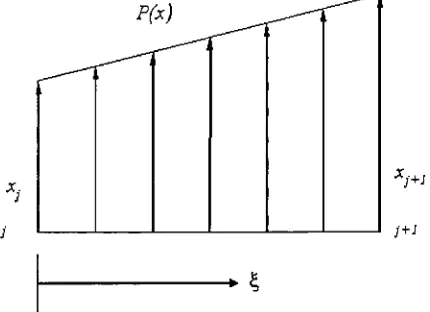
acceleration is the constant, togeneralize the situation, alinearly increasingforce on the
systemis assumed, shownbelow:
Figure 4. 1 Modeloffreevibration
For the equation[m]X+[c]x+[A"]x =[p], a known stiffness and mass matrices of the
system can be derived, and by defining parameter a and P, the damping matrix is also
derived, leaving only the force function [F]. According to theory of virtual work of
appliedforce,theshapefunction displacement isexpressedasfollows:
y(x)=(piui + cp20i+(p3u2+ cp402
Thevirtual workoftheappliedforce gravityonthebeam is:
8W = \'
p(x)Sy(x)dx
Jo
=Svi
[
p(x)(pi(x)dx+861f p(x)<p2(x)dx+Svif p(x)<pi(x)dx+Sdif p{x)(p*(x)dxJo Jo Jo JO
where(pi-4(x)are shapefunctionsfora simpleelement,shownbelow:
q>i(x)=l 32+23
with =
(p3(x)=3
42-23
(p4(x)=
x
/
Ifthe same procedure is applied to the end forces, Fi, Mi,F2 andM2,the total virtual
workis representedby
5W=
Fi8ui+Mi80 1+F26u2+M2802
Equatingthevirtual workabove, we could obtainthefollowingrelationship
Fi =
Jo
P(x)qn(x)dx M1 =jJ
p(x)q)2{x)dxF2 =
Jo
Pix)(fB{x)dx M2 =jJ
p(x)<p4(x)dxwhere/ isthelengthof elementandp(x) is obtainedbyexaminingFigure4.2,
P(x) r^*^*,
-"
'
,
V'
[image:47.528.91.306.333.489.2]i+i
Figure 4.2Forcingfunctionforasinglebeamelement
p(x)=(xj+1
-Xj)\+Xj
The force forthejthnode canbegivenby
Fj
=l'op(x)<pi(x)dx=ljlo[(xj+l -xj)+xj](l-3|2+23)d
Mj
=lp{x)(pi{x)dx=l\lo[(x]+x-x.])Z+xj](Z-22+Z3)dZ
, 1 1
M: =1 ( XM+ *,) 1
30 ; 20 J
The force forthe(j+l)thnode canbegivenby
F,+1 =p(*)p,(*)dfc=
z[(xj+1 -xj)^ +xj](3^2-2^3)^
7 3
Fj+iJ+1 =/( *,-+_ + *,)
20 ; 20 ;
Mj+l=fop(x)<pi(x)dx=
ljlo[(xi+l -x^+
x^3
-2)^
M;+1,.., =/2( *,.., x,)
20 ; 30 '
The system forcing function Fi for the ith link can be assembled by superimposing the
proceeding expressions for the general elements. For n nodes (i.e. 1, 2, 3,..., n_+i), the
following are used to obtain the equivalent nodal force, where we assume the beam is
divided inton elementswithequallength.
7 3 3 7
F(i)=/(
xU)j+l +x{0j)+l(xm)j+l +xm)j)
n+\
11 11
M(t) =
/2(_20*(')y+1 -^X(<->;)+/2(^*0>i);>i + mX<M)
7 3
F(n+D=
l(x(i)j+l+xU)J)
4.2 Stiffnessandforcingfunctionmatrices
The beam is divided into several elements. For every beamelement, gravity is the only
forceapplied onit.
Forthefirstelement
nodel
91.cpQ.Ml
node2
9Q.cp4,M2-l
u2. cp3,F2-2
andforthe second element
node2
02,cp2,M2-2
t>2,<plJ?2-2
node3
93.<p4,M3-l
u3.q>3.F3-l
Figure 4.3 Beamelements for freevibrationmodel
The endingpoint ofthe previous elementis the starting pointofthe next element, so for
every node, the generalized force is consisted of two parts, which are derived from
\\f1: shapefunctionofstartingpointoftheelement
\|/2: shapefunctionofendingpointofthe element
Seetablebelow:
Previouselement Followingelement
Pl,Vl P1,V2
[image:50.528.85.462.167.249.2]P2,\|/l P2,\|/2
Table 4.1Uniformtwobeamelements
After the generalized force for each element is found, we superimpose the previous
elemental forceto thenext one.
Ifwedividethebeamtonelementswithequal lengthZ, therearen+1 nodes onthebeam,
Forthefirstnode, thegeneralizedforce isshownbelow:
graviry(j)
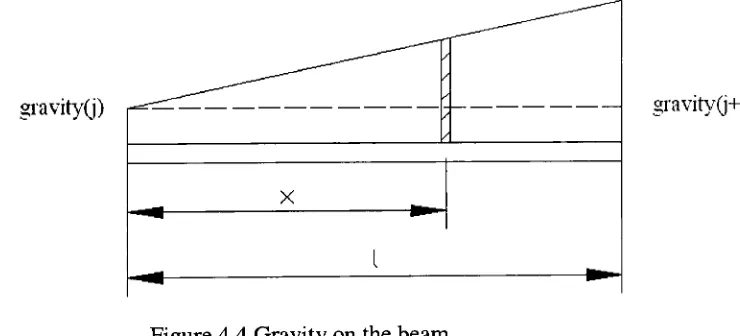
x
gravity(j+l)
Figure 4.4 Gravityonthebeam
Set =
, integrate from the starting point to the ending point, at every point, denote
gravity as
Gravityi=(gravity (j+1)
-gravity(j))*
\
+gravity(i)F =
f0
p(x)<p(i)(x)dx=jJ
Gravityi*p(/)(f)*IdB, =/
[image:50.528.124.494.383.551.2]Ifwe divide the beam into n elements, followed