STABLE CANONICAL RULES
GURAM BEZHANISHVILI, NICK BEZHANISHVILI, ROSALIE IEMHOFF
Abstract. We introduce stable canonical rules and prove that each normal modal multi-conclusion
consequence relation is axiomatizable by stable canonical rules. We apply these results to construct finite refutation patterns for modal formulas, and prove that each normal modal logic is axiomati-zable by stable canonical rules. We also define stable multi-conclusion consequence relations and stable logics and prove that these systems have the finite model property. We conclude the paper with a number of examples of stable and non-stable systems, and show how to axiomatize them.
1. Introduction
It is a well-known result of Zakharyaschev [38] that each normal extension ofK4is axiomatizable by canonical formulas. This result was generalized in two directions. In [2] it was generalized to all normal extensions of wK4, and in [21] Zakharyaschev’s canonical formulas were generalized to multi-conclusion canonical rules and it was proved that each normal modal multi-conclusion consequence relation overK4 is axiomatizable by canonical rules.
The key ingredients of Zakharyaschev’s technique include the concepts of subreduction, closed domain condition, and selective filtration. While selective filtration is very effective in the transitive case [15], and also generalizes to the weakly transitive case [6, 2], it is less effective forK. This is one of the reasons why canonical formulas and rules do not work well for K[15, 21]. In [3] a different approach to canonical formulas for intuitionistic logic was developed that uses the technique of filtration instead of selective filtration. The new canonical formulas were called stable canonical formulas, and it was shown that each superintuitionistic logic is axiomatizable by stable canonical formulas.
In this paper we generalize the technique of [3] to the modal setting. Since the technique of filtration works well for K, we show that this new technique is effective in the non-transitive case as well. We give an algebraic account of filtration, introduce stable canonical rules, and prove that each normal modal multi-conclusion consequence relation is axiomatizable by stable canonical rules. This allows us to construct finite refutation patterns for modal formulas, and to show that each normal modal logic is axiomatizable by stable canonical rules. For normal extensions of K4 we prove that stable canonical rules can be replaced by stable canonical formulas, thus providing an alternative to Zakharyaschev’s axiomatization [38].
This approach also yields a new class of multi-conclusion consequence relations and logics. Fol-lowing [3], we call these systems stable. We show that every stable multi-conclusion consequence relation and every stable logic has the finite model property. We also give a number of examples of stable and non-stable logics, and show how to axiomatize them. For more in-depth development of the theory of stable modal systems see [5]. The theory of stable superintuitionistic logics and stable intuitionistic multi-conclusion consequence relations is developed in [3, 4].
2010Mathematics Subject Classification. 03B45.
Key words and phrases. Modal logic, multi-conclusion consequence relation, axiomatization, filtration, modal algebra, variety, universal class.
The first and second authors acknowledge the support of the Rustaveli Foundation of Georgia grant FR/489/5-105/11. The second and third authors acknowledge the support of the Netherlands Organization for Scientific Research under grant 639.032.918.
Stable canonical rules have several applications. For example, they are utilized in [10] to obtain an alternative proof of the existence of explicit bases of admissible rules for the intuitionistic logic, K4, and S4. In [11] it is shown that stable logics have the bounded proof property, thus yielding a large class of logics with nice proof-theoretic properties.
The paper is organized as follows. In Section 2 we recall basic facts about modal logics, modal multi-conclusion consequence relations, modal algebras, and modal spaces (descriptive Kripke frames). In Section 3 we introduce stable homomorphisms, their dual stable maps, and the closed domain condition (CDC) for stable maps. Section 4 provides an algebraic approach to filtrations and connects them with (CDC). The main results of the paper are proved in Section 5. We give fi-nite refutation patterns for normal modal multi-conclusion consequence relations and normal modal logics. We introduce stable canonical rules and prove that every normal modal multi-conclusion consequence relation and every normal modal logic is axiomatizable by stable canonical rules. In Section 6 we provide an algebraic approach to transitive filtrations, introduce stable canonical for-mulas for K4, and prove that every normal extension of K4 is axiomatizable by stable canonical formulas. This provides an alternative to Zakharyaschev’s axiomatization. In Section 7 we in-troduce stable multi-conclusion consequence relations and stable logics, and prove that all stable systems have the finite model property. We also give a characterization of splitting multi-conclusion consequence relations and splitting logics by means of Jankov rules and Jankov formulas, thus yield-ing alternative proofs of the results of Jeˇr´abek [21] and Blok [13], respectively. Finally, in Section 8 we show how to axiomatize some well-known modal multi-conclusion consequence relations and modal logics via stable canonical rules and formulas.
2. Preliminaries
In this section we briefly discuss some of the basic facts that will be used throughout the paper. We use [15, 22, 12, 36] as our main references for the basic theory of normal modal logics, including their algebraic and relational semantics, and the dual equivalence between modal algebras and modal spaces (descriptive Kripke frames). We also use [14] for universal algebra, [31, 23] for modal rules, and [21, 20] for multi-conclusion modal rules.
Modal logic. We recall that a normal modal logic is the set of formulas of the basic modal language containing classical tautologies and (p → q) → (p → q), and closed under Modus Ponens (ϕ, ϕ→ψ/ψ), Necessitation (ϕ/ϕ), and Substitution (ϕ(p1, . . . , pn)/ϕ(ψ1, . . . , ψn)). The least normal modal logic is denoted by K, and NExtK denotes the complete lattice of normal extensions ofK.
A modal algebra is a pair A= (A,♦), where A is a Boolean algebra and ♦ is a unary function on A that commutes with finite joins. As usual, the dual operator is defined as ¬♦¬. A modal homomorphism between two modal algebras is a Boolean homomorphism h satisfying h(♦a) = ♦h(a). Let MA be the category of modal algebras and modal homomorphisms.
A modal space (or descriptive Kripke frame) is a pair X = (X, R), where X is a Stone space (zero-dimensional compact Hausdorff space) andR is a binary relation onX satisfying
R[x] :={y∈X :xRy}
is closed for each x∈X and
R−1[U] :={x∈X :∃y∈U withxRy}
is clopen (closed and open) for each clopenU ofX. Abounded morphism (orp-morphism) between two modal spaces is a continuous mapf such that f(R[x]) =R[f(x)]. LetMS be the category of modal spaces and bounded morphisms.
It is a well-known theorem in modal logic that MA is dually equivalent to MS. The functors (−)∗ : MA → MS and (−)∗ : MS → MA that establish this dual equivalence are constructed as
is, the set of ultrafilters ofAtopologized by the basis{β(a) :a∈A}, whereβ(a) ={x∈A∗ :a∈x} is the Stone map) and xRy iff (∀a∈A)(a∈y ⇒ ♦a∈x). We call R the dual of ♦. For a modal homomorphism h:A→B, its dual h∗ :B∗ →A∗ is given byh−1. For a modal spaceX= (X, R), let X∗ = (X∗,♦), where X∗ is the Boolean algebra of clopens of X and ♦(U) = R−1[U]. For a bounded morphismf :X→Y, its dualf∗ :Y∗ →X∗ is given by f−1.
LetA= (A,♦) be a modal algebra and let X= (X, R) be its dual space. Then it is well known thatR is reflexive iffa≤♦a, andR is transitive iff♦♦a≤♦a. A modal algebraAis aK4-algebra
if ♦♦a ≤ ♦a holds in A, and it is an S4-algebra if in addition a ≤ ♦a holds in A. S4-algebras are also known as closure algebras, interior algebras, or topological Boolean algebras. Let K4 be the full subcategory of MA consisting of K4-algebras, and let S4 be the full subcategory of K4 consisting of S4-algebras. A modal space X = (X, R) is a transitive space if R is transitive, and it is a quasi-ordered space if R is reflexive and transitive. Let TS be the full subcategory of MS consisting of transitive spaces, and letQSbe the full subcategory ofTS consisting of quasi-ordered spaces. Then the dual equivalence of MA and MS restricts to the dual equivalence of K4and TS, which restricts further to the dual equivalence ofS4 and QS.
For a modal algebra A = (A,♦) and a ∈ A, define ♦0a = a and ♦n+1a = ♦♦na, and set na=W
k≤n♦ka. We definen andn similarly. By Rautenberg’s criterion [30],Ais subdirectly
irreducible (s.i. for short) iff there is c6= 1 such that for each a6= 1 there is n∈ω withna≤c.
Such ac is called anopremum ofA. It is not unique.
If A is a K4-algebra, then for each n ≥ 1, we have na = a∨♦a and na = a∧a. Let
♦+a := a∨♦a and +a := a∧a. Then A+ = (A,♦+) is an S4-algebra, the set H of fixed points of + forms a Heyting algebra, and up to isomorphism, each Heyting algebra arises this way. Therefore, aK4-algebra Ais s.i. iff theS4-algebra A+ is s.i., which happens iff the Heyting algebraH is s.i., which in turn means that there is a greatest element cinH− {1}. IfX= (X, R) is the dual of A, then the dual of A+ is X+ = (X, R+), where R+ = R∪ {(x, x) : x ∈ X} is the reflexive closure ofR.
A filter F of a modal algebra A= (A,♦) is called a modal filter ifa∈F implies a∈F. It is well known that there is a 1-1 correspondence between congruences and modal filters of A, hence homomorphic images ofAare determined by modal filters. For a modal spaceX= (X, R), a subset
Y ofXis called anup-setif from x∈Y andxRyit follows thaty ∈Y. IfAis a modal algebra and Xis its dual space, then modal filters of Acorrespond to closed up-sets of X. Thus, homomorphic images ofA are determined by closed up-sets ofX.
For a modal space X= (X, R) andY ⊆X, letR0[Y] =Y, Rn+1[Y] =R[Rn[Y]], and Rω[Y] = S
n∈ωRn[Y]. If Y is a singleton {x}, then we write Rn[x] and Rω[x]. We call X rooted provided
there is x ∈ X, called a root of X, such that X = Rω[x]. Note that if R is transitive, then
Rω[x] ={x} ∪R[x] and if R is reflexive and transitive, then Rω[x] = R[x]. By [32, Thm. 3.1], a finite modal algebraAis s.i. iff its dual modal spaceXis rooted. This result extends to the infinite case as follows [35]. Let X be a modal space. Call x ∈X a topo-root of X if X is the closure of
Rω[x]. Then a modal algebra A is s.i. iff in its dual modal space X the set of topo-roots has a nonempty interior [35, Thm. 2]. We call such modal spacestopo-rooted.
Multi-conclusion modal rules. Amulti-conclusion modal rule is an expression Γ/∆, where Γ,∆ are finite sets of modal formulas. If ∆ = {ϕ}, then Γ/∆ is called a single-conclusion modal rule
and is written Γ/ϕ. If Γ =∅, then Γ/∆ is called anassumption-free modal ruleand is written /∆.
Assumption-free single-conclusion modal rules /ϕcan be identified with modal formulas ϕ. A normal modal multi-conclusion consequence relation is a setS of modal rules such that
(1) ϕ/ϕ∈ S.
(2) ϕ, ϕ→ψ/ψ∈ S. (3) ϕ/ϕ∈ S.
(5) If Γ/∆∈ S, then Γ,Γ0/∆,∆0 ∈ S.
(6) If Γ/∆, ϕ∈ S and Γ, ϕ/∆∈ S, then Γ/∆∈ S.
(7) If Γ/∆∈ S and sis a substitution, thens(Γ)/s(∆)∈ S.
Normal modal multi-conclusion consequence relations are also called normal modal rule systems. We denote the least normal modal multi-conclusion consequence relation bySK, and the complete
lattice of normal modal multi-conclusion consequence relations extending SK by NExtSK. For
a set Ξ of multi-conclusion modal rules, let SK + Ξ be the least normal modal multi-conclusion
consequence relation containing Ξ. IfS =SK+ Ξ, then we say that S is axiomatizable by Ξ, and
if Ξ is finite, then we call S finitely axiomatizable. If ρ ∈ S, then we say that the normal modal multi-conclusion consequence relation S entails orderives the modal ruleρ, and write S `ρ.
Given a normal modal multi-conclusion consequence relation S, let Λ(S) ={ϕ:/ϕ∈ S}be the corresponding normal modal logic, and for a normal modal logicL, let Σ(L) =SK+{/ϕ:ϕ∈L}
be the corresponding normal modal multi-conclusion consequence relation. Then Λ : NExtSK →
NExtK and Σ : NExtK → NExtSK are order-preserving maps such that Λ(Σ(L)) = L for each L ∈ NExtK and S ⊇ Σ(Λ(S)) for each S ∈ NExtSK. We say that a normal modal logic L is axiomatized (over K) by a set Ξ of multi-conclusion modal rules ifL= Λ(SK+ Ξ).
A valuation in a modal algebra A= (A,♦) is a map V from the propositional variables to A, which naturally extends to all formulas. The modal algebra Avalidates a multi-conclusion modal rule Γ/∆ provided for every valuation V on A, if V(γ) = 1 for all γ ∈Γ, thenV(δ) = 1 for some
δ ∈ ∆. Otherwise A refutes Γ/∆. If Avalidates Γ/∆, we write A|= Γ/∆, and if A refutes Γ/∆, we writeA6|= Γ/∆. If Γ ={φ1, . . . , φn}, ∆ ={ψ1, . . . , ψm}, and φi(x) and ψj(x) are the terms in the first-order language of modal algebras corresponding to the φi and ψj, then A|= Γ/∆ iffA is
a model of the universal sentence ∀x (Vn
i=1φi(x) = 1 →
Wm
j=1ψj(x) = 1). Consequently, normal
modal multi-conclusion consequence relations correspond to universal classes of modal algebras. It is well known (see, e.g., [14, Thm. V.2.20]) that a class of modal algebras is a universal class iff it is closed under isomorphisms, subalgebras, and ultraproducts.
On the other hand, normal modal logics correspond to equationally definable classes of modal algebras; that is, models of the sentences∀x φ(x) = 1 in the first-order language of modal algebras. It is well known (see, e.g., [14, Thm. II.11.9]) that a class of modal algebras is an equational class iff it is a variety (that is, it is closed under homomorphic images, subalgebras, and products).
We also point out that a modal algebra A validates a single-conclusion modal rule Γ/ψ iff A is a model of the sentence ∀x (Vn
i=1φi(x) = 1 → ψ(x) = 1), where Γ = {φ1, . . . , φn} and φi(x)
and ψ(x) are the terms in the first-order language of modal algebras corresponding to the φi and
ψ. Consequently, normal modal consequence relations correspond to classes of modal algebras axiomatized by quasi-identities. It is well known (see, e.g., [14, Thm. V.2.25]) that a class of modal algebras is axiomatized by quasi-identities iff it is a quasivariety (that is, it is closed under isomorphisms, subalgebras, products, and ultraproducts).
For a normal modal multi-conclusion consequence relation S, we denote by U(S) the universal class of modal algebras corresponding to S, and for a universal class of modal algebras U, we denote byS(U) the normal modal multi-conclusion consequence relation corresponding toU. Then S(U(S)) =S and U(S(U)) = U. This yields an isomorphism between NExtSK and the complete
latticeU(MA) of universal classes of modal algebras (ordered by reverse inclusion).
Similarly, for a normal modal logicL, letV(L) denote the variety of modal algebras corresponding to L, and for a variety V, let L(V) denote the normal modal logic corresponding to V. Then
L(V(L)) =LandV(L(V)) =V, yielding an isomorphism between NExtKand the complete lattice V(MA) of varieties of modal algebras (ordered by reverse inclusion).
3. Stable homomorphisms and the closed domain condition
In this section we introduce the key concepts of stable homomorphisms and the closed domain condition, and show how the two relate to each other.
Definition 3.1. LetA= (A,♦) andB= (B,♦) be modal algebras and leth:A→B be a Boolean homomorphism. We call h a stable homomorphism provided ♦h(a)≤h(♦a) for each a∈A.
It is easy to see thath :A → B is stable iff h(a)≤ h(a) for each a∈ A. Stable homomor-phisms were considered in [7] under the name of semi-homomorhomomor-phisms and in [18] under the name of continuous morphisms.
Definition 3.2. LetX= (X, R)andY= (Y, R)be modal spaces and letf :X→Y be a continuous map. We callf stable if xRy implies f(x)Rf(y).
Lemma 3.3. Let A = (A,♦) and B = (B,♦) be modal algebras, X = (X, R) be the dual of A,
Y = (Y, R) be the dual of B, and h : A → B be a Boolean homomorphism. Then h : A → B is stable iffh∗ :Y →X is stable.
Proof. By Stone duality, it is sufficient to show that♦h(a)≤h(♦a) for eacha∈Aiff xRy implies
h∗(x)Rh∗(y) for eachx, y∈Y. First suppose that♦h(a)≤h(♦a) for eacha∈A. Letx, y∈Y with
xRy, and leta∈h∗(y). Thenh(a)∈y. FromxRy it follows that♦h(a)∈x. Since ♦h(a)≤h(♦a) and x is a filter,h(♦a)∈x, hence ♦a∈h∗(x). Therefore, h∗(x)Rh∗(y).
Conversely, suppose xRy implies h∗(x)Rh∗(y) for each x, y ∈ Y. Let a ∈ A and let x ∈
R−1h−1∗ β(a). Then there is y ∈ Y such that xRy and h∗(y) ∈ β(a). Therefore, h∗(x)Rh∗(y) and h∗(y) ∈β(a). Thus, h∗(x) ∈ R−1β(a), and so x ∈h−1∗ R−1β(a). This implies R−1h−1∗ β(a) ⊆ h−1∗ R−1β(a). ButR−1h−1∗ β(a) =β(♦h(a)) and h−1∗ R−1β(a) = β(h(♦a)). This yields β(♦h(a))⊆
β(h(♦a)), and sinceβ is an isomorphism, we conclude that♦h(a)≤h(♦a) for each a∈A.
Definition 3.4. Let X= (X, R) and Y= (Y, R) be modal spaces, f :X→Y be a map, and U be a clopen subset of Y. We say that f satisfies the closed domain condition (abbreviated as CDC) forU if
R[f(x)]∩U 6=∅⇒f(R[x])∩U 6=∅.
Let D be a collection of clopen subsets of Y. We say that f :X → Y satisfies the closed domain condition (CDC) forD if f satisfies (CDC)for each U ∈D.
Lemma 3.5. Let X= (X, R) and Y= (Y, R) be modal spaces, f :X → Y be a map, and U be a clopen subset of Y. Then the following two conditions are equivalent:
(1) f satisfies (CDC)for U.
(2) f−1R−1U ⊆R−1f−1U.
Proof. (1)⇒(2): Suppose thatf satisfies (CDC) for U and x∈f−1R−1U. ThenR[f(x)]∩U 6=∅. By (CDC), f(R[x])∩U 6=∅. Thus, x∈R−1f−1U.
(2)⇒(1): Suppose that f−1R−1U ⊆R−1f−1U and R[f(x)]∩U 6=∅. Thenx ∈f−1R−1U. By (2), x∈R−1f−1U, which means that f(R[x])∩U 6=∅. Thus, (CDC) is satisfied.
Theorem 3.6. Let A= (A,♦) and B = (B,♦) be modal algebras, h :A → B be a stable homo-morphism, and a∈A. The following two conditions are equivalent:
(1) h(♦a) =♦h(a).
(2) h∗ :B∗ →A∗ satisfies(CDC) for β(a).
Proof. Since h:A →B is a stable homomorphism, ♦h(a) ≤h(♦a). Therefore, h(♦a) =♦h(a) iff
h(♦a) ≤♦h(a), which happens iff h−1∗ R−1β(a)⊆R−1h−1∗ β(a). By Lemma 3.5, the last condition
is equivalent toh∗:B∗→A∗ satisfying (CDC) forβ(a).
Definition 3.7. Let A= (A,♦) and B = (B,♦) be modal algebras and let h:A→ B be a stable homomorphism.
(1) We say that h satisfies the closed domain condition (CDC) fora∈A if h(♦a) =♦h(a).
(2) We say that h satisfies the closed domain condition (CDC) for D⊆A if h satisfies(CDC)
for each a∈D.
4. Filtrations and the closed domain condition
The filtration method is the main tool for establishing the finite model property in modal logic. The method can be developed either algebraically [28, 29] or frame-theoretically [26, 33], and the two are connected via duality [24, 25]. For a recent account of filtrations we refer to [18, 16]. In this section we give a slightly different account which is more suited for our purposes, and also discuss the connection with stable homomorphisms and the closed domain condition.
We start by recalling the frame-theoretic approach to filtrations (see, e.g., [12, Def. 2.36] or [15, Sec. 5.3]). Let M = (X, R, V) be a Kripke model and let Θ be a set of formulas closed under subformulas. For our purposes, Θ will always be assumed to be finite. Define an equivalence relation∼Θ on X by
x∼Θy iff (∀ϕ∈Θ)(x|=ϕ⇔y|=ϕ).
Let X0 = X/∼Θ and let V0(p) = {[x] : x ∈ V(p)}, where [x] is the equivalence class of x with
respect to∼Θ.
Definition 4.1. For a binary relation R0 on X0, we say that the triple M0 = (X0, R0, V0) is a
filtration of Mthrough Θ if the following two conditions are satisfied:
(F1) xRy ⇒[x]R0[y].
(F2) [x]R0[y]⇒(∀♦ϕ∈Θ)(y |=ϕ⇒x|=♦ϕ).
Note that if Θ is finite, then X0 is finite. In fact, if Θ consists ofnelements, then X0 consists of no more than 2n elements.
LetA= (A,♦) be a modal algebra and letX= (X, R) be the dual ofA. If V is a valuation on
A, then by identifying Awith the clopen subsets ofX, we can view V as a valuation on X.
Theorem 4.2. Let A = (A,♦) be a modal algebra and let X = (X, R) be the dual of A. For a valuationV onAand a set of formulasΘclosed under subformulas, letA0 be the Boolean subalgebra of A generated by V(Θ) ⊆A and let D= {V(ϕ) : ♦ϕ∈ Θ}. For a modal operator ♦0 on A0, the following two conditions are equivalent:
(1) The inclusion (A0,♦0)(A,♦) is a stable homomorphism satisfying (CDC)for D.
(2) Viewing V as a valuation on X, there is a filtration M0 = (X0, R0, V0) of M = (X, R, V)
through Θ such that R0 is the dual of ♦0.
Proof. SinceA0 is a Boolean subalgebra ofA, it follows from Stone duality that the dual ofA0 can be described as the quotient ofXby the equivalence relation given byx∼yiffx∩A0=y∩A0. AsA0
is generated byV(Θ), we havex∼yiffx∼Θ y, so we identify the dual ofA0 withX0. DefineV0 on
X0 byV0(p) ={[x] :x∈V(p)}. Let♦0 be a modal operator onA0, and letR0 ⊆X0×X0 be the dual of ♦0. By Lemma 3.3,M0= (X0, R0, V0) satisfies (F1) iff the inclusion (A0,♦0)(A,♦) is a stable homomorphism. Therefore, it remains to see thatM0satisfies (F2) iff the inclusion (A0,♦0)(A,♦) satisfies (CDC) for D. The former means that [x]R0[y] ⇒ (∀a ∈ D)(a ∈ y ⇒ ♦a ∈ x), and the latter means that ♦0a= ♦a for each a∈ D. First suppose that the inclusion satisfies (CDC) for
D. Let [x]R0[y], a ∈ D, and a ∈ y. Since [x]R0[y], we have that (∀b ∈ A0)(b ∈ y ⇒ ♦0b ∈ x). As a ∈ D ⊆ A0, from a ∈ y it follows that ♦0a ∈ x. By (CDC) for D we see that ♦0a = ♦a, so ♦a ∈ x, and hence M0 satisfies (F2). Conversely, suppose that M0 satisfies (F2). Let a ∈ D. Since the inclusion (A0,♦0) (A,♦) is stable, we have ♦a ≤ ♦0a. To see the reverse inequality,
that [x] ∈ β0(♦0a). Therefore, [x]∈ (R0)−1β0(a), so there is y ∈ X with [x]R0[y] and [y] ∈ β0(a). Asa∈D⊆A0, from [y]∈β0(a) it follows that a∈y. By (F2), this yields ♦a∈x. So x∈β(♦a). Thus,β(♦0a)⊆β(♦a), yielding♦0a≤♦a. Consequently, ♦0a=♦afor each a∈D, and hence the
embedding satisfies (CDC) forD.
Theorem 4.2 motivates the following definition.
Definition 4.3. Let A = (A,♦) be a modal algebra, V be a valuation on A, and Θ be a set of formulas closed under subformulas. Let A0 be the Boolean subalgebra of A generated by V(Θ)⊆A and let D ={V(ϕ) :♦ϕ∈Θ}. Suppose that ♦0 is a modal operator on A0 such that the inclusion
(A0,♦0)(A,♦) is a stable homomorphism satisfying (CDC) for D. Then we call A0 = (A0,♦0) a
filtration of Athrough Θ.
Lemma 4.4. Let A0 = (A0,♦0) be a filtration of A through Θand let V0 be a valuation on A0 that coincides with V on the propositional variables occurring inΘ. If ϕ∈Θ, then V(ϕ) =V0(ϕ).
Proof. Easy induction on the complexity ofϕ. SinceA0 is a Boolean subalgebra ofA, the proof for Boolean connectives is obvious, and since (A0,♦0)(A,♦) is a stable embedding satisfying (CDC)
forD, the proof for♦follows.
Let D∨ denote the (∨,0)-subsemilattice of A0 generated by D. Then 0 ∈ D∨, and a ∈ D∨ iff
a=W
F for some finite subsetF ofD. Since♦commutes with finite joins,a∈D∨ implies♦a∈A0.
Lemma 4.5. Let A= (A,♦), V, Θ,A0, and D be as above with Θand hence A0 finite. Define♦l
and ♦g onA0 by
♦la=^{b∈A0 :♦a≤b} and ♦ga=^{♦b:a≤b &b∈D∨}.
Then
(1) ♦a≤♦la≤♦ga.
(2) If a∈D∨, then ♦a=♦la=♦ga.
(3) (A0,♦l) and (A0,♦g) are modal algebras.
(4) The inclusions of (A0,♦l) and(A0,♦g) into Aare stable.
(5) The inclusions of (A0,♦l) and(A0,♦g) into Asatisfy (CDC) for D.
(6) (A0,♦l) and (A0,♦g) are filtrations ofA through Θ.
(7) If A0 = (A0,♦0) is a filtration of A throughΘ, then ♦la≤♦0a≤♦ga for each a∈A0.
Proof. (1). It follows from the definition that ♦a≤♦la. As a≤b⇒ ♦a≤♦b, we have {♦b:a≤ b& b∈D∨} ⊆ {b∈A0 :♦a≤b}, so♦la≤♦ga.
(2). Ifa∈D∨, then♦ga≤♦a. This by (1) yields ♦a=♦la=♦ga. (3). Since♦0 = 0 and 0∈A0, it is clear that ♦l0 = 0. Moreover,
♦la∨♦lb = V{
x∈A0:♦a≤x} ∨V{
y∈A0 :♦b≤y} = V
{x∨y :x, y∈A0 &♦a≤x &♦b≤y} = V{
z∈A0:♦a∨♦b≤z} = V
{z∈A0:♦(a∨b)≤z} = ♦l(a∨b).
Therefore, (A0,♦l) is a modal algebra. As ♦0 = 0 and 0 ∈ D∨, by (2), ♦g0 = 0. Because D∨ is closed under finite joins,
♦ga∨♦gb = V
{♦x:a≤x &x∈D∨} ∨V
{♦y:b≤y &y ∈D∨} = V{
♦x∨♦y :a≤x &b≤y &x, y∈D∨} = V
{♦(x∨y) :a≤x &b≤y &x, y∈D∨} = V{
Thus, (A0,♦g) is a modal algebra.
In view of (3), (4) follows from (1), (5) follows from (2), and (6) follows from (4) and (5). (7). SupposeA0= (A0,♦0) is a filtration ofAthrough Θ. Leta∈A0. Since the inclusionA0 A is a stable homomorphism, we have ♦a ≤ ♦0a. Therefore, ♦0a ∈ {b ∈ A0 : ♦a ≤ b}, which yields ♦la≤ ♦0a. Let b ∈ D∨ with a ≤ b. Then b = W
F for some finite F ⊆ D. Since A0 is a modal algebra, a≤ b implies ♦0a ≤♦0b= ♦0W
F =W
{♦0x : x ∈ F}. As the inclusionA0 A satisfies (CDC) forD, fromx∈F ⊆Dit follows that♦0x=♦x. Thus,♦0a≤W
{♦x:x∈F}=♦W
F =♦b,
yielding♦0a≤♦ga.
As a consequence, we obtain that (A0,♦l) is the least filtration and (A0,♦g) is the greatest
filtration of A through the finite set of formulas Θ. We next show that these correspond to the least and greatest filtrations of the dual of A. We recall (see, e.g., [12, Sec. 2.3] or [15, Sec. 5.3]) that the least filtration ofM= (X, R, V) through Θ isMl = (X0, Rl, V0) and the greatest filtration isMg= (X, Rg, V0), where
[x]Rl[y] iff (∃x0, y0∈X)(x∼Θx0 &y ∼Θ y0 &x0Ry0). [x]Rg[y] iff (∀♦ϕ∈Θ)(y|=ϕ⇒x|=♦ϕ).
Lemma 4.6. Let A= (A,♦),X= (X, R),A0, andX0 be as in Theorem 4.2, withA0 andX0 finite. Then Rl onX0 is the dual of ♦l onA0 and Rg on X0 is the dual of ♦g onA0.
Proof. Let R♦l be the dual of ♦l. Then [x]R♦l[y] iff (∀a∈ A0)(a∈ y ⇒ ♦la ∈ x). On the other
hand, [x]Rl[y] iff (∃x0, y0∈X)(x∼Θx0&y∼Θy0&x0Ry0). First suppose that [x]Rl[y]. Leta∈A0
anda∈y. Sincea∈A0 andy∼Θ y0, froma∈y it follows thata∈y0, sox0Ry0implies♦a∈x0. By
Lemma 4.5(1),♦a≤♦la, so♦la∈x0, and as♦la∈A0, we conclude that♦la∈x. Thus, [x]R
♦l[y].
Conversely, suppose that [x]Rl[y]. Letβ0 be the Stone map forA0. SinceA0 is finite, there isa∈A0
such that [y] =β0(a). As [x]Rl[y], we have [x]∈/ (Rl)−1β0(a).
Claim 4.7. If a∈A0, then (Rl)−1β0(a) =β0(♦la).
Proof of claim. First suppose that [x] ∈ (Rl)−1β0(a). Then there is [y] ∈ β0(a) with [x]Rl[y]. Therefore, there are x0 ∼Θ xand y0∼Θy withx0Ry0. Since a∈A0, from [y]∈β0(a) it follows that
a ∈ y, so as y ∼Θ y0, we see that a ∈ y0. Thus, x0Ry0 yields ♦a ∈ x0. Since x ∼Θ x0, this gives
♦a∈x. By Lemma 4.5(1), ♦a≤♦la, so we conclude that ♦la∈x, giving [x]∈β0(♦la).
Conversely, suppose that [x]∈β0(♦la). Then♦la∈x, so for eachb∈A0 with♦a≤b, we have
b∈x. There are two cases, either ♦a∈x or♦a /∈x.
Case 1: Suppose♦a∈x. Thenx∈β(♦a) =R−1β(a), so there is y∈β(a) with xRy. Therefore, [y]∈β0(a) and [x]Rl[y], yielding [x]∈(Rl)−1β0(a).
Case 2: Suppose♦a /∈x. If♦a∈A0, then♦a=♦la, so♦a∈x, a contradiction. Thus,♦a /∈A0.
We show that there is x0 ∈X with ♦a∈x0 and x∩A0=x0∩A0. Let F be the filter generated by {♦a} ∪(x∩A0). If 0∈F, then there isb∈x∩A0 with♦a∧b= 0, so♦a≤ ¬b, yielding¬b∈x∩A0, a contradiction. Thus, F is proper. Clearlyx∩A0 ⊆F ∩A0. Suppose c ∈F ∩A0. Then there is
b∈x∩A0 withc≥♦a∧b, so♦a≤b→c. From this we conclude thatb→c∈x∩A0, soc∈x∩A0, and henceF∩A0 =x∩A0. Therefore, a Zorn’s lemma argument produces x0 ∈X such thatF ⊆x0
and x0∩A0 =x∩A0. Thus, ♦a∈ x0 and x0∩A0 =x∩A0. Let I ={c∈A :♦c /∈x0}. Then it is easy to see thatI is an ideal and↑a∩I =∅. Therefore, there isy∈X with↑a⊆yand y∩I =∅.
Thus,a∈y and x0Ry. Consequently, [x]Rl[y] and [y]∈β0(a), yielding [x]∈(Rl)−1β0(a).
Since [x] ∈/ (Rl)−1β0(a), by Claim 4.7, [x] ∈/ β0(♦la). Because ♦la ∈ A0, this yields ♦la /∈ x. Therefore, we founda∈A0 such thata∈y but♦la /∈x. Thus, [x]R♦l[y], and soRl is the dual of
♦l.
LetR♦g be the dual of♦g. Then [x]R♦g[y] iff (∀a∈A0)(a∈y⇒ ♦ga∈x). On the other hand,
[x]Rg[y] iff (∀a ∈D)(a∈y ⇒ ♦a∈x). By Lemma 4.5, ♦a≤♦ga for each a∈A0 and
for eacha∈D. Therefore, [x]R♦g[y] implies [x]Rg[y]. Conversely, if [x]R♦g[y], then there isa∈A0
such that a∈ y and ♦ga /∈ x. Thus, there is b∈ D∨ such that a≤ b and ♦b /∈ x. As a≤b and
a∈y, we see that b∈y. Suppose that b=W
F for some finiteF ⊆D. ThenW
F ∈y implies that there is f ∈F withf ∈y. Sincef ≤b, we have♦f ≤♦b, so♦f /∈x. Therefore, we found f ∈D
withf ∈y, but♦f /∈x. Thus, [x]Rg[y], and hence Rg is the dual of♦g.
5. Finite refutation patterns and stable canonical rules
In this section we show how to construct finite refutation patterns for multi-conclusion modal rules. We introduce stable canonical rules, develop their basic properties, and prove that each normal modal multi-conclusion consequence relation is axiomatizable by stable canonical rules. We apply these results to construct finite refutation patterns for modal formulas, and prove that each normal modal logic is axiomatizable by stable canonical rules.
Theorem 5.1.
(1) For each multi-conclusion modal ruleΓ/∆, there exist(A1, D1), . . . ,(An, Dn)such that each
Ai = (Ai,♦i) is a finite modal algebra, Di ⊆ Ai, and for each modal algebra B = (B,♦), we have B 6|= Γ/∆iff there is i≤n and a stable embedding h:Ai B satisfying (CDC)
for Di.
(2) For each modal formula ϕ, there exist (A1, D1), . . . ,(An, Dn) such that each Ai = (Ai,♦i) is a finite modal algebra, Di ⊆Ai, and for each modal algebra B= (B,♦), we have B6|=ϕ iff there is i≤n and a stable embedding h:Ai B satisfying (CDC)for Di.
Proof. (1). If SK ` Γ/∆, then we taken = 0. Suppose that SK 6` Γ/∆. Let Θ be the set of all
subformulas of the formulas in Γ∪∆. Then Θ is finite. Let m be the cardinality of Θ. Since Boolean algebras are locally finite, up to isomorphism, there are only finitely many pairs (A, D) satisfying the following two conditions:
(i) A = (A,♦) is a finite modal algebra such that A is at most m-generated as a Boolean algebra and A6|= Γ/∆.
(ii) D={V(ψ) :♦ψ∈Θ}, where V is a valuation onA witnessingA6|= Γ/∆.
Let (A1, D1), . . . ,(An, Dn) be the enumeration of such pairs. For a modal algebra B= (B,♦), we prove that B 6|= Γ/∆ iff there is i≤ n and a stable embedding h :Ai B satisfying (CDC) for Di.
(⇐): First suppose that there is i≤ n and a stable embedding hi :Ai B satisfying (CDC)
forDi. Define a valuation VB onB by VB(p) =hi◦Vi(p) for each propositional letterp. For each ♦ψ ∈ Θ, we have Vi(ψ) ∈ Di. Therefore, VB(♦ψ) = ♦VB(ψ). Thus, since Vi(γ) = 1Ai for each γ ∈Γ and Vi(δ)6= 1Ai for eachδ ∈∆, we see thatVB(γ) = 1B for each γ ∈Γ andVB(δ)6= 1B for
each δ∈∆. Consequently,B6|= Γ/∆.
(⇒): Next suppose that B 6|= Γ/∆. We show that there is i ≤ n and a stable embedding
h : Ai B satisfying (CDC) for Di. Since B 6|= Γ/∆, there is a valuation VB on B such that
VB(γ) = 1B for each γ ∈ Γ and VB(δ) 6= 1B for each δ ∈ ∆. Let B0 be the Boolean subalgebra
of B generated by VB(Θ). As |VB(Θ)| ≤ |Θ|, we see that|B0| ≤ 22m. Let V0 be the restriction of
VB toB0 and setD={V0(ψ) :♦ψ∈Θ}. Let B0 = (B0,♦0) be a filtration of B through Θ. Then
the embeddingB0 B is a stable embedding satisfying (CDC) for D. By Lemma 4.4, V0 refutes Γ/∆ on B0. Since|B0| ≤22m, there isi≤nsuch thatB0=Ai andD=Di. Thus, the embedding Ai B is a stable embedding satisfying (CDC) for Di.
(2). If K`ϕ, then we take n= 0. Otherwise, since for a modal algebra A, we have A|=ϕ iff A|=/ϕ, we see thatK6`ϕiff SK 6`/ϕ. Now apply (1).
with Aand D as Γ/∆, where:
Γ = {pa∨b↔pa∨pb :a, b∈A} ∪
{p¬a↔ ¬pa:a∈A} ∪ {♦pa→p♦a :a∈A} ∪
{p♦a→♦pa :a∈D},
and
∆ = {pa:a∈A, a6= 1}.
Lemma 5.3. Let A= (A,♦) be a finite modal algebra and let D⊆A. Then A6|=ρ(A, D).
Proof. Define a valuationV onAby V(pa) =afor eacha∈A. ThenV(γ) = 1 for eachγ ∈Γ and
V(δ)6= 1 for each δ ∈∆. Therefore,A6|=ρ(A, D).
Theorem 5.4. Let A = (A,♦) be a finite modal algebra, D ⊆ A, and B = (B,♦) be a modal algebra. Then B6|=ρ(A, D) iff there is a stable embedding h:AB satisfying (CDC) for D.
Proof. First suppose that there is a stable embedding h : A B satisfying (CDC) for D. By Lemma 5.3, the valuation V(pa) = a refutes ρ(A, D) on A. We define a valuation VB on B by VB(pa) =h(V(pa)) =h(a) for eacha∈A. Sincehis a stable homomorphism,h(a∨b) =h(a)∨h(b), h(¬a) =¬h(a), and♦h(a)≤h(♦a) for each a, b∈A. Therefore,
VB(pa∨b ↔pa∨pb) = VB(pa∨b)↔VB(pa)∨VB(pb) =h(a∨b)↔h(a)∨h(b) = 1, VB(p¬a↔ ¬pa) = VB(p¬a)↔ ¬VB(pa) =h(¬a)↔ ¬h(a) = 1,
VB(♦pa→p♦a) = VB(♦pa)→VB(p♦a) =♦h(a)→h(♦a) = 1.
Since h satisfies (CDC) forD,
VB(p♦a→♦pa) =VB(p♦a)→♦VB(pa) =h(♦a)→♦h(a) = 1
for each a ∈ D. Thus, VB(γ) = 1 for each γ ∈ Γ. On the other hand, since h is an embedding, froma6= 1 it follows thatVB(pa) =h(a)6= 1. This yieldsVB(δ)6= 1 for eachδ∈∆. Consequently, ρ(A, D) is refuted onB.
Conversely, let B 6|= ρ(A, D). Then there is a valuation V on B such that V(γ) = 1 for each
γ ∈Γ and V(δ)6= 1 for each δ ∈∆. Define a maph:A→B by h(a) =V(pa) for eacha∈A. We
show thath:A→B is a stable embedding satisfying (CDC) for D.
Leta, b∈A. SinceV(γ) = 1 for each γ ∈Γ, we haveV(pa∨b)↔ V(pa)∨V(pb) = 1. Therefore, V(pa∨b) =V(pa)∨V(pb). By a similar argument,
V(p¬a) = ¬V(pa),
♦V(pa) ≤ V(p♦a), and V(p♦a) = ♦V(pa) for a∈D.
Since h(a) =V(pa) for eacha∈A, we have:
h(a∨b) = h(a)∨h(b), h(¬a) = ¬h(a),
♦h(a) ≤ h(♦a), and
h(♦a) = ♦h(a) for a∈D.
Thus, h is a stable homomorphism satisfying (CDC) for D. To see that h is an embedding, let
a∈A witha6= 1. SinceV(δ)6= 1 for eachδ∈∆, we have V(pa)6= 1, so h(a)6= 1, yielding that h
is an embedding.
Theorem 5.5.
(1) For a multi-conclusion modal rule Γ/∆, there exist (A1, D1), . . . ,(An, Dn) such that each
Ai = (Ai,♦i) is a finite modal algebra, Di ⊆ Ai, and for each modal algebra B = (B,♦), we have:
B|= Γ/∆ iff B|=ρ(A1, D1), . . . , ρ(An, Dn).
(2) For a modal formula ϕ, there exist (A1, D1), . . . ,(An, Dn) such that each Ai = (Ai,♦i) is a finite modal algebra, Di ⊆Ai, and for each modal algebraB= (B,♦), we have:
B|=ϕiff B|=ρ(A1, D1), . . . , ρ(An, Dn).
Proof. (1). By Theorem 5.1(1), there exist (A1, D1), . . . ,(An, Dn) such that each Ai = (Ai,♦i) is
a finite modal algebra, Di ⊆ Ai, and for each modal algebra B = (B,♦), we have B 6|= Γ/∆ iff
there is i ≤ n and a stable embedding h : Ai B satisfying (CDC) for Di. By Theorem 5.4, this is equivalent to the existence of i ≤ n such that B 6|= ρ(Ai, Di). Thus, B |= Γ/∆ iff B |=
ρ(A1, D1), . . . , ρ(An, Dn).
(2). This is proved similarly but uses Theorem 5.1(2).
We are ready to prove the main result of the paper.
Theorem 5.6.
(1) Each normal modal multi-conclusion consequence relationSis axiomatizable by stable canon-ical rules. Moreover, if S is finitely axiomatizable, thenS is axiomatizable by finitely many stable canonical rules.
(2) Each normal modal logic L is axiomatizable by stable canonical rules. Moreover, if L is finitely axiomatizable, then L is axiomatizable by finitely many stable canonical rules.
Proof. (1). LetS be a normal modal multi-conclusion consequence relation. Then there is a family {ρi:i∈I}of modal rules such thatS =SK+{ρi:i∈I}. By Theorem 5.5(1), for eachi∈I, there
exist (Ai1, Di1), . . . ,(Aini, Dini) such thatAij = (Aij,♦ij) is a finite modal algebra,Dij ⊆Aij, and
for each modal algebra B = (B,♦), we have B |=ρi iff B |=ρ(Ai1, Di1), . . . , ρ(Aini, Dini). Thus,
B |= S iff B |= {ρi :i ∈ I}, which happens iff B |= ρ(Ai1, Di1), . . . , ρ(Aini, Dini) for each i ∈ I.
Consequently, S =SK+Si∈I{ρ(Ai1, Di1), . . . , ρ(Aini, Dini)}, and soS is axiomatizable by stable
canonical rules. In particular, if S is finitely axiomatizable, then S is axiomatizable by finitely many stable canonical rules.
(2). Let L be a normal modal logic. Then Σ(L) = SK +{/ϕ : ϕ ∈ L} is a normal modal
multi-conclusion consequence relation. Therefore, by (1), Σ(L) =SK+{ρ(Ai, Di) :i∈I}. Thus, L= Λ(Σ(L)) = Λ(SK+{ρ(Ai, Di) :i∈I}). In particular, if Lis finitely axiomatizable, then L is
axiomatizable by finitely many stable canonical rules.
Remark 5.7. Since the axiomatization in Theorem 5.6(2) of normal extensions of Kis by means of stable canonical rules, we are required to work with all finite modal algebras, it is not sufficient to work with only finite s.i. modal algebras. As we will see in the next section, the situation improves for normal extensions of K4, where stable canonical rules can be replaced by stable canonical formulas, and it is sufficient to work with only finite s.i.K4-algebras.
Let X = (X, R) be a finite modal space and D⊆ P(X). For each x ∈ X we introduce a new propositional letterpx and define thestable canonical rule σ(X,D) as the rule Γ/∆, where
Γ = n_{px:x∈X}o∪
{px→ ¬py :x, y∈X, x6=y} ∪ {px→ ¬♦py :x, y∈X, xRy} ∪
n
px→
_
{♦py :y∈U}:x∈X, U ∈D, x∈R−1[U]
o
,
and
∆ = {¬px:x∈X}.
Then a modal space Y = (Y, R) refutes σ(X,D) iff there is an onto stable map f : Y → X
satisfying (CDC) for D. This provides an alternative way of defining stable canonical rules by avoiding algebraic terminology. Indeed, letA= (A,♦) be a finite modal algebra, X= (X, R) be its dual modal space, D⊆A, andD={β(a) :a∈D}. Then for each modal algebraB= (B,♦) with the dual spaceY= (Y, R), we haveB |=ρ(A, D) iff Y|=σ(X,D).
6. Stable canonical formulas for K4
As we have seen, all normal modal logics are axiomatizable by stable canonical rules. In general, these rules are not equivalent to formulas. In this section we show that for transitive normal modal logics we can replace stable canonical rules by stable canonical formulas. This provides an axiomatization of transitive normal modal logics, which is an alternative to Zakharyaschev’s axiomatization [38], and is a modal counterpart of [3].
Transitive filtrations. We start by developing the transitive analogues of the least and greatest filtrations.
Definition 6.1. Let A = (A,♦) be a K4-algebra, V be a valuation on A, Θ be a set of formulas closed under subformulas, and A0 = (A0,♦0) be a filtration of Athrough Θ. We call A0 a transitive filtration if A0 is also a K4-algebra.
For aK4-algebra A= (A,♦) and a∈A, we recall that♦+a=a∨♦a.
Lemma 6.2. Let A= (A,♦) be aK4-algebra, and let V, Θ, A0, D, and D∨ be as in Lemma 4.5. Define ♦t and ♦L onA0 by
♦ta=^{♦b:♦a≤♦b & b,♦b∈A0} and ♦La=^{♦b:♦a≤♦b & ♦+a≤♦+b & b∈D∨}.
Then both(A0,♦t) and (A0,♦L) are transitive filtrations of A through Θ.
Proof. Since♦0 = 0 and 0∈A0, it is obvious that ♦t0 = 0. AsA0 is closed under finite joins,
♦ta∨♦tb = V
{♦x:♦a≤♦x &x,♦x∈A0} ∨V
{♦y:♦b≤♦y &y,♦y∈A0} = V{
♦x∨♦y:♦a≤♦x &♦b≤♦y &x,♦x, y,♦y∈A0} = V
{♦(x∨y) :♦a≤♦x& ♦b≤♦y & x,♦x, y,♦y∈A0} = V
{♦z:♦(a∨b)≤♦z &z,♦z∈A0} = ♦t(a∨b).
♦La∨♦Lb = V
{♦x:♦a≤♦x &♦+a≤♦+x& x∈D∨}∨
V
{♦y:♦b≤♦y &♦+b≤♦+y &y∈D∨}
= V
{♦x∨♦y:♦a≤♦x &♦+a≤♦+x &♦b≤♦y &♦+b≤♦+y &x, y∈D∨}
= V
{♦(x∨y) :♦a≤♦x& ♦+a≤♦+x &♦b≤♦y &♦+b≤♦+y &x, y∈D∨}
= V{
♦z:♦(a∨b)≤♦z &♦+(a∨b)≤♦+z&z∈D∨}
= ♦L(a∨b).
Therefore, both (A0,♦t) and (A0,♦L) are modal algebras. It is obvious that♦la≤♦ta≤♦La≤♦ga
for eacha∈A0. Thus, both (A0,♦t) and (A0,♦L) are filtrations ofAthrough Θ. It remains to show that both (A0,♦t) and (A0,♦L) are K4-algebras. We have
♦ta=^{♦x:♦a≤♦x &x,♦x∈A0}
and
♦t♦ta=^{♦y:♦♦ta≤♦y &y,♦y∈A0}.
Letx,♦x∈A0 and ♦a≤♦x. Then
♦♦ta = ♦^{♦y:♦a≤♦y &y,♦y∈A0}
≤ ^{♦♦y:♦a≤♦y &y,♦y∈A0}
≤ ^{♦y:♦a≤♦y &y,♦y∈A0} ≤ ♦x,
so♦t♦ta≤♦ta. Also,
♦La=^{♦x:♦a≤♦x& ♦+a≤♦+x &x∈D∨}
and
♦L♦La=^{♦y:♦♦La≤♦y &♦+♦La≤♦+y &y ∈D∨}.
Letx∈D∨,♦a≤♦x, and♦+a≤♦+x. Then
♦♦La = ♦^{♦y:♦a≤♦y & ♦+a≤♦+y &y∈D∨}
≤ ^{♦♦y:♦a≤♦y &♦+a≤♦+y & y∈D∨}
≤ ^{♦y:♦a≤♦y &♦+a≤♦+y & y∈D∨} ≤ ♦x
and
♦+♦La = ♦+^{♦y:♦a≤♦y & ♦+a≤♦+y &y∈D∨}
≤ ^{♦+♦y:♦a≤♦y &♦+a≤♦+y & y∈D∨}
= ^{♦y:♦a≤♦y &♦+a≤♦+y &y∈D∨}
≤ ^{♦+y:♦a≤♦y &♦+a≤♦+y &y∈D∨} ≤ ♦+x.
This implies ♦L♦La≤♦La. Thus, both (A0,
♦t) and (A0,♦L) areK4-algebras. We recall (see, e.g., [15, Sec. 5.3] or [12, Sec. 2.3]) that theLemmon filtration of M= (X, R, V) through Θ is given by [x]RL[y] iff (∀♦ϕ∈Θ)(y|=♦+ϕ⇒x|=♦ϕ).
Proof. Let Rt denote the transitive closure of Rl. Then [x]Rt[y] iff there exist z
1, . . . , zn ∈ X
such that [x] = [z1]Rl· · ·Rl[zn] = [y]. Also, [x]R♦t[y] iff (∀a ∈ A0)(a ∈ y ⇒ ♦ta ∈ x). We
show Rt = R♦t. Since ♦la ≤ ♦ta for each a ∈ A0, we have Rl ⊆ R♦t. Also, since (A0,♦t) is a
K4-algebra, R♦t is transitive. Thus, Rt ⊆ R♦t. Conversely, suppose that [x]Rt[y]. To see that
[x]R♦t[y], it is sufficient to find a ∈ A0 such that a ∈ y and ♦ta /∈ x. Let a ∈ A0 be such that β(a) = [y]. Then a ∈ y. Since [x]Rt[y], we have [x]∩R−1[y] = ∅. If R−1[y] is saturated (that
is, R−1[y] is a union of equivalence classes), thenβ(♦a) = R−1[y] is saturated, so ♦a∈ A0. This yields ♦ta = ♦a. As x /∈ R−1[y], we have x /∈ β(♦a), so ♦a /∈ x. Thus, a ∈ y and ♦ta /∈ x. If R−1[y] is not saturated, then we consider the saturation [R−1[y]] of R−1[y]. Since [x]Rt[y], we
have [x]∩(R−1[R−1[y]]∪R−1[y]) = ∅. If R−1[R−1[y]] is saturated, then let b ∈ A0 be such that
β(b) = [R−1[y]]∪[y]. So β(♦b) =R−1[R−1[y]]∪R−1[y]⊇β(♦a) is saturated. Therefore, ♦b∈A0, ♦a ≤ ♦b, and x /∈ β(♦b). Thus, a ∈ y and ♦ta ≤ ♦b /∈ x. If [R−1[y]] is not saturated, then we continue the process by taking its saturation. Since there are only finitely many saturated subsets of X, the process will end after finitely many steps, which will produceb∈A0 such that ♦a≤♦b, ♦b∈A0, and x /∈β(♦b). Thus,a∈y and ♦ta≤♦b /∈x, and hence [x]R♦t[y].
Let RL be the Lemmon filtration. Then [x]RL[y] iff (∀♦ϕ ∈ Θ)(y |=♦+ϕ ⇒ x |=♦ϕ), which is equivalent to (∀a ∈D)(♦+a∈ y ⇒ ♦a ∈ x). Also, [x]R♦L[y] iff (∀a∈ A0)(a ∈y ⇒ ♦La ∈ x).
We show RL = R♦L. First suppose that [x]RL[y]. Then there exists a ∈ D such that ♦+a ∈ y
but ♦a /∈x. From ♦+a∈y it follows that a∈y or ♦a ∈y. As a∈D, we have ♦La=♦a. So if
a∈y, then♦La /∈x. On the other hand, if♦a∈y, then letting b=♦a, we haveb∈A0,b∈y, and ♦Lb=♦L♦a≤♦L♦La≤♦La=♦a /∈x. Therefore, in both cases we have [x]R
♦L[y]. Next suppose
that [x]R♦L[y]. Then there exists a ∈ A0 such that a ∈ y but ♦La /∈ x. The latter implies that
there exists b∈D∨ such that ♦a≤♦b,♦+a≤♦+b, and ♦b /∈ x. As a≤♦+a≤♦+b, the former
implies that♦+b∈y. Since bis a finite join of elements of D, we conclude that [x]RL[y].
Refutation patterns and stable canonical formulas for K4. Next we apply the results of Section 5 to obtain refutation patterns forK4. We will utilize the following corollary of Venema’s characterization [35] of s.i. modal algebras.
Proposition 6.4. Let A = (A,♦) be a finite modal algebra and let B = (B,♦) be a s.i. modal algebra. If there is a stable embedding h:AB, then A is also s.i.
Proof. Let X = (X, R) be the dual of A, Y = (Y, R) be the dual of B, and f : Y → X be the dual of h. Since h is 1-1, f is onto. As B is s.i., by [35, Thm. 2], the set of topo-roots ofY has nonempty interior. Let t belong to this interior. We show that f(t) is a root ofX. Because A is finite, this will imply thatAis s.i. For Y ⊆X, we denote by Y the topological closure ofY. Since
t is a topo-root of Y, we have Rω[t] = Y. Therefore, fRω[t] =X. As f is continuous and X
is finite, fRω[t]⊆f(Rω[t]) =f(Rω[t]). So f(Rω[t]) =X. Since h is stable, by Lemma 3.3,f
is stable. So for each y ∈ Y, we have f(R[y]) ⊆R[f(y)], and hence f(Rω[y]) ⊆Rω[f(y)]. Thus, f(Rω[t]) ⊆ Rω[f(t)], which yields that Rω[f(t)] = X. Consequently, f(t) is a root of X, so X is
rooted, an henceAis s.i.
We next prove the following version of Theorem 5.1(2) forK4.
Theorem 6.5. For a modal formula ϕ, there exist (A1, D1), . . . ,(An, Dn) such that each Ai =
(Ai,♦i) is a finite s.i. K4-algebra, Di ⊆ Ai, and for each s.i. modal algebra B = (B,♦), the following conditions are equivalent:
(1) B 6|=ϕ.
(2) There is i≤nand a stable embedding h:AiB satisfying (CDC) for Di.
(3) There is a s.i. homomorphic image C = (C,♦) of B, i ≤ n, and a stable embedding h :
Proof. IfK4`ϕ, then we take n= 0. Suppose that K46`ϕ. Let Θ be the set of all subformulas ofϕ. Then Θ is finite. Letm be the cardinality of Θ. Since Boolean algebras are locally finite, up to isomorphism, there are only finitely many pairs (A, D) satisfying the following two conditions:
(i) A = (A,♦) is a finite s.i. K4-algebra such that A is at most m-generated as a Boolean algebra and A6|=ϕ.
(ii) D={V(ψ) :♦ψ∈Θ}, where V is a valuation onA witnessingA6|=ϕ.
Let (A1, D1), . . . ,(An, Dn) be the enumeration of such pairs. Let B= (B,♦) be a s.i.K4-algebra.
(1)⇒(2): Suppose thatB6|=ϕ. As in the proof of Theorem 5.1, but using a transitive filtration instead of an arbitrary filtration, we construct a finite K4-algebra B0 = (B0,♦0) of size ≤22m, a valuationV0 on B0 refutingϕ, and a stable embeddingB0B satisfying (CDC) for D={V0(ψ) : ♦ψ∈Θ}. Since Bis s.i., by Proposition 6.4, so is B0. Therefore, there is i≤nsuch that B0 =Ai and D=Di. Thus, there isi≤nand a stable embedding h:Ai B satisfying (CDC) forDi.
(2)⇒(3): This is obvious.
(3)⇒(1): Suppose that there is a s.i. homomorphic imageCofB,i≤n, and a stable embedding
h : Ai C satisfying (CDC) for Di. The same argument as in the proof of Theorem 5.1 yields thatC6|=ϕ. SinceC is a homomorphic image of B, we conclude that B6|=ϕ.
Remark 6.6. While Theorem 6.5 also holds for K, unlike K4, it does not yield any substantial gains because the next definition, producing stable canonical formulas for K4, does not work for K.
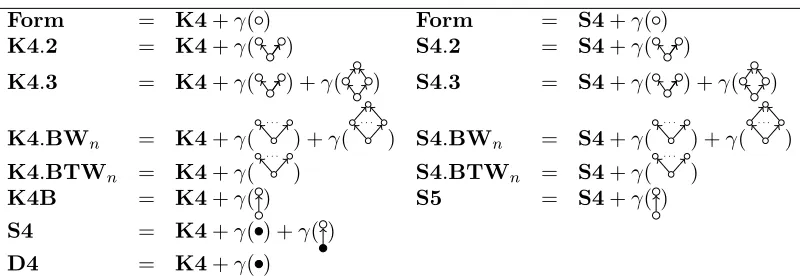
Definition 6.7. LetA= (A,♦)be a finite s.i.K4-algebra andD⊆A. For eacha∈Awe introduce a new propositional letter paand define the stable canonical formulaγ(A, D)associated withAand D as follows:
γ(A, D) = ^{+γ :γ ∈Γ} →_
{+δ :δ∈∆}
= +^Γ→_{+δ:δ ∈∆},
where Γ and ∆ are as in Definition 5.2.
Theorem 6.8. LetA= (A,♦)be a finite s.i.K4-algebra, D⊆A, andB= (B,♦)be aK4-algebra. Then B6|=γ(A, D) iff there is a s.i. homomorphic image C= (C,♦) of B and a stable embedding h:AC satisfying (CDC) for D.
Proof. First suppose that there is a s.i. homomorphic image C of B and a stable embedding h :
A C satisfying (CDC) for D. Define a valuation VA on A by VA(pa) = a for each a ∈ A. Then VA(γ) = 1A for each γ ∈ Γ and VA(δ) 6= 1A for each δ ∈ ∆. Therefore, VA(+
V
Γ) = 1A
and +δ 6= 1A for each δ ∈ ∆. Since A is a s.i. K4-algebra, its opremum c is the second largest element of the Heyting algebraH of the fixed points of+. Thus,W
{+δ:δ∈∆} ≤c, and hence
A 6|= γ(A, D). Next define a valuation VC on C by VC(pa) = h(VA(pa)) = h(a) for each a ∈ A.
The same argument as in the proof of Theorem 5.4 shows that VC(γ) = 1C for each γ ∈ Γ and VC(δ) 6= 1C for eachδ ∈∆. Therefore, VC(+VΓ) = 1C and +δ6= 1C for eachδ ∈∆. Because
C is s.i., it has an opremum, hence W
{+δ :δ ∈∆} is underneath the opremum, soC6|=γ(A, D).
Since Cis a homomorphic image of B, we conclude that B6|=γ(A, D).
Conversely, suppose that B 6|=γ(A, D). Since B is a K4-algebra, by [1, Lem. 4.1] (which is a modal analogue of [37, Lem. 1]), there is a s.i. homomorphic imageCofBand a valuationVC onC
such that VC(+VΓ) = 1C and VC(W{+δ :δ ∈∆})6= 1C. Next we define a map h:A→C by h(a) =VC(pa) for each a∈A. The proof of Theorem 5.4 then shows thath is a stable embedding
satisfying (CDC) forD.
Corollary 6.9. For a modal formula ϕ, there exist (A1, D1), . . . ,(An, Dn) such that each Ai =
(Ai,♦i) is a finite s.i. K4-algebra, Di⊆Ai, and for each s.i. K4-algebra B= (B,♦), we have:
B|=ϕ iffB|=
n
^
i=1
γ(Ai, Di).
Proof. By Theorem 6.5, there exist (A1, D1), . . . ,(An, Dn) such that each Ai = (Ai,♦i) is a finite
s.i. K4-algebra, Di ⊆Ai, and for each s.i. K4-algebra B = (B,♦), we have B 6|= ϕ iff there is a
s.i. homomorphic image C = (C,♦) of B, i ≤ n, and a stable embedding h : Ai C satisfying (CDC) forDi. By Theorem 6.8, this is equivalent to the existence ofi≤nsuch thatB6|=γ(Ai, Di). Thus,B|=ϕiff B|=Vn
i=1γ(Ai, Di).
Consequently, we arrive at a new axiomatization of modal logics aboveK4, which is an alternative to Zakharyaschev’s axiomatization.
Theorem 6.10. Each normal transitive logic L is axiomatizable over K4 by stable canonical for-mulas. Moreover, if L is finitely axiomatizable, then L is axiomatizable by finitely many stable canonical formulas.
Proof. Let L be a normal transitive logic. Then L is obtained by adding {ϕi : i ∈ I} to K4 as
new axioms. By Corollary 6.9, for each i ∈ I, there exist (Ai1, Di1), . . . ,(Aini, Dini) such that
Aij = (Aij,♦ij) is a finite s.i. K4-algebra,Dij ⊆Aij, and for each s.i. K4-algebra B = (B,♦), we
have B |=ϕi iff B |= Vni
j=1γ(Aij, Dij). Since every modal logic is determined by the class of its
s.i. modal algebras,L=K4+{Vmi
j=1γ(Aij, Dij) :i∈I}. In particular, ifLis finitely axiomatizable,
thenL is axiomatizable by finitely many stable canonical formulas.
Remark 6.11. LetSK4:= Σ(K4) be the least normal modal multi-conclusion consequence relation
containing/ϕ for eachϕ∈K4. By Theorem 5.6(1), all normal multi-conclusion consequence rela-tions extending SK4 are axiomatizable by stable canonical rules. If in the proof of Theorem 5.6(1)
we use a transitive filtration, then we obtain that all multi-conclusion consequence relations ex-tendingSK4 are axiomatizable over SK4 by stable canonical rules of finite K4-algebras. In other
words, multi-conclusion consequence relations extendingSK4are axiomatizable overSK4by stable
canonical rules of not just finite modal algebras, but by stable canonical rules of finiteK4-algebras. Remark 6.12. In [10] the technique of stable canonical rules is utilized to give an alternative proof of the existence of explicit bases of admissible rules for the intuitionistic logic, S4, and K4. Remark 6.13. LetA= (A,♦) be a finite s.i.K4-algebra and letD⊆A. In general,K4+γ(A, D) is not equal to Λ(SK4+ρ(A, D)). We do have that Λ(SK4+ρ(A, D)) ⊆K4+γ(A, D). Indeed,
for a s.i. modal algebra B = (B,♦), if B 6|= Λ(SK4+ρ(A, D)), then B 6|= ρ(A, D). Therefore,
by Theorems 5.4 and 6.8, B 6|= γ(A, D). This yields Λ(SK4+ρ(A, D)) ⊆ K4+γ(A, D). The
other inclusion, in general, may not be true. However, if U(SK4 +ρ(A, D)) is a variety, then
Λ(SK4+ρ(A, D)) = K4+γ(A, D). To see this, let B 6|= K4+γ(A, D). Then B 6|= γ(A, D).
Therefore, by Theorem 6.8, there is a s.i. homomorphic image C = (C,♦) of B and a stable embedding h :A C satisfying (CDC) for D. By Theorem 5.4, C 6|=ρ(A, D). If B |=ρ(A, D), thenB∈ U(SK4+ρ(A, D)), and since this class is a variety, it is closed under homomorphic images, soC∈ U(SK4+ρ(A, D)). But then C|=ρ(A, D), a contradiction. Thus, B6|=ρ(A, D), and hence
Λ(SK4+ρ(A, D)) =K4+γ(A, D). We leave it as an interesting open question to determine when
U(SK+ρ(A, D)) is a variety.
Let X = (X, R) be a finite rooted transitive space and let D ⊆ P(X). For each x ∈ X we introduce a new propositional letterpx and define thestable canonical formula τ(X,D) as follows:
τ(X,D) = ^{+γ :γ ∈Γ} →_{+δ:δ ∈∆}
= +^Γ→_{+δ :δ∈∆},
where Γ and ∆ are as in Remark 5.8. Then a transitive space Y= (Y, R) refutesτ(X,D) iff there is a closed topo-rooted up-setZ of Y and an onto stable map f :Z →X satisfying (CDC) for D. This provides an alternative way of defining stable canonical formulas forK4by avoiding algebraic terminology. Indeed, let A = (A,♦) be a finite s.i. K4-algebra, X = (X, R) be its dual, D ⊆ A, and D={β(a) :a∈D}. Then for each K4-algebra B= (B,♦) with its dualY= (Y, R), we have B|=γ(A, D) iffY|=τ(X,D).
7. Stable rules and Jankov rules
As we saw in Section 5, stable canonical rules ρ(A, D) axiomatize all normal modal multi-conclusion consequence relations and all normal modal logics. In this section we consider two extreme cases, when D =∅ and when D= A. In the first case we call the stable canonical rule
ρ(A,∅) simply astable ruleand denote it byρ(A). In the second case we denote the stable canonical
rule ρ(A, A) by χ(A) and call it a Jankov rule. We characterize normal modal multi-conclusion consequence relations and normal modal logics axiomatized by stable rules and prove that they all have the finite model property. On the other hand, as follows from [21] and [13], Jankov rules axiomatize splittings and join splittings in the lattices of normal modal multi-conclusion consequence relations and normal modal logics, respectively. We give alternate proofs of these results.
We start by an immediate consequence of Theorem 5.4.
Proposition 7.1. Let A= (A,♦) and B= (B,♦) be modal algebras with A finite.
(1) B 6|=ρ(A) iff there is a stable embedding h:AB.
(2) B 6|=χ(A) iff there is a 1-1 modal homomorphism h:AB.
Definition 7.2.
(1) We call a class K of modal algebras stable provided for modal algebras A = (A,♦) and
B = (B,♦), if B∈ K and there is a stable embeddingh:AB, then A∈ K.
(2) We call a normal modal multi-conclusion consequence relation S stable provided the corre-sponding universal class U(S) is stable.
Remark 7.3. By Lemma 3.3, it is clear that dually a class K of modal spaces is stable provided for modal spacesX= (X, R) andY= (Y, R), if X∈ Kand there is an onto stable mapf :XY, thenY∈ K.
Theorem 7.4. A normal modal multi-conclusion consequence relationS is stable iff S is axioma-tizable by stable rules.
Proof. First suppose thatS is stable. LetAS be the set of all nonisomorphic finite modal algebras
refuting S. We show that S = SK+{ρ(A) : A ∈ AS}. Let B = (B,♦) be a modal algebra. If
B6|=S, then there is ρ∈ S such thatB6|=ρ. The construction in the proof of Theorem 5.1 yields a finite modal algebraA= (A,♦) such thatA6|=ρand the inclusionAB is a stable embedding. Therefore, A ∈ AS. By Proposition 7.1(1), B 6|= ρ(A). Thus, B 6|= SK +{ρ(A) : A ∈ AS}.
Conversely, if B 6|= SK +{ρ(A) : A ∈ AS}, then there is A ∈ AS such that B 6|= ρ(A). By
Proposition 7.1(1), there is a stable embedding AB. If B |=S, then since S is stable, A|=S, a contradiction. Therefore, B 6|=S. Thus, S =SK +{ρ(A) :A∈ AS}, and so S is axiomatizable
Next let S be axiomatizable by stable rules. Then S = SK+{ρ(Ci) : i ∈ I}. Suppose that
B |=S and h :A B is a stable embedding. If A6|=S, then there is i∈I such that A6|=ρ(Ci).
By Proposition 7.1(1), there is a stable embeddingCiA. Therefore, there is a stable embedding Ci B. Applying Proposition 7.1(1) again yields B6|=ρ(Ci). The obtained contradiction proves
thatA|=S. Thus, S is stable.
Definition 7.5. We call a normal modal logic L stable provided there is a stable normal modal multi-conclusion consequence relation S such that L= Λ(S).
As an immediate consequence of Theorem 7.4, we obtain:
Proposition 7.6. For every L∈NextK, the following are equivalent:
(1) L is stable.
(2) L is axiomatizable by stable rules.
(3) L is the logic of a stable universal class.
Proof. (1)⇒(2): IfLis stable, thenL= Λ(S) for some stableS ∈NExtSK. By Theorem 7.4, there
is a family {Ai :i∈I} of finite modal algebras such that S =SK+{ρ(Ai) :i∈I}. Therefore, L
is axiomatizable by stable rules.
(2)⇒(3): IfL is axiomatizable by stable rules, thenL= Λ(SK+{ρ(Ai) :i∈I}) for some family
{Ai : i ∈ I} of finite modal algebras. By Theorem 7.4, S := SK +{ρ(Ai) : i ∈ I} is a stable
multi-conclusion consequence relation. Therefore, U(S) is a stable universal class. Since L is the logic of U(S), we conclude thatL is the logic of a stable universal class.
(3)⇒(1): Suppose L is the logic of a stable universal class U. Then S(U) is a stable multi-conclusion consequence relation andL= Λ(S(U)). Thus, L is a stable logic.
Definition 7.7.
(1) A normal modal multi-conclusion consequence relation S has the finite model property (fmp) if for each ruleρ withS 6`ρ, there exists a finite modal algebra A= (A,♦) such that
A|=S and A6|=ρ.
(2) A normal modal logic L has the finite model property (fmp) if for each formula ϕ with L6`ϕ, there exists a finite modal algebra A= (A,♦) such that A|=L and A6|=ϕ.
Theorem 7.8.
(1) Every stable normal modal multi-conclusion consequence relation has the finite model prop-erty.
(2) Every stable normal modal logic has the finite model property.
Proof. (1). Let S be a stable normal modal multi-conclusion consequence relation and let ρ be a multi-conclusion modal rule such that S 6`ρ. Then there is a modal algebra A= (A,♦) such that A|=S and A6|=ρ. The proof of Theorem 5.1 yields a finite modal algebra A0 = (A0,♦0) such that A06|=ρand the embedding A0 A is stable. Since S is stable, A0 |=S. Thus, S has the fmp.
(2). This is an immediate consequence of (1).
Remark 7.9. We will give numerous examples of stable multi-conclusion consequence relations and stable logics in Section 8. In fact, there are continuum many such systems. Their theory is developed in [5]. For the theory of stable superintuitionistic logics and stable intuitionistic multi-conclusion consequence relations consult [3, 4]. Proof-theoretic properties of stable logics are studied in [11], where it is shown that every stable modal logic has the bounded proof property.
We next turn to Jankov rules. We call a normal modal multi-conclusion consequence relationS
join splitting if it is a join (in the lattice NExtSK) of splitting normal modal multi-conclusion
consequence relations. Splitting and join splitting normal modal logics are defined similarly. For a modal algebra A= (A,♦), let S(A) ={ρ :A|=ρ} and L(A) ={ϕ:A|=ϕ}. Then it is straightforward to verify that S(A) is a normal modal multi-conclusion consequence relation and
L(A) is a normal modal logic. The following theorem was first proved by Jeˇr´abek [21, Thm. 6.5] using model-theoretic technique.
Theorem 7.10. Let S be a normal modal multi-conclusion consequence relation.
(1) S is splitting iff S is axiomatizable by a Jankov rule.
(2) S is join splitting iff S is axiomatizable by Jankov rules.
Proof. (1). First suppose that S is axiomatizable by a Jankov rule χ(A). It is sufficient to show that (S,S(A)) is a splitting pair in NExtSK. Since A 6|= χ(A), we have S 6⊆ S(A). Let T ∈ NExtSK with S 6⊆ T. Then there is a modal algebra B = (B,♦) such that B |= T and B 6|=S.
Therefore, B6|=χ(A). By Proposition 7.1(2), there is a 1-1 modal homomorphism AB. Thus, T ⊆ S(B)⊆ S(A), and hence (S,S(A)) is a splitting pair in NExtSK.
Next suppose thatS is splitting in NExtSK. Then there is T ∈NExtSK such that (S,T) is a
splitting pair. Therefore,T is a completely meet-prime element of NExtSK. Thus, sinceSKhas the
fmp, there is a finite modal algebra B= (B,♦) such thatS(B)⊆ T (see, e.g., [27, Sec. 4]). As B is finite, we see thatT =S(A) for some subalgebraAofB. This yields that (S,S(A)) is a splitting pair. By the above argument, (SK+χ(A),S(A)) is also a splitting pair. Thus, S =SK+χ(A).
(2). This follows from (1).
Remark 7.11. In [8, 9, 2, 3] the theory of algebra-based (or equivalently frame-based) formulas is developed and a general criterion when a logic is axiomatized by these formulas is established. Such well-known classes of formulas as Jankov formulas, stable formulas, subframe formulas and others are particular instances of algebra-based formulas. This theory has a natural generalization to the theory of algebra-based (or equivalently frame-based) rules. We will not pursue it here, and only note that stable rules and Jankov rules are particular instances of these algebra-based rules.
We call a modal algebra A= (A,♦) ofheight ≤nifn+10 = 1 (equivalently♦n+11 = 0).
Lemma 7.12. Let A = (A,♦) be of height ≤ n and a, b ∈ A with na 6≤ b. Then there is a s.i. modal algebra B= (B,♦) and an onto modal homomorphism h:AB such thath(na) = 1 and h(b)6= 1.
Proof. The proof is similar to that of [1, Lem. 4.1] and we only sketch it. Let F be the filter generated by na. Then na ∈ F and b /∈ F. If x ∈ F, then na≤ x, so na ≤ x. Since
A is of height ≤n, we have na ≤na. Therefore, na ≤x, and hence F is a modal filter.
By Zorn’s lemma, there is a maximal modal filter G such that na ∈ G and b /∈ G. Since G is maximal with this property, the quotient algebra B=A/G is s.i. Let h:A B be the quotient
map. Thenh(na) = 1 and h(b)6= 1.
Definition 7.13. Let A = (A,♦) be a finite s.i. modal algebra of height ≤ n, and let D ⊆ A. For each a∈A we introduce a new propositional letter pa and define the stable canonical formula ε(A, D) associated with A and D as follows:
ε(A, D) =
n+1⊥ ∧^{nγ :γ ∈Γ}→_{nδ:δ∈∆}
= n+1⊥ ∧n
^
Γ→_{nδ:δ ∈∆},
where Γ and ∆ are as in Definition 5.2.
Theorem 7.14. LetA= (A,♦)be a finite s.i. modal algebra of height≤n,D⊆A, andB= (B,♦)
Proof. The proof follows the same pattern as the proof of Theorem 6.8. First suppose that there is a s.i. homomorphic image C of B and a stable embedding h : A C satisfying (CDC) for
D. Define a valuation VA on A by VA(pa) = a for each a ∈ A. Then VA(γ) = 1A for each γ ∈ Γ and VA(δ) 6= 1A for each δ ∈∆. Therefore, VA(nVΓ) = 1A and VA(nδ) 6= 1A for each δ ∈ ∆. Moreover, since A has height ≤ n, we have VA(n+1⊥) = n+10A = 1A. As A is s.i.,
it has an opremum c. Let a 6= 1. Then there is m ∈ ω with ma ≤ c. Because A has height ≤ n, we see that na ≤ ma, yielding na ≤ c. Thus,
W
{VA(nδ) : δ ∈ ∆} ≤ c, and hence
A 6|= ε(A, D). Next define a valuation VC on C by VC(pa) = h(VA(pa)) = h(a) for each a ∈ A.
The same argument as in the proof of Theorem 5.4 shows that VC(γ) = 1C for each γ ∈ Γ and VC(δ) 6= 1C for each δ ∈ ∆. Therefore, VC(nVΓ) = 1C and VC(nδ) 6= 1C for each δ ∈ ∆.
Moreover, VC(n+1⊥) =n+1VC(⊥) = n+10
C =n+1h(0A)≥h(n+10A) = h(1A) = 1C. Since
C is s.i., it has an opremum, and the same argument as above yields thatW{
VC(nδ) :δ ∈∆} is
underneath the opremum, hence C 6|= ε(A, D). As C is a homomorphic image of B, we conclude thatB6|=ε(A, D).
Conversely, suppose that B 6|=ε(A, D). Let X = (X, R) be the dual of B. Then there exist a valuationV onBandx∈Xsuch thatx∈β(V(n+1⊥ ∧nVΓ)) butx /∈β(V(W{nδ :δ∈∆})).
Since x ∈ β(V(n+1⊥)), we have Rω[x] =Rn[x]. Therefore, Rω[x] is a closed up-set ofX, hence its dual modal algebra B0 is a homomorphic image of B. From Rω[x] = Rn[x] it follows that B0 is of height ≤ n. It is also clear that V(nVΓ) = 1B0 but V(W{nδ : δ ∈ ∆}) 6= 1B0. By
Lemma 7.12, there is a s.i. homomorphic imageC ofB0, and hence ofB, and a valuationVC onC
such that VC(n
V
Γ) = 1C and VC(
W
{nδ :δ ∈∆}) 6= 1C. Next we define a map h :A →C by
h(a) =VC(pa) for each a∈A. The proof of Theorem 5.4 then shows thath is a stable embedding
satisfying (CDC) forD.
We call a modal algebra A = (A,♦) of finite height if A is of height ≤ n for some n. If A is a finite s.i. modal algebra of finite height, then we denote ε(A, A) by ε(A) and call it the Jankov formula ofA. We next give an alternate proof of Blok’s theorem [13].
Theorem 7.15. Let L be a normal modal logic.
(1) L is a splitting logic iff L is axiomatizable by the Jankov formula of a finite s.i. modal algebra of finite height.
(2) L is a join splitting logic iff L is axiomatizable by Jankov formulas of finite s.i. modal algebras of finite height.
Proof. (1). First suppose thatL=K+ε(A) for some finite s.i. modal algebra A= (A,♦) of finite height. Thenε(A)∈L. On the other hand, by Theorem 7.14,A6|=ε(A). Therefore,ε(A)∈/ L(A), and hence L 6⊆L(A). Let M be a normal modal logic such that L6⊆ M. Then there is a modal algebra B= (B,♦) such that B |=M and B6|=L. This gives B 6|=ε(A). By Theorem 7.14, A is isomorphic to a subalgebra of a s.i. homomorphic imageCofB. Thus, M ⊆L(B)⊆L(C)⊆L(A). Consequently, (L, L(A)) is a splitting pair.
Conversely, suppose thatL is a splitting logic. Then there is a normal modal logicM such that (L, M) is a splitting pair. It is well known (see, e.g., [15, Cor. 3.29]) that Kis the modal logic of all finite irreflexive trees. Since (L, M) is a splitting pair, M is a completely meet-prime element of NExtK. Therefore, there is the dual modal algebra E of some finite irreflexive tree such that
L(E) ⊆ M. This, by J´onsson’s lemma, means that M = L(A), where A is a s.i. homomorphic image of a subalgebra ofE. Thus, (L, L(A)) is a splitting pair. BecauseE is of finite height, so is A. By the above argument, (K+ε(A), L(A)) is also a splitting pair. Consequently, L=K+ε(A).
(2). This follows from (1).