Appita J., 72 (1): 15 - 29 (2019) 15
Appita J., 72(1): 14-‐28 (2019) 14
Colloidal stability of Pinus radiata wood extractives
Part 1: Effect of extractives composition and process
variables
KAREN R. STACK1, NAILA YAQOOB2, ELKANA NGWENYA3, DESMOND E. RICHARDSON4 and
TREVOR W. LEWIS5
1Research Fellow and corresponding author ([email protected]), 2Research Assistant, 3Lecturer, 5Senior Lecturer,
University of Tasmania, Hobart, Australia
4 Senior Scientist, Process Chemistry
Norske-Skog, Boyer, Tasmania, Australia
SUMMARY
This paper presents the results of a study undertaken to investigate the interaction between the various key factors that have been identified to affect wood extractive colloid stability and pitch deposition of wood extractives released in thermomechanical pulp of Pinus Radiata. These key factors are temperature, soluble calcium, pH, dissolved carbohydrates and wood extractive concentration and composition. Very little work has been undertaken to study the effect of composition and seasonal changes in Pinus radiata wood extractives on their colloidal stability and pitch deposition. Two different compositions of the wood extractives, representing the maximum and minimum in ester to acid ratio (EAR) that occur during the summer and winter periods, were investigated. The EAR of the extracts was found to significantly affect the wood extract colloidal properties. Low EAR (EAR=0.31) extracts, typical of the summer period, were found to be more unstable and more susceptible to deposition and destabilisation by soluble calcium than higher EAR (EAR=0.66) extracts, typical of the winter period. Complex interactions between the various process variables were found. In particular, the dissolved organic matter (DOM) level was found to cause both stabilisation and destabilisation depending on the concentration and the pH. This was more apparent in the higher EAR extract.
Keywords: Pinus radiata, wood extractives, colloidal stability, ester to acid ratio, dissolved organic matter
INTRODUCTION
Wood extractives are a complex mixture of fatty acids (FA), triglycerides (TG), and resin acids (RA) as well as steryl esters and sterols (8). The main wood source for the Norske Skog mill in Australia is Pinus radiata which is particularly rich in resin acids, unlike other wood species used in the pulp and paper industry such as Norwegian Spruce (Picea abies) (9). The composition of wood extractives is known to vary seasonally (3) and has been attributed to hydrolysis of the glycerides to free fatty acids in the warmer summer months. The composition can be expressed in terms of the ester (triglycerides) to acid (resin and fatty acids) ratio (EAR). Some paper mills, including Norske Skog, use this ratio as a colloid stability indicator.
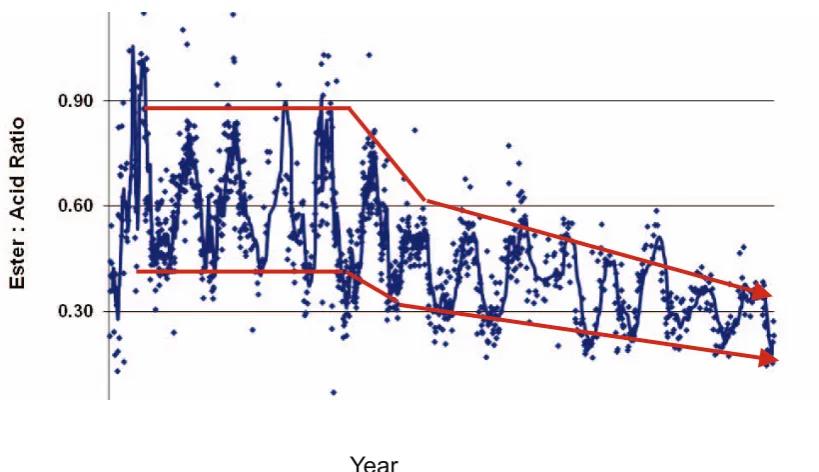
[image:2.595.93.503.335.571.2]In the period 1997-2002, Norske SkogÕ s Albury mill identified a tendency for pitch problems in summer when the EAR ratio was low (EAR= 0.4) and so associated a low EAR ratio with colloidal instability (Fig. 1) (10). From 2002 a noticeable decrease in the maximum and minimum values of the EAR ratio occurred. By 2011 the average maximum was as low as the average minimum value of the 1990Õ s and so it became a concern that the wood extractive colloids were becoming more unstable and contributing to deposition problems being experienced at times outside the normal summer pitch period. Although the full reason for these changes in EAR is not clear it is believed that drought conditions and climatic stress may have contributed to the composition changes.
Fig. 1 Variation in EAR ratio of TMP pulp extractives (10).
Pitch deposition is affected by a number of variables including pH and temperature (11, 12), shear (13), ionic strength (14,15) and dissolved organic material (16-19) as well as the chemical composition of the wood extractives (11, 20-22). Some research has been undertaken to understand the colloidal structure and behaviour of wood extractives and the effect of extractive composition (20 - 23). The most recent model of the colloid is a layered structure with the more hydrophobic components (triglycerides and steryl esters) forming the core of the colloid droplet and the less hydrophobic resin acids and fatty acids forming a shell around the core. It is also believed that the fatty acids are mobile and move from the outer region towards the inner region depending on the amount of triglycerides in the core (10, 23).
Appita J., 72 (1): 15 - 29 (2019) 17
Appita J., 72(1): 14-‐28 (2019) 16
Dissolved salts and dissolved organic material have a significant effect on colloidal stability of the colloid droplet and the phase distribution of the extractives in the process water (22- 25). Both stabilisation and destabilisation can occur and the interaction between the wood extractives, dissolved salts and dissolved organic material has been found to be complex (19). Dissolution of fatty acids and resin acids at high pH and low salt concentration (25) causes changes in both the composition and stability of the wood extractive colloids.
The work presented in this paper aims to better understand the effect that the seasonal changes in composition of the wood extractives, as measured by EAR, have on colloidal stability and pitch deposition of P.radiata wood extractives. Much of the knowledge gained to date about the factors affecting pitch deposition of P.radiata wood extractives has been compiled from separate studies into the effect of individual process variables or a combination of two process variables on pitch deposition and colloidal stability. In this paper the results of a comprehensive study of the interactions between key factors in pitch deposition and wood extractive colloidal stability, at two different wood extractive compositions representative of summer extracts with EAR values typically 0.29 and winter extracts with EAR values typically 0.60, are presented.
EXPERIMENTAL
Materials
Wood extractives were prepared from P. radiata thermo-mechanical pulp (TMP) sourced from Norske Skog’s Albury Mill. The pulp was freeze-dried and then soxhlet extracted using hexane (LR grade, Chem-Supply). The wood extractives were isolated by evaporation of the hexane. The concentrated wood extractives were stored at -24°C until required. The composition of the wood extractive (WE) samples used in this study are shown in Table 1.
Table 1: Composition of wood extractives in pulp samples collected from Norske Skog Albury Paper Mill.
% fatty acid
(FA) % resin acid (RA) % triglycerides (TG) EAR = (𝑹𝑹𝑹𝑹&𝑭𝑭𝑹𝑹)𝑻𝑻𝑻𝑻
Hexane extract 1 (WE1) 2.2 52.7 45.1 0.82
Hexane extract 2 (WE2) 3.1 54.0 42.7 0.75
Model compounds of abietic acid (AA) (Aldrich, technical grade 75% purity, impurities consist of other resin acids), oleic acid (OA) (Aldrich, technical grade, 90% purity, impurities consist of other fatty acids) and triolein (TG) (Aldrich, technical grade, 65% purity, impurities consist of other triglycerides) were also used.
Laboratory grade calcium chloride (CaCl2.2H2O) was obtained from Chem-Supply and potassium nitrate
(KNO3, 99.8% purity)was purchased from BDH. All electrolytes used were dissolved in deionised water.
Preparation of dissolved organic matter DOM
wide, >12,000 MW) over 24 h using a 1 mM KNO3 solution pH adjusted to pH 5.5. The dialysis solution
was changed every 30 min for the first 5 h and then left overnight to remove the low molecular weight material in the DOM. The solids content of the dialysed DOM solution was determined by drying a sample at 100ºC in the oven until dry.
Preparation of aqueous colloidal dispersions of wood extractives
Aqueous colloidal dispersions of the wood extractives were prepared by dissolving the wood extracts and model compounds in acetone and then adding the mixture with stirring to an aqueous solution of 1 mM KNO3 pH adjusted to
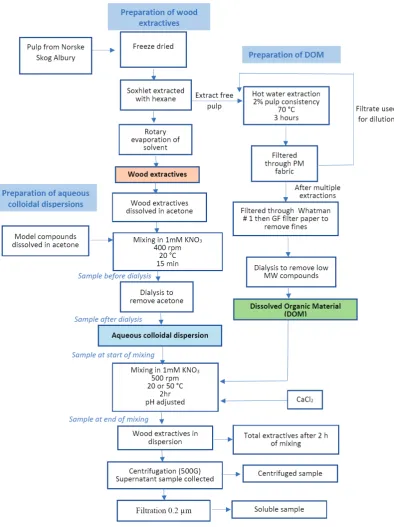
5.5. Figure 2 shows a schematic of the procedure and sampling undertaken. The high EAR extract was prepared by mixing triolein (TG) and hexane extract 1 (WE1) while the low EAR extract was prepared by mixing abietic acid (AA), oleic acid (OA) and hexane extract 2 (WE2). The aqueous dispersion was further dialysed to remove acetone, in the same manner as the DOM.
After dialysis the wood extractive colloidal dispersions were mixed with the various process chemicals to modify the pH, soluble calcium level and dissolved carbohydrates (DOM). After 2 h of mixing at 500 rpm in 200 mL round bottom flasks, at controlled temperature, samples were taken and extracted with tert-butyl methyl ether (t-BME). Additional samples from each flask after mixing were also centrifuged at 1800 rpm for 10 minutes (500 G) using an Eppendorf 5810 centrifuge. After centrifugation, the supernatant of the centrifuged sample was removed, and part of this sample was further filtered through 0.2 µm cellulose acetate membrane filters (Advantec) to obtain the soluble fraction.
The concentration of the wood extractive components before and after dialysis, before and after mixing as well as after centrifuging and filtering of the final sample were obtained. These measurements were then used to determine the amount of material deposited, in unstable and stable colloidal form and also present in a soluble form. The amount of material in the different fractions was determined as follows:
Deposited material = (total extractives at start of mixing - total extractives after 2 h of mixing) [1] Unstable colloids = (total extractives after 2 h of mixing - extractives in centrifuged sample) [2] Stable colloids = (centrifuged sample - soluble fraction sample) [3] Soluble fraction = extractives in filtered (0.2 µm), centrifuged sample after 2 h of mixing [4]
Analysis of wood extractives
Analysis of the samples was undertaken using gas chromatography following the method developed by Orsa et al (26). An internal standard consisting of heptadecanoic acid (C17:0, margaric acid, 99% purity, Sigma Aldrich), pentadecanoic acid (C15:0, 99+% purity, Sigma Aldrich), cholesteryl stearate (CS, 99% purity, Sigma Aldrich) and glyceryl triheptadecanoate (GTH, 99% purity, Sigma Aldrich) was added to each sample prior to the t-BME extraction to enable quantification of the compounds in the sample. The extracted samples were blown down with compressed air and then made up with toluene prior to analysis.
Appita J., 72 (1): 15 - 29 (2019) 19
Appita J., 72(1): 14-‐28 (2019) 18
[image:5.595.103.498.107.635.2]
Fig. 2 Schematic of experimental procedure and sampling.
RESULTS AND DISCUSSION
In order to study the effect of composition at the typical winter and summer extremes in the wood extractive composition of P. radiata, pulp samples were collected at the times that historically the wood would have a high EAR (typically 0.60) and a low EAR (typically 0.29). The composition of the pulp samples received differed from the target values proposed for the investigation and so the composition of the samples was modified to reach the target compositions typical of the maximum and minimum values of EAR for the summer and winter periods. This involved addition of triolein to hexane extract 1 to increase EAR and addition of oleic acid and abietic acid to hexane extract 2 to decrease the EAR. The average compositions of the prepared wood extractive colloidal dispersions after dialysis are shown in Table 2.
Strand et al (22) studied two levels of EAR by varying the composition of a prepared wood extractive emulsion. The high EAR emulsion had a TG:RA:FA ratio of 5.1:1.5:1.0 (EAR=2.04) and their low EAR emulsion had a TG:RA:FA ratio of 2.0:1.5:1.0 (EAR=0.8) which is in fact closer to the higher levels of EAR of P.radiata wood extracts studied. The Norwegian Spruce used in Strand’s study had significantly less resin acids in the wood extractives compared to resin acids level found in P.radiata.
[image:6.595.48.552.339.419.2]
Table 2: Comparison of composition of prepared wood extractive colloidal dispersions. % fatty acid (FA) % resin acid (RA) % triglycerides (TG) TG:RA:FA ratio EAR High EAR
extract 6.2 +/- 2.7 54.5 +/- 8.8 39.4 +/- 5.3 6.4 : 8.8 : 1 0.66 +/- 0.09 Low EAR
extract 18.5 +/- 2.4 57.9 +/- 6.9 23.6 +/- 4.1 1.28 : 3.1 : 1 0.31 +/- 0.05
Effect of temperature
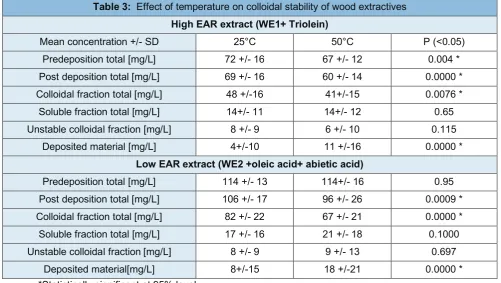
Two temperatures (25°C and 50°C) were investigated. A t-test on the means was undertaken to determine if temperature was significant (Table 3). Temperature was significant with a difference in the means for post deposition concentration, colloidal fraction concentration and deposited material concentration for the high and low EAR wood extracts. The concentration of stable colloidal extractives decreased in the aqueous dispersions but more deposited during the two-hour deposition period when the temperature was increased from 25°C to 50°C. There was no significant difference in the soluble fraction or unstable colloidal material with a change in temperature.
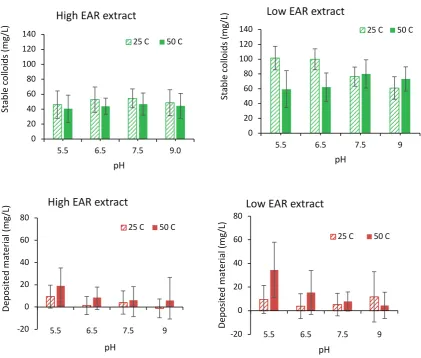
Previous work by McLean (11) found that deposition increased with temperature at pH 5.5 but decreased at pH 7.0. The results shown in Figure 3 indicate that the effect of temperature was also dependent on the wood extract composition and EAR. Increasing the temperature from 25°C to 50°C resulted in a small decrease in the amount of stable colloids and an increase in the amount of deposited material at all pH levels for the high EAR extract (WE1 fortified with triolein). However, for the low EAR extract (WE2 fortified with oleic acid and abietic acid) the effect of temperature was pH dependent with pH 5.5 and 6.5 showing a destabilisation of the colloids with increasing temperature. At 7.5 and 9.0 a small increase in the stabilisation of the colloids and reduction in deposits was observed as the temperature increased, supporting McLean’s observations.
Appita J., 72 (1): 15 - 29 (2019) 21
Appita J., 72(1): 14-‐28 (2019) 20
[image:7.595.49.551.87.370.2]
Table 3: Effect of temperature on colloidal stability of wood extractives High EAR extract (WE1+ Triolein)
Mean concentration +/- SD 25°C 50°C P (<0.05)
Predeposition total [mg/L] 72 +/- 16 67 +/- 12 0.004 *
Post deposition total [mg/L] 69 +/- 16 60 +/- 14 0.0000 *
Colloidal fraction total [mg/L] 48 +/-16 41+/-15 0.0076 *
Soluble fraction total [mg/L] 14+/- 11 14+/- 12 0.65
Unstable colloidal fraction [mg/L] 8 +/- 9 6 +/- 10 0.115
Deposited material [mg/L] 4+/-10 11 +/-16 0.0000 *
Low EAR extract (WE2 +oleic acid+ abietic acid)
Predeposition total [mg/L] 114 +/- 13 114+/- 16 0.95
Post deposition total [mg/L] 106 +/- 17 96 +/- 26 0.0009 *
Colloidal fraction total [mg/L] 82 +/- 22 67 +/- 21 0.0000 *
Soluble fraction total [mg/L] 17 +/- 16 21 +/- 18 0.1000
Unstable colloidal fraction [mg/L] 8 +/- 9 9 +/- 13 0.697
Deposited material[mg/L] 8+/-15 18 +/-21 0.0000 *
*Statistically significant at 95% level
Lee et al (13) found that increasing temperature increased colloidal stability and the critical coagulation concentration (CCC) of various salts. This would suggest that the amount of stable colloids should increase and the amount of deposits decrease with increasing temperature which is contrary to the results in Table 3. The CCCs determined by Lee et al for the calcium ion (Ca2+) were 320 mg/L (8 mM Ca2+) at 25°C and 960 mg/L (24 mM Ca2+)
at 50°C. The range of soluble calcium levels that we investigated was significantly lower than the CCC at 50°C with only the 400 mg/L Ca2+ being above the CCC at 25°C. Thus, the differences observed between Lee’s results and those
in Figure 3 may be attributed to the different soluble Ca levels investigated and the fact that most of our experiments were conducted below the CCC for Ca2+.
Variation in stirring and shear conditions between the experiments may also be a contributing factor to the differences in the observed trends with those reported in the literature. The shear conditions used by McLean (11) and in previous work (27) (300 rpm using a paddle stirrer) were lower than the current experiments which used a magnetic stirrer bar at 500 rpm. The higher stirring speed and shear would result in increased particle-particle interactions and possibly greater aggregation and deposition. At higher temperatures, the particles were expected to be softer and may have been more susceptible to aggregation than at lower temperatures under the higher shear conditions.
Effect of soluble Ca and pH
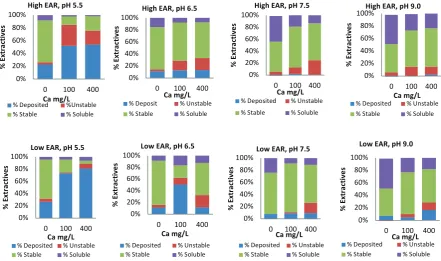
either deposited onto the container walls and stirrer or became unstable aggregated colloids that could be removed by centrifugation. The extractives from the low EAR pulp were considerably more unstable than those from the high EAR pulp, with over 80% of extractives being deposited onto surfaces at 400 mg/L soluble Ca compared to only 54% of the high EAR extractives. At pH 5.5, a greater proportion of colloids became unstable but did not deposit for the high EAR extractives system compared to the low EAR system. This is consistent with there being differences in the nature of the surface of the aggregated colloids of the high and low EAR extracts. As the pH was increased to 6.5, less material was deposited and the effect of the soluble calcium on the colloidal stability was not as great as at pH 5.5.
[image:8.595.63.485.261.619.2]
Fig. 3 Effect of temperature and pH on the concentration of stable colloids
0 20 40 60 80 100 120 140
5.5 6.5 7.5 9.0
St abl e col loi ds (m g/ L) pH
High EAR extract
25 C 50 C
0 20 40 60 80 100 120 140
5.5 6.5 7.5 9
St abl e col loi ds (m g/ L) pH
Low EAR extract
25 C 50 C
-‐20 0 20 40 60 80
5.5 6.5 7.5 9
De po site d m ate ria l ( m g/L) pH
High EAR extract
25 C 50 C
-‐20 0 20 40 60 80
5.5 6.5 7.5 9
De po site d m ate ria l ( m g/L) pH
Low EAR extract
Appita J., 72 (1): 15 - 29 (2019) 23
Appita J., 72(1): 14-‐28 (2019) 22
[image:9.595.56.498.87.348.2]
Fig. 4 Effect of soluble calcium, pH and EAR, in the absence of DOM, on the distribution of deposited extractives, extractives in stable and unstable colloids and in soluble material.
At pH 7.5 and 9.0, dissolution of the resin acid portion of the extractives was observed. The high EAR dispersions (lower ratio of resin acids) were found to have a higher % of soluble material compared to the low EAR dispersions at pH 7.5. Work by Strand et al (22), investigating the phase distribution of resin acid and fatty acids, found that decreasing the ratio of TG to RFA (resin and fatty acids), hence the EAR from 2.04 to 0.8, resulted in a decrease in the pKlw, the pH at which 50% of the resin and fatty acids were found in the water phase. This would then suggest
that the lower EAR dispersions would have a higher percentage of RA in the water phase which appears contrary to the result in Figure 4. However, if the shape of the phase distribution curves is considered then Strand’s results indicate that dissolution and release of resin acids occurred over a much narrower pH range in the lower EAR pitch emulsions and so at pH 7.5 the percent of resin acids in the water phase was slightly lower. Thus, the shape of the distribution curve also needs to be considered particularly in determining the behaviour of the components at different pH levels. Another point to note is that the ratio of RA to FA was kept constant in their work however in our experiments the ratio varied and so may be a factor in explaining the reason for the different behaviour. Release of the resin acids from the colloids has also been found to be affected by not only pH and pKa (25, 28) but also the presence of fatty acids. Sundberg
et al (25) found that addition of saturated fatty acids to pitch emulsions resulted in a decrease in pKlw of resin acids
such as dehydroabietic acid and neoabietic acid, indicating a decrease in the release of these resin acids from the pitch colloid with additional fatty acids, in the colloids. It is proposed that ion-dipole interactions are responsible for holding deprotonated carboxylic acid groups from either resin acids or fatty acids in a colloid through interaction with protonated (un-ionised) fatty acids (29,30). So, even though the high EAR extract had less resin acids (61 mg/L, 55% of the total extract) than the low EAR extract (90 mg/L, 58% of the total extract), there was a considerable difference in the amount of fatty acids in each extract with the low EAR having 29 mg/L (19% of the total extract) and the high EAR extract having only 5 mg/L (5% of the total extract). Thus the ratio of RA:FA was significantly different with the
0% 20% 40% 60% 80% 100%
0 100 400
% E xt ract ives Ca mg/L High EAR, pH 5.5
% Deposited %Unstable % Stable % Soluble
0% 20% 40% 60% 80% 100%
0 100 400
% E xt ract ives Ca mg/L High EAR, pH 6.5
% Deposit % Unstable % Stable % Soluble
0% 20% 40% 60% 80% 100%
0 100 400
% E xt ract ives Ca mg/L High EAR, pH 7.5
% Deposited % Unstable % Stable % Soluble
0% 20% 40% 60% 80% 100%
0 100 400
% E xt ract ives Ca mg/L High EAR, pH 9.0
% Deposited % Unstable % Stable % Soluble
0% 20% 40% 60% 80% 100%
0 100 400
% E xt ract ives Ca mg/L Low EAR, pH 5.5
% Deposited % Unstable % Stable % Soluble
0% 20% 40% 60% 80% 100%
0 100 400
% E xt ract ives Ca mg/L Low EAR, pH 6.5
% Deposited % Unstable % Stable % Soluble
0% 20% 40% 60% 80% 100%
0 100 400
% E xt ract ives Ca mg/L Low EAR, pH 7.5
% Deposited % Unstable % Stable % Soluble
0% 20% 40% 60% 80% 100%
0 100 400
% E xt ract ives Ca mg/L Low EAR, pH 9.0
low EAR dispersion having a ratio of RA:FA of 3:1 compared to 12:1 for the high EAR dispersion. Hence it is proposed that the higher amount of fatty acids in the low extract dispersion was responsible for holding the deprotonated resin acids in the colloid to a greater extent than in the high EAR dispersion due to the higher proportion of ion-dipole interactions between ionised resin acids and unionised fatty acids.
The addition of calcium ions had a significant effect on the amount of soluble material at pH 7.5 and pH 9.0 and caused precipitation of the soluble extractives. In the low EAR dispersion the amount of deposited material increased, while in the high EAR dispersion the amount of unstable colloids increased. This is consistent with the destabilised colloids, formed by the interaction of soluble resin acids and fatty acids with calcium ions, being “tackier” in the low EAR dispersion compared to the high EAR dispersion. These “tackier” colloids would be more readily deposited onto surfaces. The difference in RA:FA composition between the two extracts may be the reason for the difference in nature of the material. Qin (31) showed that although FA had a lower viscosity than TG or RA, increasing FA resulted in an increase in tackiness of wood resin.
Effect of DOM
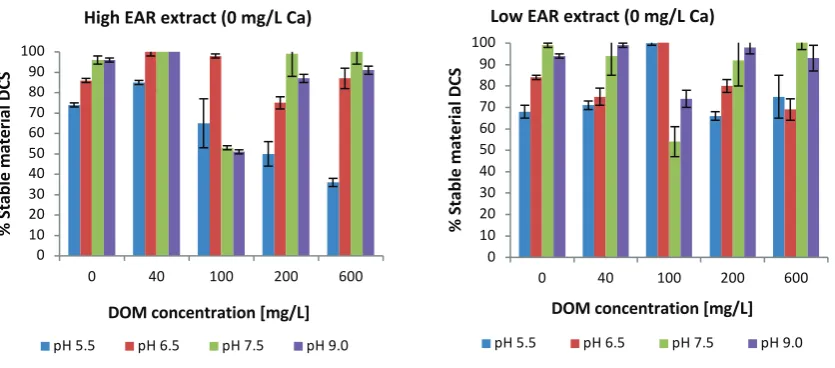
Dissolved organic material is generally acknowledged to stabilise wood extractives through steric stabilisation (14, 16), though previous work has demonstrated that it can also lead to destabilisation of P.radiata wood extractives (19) through depletion flocculation (32). Figure 5 shows the effect of DOM on percentage stable material (colloids and soluble material) at different pH levels in the absence of soluble calcium for the two extracts investigated.
The addition of DOM appears to initially stabilise the colloidal and soluble material present in the dispersions. Further addition resulted in destabilisation. The concentration of DOM to reach the initial maximum in stabilisation appears to be dependent on the EAR level and pH. For the high EAR dispersion a maximum in stabilisation occurred at 40 mg/L DOM at all pH levels while for the low EAR dispersion the maximum in stabilisation occurred at 100 mg/L DOM at pH 5.5 and 6.5 and 40 mg/L DOM at pH 7.5 and 9.0.
Destabilisation of colloidal material by the DOM was apparent at both EAR levels, with the high EAR dispersion showing a high degree of destabilisation. The DOM concentration at which the destabilisation occurred also appeared to be pH dependent. At pH 5.5, destabilisation occurred between 100 and 600 mg/L DOM which is similar to previous work (19). At pH 6.5, destabilisation appeared to occur at a slightly higher DOM addition of 200 mg/L for both EAR levels. At pH 7.5 and 9.0, destabilisation of colloidal material occurred at 100 mg/L DOM but as the DOM concentration was further increased re-stabilisation of the material was apparent for both EAR systems. The reason for the different behaviour of the two extractive dispersions is likely to be a result of the different chemical compositions of the colloids affecting the nature of the colloid surface and hence the interaction with DOM.
The presence of a small amount of DOM (40 mg/L) was found to have a significant effect on stabilising the colloids against the effect of soluble calcium at pH 5.5 as shown in Figure 6. More extractives remained as stable material (stable colloids and soluble material) and less material was deposited compared to when there is no DOM present (Figure 4). The low EAR dispersion deposited more material than the high EAR.
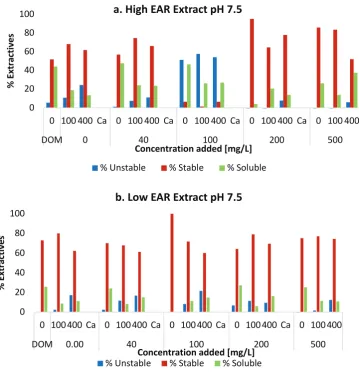
The difference in behaviour of the two different extracts with the addition of DOM is further shown in Figure 7. In the presence of 400 mg/L soluble calcium, the stabilisation-destabilisation-re-stabilisation effect of the DOM was greater for the high EAR dispersion compared to the low EAR dispersion.
Appita J., 72 (1): 15 - 29 (2019) 25
Appita J., 72(1): 14-‐28 (2019) 24
concentration of DOM than the destabilisation of the stable colloids (100 mg/L DOM), and so it is proposed that the DOM preferentially interacted with the stable colloids before interaction with the soluble material. In the low EAR dispersion destabilisation of soluble material was less apparent, though in the absence of soluble calcium a significant decrease in the soluble material occurred at 100 mg/L DOM addition.
It is proposed that interaction of the DOM with the soluble material is occurring and results in the soluble material aggregating and forming colloids. This aggregation of the soluble material to form colloids, changes the distribution between the soluble and stable colloids which is more evident at high EAR extractive dispersions.
Implications for the Paper Mill
The results confirm the anecdotal observations from mill personnel that summer wood extractives with low EAR cause more pitch deposition events. The low EAR pulp was shown to be more susceptible to forming deposits, particularly in the presence of soluble calcium, at pH levels below 7.0 and in the presence of a small amount of DOM (40 mg/L). Thus, in periods of low EAR for example summer time, soluble calcium needs to be carefully controlled and minimised in the process water. The pH control of the papermaking process needs to minimise pH fluctuations and avoid excursions to pH levels below 7. The optimum pH for periods of low EAR pulp appears to be pH 7 to 7.5. The presence of DOM in the process water is a complicating factor but maintaining DOM levels of approximately 200 mg/L should avoid periods of destabilisation of the wood extracts by DOM. Recirculation of whitewater and minimisation of freshwater make-up in the process should assist in maintaining adequate DOM levels. Overall management of the process needs to consider DOM and soluble calcium levels along with pH, with a focus on achieving stable operation to avoid deposition problems particularly during periods of low EAR conditions.
[image:11.595.58.476.452.636.2]Fig. 5 Effect of DOM and pH on amount of stable material in the absence of soluble calcium. 0
10 20 30 40 50 60 70 80 90 100
0 40 100 200 600
%
St
ab
le
m
at
er
ia
l D
CS
DOM concentration [mg/L]
High EAR extract (0 mg/L Ca)
pH 5.5 pH 6.5 pH 7.5 pH 9.0
0 10 20 30 40 50 60 70 80 90 100
0 40 100 200 600
%
St
ab
le
m
at
er
ia
l D
CS
DOM concentration [mg/L]
Low EAR extract (0 mg/L Ca)
Fig. 6 Effect of soluble calcium and EAR on distribution of extractives between deposited, stable colloids, unstable colloids and soluble material at 5.5 pH and 40 mg/L DOM.
Fig. 7 Effect of DOM and pH on the proportion of extractives as stable colloids in the presence of 400 mg/L soluble calcium. 0% 20% 40% 60% 80% 100%
0 100 400
% E xt ra ct ive s
Soluble Ca mg/L
High EAR, pH 5.5, 40 mg/L DOM
% Deposited % Unstable % Stable % Soluble
0% 20% 40% 60% 80% 100%
0 100 400
% E xt ra ct ive s
Soluble Ca mg/L
Low EAR, pH 5.5, 40 mg/L DOM
% deposited % Unstable % Stable % Soluble
0 10 20 30 40 50 60 70 80 90 100
0 40 100 200 600
% S ta bl e m ate ria l D CS
DOM concentration [mg/L] High EAR (400 mg/L Ca)
pH 5.5 pH 6.5 pH 7.5 pH 9.0
0 10 20 30 40 50 60 70 80 90 100
0 40 100 200 600
% S ta bl e m ate ria l D CS
DOM concentration [mg/L] Low EAR (400 mg/L Ca)
[image:12.595.74.499.399.579.2]Appita J., 72 (1): 15 - 29 (2019) 27
Appita J., 72(1): 14-‐28 (2019) 26
[image:13.595.108.468.94.467.2]
Fig. 8 Effect of DOM and soluble calcium on the distribution of the extractives in the unstable and stable colloidal and soluble fraction at pH 7.5.
CONCLUSIONS
Low EAR extractive dispersions whose composition is typical of summer wood extractive levels for Pinus radiata, were found to be more unstable than high EAR extractive dispersions. They were more susceptible to depositing and destabilisation by soluble calcium, which is consistent with mill observations. More dissolution of resin acids occurs at pH 7.5 in high EAR dispersions than does in low EAR solutions due to the lower levels of fatty acids in the extract. Complex interactions between soluble calcium, pH and DOM were evident. The addition of DOM caused stabilisation and destabilisation of the colloids and soluble material and the DOM level that caused maximum stabilisation was dependent on the EAR level and pH of the extract. It appears that DOM interacts with stable colloids to destabilise them in preference to destabilising soluble material.
0 20 40 60 80 100
0 100 400 Ca 0 100 400 Ca 0 100 400 Ca 0 100 400 Ca 0 100 400
DOM 0 40 100 200 500
%
E
xt
ra
ct
iv
es
Concentration added [mg/L]
a. High EAR Extract pH 7.5
% Unstable % Stable % Soluble
0 20 40 60 80 100
0 100400 Ca 0 100400 Ca 0 100400 Ca 0 100400 Ca 0 100400
DOM 0.00 40 100 200 500
%
E
xt
ra
ct
iv
es
Concentration added [mg/L]