STATE OF THE ART OF THE APPLICATION
OF NEW INFORMATION TECHNOLOGIES
IN LIBRARIES AND THEIR IMPACT
COMMISSION OF THE EUROPEAN COMMUNITIES
information management
Libraries programme
State of the art of the application
of new information technologies in libraries
and their impact on library functions:
a reassessment
NETHERLAND NBBI BP 80544 NL-2508 DEN HAAG
LIB/2 update Report
Directorate-General
Telecommunications, Information Industries and Innovation Directorate
Published by the
COMMISSION OF THE EUROPEAN COMMUNITIES Directorate-General
Telecommunications, Information Industries and Innovation L-2920 LUXEMBOURG
LEGAL NOTICE
Neither the Commission of the European Communities nor any person acttng on behalf of the Commission is responsible for the use which might be made of the following
Contents
1 Preface
2 Research framework
3 Ubraries
3. 1 Categories
3.2 Financial position 3.3 Cooperation
3.4 Union catalogues and interlibrary loan
4 Technology in libraries
4.1 Academic libraries 4.2 Special I ibraries 4.3 Public libraries
I~ 5 Key areas in library technology
5. 1 Machine readable record resources
5.2 Network access to machine readable record resources 5.3 Integrated library housekeeping systems
5.4 IT -based user services
6 Summary, major changes and trends
Appendices
A. Profiles of integrated library systems B. Questionnaire
C. References
1 Preface
This study is an update study on information technology in libraries on behalf of the European Committee. Although the authors have tried to make a report that could be read separately, it is important for the reader to know on what basis it is founded.
For the present study a study specification was given. In this specification the following was stated about what lays behind this update study:
"In response to the Resolution of the Council of Ministers, 7 September 1985, and as a preliminary to the definition of the proposed Plan of Action for Ubrarians in the EC, the Commission carried out a parallel study in each of the member states to determine the state of the art of the application of new information technologies in libraries in those states (LIB-2 Study, 1986, EUR 110361 ). These studies determined the extent to which catalogues
(especially of major collections) existed in machine readable form, the role of library networks, the level of automation for the other housekeeping functions of acquisition, circulation control and local cataloguing, the use of computer-based user-related services, and the nature and level of
interlibrary transactions and frameworks. The studies were set in the context of national and institutional policies and frameworks. They revealed wide discrepancies between member states, not only in the implementation of the new technologies but in the provision of basic library services:
The study which was carried out for the Netherlands was published in 1986 as "lnformatietechnologie in de Nederlandse bibliotheken". The following conclusions were drawn:
automation of cataloguing and housekeeping continues; it is expected that within 10 years most catalogues will be in machine readable form, for the whole library collection
research and experiments in the field of new technologies will augment because of shrinking budgets
increasing use of on-line information, not necessarily bibliographic; there is a policy to get on-line information accessible to the public; there is a role for public libraries as intermediary
cooperation is a major line of development
emphasis in government policy on information technology in for instance education, research and market sector, less on information technology in libraries, but some projects received subsidies of some importance
Successively, again quoting the study specification
forum in Luxembourg In 1989. His formulated in five action lines, targeted at: source data projects, through the creation of (new) machine readable
national bibliographies or enhancements of existing ones and through retrospective conversion projects for collections of international significance; the interlinking of networks providing services
to
libraries; the development of new services for library users; the development of new tools for librarians, to promote cost-effective working and to deliver services; and the exchange of experience and skills.There is now a need to review any progress made since the undertaking of the original LIB-2 studies in order to provide a current knowledge base for actions and to help provide additional startup information for developing projects, both at Community level and at the level of the prospective project partners in the member states.
The purpose of this update study is
to
provide factual information in order to distinguish the major changes and the take up of new technologies.Descriptions of systems which were given in the original LIB-2 study need not be repeated. Also, the update study does not repeat all the original areas of investigation in the same form, but is restricted to four key areas:
machine-readable record resources
network access to machine readable record resources integrated library housekeeping systems
information technology-based user services·
2 Research framework
In the first LIB2 study it appeared difficult to get exact data. particularly quantitative data, from libraries. This has not changed. The reliability and actuality of statistical information on the information sector has not very much improved since. In ·Kwantificering van de informatiesector·, RABIN. Den Haag 1990, Advies 5, the RABIN (Netherlands Council for Ubraries and Information Services) recommends that the efforts of the CBS (Netherlands Central Bureau of Statistics) should be intensified. The Council
commissioned research into the availability of collections of quantitative data to support this recommendation. In the inventory given in its report, the
Council included quantitative data on automation. It appeared that there is very little information about automation in public libraries and none on academic and special libraries, not even in the most obvious statistical sources.
Although this was a drawback, we thought it not impossible
to
reporteffectively, provided that it is accepted that the update study is carried out in order to support policy makers only. In information for policymaking the emphasis lies on the presentation of a general survey, on main lines and trends. Mostly detailed information is not necessary. So the reader should be aware of the fact that the present study is not a reference work full of facts about library technology.
This having been said, the research was carried out with the following proviso's:
what data could be collected without too much difficulty had to be sufficient
data collecting should be done through utilities, corporations and suppliers and vendors of information technology, instead of through individual libraries; this should be done through interviews and questionnaires; extra checks should be made by way of telephone inquiries
published sources, in particular reports and journals in the library field, should be scanned from 1987 on for extra information; the journals that were scanned were:
Automatiseringsgids Bibliotheek & Samenleving Electronic library
lnformatie en informatiebeleid Information World Review
Nieuwsbrief and other publications of NBLC Open
PICA-mededelingen RABIN-reports
Ch.L Citroen (CID/TNO) L Costers (PICA) Th.G. Geurts (NBLC)
A.P. van dar Kool rasp. J.F. Steenbakkers (Royal Ubrary) R.L Scruursma (Ubrary Erasrn.as University Rotterdam)
L.J.W. Waayers (Ubrary Technical University Delft)
the presentation of the research results should be done on a general level, effective for policy making, but not going into much detail.
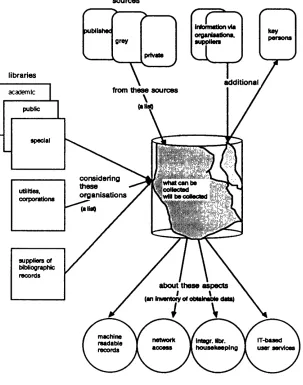
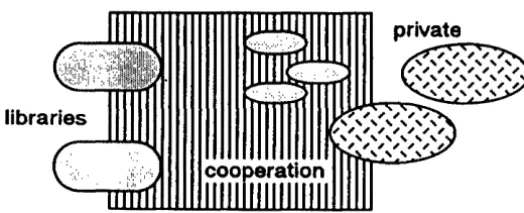
In the following figure the optimum between the .information that is obtainable and the information that we would have liked to collect is indicated.
libraries
ac~tc
public
special
utilities,
corporations
suppliers or
bibliographic records
[image:8.574.96.399.262.647.2]sources
Following this practice. we are confident that this report describes the state of the art by the end of 1990 In most respects. However, ac1ual statistical information on number of libraries. size of collections. budgets spent on automation, etc., is not available. The most recent information that is
provided by the Central Statistics Office (Centraal Bureau voor de Statistiek) on libraries, for example, dates from 1986.
The information given in this study covers only a percentage of all libraries in the Netherlands. By comparing the number of libraries in the Nederlandse Bibliotheek- en Documentatiegids 1990-'92, the list of public libraries that the NBLC compiles and the number of libraries that we came upon in our study, we assume that we covered about 80 °/o of the library field. It should. however, be noted that all the large and important libraries are covered, so that the impact of our survey goes beyond the actual percentage.
An interim report was presented in October 1990.
3 Libraries
It is not easy to get an insight into the state of the art on the aforementioned key areas without any insight in the library structure in the Netherlands. In the following paragraphs a short overview will be given of the categories of libraries and the most important characteristics of the library situation in the Netherlands. This overview acts as a framework for the survey.
3.1 Categories
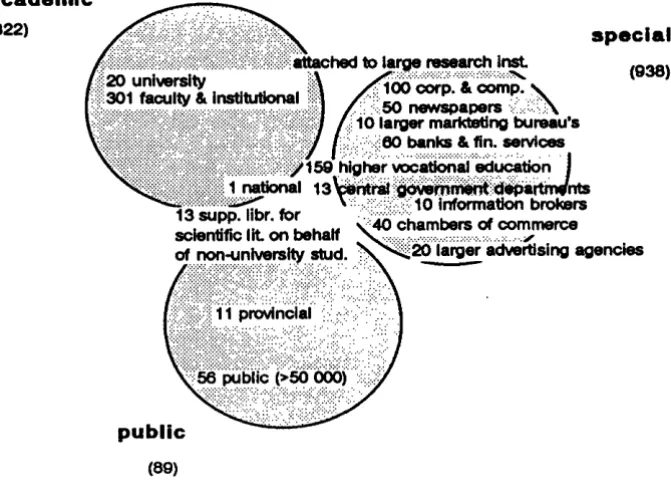
Conforming to the Unesco categories, we have made a distinction between academic, special and public libraries. The same distinction was made in the former study ·lnformatietechnologie in de Nederlandse bibliotheken·. In actual practice, this distinction is rather artificial. One library may
to
some extent be academic, in other aspects public and even special. To draw conclusions from quantitative data on this basis is dangerous. However, we tried to follow the distinction as well as possible.To give the reader an insight in the overlapping clusters in the classification, we make the following remarks:
academic libraries include the national library (called the Royal Ubrary), the central university libraries and the affiliated faculty libraries and some autonomous research libraries; all academic libraries are open to the public
higher vocational education libraries could be classified as academic or as special libraries; we have included these among the special libraries
there is a separate category of so-called libraries with a research support function for a region; some of these are autonomous research libraries, others are large public libraries with an additional function; the latter we have classified as public libraries
some special libraries are open to the public, especially government libraries; they were classified as special libraries
some special libraries are large research libraries and welcome other researchers, just like university or faculty libraries; we have included these, nevertheless, in the special libraries category
special
public
[image:11.578.104.440.104.352.2](89)
Fig. 3. 1 Ubrary categories In the Netherlands
(938)
The size of the collections and the number of libraries within a category is given in the table below. We used the following sources:
public library statistics (NBLC, CBS) scientific and special library statistics
Bibliotheek- en documentatiegids 1990-'92
vendor data (notably to assess the degree of automation)
The number of libraries in the Netherlands, excluding branch libraries and annexes, has been estimated as follows:
nationallibrary 1
university libraries 20
institutional libraries, attached to universities 30 1
higher vocational education libraries (HBO) 159
special libraries, incl. libraries attached to large research institutes 938 100 corporate business libraries and libraries attached to companies
50 newspapers
40 chambers of commerce 10 information brokers
60 banks and financial services, incl. insurance companies various export organisations
• 13 central government
public libraries, f~. comm.~nltles with more than 50 000 inhabitants,
Included regional support libraries on behalf of non-university students 30 1
provincial library centres (PBC's) 11
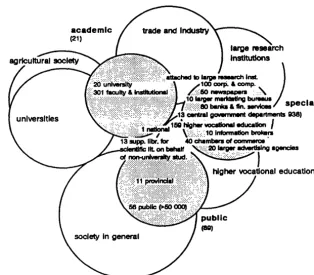
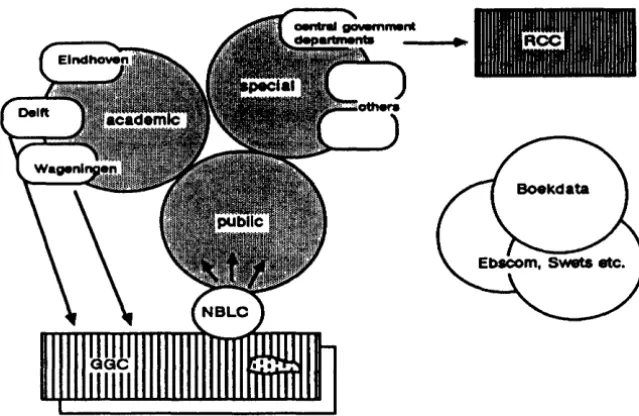
It is interesting to place the libraries in the context of their user groups, because of the non-technological aspects of networking. An impression is given in the following figure.
academic
[image:12.584.96.411.185.460.2](21)
Fig. 3.2 Libraries in their surroundings
3.2 Financial position
All libraries in the Netherlands are being funded directly or indirectly by the central, provincial or local government, except those special libraries which are part of commercial organisations. Libraries have nearly no revenues, except a (small) entrance fee, the reimbursement for copying costs, the use of databases, etc. Only special projects receive extra subsidies. Normally, the introduction and dissemination of information technology in libraries will be part of the dayly housekeeping costs. No wonder that for some facilities and for groups that are not the target group of the library in question, charging of costs is coming into practice.
3.3 Cooperation
The libraries in the Netherlands have a long tradition of cooperation. Within the context of this report we will give attention to two library organisations which play an important part in information technology on a cooperative basis. There are more organisations -and some of them do have an interest in information technology questions, e.g. the organisation of libraries with an additional support function for scientific literature on behalf of non-universitiy students and the provincial library centres- but these two are the ones that not only harmonize activities, but also offer facilities on a large scale. The organisations are:
3.3.1 PICA PICA NBLC
PICA, Centre for Ubrary Automation, is a foundation in which several library categories participate. PICA offers
facilities for shared cataloguing (from cataloguing in publication to full bibliographic description), database building and retrieval, library housekeeping and on-line public catalogues; we will refer to these facilities in chapter 5
the on-line union catalogue and facilities for the creation of the national bibliography (both under responsibility of the Royal Library); we will refer to this in the next paragraph
facilities for automated interlibrary loan; this too will be referred to in the next paragraph
network access to machine readable resources; this will be referred to in chapter 5.
In this survey we will come across PICA in the role of keeper of machine readable records, in the development of network access to machine readable records and as a vendor of an integrated library housekeeping system. We will notice that there is a convergence that affects much of what is going on in library technology assessment.
3.3.2 NBLC
NBLC, Dutch Centre for Public Ubraries and Literature, is an association in which most of the public libraries participate. The objectives of NBLC are the promotion of the public library service, the encouraging of cooperation, the encouragement of the use of information and the enhancement of
office. The tasks of the central office are: preparation and implementation of the association's policy, supervision of centrally funded local projects,
management of the national lending library for public libraries and central services. NBLC offers an extensive library service, partly in combination with the Nederlandse Blbliotheek Dienst (Dutch Ubrary Service) from reference material and acquisition to binding and labeling. Ubraries that make use of this service make a selection from the readers' reference lists and order what they think useful for their public. The ordered books arrive ready for circulation, complete with catalogue cards.
NBLC makes use of the facilities of Pica for cataloguing activities, in order to participate in the shared cataloguing advantages.
In the field of information technology NBLC offers the following services to the public libraries:
development of on-line information networking information packs, articles, seminars
acting as host for a network (NEON) for public libraries and others development of user-friendly interfaces for files often used by public libraries
project coordination
development of off-line databases (CD/ROM and WORM)
in the years between 1986 and 1990 the ·Retriever", a computer specially designed for libraries, was developed; by now it is no longer necessary to use a specially designed computer, because all the functionality is offered commercially in standard components development of a thesaurus and a directory
publication of a survey of available electronic databases
organisation of Dutch Online Information Conference together with the Vereniging van On line Gebruikers in Nederland (Association of On-line Users) and the Nederlandse Vereniging van
Blbliothecarissen, Documentalisten en Uteratuuronderzoekers (Dutch Ubrary Association)
In the present survey we will come across NBLC mainly in the paragraph about network access in the role of project coordinator, and in the role of host for a number of databases (5.2). We will notice that it looks as if, after a period of interesting experiments, public library technology assessment stands at the crossroads of several possible directions to further
3.4 Union catalogues and interlibrary loan
In the Netherlands there are three union catalogues:
national, kept by the Royal (or National) Ubrary
technical, kept by the Library of the Technical University of Delft agricultural, kept by the Library of the Agricultural University of Wageningen
The national union catalogue is by far the largest and includes the
collections of all the academic, special (especially when they are open to the public) and the larger public libraries (for the parts of the collections that are considered deposit collections). This union catalogue consist of
two
parts:in machine readable form in card files
The union catalogue in machine readable form is a collection of
bibliographic descriptions with holdings. It is accessible on line. It is called the Nederlandse Centrale Catalogus (NCC) and comprises references to, a.o., monographs, periodicals, audio-visuals. An interlibrary loan facility (IBL) is connected to it, consisting of an ordering possibility for the user and a system for decisions about the library that will procure the requested item. The chosen library will receive an order. Delivery is handled locally and mostly by post. An increasing number of libraries has a connection to this service (1989: 270 connections, 1990: 300 to 315 connections, including connections from other organizations such as booksellers, publishers, etc.).
For the NCC/IBL system the PICA-facilities are used. The database is built up from the following sources:
the shared cataloguing results from the PICA using libraries descriptions of publications that are requested on interlibrary loan and could not be found in the machine readable catalogue but could be found in the card files; they are put in successively by the Royal Library
tape input by some large libraries that use (or have used) another cataloguing system than PICA offers (University Library of
Amsterdam, Ubrary of the Free University of Amsterdam, University Library of Utrecht)
In the following chapter the emphasis will lie on information technology that serves the individual library. In general we may state that the academic libraries and the larger (and sometimes also the smaller) special and public libraries have a connection with the NCC/IBL system.
The existence of the NCC/IBL-facilities is very determining for the direction in which the technological innovations in the Netherlands develop. The impact on the library world as a whole may be visualized in the following figure.
academic
[image:16.580.94.418.180.442.2](21)
Fig. 3.3 The Impact of the NCCIIBL on the library situation in the Netherlands
The impact is enhanced by the fact that NCC/IBL is also becoming a starting point for international interlibrary lending. In this field there are two
developments:
if a publication could not be found in the NCC, a library may connect through the network the collections of the British Ubrary Document Supply Centre in the United Kingdom to realise international interlibrary lending
characteristics; test site libraries will be the VISCOUNT (academic and public) libraries In the United Kingdom, CADIST libraries in France and PICA libraries in the Netherlands
The agricultural union catalogue is not only a catalogue: it also contains documentation records from journals. Agricultural institutions are a well defined group with a strong cohesion. not only nationally but also
internationally. The agricultural union catalogue functions as information intermediary rather than as a union catalogue. The University Library of Wageningen offers
it
as the central database in AGRALIN, the network for agricultural information.The technical union catalogue for periodicals is available on line in the NCC/IBLsystem. The Ubrary of Delft is one of the more important delivering libraries in interlibrary loan circles. with a high success rate and fast delivery. The technical catalogue for monographs is available on line in the A UBI
D-network.
The holdings of the public libraries are not included in an union catalogue, but are accessible on line within regions through regional catalogues.
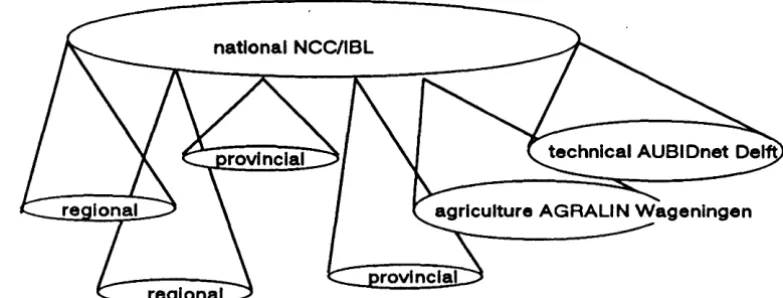
The function of the union and regional catalogues are visualized in the following figure. in which the levels of inter library lending are indicated.
national NCC/IBL
[image:17.577.91.483.443.592.2]4 Technology in libraries
4.1 Academic libraries
Academic libraries make use of the PICA- services, commercial vendors or a combination for cataloguing and library housekeeping. PICA offers a central (shared) cataloguing facility (Gemeenschappelijke Geautomatiseerde Catalogisering or GGC) and local facilities for the other functions (Locaal Bibliotheek Systeem or LBS). Commercial vendors normally offer only local operational solutions.
The majority of the academic libraries which did not use the shared
cataloguing function of PICA in 1986 now became participants. Of the larger academic libraries only the library of the Royal Academy of Science and the University Libraries of Wageningen, Delft and Eindhoven do not participate. The University Ubrary of Delft makes use of the cataloguing function for periodicals descriptions only on behalf of the NCC. For the vast machine readable bibliographic resources of the newcomers, the University Library Amsterdam, the Library of the Free University Amsterdam and the University Libraries of Utrecht and Delft conversion techniques, including the matching with the central bibliographic database of PICA (GGC) were developed. It may be concluded that the years 1986-1990 did not bring really new technology for the creation of machine readable records. But instead,
consolidation and standardization led to a less complex situation and easier ways to connect to union catalogue and interlibrary loan service.
The same seems to be true for the other housekeeping functions.
Some of the academic libraries use the local housekeeping system LBS from PICA, others use their own system, or commercially bought systems. Housekeeping systems cover acquisition, cataloguing, on-line public access to catalogues, periodicals management and circulation. All academic
libraries made their catalogues (completely or partially) available through on-line public access.
However, there are also other tendencies that indicate new directions._
Given the construction of the GGC, terminals or (especially designed and dedicated) personal computers, connected to a central computer system through telephone or data line, internetworking is a natural effect of
participating in the GGC. This phenomenon is not only specific to academic libraries. There are developments that may be more ·research-like· and therefore of more importance for academic libraries:
the transition of the PICA-network from a custom-made
the development of methods of selective downloading, e.g. from the AGRALIN-databasa for research workers
The usa of a university network not only for cataloguing, but also for the union catalogue and interlibrary loan service brings within scope what untill now PICA did not cover: bibliographic information on research level for the end user. Although in this stage of development only the libraries have connections with the network, an expected development will be that a
research student uses his personal computer in the university network for all his information needs, including bibliographic information, from databases, other libraries and the university library on the work station. This is
the
more important because SURF net offers not only facilities asthe
use of dedicated computers for certain research methods, but also connections with special knowledge centres, the so-called Expertise Centres.In some instances a CD/ROM catalogue has been produced as an
alternative for on-line access
to
the central database. The Royal Library and PICA also produced an optical disc catalogue for descriptions and images of manuscripts to be offered to end users.The use of the A GRALl N-network for research workers shows a development in the same direction: do-it-yourself use of bibliographic information. In the margin: as AGRALIN also contains documentation on articles in journals, the downloading facility is more useful for documentation records than it would have been for references to monographs and
periodical only.
There is also another line of development, however, in which the academic borders are crossed: some university libraries build up networks, not only within the university community itself but also in connection with other information services, for instance from the libraries of the institutions for higher vocational education, the libraries with an additional support function for non-university students and large public libraries. To give an example: the University Library of Utrecht, faculty libraries of the university and the public library, (also support library for non-university students in the region) have a common network. The network consists not only of a technological facility but also of special document delivery agreements and services.
Some libraries have ambitious plans for future development in which they do not only make use of technology for cataloguing and housekeeping, but grow out to centres of high-tech documentation, information and
communication. This implies the involvement of third parties, in which PICA isoften an important party.
a hich-tech centre. All attention will be directed towards improved disclosure and accessibility of information. Disclosure will become possible, even at article level in a magazine, through techniques such as image and data bases. not only for current publications, but also for grey literature (research memorandi and such) and old books and manuscipts. The KUB will do so in cooperation with PICA.
One of the new developments is the On-line Contents Catalogue, a database of periodicals, in which the tables of contents are part of the description. The contents are put in by scanning the printed material. This development is an cooperation between the University Library of Tilburg, the Royal Library and PICA. It is still in an experimental phase, but it is expected that it will be available as a service by the middle of 1991. By then. the input activities will be shared and Elseviers Science Publishers will also
participate by providing machine readable abstracts and in future even full text
Another example is the Library of the Technical University of Delft. This library has a well-developed position as information intermediary for trade and industry. besides being the central library for the university. Commercial organizations need customer and ready-made information as fast as
possible. In a memorandum concerning the automation policy for 199Q-1992 the library states the following motto: ·Tailored information please ... on the spot!• With this motto as a starting point, the library tries to bring together two types of investment for the future: in people and in material. Emphasis is laid on education and staff management to enhance the quality of knowledge. Concerning material. the library matures from automation for the library in isolation towards integration, in which consolidation of the DOBIS/LIBIS-application (so-called AUBID-project), with on-line access to central and faculty catalogues and connection with the PICA-GGC-database, play an important role.
4.2 Special libraries
Special libraries are not a coherent group. They make their own choices in automation facilities, depending on the institution's organisation. The result is a large variety of systems, amongst which the most widespread turnkey or complete systems are ADLIB, BIBIS, DLIB and VUBIS.
Furthermore, there are many systems based on IRS-software, developed with or without direct assistance of the software supplier.
The special library field, thus, shows the
largest variety of systems largest number of systems
a larg·e number of small suppliers.
There are, in addition, many in house developments, notably for periodicals management The management of loose-leaf publications is a function that seems to be automated only in the field of the special libraries.
Furthermore, there is no internetworking between special libraries. Special libraries rely on interlibrary loan facilities instead.
Apart from technological networking, there is a tendency to form groups around a specific service area, e.g. higher vocational education schools, hospital libraries, central government libraries, etc.
Special libraries in trade and industry, especially large research libraries, group together around the Library of the Technical University of Delft, and contribute to the technical union catalogue.
Special libraries for the central government have a steering committee for coordination. They do not use the same library and documentation systems, but offer access to their databases through the same host organisation, the Rijks Computer Centrum (RCC).
4.3 Public libraries
The public library structure in the Netherlands is regulated by law. The libraries receive funds from the government, central, provincial or local. Ubraries in the smaller communities used to be part of a provincial finance structure. Since a new Welfare Act was put forward in 1987 the financial structure has become further decentralized. In actual practice each public or provincial library may make its own decisions in accordance with the
community policy.
To give an impression of the number and size of libraries, we present the following figures:
Independent libraries, Inc. branches 99 libraries which used to be part of the
provincial structure, Incl. their branches 654
provinciallibraries 10
The tendency towards decentralization has its effect on the technological structure too. Smaller libraries are no longer obliged to make use of services of their provincial library centres. As a consequence, the larger central
systems still exist, but there has been no further development in this field. There is a tendency towards regional cooperation between libraries, sometimes even with other than public libraries.
There is no public policy in the Netherlands which obligates the public libraries to use the same technical solutions for library functions. As a consequence, there existst a variety of automated library systems.
4.3.1 Independent libraries
Grouped by number of inhabitants per service area, there are the following figures for independent libraries:
> 200 ()()() 100 000-200 000
< 100 ()()()
4 13 82
SYSTEM
SYSTEM NUMBER
OF USERS
TOBIAS 37
VUBIS 12
GEAC 11
UBS 100 4
OCELOT 3
ALS 3
[image:23.575.230.313.84.198.2]KAMBIS 2
Fig. 4. 1 Independent libraries serving more than 200 000 Inhabitants: all libraries are automated.
i i
NUMBER FUNCTIONS NUMBER NUMBER
OF USERS I OF FUNCTIONS
Dataoo1nt
ALS GEAC KAMBIS LIBS 100 PICA-LBS VUBIS
K.O PMS CAT OPAC IRS CIRC M/S CIS
4 X 1
2 X X X X I 2
2 X X X )( )( )( 31
1 )( )( )( )( )( I
1 X X X X )( X 1
1 )( )( X X )( 4
[image:23.575.87.509.300.420.2]1 )( )( X )( 1
Fig. 4.2 Independent libraries serving between 100 000 and 200 000 inhabitants: all libraries except one are automated.
i ! i
!
SYSTEM NUMBER FUNCTIONS l !NUMBER !NUMBER
ALS GEAC
OF USERS i IOF FUNC(IONS
K.O PMS CAT OPAC IRS CIRC MIS CIS I
I !
2 )( )( X X X 2l 5
2 X )( )( X 1i 4
)( )( X X X X )( ! II 7
Fig. 4.31ndependent libraries serving less than 100 000 inhabitants: 88 °/o percent of these libraries are automated.
[image:23.575.76.504.515.594.2]4.3.2 Provincial library centres (PBC) and their depending libraries
Each PBC is automated and provides on-line automation services to the. libraries in the region for a variety of functions.
SYSTEM NUMBER OF USERS
.A.LS 3
LIBS 100 3
GEAC 2
BUKS 1
LIBRA 1
SIAS 1
VUBIS 1
Fig. 4.4 Systems used by the PBC's
In some cases there are two separate automated systems in a provincial library centre, for different user groups. The PBC Noord-Brabant uses LIBS
100 and SISI/SIAS, the PBC Friesland uses GEAC and Buks.
The number of depending libraries served is per system as follows.
ALS 181
LIBS100 132
GEAC 70
LIBRA 49
SIAS 39
Buks 13
VUBIS 13
Within the PBC context (6541ibraries, incl. branch libraries) 80 °/o has been automated at the end of 1990.
The PBCs have automated the following functions
acquisition 33 %
cataloguing 89 %
OPAC 77 °/o
circulation 89 %
Not all libraries connected to a PBC are using the full functionality.
On the basis of the former figures we may conclude that
90 °/o of the independent libraries is automated 100 °/o of the PBCs is automated
80 °/o of the PBC connected libraries is automated there is a broad variety of systems in use
circulation, cataloguing, OPAC and management and statistics are the most used automated functions
It seems that, just as in the academic libraries, the technological
development has gone in the direction of consolidation and standardization. This is true as far as automation of the library functions is concerned. But when it comes to networking and community and other consumer
information, the public libraries have been rather active in experiments in cooperation with NBLC. A range of projects between 1986 and 1990 shows that the public libraries try to find a position in broader contexts and for a
larger audience. The networking activities will be seen into in the next chapter. Here we will only list a few and give some information about the viewpoint of the minister of Welfare. The most important projects were:
lnformatie Project Almelo (IPA) Brabants lnformatie Project (BIP)
Oosterhouts Digitaallnformatie Netwerk (ODIN) lnformatie Project 's-Hertogenbosch (IPH) Actuele Groningen lnformatie (AGI)
They were all financed (partly} by the minister of Welfare. It was the policy of the minister to obtain insight in the possibilities of digital information in the whole context of library activities and the role of public libraries in the information sector in general. That is why the projects are undertaken with very different basic assumptions. As a consequence they show a variety of solutions to essentially the same problems.
By the end of 1990 the minister has formulated the following points of view:
the products and the experience which are the result of the projects are of importance and will be brought to the attention of all the public libraries
the basis for networking is established, but it is now necessary to create standards for communication between the several solutions which have been created
Concluding. we may state that
the public libraries are nearly all automated where it comes to housekeeping functions
the increasing decentralization leads to a variety of technological solutions
a period of experiments in networking and community and other consumer Information has recently been terminated
5 Key areas
In the preceding chapter we have globally described the state of the art in the separate categories of libraries. In this chapter. we give a more detailed description of the situation In the four key areas. As far as possible we relate given information to the library categories. In the appendix all the library housekeeping systems that we came upon are listed. Of each system a short profile is given with an adress for further information.
5.1 Machine readable record resources
In the Netherlands the situation around the creation of machine readable record resources is rather specific. In the study specification a distinction was made between the following types of organizations:
n
libraries themselves where the record resource is the catalogue of one or a number of libraries (union catalogue) and including the national service
library cooperatives or •utilities· in the American sense, including organisations which have derived from these (library resource sharing networks such as PICA, BLCMP, etc.)
other private sector organisations, involved in the supply of catalogue records to libraries, such as booksellers.·
In the Netherlands, however, these categories have more or less melted together. The most outstanding feature is the resource sharing network of PICA with the GGC-database, which supports the union catalogue NCC and the national bibliographic service. The libraries of the universities of Delft and Wageningen have separate machine readable record resources, which serve as union catalogues too, but the records are also partly included in the NCC-database. Also, publishers are involved in the production of the
national bibliography, and some of them participate in NESTOR, a specific database, derived from the GGC-database. The next figure gives an
indication of the way in which record resources are blended with each other.
[image:27.580.136.398.566.672.2]In the Netherlands there are the following machine readable resources of bibliographic records:
the cataloguing records in the GGC
some smaller sets of specialized information alongside the PICA-GGC-database, e.g. Short-Title Catalogue Netherlands (STCN ), NESTOR (a set of bibliographic descriptions of publications on research level that are in print), a database of grey literature (GLIN) the cataloguing records of the Technical University of Delft
the cataloguing records of the Agricultural University of Wageningen smaller sets of specialized information which are not assembled within the library context (e.g. the Bibliography of Netherlandish language and literature studies, BNTL); which are not offered through PICA (e.g. catalogue of the Police Management Institutions,
specialized regional collections of public libraries); which are documentation records rather than cataloguing records ( e.g.
Documentation on articles in periodicals for public libraries, TACO); we excluded them from this study
the records of the library and documentation centres of the central government departments
the records of the central clearing house corporation for the booksellers, Boekdata
records of suppliers of periodicals who also offer periodicals management facilities, such as EBSCO and Swats and Zeitlinger
The above mentioned records are bibliographic records, but some
resources also include non-book materials. In the GGC, for instance, over
90 °/o consists of bibliographic items, but there are also desriptions of articles
in journals, audio-visuals, letters, maps, music and sound.
Descriptions of non-book materials/music are also available through, for instance, the Nederlandse Omroep Bedrijf (Corporation for Radio and
Television Facilities; approx. 200 000 items), Discotheek Rotterdam (approx. 100 000 items), NBLC (approx. 30 000 items).
Maps are catalogued further, for instance, at the Cartographic Institute of the University of Utrecht.
5.1.1 The cataloguing records in the GGC
The GGC is the database, offered by PICA, in which all the shared
cataloguing activities of the participating libraries take place. Participating libraries are nearly all the academic libraries, a range of special libraries and all the public libraries, be it often indirectly through NBLC.
Ubrary of Congress. supplied by the Royal Ubrary
British National Bibliography, supplied by the Royal Library Deutsche Bibliothek, supplied by the Royal Library
libraries that shifted from other systems to PICA while they already had machine readable catalogues
On-line input is done by:
Depot van Nederlandse Publicaties (Deposit Ubrary of Publications in the Netherlands; department of the Royal Library) for all Dutch publications that have been deposited
CIP-bureau (cooperation of the Royal Library and the publishers' organizations) for all Dutch publications that are still in the publication process
on-line input by NBLC on behalf of public libraries
. participating libraries for all the titles that were not found in the database; this includes full bibliographic descriptions, made with book in hand, and retrospective cataloguing from former catalogue cards; the libraries attach their holding information to the bibliographic information, whether derived from the database or put in originally
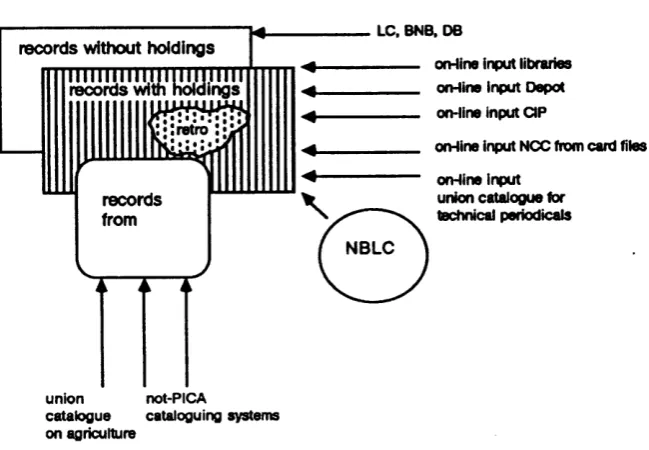
By the end of 1990 the database contained 7 million descriptions, with approx. 10 million holdings, attached to 6 million descriptions, indicating that (a} copy(ies} is (are) available in the Netherlands. Approx. 130 organizations participate. On average 83 °/o of the descriptions were found in the database so that they could be derived. Only 17 °/o had to be original input. This figure was enhanced by the fact that libraries may make use of an automated link with OCLC (Ohio) to copy on-line descriptions for retrospective cataloguing.
Machine readable records
shared cataloguing
(PICA-GGC) 7 million records
records without holdings
l"'"''"l"l"''"''""'''r'rl""''--~r"P''"'"I"''"''""'''f"'nTTT'I ...
~---•
union not-PICA
catalogue cataloguing systems
on agriculture
Fig 5.2 Machine readable records in the GGC-database
The bibliographic descriptions in the GGC-database have the following characteristics:
a variety of languages and alphabeths not restricted in publication date range
International Standard Bibliographic Description (axel. retro-description)
for monographs, periodicals, audio-visuals, software, maps, letters, sheet music
a variety of subject indexing methods; most academic and special libraries have their own method, but a Basic Classification for
common use has recently been developed for the academic libaries; most of the public libraries use a common classification and subject heading
authors' names are subject to authority filing in a thesaurus in PICA-format, i.e. compatible with the MARC-format
Output is possible:
on hardcopy (card or list), tape, CD/ROM, floppy disc (output on microfiche is no longer available)
[image:30.575.141.466.134.359.2]The costs of the use of the PICA-GGC-facillties depend on the facilities that are used. Parameters are:
price per on-line catalogued item: f
5.-
per item for the first 10 000 items, f 3.65 for the next 10 000, f 2.60 for the third 10 000 and f 1.05 for items above 30 000; for retrospective input irrespectively of numbers f 0.50 per itemsearching is obligatory before Input. in order to be able to derive records that have already been put in; 3 search actions for a record are free, above 3 f 1.25 for a hit
output f 0.15 for each item
price for output medium. depending on the medium
On-line access to the database other than for cataloguing is not allowed. The union catalogue NCC contains the same information, minus records that have been put in from Ubrary of Congress. British National Bibliography and Deutsche Bibliothek and that are not used by participating libraries. For searching bibliographic information in the NCc-database f1.25 per search action is charged.
5.1.2 Other cataloguing records
5.1.2.1 Specialized sets along side the GGC-database
The smaller specialized sets of bibliographic records are produced by using the the GGC-cataloguing functionality. They are accessible on line for
participants only (STCN) or on subscription (NESTOR, GUN).
The Short-Title Catalogue Netherlands STCN is a project for the realisation of a bibliography of books, printed in the Netherlands between 1540 and 1800, and all books, printed elsewhere (with the exclusion of Belgium) in the Dutch language. Cataloguing is done book-in-hand by a STCN-bureau under the responsibility of the Royal Library. It will take at least another twenty years to complete the project, depending on financial support The total sum of records will by than be approx. 300 000. By the end of 1990 STCN comprised 35 000 records. There are special description rules for the project. On-line retrieval is possible by way of PICA ORS (On-line Retrieval System).
The Netherlands Educational and Scientific Titles for Online Retrieval
(free). another PICA-service (first time f 100.- without and f 500.- with support) or not (f
900.-).
Grijze Uteratuur in Nederland (Grey Literature in the Netherlands GUN) consists of full bibliographic descriptions of reports that have been labelled •grey literature•. Input Is done under the responsibility of the Royal Ubrary. GLIN contains 57 000 records, that may be retrieved under PICA ORS.
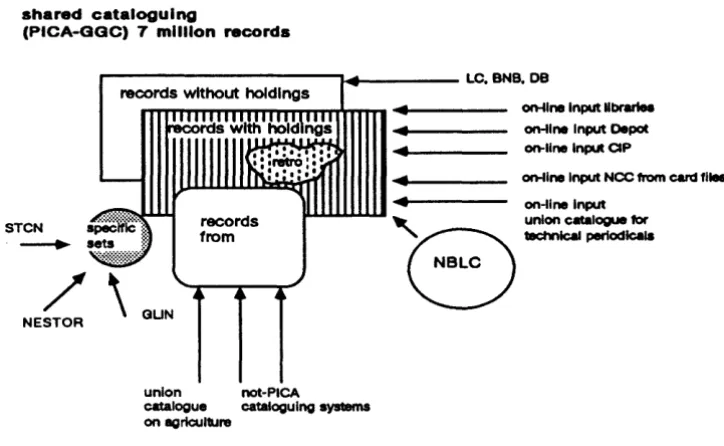
There are other files in the GGC-context that are available under PICA ORS. but these are documentation files. not catalogue files. They are not included in this study. The smaller specific sets of records in the GGC are included in the following figure.
5.1.2.2
Machine readable records
shared cataloguing
(PICA-GGC) 7 million records
r---,...,_ ___
LC. BNB. DBI'TTTTTn'TTT'I!'TTT'lrTT'I"lrTT'I"lr"l'l"''"...,.,.n .,..~>---- on-lire Input Ubrartee
QUN
union not-PICA
catalogue cataloguing systems on agriculture
on-lire Input Depot
~lire Input QP
or'Hire Input NCC from card flies on-lire Input
'r:::::\
=-~
[image:32.577.92.454.283.506.2]0
Fig. 5.3 Smaller specific databases alongside the GGc-database
Machine-readable records outside the GGC-database
We distinguish four categories of other sets of machine readable catalogue records of some importance outside the GGC-database.
The categories are:
in academic libraries
*
*
the records of the Technical University of Delft, the Central Technical Catalogue (CTC). of which only the records for periodicals are put in in the GGC-database; Detft maintains its own collection In the database of the DOBIS/UBIS
housekeeping system that the library uses; total amount: 550 000 records
the cataloguing records of the Agricultural University of Wageningen, the Central Agricultural Catalogue (CLC) which are also put in into the GGC-database; total amount, including documentation records: 580 000 records
in special libraries
*
*
the ·cataloguing records of the central government departments of a.o. Education and Science, Home Affairs, Transport and Public Works, Agriculture and Fishery, Housing and
Environment and Social Affairs and Employment and Trade and Industry, and the Parliament. which are stored in the database of the Rijks Computer Centrum (State Computer Centre) and which are retrievable through Stairs; total amount, included documentation records approx. 500 000
an unknown quantity of cataloguing records in special libraries; presumably all rather small collections compared to the afore-mentioned
in public libraries
* as the public libraries are PICA-participants, directly or by way of the NBLC, we assume that there are no significant
collections of machine-readable cataloguing records in public libraries, that are not also in the GGC-database
with booksellers and periodical suppliers
*
*
in Boekdata, the central database of the Centraal Boekhuis, the central clearing house for booksellers, approx. 200 000
records are available of deliverable publications
some periodical suppliers (Ebsco, Swats, Faxon a.o.) also offer periodicals administration services; normally their machine-readable records are for their internal use only; depending on the supplier, the databases are between 60 and 120.000 records, comparable with Ulrich's and other periodical lists
5.2 Network access to machine readable resources
Network access to machine readable resources as dealt with in this paragraph is restricted to access to catalogue files through wide area networks. In some cases the access to the catalogue file also gives access to other comparable files, e.g. documentation on articles in periodicals, etc. When the combination is being offered, we made a note of it. When only this kind of information is offered, we excluded it from the survey. But. of course, the access to resources of this kind is not unimportant. Most of it is offered by way of a host organisation. The following figures for on-line use of
databases may be given (there is no information that is more up to date):
on-line searches In 1986: 65 881: estimated growth perhaps: 25 Ofo In 5 years: on-line searches by the end of 1990:82 351
The extent to which catalogue information is offered by way of local area networks is unknown. In general we could state that larger corporations tend to have some in-house networks. In some cases the catalogue of the library is offered through the network. But in the cases we know of, the library systems are not really integrated into the local network, but are separate developments. This is enhanced by the fact that there are no campus universities in the Netherlands and that even large institutions like central government departments are housed in several buildings over the country, so that wide area networks are of more importance. But with the growing demand for end-user facilities in the university environment, it became vital to integrate library systems at least in the local area networks of the
universities. Although at the end of 1990, the integration has not yet been realized, steps towards this kind of integration are interesting enough to be reported here.
For wide area networks the PTT always delivers the basic physical facilities and often more. Some public libraries, however, experimented with
networking through radio/television cable networks that are not operated by the PTT but by private corporations.
There are two possible ways
to
present information about network access in the Netherlands: by describing networks that have an autonomous status and by describing machine readable catalogue files which are accessible on line. Both are relevant.5.2. 1 Networks with an autonomous status
There are two main lines of development of networking:
5.2.1.1
In the target group-oriented networking there are the following networks:
a network aimed at research and higher education (SURFnet) a network aimed at libraries that participate in the PICA-shared cataloguing facilities GGC (PICAnet/Open Bibliotheek Net)
a network aimed at agricultural industry and institutions (AGRALIN) a network aimed at professional users in the field of science and technology (Technical University Delft/ MISTEL and DISTEL) a network aimed at the booksellers (Boekdata)
The networks are meant for professional users, particularly library staff, but there is a tendency to allow the professional end user to find his own way.
The region-oriented networking consists of two
two
main lines:library networks within a region, aimed at library cooperation
end user networks, also within a region and focused on information that is of interest for inhabitants of the region
The library networks within a region are of course meant for library staff. There is always more involved than technological networking: organization of interlibrary loan, transport etc.
SURFnet
The Dutch universities developed a common network for their
[image:36.578.129.412.550.664.2]union-members, SURF net. The network is open to other relevant parties too, such as research institutions, higher vocational education institutions, etc. The user groups of SURF and PICA-libraries largely coincide. This made it attractive for PICA to shift from the PICA-network with leased telephone lines to SURFnet.
Since 1990 SURFnet has taken over the responsibility for the network service for all PICA-facilities.
[image:37.575.102.397.111.340.2]other connected Institutions
Fig. 5.6 PICA In SURF net (courtesy PICA)
SURFnet is a value added network offering to Dutch universities, schools of higher education, public and private research and expertise centres and libraries that make use of PICA-facilities, a wide range of services, e.g. electronic mail, file transfer, remote log in and job entry, conference facilities and bulletin boards. Gateway services to other networks, e.g. EARN/Bitnet, lnternet/EUnet, lXI (COSINE) and the public Datanet of the PTT, are also provided.
SURF net uses a private network infrastructure based on the X.25 standard/1984. The user group is restricted.
Libraries that make use of PICA-facilities made a separate contract with SURF net for the network services and all the other services that come with it (most of them free of charge). Ubraries that are part of an organization which participates in SURFnet, are easily connected. Other libraries, however, may use SURFnet free unti111992, when other arrangements will be made. The costs for the use of SURFnet differ from library to library, depending
circumstances and services used.
Those libraries that do not want to use SURF net, may still use the former leased line or Datanet-1 connection with the PICA-systems.
Fig. 5. 7 SURF net in the Netherlands
Fig. 5.81nternational networking
5.2.1.2 PICAnet/Open Bibliotheek Netwerk
PICA and SURF net cooperate in the development of an open integrated library network, supported financially by the Dutch government: Open
Ubrary Network (Open Bibliotheek Netwerk OBN). OBN is an intensified and enriched way to use SURFnet, in connection with the university local area networks. In this network library staff and users can use from each
workstation the local PICA-facilities for on-line public catalogue and mail service (in LBS) and central PICA-facilities (GGC, NCC/IBL and ORS), without difficult log in - log out procedures. The network facilities will make the linking transparant for the user. Both SURF net and PICA maintain the policy to use OSI (Open Systems Interconnection) standards. PICA
participates in OSI-developments specifically for library applications. In this context a Virtual Terminal Protocol, a Search Retrieve Update Protocol and an Interlibrary Loan Protocol were designed. The Virtual Terminal Protocol will make access possible to all local systems from one
proprietary
to
the system but of which the above-mentioned VTP will be one of the spin offs in standardization. When OBN Is complete, other non-PICA systems will be connected, provided that they support OSI«andards. Till OBN Is implemented, the libraries link their functions In PICAnet through PICAitnk. PICAiink has restricted possibilities and is used only in theacquisition function to copy descriptions from the GGC for the local
acqusition file. In OBN catalogued records will be available at the same time in the central GGC-database and in the local library catalogues. In the present solution cataloguing is done shared in the central system; the local systems receive the new data through weekly tape-output, so there is always a time lag.
When working in OBN, it will also be possible to use a new version of OPC for end users. In this version not only the catalogue of the library in question will be available on line, but in principle all the other catalogues and
retrieval files of connected libraries as well. Although connection with the NCC/IBL system is technically possible, there are constraints for the implementation. The effect of direct end-user access to interlibrary loan facilities is difficult to predict. The fear is that the number of interlibrary loan demands will increase beyond the document delivery capacity of libraries.
The difference between the PICAiink facilities and working with OBN is visualized in the following figures.
worklltatlona
acqulslton
circulation control
[image:40.577.97.457.433.586.2]etc.
_..tat~o~ ..
Fig. 5.10 Working In OBN
5.2.1.3
AGRALIN
The scope of AGRALIN (Agrarisch Uteratuur lnformatienetwerk Nederland) has been, from its beginning, to present catalogue and documentation information on agriculture in an integrated form.
There are 60 connected libraries and the database contains 580 000 reference items, with the possibility to gateway to the publications of the Federation of Agricultural Organizations FAO, and information about 6500 research projects.
Access to the files is possible through the public telephone network by terminal or pc, or through SURF net, Agronet (the international agricultural
network) and Datanet-1. The costs are:
first time connection f 175.-, incl. user documentation
connect time f 60.- per hour, with a minimum off 200.- per hour it is advisable to follow an introduction course (f 150.-)
Fig. 5.11 AGRALIN
5.2.1.4 Technical University of Delft
The Ubrary of the Technical University of Delft has a national task, to keep the technical union catalogue. In this role the library participates in the
NCC/IBL for periodicals. The target group beside the university users are the professional workers in science and technology who are mostly employed in trade and industry. The library is also the technical library with the most important role in document delivery, so emphasis is laid on fast delivery procedures and techniques. Despite the NCC/IBL facilities, about 60 °/o of the user groups of the library seem to prefer to order photocopies directly from the TUD Library, because it is quicker and safer. The library decided to look for facilities for electronic document ordering and delivery, such as CD/ROM, electronic mail, telefax. This is called the DISTEL-project
For the monographs, the library has built its own database, consisting of their own holdings and those of other technical libraries, in the DOBIS/LIB IS system the library uses, the AUBID-project. From 1989 on this catalogue is accessable for on-line searching by the central and faculty libraries.
connection are f 1800.- a year; there are no separate fees for searching. only for output material.
In 1989 the library decided to lay emphasis on information retrieval and delivery facilities instead of cataloguing, In the MISTEL-project.
In this project the library works together with the library of the Royal Academy of Sciences and the library of the Agricultural University of Wageningen. Experiments were done with electronic supply from CD/ROM in the so-called ADONIS-project.
The network is also planned
to
be part of the international network facilities for scientific and technical literature, EIDOSTAS, European Infrastructure forDocument Supply in the field of Technology and the Applied Sciences.
The position of the Ubrary of the Technical University of
Delft
may be visualized as follows.5.2.1.5
academic
(21)
Fig. 5.12 AUBIDnet Delft
Boekdata
[image:43.574.88.402.292.619.2]5.2.1.6
Library networks within a region, aimed at library cooperationWith the Provincial Ubrary Centres as a starting point, public libraries within a region have set up networks for catalogue access and interlending
facilities.
In provinces or larger cities, especially university cities, networks between libraries of different categories emerge. These networks are intended for cooperation between libraries, e.g. in interlibrary lending. Users are
normally library staff members. In some cases the networks also are meant for the end users. But, in actual practice, the use of different types of
catalogues (public and academic) is a barrier for end users. In this paragraph we describe the networks in which end user facilities are not dominant.
There is no central policy for networking on a regional basis, nor is there a special necessity for it. It just seems to be done as an effect of the
possibilities of machine readable catalogues and networking facilities. The examples we came upon are:
within the university environment the OPACs of the university libraries and institutional libraries are interconnected by way of SURF net
within cities
Rotterdam Bibliotheek- en lnformatienetwerk ROBIN, in which an interactive connection has been made between the libraries of the Erasmus University and the City of Rotterdam; this
network is used for consultation of each others catalogues and for loan demands; the access facilities were created by means of a Virtual Terminal Protocol for the libraries; in a further stage other institutions will be connected, such as the City Record Office, musea, higher vocational education institutions; the network will by then also be end user oriented
Utrecht library network, a connection between the University Library, the City Library and the Provincial Library was made; in this network three GEAC-configurations and PICA-:-GGC had to be connected
within provinces
examples of public library networks are Noord- and Zuid-Holland and Overijssel (ALS), Zeeland (VUBIS) and Utrecht (GEAC)
network In GEAc-envlronrnent for public libraries, run by the Provincial library (SIBL)
Infrastructure voor Higher Education (IHOL), an initiative to compose a regional union catalogue
local library system (PICA-LBS) In the University Library Umburg
the City Ubrary Maastricht is a support library for scientific literature on behalf of non-university students (WSF-Iibrary); like the other WSF-Iibraries, the City Ubrary makes use of the cataloguing facilities of PICA-GGC; there is no local catalogue, but the records were loaded in the local catalogue of the University Ubrary
In the so-called LINK-project these initiatives came together. The network structure looks like this:
catalogUea
VAX
' - - - '
Fig. 5.13 LINK-project (courtesy LINK-project)
The LINK-project is part of a larger networking initiative PUPIL, in which end user information is also an issue.
the Technical University of Eindhoven, the University of Brabant (Tilburg) and the provincial and city libraries of Eindhoven have a network together with connected VUBIS-systems
[image:45.575.130.481.326.492.2]5.2.1.7
academic
(21)
Fig. 5.14 Regional library networks
End-user networks
SURFnet may be seen as an end-user network for professional users, e.g. research workers and students. The libraries that participate in PICA use the network for library staff, but it is foreseen that in the Mure the on-line
catalogues of the participants will be open to other universities as well. But some libraries fear that this will increase the pressure on library facilities, such as the demand for document delivery facilities. So it looks as if the technological development will not be the most important barrier.
Along with more professional facilities, some other kinds of information are offered to the users, such as lecture programs, agendas, etc. The
experiments in some of the academic libraries were untill now not very succesfull. The same information is more easily available in print.
In the last five years the public libraries especially have been experimenting with networking for end users in a broader context than library information alone. Some of the experiments were part of larger projects aimed at the creation of an information infrastructure for end-users. It is not the policy of the Dutch government to create such an infrastructure with public funds, as
[image:46.575.92.423.84.395.2]presented on television by means of a push-button telephone.
The information offered to the users is mainly information in the faeld of government, welfare, education, and employment, but sometimes it also includes recreational and tourist information, information about stray animals etc. and facilities like home banking, teleshopping, etc.
The best known experiments are:
lnformatie Project Almelo (IPA): community Information on education, welfare, sports, etc.; Biblitel application, presentation in videotex mode; access points in libraries, city hall, tourist information office, etc.; IPA is now cooperating with a commercial firm, Brokerits, in an independent host organisation for the regia Twente
Brabants lnformatie Project (BIP); originally very ambitious
technically; with so-called •chapeau software· a videotex simulation for transparant presentation of information from different sources was presented; with use of telephone network and radioltelevison cable network; should bring information of local interest, such as news, city-council information, transport information, business information, teleshopping, telebanking, directories, library information; there were problems with the technique and commercial firms were not eager in using the network; also, the public (home access) was not as
interested in the offered information, as was expected; the developed technology is now used by NEON
Oosterhouts Digitaallnformatie Netwerk (ODIN): city-council information, directories, programs of cinemas, theatres, etc.;
Wordperfect files, presented under videotex; access in the library and other public offices
lnformatie Project 's-Hertogenbosch: information on education, sports, tourist information, etc., gateway to BIP, videotex presentation;
software Biblitel; access in the libraries and other public offices Actuele Groningen lnformatie (AGI), a library initiative with a lot of actual information for the regio, such as on education, employment, real estate information, weather forecasts, city-council information, programs of concerts, theaters, etc.;it is now nationally available through Videotex Nederland; access points in libraries and other
public offices
Eindhovens Bibliotheek lnformatie Netwerk (EBIN), participating in BIP, VUBIS system, offering a variety of community information on education, welfare, sports and employment; access in libraries and other public offices
Publieks lnformatie Gemeente Amsterdam (PIGA): originally a
public offices
Haags lnformatie Netwerk Stadsinformatie (HANS), originally Raads lnformatle Systeem for the city-council only, but now extended as a library network too; videotex module ALS; access points in one quarter of The Hague
All the above-mentioned projects have been subsidized by the central government. In paragraph 4.3
H was
already indicated that the minister of Welfare does not intend to subsidize more projects, nor increase thebudgets for the ongoing ones. From 1991 onwards they have to be self-supporting or be financed locally.
In an evaluation report from NBLC on some of the projects a.o. the following statements were made:
because electronic information is often cheaper and more easily available in printed form, the public is not very much interested the public is not yet used to electronic information retrieval, even in simple forms
technologically, the networks are beginning te consolidate the experience that was built up in all these projects is extremely useful
libraries should decide very carefully whether certain categories of end-user information belong to their primary tasks or not
Fig. 5.15 End-user networks
5.2.2 On-line accessabla catalogues
5.2.2.1
There are two ways to consider the situation of on-line accessable catalogues in the Netherlands:
from the viewpoint of the catalogue offered from the viewpoint of access points
As both viewpoints have led
to
developments in the last five years, we will give information about them both. We will restrict this paragraph, however, to those on-line facilities, which are not part of an autonomous network.Catalogues which are offered on line
The catalogues which are offered on line are offered
through hosts or intermediate hosts on off-line machine readable media
There are three important hosts for catalogue information: