This is a repository copy of Do issues matter? Anti-austerity protests’ composition, values, and action repertoires compared.
White Rose Research Online URL for this paper: http://eprints.whiterose.ac.uk/93884/
Version: Accepted Version
Book Section:
Grasso, M. and Giugni, M. (2016) Do issues matter? Anti-austerity protests’ composition, values, and action repertoires compared. In: Davies, T., Ryan, H. and Peña, A., (eds.) Protest, Social Movements and Global Democracy Since 2011: New Perspectives. Research in Social Movements, Conflicts and Change, 39 . Emerald , pp. 31-58. ISBN 978-1-78635-028-2
https://doi.org/10.1108/S0163-786X20160000039002
© 2016 Emerald Publishing Group. This is an author produced version of a chapter subsequently published in Davies, T. et al (2016), Protest, Social Movements and Global Democracy Since 2011: New Perspectives (Research in Social Movements, Conflicts and Change, Volume 39. Uploaded in accordance with the publisher's self-archiving policy.
[email protected] https://eprints.whiterose.ac.uk/ Reuse
Unless indicated otherwise, fulltext items are protected by copyright with all rights reserved. The copyright exception in section 29 of the Copyright, Designs and Patents Act 1988 allows the making of a single copy solely for the purpose of non-commercial research or private study within the limits of fair dealing. The publisher or other rights-holder may allow further reproduction and re-use of this version - refer to the White Rose Research Online record for this item. Where records identify the publisher as the copyright holder, users can verify any specific terms of use on the publisher’s website.
Takedown
If you consider content in White Rose Research Online to be in breach of UK law, please notify us by
1
Do Issues Matter?
Anti-Austerity Protests’ Composition, Values, and
Action Repertoires Compared
Maria T. Grasso* and Marco Giugni^
*Department of Politics, University of Sheffield,
Elmfield, Northumberland Road, Sheffield S10 2TU, United Kingdom E-mail: [email protected]
^Department of Political Science and International Relations, University of Geneva,
2
Running head: Do Issues Matter? Anti-Austerity Protests
3 Abstract
An important wave of anti-austerity protests has swept across Western Europe in recent years. We can thus distinguish between three different types of protest occurring in Western Europe recently: (1) “old” issue protests: relating to the trade union and labour movement; (2) “new”
issue protests: relating to culture and identity issues; (3) anti-austerity protests: emerging directly in reaction to austerity measures and cuts enacted in the current period. Following
previous literature, we hypothesise that anti-austerity protests have attracted a new
constituency to the streets and that they will be different from both “old and “new” protests in terms of their social composition, value orientations, and action repertoires. We expect
anti-austerity protesters to be on the whole younger, and in more precarious working conditions; to be more concerned with economic over social issues, but also to be considerably less
institutionalized and embedded in organizational networks and to have lower experiences of previous extra-institutional participation. We test these hypotheses by analysing a unique and novel dataset containing data from over 10,000 protestors from 72 demonstrations
4 Introduction
Western European countries are still struggling with economic crisis, particularly high levels of unemployment and lowered purchasing power/living standards. Commentators across both sides of the Atlantic bemoan the emergence of a “Lost Generation” of youth. As
citizens try to cope with the effects of negative economic conditions, attention has also been drawn to the potential social and political effects of the recession (Bermeo and Bartels 2014;
Clarke and Heath 2014; Giugni and Grasso 2015; Lim and Laurence 2015). One type of possible negative effect of economic hardship is the decline of activism and protest around “new” issues such as the environment as individual return to bread-and-butter issues in times
of economic crisis (Giugni and Grasso 2015). If citizens need to struggle with working overtime to keep a job or have to search for a new job, or deal with the array of difficulties
resulting from economic hardship, they will have less time and resources to engage in
political action to support wider moral causes such as those espoused by “new” movements. The “new social movement” paradigm emphasises the primacy of struggles
surrounding questions of culture and identity – such as ecology, feminism, LGBT rights, anti-nuclear, etc. – over questions of socio-economic equality and the redistribution of resources in
post-industrial societies (Giugni and Grasso 2015). According to this paradigm the traditional labour-capital struggle linked to trade unions and the labour movement had become less prominent relative to “new” struggles in the post-war period. Recently and important wave of
anti-austerity protests has swept across Western Europe in recent years and has been widely documented by students of social movements (Pickerill and Krinsky 2012; Fominaya and Cox
2013; Gamson and Sifry 2013; Della Porta and Mattoni 2014; Ancelovici 2015; Della Porta 2015; Giugni and Grasso 2015; Ancelovici, Dufour et al. Forthcoming; Fominaya and Hayes Forthcoming). These events have brought back questions of inequality and the distribution of
5
While the experience of economic difficulty can certainly be understood to push
people away from protesting in favor of wider moral causes such as animal rights and against nuclear energy, tough economic conditions can on the other hand be seen to generate
grievances which people may seek to redress through political participation, and, in particular,
protest (Grasso and Giugni 2013; Grasso and Giugni 2015). The economic crisis may provide the political space and motivations for the mobilization of those seeking to criticize what are
perceived to be unjust patterns of wealth distribution in advanced capitalist democracies and to draw attention to the fact that not all sectors of society bear the costs of economic crisis evenly. In particular, scholars such as Della Porta (2015) and Martin (2015) have emphasized
the importance of the “precariat” as the new agents of protest in times of austerity. These accounts build on some of the insights of accounts of the emergence of a new cleavage
between winners and losers of globalization or modernity (Kriesi, Grande et al. 2012; Hutter 2014) with the focus being on the progressive potential of new cleavages as opposed to the reactionary potential for xenophobic and anti-immigrant claims.
However, while the economic crisis might have been the spur for political
mobilization and the focus of anti-austerity movements’ rhetoric, it is not clear whether those
people with the most serious grievances to redress actually engaged in protest action of this sort. An alternative to voicing discontent is of course dropping out from politics altogether. According to a resource-based interpretation, those hardest hit by economic recession are also
those most likely to exit the political sphere and withdraw from political engagement. It is only those who are relatively insulated from financial hardship who may have the resources
(whether economic or social) necessary to voice their concerns and engage in political action. We can distinguish between three different types of protest occurring in Western Europe in recent years: (1) “old” issue protests: relating to the trade union and labour
6
protests: emerging directly in reaction to austerity measures and cuts enacted in the current
period. Based on theoretical arguments in the literature, we hypothesise that anti-austerity protests have attracted a new constituency to the streets. We test this through the analysis of a unique dataset containing data from over 10,000 protestors from seventy-two large-scale
demonstrations taking place between 2009 and 2013 across Western Europe. Our results support our hypotheses. The main exception is the idea that “precarity” forms a new social
base for anti-austerity protests: all three types of protests are disproportionately drawn from upper middle class professions. In the context of this special issue this paper will provide evidence showing the extent to which austerity movements show continuity or change from
both old and new social movements and the extent to which they are novel modes of organization for challenging the new hegemonic structures.
The remainder of the paper proceeds as follows. In the first part we review the literature and outline the relevant theoretical dimensions for comparing the constituencies of anti-austerity, “old” and “new” movement participants. In the next section we discuss our data
and operationalisation. We then move to discussing our results from multi-level models which take into account the clustered nature of the data. In the last section we discuss the
implications of our results in relation to the literature and wider theoretical developments.
Theory and Previous Research
Grievances, Deprivation, and Political Protest
The rise of anti-austerity protests has brought to the fore a long-standing question: Does
deprivation lead to an increase or a decrease in protest participation? Early grievance theories of social movements emerging out of the collective behavior and crowd-control literature have been historically dismissed in favour of resource-based, political process, and framing
7
Snow 2004). These mobilization models, which emphasize the importance of resources,
political opportunities, the construction of political problems and ideological identification for the development of political solidarity and the organizational structures necessary for political action and mobilization, have since then become the mainstay of social movement analysis
(McAdam, McCarthy et al. 1996). The key reasons for this shift in focus were that while groups may be relatively deprived, they first need to realize, or perceive this, and also see
themselves as social agents able to mobilize and effect political change, generally through membership of a political group or organization (McAdam 1982; McAdam 1986). In the absence of the construction of grievances and relative deprivation as social or political
problems which can be redressed through political action, and without the organizational structures, resources, and political opportunities necessary to mobilize and effect political
change, the experience of economic hardship or other forms of disadvantage on their own are unlikely to lead to political participation. According to this line of argument, the experience of economic recession, and more specifically, the costs and pressures experienced by individuals
suffering economic hardship, are more likely to push them to exit political engagement, rather than mobilize them to action.
In line with this, the post-materialism thesis (Inglehart 1977; Inglehart 1990; Inglehart and Catterberg 2002; Inglehart and Welzel 2005) suggests that the experience of relative economic security during the early years of socialization leads to the development of values
which emphasize self-actualisation and aesthetic, moral and socially liberal over materialist ones. In turn, post-materialist values are understood to spur people to anti-state
“elite-challenging” political action such as demonstrating, joining boycotts, signing petitions and participation in new social movements. According to this theory, it is the opposite of the experience of economic hardship – material security – which leads to political participation
8
causes which are seen to be conducive to protest participation. As such, one would expect
higher levels of participation amongst those individuals which grew up during relatively affluent times and lower levels of political participation amongst those individuals – from the youngest generations – who are currently experiencing their “formative years” (Mannheim
1928) during economic crisis.
However, it could also be suggested that the experience of hard times could lead
individuals to focus attention on economic inequalities and the human costs these exert on fellow citizens. In turn, this could foster support for redistributive policies and welfare support measures as a means to defend fellow human beings from the worse effects of poverty.
Support for these policies could presumably spur individuals to political action. Engagement in social movements would further reinforce the social understanding of hardship and
deprivation as resulting from human, chosen political arrangements which can be altered through political intervention. Additionally, tough economic times can also be seen to provide the basis for political solidarity and identification with kindred social others going through
similar experiences and struggling against common enemies, leading people to mobilize through collective action. Given these contradictory theories, it therefore remains a puzzle as
to whether deprivation leads people to engage in protests and, if so, under which
circumstances, and particularly whether more resource-poor groups are more likely to engage in protests around anti-austerity issues compared to other, “new” or “old” issues.
The Evolution of Protest Participation
Initially understood as – often irrational – outbursts of anger from disorderly crowds, political protest has become mainstream in advanced industrial democracies (Van Aelst and Walgrave 2001). The rise of protest and other extra-institutional repertoires including protest
9
participation patterns of Western publics since the 1960s (Inglehart 1977; Inglehart 1990;
Topf 1995; Inglehart and Catterberg 2002; Norris 2002). Extra-institutional participation is seen to be in continuous expansion as a result of the entry into the political arena of younger, more highly educated and protest-prone cohorts since the mid-to-late 1960s (Barnes and
Kaase 1979). Novel channels of participation are seen to have flourished in what has been heralded as the “social movement society” (Meyer and Tarrow 1998) developing out of the
student revolts of Mai 1968. Those participatory repertoires – marches, rallies,
demonstrations, occupations, sit-ins, and other forms of public protest – once perceived to be the sole remit of “anti-state rebels” (Norris, Walgrave et al. 2005) are said to have become
widespread and “normalized” (Van Aelst and Walgrave 2001) in contemporary Western democracies.
Many scholars explain the rise in protest action on the basis of the rise of post-material values amongst new generations. Indicative of this line of argument is Inglehart and
Catterberg (2002: 302) where the link is clearly presented: “as younger, better-educated, and
more post-materialist cohorts replace older ones in the adult population, intergenerational population replacement will tend to bring a shift toward increasingly participant publics”. For
Norris (2002: xi), the rise of protest and other extra-institutional modes of actions heralds a “democratic phoenix” with young citizens in particular shifting from “the politics of loyalties” to “the politics of choice”; from “citizen-oriented” to “cause-oriented” repertoires
of political participation. In the future, protest participation is understood to continue to rise in post-industrial nations since younger more “cognitively mobilized” and post-materialist
generations participate via this repertoire (Inglehart 1977, 1990; Inglehart and Catterberg 2002). There is evidence that protest has continued to rise due to inter-generational replacement (Jennings and Van Deth 1990; Dalton 1996; Inglehart 1997; Inglehart and
10
profile of demonstrators around “new” or post-material issues should be relatively much more
young that of “old” bread-and-butter issue protests. Socialization and political generations outlooks (Mannheim 1928) would suggest that the period of one’s coming of age should be most important for the development of values. In line with this, the youngest generations,
currently coming of age in the context of crisis, should be the most likely to engage in anti-austerity protests. In the next section, we turn to outlining other factors that are important for
protest participation, before moving on to highlighting, in the final section of this literature review, how these factors might vary for protests around different issues.
The Determinants of Protest Participation
Social characteristics such as gender and generation are generally understood to have an effect
on someone’s likelihood to protest. Research tends to find that young people and men protest more (Schussman and Soule 2005; Grasso 2013; Grasso 2016) and that members of younger generations coming of age since the 1960s are also more likely to protest (Inglehart and
Catterberg 2002). However, new research shows that once the appropriate age-period-cohort analysis methods are applied it is only the 1960s-70s generation that stands out as highly
participatory in protest (Grasso 2011; Grasso 2014; Grasso 2016).
Many scholars tend to see resources as instrumental to participation – particularly those coming from the resource mobilization approach: people with higher levels of education
and those from the middle classes are seen to have more resources (Brady 1995; Verba, Schlozman et al. 1995). However, grievance theory spells out an alternative mechanism: that
it is those with the least resources – those who have the least to lose – that will be more likely to protest in society (Piven and Cloward 1977; Buechler 2004; Snow, Soule et al. 2005). Following this perspective, one way in which grievances have been understood is in terms of
11
seen as a proxy for absolute deprivation, but grievances can also be understood in relative
terms, in relation to some kind of reference group – either oneself at other times (including expectations of oneself in the future that are no longer likely – e.g. loss of savings or a home during economic crisis) or some other group of people. This type of grievance is probably
better measured through subjective political attitudes e.g. satisfaction with democracy and evaluations of economic situation in the present vs the future etc. Politicization of social
cleavages in the public sphere is crucial for inequalities to be socially understood as
grievances. In a society that did not recognise inequality as problematic – e.g. in feudal times – being of a lower socio-economic status could not be understood as a grievance. In particular
for protest and social movement participation, there are notable historical examples of
participation by disenfranchised groups such as workers protesting for better work conditions,
protests by the unemployed, immigrants, and most, recently, anti-austerity movements (Piven and Cloward 1977; Tilly 1978; Buechler 2004; Giugni and Grasso 2015). Historically, protest was one of the few repertoires of action open to the disenfranchised and the poor. Strikes,
picket lines, and occupations of factories also played a similar role. However, new social movements are seen to be different to previous social movements in terms of their social
bases – attracting well-connected and resource-rich individuals such as post-materialists and socio-cultural specialists, not just the traditional working classes (Eggert and Giugni 2015). Moreover, the effect of unemployment is unclear. Biographical availability theories suggest
that unemployed people are more likely to be mobilized given fewer commitments and greater amounts of time (McAdam 1986). However, it should be noted that the causal mechanism
could also be operating in the other direction with protest having ‘biographical effects’ on protesters leading to non-traditional choices and irregular work histories (McAdam 1999; Giugni and Grasso 2016). Research has shown that some unemployed people are more
12
al. 2014). This in turn might attenuate the wider negative effects of losing a job and having a
restricted network as a result of being out work (Jahoda, Lazarsfeld et al. 1933).
Political values are also seen as important to participation (Dalton 1996; Norris 2002; Verba et al. 1995). Research shows that more left-libertarian individuals are more likely to
engage in protest but it remains unclear whether it is support for economic left values as opposed to socially libertarian values that leads to this effect (Inglehart 1977; Kaase and
Marsh 1979; Kitschelt 1988; Kriesi and Wisler 1996). In particular, the post-materialism thesis (Inglehart 1990; Dalton 1996; Norris, Walgrave et al. 2005; Welzel 2012) sees libertarian, self-expressive values as fundamental to participation.
Mobilization and recruitment through previous political activism and/or associational networks are crucial factors (Klandermans and Oegema 1987; McAdam and Paulsen 1993;
McAdam, McCarthy et al. 1996; Norris 2002; Diani and McAdam 2003; Schussman and Soule 2005; Diani 2015) . However, even here is it unclear whether mobilization occurs primarily through associational memberships or rather through other types of more
mainstream political action. It is also unclear whether individuals are mobilized through participation in any type of political activity (i.e. institutional or extra-institutional) or
primarily through other modes of extra-institutional participation, or even still whether it is the level of commitment and frequency of action which is the most important factor
(Saunders, Grasso et al. 2012).
The Importance of Issues
In this paper we aim to unravel what factors distinguish between participants in different types of protest rather than simply examine the extent to which different factors lead individuals to protest or not. As such we examine ways in which “old”, “new” and
13
Old social movements are understood to revolve around questions of socio-economic
equality, the distribution of resources, the trade union movement, and the labour-capital struggle between the bourgeoisie and the working class. In contrast to this picture, Melucci (1989) theorized new social movements as emerging out of one section of the middle class
(those in socio-cultural professions) challenging the other section that is in power (mainly managerial, economic, political). Therefore, new social movements are understood as
challenges over values as opposed to questions of class and economic resources. “Old” movements are therefore defined as those struggling for socio-economic issues, whereas “new” movements are those struggling for wider moral causes such as the environment,
anti-nuclear, women’s rights, LGBT rights, etc. Recently, a new wave of “anti-austerity”
movements has emerged across advanced democracies, from the 15M/Indignados movement
in Spain to Occupy in America and the UK where UK Uncut and other anti-cuts coalitions formed, to the constellation of movements against spending cuts emerging across Europe and particularly the Southern European nations hardest hit by the crisis. These anti-austerity
movements are those emerging in direct reaction to the recent economic crisis and against the austerity policies of many governments across Western Europe. For some, these movements
are a resurgence of the wave of protest of the late 1990s Global Justice Movements
(Fominaya and Cox 2013) As such, the protests occurring in Western Europe between 2009-2013 can be divided into three main types: those around old issues, those around new issues,
and those emerging directly against economic crisis and austerity.
In particular, new social movement theory has stressed the difference between new
movements based on cultural and identity conflicts – emerging since the 1960s – in contrast to the old social movements based around socio-economic equality, trade-unions,
Marxist-Leninst politics, and the labor-capital struggle (Touraine 1971; Touraine 1981; Offe 1987).
14
in terms of social bases, organizational forms, action repertoires, and so forth, setting them
apart from other, older movements, and particularly the labor movement based around trade unions. From this perspective, that which distinguishes old from new social movements most clearly is their different social bases.
Kriesi (1989) famously argued how “social-cultural specialists”, that particular
segment of the emerging “new middle class”, displayed left-libertarian values. Various studies
have shown that this social category is over-represented in new social movements (Kriesi and Van der Praag 1987; Kriesi 1989; Kriesi 1993). Moreover, the new middle class would also be more inclined to engage in the protest activities organized and mobilized for by social
movements and social movement organizations: “social-cultural specialists are slightly more likely than unskilled workers to vote in national elections but far more likely to use protest
activities to articulate their claims (Kriesi, Grande et al. 2012). Kitschelt (1988) termed used the term “left-libertarian” to denote economic leftism coupled with social libertarianism. In particular, the social libertarian-authoritarian, not simply the economic left-right, value
dimension seems an important consideration for studying engagement with new social movements and protest activism. More recently, Della Porta (2015) sees “the precariat” as
the major social base of anti-austerity protests.
Given the literature on the differences between the movements discussed, we expect that participants in old and new issues protests will diverge, as follows. Relative to
participants in movements around new issues, old movement participants should be more likely to be male owing to men’s traditionally greater participation in the labour force. They
should also be more likely to belong to older generations i.e. the post-war generation since the class cleavage was most popular at their time of socialisation as well as to be less highly educated given these movements tended to be more resource-poor. They should be less likely
15
working class; and also less likely to be unemployed or students since movements tended to
be organised around trade unions, factories and other places of work. We would expect them to be more satisfied with democracy given the focus was more on the distribution of resources and less on post-material questions of self-expression as well as more leftist given the focus
on socio-economic equality and the economic left-right value dimension. However, they should be less socially libertarian but more likely to be embedded in organizational networks
given the links of the movement around trade unions and left-wing parties as opposed to the more horizontal, fluid structures of new social movements. We also expect them to be more likely to engage via institutional means including voting, contacting politicians, etc. but less
likely to engage in a variety of extra-institutional means such as occupations, direct action, etc. as these tend to be more closely linked to new social movements; more likely to
demonstrate only more frequently as new social movements tend to use a wider variety of extra-institutional tactics such as civil disobedience etc.
What about anti-austerity protests? To what extent do they resemble old, as opposed to
new movements and to what extent are is their constituency more similar to that of protests around old issues compared to those around new issues? To address these research questions
we compare anti-austerity protest participants to the other two groups and empirically analyse to which group they are more similar and to what extent – and on what dimensions – they differ from either.
Data and Methods
To answer these research questions, our analyses rely on data from an original dataset produced in the context of the Caught in the Act of Protest: Contextualising Contestation (Klandermans, Della Porta et al. 2009) project. This is a collaborative effort, funded by
16
Science Foundation (ESF), which involved nine countries (Belgium, Czech Republic, Italy,
Mexico, Netherlands, Spain, Switzerland, and the United Kingdom) and aimed at studying who participates in demonstrations, why, and how. To do so, national teams of researchers have conducted on-site surveys among participants in demonstrations. The robust and
methodologically rigorous data collection procedures are explained in detail in van
Stekelenburg, Walgrave et al. (2012). There have been a number of publications with data
from the project, see for example Eggert and Giugni (2012) or Saunders, Grasso et al. (2012) and the other papers in the same issue of Mobilization. Moreover, face-to-face interviews (achieving an almost perfect response rate) were conducted with a sub-sample of respondents
to allow for non-response bias checks on the mail-back surveys, thus ensuring a robust
methodology and ensuring reliable results that are both representative and generalizable to the
population of demonstration participants across Western Europe.
The data are hierarchically structured, so as to lend themselves to multi-level analyses in which the individual-level data are nested into the country level. The dataset used in this
analysis contains data from 72 demonstrations in seven Western European countries – Belgium, Britain, Italy, the Netherlands, Spain, Sweden, and Switzerland – containing over
10,000 respondents. The Appendix lists all the demonstrations included in the dataset and categorizes them by whether they are old, new or an austerity march, based on expert judgements, showing that the spread of issues is even, reflecting the fact that the project
aimed to survey all large demonstrations (more than 3,000 estimated protesters) occurring in each participating country between 2009 and 2013. As mentioned previously, the
demonstrations were categorized by expert research teams who had conducted the fieldwork and were familiar with the protests and organisers on the following basis: (1) “old” issue protests: relating to the trade union and labour movement; (2) “new” issue protests: relating to
17
austerity measures and cuts enacted in the current period. It should be noted of course that the
same individuals may have attended different types of protests so we only generalise at the level of protest crowds (Diani 2015).
Additionally, the models include a number of variables to test difference between
participants at the three types of protest: gender; we include a variable for cohorts or
generations; education; SES; occupation; democratic satisfaction (a continuous scale where 0
means very dissatisfied with the way democracy works in the respondent’s country and 10 means very satisfied) and political values – economic and social values – we constructed two scales using principal component analysis (in both cases the items loaded onto one component
with eigenvalue greater than 1). The first, for economic values is a mean scale of two Likert items (Strongly Disagree to Strongly Agree) ranging from 1 meaning Right and 5 meaning
Left from two items: Government should redistribute income from the better off to those who are less well off. Even the most important public services and industries are best left to private enterprises. The second item was first recoded in reverse order so higher values signified a
more left-wing position. The second scale for social values, is also a mean scale of two Likert items (Strongly Disagree to Strongly Agree) ranging from 1 meaning Authoritarian and 5
meaning Libertarian from two items: Children should be taught to obey authority. People from other countries should be allowed to come to my country and live in it permanently if they want to. The first item was first recoded in reverse order so higher values signified a
more libertarian position.
Moreover, we include a variable for organizational membership (this is a continuous
variable measuring the number of organizations that the respondent has been involved with in the past 12 months); a variable for institutional participation ( an additive scale from 0 to 4 where 0 means the respondent engaged in no institutional activities and 4 means they engaged
18
component with an eigenvalue greater than 1 (1.5). This is derived from two questions. One
asking individuals whether they voted at the last election, the other asking individuals the following question (the same one we used from the dependent variable for extra-institutional participation) and allowing individuals to select the activities they engaged in the last 12
months: “There are many things that people can do to promote or prevent change. Have you, in the past 12 months…? contacted a politician; worn a badge or campaign sticker; donated
money to a political campaign.”
For extra-institutional activism, we created an additive scale where 0 means the respondent participated in none of these other extra-institutional activities and 6 means the
respondent engaged in all six, based on responses to the question: “There are many things that people can do to promote or prevent change. Have you, in the past 12 months…? signed a
petition? boycotted certain products? bought products for political, ethical or environmental reasons? joined a strike? taken part in direct action? used violent forms of action?” The results of principal component analysis also showed that all six items loaded on one component with
an eigenvalue of 1.7; the only other component with an eigenvalue greater than 1 – of 1.3 – showed that the first three items had negative loadings and the other three had positive
loadings highlighting the more confrontational nature of the latter three activities vis-a-vis the more mainstream first three). We also include a measure for frequency of protest in the last 12 months.
To accurately reflect the hierarchical nature of the data, and the fact that respondents were sampled within countries and therefore the fact that their errors are likely to be
correlated, we apply two-level random-intercept models, with the country as the higher level of analysis. We present three logistic multi-level models. In the first one old and new
movement participants are contrasted to each other so as to have a baseline against with to
19
participants are contrasted to old movement protest participants. In the third one they are
contrasted to new movement protest participants.
Findings
The analysis proceeds in two steps: in the first step we describe the composition of the three types of demonstrations according to a number of social, political, and other characteristics: in
the second step we run logistic multi-level models with these variables in order to predict participation in anti-austerity movements.
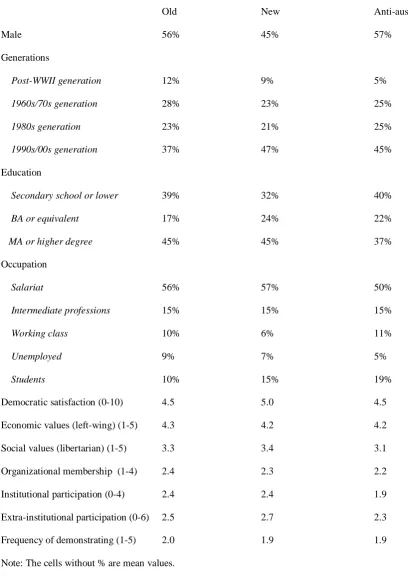
Table 1 shows descriptives for old, new, and austerity movement participants. The
first thing that is striking from the results is that, while there are clearly some differences, the profile of demonstrators at the three different types of protests is rather similar, confirming
perhaps arguments over a “homogenization” across movements (Eggert and Giugni 2012). Anti-austerity movement participants have a profile similar to old movement participants on some aspects, while being more similar to new movement participants on other aspects.
However, in general, austerity participants seem to be closer to the profile of old movement participants than to that of new movement participants. Compared to new protests, old
movement protest and anti-austerity protests are similar in that they attract more men than women; more people with a lower educational qualification than in new protests; there are more working class people than in new protests; they have lower democratic satisfied
constituencies than new protests; they are less socially libertarian than new protest constituencies; and less involved in various types of extra-institutional modes of action.
Table 1
Anti-austerity protest participants are more similar to new movement participants compared to old movement participants in that their generational profile is younger and they
20
are similar in their profile to old movement protest participants in having higher proportions
of less highly educated and more working class participants compared to new movement protest; they are also less democratically satisfied and less socially libertarian, less involved in extra-institutional modes compared to new movement participants; they are however younger
and less organizationally embedded relative to old movement participants.
However, we can also observe differences across the three types of movements.
Participants in old, new, and austerity demonstrations do not look perfectly alike. For
example, women are more present in new social movements that in both old and anti-austerity movements; anti-austerity movement participants are younger than new movement
participants and especially than old movement participants; austerity participants seems slightly less educated than both of the other two movement participants; and the share of
students is somewhat higher in the former than in the latter two. In terms of values, the most important differences can be observed on democratic satisfaction: anti-austerity movement participants are less satisfied than new movement participants (but equally interested than old
movement participants). Finally, austerity participants are less prone to engage in both institutional and extra-institutional participation. These differences can be seen in further
detail in the multi-level models below. It should be noted, however, that results might differ in part from the descriptive analyses as the samples used are not the same.
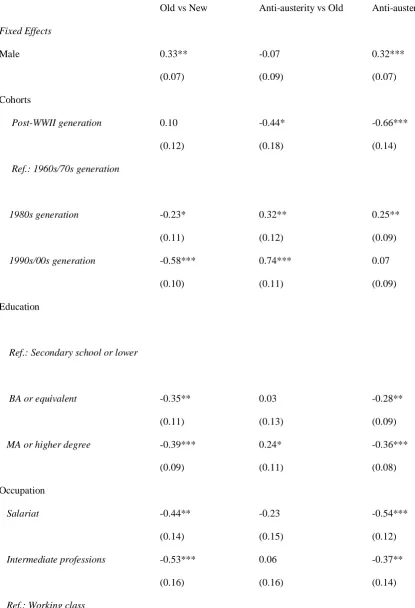
Table 2 presents the results of three logistic multi-level models contrasting participants
in old, new, and austerity demonstrations. While Table 1 presented descriptive statistics for the three groups these models allow us to test for significant differences while controlling for
the other variables in the model. We first turn to Model 1 which addresses the differences between old and new movement participants. Compared to new movement participants, old movement participants are more male, more likely to come from older generations. They are
21
with new social movement theory, which has depicted the so-called social-cultural specialists
– the core constituency of these movements – as being characterized precisely by such social characteristics contrasting them to people engaged in old movements, in particular the labor movement (Kriesi and Van der Praag 1987; Kriesi 1989; Kriesi 1993). This evidence shows
that these two movement sectors are still different in many respects. Additionally, old movement participants are more dissatisfied with democracy, more highly economically
left-wing, more likely to be members of organizations, less likely to engage in other extra-institutional activities, and more likely to protest more frequently.
Table 2
The main focus of our paper, however, is on anti-austerity demonstrations. So, the main question is: What characterizes participants in those demonstrations, as compared to
both old and new movements? Let us have a look at each contrast in turn. The results for Model 2 show that anti-austerity movement participants differ from those from old movements on a number of important dimensions. They are more likely to come from the
younger generations. They are more likely to be educated than old movement participants and more likely to be students. They are even more left-wing economically than old movement
participants and more socially libertarian. They are less likely to be embedded in networks and to engage in institutional participation. However they are more likely than old movement participants to engage in other extra-institutional activities and to demonstrate more
frequently.
Finally, Model 3 compares anti-austerity movement participants to new movement
22
movement participants, more working class or students, they are less socially liberal than new
movement participants, less likely to engage institutionally, but protest more frequently. Taken together, the results from our models show that anti-austerity protests, like old movement protests, other than being more male-dominated than new movement protests, they
are also less well-educated, less middle class, less socially liberal, and more frequently involved in protest. Anti-austerity participants are however less institutionally embedded than
both old and new movement protest participants. As such, they are even more resource-poor than old movement constituencies. While old movements are strongly embedded with trade unions and parties, the new generation’s anti-austerity movement lacks the organizational
basis and as such might explain their greater reliance on protest-events, hence the higher scores for frequency of political protest. Moreover, while anti-austerity protests are populated
by individuals from the younger generations, they are not younger in profile than protests around “new” issues. While highly educated, this is slightly less so than the profile of new types of protest due perhaps to the higher proportion of full time students, i.e. individuals still
completing education. There is no clear sign, at least in this data, that they are more likely to be members of a “precariat” (Della Porta 2015): most are in middle class occupations and
they are not more likely to be unemployed than participants in old and new movements. They are also not particularly more democratically dissatisfied than other types of movement participants. So why democratic dissatisfaction might be a characteristic of protesters this
appears not to be particularly distinctive to anti-austerity protesters (Calvo 2013).
Discussion and Conclusion
So what have we learned and where do these results take us? Anti-austerity demonstrations and movements form an important share of the extra-institutional contention that has occurred
23
period characterized by one of the most profound economic crises Western Europe has ever
experienced. Students of social movements have long argued that grievance theories do not hold and that protest is not linked – at least not directly – to situations of economic hardship and the social stress as well as the discontent stemming from them (McCarthy and Zald 1973;
Tilly 1978). Anti-austerity mobilizations challenge understandings of the relationship between economic hardship and protest behavior. Resource mobilization and political process theories
have gone far in this direction, showing convincingly how protest emerges from a good mix of endogenous (organization) and exogenous (political opportunities) conditions. However, as detailed in previous sections, the most recent developments have lead scholars to challenge
the assumption that grievances do not matter. The emergence of anti-austerity protests in the past few years and their characteristics, including their social composition, call for further
examination of the extent to which grievances and feelings of relative deprivation might help explain engagement in protest, and whether this vary from one type of movements to the other.
At the individual level of participation in social movements, this debate brings in the question of what is the “average” profile of participants – in terms of social characteristics,
resources, political values, and extent of political engagement – of participants in different types of movements. More specifically, the characteristics of participants in anti-austerity movements need to be scrutinised in order to determine whether they resemble or differ from
those of participants in other types of movements. Based on a unique dataset, in this paper we have examined the characteristics of participants in anti-austerity demonstrations, contrasting
them to participants in demonstrations emanating, respectively, from old and new issues. Our findings suggest that participants in anti-austerity demonstrations share more characteristics with old issue protests. However, similar does not mean identical. Important
24
other anti-austerity movements – similar to their precursor, namely the global justice
movement – have displayed innovative forms of organizing and mobilizing (e.g. the use of Facebook, Twitter, and other social networks; social forums, participatory budgeting, and other forms of deliberative-participative democracy). Yet protesters at anti-austerity protests,
while not particularly more “precarious,” do tend to be more resource-poor relative to those from new social movements.
It would seem that post-materialist theory is more useful for predicting participation in protests that tend to be less confrontational, ritualistic and have a constant supply, such as “national climate marches” for example. However, the economic crisis that started in 2008 as
well as the austerity policies enacted by European governments seem to have brought to the streets young people which are more resource-poor relative to the usual suspects attending
protests around “new” issues. These findings remind us of the importance of the supply of protest and the distinction between protests around different issues: events such as
government reducing pensions, public spending, student allowances, and so forth will
provoke individuals to take to the streets against this perceived injustice. This type of event will attract a rather different crowd to the one that attends more ritualistic, peaceful
demonstrative events. Therefore different types of protests have different dynamics and different types of social composition, value orientations, and action repertoire profiles that deserve future study. As other research on this topic has shown, context – including issue
context – needs greater consideration in the study of protest participation (Giugni and Grasso 2015). Our study comparing anti-austerity movement participants with those from old and
new issue protests shows that an understanding of protest participation cannot be abstracted from context and issue. While voting happens every few years and people can join parties whenever they can, people only join a protest when it happens and only if its issue motivates
25
of who engages and why. Studies that simply examine what variables impact on whether
someone participates in a protest or not are agnostic to these factors and assume that the same dynamics underlie all protest participation. Comparing constituencies at different type of protests allowed us to show what these different underlying dynamics are that they vary by
protest issue. We thus stress that future research should as much as possible try to take into account the type of protest issues.
Our results show that issues matter. Anti-austerity protests attract constituencies that are less well-educated and middle class than new issue demonstrations; at the same time, these constituencies are less organizationally embedded than those at old issue protests and so
are more resource-poor even on the organizational level. They are more likely to be drawn from younger generations, and to be students. At such it appears that anti-austerity
movements have brought new groups of young people to the streets to protest the current economic measures featuring spending cuts and welfare retrenchment in many European countries. These cuts are disproportionately more likely to hit the poorest sections of society.
While it is unclear whether anti-austerity protesters took to the streets mainly to defend their own livelihoods or in solidarity with those poorer, hard-hit sectors of society – these new
developments appear to have shifted back the focus from wider, moral, and cultural issues, back to the more bread-and-butter, redistributive concerns. Only the future will tell whether this signals a more long-term shift and whether the anti-austerity movement will able to
articulate convincing progressive answers for a new era in order to move advanced
26 Acknowledgements
We would like to thank the two anonymous reviewers, as well as Alejandro Pena, Holly Ryan and Thomas Davies for their useful feedback. We are also grateful to the other presenters at the British International Studies Association BISA@40 Workshop on Protest, Social
Movements and Democracy, London, 16 June, 2015 as well as the participants of the panels we coordinated on Social Movements and Political Protest in Times of Austerity at the XXVII
Meeting of the Italian Political Science Association (SISP), University of Florence, 12-14 September, 2013 for their insightful comments on our paper. This work would have not been possible without the European Science Foundation (ESF) and the various national funding
agencies across the countries of the project as well as the cross-national research team of
Caught in the Act, including the many students that helped us with data collection in the field.
27 References
Ancelovici, M. (2015). Crisis and contention in Europe: A political process account of anti-austerity protests. . Europe’s Prolonged Crisis: The Making or the Unmaking of a Political Union. H.-J. Trenz, V. Guiraudon and C. Ruzza. Houndmills, Palgrave.
Ancelovici, M., P. Dufour, et al., Eds. (Forthcoming). Street Politics in the Age of Austerity: From the Indignad@s to Occupy. Amsterdam, Amsterdam University Press.
Barnes, S. and M. Kaase (1979). Political Action: Mass Participation in Five Western Societies. Thousand Oaks, California, Sage.
Bermeo, N. and L. Bartels (2014). Mass Politics in Tough Times. Mass Politics in Tough
Times: Opinions, Votes and Protest in the Great Recession. N. Bermeo and L. Bartels. Oxford, Oxford University Press.
Brady, H. E., Verba, S. and Scholzman, K. L. (1995). "Beyond SES?: A Resource Model of Political Participation. ." American Political Science Review 89(2): 271-294.
Buechler, S. M. (2004). Tthe Strange Career of Strain and Breakdown Theories of Collective
Action. The Blackwell Companion to Social Movements. S. A. S. D. A. Snow, H. Kriesi. Malden, MA, Blackwell. 47-66.
Calvo, K. (2013). Fighting for a voice: The Spanish 15-M/ Indignados Movement
Understanding European Movements: New social movements, global justice struggles, anti-austerity protest. C. F. Fominaya and L. Cox. London, Routledge.
Clarke, T. and A. Heath (2014). Hard Times: The Divisive Toll of the Economic Slump. New Have, CT, Yale University Press.
Dalton, R. J. (1996). Citizen politics : public opinion and political parties in advanced industrial democracies. Chatham, N.J., Chatham House.
Della Porta, D. (2015). Social Movements in Times of Austerity: Bringing Capitalism Back
28
Della Porta, D. and A. Mattoni, Eds. (2014). Spreading Protests in Social Movements of the
Crisis. Colchester, ECPR Press.
Diani, M. (2015). The Cement of Civil Society: Studying Networks in Localities. Cambridge, Cambridge University Press.
Diani, M. and D. McAdam (2003). Social Movements and Networks. Relational Approaches to Collective Action. Oxford, Oxford University Press.
Dunn, A., M. T. Grasso, et al. (2014). "Unemployment and Attitudes to Work: asking the ‘right’ question." Work, Employment, and Society 28(6): 904-925.
Eggert, N. and M. Giugni (2012). "The Homogenization of 'Old' and 'New' Social
Movements: A Comparison of Participants in May Day and Climate Change Demonstrations." Mobilization 17: 335-348.
Eggert, N. and M. Giugni (2015). "Does the Class Cleavage Still Matter? The Social
Composition of Participants in Demonstrations Addressing Redistributive and Cultural Issues in Three Countries." International Sociology 30(21-38).
Fominaya, C. F. and L. Cox, Eds. (2013). Understanding European Movements: New Social Movements, Global Justice Struggles, Anti-Austerity Protest. London, Routledge.
Fominaya, C. F. and G. Hayes (Forthcoming). "Resisting austerity: Collective action in European in the wake of the global financial crisis." Special Issue of Social Movement Studies.
Gamson, W. A. and M. L. Sifry (2013). "The #Occupy movement: An introduction." The Sociological Quarterly 54(2): 159–163.
29
Giugni, M. and M. T. Grasso (2015). Introduction: Austerity and Protest: Debates and
Challenges. Austerity and Protest: Popular Contention in Times of Economic Crisis. M. Giugni and M. T. Grasso. Farham, Surrey, Ashgate.
Giugni, M. and M. T. Grasso (2016). The biographical impact of participation in social
movement activities: beyond highly committed new left activism. The Consequences of Social Movements. L. Bosi, M. Giugni and K. Uba. Cambridge, Cambridge
University Press.
Giugni, M. G. and M. T. Grasso, Eds. (2015). Austerity and Protest: Popular Contention in Times of Economic Crisis. Farnham, Surrey Ashghate.
Giugni, M. G. and M. T. Grasso (2015). "Environmental Movements in Advanced Industrial Democracies: Heterogeneity, Transformation, and Institutionalization " Annual
Review of Environment and Resources 40: 337–361.
Grasso, M. T. (2011). Political Participation in Western Europe. D. Phil., University of Oxford.
Grasso, M. T. (2013). "The Differential Impact of Education on Young People’s Political Activism: Comparing Italy and the United Kingdom." Comparative Sociology 12:
1-30.
Grasso, M. T. (2014). "Age-period-cohort analysis in a comparative context: Political generations and political participation repertoires." Electoral Studies 33 63-76.
Grasso, M. T. (2016). Generations, Political Participation and Social Change in Western Europe. London, Routledge.
Grasso, M. T. (2016). Political Participation. Developments in British Politics 10. R. Heffernan, P. Cowley and C. Hay. Basingstoke, Palgrave MacMillan.
Grasso, M. T. and M. Giugni (2013). Anti-austerity movements: Old wine in new vessels?
30
Grasso, M. T. and M. Giugni (2015). Are Anti-Austerity Movements Old or New? Austerity
and Protest: Popular Contention in Times of Economic Crisis. M. G. Giugni and M. T. Grasso. Farnham, Surrey Ashghate.
Hutter, S. (2014). Protesting Culture and Economics in Western Europe: New Cleavages in
Left and Right Politics. Minneapolis, University of Minnesota Press.
Inglehart, R. (1977). The silent revolution: changing values and political styles among
Western publics. Princeton, Princeton University Press.
Inglehart, R. (1990). Culture Shift in Advanced Industrial Society. Princeton, Princeton University Press.
Inglehart, R. (1997). Modernization and Postmodernization: Cultural, Economic and Political Change in 43 Societies. Princeton, Princeton University Press.
Inglehart, R. and G. Catterberg (2002). "Trends in Political Action: The Developmental Trend and the Post-Honeymoon Decline." International Journal of Comparative Sociology 43: 300-316.
Inglehart, R. and C. Welzel (2005). Modernization, cultural change and democracy: The human development sequence. Cambridge, UK, Cambridge University Press.
Jahoda, M., P. F. Lazarsfeld, et al. (1933). Marienthal: The Sociography of an Unemployed Community. Brunswick, NJ, Transaction Publishers.
Jennings, K. and J. Van Deth (1990). Continuities in political action. A longitudinal study of
political participation in three Western democracies DeGruyter.
Kaase, M. and A. Marsh (1979). Political action: a theoretical perspective. Political action:
Mass participation in five Western democracies. S. Barnes and M. Kaase. Beverly Hills, Sage: 27-56.
Kitschelt, H. (1988). "Left-Libertarian Parties: Explaining Innovation in Competitive Party
31
Klandermans, B., D. Della Porta, et al. (2009). "Caught in the Act of Protest: Contextualising
Contestation." European Science Foundation (ESF) www.protestsurvey.eu. Klandermans, B. and D. Oegema (1987). "Potentials, Networks, Motivations, and barriers:
Steps Toward Participation in Social Movements." American Sociological Review
52(40): 519-531.
Kriesi, H. (1989). "New Social Movements and the New Class in the Netherlands." American
Journal of Sociology 94(5 ): 1078-1116.
Kriesi, H. (1993). Political Mobilization and Social Change. Vienna, Avebury. Kriesi, H., E. Grande, et al. (2012). Political Conflict in Western Europe. Cambridge,
Cambridge University Press.
Kriesi, H. and P. Van der Praag (1987). "Old and new politics: The Dutch peace movement
and the traditional political organizations." European Journal of Political Research 15(3): 319–346.
Kriesi, H. and D. Wisler (1996). "Social Movements and Direct Democracy in Switzerland."
European Journal of Political Research 30(1): 19-40.
Lim, C. and J. Laurence (2015). "Doing good when times are bad: volunteering behaviour in
economic hard times." British Journal of Sociology 66(2): 319-344.
Mannheim, K. (1928). The Problem of Generations Essays on the Sociology of Knowlegde London, Routledge.
Martin, G. (2015). Understanding Social Movements, Routledge.
McAdam, D. (1982). Political process and the development of black insurgency. . Chicago,
University of Chicago Press. .
32
McAdam, D. (1999). The Biographical Impact of Activism. How Social Movements Matter.
M. Giugni, McAdam, D., Tilly, C.I. Mineaopolis, University of Minesota Press. McAdam, D., J. McCarthy, et al. (1996). Comparative Perspectives on Social Movements:
Political Opportunities, Mobilising Structures and Cultural Framing. Cambridge,
Cambridge University Press.
McAdam, D. and R. Paulsen (1993). "Specifying the Relationship Between Social Ties and
Activism." American Journal of Sociology 99(3): 640-667.
Melucci, A. (1989). The Nomads of the Present: Social Movements and Individual Needs in Contemporary Society London, Hutchinson Radius.
Meyer, D. and S. Tarrow, Eds. (1998). The Social Movement Society: Contentious Politics for a New Century. Lanham, Maryland Rowman & Littlefield Publishers.
Norris, P. (2002). Democratic Phoenix. Reinventing Political Activism. Cambridge, MA, Cambridge University Press.
Norris, P., S. Walgrave, et al. (2005). "Who Demonstrates? Anti-State Rebels, Conventional
Participants, or Everyone?" Comparative Politics 37(2).
Offe, C. (1987). Challenging the Boundaries of Institutional Politics: Social Movements since
the 1960s. Changing the Boundaries of the Political. C. Maier. Cambridge, Cambridge University Press: 63-104.
Pickerill, J. and J. Krinsky (2012). "Why does Occupy matter." Social Movement Studies
11(3-4): 279–287.
Piven, F. F. and R. Cloward (1977). Poor Peoples’ Movements. New York, Vintage Books.
Saunders, C., M. T. Grasso, et al. (2012). "Explaining Differential Protest Participation: Novices, Returners, Repeaters and Stalwarts." Mobilization 17(3): 263-280
Schussman, A. and S. Soule (2005). "Process and Protest: Accounting for Individual Protest
33
Snow, D. (2004). Framing Processes, Ideology and Discursive Fields The Blackwell
Companion to Social Movements. D. Snow, S. Soule and H. Kriesi. Oxford, Blackwell.
Snow, D., S. A. Soule, et al. (2005). "Identifying the Precipitants of Homeless Protest across
17 US Cities, 1980-1990." Social Forces 83: 227-254.
Tarrow, S. (1996). States and opportunities: The political structuring of social movements.
Comparative Perspectives on Social Movements: Political Opportunities, Mobilizing Structures, and Cultural Framings,. D. McAdam, J. McCarthy and M. N. Zald. Cambridge, Cambridge University Press.
Tilly, C. (1978). From Mobilization to Revolution. Reading, MA, Addison-Wesley. . Topf, R. (1995). Beyond Electoral Participation. Citizens and the State. Klingermann and
Fuchs. Oxford, Oxford University Press: 52-91
Touraine, A. (1971). The Post-Industrial Society. New York, Random House. Touraine, A. (1981). The Voice and the Eye. Cambridge, CUP.
Van Aelst, P. and S. Walgrave (2001). "Who is that (Wo)man in the Street? From the Normalisation of Protest to the Normalisation of the Protester." European Journal of
Political Research 39: 461-486.
van Stekelenburg, J., S. Walgrave, et al. (2012). "Contextualizing Contestation: Framework, Design, and Data." Mobilization 17.
Verba, S., K. Schlozman, et al. (1995). Voice and Equality: Civic Voluntarism in American Politics. Cambridge, Harvard University Press.
34
Table 1: Characteristics of old, new, and anti-austerity protest participants
Old New Anti-austerity
Male 56% 45% 57%
Generations
Post-WWII generation 12% 9% 5%
1960s/70s generation 28% 23% 25%
1980s generation 23% 21% 25%
1990s/00s generation 37% 47% 45%
Education
Secondary school or lower 39% 32% 40%
BA or equivalent 17% 24% 22%
MA or higher degree 45% 45% 37%
Occupation
Salariat 56% 57% 50%
Intermediate professions 15% 15% 15%
Working class 10% 6% 11%
Unemployed 9% 7% 5%
Students 10% 15% 19%
Democratic satisfaction (0-10) 4.5 5.0 4.5
Economic values (left-wing) (1-5) 4.3 4.2 4.2
Social values (libertarian) (1-5) 3.3 3.4 3.1
Organizational membership (1-4) 2.4 2.3 2.2
Institutional participation (0-4) 2.4 2.4 1.9
Extra-institutional participation (0-6) 2.5 2.7 2.3
Frequency of demonstrating (1-5) 2.0 1.9 1.9
35
Table 2: Logistic multi-level models predicting participation in three different types of movements
Old vs New Anti-austerity vs Old Anti-austerity vs New Fixed Effects
Male 0.33**
(0.07) -0.07 (0.09) 0.32*** (0.07) Cohorts
Post-WWII generation 0.10 (0.12)
-0.44* (0.18)
-0.66*** (0.14) Ref.: 1960s/70s generation
1980s generation -0.23* (0.11)
0.32** (0.12)
0.25** (0.09) 1990s/00s generation -0.58***
(0.10) 0.74*** (0.11) 0.07 (0.09) Education
Ref.: Secondary school or lower
BA or equivalent -0.35** (0.11)
0.03 (0.13)
-0.28** (0.09) MA or higher degree -0.39***
(0.09) 0.24* (0.11) -0.36*** (0.08) Occupation
Salariat -0.44** (0.14)
-0.23 (0.15)
-0.54***
(0.12) Intermediate professions -0.53***
(0.16)
0.06 (0.16)
36 Unemployed -0.41*
(0.18)
0.23 (0.22)
0.08
(0.18) Students -0.38*
(0.17)
0.54** (0.20)
0.43*** (0.15)
Democratic satisfaction 0.04**
(0.02)
-0.02 (0.02)
-0.01
(0.02) Economic values (left-wing) 0.63***
(0.07)
0.29*** (0.06)
0.09 (0.05) Social values (libertarian) -0.10
(0.05)
0.13* (0.05)
-0.31*** (0.04) Organizational membership 0.14**
(0.04)
-0.10*
(0.05)
-0.00
(0.04) Institutional participation -0.01
(0.04)
-0.36*** (0.05)
-0.28***
(0.04) Extra-institutional participation -0.26***
(0.04)
0.20*** (0.04)
-0.04 (0.03) Frequency of demonstrating 0.24***
(0.06)
0.22** (0.07)
0.34***
(0.06)
Constant 00 -2.98
(2.08) -3.01 (2.97) -1.05 (2.90) Random Effects 2
u 27.78 53.51 51.37
- Log Likelihood -2437.15 -1761.51 -2916.67
BIC 5042.06 3684.80 6003.58
AIC 4912.30 3561.03 5871.34
Groups 7 7 7
N 6,832 4,986 7,786
37
Appendix: Demonstrations included in the analysis: coding based on expert judgments
O= “old” movement issue protests; N= “new” movement issue protests; A= anti-austerity protests
Belgium
1. Antwerp, 1st of May March (2010): O
2. Brussels, Climate Change (2009): N 3. Brussels, March for Work (2010): A
4. Brussels, No to Austerity (2010): A
5. Brussels, No Government, Great Country (2011): N 6. Brussels, Not in Our Name (2011): N
7. Brussels, Non-Profit Demonstration (2011): A 8. Brussels, We have alternatives (2011): A
9. Brussels, Fukushima never again (2012): N
Britain
10. London, National Climate March (2009): N 11. London, May Day Labour March (2010): O
12. London, Take Back Parliament (2010): N 13. London, No to Hate Crime Vigil (2010): N
14. London, Unite Against Fascism National Demo (2010): N
38 16. London, National Climate March 2010 (2010): N 17. London, Second Student National Demo (2010):A
18. London, Million Women Rise (2011): N
19. London, 'TUC's March for the Alternative: Jobs, Growth, Justice (2011): O
20. London, Occupy London (2011): A 21. London, London Pride Parade (2012): N
Italy
22. Assisi, Marcia Perugia-Assisi (2011): N
23. Bologna, Gay Pride (2012): N
24. Firenze, Semi di giustizia, fiori di corresponsabilità (2013): N 25. Florence, May Day (2011): O
26. Florence, General Strike (2011): A
27. Florence, Florence 10+10/Joining forces for another Europe (2012): A
28. Milan, Euromayday (2011): N 29. Niscemi, No Mous (2013): N 30. Rome, No Monti Day (2012): A
The Netherlands
31. Amsterdam, Student demo 1 (2010): A
32. Amsterdam, Culture demo Amsterdam (2010): A 33. Amsterdam, Stop racism and exclusion (2011): N
39
35. Amsterdam, Utrecht, Rotterdam, Occupy Netherlands (2011): A 36. Haarlem, Pink Saturday Parade Survey (2012): N
37. Rotterdam, Retirement demonstration (2009): A 38. The Hague, Together strong for public work (2011): A
39. The Hague, Student demo 2 (2011): A 40. The Hague, Military demo (2011): A
41. The Hague, Stop budget cuts (care & welfare) (2011): A
42. Utrecht, Climate demo (2009): N
43. Utrecht, Culture demo Utrecht (2010): N
Spain
44. Barcelona, Against the Europe of Capital, Crisis and War (2010): A
45. Barcelona, Self-determination is democracy (2010): O 46. Barcelona, We are a nation, we decide (2010): O
47. Barcelona, 1st May, Labour Day (2010): O 49. Madrid, Against Labor Law (2010): A
50. Madrid, Real Democracy Now! We are not good in the hands of politicians and
bankers! (2011): A
51. Santiago de Compostela, Demonstration against language decree (2010): O
52. Santiago de Compostela, Demonstration against the new labour law (2010): O 53. Vigo, Celebration May Day (2011): O
40 Sweden
55. Copenhagen, Climate March (2009): N
56. Gothenburg, May Day (Left Party) (2012): N
57. Gothenburg, May Day (Social Democratic Party/LO) (2012): O
58. Gothenburg, Rainbow Parade (LGBTQ festival) (2012): N 59. Malmö, May Day (Left Party) (2011): N
60. Malmö, May Day (SAP/LO) (2011): O
61. Stockholm, May 1 March, Left Party (2010): N 62. Stockholm, Against racist politics (2010): N
63. Stockholm, May 1 March, Social Democratic Party (2010): O 64. Stockholm, Anti-nuclear demonstration (2011): N
Switzerland
65. Bern, World March of Women (2010): N
66. Beznau, Anti Nuclear Manifestation (2011): N 67. Geneva, Gay Pride Geneva (2011): N
68. Geneva, Women demonstration Geneva (2011): N
69. Geneva, May 1ste demonstration 2011 (2011): O 70. Mühleberg, Anti-nuclear (2012): N