
by Kevin Beaver
Foreword by Stuart McClure
Hacking
FOR
DUMmIES
‰by Kevin Beaver
Foreword by Stuart McClure
Hacking
FOR
DUMmIES
‰Wiley Publishing, Inc.
111 River Street Hoboken, NJ 07030-5774
www.wiley.com
Copyright © 2007 by Wiley Publishing, Inc., Indianapolis, Indiana Published by Wiley Publishing, Inc., Indianapolis, Indiana Published simultaneously in Canada
No part of this publication may be reproduced, stored in a retrieval system or transmitted in any form or by any means, electronic, mechanical, photocopying, recording, scanning or otherwise, except as permit-ted under Sections 107 or 108 of the 1976 Unipermit-ted States Copyright Act, without either the prior written permission of the Publisher, or authorization through payment of the appropriate per-copy fee to the Copyright Clearance Center, 222 Rosewood Drive, Danvers, MA 01923, (978) 750-8400, fax (978) 646-8600. Requests to the Publisher for permission should be addressed to the Legal Department, Wiley Publishing, Inc., 10475 Crosspoint Blvd., Indianapolis, IN 46256, (317) 572-3447, fax (317) 572-4355, or online at
http://www.wiley.com/go/permissions.
Trademarks:Wiley, the Wiley Publishing logo, For Dummies, the Dummies Man logo, A Reference for the Rest of Us!, The Dummies Way, Dummies Daily, The Fun and Easy Way, Dummies.com, and related trade dress are trademarks or registered trademarks of John Wiley & Sons, Inc. and/or its affiliates in the United States and other countries, and may not be used without written permission. All other trademarks are the property of their respective owners. Wiley Publishing, Inc., is not associated with any product or vendor mentioned in this book.
LIMIT OF LIABILITY/DISCLAIMER OF WARRANTY: THE PUBLISHER AND THE AUTHOR MAKE NO REP-RESENTATIONS OR WARRANTIES WITH RESPECT TO THE ACCURACY OR COMPLETENESS OF THE CONTENTS OF THIS WORK AND SPECIFICALLY DISCLAIM ALL WARRANTIES, INCLUDING WITHOUT LIMITATION WARRANTIES OF FITNESS FOR A PARTICULAR PURPOSE. NO WARRANTY MAY BE CRE-ATED OR EXTENDED BY SALES OR PROMOTIONAL MATERIALS. THE ADVICE AND STRATEGIES CON-TAINED HEREIN MAY NOT BE SUITABLE FOR EVERY SITUATION. THIS WORK IS SOLD WITH THE UNDERSTANDING THAT THE PUBLISHER IS NOT ENGAGED IN RENDERING LEGAL, ACCOUNTING, OR OTHER PROFESSIONAL SERVICES. IF PROFESSIONAL ASSISTANCE IS REQUIRED, THE SERVICES OF A COMPETENT PROFESSIONAL PERSON SHOULD BE SOUGHT. NEITHER THE PUBLISHER NOR THE AUTHOR SHALL BE LIABLE FOR DAMAGES ARISING HEREFROM. THE FACT THAT AN ORGANIZATION OR WEBSITE IS REFERRED TO IN THIS WORK AS A CITATION AND/OR A POTENTIAL SOURCE OF FUR-THER INFORMATION DOES NOT MEAN THAT THE AUTHOR OR THE PUBLISHER ENDORSES THE INFORMATION THE ORGANIZATION OR WEBSITE MAY PROVIDE OR RECOMMENDATIONS IT MAY MAKE. FURTHER, READERS SHOULD BE AWARE THAT INTERNET WEBSITES LISTED IN THIS WORK MAY HAVE CHANGED OR DISAPPEARED BETWEEN WHEN THIS WORK WAS WRITTEN AND WHEN IT IS READ. FULFILLMENT OF EACH COUPON OFFER IS THE SOLE RESPONSIBILITY OF THE OFFEROR.
For general information on our other products and services, please contact our Customer Care Department within the U.S. at 800-762-2974, outside the U.S. at 317-572-3993, or fax 317-572-4002. For technical support, please visit www.wiley.com/techsupport.
Wiley also publishes its books in a variety of electronic formats. Some content that appears in print may not be available in electronic books.
Library of Congress Control Number: 2006932690 ISBN-13: 978-0-470-05235-8
ISBN-10: 0-470-05235-X
Manufactured in the United States of America 10 9 8 7 6 5 4 3 2 1
About the Author
Kevin Beaveris an independent information security consultant, speaker, and expert witness with Atlanta-based Principle Logic, LLC. He has two decades of experience and specializes in performing information security assessments for Fortune 500 corporations, security product vendors, independent soft-ware developers, government agencies, nonprofit organizations, and small businesses — basically any size organization that takes security seriously. Before starting his information security consulting practice over six years ago, Kevin served in various information technology and security roles for several healthcare, e-commerce, financial, and educational institutions.
Kevin has authored or co-authored six information security books, including Hacking Wireless Networks For Dummies(Wiley), Securing the Mobile Enterprise For Dummies(Wiley),The Definitive Guide to Email Management and Security (Realtimepublishers.com), and The Practical Guide to HIPAA Privacy and Security Compliance(Auerbach). In addition to his books, Kevin writes and produces practical information security advice called Security on Wheels™— podcast-centric content for security professionals on the go. He is also a regu-lar columnist and information security advisor for various Web sites, including SearchWindowsSecurity.com, SearchSQLServer.com, and SearchStorage.com. Kevin’s information security articles have also been published in Information Security Magazineand CSI’s Computer Security ALERTnewsletter, and he has been quoted in numerous technical and business magazines and newspapers nationwide. He is consistently a top-rated speaker on information security at various conferences, such as the RSA Conference, CSI Computer Security Conference and Exhibition, Novell BrainShare, Institute of Internal Auditors’ IT Conference, SecureWorld Expo, and the Cybercrime Summit.
Dedication
For little Mary-Anderson. You’re a miraculous inspiration.
Author’s Acknowledgments
First, I’d like to thank Melody Layne, my acquisitions editor at Wiley, for originally contacting me with this book idea and providing me this great opportunity, again.
I’d like to thank my project editor, Jean Rogers. You’ve been more than a plea-sure to work with. I’d also like to thank Andy Hollandbeck, my copy editor, for keeping my focus (and English) in line. Also, many thanks to my technical editor, business colleague, and co-author of Hacking Wireless Networks For Dummies,Peter T. Davis. Again, I’m honored to be working with you on this project.
Thanks to Ira Winkler, Jack Wiles, Philippe Oechslin, David Rhoades, Laura Chappell, Matt Caldwell, Thomas Akin, Ed Skoudis, and Caleb Sima for your original case study contributions and for advancing the field of information security.
Much gratitude to Kim Dinerman and Tracy Simmons with SPI Dynamics; Tom Speros with Application Security; Chia-Chee Kuan with AirMagnet; Ronnie Holland with WildPackets; Vladimir Katalov with Elcomsoft; Tony Haywood and Matt Foster with Karalon; Victoria Muscat Inglott with GFI Software; Stu Sjouwerman, Alex Eckelberry, and Wendy Ivanoff with Sunbelt Software; Tamara Borg with Acunetix; Jeff Cassidy with Core Security Technologies; Kyle Lai with KLC Consulting; Jim Taylor with NGSSoftware; Mickey Denny with Northwest Performance Software; David Vest with Mythicsoft; Thiago Zaninotti and Sabrina Martins with N-Stalker; Mike Andrews and Chris Neppes with Port80 Software; G.C. with RainbowCrack-Online.com; Sybil Shearin and James Van Bokkelen with Sandstorm Enterprises; Stefan Fleischmann with X-Ways Software Technology; Michael Berg with TamoSoft; Terry Ingoldsby with Amenaza Technologies; Chris Gaither with Qualys; and Steve Erbst, Bill Paul, Brian de Haaff, and Chris Andrews with Network Chemistry for responding to all my requests. Much gratitude to all the others I forgot to mention as well!
Thanks to Neal Boortz for educating and informing me and so many others about the world we live in. I’m glad that somebody’s saying it! You keep me motivated as an entrepreneur and small business owner. Thanks for that real estate tip too. Keep it coming!
Thanks to Brian Tracy for your immeasurable insight and guidance it takes to be a better person. I can’t imagine that you truly know the depth of your help and value of your contributions.
Publisher’s Acknowledgments
We’re proud of this book; please send us your comments through our online registration form located at www.dummies.com/register/.
Some of the people who helped bring this book to market include the following:
Acquisitions, Editorial, and Media Development
Associate Project Editor:Jean Rogers
(Previous Edition: Pat O’Brien)
Acquisitions Editor:Melody Layne
Copy Editor:Andy Hollandbeck
Technical Editor:Peter T. Davis
Editorial Manager:Kevin Kirschner
Media Development Specialists:
Angela Denny, Kate Jenkins, Steven Kudirka, Kit Malone
Media Development Coordinator:
Laura Atkinson
Media Project Supervisor:Laura Moss
Media Development Manager:
Laura VanWinkle
Media Development Associate Producer:
Richard Graves
Editorial Assistant:Amanda Foxworth
Sr. Editorial Assistant:Cherie Case
Cartoons:Rich Tennant (www.the5thwave.com)
Composition Services
Project Coordinator:Adrienne Martinez
Layout and Graphics: Claudia Bell, Carl Byers, Joyce Haughey, Stephanie D. Jumper, Barbara Moore, Barry Offringa, Alicia South, Ronald Terry
Proofreaders: John Greenough, Christine Pingleton, Techbooks
Indexer: Techbooks
Anniversary Logo Design:Richard Pacifico
Special Help
Mary Lagu
Publishing and Editorial for Technology Dummies
Richard Swadley,Vice President and Executive Group Publisher
Andy Cummings,Vice President and Publisher
Mary Bednarek,Executive Acquisitions Director
Mary C. Corder,Editorial Director
Publishing for Consumer Dummies
Diane Graves Steele,Vice President and Publisher
Joyce Pepple,Acquisitions Director
Composition Services
Gerry Fahey,Vice President of Production Services
Contents at a Glance
Foreword...xvii
Introduction ...1
Part I: Building the Foundation for Ethical Hacking ...7
Chapter 1: Introduction to Ethical Hacking ...9
Chapter 2: Cracking the Hacker Mindset...23
Chapter 3: Developing Your Ethical Hacking Plan...33
Chapter 4: Hacking Methodology ...45
Part II: Putting Ethical Hacking in Motion ...59
Chapter 5: Social Engineering ...61
Chapter 6: Physical Security ...75
Chapter 7: Passwords ...85
Part III: Hacking the Network ...113
Chapter 8: War Dialing ...115
Chapter 9: Network Infrastructure ...127
Chapter 10: Wireless LANs ...161
Part IV: Hacking Operating Systems ...187
Chapter 11: Windows ...189
Chapter 12: Linux ...221
Chapter 13: Novell NetWare ...243
Part V: Hacking Applications ...263
Chapter 14: Messaging Systems ...265
Chapter 15: Web Applications ...293
Part VI: Ethical Hacking Aftermath ...325
Chapter 16: Reporting Your Results...327
Chapter 17: Plugging Security Holes ...333
Chapter 18: Managing Security Changes ...339
Part VII: The Part of Tens ...345
Chapter 19: Ten Tips for Getting Upper Management Buy-In ...347
Chapter 20: Ten Deadly Mistakes ...353
Appendix: Tools and Resources...357
Table of Contents
Foreword ...xvii
Introduction...1
Who Should Read This Book?...1
About This Book...2
How to Use This Book ...2
What You Don’t Need to Read ...3
Foolish Assumptions ...3
How This Book Is Organized...3
Part I: Building the Foundation for Ethical Hacking...4
Part II: Putting Ethical Hacking in Motion ...4
Part III: Hacking the Network ...4
Part IV: Hacking Operating Systems ...4
Part V: Hacking Applications ...5
Part VI: Ethical Hacking Aftermath ...5
Part VII: The Part of Tens ...5
Icons Used in This Book...6
Where to Go from Here...6
Part I: Building the Foundation for Ethical Hacking...7
Chapter 1: Introduction to Ethical Hacking . . . .9
Straightening Out the Terminology ...9
Defining hacker ...10
Defining rogue insider...11
How Malicious Attackers Beget Ethical Hackers ...11
Understanding the Need to Hack Your Own Systems ...12
Understanding the Dangers Your Systems Face ...13
Nontechnical attacks ...14
Network infrastructure attacks ...14
Operating system attacks...14
Application and other specialized attacks...15
Obeying the Ethical Hacking Commandments ...15
Working ethically...16
Respecting privacy...16
Not crashing your systems ...16
The Ethical Hacking Process ...17
Formulating your plan ...17
Executing the plan...21
Evaluating results ...22
Moving on...22
Chapter 2: Cracking the Hacker Mindset . . . .23
What You’re Up Against...23
Who Breaks into Computer Systems ...26
Why They Do It...28
Planning and Performing Attacks...30
Maintaining Anonymity ...32
Chapter 3: Developing Your Ethical Hacking Plan . . . .33
Getting Your Plan Approved ...33
Establishing Your Goals...34
Determining Which Systems to Hack ...36
Creating Testing Standards ...39
Timing ...39
Specific tests ...40
Blind versus knowledge assessments ...41
Location ...41
Reacting to major vulnerabilities that you find...42
Silly assumptions...42
Selecting Tools...43
Chapter 4: Hacking Methodology . . . .45
Setting the Stage...45
Seeing What Others See ...47
Gathering public information ...47
Mapping the network ...49
Scanning Systems...52
Hosts ...52
Modems and open ports ...53
Determining What’s Running on Open Ports...53
Assessing Vulnerabilities ...55
Penetrating the System ...57
Part II: Putting Ethical Hacking in Motion ...59
Chapter 5: Social Engineering . . . .61
Social Engineering 101...61
Before You Start...62
Why Attackers Use Social Engineering...64
Understanding the Implications...65
Performing Social Engineering Attacks ...66
Fishing for information ...66
Building trust ...68
Social Engineering Countermeasures ...72
Policies...72
User awareness and training...72
Chapter 6: Physical Security . . . .75
Physical Security Vulnerabilities ...75
What to Look For...76
Building infrastructure ...78
Utilities...79
Office layout and usage ...80
Network components and computers ...81
Chapter 7: Passwords . . . .85
Password Vulnerabilities...86
Organizational password vulnerabilities...86
Technical password vulnerabilities ...88
Cracking Passwords...88
Cracking passwords the old-fashioned way ...89
High-tech password cracking...91
Password-protected files ...102
Other ways to crack passwords ...103
General Password-Cracking Countermeasures ...108
Storing passwords...108
Policy considerations ...109
Other considerations ...110
Securing Operating Systems...111
Windows ...111
Linux and UNIX ...112
Part III: Hacking the Network ...113
Chapter 8: War Dialing . . . .115
Modem Safety ...115
General Telephone System Vulnerabilities ...116
Attacking Systems by War Dialing...116
Gathering information ...118
Selecting war dialing tools ...119
Dialing in from the outside...120
Using tools...121
Rooting through the systems...124
War Dialing Countermeasures ...125
Phone numbers...125
Modem operation ...125
Chapter 9: Network Infrastructure . . . .127
Network Infrastructure Vulnerabilities ...129
Choosing Tools ...130
Scanners and analyzers ...130
Vulnerability assessment ...131
Scanning, Poking, and Prodding...131
Port scanners...132
SNMP scanning ...139
Banner grabbing ...142
Firewall rules...143
Network analyzers...146
The MAC-daddy attack ...153
Denial of service ...157
General Network Defenses...159
Chapter 10: Wireless LANs . . . .161
Understanding the Implications of Wireless Network Vulnerabilities ...161
Choosing Your Tools...162
Wireless LAN Discovery ...165
Checking for worldwide recognition...165
Scanning your local airwaves ...167
Wireless Network Attacks ...168
Encrypted traffic ...168
Countermeasures against encrypted traffic attacks...172
Rogue wireless devices...173
Countermeasures against rogue wireless devices ...178
MAC spoofing...179
Countermeasures against MAC spoofing ...183
Queensland DoS attack...183
Countermeasures against DoS attacks ...184
Physical security problems...184
Countermeasures against physical security problems ...184
Vulnerable wireless workstations ...185
Countermeasures against vulnerable wireless workstations ...185
Default configuration settings ...186
Countermeasures against default configuration settings exploits...186
Part IV: Hacking Operating Systems ...187
Chapter 11: Windows . . . .189
Windows Vulnerabilities ...190
Choosing Tools ...190
Essential tools...191
All-in-one assessment tools...192
Task-specific tools ...192
Information Gathering ...193
System scanning ...194
NetBIOS...196
RPC...199
Enumeration...200
Countermeasures against RPC enumeration ...200
Null Sessions...201
Hacks...201
Countermeasures against null session hacks ...206
Share Permissions...208
Windows defaults ...208
Testing ...209
Hardcore Vulnerability Exploitation ...210
Using Metasploit...212
Using CORE IMPACT...215
Countermeasures against hardcore vulnerability exploits...217
Authenticated Scans ...218
General OS vulnerabilities...218
Rooting out sensitive text in network files...219
Chapter 12: Linux . . . .221
Linux Vulnerabilities ...222
Choosing Tools ...222
Information Gathering ...223
System scanning ...223
Countermeasures against system scanning...227
Unneeded Services ...227
Searches...227
Countermeasures against attacks on unneeded services...229
.rhosts and hosts.equiv Files ...231
Hacks using the .rhosts and hosts.equiv files ...231
Countermeasures against .rhosts and hosts.equiv file attacks....232
NFS ...233
NFS hacks ...234
Countermeasures against NFS attacks ...235
File Permissions ...235
File permission hacks ...236
Countermeasures against file permission attacks ...236
Buffer Overflows ...237
Attacks ...237
Countermeasures against buffer-overflow attacks ...238
Physical Security...238
Physical security hacks ...238
Countermeasures against physical security attacks ...238
General Security Tests...239
Distribution updates ...241
Multiplatform update managers...242
Chapter 13: Novell NetWare . . . .243
NetWare Vulnerabilities...243
Choosing Tools ...244
Getting Started ...244
Server access methods...245
Port scanning ...245
NCPQuery...247
Countermeasures against enumeration ...248
Authentication...248
rconsole ...249
Server-console access ...251
Intruder detection ...252
Rogue NLMs ...253
Cleartext packets...257
Solid Practices for Minimizing NetWare Security Risks ...258
Rename admin ...258
Disable eDirectory browsing ...259
Remove bindery contexts ...260
Audit the system ...261
TCP/IP parameters ...261
Patch ...262
Part V: Hacking Applications ...263
Chapter 14: Messaging Systems . . . .265
Messaging System Vulnerabilities...265
E-Mail Attacks ...266
E-mail bombs ...268
Banners...271
SMTP attacks ...272
General best practices for minimizing e-mail security risks...280
Instant Messaging ...281
IM vulnerabilities...281
Countermeasures against IM vulnerabilities ...284
Voice over IP ...286
VoIP vulnerabilities ...286
Countermeasures against VoIP vulnerabilities ...292
Chapter 15: Web Applications and Databases . . . .293
Choosing Your Web Application Tools ...294
Web Application Vulnerabilities...294
Unsecured login mechanisms ...296
Countermeasures against unsecured login systems ...298
Countermeasures against directory traversals ...302
Input filtering attacks...303
Countermeasures against input attacks ...309
Memory attacks ...310
Countermeasures against memory attacks ...311
Default script attacks ...312
Countermeasures against default script attacks...312
URL filter bypassing ...313
Countermeasures against URL filter bypassing ...315
General security scans for Web application vulnerabilities ...315
Database Vulnerabilities ...316
Finding database servers on the network...317
Cracking database server passwords...318
Scanning databases for vulnerabilities...320
General Best Practices for Minimizing Security Risks...322
Obscurity...322
Firewalls...323
Part VI: Ethical Hacking Aftermath ...325
Chapter 16: Reporting Your Results . . . .327
Pulling the Results Together...327
Prioritizing Vulnerabilities ...329
Reporting Methods ...330
Chapter 17: Plugging Security Holes . . . .333
Turning Your Reports into Action...333
Patching for Perfection...334
Patch management...334
Patch automation ...335
Hardening Your Systems ...336
Assessing Your Security Infrastructure...337
Chapter 18: Managing Security Changes . . . .339
Automating the Ethical Hacking Process ...339
Monitoring Malicious Use ...340
Outsourcing Ethical Hacking ...341
Instilling a Security-Aware Mindset ...343
Keeping Up with Other Security Issues...344
Part VII: The Part of Tens...345
Chapter 19: Ten Tips for Getting Upper Management Buy-In . . . .347
Appendix: Tools and Resources ...357
Awareness and Training ...357
Bluetooth...358
Certifications ...358
Dictionary Files and Word Lists ...358
Exploit Tools ...358
General Research Tools...359
Hacker Stuff...360
Linux ...360
Log Analysis...361
Malware ...361
Messaging...361
NetWare ...362
Networks ...362
Password Cracking...364
Patch Management ...364
Source Code Analysis ...365
Security Standards ...365
Security Education...366
Storage...366
Risk Analysis and Threat Modeling ...366
Voice over IP ...366
War Dialing ...367
Web Applications and Databases...367
Windows...368
Wireless Networks ...369
Foreword
L
ittle more than a decade ago, IT security was barely a newborn in diapers. With only a handful of security professionals in 1994, few prac-ticed security and even fewer truly understood it. Security technologies amounted to little more than anti-virus software and packet filtering routers at that time. And the concept of a “hacker” came primarily from theHollywood movie WarGames;or more often it referred to someone with a low golf score. As a result, just like Rodney Dangerfield, it got “no respect,” and no one took it seriously. IT professionals saw it largely as a nuisance, to be ignored — that is until they were impacted by it.
Today, the number of Certified Information Systems Security Professionals (CISSP) has topped 41,000 (www.isc2.org) worldwide, and there are more security companies dotting the landscape than anyone could possibly remember. Today security technologies encompass everything from authenti-cation and authorization to firewalls and VPNs. There are so many ways to address the security problem that it can cause more than a slight migraine simply considering the alternatives. And the term hackerhas become a per-manent part of our everyday vernacular — as defined in nearly daily head-lines. The world (and its criminals) has changed dramatically.
So what does all this mean for you, the home/end-user or IT/security profes-sional that is thrust into this dangerous online world every time you hit the power button on your computer? The answer is everything.The digital land-scape is peppered with land mines that can go off with the slightest touch or, better yet, without any provocation whatsoever. Consider some simple scenarios:
Simply plugging into the Internet without a properly config-ured firewall can get you hacked before the pizza is delivered, within 30 minutes or less.
Opening an e-mail attachment from a family member, friend, or work colleague can install a back door on your system, allowing a hacker free access to your computer.
Downloading and executing a file via your Internet Messaging (IM) program can turn your pristine desktop into a Centers for Disease Control (CDC) hotzone, complete with the latest alphabet soup virus.
Trust me when we say the likelihood of becoming an Internet drive-by statis-tic on the information superhighway is painfully real.
I am often asked, “Is the fear, uncertainty, and doubt (FUD) centered on cyber-terrorism justified? Can cyber-terrorists really affect our computer sys-tems and our public infrastructure as some have prognosticated like new-age Nostradamus soothsayers?” The answer I always give is, “Unequivocally, yes.” The possibility of a digital Pearl Harbor is closer than many think. Organized terrorist cells like Al Qaeda are raided almost weekly, and when computers are discovered, their drives are filled with cyber-hacking plans, U.S. infrastructure blueprints, and instructions on attacking U.S. computer and infrastructure targets.
Do you believe the energy commissions report about the biggest power outage in U.S history? The one that on August 14, 2003, left one-fifth of the U.S. population without power (about 50 million people) for over 12 hours? Do you believe that it has to do with untrimmed trees and faulty control processes? If you believe in Occam’s Razor, then yes, the simplest explana-tion is usually the correct one, but remember this: The power outage hit just three days after the Microsoft Blaster worm, one of the most vicious com-puter worms ever unleashed on the Internet, first hit. Coincidence? Perhaps.
Some of you may be skeptical, saying, “Well, if the threat is so real, why hasn’t something bad happened yet?” I respond simply, “If I had come to you on September 10, 2001, and said that in the near future people would use commercial airplanes as bombs to kill over 3,000 people in the matter of 5 hours, would you believe me?” I understand your skepticism. And you should be skeptical. But we are asking for your trust, and your faith, before some-thing bad happens. Trust that we know the truth, we know what is possible, and we know the mind of the enemy. I think we can all agree on at least one thing, we cannot allow them to succeed.
Every minute of every day there are governments, organized crime, and hacker groups turning the doorknobs on your house looking for an unlocked entry. They are rattling the windows and circling your domicile, looking for a weakness, a vulnerability, or a way into your house. Are you going to let them in? Are you going to sit idly by and watch as they ransack your belongings, make use of your facilities, and desecrate your sanctuary? Or are you going to empower yourself, educate yourself, and prevent them from winning? The actions you take today will ultimately answer that question.
The greatest gift you can give yourself is that of education. What you don’t know may not kill you, but it may seriously impact you or someone you care about. Knowing what you don’t know is the real trick. And filling in the gaps of knowledge is paramount to preventing a significant attack. Hacking For Dummiescan fill in those gaps. Kevin has done a remarkable job in presenting material that is valuable and unique in that it covers hacking methodologies for Windows, Novell, and Linux, as well as such little-covered topics as physi-cal security, social engineering, and malware. The varied coverage of security topics in this book is what helps you more completely understand the minds of hackers and how they work, and it will ultimately be the singular reason you may avoid an attack in the future. Read it carefully. Learn from it. And practice what it says in every area you can.
Make no mistake; the digital battlefield is very real. It has no beginning, it has no ending, it has no boundaries, and it has no rules. Read this book, learn from it, and defend yourself, or we may lose this digital war.
Introduction
W
elcome to Hacking For Dummies,2nd Edition. This book outlines — in plain English — computer hacker tricks and techniques that you can use to assess the security of your own information systems, find security vulnerabilities, and fix the weaknesses before criminal hackers and rogue insiders have an opportunity to take advantage of them. This hacking is the professional, aboveboard, and legal type of security testing — which I call ethical hacking throughout the book.Computer and network security is a complex subject and an ever-moving target. You must stay on top of it to ensure that your information is protected from the bad guys. That’s where the tools and techniques outlined in this book can help.
You can implement all the security technologies and other best practices possible, and your information systems may be secure — as far as you know. However, until you understand how malicious attackers think, apply that knowledge, and use the right tools to assess your systems from their point of view, you can’t get a true sense of how secure your information really is.
Ethical hacking — which encompasses formal and methodical penetration testing, white-hat hacking, andvulnerability testing— is a necessary require-ment to help validate that information systems are truly secure on an ongo-ing basis. This book provides you with the knowledge required to successfully implement an ethical hacking program along with countermeasures that you can implement to keep malicious hackers and rogue insiders out of your business.
Who Should Read This Book?
If you want to hack other people’s computer systems maliciously, this book is not for you.
Okay, now that that’s out of the way, it’s time for the good stuff! This book is for you if you’re a network administrator, information security manager, security consultant, security auditor, or someone interested in finding out more about legally and ethically testing computer systems to make them more secure.
As the ethical hacker performing well-intended information security assess-ments, you can detect and point out security holes that may otherwise be overlooked. If you’re performing these tests on your own systems, the infor-mation you uncover in your tests can help you win over management and prove that information security really is a business issue and should be taken seriously. Likewise, if you’re performing these tests for your clients, you can help find security holes that can be plugged before malicious attackers have a chance to exploit them.
The information in this book helps you stay on top of the security game and enjoy the fame and glory that comes with helping your organization and clients prevent bad things from happening to their information.
About This Book
Hacking For Dummies,2nd Edition, is a reference guide on hacking computers and network systems. The ethical hacking techniques are based on both writ-ten and unwritwrit-ten rules of computer system penetration testing, vulnerability testing, and information security best practices. This book covers everything from establishing your hacking plan to testing your systems to plugging the holes and managing an ongoing ethical hacking program. Realistically, for many networks, operating systems, and applications, thousands of possible hacks exist. I cover the major ones on various platforms and systems that you should be concerned about. Whether you need to assess security vulner-abilities on a small home office network, a medium-size corporate network, or across large enterprise systems, Hacking For Dummies,2nd Edition, pro-vides the information you need.
How to Use This Book
This book includes the following features:Various technical and nontechnical hack attacks and their detailed methodologies
Information security testing case studies from well-known information security experts
Each chapter is an individual reference on a specific ethical hacking subject. You can refer to individual chapters that pertain to the type of systems you’re assessing, or you can read the book straight through.
Before you start hacking your systems, familiarize yourself with the informa-tion in Part I so you’re prepared for the tasks at hand. The adage “if you fail to plan, you plan to fail” rings true for the ethical hacking process. You must get permission and have a solid game plan.
This material is not intended to be used for unethical or illegal hacking pur-poses to propel you from script kiddie to mega hacker. Rather, it is designed to provide you with the knowledge you need to hack your own or your clients’ systems — ethically and legally — to enhance the security of the information involved.
What You Don’t Need to Read
Depending on your computer and network configurations, you may be able to skip chapters. For example, if you aren’t running Linux or wireless networks, you can skip those chapters.
Foolish Assumptions
I make a few assumptions about you, the aspiring information security professional:
You’re familiar with basic computer-, network-, and information-security-related concepts and terms.
You have a basic understanding of what hackers and rogue insiders do. You have access to a computer and a network on which to test these
techniques.
You have access to the Internet in order to obtain the various tools used in the ethical hacking process.
You have permission to perform the hacking techniques described in this book.
How This Book Is Organized
around from one part to another as needed. Each chapter provides practical methodologies and practices you can use as part of your ethical hacking efforts, including checklists and references to specific tools you can use as well as resources on the Internet.
Part I: Building the Foundation
for Ethical Hacking
This part covers the fundamental aspects of ethical hacking. It starts with an overview of the value of ethical hacking and what you should and shouldn’t do during the process. You get inside the malicious mindset and discover how to plan your ethical hacking efforts. This part covers the steps involved in the ethical hacking process, including how to choose the proper tools.
Part II: Putting Ethical Hacking in Motion
This part gets you rolling with the ethical hacking process. It covers several well-known and widely used hack attacks, including social engineering and cracking passwords, to get your feet wet. This part covers the human and physi-cal elements of security, which tend to be the weakest links in any information security program. After you plunge into these topics, you’ll know the tips and tricks required to perform common general hack attacks against your systems, as well as specific countermeasures to keep your information systems secure.Part III: Hacking the Network
Starting with the larger network in mind, this part covers methods to test your systems for various well-known network infrastructure vulnerabilities. From weaknesses in the TCP/IP protocol suite to wireless network insecuri-ties, you find out how networks are compromised by using specific methods of flawed network communications, along with various countermeasures that you can implement to avoid becoming a victim. This part also includes case studies on some of the network hack attacks that are presented.
Part IV: Hacking Operating Systems
Windows, Linux, and NetWare. The hacking methods include scanning your operating systems for vulnerabilities and enumerating the specific hosts to gain detailed information. This part also includes information on exploiting well-known vulnerabilities in these operating systems, taking over operating systems remotely, and specific countermeasures that you can implement to make your operating systems more secure. This part also includes case stud-ies on operating system hack attacks.
Part V: Hacking Applications
Application security is gaining more visibility in the information security arena these days. An increasing number of attacks are aimed directly at vari-ous applications, which are often able to bypass firewalls, intrusion-detection systems, and antivirus software. This part discusses hacking specific applica-tions, including coverage of e-mail systems, instant messaging, and voice over IP (VoIP), along with practical countermeasures that you can put in place to make your applications more secure.
One of the most common network attacks is against Web applications. Practically every firewall lets Web traffic into and out of the network, so most attacks are against the millions of Web applications available to almost anyone. This part also covers Web application hack attacks, countermeasures, and some application hacking case studies for real-world security testing scenarios.
Part VI: Ethical Hacking Aftermath
After you’ve performed your ethical hack attacks, what do you do with the information you’ve gathered? Shelve it? Show it off? How do you move for-ward? This part answers all these questions and more. From developing reports for upper management to remediating the security flaws that you dis-cover to establishing procedures for your ongoing ethical hacking efforts, this part brings the ethical hacking process full circle. This information not only ensures that your effort and time are well spent, but also is evidence that information security is an essential element for success in any business that depends on computers and information technology.
Part VII: The Part of Tens
This part also includes an appendix that provides a one-stop reference listing of ethical hacking tools and resources, as well as information you can find on the Hacking For DummiesWeb site.
Icons Used in This Book
This icon points out technical information that is interesting but not vital to your understanding of the topic being discussed.
This icon points out information that is worth committing to memory.
This icon points out information that could have a negative impact on your ethical hacking efforts — so please read it!
This icon refers to advice that can help highlight or clarify an important point.
Where to Go from Here
The more you know about how external hackers and rogue insiders work and how your systems should be tested, the better you’re able to secure your computer systems. This book provides the foundation that you need to develop and maintain a successful ethical hacking program for your organiza-tion and customers.
In this part . . .
Y
our mission — should you choose to accept it — is to find the holes in your network before the bad guys do. This mission will be fun, educational, and most likely entertaining. It will certainly be an eye-opening experi-ence. The cool part is that you can emerge as the hero, knowing that your company will be better protected against malicious hacker and insider attacks and less likely to have its name smeared across the headlines.Chapter 1
Introduction to Ethical Hacking
In This Chapter
Understanding hacker and rogue insider objectives
Outlining the differences between ethical hackers and malicious attackers
Examining how the ethical hacking process has come about
Understanding the dangers that your computer systems face
Starting the ethical hacking process
T
his book is about hacking ethically — the science of testing your comput-ers and networks for security vulnerabilities and plugging the holes you find before the bad guys get a chance to exploit them.Although ethicalis an often overused and misunderstood word, Webster’s New World Dictionarydefines ethicalperfectly for the context of this book and the professional security testing techniques that I cover — that is, “conforming to the standards of conduct of a given profession or group.” IT practitioners are obligated to perform all the tests covered in this book above-board and only after permission has been obtained by the owner(s) of the systems — hence the disclaimer in the introduction.
Straightening Out the Terminology
In this book, I use the following terminology:
Hackers (or external attackers) try to compromise computers and sensi-tive information for ill-gotten gains — usually from the outside — as an unauthorized user. Hackers go for almost any system they think they can compromise. Some prefer prestigious, well-protected systems, but hack-ing into anyone’s system increases their status in hacker circles.
Rogue insiders(or internal attackers) try to compromise computers and sensitive information from the inside as authorized users. Rogue insid-ers go for systems they believe can be compromised for ill-gotten gains or revenge.
Malicious attackers are, generally speaking, both hackers and rogue insiders. For the sake of simplicity, I refer to both as hackersand specify hackeror rogue insideronly when I need to drill down further into their tools, techniques, and ways of thinking.
Ethical hackers(or good guys) hack a system to discover vulnerabilities for the purpose of protecting computers against illicit entry, abuse, and misuse.
Defining hacker
Hackerhas two meanings:Traditionally, a hacker is someone who likes to tinker with software or electronic systems. Hackers enjoy exploring and learning how computer systems operate. They love discovering new ways to work — both mechanically and electronically.
In recent years, hacker has taken on a new meaning — someone who maliciously breaks into systems for personal gain. Technically, these criminals are crackers(criminal hackers). Crackers break into (crack) systems with malicious intent. They are out for personal gain: fame, profit, and even revenge. They modify, delete, and steal critical informa-tion, often making other people miserable.
Many malicious hackers claim that they don’t cause damage but instead are altruistically helping others. Yeah, right. Many malicious hackers are elec-tronic thieves.
Defining rogue insider
Rogue insider — meaning a malicious employee, intern, or other user who abuses his or her privileges — is a term heard more and more within security circles and headlines talking about information breaches. An old statistic states that 80% of all security breaches are carried out by insiders. Whether or not this number is accurate is still questionable, but based on what I’ve seen and based on numerous annual surveys, there’s undoubtedly an insider problem.
The issue is not necessarily users “hacking” internal systems, but rather users — from regular employees to auditors to contractors — who abuse the computer access privileges they’ve been given. There are cases of users fer-reting through critical database systems to glean sensitive information, e-mailing confidential client information to the competition or other third parties, or deleting sensitive files from servers that they probably shouldn’t have had access to in the first place. There’s also the occasional “idiot insider” who’s intent is not malicious but who still causes security problems nonethe-less by moving, deleting, or otherwise corrupting sensitive information.
These rogue insiders are often our very worst enemies because they know exactly where to go to get the goods and don’t need to be very computer-savvy in order to compromise very sensitive information.
How Malicious Attackers
Beget Ethical Hackers
You need protection from hacker shenanigans; you need (or need to become) an ethical hacker. An ethical hacker possesses the skills, mindset, and tools of a hacker but is also trustworthy. Ethical hackers perform the hacks as security tests for their systems based on how a hacker or rogue insider would work.
The intent of ethical hacking is to discover vulnerabilities from a malicious attacker’s viewpoint so systems can be better secured. It’s part of an overall information risk management program that allows for ongoing security improvements. Ethical hacking can also ensure that vendors’ claims about the security of their products are legitimate.
If you perform ethical hacking tests for clients or simply want to add another certification to your credentials, you may want to consider becoming a Certified Ethical Hacker, a certification program sponsored by EC-Council. See www.eccouncil.org/CEH.htmfor more information.
Understanding the Need to
Hack Your Own Systems
To catch a thief, you must think like a thief.That’s the basis for ethical hack-ing. It’s absolutely critical to know your enemy. See Chapter 2 for details about how malicious attackers work.
The law of averages works against security. With the increased number and expanding knowledge of hackers, combined with the growing number of system vulnerabilities and other unknowns, the time will come when all com-puter systems are hacked or compromised in some way. Protecting your systems from the bad guys — and not just the generic vulnerabilities that everyone knows about — is absolutely critical. When you know hacker tricks, you can find out how vulnerable your systems really are.
Hacking preys on weak security practices and undisclosed vulnerabilities. Firewalls, encryption, and virtual private networks (VPNs) can create a false feeling of safety. These security systems often focus on high-level vulnerabili-ties, such as viruses and traffic through a firewall, without affecting how hackers work. Attacking your own systems to discover vulnerabilities is a big step toward making them more secure. This is the only proven method of greatly hardening your systems from attack. If you don’t identify weaknesses, it’s a matter of time before the vulnerabilities are exploited.
You don’t have to protect your systems from everything.You can’t. The only protection against everything is to unplug your computer systems and lock them away so no one can touch them — not even you. That’s not the best approach to information security and is certainly not good for business. What’s important is to protect your systems from known vulnerabilities and common attacks.
It’s impossible to anticipateall the possible vulnerabilities you’ll have in your systems and business processes. You certainly can’t plan for all possi-ble attacks — especially the ones that are currently unknown. However, the more combinations you try — the more you test whole systems instead of individual units — the better your chances of discovering vulnerabilities that affect your information systems in their entirety.
Don’t take ethical hacking too far, though. It makes little sense to harden your systems from unlikely attacks. For instance, if you don’t have a lot of foot traf-fic in your oftraf-fice and no internal Web server running, you may not have as much to worry about as an Internet hosting provider would have. Your over-all goals as an ethical hacker should be as follows:
Hack your systems in a nondestructive fashion.
Enumerate vulnerabilities and, if necessary, prove to management that vulnerabilities exist and can be exploited.
Apply results to remove the vulnerabilities and better secure your systems.
Understanding the Dangers
Your Systems Face
It’s one thing to know that your systems generally are under fire from hackers around the world and rogue insiders around the office; it’s another to under-stand specific attacks against your systems that are possible. This section offers some well-known attacks but is by no means a comprehensive listing.
Nontechnical attacks
Exploits that involve manipulating people — end users and even yourself — are the greatest vulnerability within any computer or network infrastructure. Humans are trusting by nature, which can lead to social-engineering exploits. Social engineering is the exploitation of the trusting nature of human beings to gain information for malicious purposes.
Other common and effective attacks against information systems are physical. Hackers break into buildings, computer rooms, or other areas containing criti-cal information or property to steal computers, servers, and other valuable equipment. Physical attacks can also include dumpster diving — rummaging through trash cans and dumpsters for intellectual property, passwords, net-work diagrams, and other information.
Network infrastructure attacks
Hacker attacks against network infrastructures can be easy because many networks can be reached from anywhere in the world via the Internet. Here are some examples of network-infrastructure attacks:
Connecting into a network through a rogue modem attached to a com-puter behind a firewall
Exploiting weaknesses in network protocols, such as TCP/IP and NetBEUI
Flooding a network with too many requests, creating a denial of service (DoS) for legitimate requests
Installing a network analyzer on a network and capturing every packet that travels across it, revealing confidential information in clear text Piggybacking onto a network through an unsecure 802.11 wireless
configuration
Operating system attacks
Occasionally, some operating systems that appear to be more secure out of the box — such as Novell NetWare and various flavors of BSD UNIX — are attacked, and vulnerabilities turn up. But hackers often prefer attacking oper-ating systems such as Windows and Linux because they are widely used and better known for their publicized weaknesses.
Here are some examples of attacks on operating systems:
Exploiting specific network protocol implementations Attacking built-in authentication systems
Breaking file system security
Cracking passwords and encryption mechanisms
Application and other specialized attacks
Applications take a lot of hits by hackers. Programs such as e-mail server software and Web applications are often beaten down:Hypertext Transfer Protocol (HTTP) and Simple Mail Transfer Protocol (SMTP) applications are frequently attacked because most firewalls and other security mechanisms are configured to allow full access to these services from the Internet.
Voice over IP (VoIP) faces increasing attacks as it finds its way into more and more businesses.
Unsecure files containing sensitive information are scattered throughout workstation and server shares, and database systems contain numerous vulnerabilities — all of which can be exploited by rogue insiders.
Ethical hacking helps carry out such attacks against your computer systems and highlights any associated weaknesses. Parts II through V of this book cover these attacks in detail, along with specific countermeasures you can implement against attacks on your systems.
Obeying the Ethical Hacking
Commandments
planning or executing ethical hacking tests. The results weren’t positive — trust me.
Working ethically
The word ethicalin this context can be defined as working with high profes-sional morals and principles. Whether you’re performing ethical hacking tests against your own systems or for someone who has hired you, every-thing you do as an ethical hacker must be aboveboard and must support the company’s goals. No hidden agendas are allowed!
Trustworthinessis the ultimate tenet. The misuse of information is absolutely forbidden. That’s what the bad guys do. Let them be the ones who get fined or go to prison because of their bad choices.
Respecting privacy
Treat the information you gather with the utmost respect. All information you obtain during your testing — from Web application log files to clear text passwords — must be kept private. Don’t snoop into confidential corporate information or employees’ private lives. If you sense that privacy is being breached by a colleague or team member and you feel like someone should know about it, consider sharing that information with the appropriate manager.
Involve others in your process. This is a “watch the watcher” system that can build trust and support for your ethical hacking projects.
Not crashing your systems
One of the biggest mistakes I’ve seen when people try to hack their own sys-tems is inadvertently crashing the very syssys-tems they’re trying to keep run-ning. The main reason for this is poor planrun-ning. These testers have not read the documentation or misunderstand the usage and power of the security tools and techniques.
Many security assessment tools can control how many tests are performed on a system at the same time. These tools are especially handy if you need to run the tests on production systems during regular business hours.
You can even accidentally create an account or system lockout condition by socially engineering someone into changing a password, not realizing that doing so might create a system lockout condition.
The Ethical Hacking Process
Like practically any IT or security project, ethical hacking needs to be planned in advance. Strategic and tactical issues in the ethical hacking process should be determined and agreed upon. To ensure the success of your efforts, spend time up front planning things out. Planning is important for any amount of testing — from a simple password-cracking test to an all-out penetration test on a Web application.
If you choose to hire a “reformed” hacker to work with you during your test-ing or to obtain an independent perspective, there are many thtest-ings you must consider. I cover the pros and cons and do’s and don’ts associated with hiring an ethical hacker in Chapter 18.
Formulating your plan
Approval for ethical hacking is essential. Make what you’re doing known and visible — at least to the decision makers. Obtaining sponsorshipof the project is the first step. This could be your manager, an executive, your client, or even yourself if you’re the boss. You need someone to back you up and sign off on your plan. Otherwise, your testing may be called off unexpectedly if someone claims they never authorized you to perform the tests.
The authorization can be as simple as an internal memo or e-mail from your boss if you’re performing these tests on your own systems. If you’re testing for a client, have a signed contract in place, stating the client’s support and authorization. Get written approval on this sponsorship as soon as possible to ensure that none of your time or effort is wasted. This documentation is your Get Out of Jail Freecard if anyone questions what you’re doing, or worse, if the authorities come calling.
Specific systems to be tested:When selecting systems to test, start with the most critical systems and processes or the ones you suspect to be the most vulnerable. For instance, you can test computer passwords, an Internet-facing Web application, or attempt social engineering attacks before drilling down into all your systems.
Risks involved:It pays to have a contingency plan for your ethical hack-ing process in case somethhack-ing goes awry. What if you’re assesshack-ing your firewall or Web application and you take it down? This can cause system unavailability, which can reduce system performance or employee pro-ductivity. Even worse, it could cause loss of data integrity, loss of data itself, and even bad publicity. It’ll most certainly tick off a person or two and make you look bad.
Handle social engineering and DoS attacks carefully. Determine how they can affect the systems you’re testing and your entire organization. When the tests will be performed and your overall timeline:
Deter-mining when the tests are performed is something that you must think long and hard about. Do you perform tests during normal business hours? How about late at night or early in the morning so that produc-tion systems aren’t affected? Involve others to make sure they approve of your timing.
The best approach is an unlimited attack, wherein any type of test is possible at any time of day. The bad guys aren’t breaking into your sys-tems within a limited scope, so why should you? Some exceptions to this approach are performing DoS attacks, social engineering, and physi-cal security tests.
How much knowledge of the systems you have before you start test-ing:You don’t need extensive knowledge of the systems you’re testing — just a basic understanding. This basic understanding helps protect you and the tested systems.
Understanding the systems you’re testing shouldn’t be difficult if you’re hacking your own in-house systems. If you’re testing a client’s systems, you may have to dig deeper. In fact, I’ve never had a client ask for a fully blind assessment. Most IT managers and others responsible for security are scared of these assessments — and they can take more time and cost more to boot. Base the type of test you will perform on your organi-zation’s or client’s needs.
What action will be taken when a major vulnerability is discovered:
The specific deliverables:This includes security assessment reports and a higher-level report outlining the general vulnerabilities to be addressed, along with countermeasures that should be implemented.
One of your goals may be to perform the tests without being detected. For example, you may be performing your tests on remote systems or on a remote office, and you don’t want the users to be aware of what you’re doing. Otherwise, the users may catch on to you and be on their best behavior — instead of their normal behavior.
Selecting tools
As with any project, if you don’t have the right tools for ethical hacking, accomplishing the task effectively is difficult. Having said that, just because you use the right tools doesn’t mean that you will discover all vulnerabilities.
Know the personal and technical limitations. Many security assessment tools generate false positives and negatives (incorrectly identifying vulnerabili-ties). Others just skip right over vulnerabilities altogether. If you’re perform-ing tests such as social engineerperform-ing or physical security assessments, you may miss weaknesses because security testing tools aren’t quite that smart.
Many tools focus on specific tests, and no tool can test for everything. For the same reason you wouldn’t drive in a nail with a screwdriver, you shouldn’t use a word processor to scan your network for open ports. This is why you need a set of specific tools that you can call on for the task at hand. The more (and better) tools you have, the easier your ethical hacking efforts are.
Make sure you’re using the right tool for the task:
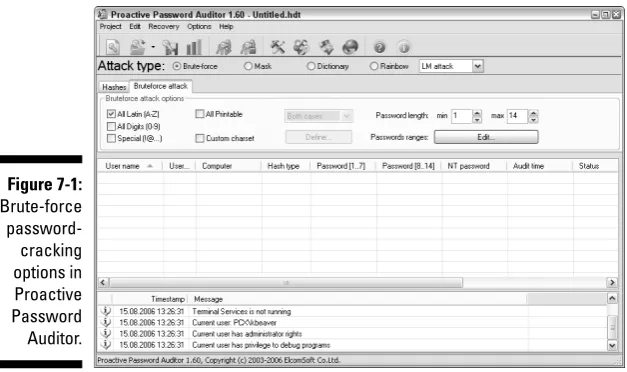
To crack passwords, you need cracking tools like pwdump3 and Proactive Password Auditor.
A general port scanner, such as SuperScan or Nmap, just won’t work for cracking passwords.
For an in-depth analysis of a Web application, a Web application assess-ment tool (such as N-Stalker or WebInspect) is more appropriate than a network analyzer (such as Ethereal).
Hundreds, if not thousands, of tools can be used for ethical hacking — from your own words and actions to software-based vulnerability assessment pro-grams to hardware-based network analyzers. The following list runs down some of my favorite commercial, freeware, and open source security tools:
Cain and Abel EtherPeek SuperScan QualysGuard WebInspect
Proactive Password Auditor
LANguard Network Security Scanner RFprotect Mobile
ToneLoc
I discuss these tools and many others in Parts II through V when I go into the specific hack attacks. Appendix A contains a more comprehensive listing of these tools for your reference.
The capabilities of many security and hacking tools are often misunderstood. This misunderstanding has cast negative light on otherwise excellent and legitimate tools.
Some of these security testing tools are complex. Whichever tools you use, familiarize yourself with them before you start using them. Here are ways to do that:
Read the readme and/or online help files for your tools. Study the user’s guides for your commercial tools. Use the tools in a lab/test environment.
Consider formal classroom training from the security-tool vendor or another third-party training provider, if available.
Look for these characteristics in tools for ethical hacking:
Adequate documentation
Detailed reports on the discovered vulnerabilities, including how they may be exploited and fixed
Availability of updates and support
High-level reports that can be presented to managers or nontechie types
These features can save you a ton of time and effort when you’re performing your tests and writing your final reports.
Executing the plan
Good ethical hacking takes persistence. Time and patience are important. Be careful when you’re performing your ethical hacking tests. A hacker in your network or a seemingly benign employee looking over your shoulder may watch what’s going on and use this information against you.
It isn’t practical to make sure that no hackers are on your systems before you start. Just make sure you keep everything as quiet and private as possible. This is especially critical when transmitting and storing your test results. If possible, encrypt any e-mails and files containing sensitive test information by using Pretty Good Privacy (PGP) (www.pgp.com) or similar technology. At a minimum, password-protect them.
You’re now on a reconnaissance mission. Harness as much information as possible about your organization and systems, which is what malicious hack-ers do. Start with a broad view and narrow your focus:
1. Search the Internet for your organization’s name, your computer and network system names, and your IP addresses.
Google is a great place to start.
2. Narrow your scope, targeting the specific systems you’re testing.
Whether you’re assessing physical security structures or Web applica-tions, a casual assessment can turn up a lot of information about your systems.
3. Further narrow your focus with a more critical eye. Perform actual scans and other detailed tests to uncover vulnerabilities on your systems.
Evaluating results
Assess your results to see what you uncovered, assuming that the vulnerabil-ities haven’t been made obvious before now. This is where knowledge counts. Evaluating the results and correlating the specific vulnerabilities discovered is a skill that gets better with experience. You’ll end up knowing your systems much better than anyone else. This makes the evaluation process much sim-pler moving forward.
Submit a formal report to upper management or to your client, outlining your results and any recommendations you wish to share. Keep these parties in the loop to show that your efforts and their money are well spent. Chapter 16 describes the ethical hacking reporting process.
Moving on
When you’ve finished your ethical hacking tests, you (or your client) still need to implement your recommendations to make sure the systems are secure.
Chapter 2
Cracking the Hacker Mindset
In This Chapter
Understanding the enemy
Profiling hackers and rogue insiders
Understanding why attackers do what they do
Examining how attackers go about their business
B
efore you start assessing the security of your own systems, it helps to know something about the enemies you’re up against. Many information security product vendors and other professionals claim that you should pro-tect your systems from the bad guys — both internal and external. But what does this mean? How do you know how these people think and work?Knowing what hackers and rogue insiders want helps you understand how they work. Understanding how they work helps you look at your information systems in a whole new way. In this chapter, I describe what you’re up against, who’s actually doing the hacking, and what their motivations and methods are so you’re better prepared for your ethical hacking tests.
What You’re Up Against
Thanks to sensationalism in the media, the definition of hackerhas trans-formed from harmless tinkerer to malicious criminal. Be that as it may, hack-ers often state that the general public misundhack-erstands them, which is mostly true. It’s easy to prejudge what you don’t understand. Unfortunately, many hacker stereotypes aren’t based on fact but on misunderstanding, fueling a constant debate.
intent seek some form of personal gain. Unfortunately, the negative aspects of hacking usually overshadow the positive aspects, resulting in the stereotyping.
Historically, hackers hacked for the pursuit of knowledge and the thrill of the challenge. Script kiddies aside, hackers are adventurous and innovative thinkers and are always devising new ways to exploit computer vulnerabili-ties. (For more on script kiddies, see “Who Breaks into Computer Systems,” later in this chapter.) They see what others often overlook. They wonder what would happen if a cable were unplugged, a switch were flipped, or lines of code were changed in a program. These old-school hackers are like Tim “The Toolman” Taylor — Tim Allen’s character on the late, great sitcom Home Improvement— thinking mechanical and electronic devices can be improved if they’re “rewired.” More recent evidence shows that many hackers (a.k.a. hacktivists) are hacking for political, competitive, and even financial pur-poses, so times are changing.
When they were growing up, hackers’ rivals were monsters and villains on video game screens. Now hackers see their electronic foes as only that — electronic. Hackers who perform malicious acts don’t really think about the fact that human beings are behind the firewalls and Web applications they’re attacking. They ignore that their actions often affect those human beings in negative ways, such as jeopardizing their job security.
On the flip side, odds are you have at least one or two employees, contrac-tors, interns, or consultants who intend to compromise sensitive information on your network for malicious purposes. These people aren’t “hacking” as we know it. Instead, they’re rooting around files on server shares, delving into databases they know they shouldn’t be in, and sometimes stealing, modify-ing, and deleting sensitive information to which they have access. This behavior is often very hard to detect — especially given the widespread belief by management that all users can be trusted. This is further perpetu-ated if these users passed their criminal background and credit checks before they were hired. It’s true that past behavior is often the best predictor of future behavior, but just because someone has a clean record doesn’t mean he or she won’t do anything bad. Criminals have to start somewhere!
However you view the stereotypical hacker or rogue insider, one thing is cer-tain: Somebody always will try to take down your computer systems and com-promise information by poking and prodding where he shouldn’t, by all-out hacking or by creating and launching automated worms and other malware. You must take the appropriate steps to protect your systems against this.
Thinking like the bad guys
Malicious attackers often think and work just like thieves and other organized criminals you hear about in the news every day. The smart ones constantly devise ways to fly under the radar and exploit the smallest weakness(es) that lead them to their target. The following are examples of how hackers and rogue insiders think and work. This list isn’t intended to high-light specific exploits that I cover in this book or recommend you carry out, but rather to demon-strate the context and approach of a malicious mindset:
Evading an IDS by changing their DHCP address (or even packets sent) every few minutes to get further into a network with-out being completely blocked
Exploiting a physical security weakness by being aware of offices that have already been cleaned by the cleaning crew and are unoccupied (and thus easy to access with little chance of getting caught) by simply noting that the office blinds are opened and the curtains are pulled two-thirds shut in the early morning
Bypassing Web access controls by chang-ing a malicious site’s URL to its dotted dec-imal IP address equivalent and then converting it to hexadecimal for use in the Web browser
Using unauthorized software that would otherwise be blocked at the firewall by changing the default TCP port that it runs on
Setting up a wireless “evil twin” near a local Wi-Fi hotspot to lure unsuspecting Internet surfers onto a rogue network where everything can be captured and easily manipulated
Using a trusting colleague’s user ID and password to gain access to sensitive infor-mation that would otherwise be impossible to obtain
Unplugging the power cord or Ethernet connection to a networked CCTV security camera that monitors access to the com-puter room or other sensitive areas and gaining unmonitored access
![Improvements for Kosovo's spatial planning system / [presentation given in May 2011]](data:image/gif;base64,R0lGODlhAQABAIAAAP///wAAACH5BAEAAAAALAAAAAABAAEAAAICRAEAOw==)