White Rose Research Online URL for this paper:
http://eprints.whiterose.ac.uk/81677/
Version: Published Version
Article:
Abu Shawar, BA and Atwell, ES (2005) A chatbot system as a tool to animate a corpus.
ICAME Journal: International Computer Archive of Modern and Medieval English Journal,
29. 5 - 24. ISSN 0801-5775
Reuse
Unless indicated otherwise, fulltext items are protected by copyright with all rights reserved. The copyright exception in section 29 of the Copyright, Designs and Patents Act 1988 allows the making of a single copy solely for the purpose of non-commercial research or private study within the limits of fair dealing. The publisher or other rights-holder may allow further reproduction and re-use of this version - refer to the White Rose Research Online record for this item. Where records identify the publisher as the copyright holder, users can verify any specific terms of use on the publisher’s website.
Takedown
If you consider content in White Rose Research Online to be in breach of UK law, please notify us by
Bayan Abu Shawar and Eric Atwell University of Leeds
1
Introduction
“Before there were computers, we could distinguish persons from non-persons on the basis of an ability to participate in conversations. But now, we have hybrids operating between person and non persons with whom we can talk in ordinary language.” (Colby 1999). Human machine conversation as a technol-ogy integrates different areas where the core is language, and the computational methodologies facilitate communication between users and computers using natural language.
A related term to machine conversation is the chatbot, a conversational agent that interacts with users turn by turn using natural language. Different chatbots or human-computer dialogue systems have been developed using text communication starting from ELIZA (Weizenbaum 1966) that simulates a psy-chotherapist, then PARRY (Colby 1973) which simulates a paranoid patient. “Colby regarded PARRY as a tool to study the nature of paranoia, and consid-ered ELIZA as a potential clinical agent who could, within a time-sharing framework, autonomously handle several hundred patients an hour.” (Guzeldere and Franchi 1995).
Nowadays a lot of chatbots are available online and are used for different purposes such as: MIA (MIA 2004) which is a German advisor on opening a bank account; and Sanelma (MUMMI 2004), a fictional female to talk with in a museum that provides information related to specific pieces of art.
are allowed a short chat (10 to 15 minutes) with each chatbot, and asked to rank them in terms of “naturalness”.
Most chatbots are restricted to knowledge that is manually “hand coded” in their files, and to a specific natural language which is written or spoken. To overcome this problem and to generate chat which is closer to human language, we developed a program to convert a machine readable text (corpus) to a spe-cific chatbot format, which is used to retrain the chatbot.
Sinclair (1991) defined the corpus as “A collection of naturally occurring language text, chosen to characterize a state or variety of a language.” Linguists collect texts whether written or spoken to aid study of language features such as syntax, semantics and pragmatics. Leech (1992) states “The focus of study is on performance rather than competence and on observation of language in use lead-ing to theory rather than vice versa.”. In other words, the collected text repre-sents the corpus, and studying the language using a corpus based approach is known as corpus linguistics. With the rapid evolution of computer capacities and capabilities, many corpora have become available in machine readable form, and a lot of software tools have been developed to annotate the corpora, e.g. CLAWS used to PoS_tag the LOB and BNC corpora (Leech et al. 1994); and retrieve data from a corpus, e.g. XAIRA, a web based concordance applica-tion, developed for use with the British National Corpus (BNC) (Burnard and Dodd 2003); or lemmatised and unlemmatised frequency lists generated by Kil-garriff (1996).
In this paper, we present the chatbot system as a tool to explore or visualize different types of English language used in the BNC corpus in a qualitative man-ner in contrast to tools such as Wmatrix which visualises a corpus in terms of quantitative statistics. Section 2 reviews the ALICE chatbot system, the linguis-tic knowledge representation format and the pattern matching technique. In sec-tion 3, the Wmatrix tool is used to show the difference between human to human dialogues and ALICE chatbot dialogues. Section 4 presents the BNC corpus and the problems which arose during the automation process, and the software tool that maps the BNC spoken transcripts to ALICE chatbot internal knowledge representation, called AIML. Sample of dialogues generated from the BNC are shown in section 5. Section 6 presents our conclusions.
2
The ALICE chatbot system
ALICE (Alice 2000, Abu Shawar and Atwell 2002, 2003, Wallace 2003) is the Artificial Linguistic Internet Computer Entity, first implemented by Wallace in 1995. ALICE knowledge about English conversation patterns is stored in AIML files. AIML, or Artificial Intelligence Mark-up Language, is a derivative of Extensible Mark-up Language (XML). It was developed by Wallace and the Alicebot free software community during 1995-2000 to enable people to input dialogue pattern knowledge into chatbots based on the A.L.I.C.E. open-source software technology.
AIML consists of data objects called AIML objects, which are made up of units called topics and categories. The topic is an optional top-level element; it has a name attribute and a set of categories related to that topic. Categories are the basic units of knowledge in AIML. Each category is a rule for matching an input and converting to an output, and consists of a pattern, which matches against the user input, and a template, which is used in generating the Alice chatbot answer.
The AIML pattern is simple, consisting only of words, spaces, and the wild-card symbols _ and *. The words may consist of letters and numerals, but no other characters. Words are separated by a single space, and the wildcard char-acters function like words. The pattern language is case invariant. The idea of the pattern matching technique is based on finding the best, longest, pattern match.
2.1 Types of ALICE/AIML categories
There are three types of categories: atomic categories, default categories, and recursive categories.
a. Atomic categories are those with patterns that do not have wildcard
sym-bols, _ and *, e.g.:
<category><pattern>HELLO ALICE</pattern> <template>hello</template></category>
In the above category, if the user inputs ‘hello Alice’, then ALICE answers ‘hello’.
b. Default categories are those with patterns having wildcard symbols * or _.
<category><pattern>HELLO *</pattern> <template>hello friend</template> </category>
So ALICE answers ‘hello friend’.
c. Recursive categories are those with templates having <srai> and <sr> tags,
which refer to simply recursive artificial intelligence and symbolic reduc-tion. Recursive categories have many applications: symbolic reduction that reduces complex grammatical forms to simpler ones; divide and conquer that splits an input into two or more subparts, and combines the responses to each; and dealing with synonyms by mapping different ways of saying the same thing to the same reply.
c.1 Symbolic reduction
<category> <pattern>DO YOU KNOW WHAT THE * IS</pattern> <template> <srai>What is <star/></srai> </template> </category>
In this example <srai> is used to reduce the input to simpler form “what is *”.
c.2 Divide and conquer
<category> <pattern>YES*</pattern>
<template> <srai>YES</srai><sr/> <template> </category>
The input is partitioned into two parts, “yes” and the second part; * is matched with the <sr/> tag.
<sr/> = <srai><star/></srai>
c.3 Synonyms
<category> <pattern>HI</pattern>
<template> <srai>Hello</srai> </template> </category>
There are more than 50,000 categories in the current public-domain Alice “brain”, added by the Botmaster over several years. However, all these catego-ries are “hand-coded”, which is time-consuming, and restricts adaptation to new discourse-domains and new languages. In the following sections we will present the automation process we developed to train Alice using a corpus based approach.
3
Human to human versus human to chatbot dialogues
Before training ALICE-style chatbots with human dialogue corpus texts, we investigated the differences between chatbot dialogue and human-human dialogue (Abu Shawar and Atwell 2003a). To do this, we compared a dialogue transcript generated via chatting with ALICE, and real conversations extracted from different dialogue corpuses. The comparison illustrates the strengths and weaknesses of ALICE as a human simulation, according to lin-guistic features: lexical, Part-of-Speech, and semantic differences. The Wmatrix tool (Rayson 2002) was used for this comparison. Wmatrix computes Part-of-Speech class and semantic class for each word in the texts, and then highlights specific words, Part-of-Speech categories, and semantic word-classes, which appear more often in one text than the other. The comparison results are viewed as feature frequency lists ordered by log-likelihood ratio: highest LL values indicate the most important differences between corpora. We used Wmatrix to compare between human-to-human dialogues extracted from several sub-cor-pora included in the DDC, Dialogue Diversity Corpus (Mann 2002), and human-to-computer dialogues extracted from chats with ALICE on the AI movie website (Spielberg 2000). Four different corpuses in different fields and sizes were investigated; the DDC sub-corpora and ALICE transcript are not equal in size, so we look at the relative frequencies from each file. Since the semantic and PoS comparisons are inferred from the text words, word differ-ences will be illustrated within semantic and PoS analysis.
3.1 ALICE against Spoken Professional American English transcripts
3.1.1 Semantic comparison between chatbot dialogue and professional American English
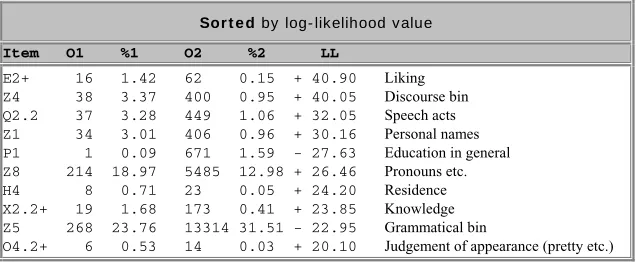
Table 1: Semantic comparison between ALICE (01) and CSPA (02)
The semantic comparison in Table 1 shows that the following semantic catego-ries are used more in ALICE transcripts: explicit speech act expressions are highly used within ALICE, an attempt to reinforce the impression that there is a real dialogue; pronouns (e.g. he, she, it, they) are used more in ALICE, to pre-tend personal knowledge and contact; discourse verbs (e.g. I think, you know, I
agree) are overused in ALICE, to simulate human trust and opinions during the
chat; liking expressions (e.g. love, like, enjoy) are overused in ALICE, to give an impression of human feelings. The only categories used noticeably more in CSPA Professional American English are education terms, hardly surprising given the academic discourse source; and grammatical function words, corre-sponding to more complex grammar.
Sor t e d by log- likelihood value Item O1 %1 O2 %2 LL
E2+ 16 1.42 62 0.15 + 40.90 Liking
Z4 38 3.37 400 0.95 + 40.05 Discourse bin
Q2.2 37 3.28 449 1.06 + 32.05 Speech acts
Z1 34 3.01 406 0.96 + 30.16 Personal names
P1 1 0.09 671 1.59 - 27.63 Education in general
Z8 214 18.97 5485 12.98 + 26.46 Pronouns etc.
H4 8 0.71 23 0.05 + 24.20 Residence
X2.2+ 19 1.68 173 0.41 + 23.85 Knowledge
Z5 268 23.76 13314 31.51 - 22.95 Grammatical bin
3.1.2 Part-of-Speech comparison between chatbot dialogue and professional American English
Table 2: Part-of-Speech comparison between ALICE (01) and CSPA (02)
Table 2 shows the Part-of-Speech frequency differences between the two sources. Singular first-person pronoun (e.g. I), second-person pronoun (e.g. you) and proper names (e.g. Alice) are used more in ALICE, to mark participant roles more explicitly and hence reinforce the illusion that the conversation really has two participants. Plural personal pronouns (e.g. we) were used more in Profes-sional American English, because all samples were extracted from meetings between cooperating professionals, using inclusive language. Coordinating con-junctions (e.g. and, or) and subordinating concon-junctions (e.g. if, because, unless) are used more within Professional American English; these indicate more com-plex clause and phrase structure, which ALICE avoids because it applies simple pattern matching techniques, and so it has problems trying to handle dependen-cies between clauses. Professional American English makes less use of interjec-tions, preferring more formal clause structure; another interpretation of this imbalance could be that ALICE makes more use of interjections, as fillers when no good match is found in the pattern database.
Sort ed by log- likelihood value
Item O1 %1 O2 %2 LL
3.1.3 Lexical comparison between chatbot dialogue and professional American English
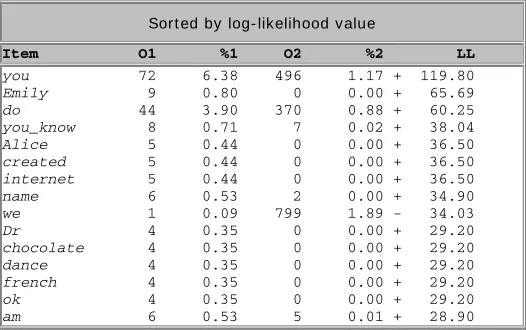
[image:9.425.74.337.201.366.2]Word-level analysis results shown in table 3 confirm and exemplify the more general Part-of-Speech and semantic class preferences. ALICE transcripts made more use of specific proper names “Alice” (not surprisingly!) and “Emily”; and of “you_know”, where the underscore artificially creates a new single word from two real words. ALICE and human dialogue corpora also made more use of lexical items which correspond to the “marked” PoS and semantic categories above; for example, Alice transcripts included more use of “I”, “you”.
Table 3: Word comparison between ALICE (01) and CSPA (02)
The above comparison shows that when ALICE tries to simulate real dialogue, it over-exaggerates use of key lexical, grammatical and semantic features of dia-logue. We compared several other DDC human dialogue corpus texts against ALICE transcripts (Abu Shawar and Atwell 2003a); there are genre- or topic-specific differences for each Corpus, but ALICE’s over-exaggerated use of speech act verbs, first-person pronouns, and similar explicit dialogue cues are a recurring result.
Sort ed by log- likelihood value
Item O1 %1 O2 %2 LL
you 72 6.38 496 1.17 + 119.80
Emily 9 0.80 0 0.00 + 65.69
do 44 3.90 370 0.88 + 60.25
you_know 8 0.71 7 0.02 + 38.04
Alice 5 0.44 0 0.00 + 36.50
created 5 0.44 0 0.00 + 36.50
internet 5 0.44 0 0.00 + 36.50
name 6 0.53 2 0.00 + 34.90
we 1 0.09 799 1.89 - 34.03
Dr 4 0.35 0 0.00 + 29.20
chocolate 4 0.35 0 0.00 + 29.20
dance 4 0.35 0 0.00 + 29.20
french 4 0.35 0 0.00 + 29.20
ok 4 0.35 0 0.00 + 29.20
4
Training ALICE with conversation transcripts
It took several years for the ALICE Botmaster to accumulate the 50,000 catego-ries in the current public-domain set of AIML files (Wallace 2003). We devel-oped a program to read text from a corpus and convert it to the AIML format. We used this program to generate chatbots speaking other languages including Afrikaans (Abu Shawar and Atwell 2003b) and Arabic (Abu Shawar and Atwell 2004). To retrain ALICE with English corpora, we examined these sources of English dialogue: the dialogue Diversity Corpus (DDC) and the spoken part of the British National Corpus (BNC), and online FAQ (Frequently Asked Ques-tions) websites. Two main goals are achieved using the BNC: the ability of the program to generate more than one million categories extracted from the BNC; and the ability to use the chatbot as a tool to explore and visualise or animate the domain-specific English dialogue.
4.1 Problems with using BNC as chatbot training data
The British National Corpus (BNC) (Aston and Burnard 1998) is a collection of text samples amounting to over 100 million words, extracted from 4,124 modern British English texts of all kinds, both spoken and written. The corpus is anno-tated using SGML (XML-like) mark-up, including CLAWS Part-of-Speech cat-egory of every word. All annotations are marked between <angle brackets>. The corpus is partitioned into two types: the spoken and the written transcripts. In order to generate versions of ALICE which talk like humans, we decided to retrain ALICE using the BNC spoken transcripts comprising 10 million words.
Sa m ple 1 .a illu st r a t e s t h e lon g m on olog pr oble m < u w ho= F72PS002>
< s n= " 29" > < w PNP> You < w VDB> do< c PUN> ?
< s n= " 30" > < w AV0> Well < w PNP> you < w VBB> are < w AV0> ver y < w AJ0> for t unat e < w NN0> people< c PUN> .
< s n= " 31" > < w CJC> But < w PNI > none < w PRF> of < w PNP> you < w VM0> w ill < w VVI > k now < w DPS> m y < w NN1> fr iend < w AV0> over her e < w
DTQ> w hose < w NN1> nam e < w VBZ> is < w NP0> Donald< c PUN> . < / u>
Sa m ple 1 .b illu st r a t e s t h e ove r la ppin g pr oble m < u w ho= w 0014>
< s n= 00011> < w AJ0> Poor < w AJ0> old < w NP0> Luxem bour g'< w VBZ> s < w AJ0- VVN> beat en< c PUN> .
< w AV0> absolut ely < w AV0> j ust < w VVN> gone < w AV0> st raight < pt r t ar get = P1> < w PRP> over < w PNP> it < pt r t ar get = P2> < / u> < u w ho= w 0001>
< s n= 00013> < pt r t ar get = P1> < w PNP> I < w VHB> haven< w XX0> 't < c PUN> . < pt r t ar get = P2/ > < / u>
< u w ho= w 0014>
< s n= 00014> < w CJC> and < w VVN> for got t en < w AT0> t he < w AJ0> poor < w AJ0> lit t le< w NN1> count r y < c PUN> . < / u>
Figure 1: Samples of BNC corpus illustrating some problems
Each corpus file starts with a long Header section, containing details of source, speakers, etc. In the transcript body, the dialogue consists of a series of utter-ances or speaker-turns, marked at start and end by <u> and </u> tags. Each utterance tag also includes a speaker number (anonymous, e.g. F72PS002). Within a text sample, all sentences are tagged <s> and numbered; and each word is preceded with a CLAWS Part-of-Speech tag, e.g. ITJ = interjection, PUN = punctuation mark, NP0 = singular proper name. Some example utterances are shown in Figure 1.
The translation process from BNC format to AIML is not as simple as it might seem to be on the surface. A range of problems emerged during the trans-lation process:
• More than two speakers and long monologues as illustrated in sample 1.a • Unclear sections and overlapping as illustrated in sample 1.b
• Other problems including: extra-linguistic annotations, abbreviations, and using character entity references.
4.2 Using the BNC word-frequency list
the least-frequent word from the BNC we utilised, the unlemmatised list imple-mented by Kilgarriff (1996). The unlemmatised list counts the frequency for each verbal instance separately. There are six forms of the unlemmatised list: sorted alphabetically, or by frequency, complete lists, a smaller file containing only those items occurring over five times, and compressed and uncompressed versions of all available lists. The unlemmatised list format compromises four fields separated by spaces, starting with the frequency, the word, the POS, and finally the number of files the word occurs in, as shown Figure 2.
6187267 t he at 0 4120
2941444 of pr f 4108
2682863 and cj c 4120
2126369 a at 0 4113
1812609 in pr p 4109
Figure 2: Sample of the (Kilgarriff 1996) BNC word-frequency list
Since the BNC spoken transcripts are annotated with Part-of-Speech tags, we used these tags to extract the meaningful words to be used as the first word or least frequent words. Questions, prepositions, and pronouns are not considered. This modification improves the matching process and we recorded better user satisfaction than before.
5
A chatbot as a tool to visualize or animate corpus texts
One possible use of a corpus-trained chatbot is as a novel corpus visualization tool; Abu Shawar and Atwell (2004b) suggested:
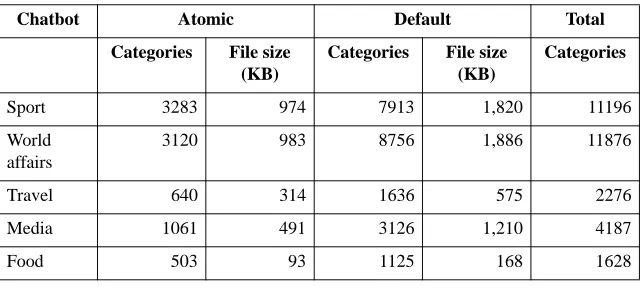
Information Visualisation techniques are usually applied to large numerical datasets, but linguists do have some tools for summarising and abstracting over-view information from textual datasets. For example, Wmatrix presents sum-mary statistical information comparing two corpora; although strictly speaking the output is not a “picture” of the corpora, it can still be seen as a visualisation: “In general, the notion ‘visualization’ refers to the process of mapping (non-visual) data to a suitable representation that simplifies the data interpretation by the user” (MoVi 1996). In contrast to Wmatrix, the chatbot can give qualitative impressions about a corpus. The chatbot could be used as a tool to visualise the vocabulary and typical turn-taking within the context, in addition to viewing the type of language used. Perhaps a better description for use of a corpus-trained chatbot to explore a corpus is “animate”: “to give life to or cause to come alive” (Collins English dictionary). A range of different chatbot systems were gener-ated using the program that converts the BNC to AIML format; this enabled us to animate and explore the language of various BNC sample texts. 1,153,129 categories were created in total, divided in files representing a range of domains as illustrated in Table 4.
Table 4: Sample of AIML chatbot models learnt from BNC domains
Chatbot Atomic Default Total
Categories File size (KB)
Categories File size (KB)
Categories
Sport 3283 974 7913 1,820 11196
World affairs
3120 983 8756 1,886 11876
Travel 640 314 1636 575 2276
Media 1061 491 3126 1,210 4187
H u m a n : Hi, do you like spor t ?
Ch a t bot :Hi t her e. No I 'm not m uch int o spor t s. I like solo sport s like r oller blad-ing and skiblad-ing t hough.
H u m a n : Do you k now any t hing about foot ball?
Ch a t bot : Any of several gam es played w it h an inflat ed leat her ball by t w o t eam s on a field w it h goals at each end, t he obj ect being t o get t he ball acr oss t he opponent s' goal.
H u m a n : What about w om en's foot ball?
Ch a t bot :I t hink foot ball seem s t o, t o br ing out t he w or st in a lot of people and t hat 's t he par t of it t hat I do not like
H u m a n : Do you like it ?
Ch a t bot :and er, I t hink unt il w om en's foot ball t ake it on boar d all t he way er m , t hey'r e not r eally gonna st and up w it h t he m en t hey have t o becom e, refer ees, t hey have t o becom e coaches, and m or e and m or e of t hese people er m , t ak ing r esponsibilit y I go along and wat ch w om en's foot ball and get r eally infur iat ed t o see a m an out t her e r efer eeing t he gam e, and oft en in a ver y condescending m anner ! I nst ead of car ding som eone he'll put his ar m r ound her and say Do not ! I t 's not ver y nice t o do t hat ! Do not do t hat again!
H u m a n : I t is an enj oyable gam e.
Ch a t bot :Aha Aha I t is a case is not it , t hat if you want t o be a er a pr ofessional w om an foot baller, cer t ainly t her e's m or e oppor t unit ies on t he cont inent t han t her e are in Br it ain, is, is is is t hat t he case?Yes?
H u m a n : I wat ch it r egular ly.
Ch a t bot :Because if foot ball's on it has t o be wat ched! I t 's like a a r eligion! Fi H u m a n : Can you adm it how m any hour s do you wat ch foot ball?
Ch a t bot :I f played pr oper ly, it 's poet r y in m ot ion! And as t he lady dow n her e said, if t he ladies do not like it , sw it ch it .
off! I f I had t he chance I 'd wat ch it t w ent y four hour s a day ! H u m a n : What about basket ball?
Ch a t bot :m m
Chatting 1: Sample of chat with BNC trained Sports chatbot
foot-ball. This is because the chatbot was trained with a range of BNC texts, not just a single speaker, so it models an amalgam of all the conversations about sport; also, the ALICE architecture does not maintain a “belief model”, so it has no way of avoiding logical inconsistencies across the chatting session. However, it is possible to visualize or animate other aspects of language use: for example, longer turns when the chatbot (speaker) gets enthused; use of domain specific collocations or idioms in context (eg “its’ poetry in motion”); gender variation in language (the speaker in the training text was obviously a man; a chatbot trained with transcripts of women talking about sport would respond differ-ently).
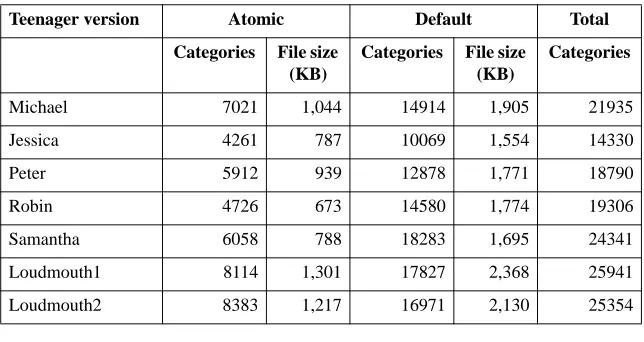
Table 5: Sample of AIML chatbot models learnt from BNC London teenager
and “loudmouth” transcripts
H u m a n : I never give cigar et t es
Pe t e r : Did you give t hat one back t o Dan and Honey? H u m a n : You w ould not give m e a cigar et t e anyway
Pe t e r : I n any case, Who else w ould not give you a cigar et t e? H u m a n : I t depends
Pe t e r : Yeah
H u m a n : Did your m um k now t hat you sm oke cigar et t es
Teenager version Atomic Default Total
Categories File size (KB)
Categories File size (KB)
Categories
Michael 7021 1,044 14914 1,905 21935
Jessica 4261 787 10069 1,554 14330
Peter 5912 939 12878 1,771 18790
Robin 4726 673 14580 1,774 19306
Samantha 6058 788 18283 1,695 24341
Loudmouth1 8114 1,301 17827 2,368 25941
A significant subset of BNC spoken conversation transcripts are of London teenager chat collected by the COLT project. To animate these, we built several London-teenager chatbots trained on specific transcripts. We also posted a query to ICAME’s CORPORA email discussion list, asking for suggestions for “inter-esting” training texts in the BNC; replies suggested two texts to train two chat-bots, Loudmouth1 and Loudmouth2, to illustrate loudmouth vocabulary and dia-logue. Table 5 shows statistics for some of the AIML models extracted from BNC London teenager and loudmouth files. Chatting 2 illustrates dialogue between a user and our Peter chatbot.
Another sort of English “dialogue” text is FAQs: Frequently Asked Ques-tions websites. Corpus Linguists have shown increasing interest in possibilities of using the Web as corpus source, so we decided to try using FAQs as pseudo-dialogue to train chatbots. In these versions the chatbot expects user input simi-lar to FAQ questions, and replies with FAQ answers, or with lists of links to pos-sible FAQ answers. FAQs have clear turn-taking structure, and are widely used in computing, so are a good source of training corpus data.
Two example English FAQ chatbots were generated: Askme (2004) which is trained using the FAQ of the School of Computing (SoC) at the University of Leeds; and a Python advisor (2004), trained on the public-domain Python pro-gramming language FAQ website. The Python FAQ website has been translated into other languages, so we were able to generate a Spanish-speaking Python advisor. Chatting 3 illustrates the questions and answers generated with these FAQ chatbots.
a . U sin g t h e FAQ of t h e Sch ool of Com pu t in g a t t h e U n iv e r sit y of Le e ds
H u m a n : How t o r em ove a j ob fr om t he pr int er ? Ask m e :
I f you want t o rem ove a j ob fr om t he print er queue t hen find out t he j ob num -ber using t he lpq com m and, and in a UNI X shell t ype:
% lp r m - P pr int er nam e j ob_no
You can only r em ove j obs t hat you have sent t o t he print er yourself - apart fr om Suppor t t hat is.
For m or e inform at ion look at :
b. Usin g t h e FAQ of t h e Py t h on pr ogr a m m in g la n gu a ge w e bsit e
H u m a n : w hat is a class ? En glish _ Py t h on _ FAQ:
A class is t he par t icular obj ect t ype cr eat ed by execut ing a class st at em ent . Class obj ect s ar e used as t em plat es t o cr eat e inst ance obj ect s, w hich em body bot h t he dat a ( at t r ibut es) and code ( m et hods) specific t o a dat at y pe.
A class can be based on one or m or e ot her classes, called it s base class( es) . I t t hen inher it s t he at t r ibut es and m et hods of it s base classes. This allow s an obj ect m odel t o be successively r efined by inher it ance. You m ight have a gener ic Mailbox class t hat pr ovides basic accessor m et hods for a m ailbox, and subclasses such as MboxMailbox, Maildir Mailbox , Out lookMailbox t hat handle var ious specific m ailbox for m at s.
Chatting 3: Example questions with answers generated by the FAQ chatbot versions
A Frequently Asked Questions document or FAQ is a structured database; most of the “data-cleaning” problems found with dialogue corpora (such as overlap-ping, and more than two speakers) are not found in the FAQs. Moreover almost all HTML tags embedded in the FAQ file are recognised by the ALICE inter-preter, because the AIML definition allows HTML tags to be embedded within templates. The questions and answers were extracted directly from the HTML files of the FAQ.
6
Conclusions
subsets of the BNC to animate and explore the type of the language used within a specific domain. In contrast to the Wmatrix tool which gives a quantitative view about the syntax, semantics and PoS used within the corpus, the chatbot system gives a qualitative illustration or animation of the language of a specific domain or speaker type.
Future research includes finding useful applications. The ALICE-style chat-bot could be used as an English conversation practice tool; for example Speak2Me.net (Speak2Me 2004) is a web-based version of ALICE aimed at Chinese learners of English, allowing them to practise chatting to a well-spoken young lady, a virtual British English native speaker. Our chatbot-training tech-nique could be used in producing chatbots aimed at learners with other first lan-guages, e.g. German or Italian (Atwell et al. 2003), or chatbots specialising in English for specific purposes, by retraining ALICE with BNC corpus (or other ESP corpus texts) on specific domains.
References
Abu Shawar, Bayan and Eric Atwell. 2002. A comparison between ALICE and Elizabeth chatbot systems. School of Computing research report 2002.19, University of Leeds.
Abu Shawar, Bayan and Eric Atwell. 2003a. Using dialogue corpora to retrain a chatbot system. In D. Archer, P. Rayson, A. Wilson and T. McEnery (eds.). Proceedings of the Corpus Linguistics 2003 Conference (CL2003), 681-690. Lancaster: Lancaster University.
Abu Shawar, Bayan and Eric Atwell. 2003b. Using the Corpus of Spoken Afri-kaans to generate an AfriAfri-kaans chatbot. Southern African Linguistics and
Applied Language Studies 21: 283-294.
Abu Shawar, Bayan and Eric Atwell. 2004a. Accessing an information system by chatting. In F. Meziane and E. Metais (eds.). Natural Language
Process-ing and Information Systems, 9th International Conference on Applications of Natural Languages to Information Systems. Proceedings (NLDB’04),
407-412. Berlin: Springer.
Abu Shawar, Bayan and Eric Atwell. 2004b. A chatbot as a novel corpus visual-ization tool. In M. Teresa Lino, M. Francisca Xavier, F. Ferreira, R. Costa, R. Silva, C. Pereira, F. Caevalho, M. Lopes, M. Catarino and S. Barros (eds.). Proceedings of Fourth International Conference on Language
Resources and Evaluation (LREC’04) IV, 2057-2060. Paris: ELRA.
Aston, Guy and Lou Burnard. 1998. The BNC handbook: Exploring the British
National Corpus with SARA. Edinburgh: Edinburgh University Press.
Atwell, Eric, Peter Howarth and Clive Souter. 2003. The ISLE corpus: Italian and German spoken learner’s English. ICAME Journal 27: 5-18.
Burnard, Lou and Tony Dodd. 2003. Xara: An XML aware tool for corpus searching. In D. Archer, P. Rayson, A. Wilson and T. McEnery (eds.).
Pro-ceedings of the Corpus Linguistics 2003 Conference (CL2003), 142-144.
Lancaster: Lancaster University.
Colby, Kenneth. 1973. Simulation of belief systems. In R. Schank and K. Colby (eds.). Computer models of thought and language, 251-286. San Francisco: Freeman.
Colby, Kenneth. 1999. Comments on human-computer conversation. In Y. Wilks (ed.). Machine conversations, 5-8. Boston, Dordrecht and London: Kluwer.
Cunningham, Hamish. 1999. A definition and short history of Language Engi-neering. Journal of Natural Language Engineering 5.1: 1-16.
Güzeldere, Güven and Stefano Franchi. 1995. Dialogues with colourful person-alities of early ai. Stanford Electronic Humanities Review 4.2, http:// www.stanford.edu/group/SHR/4-2/text/toc.html
Kilgarriff, Adam. 1997. Putting frequencies in the dictionary. International
Journal of Lexicography 10.2: 135-155.
Leech, Geoffrey. 1992. Corpora and theories of linguistic performance. In J. Svartvik (ed.). Directions in corpus linguistics, 105-122. Berlin: Mouton de Gruyter.
Leech, Geoffrey, Roger Garside and Michael Bryant. 1994. CLAWS4: The tag-ging of the British National Corpus. In Proceedings of the 15th International Conference on Computational Linguistics (COLING 94), 622-628. Kyoto,
Japan.
Loebner, Hugh. 2003. Home Page of the Loebner Prize-The First Turing Test, http://www.loebner.net/Prizef/loebner-prize.html
Mann, William. 2002. Dialog Diversity Corpus,
http://www-rcf.usc.edu/~billmann/diversity/DDivers-site.htm MIA. 2004. http://www.aitools.org/livebots/
MoVi. 1996. MoVi Glossary,
MUMMI. 2004. A Concept for chatbot: ”Sanelma” building engaging
relation-ship between the work of art and the exhibition visitor, http://
www.mlab.uiah.fi/mummi/sanelma/
Rayson, Paul. 2002. Matrix: A statistical method and software tool for linguistic analysis through corpus comparison. Ph.D. thesis, Lancaster University, UK.
Sinclair, John McH. 1991. Corpus, concordance, collocation. Oxford: OUP. Speak2Me. 2004 www.speak2me.net
Spielberg Stephen. 2000. Random conversation with a chatbot, http:// www.aimovie.warnerbros.com/
Wallace, Richard. 2003. The elements of AIML style. ALICE AI Foundation. Weizenbaum, Joseph. 1966. ELIZA-A computer program for the study of
natu-ral language communication between man and machine. Communications
of the ACM 10.8: 36-45.