THESES, SIS/LIBRARY A.G. MENZIES BUILDING N02 Australian National University Canberra ACT 0200 Australia
USE OF THESES
This copy is supplied for purposes
of private study and research only.
Passages from the thesis may not be
copied or closely paraphrased without the
written consent of the author.
THE AUSTRALIAN NATIONAL UNMRSITY
Telephone: +61 2 6125 4631 Facsimile: +61 2 6125 4063
CLAUSE STRUCTURE I N
F I J I A N
by
Aubrey L. Parke
A thesis submitted i.n partial. satisfaction of the requirements for th1.! degree of Master of Arts at the Australian National Univeroity.
Title Page (i)
Declaration (ii)
l'cknowledg,·:nents (iv)
l\bbreviationu (v)
Table of Contents (vii)
iv
ACKNOWLEDGEMENTS
This study is a distillation of the learning and use of Fijian which beqan for me thirty years ago under the guidance of George Milner and N. C. Scott of the School of Ori••ntal and African Studies, London and Ratu Livai Volavola who at the time was at the Institute of Education.
I could not begin to list the names of the people in Fiji who from 1951 to 1971 wittingly or unwittingly continued to facilitate my exposure to Fijian as it is spoken in the various parts of Fiji where I was serving as an administrative officer. I must hcwever mention G.K. Roth and Ulaiasi Vosabalavu who during my fi.cst tour of duty nurtured the seedlings of learning planted by Georg•· Milner.
outside of Fiji, Al Schutz started to direct my pr-~ctical language learning into more theoretical fields and over the years both in Hawaii and Fiji and by post was coc.stantly advising me on some of my earlier attempts to write about Fijian dialects. I also received encouragement from Bruce Biggs and Andrew Pawley, and it was
Ron Crocornbe and Arthur Capell who suggested that on moving to Canberra
T. should undertake formal training in linguistics at the Australian National University.
I was formally tutored .'.n the preparation of this study of Fijian bJ Bill Foley, my appointee supervisor, who suggested the model for me to follow. Bob Dixon bravely read and kindly commented on my handwritten draft. ~ly especial thanks are due to John Harris who never
faile~ to provide a word of encouragement, advice or suggestion, what-ever the p!ace or time.
Many of the examples cited in this stud.y were provided by members of the Fijian community in Canberra, and especially by Toga Wailevu when servil1g at the Fiji High Commission,who spent so rr.iny hours with me. It was with Toga that I delved into some of those
areas of. "ij ian semantics and syntax which till then had been as obscure
to me as the innernost recesses of Degei's cave on Nakauvadra Mountains.
Jennifer Hyles typed the thesis with amazing speed, accuracy and understanding, and Avery Andrews suggested the title.
ABBREVIATIONS
a/e adj art adv
c
c.i. class coll com compl con cont con tr coord deic dir dom drink ed exc fut hab hum incin ts loc locu n, N
neg non-s NP
num
actor-experiencer ~riented
adjective article adverb consonant
clause introducing particle classifier
collective prefix
connnon
complementising particle connecting particle
continue
contrasting particle coordir.ating particle deictic
directional
dominan·t possession drinkable possession edible pcssession
exclusive
future tense habitual particle human
inclusive intransitive locative
locutive
noun negative non-singular
noun phrase
numeral
ABBREVIATIONS (cont.)
0
ob liq om, OM part pat pauc pl
poss
p.p. prep prop
R rel
s
s
scm spon sub subd temp ts, TS utter
v,
v
vp
y l 2
3
object oblique
object marker particle
,?atient oriented paucal
plural
possessive pronoun personal pronoun preposition proper
reduplication relating particle
singular
st . .')ject
subject conc~rd marker spontaneous pref ix subo~dinate possession
subordinating particle te.mporal
transitive suffix
utterance/greeting pref ix verb
verbal particle younger
CONTENTS
Chapter l
l.l-2 1.3 1.3.l 1.3.2 1.3.2.l 1.3.2.2 !.3.2.3 l.3.2.4 l.3.2.5 1. 3. 3 l.3.3.l 1.3.3.2 1.3.4 1.3.4.1 l.3.4.2-3 1.4
1.4.l l.4.2 1.4.3 l.4.4 l.4.5 1.4.5.1 l.4.5.2
Chapter 2
2.1 2.2 2.3 2.4
The Noun·Phrase
Introduction l
Non-possessive NP 2
General 2
Noun modification 2
Adjectives 3
Adjectival modification 3
Deictics 4
Numerals 5
Indefinite 6
Noun juxtaposition 6
Article N article N 7
Article N N 7
Noun connection
a
Article N con. article N
s
Article N rel. N 9
Possessive NP 11
General 11
Obligatory-optional "possession" 12
"Dominant-subordinate" relationship 13
"Edible-drinkable" semantic classification 15
Expanded possessive NP 16
Appositional construction 17
Relating particle i construction 18
The Verb Phrase
Introduction 20
Categories of verbs 20
Verbal particle and subject concord marker 22
Transitive suffix and object marker 25
Chapter 3
3.l
3.2
3.2.l
3.2.2
3.2.3
3.2.4
3.3
•)'apter 4
4.l
4.2
4.3
4.4
4.4.l
4.4.2
4. 4. 3
4.4.3.l
4.4.3.2
4.4.3.3
4.4.3.4
4.4.4
4.5
4.6
4.7
4.7.l
4.7.2
4.7.3
4.8
-Clauses
Introduction 29
Predicative clauses 29
General 29
Intransitive clauses 29
Transitive clauses 32
Word order 33
Equational clauses 35
Internal Organisa~ion of Clauses
Introdu~tion 36
Subject/object identifi~ation 39
Floating quantifiers 40
Role marking by suffix 41
General 41
Role of subject 41
Role of object 42
Patient oriented verb~ with -Ci suffix 42
Patient oriented verbs with -Caki suffix 42
Actor-experiencer oriented verbs with -Ci suffix 43
Actor-experiencer oriented verb~ with -Caki suffix <:3
-Ci, -~ compared
Role marking by prep?sition
Passive-like clause~
Spontaneous and ins~rumental prefixes
General
Spontaneous prefixes
Instrumental prefix
lau-Collective
prefix~!-44
44
46
47
47
47
ix
Chapter 5 Relative Clauses
5.1 Introduction 51
5.2 Nominal deletion Sl
5.3 Anaphoric personal pronouns 53
5.4 Possible ambiguities - c~nditions for ambiguity 56
5.5 "Disa..'llbiguating" 58
5.5 Anaphoric possessive pronouns 62
5.7 Oblique anaphoric pronouns and particles 67
5.7.1-3 Gene-,-1. 67
5.7.3.l Goal marking 69
5.7.3.2 Source marking 70
5.7.3.3 Instrument marking 7l
5.7.3.4 Locative··temporal. marking 72
5.7.3.5 Comitative marking 73
5.7.4 Summary of oblique relativisation 75
5.8 Case 111<'-::ing by suffix 76
5.9 Relative clause introduction 78
5.10 Order c.,g of the her.:l r:oun 79
Chapter 6 causative and Siznilar Constructions
6.1 Introl! ... ction 84
6.2 Causative vaka- + verb 86
6.2.l General 86
6.2.2 Intransitive clauses 89
6.2.3 Transitive clause~ 91
6.3 Causative vaka- + adjective 97
6.3.l General 97
6.3.2 Adjectives as attributes or exprnssions of feeling 97
6.4 Causative ,.Yaka.., + noun 99
6.5 Intensify.' 1g ~-
loo
6.5.1-3 General
lot
6.5.4 Comparison of word orde~ - causacive and intensifying 102
6.6 D.elocutive vak~- 104
6.7 'Attributing' ~- 105
6.8 Comparison of meanings and functions of vaka- 107
Chapter 7
7.1 7.2 7.2.1-2 7.2.3 7.2.4 7.?.. 5
7.2.6 7.3 7.3.l 7.3.2 7.3.3 7.3.4 7.3.5 7. 3.6 7.4 7.4.1-6 7.4.7 Chapter 8
8.1 8.1.l B.l.2
8.2 8.3 8.4 8.4.l 8.4.2 8.4.3 8.4.4 8.4.5 8.5 8.6 8.'/
9.8
"
Verb Serialisation and Complementation
Introduction 110
Verb serialisation 110
General 110
Transitive verb + transitive verb 111
Intransitive verb + transitive verb 113
Transitive verb + intransitive verb 115
Intransitive verb
+
intransitive verb 118Complementiser construction 122
General 122
Complementiser me 124
Comp~ementiser ni 133
Complementiser se 138
Co)nplemer1tiser de 140
Comparison of meaning of complementisers 141
Norninalisation 141
General 141
Semantics of nominalised complements 144 Subordinatinq Particles
Introduction 146
General 146
Clause order 14 7
Particle me 149
Particle ni 152
r,,,rticle ke 154
General 154
ke vaka 155
ke ... ke 155
ke vaka ... ke 156
ke ... ke and ke vaka ... ke contrasted 157 Comparison of particles ni and ke 158
Particle de 159
Independent clauses loO
Rela~ionship between complementisers and 161
xi
Chaoter 9 Coordinating Particles
9.1 Introduction 163
9.1.l General 163
9.1.2 Deletion of shared forms 164
9.2 Particle ka 167
9.J Particle se 171
9.4 Particle ia 174
Bibliography 180
-INTRODUCTION
Fiji is a group of islands lying to the west of the New Hebrides, the Solom01s and other M:? lanesian areas, and to t• .. -:? east of Tonga anti
other Polynesian areas. The island of Rotuma , to which mention is
made later in this introduction, lies to the north of the group. Although regarded as par~ of Fiji $ince it was ceded to the British Crown i~ 1881, Rot:.nna has it~ own distinct language and people. Fiji is called 'Viti' by the Fijians who refer to themselves as 'iTaukei' or owners.
Fiji had beer. " British Crown Colony since 1876, and it retained this status during most c<: the period while field work for this study was being carried out. !.: then became an independent Dominion within the Commonwealth as from 10 October 1970.
The Fiji Handbook (1980, p.39) Gays that the estimates of the number of islands in the Fiji group vary from 300 to 500, depending on
t<)S"f which small rocky islets and sand cays are included. Derrick (l.-956, p.3) names 361 islands. There are more than 300 isl;.nds of an area of 2.59 sq km or over, of which not more than 100 arc permanently inhabited. The total land area is about 18,376 sq km, of which the two main islands of Viti Levu and Vanua Levu account for 10,381 sq km and 5,538 sq km respectively. The chiefly island of Bau, the dialect of which is the subject of this study 1 lies off the south-east coast of Viti r.evu, to which it is connected by mudflats at low tide. Bau covers 8 hectares and had a population of 265 at th1 time of the 1976 Census (Fiji Handbook, 1980: p. 275).
The 1976 Census showed (Fiji Handbock, 1980: p.25) that out of a total multiracial population of 55~,068, the indigenous Fijians 1UJl'bered 259,932. The Indian population, many of whom were descended from indentured labourers brought from Intlia to Fiji between 1879 and 1916, numbered 292,896. The balance of the population was made up of Europeci.,.s and .: ;;;. :·t-Europeans, Chinese, Rotumans and other Pacific
xiii
There are many local dialects or languages still spoken by Fijians. Capell and Lester (1941: p.34-37) contrasted some lexical items in 'Western and Eastern Viti Levu and vanua Levu dialects, and some syntactic features of nine dialects from various parts of the group. Schutz (1963: p.61-72) analysed the consonant systems of the dialects of informants from 105 villages, and reduced t:1e nu.'!lber of such systems to thirteen. Pawley and Sayaba (1971, p.407) point o~t that 'no one knows exactly how ~any Fijian communalects there are, but it is certain that the total number runs into hundreds'. Whatever the number may be, Schutz, and Pawley and Sayaba show that the dialects can be divided into two main groups - the Western group and the Eastern group - divided geographically by a line running more or less north to south across the ~.ain island of Viti Levu.
The Bauan dialect which is the subject of this study falls into the Eastern group. It is the prestige diale~t of the three villages
on the chiefly island of Bau and of the villages on the nearby Kaba Peninsula where Milner carried out much of his field work.
Use of the Bauan dialect has spread throughout the Fiji group, through the influence of officials, school teachers and church dignitaries as well as radio, newspapers and social necessity. It has become the dialect generally used by and comprehensible to Fijians who have moved
from their villages to urban and industrial areas or who have been
born and bred in such areas. Now that Bauan has become such a widespread medium of communication, Arms (1974,p.4) suggests that it should be te•med
'standard Fijian'. Indeed I have noted that it is equally common to refer to the dialect as 'Fijian' (na vosa vakc.1/iti) or to 'Bauan'
(~a vosa vakaBau) •
While confirming that 'the Fijian dialects belong to the
Austronesian (Malayo-Polynesian) family of languages', Pawley (1971,p.411) says that the exact position of Fijian withir. this family has been a
matter of s"me argument'. Milner says (1971,p.~12) that there is 'good reason to believe that the features of Bauan which are reminiscent of Polynesian, both lexically and gramrnatic;:.lly, are the result of re la ti vely re=ent borrowings which have been superimposed on a different type of language stiucture 'tlhich is even more marked in the westerr~ dialects of Fiji and is characteristic of the languages of Melanesia'.
xiv
acclllllulated a considerable corpus of phonological, lexical and grammatic al evidence in support of his proposal (1959,p.l) that "the extra-Polynesian languages to which Polynesian is most closely related are the lancpiages
of Fiji and Rotuma; i.e., that. Fijian, Rotuman and Polynesian c:or~stitute a sub-group within the Austronesian family". He called (1959,p.65) this sub-group Easter~ AustronBsian.
Pawley and Sayaba ~ho had the advantage over Grace of working with their ow:: first-hand evidence from Fiji say (1971,p.411) that "most scholars are no-w agreed that Fijian is a member of the Oceanic branch of Austronesian, which includes many of the languages of
Micronesia and Melanesia, together wi'~h the Polynesian group. Further·· more, there is increasing agreement about its position within the
Oceanic group. The closest relatives of Fijian appear to be the Polynesian languages -and certain lanquaqes of the New Hebrides-Banks archipe:i.ago and the South-East Solomons, and perhaps Rotutra. All these
languages have been assigned to a sub-group called Eastern Oceanic." It is to be ho9ed that the place of Bauan and other Fijian dialects in the Austronesian family will become clearer as other dialects are studied in depth and information is published. On the other hand, it co11ld well be that detailed information about these diulects will show such a diverse patterning of phonological, lexical and syntactic features that the relationship of Fijian to other
languages will become an increasingly complex question. A more profitable line to take may be to study divergent Fijian dialects in depth and then to compare individual dialects with non-Fijian languages.
Fijian dialects, expec ially Bauan, ha•;e been commented on and analysed by 1, '<lide variety of people. Suffice it for the purpose of
background t• this study if four studies of Bauan are acknowledged. Hazlewood' s 'A Compendious Grammar of the Feej eean Language with Examples of Native Idioms' was published in 1850. He did not get very far beyond describing units larger than words, and his short account of word order is not very satisfactory. Churchward's 'A new Fijian grammar' was published in 1941. His explanation of introductory particles and conjunctions is significant, but one searches virtually in vain for any account in depth of syntax beyond the level of th(;' phrase. Biggs and Nayacakalou describe (1958:1J.80) l·!ilner' s 'Fijian Grammar' as "perhaps the first complete grammar of a Melanesian
c··
xv
J.ays the foundations of his description of Fij J.an on a system of bases and particles. I believe that it is clearer if one bases the description
on a syste.'l\ of noun pl"~ases and verb phrases. t·!ilner and then Cammack
in his 'Bauan Grammar' submitted for his doctoral thesis in 1962, are concerned wi~h phrases and clauses, but neither has treated inter-clausal relationship in any significant detail.
This present study of Fijian deals fairly briefly with the noun phrase (Chapter 1) , anal~}'s:ing • non-possessivf!' and 'possessive 1 noun phrases: and with the verb phr<se (Chapter 2). In Chapter 2, I have freely followed Pawley, Arms and Foley and I acknowledge their insights "hich my data generally su;>port. In Chapters 3 and 4, I have discussed clauses and the internal organisation of clauses, concerning myself especially with role-me.rkin0 devices, such as verbal suffixes and prepositions before a noun4 The remaining chapters deal with inter-clausal relation.ships - relative clauses in Chapter 5; 'rausative' constructions in Chapter 6; verb serialisation and complementation in Chapter 7; s-1~ordinate clauses in Chapter 8; and coordinate clauses in Chapter 9. I have concerned myself especially with ambiguities and deviceG for disambiguating. The study is essentially synchronic and descriptive. I have used the official. Fijian orthography, w'. '.ch . includes the foll~wing conventions:
B voiced bilabial stop, preceded by homorganic nasal
c
voiced dental fricativeD voiced dental stop, preceded by homorganic nasal
G velar nasal
l. 'rHE NOUN PliRASE
l.l Introduction
A noun phrase consists essentially of a nominal particle or article
which preccdeG a noun. For ei<ample:
(1.1) (a)
(bl
na vale
particle n cam.art. house the house.
ko Leka
particle n
prop.art. Leka(name of person)
Leka.
The particle !!!!.~~~4rks a common noun, and is the common article.
na is the usual form. !!.may be useci at the beginning of a clause.
The particle ko-~marks a proper noun, and is the proper article. ko is the usual form. ~ may be us.-d at the beginning of a clause, or
in the environment of velars.
l. l. l The noun slot of a noun phrase may be filled not only by a common or proper noun (see ei<ample ( l . ll (al and (b)), but also by a
pronoun, (ei<ample (l.2) (a)), or by an adjective or a verb (see ei<ample
(l. 2) (bl and (c)), which beer.me norrd.nalised by the article na. What
distinguishes a noun phrase from other syntactic constructions is the
use of the article. For ei<ample:
(l.2) (a) ko koya article + Ero noun
3s ;:irop.art. p.p.
he.
(b) (i) na ca (ii) na tamata ca art + adj
adj n adj
com.art. bad art. man bad
evil. the bad man.
(c) (i) na gunu (ii) e ra qunu art + verb
v 3pl v
art. drink c.i. scm drink
the drink. they drink.
•-1. 2 Noun phrases may be divided inf;o two main types
-{a) {b)
the non-possessi\'e NP; the possessive NP.
What distinguishes a possessive noun phrase from a non-possessive one is the use of a pcssessive pronoun. For example:
(1.3) {a) na wai non-possessive
n art water the water.
na !!?.'l:!.. vale
'b) possessive
ls n
art poss .. house my house.
(c) na taci -~
n ls
art r.brother poss ..
my younger brother (man speaking).
2
In (a), there is no possessive pronoun. In (b), there is an independent posRessive pronoun ~between the article and the noun. In (c),
the possessive pronoun
...::S!!..
is a suffix.1.3 Non-possessive NP
1.3.l The non-possessive noun phrases may be divided into the following syntactic constructions:
(a) noun rr~dification, in which at least one modifier must be present; (see 1.3.2)
(b) noun juxtap.-Jsition, in which two nouns or noun phrases
are juxtaposed; (see l.3.3)and
(c) noun connection, in whicl1 two nouns or noun phrases are
connected by a particle ( see 1.3.2 Noun modification
1.3.4).
A noun phrase may be roodified by a following adjective or deictic, or by a preceding or fdlowing numeral or indefinite form, as follows:
(modifier) article N (modifier(s)) numeral(l.3.2.4)
indefinite(l.3.2.5)
1.3.2.l Adjectives
(1.4) (a) na vuaka vulavula
n adj
art pig white the white pig.
(b) na vusi damudamu cudruc11dru
n adj adj
art cat red angry
the angry red cat.
(c) na vatu loaloa momokiti
n adj adj
art stone black round the round black stone. (d) na vatu momoki•i lcaloa
n adj adj
.!rt stone round black the black round stone.
The modifying adjective always followD the nour., as in the above examples. The ordering of multiple adjectives is ser."-lntically con-ditioned. The quality regarded as more permanent comes closer to the noun, as in (b). In (c) and (d), the same adjectives modify the same noun, but the reversed order of the adjectives reflects the attitude of the speaker to the object modified. In (d), the speaker is referring to a black stone as opposed to say a white stone, in an area, such as a beach, where most stones are round. In (c), the speaker is referri;ig to a round stone as opposed to say an oblong stone in an area, such as an old ·volcano, where there is basalt. In (c), loaloa is regarded as more permanent than rromokiti. In (d) , it is regarded as more
permutable.
A modifying adjective may be modified by a modifying particle. 1.3.2.2 Adjectival modification: rui 'too much' and sara 'very'
(1.5) (a)
(b)
(c)
e dua na tamata rui voravora
num. n adj
one art person tyran:1ical too tyrannical a person.
e dua na vosa balavu ~'E
num. n adj
one art speech long V' a very long sr,ech.
e dua na bile
num. n
one art cup
~ lailai adj small
much too small a cup.
sara
•
The moaifying particle rui precedes the adjective - see (a). It indicates 'too much', a degree of the quality beyond that eY.pected by the speaker.
The modifying particle sara follows the adjective - see (b). It indicates 'very'.
4
Both particles can be used to modify the san1e adjective - see (c) . If a noun is modified by a series of adjectives, only the final one can be modified by a particle. For example:
(1. 6) (a) e dua na koli
num n
one art dog
vulavula adj white a very angry white dog.
cudrucudru sara adj
angry
1.3.2.3 peictics.: oqo this; oqori that; koya (that ever there)
(1. 7) (a) na vuaka cqo n
art pig this
this pig (near the speaker) .
(b) na gauna makawa ko;•a
n adj
art time old that
those olden days (remote from the time of speaking) . (c) na gata lekaleka oqori
n adj
art snake short that
that short snake (the addressee was talking about) . The modifying deictic always follows the noun and its modifying adjective, if there is one. The form of the deictic may indicate a spatial (in (a)), a temporal (in (b)) or a speech act (in (c)) relationship between the
time or event described and the speaker or the addressee and their
speech act~.
oqo relates to a place near to the speaker, or to a time or event occurring at about the time when the speaker is speaking, or to a time or event to which the speaker is referring.
oaori refers to a place near to the addresser~ '>r to a time
~
or event occurring a short while either before or aftP.r the speaker is speaking, or to a time or event to which the addressee is referring.
koya refers to a place far from either tne speaker or the
addressee, or to a time or event occurring a I.ong time after or usually, bef""e the speaker is .~peaking, or to a timP. or event to which neither the speaker nor the add!:essee ha1; been referring up to the time it is
1.3.2.4 Numerals
A numeral may precede or follow the noun phrase. For nxample:
(:?..8) (a) e tini na vu aka n
ten art pig
ten pigs.
(b) na vu aka e tini n
art pig ten the ten pigs.
The numeral precedes the noun phrase, if the noun phraae is indefinite, as in (a). It follows a definite noun phrase, as in (b).
(l.9) £...!~ na tamata
num. n
person. art person fOUrpersons.
If the noun phrase is indefinite and human, the human classifier le is placed between ~and the numeral root - in (1.9), the numeral root is va. Compare with (l.ll).
(l.10) (a) na tamata liga dua
n n num
art per·· .:me
the on. d.rtnea t- . ' .,,t:in.
(b) na ·•ale katu lima
n n num
art house fathom five the five-fathom house.
(c) na bcgi ~
n num
art night eight
the "eight night" wind.
If the noun which is modified is itself part of a whole object (in (a), the arm is part of a man), or if it refers to a measure of space (~n
(b), the length of a house) or of time (in (c), a r.umber of »ights), the modifying numeral root follows directly after the noun - e is deleted. This constriction is also used with lewe inhabitant (as in
na lewe ni koro: the village population). For example:
(l. ll) na ~ va na tamata
n num n
art four art person
In this construction the two noun phrases na lewe va and ~a tamata are in apposition (see 1.3.3).
6
This construction is used if the second noun phrase is definite and hwnan. Compare with (1.9).
1.3.2.5 Indefinite: e vica few; e vuqa many; ~some.
An indefinite modifier
=·;
precede or follow thenouJ.l phrase. For e.xa..TTiple:
(1.12) (a) ~~ na ibe n few art mat a few mats.
\h) na ibe e vuaa n
art mat many the :.any mats.
'.s with numerals (.:xample (1.8)), the indefinite precedes the noun phrase, if the noun phrase is indefinite , as in (a). It follows a definite noun phrase, as in (b).
e vica and e vuqa usually modify countables, and are themselves modified by le (example 1. 9) , if the modified noun is human. Non-countables are only modified by~, but countables are also sometimes modified by this indefinite. le is not used with~ For example:
(1.13) (a)
(;,)
e le vuqa na human many
class art
"-:my children.
e so
SUJle
na sucu
art milk
sortie milk.
gone n child
(c) ~ na tamata
n some art person some per.sons.
The use of ~ in (c) is acceptable, but e vica or e vuaa would be preferred. Only ~ would be acceptable in (b) , because milk is non-countable, and neither e vuaa nor e vica could occur.
1.3.'l Noun juxtaposition
A noun phrase may be followed by another juxtaposed noun phrase
1.3.3.l Article N article N
(1.14) (a)
(b)
(c)
au kila na koro 0 Vitawa
ls v
ts
com n prop 'I\scm knJ~ art village art Vitawa
I know the village of Vitawa. au domona
ls v tsom scm love
na luvequ ko com n lsµ>ssprop art child art I love my son Jone.
e kawaboko na mataqali
adj com n
c.i extinct art matagali
Jone n Jone
kc prop art
Matanikorovatu n
Matanikorovatu The Matanikorovaumataqali (social group) is extinct. In each of trese examples, a noun phrase in the form article N is followed by a noun phrase in the same form. The second NP is usually proper and the article is not deleted. The two noun phrases are
juxtaposed. The speaker refers to the second noun phrase in order to .~dentify more precisely the first phrase.
l.3.3.2 Article N N
(1.15) (a)
(b)
(c)
(d)
au via ls
gunuva e dua v tsom scm want to drink num I want to drink a cup of au .a kania e dua na ls v tsom
scm put eat num art
na bile wai n n c::.rt cup water water.
veleti vuaka
n n
plate pork
I will eat a plate of pork.
au via volia e dua na itui ika
ls v tsom n n
scm want to buy num art string- fish I want to huy a string of fish to fry.
au a tara e dua na vale kau
ls v tsom n n
scm past build num art house wood I built a wooden house.
me'u
lscn1
to
tavuteketaka
v t30•ll
fry
In each of these examples, an articl~ na is followed by a
succession of two nouns. The second noun is always common and is never preceded by an a.:t:t.icle. Both nouns have objects of reference which the speaket· has in mind. The speaker is equally concerned with both objects of reference. Indeed, the verbs of (al, and (b) and (c) -gunuva (drfo.c) , Y.ania (eat) , and tavuteketaka (fry) - are evidence
veleti (plate), and itui (string). Typically the f~rst noun is a container suc!l as a cup,· plate or sack, ·and the second nouL .,: .. scribes what is contained at the time of ~eference.
l. 3.4 Noun connection
A noun phrase may be connected to another noun phrase or to another noun by a connecting particle.
1.3.4.1 Article N con. article N
-~~~~~·~~~
8
A noun phrase may be connected to a second noun phrase by the conj1inctive particle l·~ei 'and 1
, or the disjunctive partic: ... ~ se 'or 1• For example:
and (b)
!l.16) {a)
(b)
(c)
(d)
•
na koli kei na kalavo n
art dog
n art rat
the dog and the rat.
na uto se na
n
art breadfruit art breadfruit or taro.
kc Mere prop n
art Mei:~
kei Luisa n Luisa r-1ere anci. Luisa. kc Suva se Nausori
prop n n
art Suva Nausori
Suva or Nausori.
dalo n taro
If the second NP is col'll!lon, the article ~ is retained.See (a) lf it is proper, the article ~ is deleted.See.(c) and (d)
(1.17) (a) kc vltawa kei Narewa k~i Naivuvuni
prop n
art Vitawa
n
l~arewa
n
Naivuvuni (names of villages)
vitawa, Narewa and Naivuvuni. (b) na suka se na sucu se na sovu
com n art sugar
com n art milk sugar, milk or soap.
com n ,").rt soap
I~ more than two NPs are connected, it is usual to connect each pair
of NPs by a particle.
(1.18) (a) na vusi lailai kei na
b
levun adj art n
art cat little thing big
(b) ko Pita lailai se (ko) k~ le vu
prop n adj prop n adj
art Pita little art thing big little Pita or big Pita.
(c) ko Mere lailai kei ka le vu kei ka lekaleka
n adj n adj n adj
art Mere little thing big thing short
little Mere, big Mere and short Mere
If e~ther particle connects NP with a shared head noun, then ka thing 1:e:9laces this ncn1n in the second and any succeeding NPs. If th.? shared
NP is common, the common article ~is retained in each NP. If it is propei, ko may be optionally retained after se. It is obligatorily deleted after kei, perhaps in order to avoid a sequence of velars. 1.3.4.2 Art N rel. N
A noun preceded by an article may be connected to a second noun by the relating particle ni. The second no..;:; is usually common and may be ncn-human (1.19) ( (a-d) or human (e?) an<i (f) bc:t may be prooer and non-hwnan. The article of the second noun is always deleted. For example:
(1.19) (a) na bile ni ti
n n
art cup tea
t'1e teacup.
(b) ;•_.~· iyalayala
!!.!.
koron n
art boundary village
the village boundary.
(c) na bai ni vuaka
n n
art .fence pig the pig fence.
(d) na ·;ale
ui.
kaun n
art house wood
the woodshed.
(e) na icibaciba I]_i .;lo
n r.
art jumping-off spirit
place
the place where spirits jump off into the spirit world.
(f) e me vaka na ibulibuli ni tanata na yalobula
v n n n
c. i. ju$t as art form person art ghost
k~l basika mai v
cor~ ·,:d appear here
10
In each of th~se examples, the second noun is common. The speaker has in mind an object of reference for the first noun but the second noun is non-referential, as far as the speaker is concerned. He has in mind a cup of the kind that is used for tea, but he is not concerned whether there ia any tea in it (a). In (b), he has in ~ind a boundary of the kind that is suitabie for a village (which may not yet have been established). One can have a fence of the kind suitable for pigs, but no pigs (c). The same principles apply to (d), (e) and (f). (a) and
(c) may be contrasted with (1.15) (a) and (d) - glossed as a cup of water/a cup for water; a house of wood/a house for wood.
In each of t.'.1e following examples, the second noun is proper
but non-human:
(1. 20) (a) e dua na waqa ni Viti
n n
num art canoe Fiji A Fiji-kind of canoe
-(bl e dua na bu. ni_ Ovalau
n n
num art drinking coconut Ovalau (place) An Ovalau-kind of drinking coconut.
(c) e dua na turaga ni Bau
n n
num art chief Bau (place) a Bau-kine of chief.
Again the speaker has in mind primarily an object nf reference for t'ie first noun, and he is less concerned about the otj cct of ~t:ferer.ce of the second noun. The speaker has in mind a canoe of the kind that is built and used in Fiji; a drinking coconut of the kind that is grown and drunk on the island of ovalau; and a chief of the kind that lives
on the chiefly island of Bau.
In each of the following examples, the first noun is of the kind that is usually marked by obligatory possession. The second
noun is common and non-human.
(1.21) Cal au via kania e dua na yava ni tea
ls v tsam n n
scm want to eat num art leg chicken I want to eat a chicken leg.
(bl au via kabata e dua na de la ni vanua
ls v tsom n n
scm want to climb num art top land
Cc) au laki betia e so na drau ni kau
ls v v tsom n n
scm go to pick some art leaf tree
: go to pick some leaves.
Cd) ni rau sot a na tama ni ga
3 dual v n n
when scm meet art father duck
When two ducks meet ...
Ce) e ra dau kania ni.l !ewe ni tamata o ira r,a qase e liu
3pl v tsom n n art 3pl n
c.i. scm habit eat art flesh person p.p.art old before
man
The old men in the olden days used to eat human flesh.
Again,inthese e.~amples, the speaker has in mind an object of reference
for the first nol\n. However, as far as he is concerned the second nou•~ is non-referential. He has in mind an object \·1hich is of the kind
that is part of another object CCal - Cc)), or a relation of another
object Cd). The second noun is usually non-human-Ce) is not really
a counterexample, because tamata is being treated as if it was
non-human.
1.3.4.3 The relating particle ni connects two nouns, both of which
are usually common. The second may be proper but non-human. The
speaker focuses on the object of reference of the first noun, and the
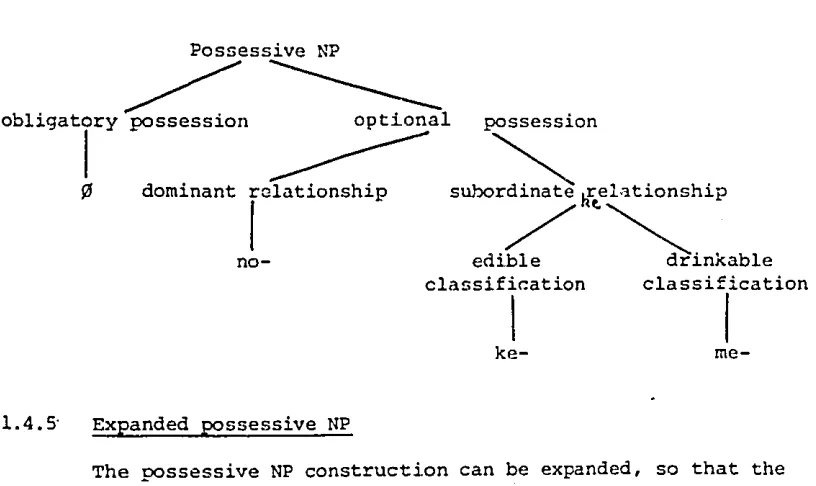
second noun is non-referential, or, in the case of ~~aper noun, is of
less concern to the speaker.
l.4 Possessive NP
1.4 . l So-called possessive NP can express the relationship between
the thing "possessed" and the 11possessor" at three levels of contrast:
Cal
Cb)
Cc)
obligatory-optional "possession";
11dominant-subordinate11 relationship;
"edible-drinkable" semantic classification.
A possessive NP includes a pcssessor suffix. The form of this
suffix indicates the number and person of the possessor.
A possessive NP also includes a classifier which indicates the
relationship between the thing possessed and the possessor. The
classifiers are:
no-,
ke-
me-obligatory possession;
optional possession; dominant relationship;
optional possession; subordinate relationship; edible
classif icatior
1.4.2 Obligatory-optional "possession"
Nouns may be clas!.ified as those which nay be optionally possessed and thos~ which must be obligatorily possessed.
An optionally possessed noun, if in a p.:>ssessive NP, must be preceded by one of the classifiers no-ke-me -:· a possessor suffix. 1
-For <>.xample:
(1. 22) (a) na no
-
na valedom. 3s n
art house
his house.
(b) na me
-
da. tichink. lplincl .n
art tea
our tea.
(c) na ke
-
mu uvied. 2s n
art yam
your yam.
12
An obligatorily possessed noun has a ~ classifier and Faley (personal communicationf) has suggested that a possessor suffix cannot stand alone after the ~ classifier. It is attached as a suffix to the
2
possessed noun. For example:
(1. 23) (a) na tina - qu
n ls
art mother
my mother.
(b) na yava - mu
n 2s
art leg your leg.
(c) na drau - na
n 3s
art leaf its leaf.
Obligatorily possessed nouns fall into semantic categories of parts of wholes, including kinship terms and body parts. However, not all
nouns falling into these categories are obligatorily possessed. Some 'tabu' words such as toitoi clitoris, or words for body ezudation such as ~ earwax do not take the possessor suffix. With some words, the
The full table of these classifiers and suffixes is set out at paras
162 (c) (d), (e) of ~ilner (1972 :79).
2 I find evidence for this analysis in sOI:le Western dialects, where the
possessor suffix is attached as a prefix to the possessed noun. e.g. In
Nadroga, "n,,a~~==t=a=i ls n a t
use of the suffix is optional - na nona uti- na utina his penis. With other words, the meaning will change depending on whether the construction
for optional or obligatory possession is used - na yacaqu, my name(obligatory)an'
na noqu yaca, my namesake(optional possession). 1.4.3 "dominant-subordinate11
relationship
The form of the classifier in the "possessive" indicates the
relationship of the "possessor11 to the "possessed", \.;hen the "possessed"
is optionally "possessed". For example: (1.24) (a)
(b)
(1.25) (a)
(b)
(1.26) (a) e
au rogoca
ls v tsom lcm hear
na nona itukutuku art dom3s n
message
I hear his message (which he brings).
au rogoca
ls v tsem scm hear
na ken.J. sub 3s art
itukutuku
n
message I he:•r the message about him.
au vakaraica na non a yaq:ma
ls v tsort dom3s n
scm look at art kava
I look at his kava (which he planted) . au vakaraica na kena yaqoaa
ls v tsorn sub3s n
scm look at art kava
I look at the kava presented on his behalf.
a kacivi ira vat a na .!12.na turaga ni kc.re o Roko
v ts 3pl dom3s n n art
Tui
c;i, past om tog- art chief rel.village Roko •rui
(b)
(1.27) (a)
call ether
The Roko Tui Ba called his village chiefs together (the chiefs over whom he has authority).
e ra via
3nl SCIO
c. i. want
gunu yaqona mai Bau na kena turaga
v n snb3s n
drink kava at Bau art chief
Its chiefs want to drink kava on Bau (the chiefs with authority over Bau) .
oqo na matai. e mai vei na !!!?_na vale?
deic n 3s n
here art car pen- c.i where?art oom house ter.
Ba
B~ (title,
Here is the carpeater. Where is his house? (which he built:)
(b) oqo na vuaka. e mai vei na kena vale?
deic n 3s n
here art pig. c i. where? art sub house
14
In the (a) examples, the possessive nona has the classifier no-
- -
- ·
The possessor is the actor, being active, formative or influentiall towardsthe things "possessed". In th e (b) examp es, t e l h possessive~ has
the classifier ke-. The possessor is the patient, being acted upon, characterised or influenced by the possessed.
~his contrast in meaning of the classifiers no- and ke- is
even clE:arer in the following examples: (1. 28) (a)
(b)
au na ls
talanoataka na
v tsom
scm fut tell art
t;2Ila vaka rus~ dorn3s v ts om
destroy
na koro n
art village
I will tell about. his destruction of the village (~ destroying the village) .
talanoataka na
tsom
au na ls
scm v
fut tell art
kena
sub3s
vakarusai na
v ts
destroy art
koro n
'tillage
I will tell about the destruction of the village (the villages's destruction).
In (a), !!£_- in the possessive nona indicates that the unspecified
11possessor11 was active in his relation to the "possessed"
-vakarusa na koro his destruction of the village.
In (b), kena indicates that na koro the village which is the
"possessor" was passive in relation to the "possessed''- vakarusai its
destruction. In this example, the form of the classifier correlates with the mood of the verb: no- and active mood; ke- and passive mood.
With~-, the 11possessor11 is actor: with ~-, the .. possessor" is
patient.
The contrast in meaning of these classifiers is _equally clear
in th·e following examples:
l
(1. 20) (al
(b)
au a raica na ~na
ls v tscm dom3s
scmpasfee art
I 5aw his depa:i:ture (he
au a raica na ~na ls v tsom sub3s scm past see art
lake yani v
qo is
away going). sele v
be castrated
I saw its castration (it is being castrated).
In (a}, ~ shows that the "possessor" was the subject of a nom.inalised intransitive actor-experiencer oriented verb, and was therefore active in relation to the "possessed" lako yani. In (b) , kena shews that the
11possessor11
was the subject of a nominalised intransitive patient-oriented verb, and was therefore passive in relation to the possessed
~· In these examples, the form of the classifier correlates with the type of
oriented) 1:
verb (actor·experiencer 3ubject oriented, or patient subject no- and actor-experiencer subject verb; ke- and patient subject verb.
The uses of ~and~ have been shown to correlate with active or passive moods (examples (l.28) and with actor-experiencer or patient oriented verbs (examples 1.29).
1.4.4 11Edible-drinkable11 semantic classification
There are certain semantic categories of nouns which can be marked by the classifier ke- as being edible or by me- as being drinkable. This marking of the possessive to indicate the semantic classification of the possessed may only be applied when the possessor has a •subordinate' relation to the possessed. A dominant relation is still marked by the .!!£_- classifier. For example:
(1. 30) (a)
(b)
(1. 31) (a)
(b)
kauta mada mai na nona ika
v tsorn dom3s n
bring please here art fish please bring his fish (he caught). kauta m,.J.a mai na kena ika
v tsom ed. 3s n
bring please ht,.C,: art fish please bring his fish (for him to eat) .
laki takia na v v tsom go draw art
nona wai dom3s n
watar
go and draw his water (he will use to wash in) .
laki v go
takia na .Jl!l.na v ts . 3s
om drink. draw art
wai n water
go and draw his water (for him to drink).
In the (a) examples, the possessor is seen as being active towards the thing possessed and this relationship is marked by no- as being dominant.
16 In (1. 30) (b) , the fish is seen as s.1mething being prepared for the possessor. The possessor is in a subordinate relationship to the
possessed. In (l.31) (b), the water is seen as something being prepared for the possessor. Again the possessor is in a subordinate relation-ship to the water. Because of this subordinate relationship, it is possible to mark the semantic classificatior- of the fish and the water. il<a is of the edible classification and is marked by ke-. w.\i is of the drinkable cla~sification and is marked by ~·
The form of classifier in the possessive may vary between ~
and ke-, according to the relationship of the possessor to the possessed. It may vary between ke- and~-, according to the semantic category of the possessed. See Table 1 in which the three contrasts described in 1.4.2., 1.4.3, and 1.4.!. are swrunarised
TABLE 1
/ess~
obligatory possession optional possession
!
'o•fo•.C,~
"""°~{."~°''
no- edible drinkable
cla!>sific:ation
I
classiycationke-
me-1. 4.
s·
Expanded possessive NPThe possessive NP construction can be expanded, so that the
possessor is specified. This can be done by an appositional construction or by the use of the relating particle i.
1.4.5.1 appositional construction
In this construction, the possessor NP follows the possessed
NP in apposition, and the possessive suffix coreferential with the specified possessor.
in the possessed NP is For example:
coreferential (1. 32) (a)
au sega ni tara rawa na uluna
ls v v ts v n 3s
scm not
cornpl.to8~
be hl art head a e I cannot touch the chief's head. [image:31.571.86.494.361.604.2](b) au via vakaraica na noJla vale na
ls v tsom dom3s n
scm want to look at art poss house art
I want to look at the chief's house.
(c)
au na talanoataka na kena vakarusai na ls v tsom stJ.b3s v ts scm fut tell about art destroy art
I will tell about the vil~age's destruction.
17
I
turaga n chiefkoro n
village
This construction is used when both NP are common. In (a), the possessed N!.' is obligatorily possessed. In (b) and (c), pos~~ssion is
non-obligatory. In (b), the poscessor n~ turag>is 'dominant'; in (c),
the poSSeSSQr na koro is I Sul"'· 'lrdinate I • 1. 4. 5. 2 relating particle i C.>Jnstruction
In this construction, the possessor NP follows the possesi:;ed
NP, and the two NP are connected by the relating particle.!:_ preceded by a classifier. For example:
(l.33)(a)
(b)
(1. 34) (a)
(b)
(1. 35) (a)
(b)
oqo na luvena deic n 3s here art child
here is her child.
-oqo deic here
here
-oqo daic here
here
-oqo deic here
na luve
iJ
i n clasS art childis Mere•s child.
na non a vale dom3s n art class house is
na
her house.
vale n
ne !_
dam art house class
Mere n Mere
Mere
n Mere
here is Mere's house (the house which Mere owns).
oqo na kena turaou deic sub3s n here art class chief
here is its chief (the chief with authority over it).
-
turaga kei
Bau oqo nadeic dam n
here art chief class Eau
here is the chief with authority over Bau.
1~is construction is used when the second noun iz proper. The (a)
e:tamples show unspecified possessors; the (bl examples are corresponding
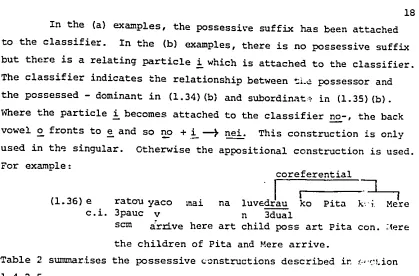
18 In the (a) examples, the possessive suffix has been attached to the classifier. In the (b) examples, there is no possessive suffix but there is a relating particle .!:_which is attached to the classifier. The classifier indicates the relationship between 4:i.c possessor and the possessed - dominant in (l.34) (b) and subordinat~ in (1.35) (b). Where the particle .!:_becomes attached to the classifier ~-, the back vowel ~ fronts to ~ and so i::..o +
.!..
~ nei. This construction is or.ly used in th~ singular. Otherwise the appositional construction is used. For example :(1.36) e ratou yaco :nai na c.i. 3pauc v
scm a:·rrive here art
coreferential
I
.---l,
luvcdrau ko Pita k·.·i Mere n 3dual
child poss art Pita con. ;.{~re
the children of Pita and Mere arrive.
[image:33.559.80.499.85.361.2]obligatory possession
unspecified na ulu+~a posseBsor her head
specified possessor proper
specified possessor conunon
na uluiMere Mere' s head
na uluna na turaqa the chief's head
dominant
na nona vale her house
na vale nei Mere Mere's house
subordinate
na kena itaba her picture
edible
na kena ika her fish
drinkable
na mena wai her water
na itaba kei Mere Mere's photo
edible drinkable
na ika kei ~lerc na wai mei l1ere Mcre's fish Mcre's water
na nona vale na turaga the c~icf's house
na kena ita~, na gone the ch:i l"'i;; photo
edible drinkable
~a kena ika na turaqa na mena wai na turaga the chicf1s fish the chief's water
!~
/:
....
20 2. THE VERB PHRASE
2.1 Introduction
A verb phras•' ._., .. 1sist~ .,ssentially ot a verbal partich. which
precedes a verb, and a subject concord marker which comes between the vr.rbal particle and the verb. If the verb is transitive, there is also
a transitiv<l suffix to the verb and there may be an o:iject marker which
fol'ows the ~ransitive suffix. For exarnple: (2.l)(a)
(b)
e r.atou 3p v.p. scm c ~i. They (few)
e rau v.p. 3dual
c .i . sen
They
(~i
gunu v drink
drink (intransit~ve) .
gunu+va v tsorn
.JI; t•;~
drink (transitive).
In these examples, the verbal particle is the r.lause introducer ~·
This will be described in section 2.3. In (a) the subject concord
marker ~s the third person paucaJ. ~· In (b) , it is the third person
dual rau. The verb in each example is~· In (a), it is in the
intransitive form. In (b), it is in the transitive form, being rnodif:'.ed by the transitive suffix -vi,. 'l'he obj ec:t marker in (b) is the suffix
~, before which lhe vowel i of the tLansitive suffix is deleted.
What distinguishes a verb phrase from ot .. er syntactic constructions
fr the use of a verbal particle. By the use of this verbal p.·rticle, •.t is possible to verbalise adjectives or nouns. For example:
2.2
(2.2) (a) e vulavula v .p. adj c.i. white i t is white.
(bl e bogi v.p. n c. i· night
it is night. (c) e ka ni
v.p. n
c. i· thing rel. i t is a matter
Categories of verb
madna
n shame
of shame.
Following Foley (1976: ppl57/B) and Arr.ls (1974), I have divided
verbs into two main categories:
(a)
(b)
actor-e~rperiencer oriented verb,
The first category incl~desverbswhich genbtally describe action or a Gtate of mind or body. The role of the subject of an intransitive verb is actor or experiencer. For example:
(2. 3) (a) e ratou t::ici
v.p. J pauc
-,
l':. 1.. scm run
they l."\:i.~ .•
(b) e rau cudru
v.p. 3dual v
c. i. scm angry
they are ar:i.gry. (c) e ra rooce
v.p. 3pl v c. i. scm s1.'"ep they sleep. Typical verbs in thi~ category are:
rai see
sau pay
rere be afraid rnasu pray vana shoot dabe sit vodo ride raqa flirt with kata bite regu kis.s ravu strike
val a sore
taro
t.oro kere kana vuli
soli bale sara lako
f."i9ht
as ...
.Jlogiseask approach ask for eat learn give fall
look at go
The secona category includes verl::swhich general~y d~scribe process or a sta~e resulting from a change of state. The role of the subject of an intransitive verb is patient.1 For example:
(2.4) (a) e (~.resu na isulu
v.p.
,
nc.i. tear art cloth the cloth tears (is torn).
(b) e kama na vale
v.p. v n
c.i. burn art house
the house burns (is burnt).
In these examples, the verb describes an ambiguous event - a process
or a state resulting from a change of state.
(2.S)(a) e bulu na vudi
v.p. v n
c ·i. hury art banana the banana is buried.
(b) e ubi na kakana
v.p. v n
c • l. • cover art food
the food is covered.
In these examples, the verb describes a state resulting from a change of state.
Typical verbs in this category are:
do la open sele castrate, cut
sere undo taki draw (water)
musu break ca vu pull up
bola split boko extinguish
vavi roast
·-
cola carryrogo hear kau carry
dromu sink oti finish
sogo close vuki turn over
22
The verb may be either intransitive or transitive. If it is transitive, it is modified by a transitive suffix. If it is intransitive, there is no special marking. For example:
intransitive transitive
root root t.suffix
run cici cici + vi
sleep mace m·~.:::e + ri
break musu musu + ki
shoot vana vana + taki
I will discuss the tra.isitive sl!ffix in section 2.4. 2. 3 Verbal P«•ticle and subject concord marker
Tr.ere are several verbal particles which are used to introduce a clause. Chapter 6 will discuss verbal particles m:=_ 'so that'; ni
'when'; ~'if'; and de 'lest' which introduce subordinate cl~uses. The verbal particles ka, s~ and !:,_which introduce relative clauses are discussed in chaptt• 5. In a verb phrase, C'l.ch of these particles precedes the subject concord marker which in turn precedes the verb.
In a main clause, the introductory verbal particle is the subject concord marker if the subject is first or second person. For
(2.6)(a) (k)au gunu ls v scm drink I drink.
(b) (k)edatou gunu
lpauc inc v
scm drink
we drink.
(c) keimami gunu:_
lpl
ex'
vscm drink
we dr•.nk
(d) (k)oni gunu
2 pl v
scm drink
you drink.
The dropping of the (k) in (al,(b) & (d) is optional in the 1 sing, 1
inclusive and 2 persons, but not in 1 exclusive (c).
If the subject is third pers~n, there is a clause introducing particle ~which precedes the subject concord marker which precedes
the verb. For example:
(2.7)(a) e ratou gunu
v.p. 3pauc v c. i. scm drinh· they drink.
(b) e ra gunu
v.p. 3pl v c. i. scm drink they drink.
(c) e
fl
gunuv.p. v
~-::. i. scm drink it drinks.
Milner (1972, p54) sets out the full set of subJect concord markers
in his paragraph 112, as follows: FIRST PERSON
EXCLUSIVE INCLUSIVE
SINGULAR (k) au 'u
'
DUAL keii:au (e)daru
TF.Il\L keitou (e) datou
~¥'.()RKtucal) ~eirnami (e)da
SECOND PERSON
(k)o (k)odrau (k)o dou
-(k) 0 ni
THIRD PERSON
(e)rau (e)ratou
(e) ra I differ from him in 1 inclusive and 3 person columns. My data are
(k)edaru, (k)edatou, (k)eda as ~ dual, paucal and plural subject concord markers for a main clause: and ~' ~and ra as 3 dual, paucal and
24
If Milner's data are correct, it could be said that the clause introducing partJ~te ~ is used with the third person and the first person inclusiv: ~-.&.bjects. If mine are correct and my informants say they are, then ~ is only used with the third person. Foley (1976, p56) explains the use
oC
the clause introducing particle ~ when the subject is third person, in terms of a reanalysis of the 3 person singular concord marker. He points out that most Eastern C•ceanic languages have a basic word order of subj~ct-verb-object, but that Fijian innovated a basic word order of verb-object-subject. The expressed noun phrase subject shifted from left to right but the pronominal con-cord marker did not. It re.~ained stranded ta tho left. Ultimately the 3 singular pronominal concord marker !:. was reanalysed as an intro-ducing particle and the new third singular pronominal concord marker wasf3.
With the first and second persons as subjects, the previous ~urd order SVO was retained in Fijian because there is no expressednoun phrase to shift to the right. I f Milner's data about 1 inclusives
are correct, Foley's analysis is even more convincing. The ~preceding
daru, ~, da as well as the~ pruceding ~, ratou, ra can both.
be interpreted as the same clause introducing particle, being reanalysed as such from the form of the 3 singular subject concord marker before
Fijian innovated from SVO to VOS. My dat:a do not ~~1nr:nrr. -:t..i-; i_pr-~ .. !'lretation of
e and 1 inclusive.
- The number of the 3rd person subject concord Marker depends
on whether the subject is human or non-human. For example:
1
(2.8) (a)
(b)
(c)
(d)
e ra gunu (na gone lalai 1J
3pl v n adj non-sing
c. i. scm drink art child little they/the little chiltlren drink. e ;l bale (na vunikau lekaleka)
3s v n adj sing
c.i.scrn fa.!l art tree short it/the short tree falls.
e gunu (na
v
1 cikinovu balabalcivu )
n adj
c.·. scm drink art centipede long they/the
e (ral 3pl c.i. scm
long centipedes drink. gunu na vusi lalai 1
v n adj
drink art cat little
the kittens drink.
If the subject is human, the number of the concord marker is the same
:lon-singular form of balavu or laila~