From the authors
of the best-selling
Your E-
commerce
Site
™
1 YEAR UPGRADE
BUYER PROTECTION PLAN
Your E-
commerce
Site
From the authors
of the best-selling
Ryan Russell Teri Bidwell Oliver Steudler Robin Walshaw
L. Brent Huston Technical Editor
The Only Way to Stop a Hacker Is to Think Like One
• Step-by-Step Instructions for Securing Financial Transactions
and Implementing a Secure E-Commerce Site
• Hundreds of Tools & Traps and Damage & Defense Sidebars
and Security Alerts!
s o l u t i o n s @ s y n g r e s s . c o m
With more than 1,500,000 copies of our MCSE, MCSD, CompTIA, and Cisco study guides in print, we continue to look for ways we can better serve the information needs of our readers. One way we do that is by listening.
Readers like yourself have been telling us they want an Internet-based ser-vice that would extend and enhance the value of our books. Based on reader feedback and our own strategic plan, we have created a Web site that we hope will exceed your expectations.
[email protected]is an interactive treasure trove of useful infor-mation focusing on our book topics and related technologies. The site offers the following features:
■ One-year warranty against content obsolescence due to vendor product upgrades. You can access online updates for any affected chapters.
■ “Ask the Author”™ customer query forms that enable you to post questions to our authors and editors.
■ Exclusive monthly mailings in which our experts provide answers to reader queries and clear explanations of complex material.
■ Regularly updated links to sites specially selected by our editors for readers desiring additional reliable information on key topics.
Best of all, the book you’re now holding is your key to this amazing site. Just go to www.syngress.com/solutions, and keep this book handy when you register to verify your purchase.
Thank you for giving us the opportunity to serve your needs. And be sure to let us know if there’s anything else we can do to help you get the max-imum value from your investment. We’re listening.
The Only Way to Stop a Hacker is to Think Like One
Your E-
commerce
Site
™
1 YEAR UPGRADE
BUYER PROTECTION PLAN
Your E-
commerce
Syngress Publishing, Inc., the author(s), and any person or firm involved in the writing, editing, or production (collectively “Makers”) of this book (“the Work”) do not guarantee or warrant the results to be obtained from the Work.
There is no guarantee of any kind, expressed or implied, regarding the Work or its contents.The Work is sold AS IS and WITHOUT WARRANTY.You may have other legal rights, which vary from state to state. In no event will Makers be liable to you for damages, including any loss of profits, lost savings, or other inci-dental or consequential damages arising out from the Work or its contents. Because some states do not allow the exclusion or limitation of liability for consequential or incidental damages, the above limitation may not apply to you.
You should always use reasonable case, including backup and other appropriate precautions, when working with computers, networks, data, and files.
Syngress Media®, Syngress®, and “Career Advancement Through Skill Enhancement®,”are registered trademarks of Syngress Media, Inc. “Ask the Author™,”“Ask the Author UPDATE™,”“Mission Critical™,” and “Hack Proofing™” are trademarks of Syngress Publishing, Inc. Brands and product names mentioned in this book are trademarks or service marks of their respective companies.
KEY SERIAL NUMBER
001 AERAF43495
002 VNA49FU4FJ
003 CAKL3956FM
004 BNA424TURT
005 BNTUR495QF
006 596JFA3RRF
007 Y745T9TBLF
008 QW5VCD986H
009 BN3TE5876A
010 NVA384NHS5
PUBLISHED BY Syngress Publishing, Inc. 800 Hingham Street Rockland, MA 02370
Hack Proofing Your E-Commerce Site
Copyright © 2001 by Syngress Publishing, Inc. All rights reserved. Printed in the United States of America. Except as permitted under the Copyright Act of 1976, no part of this publication may be reproduced or dis-tributed in any form or by any means, or stored in a database or retrieval system, without the prior written permission of the publisher, with the exception that the program listings may be entered, stored, and executed in a computer system, but they may not be reproduced for publication.
Printed in the United States of America 1 2 3 4 5 6 7 8 9 0
ISBN: 1-928994-27-X
Technical edit by: L. Brent Huston Copy edit by: Darren Meiss and Beth A. Roberts Technical review by: Kevin Ziese Freelance Editorial Manager: Maribeth Corona-Evans Co-Publisher: Richard Kristof Index by: Robert Saigh
Developmental Editor: Kate Glennon Page Layout and Art by: Shannon Tozier Acquisitions Editor: Catherine B. Nolan
v
Acknowledgments
v
We would like to acknowledge the following people for their kindness and support in making this book possible.
Richard Kristof and Duncan Anderson of Global Knowledge, for their generous access to the IT industry’s best courses, instructors and training facilities.
Ralph Troupe, Rhonda St. John, and the team at Callisma for their invaluable insight into the challenges of designing, deploying and supporting world-class enterprise networks.
Karen Cross, Lance Tilford, Meaghan Cunningham, Kim Wylie, Harry Kirchner, Bill Richter, Kevin Votel, and Brittin Clark of Publishers Group West for sharing their incredible marketing experience and expertise.
Mary Ging, Caroline Hird, Simon Beale, Caroline Wheeler,Victoria Fuller, Jonathan Bunkell, and Klaus Beran of Harcourt International for making certain that our vision remains worldwide in scope.
Anneke Baeten, Annabel Dent, and Laurie Giles of Harcourt Australia for all their help.
David Buckland,Wendi Wong, Daniel Loh, Marie Chieng, Lucy Chong, Leslie Lim, Audrey Gan, and Joseph Chan of Transquest Publishers for the enthusiasm with which they receive our books.
Kwon Sung June at Acorn Publishing for his support.
Ethan Atkin at Cranbury International for his help in expanding the Syngress program.
vii
Contributors
Ryan Russell(CCNA, CCNP) is the best-selling author of Hack
Proofing Your Network: Internet Tradecraft(ISBN: 1-928994-15-6). He is MIS Manager at SecurityFocus.com, has served as an expert witness on secu-rity topics, and has done internal secusecu-rity investigation for a major soft-ware vendor. Ryan has been working in the IT field for over 11 years, the last 6 of which have been spent primarily in information security. He has been an active participant in various security mailing lists, such as
BugTraq, for years. Ryan has contributed to four Syngress titles on the topic of networking. He holds a Bachelors of Science degree in Computer Science. Ryan wishes to thank Karen Mathews at the U.S. Department of Energy for her assistance in preparing Chapter 10.
Mark S. Merkow(CCP) has been an Information Systems professional
since 1975, working in a variety of industries. For the last 12 years he has been working for a Fortune 50 financial services company in Phoenix, AZ. Mark holds a Masters in Decision and Information Systems from Arizona State University’s College of Business and is completing his Masters of Education in Educational Technology at ASU’s College of Education, specializing in developing distance learning courses.Today he serves as an e-commerce Security Advisor working with both internal and external Web designers and developers. Mark has authored or co-authored six books on computer technology since 1990, including Breaking Through Technical Jargon,Building SET Applications for Secure Transactions,Thin Clients Clearly Explained,Virtual Private Networks For Dummies,A Complete Guide to Internet Security, and The ePrivacy Imperative. In addition, Mark is a computer columnist for several local, national, and international print publications, along with an e-zine hosted
at Internet.com.
Robin Walshaw(MCSE, DPM), author of Mission Critical Windows
viii
corporations around the globe. By applying a combination of sound busi-ness sense and technical insight, Robin is able to design and deliver scal-able solutions targeted at enabling the enterprise to effectively leverage technology.With a flair for developing strategic IT solutions for diverse clients, he has worked in the world of computers in 8 countries, and has traveled to over 30 in the last 10 years. A veteran of numerous global pro-jects, Robin has honed his skills across a wide variety of businesses, plat-forms, and technologies. He has managed to scratch his head and look slightly confused in the world of security, network operating systems, development, and research.
Having traversed the globe and seen its many beautiful wonders, Robin is still captivated by the one thing that leaves him breathless— Natalie, his wife. She is a light against the darkness, a beauty whose smile can melt even the coldest heart.
Teri Bidwell(GCIA) has been involved in Internet security for over 10
years as an analyst, engineer, and administrator and is a SANS-Certified GCIA Intrusion Analyst. Her career began securing Unix networks at the University of Colorado and continued as a Cisco network engineer and DNS manager for Sybase, Inc.Today,Teri is a security analyst for a firm headquartered in Reston,VA. She is a key contributor to corporate secu-rity strategy and is an advisor for e-business development. Her specialties include policy creation, vulnerability assessment, penetration testing, and intrusion detection for corporate environments.
Teri received a Computer Science degree from the University of Colorado and sits on the SANS GCIA Advisory Board. She currently lives and works in Boulder, CO with her family, Clint,Wes, and Michael.
Michael Cross(MCSE, MCP+I, CNA) is a Microsoft Certified System
ix
team that provides support to a user base of over 800 civilian and uniform users. His theory is that when the users carry guns, you tend to be more motivated in solving their problems.
Michael owns KnightWare, a company that provides consulting, pro-gramming, networking,Web page design, computer training, and other services. He has served as an instructor for private colleges and technical schools in London, Ontario Canada. He has been a freelance writer for several years and has been published over two dozen times in books and anthologies. Michael currently resides in St. Catharines, Ontario Canada with his lovely fiancée Jennifer.
Oliver Steudler(CCNP, CCDP, CSE, CNE) is a Senior Systems
Engineer at iFusion Networks in Cape Town, South Africa. Oliver spe-cializes in routing, switching, and security and has over 10 years of experi-ence in consulting, designing, implementing, and troubleshooting
complex networks. He has written articles on TCP/IP, networking, secu-rity, and data communications and also co-authored another Syngress title, Managing Cisco Network Security (ISBN: 1-928994-17-2).
Kevin Zieseis a computer scientist at Cisco Systems, Inc. Prior to
joining Cisco, he was a senior scientist and founder of the Wheelgroup Corporation, which was acquired by Cisco Systems in April of
x
L. Brent Hustonearned his Associate of Applied Science degree in
Electronics at DeVry Technical Institute (Columbus, Ohio) in 1994. He has more than 10 years of experience in IT, mostly in the areas of cyber security testing, network monitoring, scanning protocols, firewalls, viruses and virus prevention formats, security patches, and hacker techniques. As President and CEO of his own information security company,
MicroSolved, Inc., he and his staff have performed system and network security-consulting services for Fortune 500 companies and all levels of governmental facilities. He is well versed in the use and implementation of all the major security tools and appliances. In the past, Brent developed “Passys”—a passive intrusion detection system for Unix and has also iden-tified previously unknown security vulnerabilities in Ascom routers, Windows NT, and Linux operating systems.
Brent is an accomplished computer and information security speaker and has published numerous white papers on security-related topics. Recently he was involved in the laboratory testing of major firewall appli-ances at his company’s central Ohio facilities.This testing was to prove the worthiness of each appliance as well as possible vulnerabilities that had not as yet been established by their parent companies. He reported his results both to the individual product companies and at a national security industry presentation. Brent is also currently engaged with the Office of Independent Oversight and Performance Assurance in Columbus, OH. He was responsible for designing and implementing a state-of-the-art cyber security testing and research lab for this office and several DOE national laboratories have utilized his expertise to perform network pene-tration and detection services. Such services have required a high security clearance from Brent. Brent is an Internet Security Systems Certified Engineer, Sidewinder Firewall Certified Administrator, IBM Secure Network Gateway Certified Administrator, and Phoenix Firewall Certified Administrator.
Contents
xi
Foreword xxv
Chapter 1 Applying Security
Principles to Your E-Business 1
Introduction 2 Security as a Foundation 3 Confidentiality 3 Integrity 4 Availability 4 Presenting Security As More Than
a Buzzword 6
The Goals of Security in E-Commerce 9 Planning with Security in Mind 10 Security during the Development Phase 13 Implementing Secure Solutions 14 Managing and Maintaining Systems in
a Secure Environment 15 Applying Principles to Existing Sites 20 It All Starts with Risk 21 Fix the Highest Risks First 22 Management and Maintenance during
the Patching Process 23 Impact of Patching on Production
Systems 24
The Never-Ending Cycle of Change 25 Developing a Migration Plan 26 How to Justify a Security Budget 27 The Yardstick Approach 27
Understand the Goals of Security in the Commerce Process
■ Protect the privacy of
the consumer at the point of purchase.
■ Protect the privacy of
the customers’ information while it is stored or processed.
■ Protect the
confidential identity of customers, vendors, and employees.
■ Protect the company
from waste, fraud, and abuse.
■ Protect the
information assets of the company from discovery and disclosure.
■ Preserve the integrity
of the organization’s information assets.
■ Ensure the availability
of systems and processes required for consumers to do business with the company.
■ Ensure the availability
A Yardstick Approach Case Study 29 Possible Results of Failure 30 The Fear Tactic Approach 31 A Fear Tactic Approach Case Study 32 Possible Results of Failure 34 Security as a Restriction 35 Security as an Enabler 36 Summary 38 Solutions Fast Track 39 Frequently Asked Questions 43
Chapter 2 DDoS Attacks:
Intent, Tools, and Defense 45
Introduction 46 What Is a DDoS Attack? 47 Laying the Groundwork: DoS 48 Resource Consumption Attacks 50 Malformed Packet Attacks 57 Anatomy of a DDoS attack 60 The Attacks of February 2000 63 Why Are E-Commerce Sites Prime Targets
for DDoS? 67
A Growing Problem 68
How the Media Feeds the Cycle 69 What Motivates an Attacker to Damage
Companies? 70 Ethical Hacking: A Contradiction in Terms? 70 Hacktivism 72 Fifteen Minutes of Fame 72 Hell Hath No Fury Like a Hacker Scorned 73 Show Me the Money! 73
Malicious Intent 74
What Are Some of the Tools Attackers Use
to Perform DDoS Attacks? 75 Trinoo 76 Understanding How Trinoo Works 76
Damage & Defense Sidebars Provide You with Additional Information on Minimizing Risk
Damage & Defense… Configuration Management
TFN2K:The Portable Monster 78 Understanding How TFN2K Works 78 Stacheldraht—A Barbed-Wire Offensive 81 Understanding How Stacheldraht Works 81 More DDoS Families 86 How Can I Protect My Site against These
Types of Attacks? 87
Basic Protection Methods 90 Using Egress Rules to Be a
Better “Net Neighbor” 95 Defending against the SYN’s of
the Internet 99
Methods for Locating and Removing
Zombies 103 Summary 109 Solutions Fast Track 111 Frequently Asked Questions 117
Chapter 3 Secure Web Site Design 119
Introduction 120 Choosing a Web Server 121 Web Server versus Web Service 121 Factoring in Web Servers’ Cost and
Supported Operating Systems 122 Comparing Web Servers’ Security Features 127 Authentication 127 Using the SET Protocol 133 Setting Permissions 134 Using CGI Applications 134 Security Features Side By Side 134 The Basics of Secure Site Design 143 Creating a Security Plan 143 Protecting against Internal Threats 145 Adding Security Tiers beyond the
Web Server 146
Apache versus Internet Information Services 149 Installation:The First Step 151
Know What You May Be Giving Away in Your HTML Code
Each hidden tag can be used with forms on your site and includes a name and a value. When the form is submitted, the name and value in the hidden field is included with the results. For example, the following line of code shows an input value of $100.00 associated with a variable called "cost."
<input type=hidden name="cost"
value="100.00">
Installing and Configuring Apache 152 Installing and Configuring Internet
Information Server 5.0 164 Windows 2000 Server and Internet
Information Server 5.0 Security 168 Hardening the Server Software 173 Install Patches 174 Disable Unneeded Ports, Services, and
Components 174 Delete Unneeded Scripts and Files 175 Hardening the Overall System 176 Password Hacking and Analysis Tools 178 Web Design Issues Dealing with HTML
Code 183 Information in HTML Code 183 Using Server Side Includes (SSI) in
HTML Code 186
Guidelines for Java, JavaScript, and Active X 189 Understanding Java, JavaScript, and
ActiveX—and the Problems They
May Cause 189
Preventing Problems with Java,
JavaScript, and ActiveX 191 Programming Secure Scripts 196 Code Signing: Solution or More Problems? 199 Understanding Code Signing 199 The Strengths of Code Signing 200 Problems with the Code Signing Process 201 Should I Outsource the Design of My Site? 202 Understanding the Required Skills 203 Pros and Cons of Outsourcing Design Work 204 Workload 204 Security 205 Contracts and Cost 206 No Matter Who Designs It, Double-Check
Summary 209 Solutions Fast Track 210 Frequently Asked Questions 214
Chapter 4 Designing and Implementing
Security Policies 219
Introduction 220 Why Are Security Policies Important to an
E-Commerce Site? 220
What Is a Security Policy? 221 Value versus Risk 222 Security versus Services Provided 223 Cost of Security versus Cost of Not
Having Security 224 Where Do I Begin? 225 What Elements Should My Security Policy
Address? 228
Confidentiality and Personal Privacy Policies 230 Requirements for Authentication 231 Requirements for Protecting Customer
Information 236
Privacy Policies 239 Information Integrity Policies 240 Quality Assurance Policies 241 Assuring Information Integrity through
Technology 244
Availability of Service Policies 244 Are Prewritten Security Policies Available on
the Net? 246
All Organizations Are Different—and So
Are Their Policies 246 Example Policies and Frameworks 247 A Word about the Outsourcing of Policy
Development 248 How Do I Use My Security Policy to
Implement Technical Solutions? 248
Learn How to Produce a Security Policy
Policy Research New Security
Issue
How Do I Inform My Clients of My
Security Policies? 251 Building Customer Confidence through
Disclosure 252 Security as a Selling Point 253 Summary 254 Solutions Fast Track 255 Frequently Asked Questions 259
Chapter 5 Implementing a Secure
E-Commerce Web Site 261
Introduction 262 Introduction to E-Commerce Site
Components 262 Implementing Security Zones 264 Introducing the Demilitarized Zone 266 Multiple Needs Equals Multiple Zones 268 Problems with Multi-Zone Networks 271 Understanding Firewalls 272 Exploring Your Firewall Options 272 Designing Your Firewall Rule Set 275 It Starts with a “Deny All” Attitude 276 Common Ports for Common
Communications 276 Converting Pseudo-Code to Firewall
Rules 278 Protocols and Risks: Making Good
Decisions 279 How Do I Know Where to Place My
Components? 280 Profiling Systems by Risk 280 Establishing Risk Control Requirements 282 Creating Security Zones through
Requirement Grouping 283 Implementing Intrusion Detection 283 What Is Intrusion Detection? 285 Your Choices in Intrusion Detection 286
Chapter 5 Answers All Your Questions About Implementing a Secure Site
Q:How do I know if I am logging too much or too little information on my systems?
A:Log the information you feel that you need to make good
Network-Based IDS 288
Host-Based IDS 290
Example of a Network-Based IDS 292 Example of a Host-Based IDS 293 Managing and Monitoring the Systems 295
What Kind of Management Tasks Can
I Expect to Perform? 295 What Kinds of Monitoring Should I Be
Performing? 296 Basic System Monitoring 298 Monitoring Your Security Devices 299 Log File Management 300 Should I Do It Myself or Outsource My Site? 301 Pros and Cons of Outsourcing Your Site 302 Co-Location: One Possible Solution 303 Selecting an Outsource Partner or ASP 303 Summary 305 Solutions Fast Track 305 Frequently Asked Questions 311
Chapter 6 Securing Financial Transactions 313
Introduction 314 Understanding Internet-Based Payment
Card Systems 315
Credit, Charge, or Debit Cards:What Are
the Differences? 315 Point-of-Sale Processing 317
Differences That Charge Cards
Bring into the Picture 318 Capture and Settlement 319 Steps in an Internet-Based Payment
Secure Payment Processing Environments 331 Additional Server Controls 335 Controls at the Application Layer 336 Understanding Cryptography 337 Methodology 337 Substitution Method 337 Transposition Method 338 Transposition Example 339 The Role of Keys in Cryptosystems 342
Symmetric Keys 342
Asymmetric Keys 342 Principles of Cryptography 343 Understanding Hashing 344
Digesting Data 345
Digital Certificates 348
CCITT X.509 349
Examining E-Commerce Cryptography 351 Hashing Functions 351
Block Ciphers 352
Implementations of PPK Cryptography 352
The SSL Protocol 353
Transport Layer Security (TLS) 355 Pretty Good Privacy (PGP) 356 S/MIME 357 Secure Electronic Transactions (SET) 357 XML Digital Signatures 359 Virtual POS Implementation 362 ICVERIFY 362 Alternative Payment Systems 364 Smart-Card-Based Solutions 365 EMV 365 MONDEX 367
Visa Cash 368
The Common Electronic Purse
Specification (CEPS) 369 Proxy Card Payments 369 PayPal 370
Complete Coverage of Third Party Merchants' POS Systems.
ICVERIFY's features include the following:
■ Importing credit card
transaction data from other PC applications, such as spreadsheets or databases.
■ Offline group mode to
submit a batch of transactions at one time for authorization.
■ Support for Address
Verification Systems (AVSs), Retail AVSs, CVV2s, and CVC2s to help reduce fraud due to stolen or fraudulent cards.
■ Data import analysis of
Amazon Payments 370
Funny Money 371
Beenz 371 Flooz 371 Summary 372 Solutions Fast Track 373 Frequently Asked Questions 379
Chapter 7 Hacking Your Own Site 381
Introduction 382 Anticipating Various Types of Attacks 382 Denial of Service Attacks 382 Information Leakage Attacks 384 File Access Attacks 385 Misinformation Attacks 386 Special File/Database Access Attacks 387 Elevation of Privileges Attacks 388 Performing a Risk Analysis on Your Site 389 Determining Your Assets 390 Why Attackers Might Threaten Your Site
and How to Find Them 392 Testing Your Own Site for Vulnerabilities 395 Determining the Test Technique 396 Researching Your Vulnerabilities 399 Mapping Out a Web Server 407 Using Automated Scanning Tools 409 Hiring a Penetration Testing Team 414 Summary 418 Solutions Fast Track 419 Frequently Asked Questions 423
Chapter 8 Disaster Recovery
Planning: The Best Defense 425
Introduction 426 What Is Disaster Recovery Planning? 426 Structuring a Disaster Recovery Plan 428 Loss of Data or Trade Secrets 429
Tools & Traps, Security Alerts, and Damage & Defense Sidebars Make Sure You Don’t Miss a Thing:
Tools & Traps…Gauge Your Threat Level with a Honeypot
A honeypot (in an information security context) is a system that is designed to be broken into. Setting up a
Loss of Access to Physical Systems 431 Loss of Personnel or Critical Skill Sets 436 Practicing Compliance with Quality
Standards 436 Ensuring Secure Information Backup and
Restoration 438 The Need for Backups and Verification 439 An Example Backup Rotation Process 440 Storage Area Networks 442 Protecting Backups of Sensitive Information 443 User Authentication 444 Data Encryption and Controls 445
Key Management 446
Planning for Hardware Failure or Loss of
Services 447 The Single Point of Failure Problem 448
ISP Redundancy 449
Network Hardware Redundancy 451 System Hardware Redundancy 451 Expanding the Scope of Your Solutions 453 How Do I Protect against Natural Disasters? 454 Hot Sites:The Alternate Path to Recovery 455 How Do I Choose a Hot Site? 456 Testing the Process 456 Understanding Your Insurance Options 457 Errors and Omissions Coverage 458 Intellectual Property Liability 459 First Party E-Commerce Protection 460 Determining the Coverage You Need 461 Financial Requirements 463 The Delicate Balance: Insurance and
the Bottom Line 464 Coverage That May Not Be Needed 464 Summary 466 Solutions Fast Track 467 Frequently Asked Questions 472
Chapter 8 Answers All Your Questions About Disaster Recovery Planning:
Q:How does e-commerce insurance pay out benefits when I incur a loss?
A:Types of insurance payout provisions are "Pay on Behalf" versus "Indemnification." Pay on Behalf takes care of expenses as they are incurred by the insured and works a bit like homeowner’s
insurance. If the policy covers your defense in a lawsuit, the legal fees will be paid as they are incurred. Indemnification reimburses the insured for covered expenses already incurred and works a bit like traditional health insurance. You pay for the covered expense and then apply for reimbursement from the insurer. Most insurance offerings for e-commerce are of the "Pay on Behalf" variety.
Q:What’s the difference between a password and a passphrase?
Chapter 9 Handling Large Volumes
of Network Traffic 475
Introduction 476 What If My Sites Popularity Exceeds My
Expectations? 476 Determining the Load on Your Site 478 Determining Router Load 479 Determining Switch Load 483 Determining Load Balancer Load 484 Determining Web Server Load 485 Performance Tuning the Web Server 488 How Do I Manage My Bandwidth Needs? 493 Contracting for Bandwidth 493 Estimating Required Service Levels 496 How Do I Know When I Need More
Bandwidth? 497 Obtaining Bandwidth on Demand 498 Introduction to Load Balancing 499 What Is Load Balancing? 500 Changing the Destination MAC Address 501 Modifying the IP Addresses 502 Using a Proxy Server 503 Finding a Custom Software/Clustering
Solution 504 Determining Load 504 The Pros and Cons of Load Balancing 505 Load Balancing and Security 505 Summary 509 Solutions Fast Track 510 Frequently Asked Questions 512
Chapter 10 Incident Response,
Forensics, and the Law 515
Introduction 516 Why Is an Incident Response Policy Important? 516 Panic or Be Calm:You Decide 516 How Not to Handle an Incident 517
Understand Load Balancing and Security
For the most part, load balancers don’t change security much, and in fact some can enhance it by acting as limited firewalls. However, in a few cases, security may be impacted.
Proper Policy Pays Off 518 Incident Response Policy Recap 524 Establishing an Incident Response Team 525 Setting the Prosecution Boundaries 526 Attackers Crossing the Line 526 Understanding the Chain of Custody 529 Establishing an Incident Response Process 530 Introduction to Forensic Computing 531 Tracking Incidents 538 Resources 542 Legal/Government/Law Enforcement 542 Backup/Forensics 542 Incident Tracking Systems 543 Miscellaneous 544 Summary 545 Solutions Fast Track 546 Frequently Asked Questions 550
Appendix A Cisco Solutions
for Content Delivery 553
Introduction 554 Improving Security Using Cisco LocalDirector 555 LocalDirector Technology Overview 555 LocalDirector Product Overview 556 LocalDirector Security Features 557 Filtering of Access Traffic 557 Using synguardto Protect against
SYN Attacks 557
Using Network Address Translation
to Hide Real Addresses 559 Restricting Who Is Authorized to
Have Telnet Access to the
LocalDirector 560 Password Protection 561
Syslog Logging 562
Security Geographically Dispersed Server
Farms Using Cisco DistributedDirector 563
Maintain a Chain of Custody List
■ Who was in custody
(possession) of the evidence?
■ Where was the
evidence?
■ What security
measures are in place at that location?
■ What items of
DistributedDirector Technology Overview 563 DistributedDirector Product Overview 565 DistributedDirector Security Features 565 Limiting the Source of DRP Queries 565 Authentication between
DistributedDirector and DRP Agents 566 Password Protection 568
Syslog Logging 570
Improving Security Using the Cisco Content
Services Switch 570
Content Services Switch Technology
Overview 571 Content Services Switch Product Overview 572 Content Services Switch Security Features 573 FlowWall Security 573 Using Network Address Translation
to Hide Real Addresses 574 Firewall Load Balancing 575 Password Protection 576 Disabling Telnet Access 577
Syslog Logging 578
Known Security Vulnerabilities 578 Summary 580 Frequently Asked Questions 581
Appendix B Hack Proofing Your
E-Commerce Site Fast Track 583
Hack Proofing Your E-Commerce Site was written in response to requests from
readers of our first book,Hack Proofing Your Network: Internet Tradecraft. Many of
you asked us for more detail on how to protect e-commerce sites, given the unique risk and exposure such sites represent to organizations.We hope this book answers all of your questions on the topic and then some. If your organization engages in e-commerce, you will find this book invaluable, especially if security has been dealt with in a reactive fashion in the past. If you are a seasoned security professional, we believe that the level of detail in this book will be useful in cov-ering topics such as customer privacy policies and securing financial transactions. As practitioners, we encounter two types of networks:Those that haven’t been hacked and those that have. Our goal is to provide you with the tools and
resources to avoid seeing your network become part of the latter group.To that end, this book is thoroughly practical.We recognize that doing the “right” thing—creating a forensics laboratory and halting production to investigate each breach in painstaking detail—is beyond most staff resources, so we offer real-world solutions to approach that ideal within your limits.
We believe that for this book to be practical, it must also cover topics such as disaster recovery, load balancing, and performance optimization.We’ve tried to
Foreword
avoid the trap of recommending ill-defined “black-box” hardware solu-tions, a trap that other books in the field often fall into.
This book shares a feature in common with many Syngress books: It
teaches whyalong with how.This is especially critical in the world of
information security because technologies evolve at such a rapid pace and are also incredibly diverse.There are as many different ways to piece together an e-commerce site as there are e-commerce sites. It wouldn’t be possible to anticipate any given reader’s configuration.We present material that is designed to make you think.We want you to be able to take the information presented and adapt it to your situation.
We really hope you enjoy this book.You’ll notice that Syngress offers an “Ask the Author” feature on their Web site for folks who have purchased the book. Please take advantage of that; we’d love to hear from you.
Applying Security
Principles to Your
E-Business
Solutions in this chapter:
■ Security as a Foundation
■ Applying Principles to Existing Sites ■ How to Justify a Security Budget ■ Security as a Restriction
■ Security as an Enabler
; Summary
; Solutions Fast Track
; Frequently Asked Questions
Chapter 1
Introduction
Security in the virtual world of the Internet is even more confusing than in the real world we inhabit. Buzzwords and marketing hype only serve to add to the puzzle.Vendors and free products abound, but according to the experts, the Internet world is becoming more dan-gerous every day. How can that be? How can all these solutions from so many directions not solve even the basic problems?
The answer is not simple because the problems are so complex. Security is difficult to create and maintain. Security is messy.The problem is that the online world was built around a system of protocols and rules, but unfortunately, those rules are not always followed.The complexity of today’s computer systems and software applications often creates programs that act in a manner unforeseen by the Internet’s oper-ational guidelines. Add to that scenario a few humans who insist on testing the rules and purposefully acting unexpectedly, and you have a huge potential for a rather large mess.
Attaining and maintaining suitable levels of security also requires resources. It requires people with the technical and business skills in bal-ance. It requires time, energy, and of course, money. Security is not cheap. Products and training and doing things the right way are usually more expensive in the short term than taking shortcuts and cutting cor-ners, but in the long run, security protects the assets that your organiza-tion depends on for survival.
Given all these dynamics, the concept of security can be seen as an ever-changing ideal that encompasses these threats and adapts as they adapt, like a living process. Security is most assuredly a journey and not a destination.
The easiest starting point on that journey is from the ground up. In the e-commerce world, those who benefit the most from security’s elu-sive protections are those who started the process with security firmly in mind.While it is possible to apply security to existing sites, the imple-mentation is often more difficult than starting the process anew.
measure its successes. For those of you who are tasked with defending an existing e-commerce site or other Web presence, we will explore the roles you should play in your organization and the process by which you can improve your site’s security posture.
Security as a Foundation
The easiest, and many agree, the best way to create a secure environment is to start with security in mind.This means applying the principles of secure operation as the foundation upon which the rest of the project will be built.The primary principles of security are confidentiality, integrity, and availability.To succeed, the project must address these prin-ciples in all phases and applications.
Confidentiality
Confidentiality is the most widely known of the principles. Businesses have been dealing with confidentiality since commerce began.Today, it is a basic expectation of consumers that their personal information will be protected from disclosure.Vendors also expect a level of confidentiality to protect custom pricing, custom scheduling, and contractual details of their transactions with your company.Yet, as widely accepted as the con-cept of confidentiality is, it remains difficult to execute. Companies are in the news regularly because information about clients, vendors, or the politics of business relationships has become known.
If your company had exposed the records of these clients, what would the damage to your bottom line have been? How would your company deal with such a situation?
Integrity
Integrity is perhaps the most difficult of the principles to achieve, yet it is the most vital of the three. Businesses must manage and maintain the integrity of the information with which they are entrusted. Even the slightest corruption of that data can cause complete chaos.The myriad of decisions based upon that integrity range from the basic business operation to the growth plans of the business long term. Over the cen-turies, various methods have evolved for building and maintaining the integrity of information.The double entry accounting system, the cre-ation of jobs such as editors and proofreaders, and the modern checksum methods are all technical advances aimed at creating integrity.Yet, even with these modern tools and all the attention paid to the process over the years, integrity remains one of our greatest concerns. Integrity is something we almost take for granted.We assume that the database system we are using will maintain the records of our sales correctly.We believe that our billing system is smart enough to add the items on a customer’s bill.Without some form of integrity checking, neither of these situations may be true. Integrity of information can have an even larger impact on an organization.
Imagine a computer virus that infected your accounting systems and modified all the sevens in your Excel spreadsheets, turning them into threes.What would the effect of those illicit modifications mean to your business? What steps would your organization take to recover the correct figures and how would you even discover the damage?
Availability
in sales, even downtimes of less than an hour can do immense financial damage to a company. Consider the amount of damage done to your company if your Web site became unavailable for four hours, which is the length of time that most vendors used as a benchmark for
turnaround time in the pre-Internet world. Such an outage in e-com-merce could cost tens of thousands of dollars, as we will see in Chapter 2. How long could your company continue to do business if your Internet presence was destroyed? How much money per hour would your organization lose if you could not do business online?
Security also entails a three-step process of assessment, revision, and implementation of changes (see Figure 1.1).This continual process of
evaluation and feedback is necessary to adapt processes and products to the ever-changing conditions of the online world. As hackers examine existing software and hardware systems and discover new vulnerabilities, these vulnerabilities must be tested against your own systems and
changes made to mitigate the risks they pose.The systems must then be tested again to ensure that the changes did not create new weaknesses or expose flaws in the systems that may have been previously covered. For example, it is fairly for common for software patches and version upgrades to replace configuration files with default settings. In many Figure 1.1The Continual Security Assessment Process
Assess
Revise
cases, this opens additional services on the box, or may re-enable proto-cols disabled by the administrator in a previous configuration.This ongoing process of evaluation strengthens the three principles and ensures their continued success.
Based on these ideas and the scenarios that can occur when the three principles are not managed well, you can see why building security from the ground up is so important. Building the three principles into a business certainly requires work and planning. Security is neither easy to accomplish nor easy to maintain, but with proper attention, it is sustainable.
Presenting Security As
More Than a Buzzword
Security must be more than a buzzword or a group within your organi-zation. Security needs to be on the mind of every employee and in the forefront of the day-to-day operations. Security staff members need to work as partners or consultants to other groups within the company. They need to remain approachable and not be seen as “Net cops” or tyrants.They need to allow for dialogue with every employee, so that they can make suggestions or bring to their attention any events that seem out of place.
Security works best when all employees are attentive to situations that may expose customers to danger or the site to damage.The key to achieving this level of awareness is education. Education is the tool that disarms attackers who prey on miscommunication, poorly designed pro-cesses, and employee apathy. Such attacks, often called “social engi-neering” by hackers, can be devastating to a company and its reputation.
policies and their enforcement for long-term success to be achieved and maintained.
The security team also requires the support of management. A uni-versal attitude of cooperation must be presented and maintained across all lines of business with the security group. Every employee needs to feel that the security group is approachable and they should have no fear of reporting things that seem suspicious. Employees need to know exactly whom to contact, and they need to be treated with respect instead of sus-picion when they talk to the security team and its members.
Social Engineering
In the average business there are a number of avenues ripe for social engineering exploitation. With the security focus often turned to the more romantic notions of stealthy hacks and exotic code, the more prosaic methods of bypassing security are often neglected. Unfortunately, attempting to prevent social engineering can be a double-edged sword. Processes and procedures aimed at reducing the possibility of social engineering can do as much harm as good, driving users to ignore them due to their overly rigid and complex implementation. This said, there are a number of areas that are commonly open for abuse, including the following:
■ Passwords Overly complex passwords are often written
down and easily accessible. More memorable pass-words, however, are often a greater risk because simpler passwords such as a husband’s first name are easily guessed. Some companies employ strong authentication that requires the user to use a combination of a pass-word and a number generated by a special token which the user possesses.
Tools & Traps…
■ Support Services When a user calls a help desk or a
network engineer for support, the authenticity of the user is often taken for granted. A negligent help desk could easily respond to a request for a password change for a user’s account without a guarantee that the caller is who he says he is. In this scenario the hacker typically leverages the anonymity provided by a telephone or e-mail message. Using a similar angle, a hacker could pre-tend to be part of the support services and during a phony “support” call obtain a user’s logon ID and pass-word.
■ Physical Access Without adequate physical security a
hacker or even a non-technical criminal with a confident bearing can walk directly into an office and begin using computer systems. In fact, a case reported in China detailed how a man walked into a securities firm posing as an employee and used an unsecured terminal to affect stock prices and the stability of the Shanghai stock market.
Since social engineering is such a dangerous weapon in the attacker’s toolkit, it only makes sense to educate yourself about it. Here are some Web sites where you can learn more about social engineering:
■ www.netsecurity.about.com/compute/netsecurity/
cs/socialengineering
■ www.cert.org/advisories/CA-1991-04.html ■ www.pacbell.com/About/ConsumerInfo/
0,1109,157,00.html
The Goals of Security in E-Commerce
Security plays a very important role in e-commerce, and is essential to the bottom line.While e-commerce done correctly empowers your company and the consumer, e-commerce done poorly can be devas-tating for those same participants.The goals of security in the commerce process must be to:
■ Protect the privacy of the consumer at the point of purchase. ■ Protect the privacy of the customers’ information while it is
stored or processed.
■ Protect the confidential identity of customers, vendors, and employees.
■ Protect the company from waste, fraud, and abuse.
■ Protect the information assets of the company from discovery and disclosure.
■ Preserve the integrity of the organization’s information assets. ■ Ensure the availability of systems and processes required for
consumers to do business with the company.
■ Ensure the availability of systems and processes required for the company to do business with its vendors and partners.
These goals are a starting point for the creation of a good security policy. A great security policy, as described in Chapter 4, will address all of these goals and lay out processes and practices to ensure that these goals are met and maintained.Think of your security policy as your first line of defense, because from it should come all the processes and tech-nical systems that protect your business and your customer.
Planning with Security in Mind
Building the foundation from a secure starting point is very important. For this reason, the three principles have to be applied to the process from the beginning stages of planning. Examine the business plan and apply the aspects of confidentiality, integrity, and availability. Ask your staff and yourself questions such as:
■ How are we going to ensure the confidentiality of our customers?
■ How will we protect our business information from disclosure? ■ What steps are we taking to double-check the integrity of our
data gathering?
■ What processes are we using to ensure that our data maintains integrity over time?
■ How are we protecting ourselves against the loss of availability? ■ What are our plans for failure events?
As the business plans begin to take shape, apply the three principles to them. Keep the principles involved continually as the planning
evolves, and you will find that your questions give birth to scenarios, and those scenarios lead to solutions.
An example scenario for this process might include something like this: If an attacker used the latest exploit of the week to gain access to your Web server, what other systems could be easily compromised? In a recent, all too real example, a client called me when this had happened. The attacker had used the Unicode exploit (See Rain Forest Puppy’s page at www.wiretrip.net/rfp/p/doc.asp?id=57&iface=6 for more details on Unicode.) against my client’s Web server to gain access to the file system. After uploading a Trojan horse program, they quickly managed to grab the Repair password file and crack Administrator access to the system. Unfortunately, for my client, the attacker had compromised the system that they had designated to be the Domain Controller for all the Web server systems in the DMZ.They had chosen, unwisely, to deploy a Windows Domain for easier systems management of the Web servers and the server they used to allow vendors to pickup orders from their site. Also members of the same domain used their primary e-mail server and their ftp server. Each of these systems was, in turn, compromised by the attacker. By the time the damage had been discovered, each of these systems had to be removed from service and completely rebuilt.Their partners were advised of the damage, and they lost valuable time and money, not to mention confidence in their company by their partners. To date, that single mistake of making each of the systems a member of a Windows Domain instead of stand-alone servers has cost them thou-sands of dollars and several IT managers their jobs. Even small miscalcu-lations can have large ramifications on security.
Understand that for every scenario and threat that you think of, dozens of others may exist or may come to exist in the future. Don’t be alarmed if you feel like you have only thought of the most basic threats. This very act of preparation and scenario development will create large amounts of awareness to the issues encompassed in the three principles. In addition, your team’s ability to handle security incidents down the road will be increased as you become more familiar with details of your business process.
example is shown in Table 1.1.These examples are basic, and you should certainly have many more than this, but it is a start to give you the idea of a framework.
Consumer Check-out
Credit Card Data Transfer to the ISP Credit Systems
Any Phase
Any Phase
We will use SSL encryp-tion to protect the information as it travels across the Internet.
We will use SecureFTP to send the data down an SSH tunnel to pre-vent sniffing attacks.
We will protect the server by removing all unneeded services and installing a file system checksum program to alert us to changes. We will also locate the server in separate DMZ segment and only allow encrypted
transfer through a SQL proxy to interact with the system.
We will protect our-selves by using redun-dant servers and a load balancing router. We will also be prepared to implement traffic blocking access control rules on the ISP router by calling their help desk line.
An attacker could mon-itor the transmission of the credit card and con-sumer data.
An attacker could mon-itor our credit card batch file when we transfer it to the ISP credit card system each hour for processing. An attacker could com-promise our database server that we use to store our client’s per-sonal information and purchase history.
An attacker could seek to shut us down by flooding our network.
Table 1.1Sample Risk Mitigation Chart
Phase of E-commerce Explanation of Strategy for Risk
Security during the Development Phase
The steps involved in translating the plans established into actual prod-ucts and processes can be very dangerous to the security principles. Often, compromises must be made to facilitate budgets, timeframes, and technical requirements. Many times, these compromises impact the overall security of a project.
The single best way to ensure that the underlying security of the project remains intact through the development phase is through con-tinual involvement. As each process or product is defined, apply the three principles to it and revise the definition to answer the scenarios you cre-ated in the planning process. If compromises must be made that impact the security of the project, carefully profile those changes and create a list of the risks involved in them.This list of risks will become important in the implementation phase, as it gives you a worksheet for problems that must be mitigated through the combination of technology, policy, and awareness. Often, compromises in key areas will have a major impact on attempts to secure other dependent areas. Be sure that attempts to save a dollar when building an underlying component doesn’t cost you ten in trying to patch the pieces sitting on top.
Each process and product must be carefully examined to define the various risk factors involved. Attention to detail is highly important in this step, as is the cross-examination of a process or product by the var-ious team members. Each of the team members will have his or her area of concern, and thus will bring a different angle of examination to the table.This cross-examination, or “peer review,” often creates stronger designs and more secure solutions. In fact, peer review can be a very helpful tool in your policy creation tool box as well.The whole concept is to pass each policy or development process by each team member allowing each to comment on the process or policy from their point of view. At the end, someone, usually the original author, edits all the com-mentary back into the policy or process to create a better end product. Peer review is often done across the board for policies, technical infor-mation, and new processes before they are released to the general public.
beginning to end. Many times, during the combination of the various discreet processes into the overall product, security holes are created inadvertently through the communication and storage of information. Two components may not be insecure on their own, but can create a hole when they interact. An example might be two e-commerce systems that both store their information in encrypted databases but interact with each other, moving that same information over an unencrypted link. In this example, the vulnerability is not in the database servers, but in the method used to communicate with each other. Examine these types of scenarios carefully. Again, revise the processes as required, or note the accepted risks for mitigation during the implementation phase.
Implementing Secure Solutions
The most important thing to remember as your business moves into the implementation phase is to only bring systems online afterthey have been thoroughly tested and established as being secure.The largest danger faced in this phase is that the systems will be rushed into operation before they have been thoroughly evaluated. Securing your systems after they have been brought online could leave you vulnerable for long enough to allow an attacker to plant a backdoor for later attack, or to compromise the system at that time. Securing an already compromised setup is not only futile, it is often very difficult to detect.The moral of the story is: Don’t bring it online until you know it is ready for the world.
Once you have successfully secured your environment and processes down to the level of your accepted risks, it is time to mitigate those issues through a combination of technology, policy, and awareness. Begin by using your list of accepted risks to create a policy to deal with them. Security policies are the backbone of your system of defense.These poli-cies act as the basis for determining actions, system configurations, and the types of devices you will use to secure your network.They should be generated by your security staff, in conjunction with team members from Human Resources, your legal team, and the group that is developing and implementing your site. Involving these other teams in the policy cre-ation will establish not only a sense of trust, but also a more open policy. It is easy to establish a restrictive, draconian security policy, but very diffi-cult to create one that balances corporate, technical, and legal factors while still allowing the business to perform its needed functions.
Ensure that all of these issues are added to your security policy, and then implement technical systems to enforce those policies in real time. Systems such as firewalls, intrusion detection systems, and monitoring tools can be used to mitigate the risks you have accepted as an inherent part of your process.
Once you have mitigated your risks, you can begin to bring your systems online and offer access to the public. Many sites choose to roll out their systems in phases of deployment, while others release the entire site at once. Making this selection depends on your site and the level of staffing resources you have to handle situations as they arise. Remain attentive as the site begins to become popular. Carefully watch your pro-cesses and continue to evaluate your performance against the three prin-ciples. Remember, security is a journey and not a destination.
Managing and Maintaining Systems
in a Secure Environment
One of the most complicated issues surrounding an e-commerce site is the secure management and maintenance of the systems involved.
physical maintenance. Log files have to be monitored, backups have to be performed, and the systems have to be administered for day-to-day opera-tion. In addition, all of these events are expected to occur without com-promising security or impacting the operation of the business.
In the pre-Internet days, data systems had scheduled outage times to handle maintenance and administration issues. However, in today’s 24-hour consumer environment of the online world, sites must be available at all times to consumers or they will simply take their business else-where.Thus today, system operators and e-commerce businesses must strive for zero downtime and lower impact on the site to perform these management functions.This is made possible by hardware that is more powerful, faster networks, and redundancy for mission-critical systems.
Providing Mirrored Implementations
for Administrators
Zero downtime is nearly impossible without creating a near dupli-cate environment for your system administrators to test their patches, fixes, modifications, and ideas. Ideally, this mirrored envi-ronment should be exactly like your production site. The smaller the variances between the test setup and the real site, the smaller the chance for problems or unpredicted behavior. While expense is often a factor in building such a mirrored lab, the long-term ben-efits are usually significant.
Mirroring your site or creating a test bed does not have to be cost prohibitive. If you cannot exactly duplicate your existing pro-duction systems, come as close as your budget will allow. At a min-imum, allow your staff to create a test network segment with several systems that have swappable hard drives to allow them to be configured in a multitude of ways. With some imagination, using flexible hardware, you will find that you can simulate many varying environments.
Damage & Defense…
Day-to-day management is mainly performed through automated processes on systems remote from the mission-critical systems to take advantage of speed and to reduce the danger of human error. Secure tunnels transfer log files and other monitoring information across our networks to prevent unauthorized observance and discovery. Devices communicate events back to common monitoring stations via commu-nications bursts to alert operators and administrators that events have occurred or that they need attention. Administrators may then remotely access the systems across these secure tunnels or by physically visiting the machines if required.
Keep in mind that while the process of managing these machines seems largely automated, it still has inherent risks. Software packages require continual patching as vulnerabilities are discovered and repaired. Each of these patches could cause unexpected behavior in your environ-ment.Vendors do test their patches, but the complexities and individual-ization of today’s Internet sites make it impossible for them to test their
I had the experience of assisting a client using Windows NT after they had neglected to use a test bed before applying a service pack. They had applied the service pack to a server upon which they had used Partition Magic to grow the main partition to larger than the Windows Disk Manager would allow. Everything worked fine before the service pack, but afterward the system would not boot. What had happened was this: Partition Manager had made the drive so large that the newer versions of the Windows NT software could not access them correctly and thus could not locate the kernel files for NT. While the solution in this case was simply to resize the partition back to less than the minimum, it also required moving data to the new extended partitions and reconfiguring several applications. The downtime for this system exceeded two hours, which was a costly timeframe for the company. However, they did learn an expensive lesson.
software for every circumstance. In addition, the slightest change to your network components could also have a vast impact on the security of your site. As administrators change out equipment for maintenance or replace components or applications with new revisions. they may acci-dentally introduce misconfigurations or other weaknesses into your site.
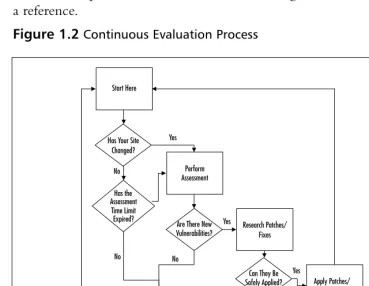
[image:45.612.69.438.327.613.2]The method used to avoid these issues is to continually evaluate your site against your known baselines. If new vulnerabilities or risks appear, changes may have been made.These changes may be the result of new vulnerabilities that have been discovered or the result of changes made to components. Either way, these vulnerabilities must be immediately mitigated through repair or by managing them through your combina-tion of technology, policy, and awareness.The only way to ensure the long-term security of your site is to continually assess it, revise it, and implement the changes required to mitigate your risks.To help you maintain the process, the flow chart shown in Figure 1.2 can be used as a reference.
Figure 1.2Continuous Evaluation Process
Start Here
Has Your Site Changed?
Has the Assessment Time Limit Expired?
Perform Assessment
Are There New
Vulnerabilities? Research Patches/Fixes
Can They Be
Safely Applied? Apply Patches/ Fixes
Create Other Methods for Mitigating the Risks Stop for Now
Begin Again at Next Interval
Yes
Yes Yes
No
Sources to Learn The Basics
Security is a field that is both wide and deep. There are a lot of bases to cover when you are first getting started and a lot of places to look for good security information. Here is a list of some basic sites, mailing lists, and magazines that you might want to visit to widen your horizons or learn the ropes.
■ www.securityfocus.com Site for general security news,
also the host of Bugtraq, the world famous announce-ment mailing list for new vulnerabilities. SecurityFocus also has a very useful vulnerability database.
■ www.securityportal.com Another great site for
keeping up to date on security happenings. They also have excellent articles for beginners that cover the basics of security and hacking.
■ www.atstake.com/security_news/ Security news from
the hacker’s point of view.
■ http://phrack.infonexus.com The immortal Phrack
online Zine, which has years and years of hacker history, techniques, and insight. Read them all and learn to see inside the mind of your adversary.
■ www.defcon.org The largest gathering of hackers in
the world happens yearly in Las Vegas. Keep up to date on this site or better yet come and out and meet face to face with real, live hackers.
■ www.sans.org The SANS page details training that is
available to security professionals and gives insight into the status of threats from around the online world.
Tools & Traps…
Applying Principles to Existing Sites
While it is optimal to begin the e-commerce process with security in mind, it is possible to apply the three principles of confidentiality,
integrity, and availability to already operational sites as well. In fact, since much of the site development work is done, these sites are often able to apply greater time, effort, and money to securing their environment.
The process of applying the three principles to existing sites differs a bit from new sites, but many of the concepts are the same. Obviously, the principles themselves don’t change, nor does the cycle of continuous security assessment. However, what does change is where and when these tools begin to be applied. For example, beginning the assessment process on your existing site could damage your production systems, so most sites begin by testing their development environment or a mirror of their production environment created just for the purpose of testing. They then begin to apply the revisions and patches to these test systems, giving them time to examine the impact before making these changes to the production site. Always remember, though, that security fixes are a race against the clock as attackers may be probing for those vulnerabili-ties while you are testing the fixes.The major effort here is to limit the size of this window of opportunity without causing damage to your site.
■ http://packetstorm.securify.com The most popular site
for hacker tools, toys, and exploits. The tools can come in handy for administrators and security professionals, but use caution.
■ www.astalavista.com Search engine entrance to the
It All Starts with Risk
Whether you choose to start with your test environment or take the risks of auditing your production site, the beginning point for applying the principles is to identify risks.The same tools from Chapter 8 are again used to perform an audit of your processes and applications to determine what vulnerabilities and risks already exist. Each of these risks must then be examined, and your site either fixed or revised to provide mitigation.
Depending on the complexity, nature, and size of your site, you may discover a few vulnerabilities, or thousands. Checkout www.cve.mitre .org for a dictionary of known vulnerabilities. Each of these vulnerabili-ties may vary in its significance, from allowing an attacker to gain infor-mation about your network to allowing someone complete access to your most critical systems at the highest level.The tools used to perform the audit should explain, in detail, the risks associated with each vulnera-bility. Keep in mind that in some circumstances, minor and medium vul-nerabilities could be used to create major problems within your site, and could even be used to create denial of service (DoS) conditions.
Vulnerability Chaining
Vulnerability chaining is the name given to a situation in which certain vulnerabilities become more significant when combined with other vulnerabilities. An example of this is the classic echo/ chargen attack.
Echo is a service that runs on most UNIX systems by default. Its behavior is just as expected: characters sent to the echo port are simply echoed back. Chargen is also a basic UNIX service and it simply generates characters continuously upon connection to its port. While the existence of either of these services alone poses little risk, together they can be used to cause a simple denial of service attack.
Fix the Highest Risks First
Once you have the report of your vulnerabilities and have examined the impact of the findings on your environment, begin to put the actions required for fixing them into order based on the levels of risk.
How do you know the level of risk for each vulnerability? Easy. Relate the risks to the real assets that your need to protect. By taking the time to identify company assets, the risk evaluation process gets much easier. Spend time thinking about your company and the business it does.What assets does the company hold that are valuable to it? Where are those resources located and how are they protected? Use the peer review process to create a detailed list of these assets and then relate the risks to that list. If any risk has even a remote possibility of compro-mising those assets then that risk gains the highest priority. Multiples of conditions that must be met to impact an asset gains the risk a medium level, while the lowest risk are those that have little impact on any crit-ical asset. Again, use peer review to ensure that you have an accurate view of the priorities for the risks you have developed.
Fix those vulnerabilities with the highest risk first. Often, it is a good idea to mitigate these risks through additional means (such as by
blocking the appropriate ports at the firewall or at border routers) while your staff works toward implementing the patches and modifications. In general, ensure that each and every process or application running on your production systems is up to the highest and most current patch
To perform the assault, the attacker spoofs a conversation between the two services and redirects the output of each service to the other, creating a rapidly expanding spiral of traffic. Essentially, the system begins to consume memory and processor power, eventually causing the whole device to become non-responsive to user commands.