New Methods and
Applications
Pascal Poncelet
Maguelonne Teisseire
Florent Masseglia
New Methods and Applications
Pascal Poncelet
Ecole des Mines d’Ales, France
Maguelonne Teisseire
Université Montpellier, France
Florent Masseglia
Inria, France
Hershey • New York
Typesetter: Jeff Ash Cover Design: Lisa Tosheff Printed at: Yurchak Printing Inc. Published in the United States of America by
Information Science Reference (an imprint of IGI Global) 701 E. Chocolate Avenue, Suite 200
Hershey PA 17033 Tel: 717-533-8845 Fax: 717-533-8661 E-mail: [email protected]
Web site: http://www.igi-global.com/reference and in the United Kingdom by
Information Science Reference (an imprint of IGI Global) 3 Henrietta Street
Covent Garden London WC2E 8LU Tel: 44 20 7240 0856 Fax: 44 20 7379 0609
Web site: http://www.eurospanonline.com
Copyright © 2008 by IGI Global. All rights reserved. No part of this publication may be reproduced, stored or distributed in any form or by any means, electronic or mechanical, including photocopying, without written permission from the publisher.
Product or company names used in this set are for identification purposes only. Inclusion of the names of the products or companies does not indicate a claim of ownership by IGI Global of the trademark or registered trademark.
Library of Congress Cataloging-in-Publication Data
Data mining patterns : new methods and applications / Pascal Poncelet, Florent Masseglia & Maguelonne Teisseire, editors. p. cm.
Summary: "This book provides an overall view of recent solutions for mining, and explores new patterns,offering theoretical frameworks and presenting challenges and possible solutions concerning pattern extractions, emphasizing research techniques and real-world applications. It portrays research applications in data models, methodologies for mining patterns, multi-relational and multidimensional pattern mining, fuzzy data mining, data streaming and incremental mining"--Provided by publisher.
Includes bibliographical references and index.
ISBN 978-1-59904-162-9 (hardcover) -- ISBN 978-1-59904-164-3 (ebook)
1. Data mining. I. Poncelet, Pascal. II. Masseglia, Florent. III. Teisseire, Maguelonne. QA76.9.D343D3836 2007
005.74--dc22
2007022230 British Cataloguing in Publication Data
A Cataloguing in Publication record for this book is available from the British Library.
Preface ... x
Acknowledgment ... xiv
Chapter I
Metric Methods in Data Mining / Dan A. Simovici ...1
Chapter II
Bi-Directional Constraint Pushing in Frequent Pattern Mining / Osmar R. Zaïane
and Mohammed El-Hajj ...32
Chapter III
Mining Hyperclique Patterns: A Summary of Results / Hui Xiong, Pang-Ning Tan,
Vipin Kumar, and Wenjun Zhou ...57
Chapter IV
Pattern Discovery in Biosequences: From Simple to Complex Patterns /
Simona Ester Rombo and Luigi Palopoli...85
Chapter V
Finding Patterns in Class-Labeled Data Using Data Visualization / Gregor Leban,
Minca Mramor, Blaž Zupan, Janez Demšar, and Ivan Bratko ...106
Chapter VI
Summarizing Data Cubes Using Blocks / Yeow Choong, Anne Laurent, and
Dominique Laurent ...124
Chapter VII
Social Network Mining from the Web / Yutaka Matsuo, Junichiro Mori, and
Chapter IX
Mining XML Documents / Laurent Candillier, Ludovic Denoyer, Patrick Gallinari
Marie Christine Rousset, Alexandre Termier, and Anne-Marie Vercoustre ...198
Chapter X Topic and Cluster Evolution Over Noisy Document Streams / Sascha Schulz, Myra Spiliopoulou, and Rene Schult ...220
Chapter XI Discovery of Latent Patterns with Hierarchical Bayesian Mixed-Membership Models and the Issue of Model Choice / Cyrille J. Joutard, Edoardo M. Airoldi, Stephen E. Fienberg, and Tanzy M. Love ...240
Compilation of References ... 276
About the Contributors ... 297
Preface ... x
Acknowledgment ... xiv
Chapter I
Metric Methods in Data Mining / Dan A. Simovici ...1
This chapter presents data mining techniques that make use of metrics defined on the set of partitions of finite sets. Partitions are naturally associated with object attributes and major data mining problem such as classification, clustering and data preparation which benefit from an algebraic and geometric study of the metric space of partitions. The metrics we find most useful are derived from a generalization of the entropic metric. We discuss techniques that produce smaller classifiers, allow incremental clustering of categorical data and help users to better prepare training data for constructing classifiers. Finally, we discuss open problems and future research directions.
Chapter II
Bi-Directional Constraint Pushing in Frequent Pattern Mining / Osmar R. Zaïane
and Mohammed El-Hajj ...32
Frequent itemset mining (FIM) is a key component of many algorithms that extract patterns from transactional databases. For example, FIM can be leveraged to produce association rules, clusters, classifiers or contrast sets. This capability provides a strategic resource for decision support, and is most commonly used for market basket analysis. One challenge for frequent itemset mining is the potentially huge number of extracted patterns, which can eclipse the original database in size. In addition to increasing the cost of mining, this makes it more difficult for users to find the valuable patterns. Introducing constraints to the mining process helps mitigate both issues. Decision makers can restrict discovered patterns according to specified rules. By applying these restrictions as early as possible, the cost of mining can be constrained. For example, users may be interested in purchases whose total price
This chapter presents a framework for mining highly correlated association patterns named hyperclique patterns. In this framework, an objective measure called h-confidence is applied to discover hyperclique patterns. We prove that the items in a hyperclique pattern have a guaranteed level of global pairwise similarity to one another. Also, we show that the h-confidence measure satisfies a cross-support property, which can help efficiently eliminate spurious patterns involving items with substantially different support levels. In addition, an algorithm called hyperclique miner is proposed to exploit both cross-support and anti-monotone properties of the h-confidence measure for the efficient discovery of hyperclique patterns. Finally, we demonstrate that hyperclique patterns can be useful for a variety of applications such as item clustering and finding protein functional modules from protein complexes.
Chapter IV
Pattern Discovery in Biosequences: From Simple to Complex Patterns /
Simona Ester Rombo and Luigi Palopoli...85
In the last years, the information stored in biological datasets grew up exponentially, and new methods and tools have been proposed to interpret and retrieve useful information from such data. Most biologi
-cal datasets contain biologi-cal sequences (e.g., DNA and protein sequences). Thus, it is more significant to have techniques available capable of mining patterns from such sequences to discover interesting information from them. For instance, singling out for common or similar subsequences in sets of bi
-osequences is sensible as these are usually associated to similar biological functions expressed by the corresponding macromolecules. The aim of this chapter is to explain how pattern discovery can be ap
-plied to deal with such important biological problems, describing also a number of relevant techniques proposed in the literature. A simple formalization of the problem is given and specialized for each of the presented approaches. Such formalization should ease reading and understanding the illustrated material by providing a simple-to-follow roadmap scheme through the diverse methods for pattern extraction we are going to illustrate.
Chapter V
Finding Patterns in Class-Labeled Data Using Data Visualization / Gregor Leban,
Minca Mramor, Blaž Zupan, Janez Demšar, and Ivan Bratko ...106
Data visualization plays a crucial role in data mining and knowledge discovery. Its use is however of
-ten difficult due to the large number of possible data projections. Manual search through such sets of projections can be prohibitively timely or even impossible, especially in the data analysis problems that comprise many data features. The chapter describes a method called VizRank, which can be used to automatically identify interesting data projections for multivariate visualizations of class-labeled data. VizRank assigns a score of interestingness to each considered projection based on the degree of separa
In the context of multidimensional data, OLAP tools are appropriate for the navigation in the data, aiming at discovering pertinent and abstract knowledge. However, due to the size of the dataset, a systematic and exhaustive exploration is not feasible. Therefore, the problem is to design automatic tools to ease the navigation in the data and their visualization. In this chapter, we present a novel approach allowing to build automatically blocks of similar values in a given data cube that are meant to summarize the content of the cube. Our method is based on a levelwise algorithm (a la Apriori) whose complexity is shown to be polynomial in the number of scans of the data cube. The experiments reported in the chapter show that our approach is scalable, in particular in the case where the measure values present in the data cube are discretized using crisp or fuzzy partitions.
Chapter VII
Social Network Mining from the Web / Yutaka Matsuo, Junichiro Mori, and
Mitsuru Ishizuka...149
This chapter describes social network mining from the Web. Since the end of the 1990’s, several attempts have been made to mine social network information from e-mail messages, message boards, Web linkage structure, and Web content. In this chapter, we specifically examine the social network extraction from the Web using a search engine. The Web is a huge source of information about relations among persons. Therefore, we can build a social network by merging the information distributed on the Web. The growth of information on the Web, in addition to the development of a search engine, opens new possibilities to process the vast amounts of relevant information and mine important structures and knowledge.
Chapter VIII
Discovering Spatio-Textual Association Rules in Document Images /
Donato Malerba, Margherita Berardi, and Michelangelo Ceci ...176
This chapter introduces a data mining method for the discovery of association rules from images of scanned paper documents. It argues that a document image is a multi-modal unit of analysis whose semantics is deduced from a combination of both the textual content and the layout structure and the logical structure. Therefore, it proposes a method where both the spatial information derived from a complex document image analysis process (layout analysis), and the information extracted from the logical structure of the document (document image classification and understanding) and the textual information extracted by means of an OCR, are simultaneously considered to generate interesting pat
XML documents are becoming ubiquitous because of their rich and flexible format that can be used for a variety of applications. Giving the increasing size of XML collections as information sources, mining techniques that traditionally exist for text collections or databases need to be adapted and new methods to be invented to exploit the particular structure of XML documents. Basically XML documents can be seen as trees, which are well known to be complex structures. This chapter describes various ways of using and simplifying this tree structure to model documents and support efficient mining algorithms. We focus on three mining tasks: classification and clustering which are standard for text collections; discovering of frequent tree structure, which is especially important for heterogeneous collection. This chapter presents some recent approaches and algorithms to support these tasks together with experimental evaluation on a variety of large XML collections.
Chapter X
Topic and Cluster Evolution Over Noisy Document Streams / Sascha Schulz,
Myra Spiliopoulou, and Rene Schult ...220
We study the issue of discovering and tracing thematic topics in a stream of documents. This issue, often studied under the label “topic evolution” is of interest in many applications where thematic trends should be identified and monitored, including environmental modeling for marketing and strategic manage
-ment applications, information filtering over streams of news and enrich-ment of classification schemes with emerging new classes. We concentrate on the latter area and depict an example application from the automotive industry—the discovery of emerging topics in repair & maintenance reports. We first discuss relevant literature on (a) the discovery and monitoring of topics over document streams and (b) the monitoring of evolving clusters over arbitrary data streams. Then, we propose our own method for topic evolution over a stream of small noisy documents: We combine hierarchical clustering, performed at different time periods, with cluster comparison over adjacent time periods, taking into account that the feature space itself may change from one period to the next. We elaborate on the behaviour of this method and show how human experts can be assisted in identifying class candidates among the topics thus identified.
Chapter IX
Discovery of Latent Patterns with Hierarchical Bayesian Mixed-Membership Models and the Issue of Model Choice / Cyrille J. Joutard, Edoardo M. Airoldi,
Stephen E. Fienberg, and Tanzy M. Love ...240
Statistical models involving a latent structure often support clustering, classification, and other datamin
from the National Long Term Care Survey. For both, we elucidate strategies for model choice and our analyses bring new insights compared with earlier published analyses.
Compilation of References ...276
About the Contributors ...297
Preface
Since its definition a decade ago, the problem of mining patterns is becoming a very active research area, and efficient techniques have been widely applied to problems either in industry, government or science. From the initial definition and motivated by real applications, the problem of mining patterns not only addresses the finding of itemsets but also more and more complex patterns. For instance, new approaches need to be defined for mining graphs or trees in applications dealing with complex data such as XML documents, correlated alarms or biological networks. As the number of digital data are always growing, the problem of the efficiency of mining such patterns becomes more and more attractive.
One of the first areas dealing with a large collection of digital data is probably text mining. It aims at analyzing large collections of unstructured documents with the purpose of extracting interesting, relevant and nontrivial knowledge. However, patterns became more and more complex, and led to open problems. For instance, in the biological networks context, we have to deal with common patterns of cellular interac-tions, organization of functional modules, relationships and interaction between sequences, and patterns of genes regulation. In the same way, multidimensional pattern mining has also been defined, and a lot of open questions remain regarding the size of the search space or to effectiveness consideration. If we consider social network in the Internet, we would like to better understand and measure relationships and flows between people, groups and organizations. Many real-world applications data are no longer appropriately handled by traditional static databases since data arrive sequentially in rapid, continuous streams. Since data-streams are contiguous, high speed and unbounded, it is impossible to mine patterns by using traditional algorithms requiring multiple scans and new approaches have to be proposed.
In order to efficiently aid decision making, and for effectiveness consideration, constraints become more and more essential in many applications. Indeed, an unconstrained mining can produce such a large number of patterns that it may be intractable in some domains. Furthermore, the growing consensus that the end user is no more interested by a set patterns verifying selection criteria led to demand for novel strategies for extracting useful, even approximate knowledge.
The goal of this book is to provide an overall view of the existing solutions for mining new kinds of patterns. It aims at providing theoretical frameworks and presenting challenges and possible solutions concerning pattern extraction with an emphasis on both research techniques and real-world applications. It is composed of 11 chapters.
Mining patterns from a dataset always rely on a crucial point: the interest criterion of the patterns. Literature mostly proposes the minimum support as a criterion; however, interestingness may occur in constraints applied to the patterns or the strength of the correlation between the items of a pattern, for instance. The next two chapters deal with these criteria.
In “Bidirectional Constraint Pushing in Frequent Pattern Mining” by O.R. Zaïane and M. El-Hajj, proposes consideration of the problem of mining constrained patterns. Their challenge is to obtain a sheer number of rules, rather than the very large set of rules usually resulting from a mining process. First, in a survey of constraints in data mining (which covers both definitions and methods) they show how the previous methods can generally be divided into two sets. Methods from the first set consider the monotone constraint during the mining, whereas methods from the second one consider the antimonotone constraint. The main idea, in this chapter, is to consider both constraints (monotone and antimonotone) early in the mining process. The proposed algorithm (BifoldLeap) is based on this principle and allows an efficient and effective extraction of constrained patterns. Finally, parallelization of BifolLeap is also proposed in this chapter. The authors thus provide the reader with a very instructive chapter on constraints in data mining, from the definitions of the problem to the proposal, implementation and evaluation of an efficient solution.
Another criterion for measuring the interestingness of a pattern may be the correlation between the items it contains. Highly correlated patterns are named “Hyperclique Patterns” in the chapter of H. Xiong, P. N. Tan, V. Kumar and W. Zhou entitled “Mining Hyperclique Patterns: A Summary of Results”. The chapter provides the following observation: when the minimum support in a pattern mining process is too low, then the number of extracted itemsets is very high. A thorough analysis of the patterns will often show patterns that are poorly correlated (i.e., involving items having very different supports). Those patterns may then be considered as spurious patterns. In this chapter, the authors propose the definition of hyperclique patterns. Those patterns contain items that have similar threshold. They also give the definition of the h-confidence. Then, h-confidence is analyzed for properties that will be interesting in a data mining process: antimonotone, cross-support and a measure of association. All those properties will help in defining their algorithm: hyperclique miner. After having evaluated their proposal, the authors finally give an application of hyperclique patterns for identifying protein functional modules.
This book is devoted to provide new and useful material for pattern mining. Both methods afore -mentioned are presented in the first chapters in which they focus on their efficiency. In that way, this book reaches part of the goal. However, we also wanted to show strong links between the methods and their applications. Biology is one of the most promising domains. In fact, it has been widely addressed by researchers in data mining those past few years and still has many open problems to offer (and to be defined). The next two chapters deal with bioinformatics and pattern mining.
Biological data (and associated data mining methods) are at the core of the chapter entitled “Pattern Discovery in Biosequences: From Simple to Complex Patterns” by S. Rombo and L. Palopoli. More precisely, the authors focus on biological sequences (e.g., DNA or protein sequences) and pattern ex -traction from those sequences. They propose a survey on existing techniques for this purpose through a synthetic formalization of the problem. This effort will ease reading and understanding the presented material. Their chapter first gives an overview on biological datasets involving sequences such as DNA or protein sequences. The basic notions on biological data are actually given in the introduction of this chapter. Then, an emphasis on the importance of patterns in such data is provided. Most necessary no -tions for tackling the problem of mining patterns from biological sequential data are given: defini-tions of the problems, existing solutions (based on tries, suffix trees), successful applications as well as future trends in that domain.
Data Visualization.” The first contribution of their chapter is to provide a new visualization method for extracting knowledge from data. WizRank, the proposed method, can search for interesting multidi -mensional visualizations of class-labeled data. In this work, the interestingness is based on how well instances of different classes are separated. A large part of this chapter will be devoted to experiments conducted on gene expression datasets, obtained by the use of DNA microarray technology. Their ex -periments show simple visualizations that clearly visually differentiate among cancer types for cancer gene expression data sets.
Multidimensional databases are data repositories that are becoming more and more im -portant and strategic in most of the main companies. However, mining these particular data -bases is a challenging issue that has not yet received relevant answers. This is due to the fact that multidimensional databases generally contain huge volumes of data stored according to particular structures called star schemas that are not taken into account in most popular data mining techniques. Thus, when facing these databases, users are not provided with useful tools to help them discovering relevant parts. Consequently, users still have to navigate manu -ally in the data, that is—using the OLAP operators—users have to write sophisticated queries. One important task for discovering relevant parts of a multidimensional database is to identify homo-geneous parts that can summarize the whole database. In the chapter “Summarizing Data Cubes Using Blocks,” Y. W. Choong, A. Laurent and D. Laurent propose original and scalable methods to mine the main homogeneous patterns of a multidimensional database. These patterns, called blocks, are defined according to the corresponding star schema and thus, provide relevant summaries of a given multidi -mensional database. Moreover, fuzziness is introduced in order to mine for more accurate knowledge that fits users’ expectations.
The first social networking website began in 1995 (i.e., classmates). Due to the development of the Internet, the number of social networks grew exponentially. In order to better understand and measuring relationships and flows between people, groups and organizations, new data mining techniques, called social network mining, appear. Usually social network considers that nodes are the individual actors within the networks, and ties are the relationships between the actors. Of course, there can be many kinds of ties between the nodes and mining techniques try to extract knowledge from these ties and nodes. In the chapter “Social Network Mining from the Web,” Y. Matsuo, J. Mori and M. Ishizuka address this problem and show that Web search engine are very useful in order to extract social network. They first address basic algorithms initially defined to extract social network. Even if the social network can be extracted, one of the challenging problems is how to analyze this network. This presentation illustrates that even if the search engine is very helpful, a lot of problems remain, and they also discuss the literature advances. They focus on the centrality of each actor of the network and illustrate various applications using a social network.
Text-mining approaches first surfaced in the mid-1980s, but thanks to technological advances it has been received a great deal of attention during the past decade. It consists in analyzing large collections of unstructured documents for the purpose of extracting interesting, relevant and nontrivial knowledge. Typical text mining tasks include text categorization (i.e., in order to classify document collection into a given set of classes), text clustering, concept links extraction, document summarization and trends detection.
involving words, sentences and concepts, the purpose of document image mining is to extract high-level spatial objects and relationships. In this chapter they introduce a new approach, called WISDOM++, for processing documents and transform documents into XML format. Then they investigate the discovery of spatio-textual association rules that takes into account both the layout and the textual dimension on XML documents. In order to deal with the inherent spatial nature of the layout structure, they formulate the problem as multi-level relational association rule mining and extend a spatial rule miner SPADA (spatial pattern discovery algorithm) in order to cope with spatio-textual association rules. They show that discovered patterns could also be used both for classification tasks and to support layout correction tasks.
L. Candillier, L. Dunoyer, P. Gallinari, M.-C. Rousset, A. Termier and A. M. Vercoustre, in “Mining XML Documents,” also consider an XML representation, but they mainly focus on the structure of the documents rather than the content. They consider that XML documents are usually modeled as ordered trees, which are regarded as complex structures. They address three mining tasks: frequent pattern ex -traction, classification and clustering. In order to efficiently perform these tasks they propose various tree-based representations. Extracting patterns in a large database is very challenging since we have to consider the two following problems: a fast execution and we would like to avoid a memory-consum-ing algorithm. When considermemory-consum-ing tree patterns the problem is much more challengmemory-consum-ing due to the size of the research space. In this chapter they propose an overview of the best algorithms. Various approaches to XML document classification and clustering are also proposed. As the efficiency of the algorithms depends on the representation, they propose different XML representations based on structure, or both structure and content. They show how decision-trees, probabilistic models, k-means and Bayesian net-works can be used to extract knowledge from XML documents.
In the chapter “Topic and Cluster Evolution Over Noisy Document Streams,” S. Schulz, M. Spiliopoulou and R. Schult also consider text mining but in a different context: a stream of documents. They mainly focus on the evolution of different topics when documents are available over streams. As previously stated, one of the important purpose in text mining is the identification of trends in texts. Discover emerging topics is one of the problems of trend detection. In this chapter, they discuss the literature advances on evolving topics and on evolving clusters and propose a generic framework for cluster change evolu -tion. However discussed approaches do not consider non-noisy documents. The authors propose a new approach that puts emphasis on small and noisy documents and extend their generic framework. While cluster evolutions assume a static trajectory, they use a set-theoretic notion of overlap between old and new clusters. Furthermore the framework extension consider both a document model describing a text with a vector of words and a vector of n-gram, and a visualization tool used to show emerging topics.
Acknowledgment
The editors would like to acknowledge the help of all involved in the collation and review process of the book, without whose support the project could not have been satisfactorily completed.
Special thanks go to all the staff at IGI Global, whose contributions throughout the whole process from inception of the initial idea to final publication have been invaluable.
We received a considerable amount of chapter submissions for this book, and the first idea for re -viewing the proposals was to have the authors review their papers with each other. However, in order to improve the scientific quality of this book, we finally decided to gather a high level reviewing committee. Our referees have done an invaluable work in providing constructive and comprehensive reviews. The reviewing committee of this book is the following: Larisa Archer, Gabriel Fung, Mohamed Gaber, Fosca Giannotti, S.K. Gupta, Ruoming Jin, Eamonn Keogh, Marzena Kryszkiewicz, Mark Last, Paul Leng, Georges Loizou, Shinichi Morishita, Mirco Nanni, David Pearson, Raffaele Perego, Liva Ralaivola, Christophe Rigotti, Claudio Sartori, Gerik Scheuermann, Aik-Choon Tan, Franco Turini, Ada Wai-Chee Fu, Haixun Wang, Jeffrey Xu Yu, Jun Zhang, Benyu Zhang, Wei Zhao, Ying Zhao, Xingquan Zhu.
Warm thanks go to all those referees for their work. We know that reviewing chapters for our book was a considerable undertaking and we have appreciated their commitment.
In closing, we wish to thank all of the authors for their insights and excellent contributions to this book.
About the Editors
Pascal Poncelet ([email protected]) is a professor and the head of the data mining research group
in the computer science department at the Ecole des Mines d’Alès in France. He is also co-head of the department. Professor Poncelet has previously worked as lecturer (1993-1994), as associate professor, respectively, in the Méditerranée University (1994-1999) and Montpellier University (1999-2001). His research interest can be summarized as advanced data analysis techniques for emerging applications. He is currently interested in various techniques of data mining with application in Web mining and text mining. He has published a large number of research papers in refereed journals, conference, and workshops, and been reviewer for some leading academic journals. He is also co-head of the French CNRS Group “I3” on data mining.
Maguelonne Teisseire ([email protected]) received a PhD in computing science from the Méditer -ranée University, France (1994). Her research interests focused on behavioral modeling and design. She is currently an assistant professor of computer science and engineering in Montpellier II University and Polytech’Montpellier, France. She is head of the Data Mining Group at the LIRMM Laboratory, Montpellier. Her interests focus on advanced data mining approaches when considering that data are time ordered. Particularly, she is interested in text mining and sequential patterns. Her research takes part on different projects supported by either National Government (RNTL) or regional projects. She has published numerous papers in refereed journals and conferences either on behavioral modeling or data mining.
Florent Masseglia is currently a researcher for INRIA (Sophia Antipolis, France). He did research
Chapter I
Metric Methods in Data Mining
*Dan A. Simovici
University of Massachusetts – Boston, USA
Copyright © 2008, IGI Global, distributing in print or electronic forms without written permission of IGI Global is prohibited.
AbstrAct
This chapter presents data mining techniques that make use of metrics defined on the set of partitions of finite sets. Partitions are naturally associated with object attributes and major data mining problem such as classification, clustering and data preparation which benefit from an algebraic and geometric study of the metric space of partitions. The metrics we find most useful are derived from a generaliza-tion of the entropic metric. We discuss techniques that produce smaller classifiers, allow incremental clustering of categorical data and help users to better prepare training data for constructing classifiers. Finally, we discuss open problems and future research directions.
IntroductIon
This chapter is dedicated to metric techniques applied to several major data mining problems: classification, feature selection, incremental clustering of categorical data and to other data mining tasks.
These techniques were introduced by R. López de Màntaras (1991) who used a metric between partitions of finite sets to formulate a novel split-ting criterion for decision trees that, in many cases, yields better results than the classical entropy gain (or entropy gain ratio) splitting techniques.
Important contributions in this domain have been made by J. P. Barthélemy (1978), Barthélemy and Leclerc (1995) and B. Monjardet (1981) where a metric on the set of partitions of a finite set is introduced starting from the equivalences defined by partitions.
Our starting point is a generalization of Shan-non’s entropy that was introduced by Z. Daróczy (1970) and by J. H. Havrda and F. Charvat (1967). We developed a new system of axioms for this type of entropies in Simovici and Jaroszewicz (2002) that has an algebraic character (being formulated for partitions rather than for random distributions). Starting with a notion of generalized conditional entropy we introduced a family of metrics that depends on a single parameter. Depending on the specific data set that is analyzed some of these metrics can be used for identifying the “best” splitting attribute in the process of constructing decision trees (see Simovici & Jaroszewicz, 2003, in press). The general idea is to use as splitting attribute the attribute that best approximates the class attribute on the set of objects to be split. This is made possible by the metric defined on partitions.
The performance, robustness and useful-ness of classification algorithms are improved when relatively few features are involved in the classification. Thus, selecting relevant features for the construction of classifiers has received a great deal of attention. A lucid taxonomy of algorithms for feature selection was discussed in Zongker and Jain (1996); a more recent reference is Guyon and Elisseeff (2003). Several approaches to feature selection have been explored, including wrapper techniques in Kohavi and John, (1997) support vector machines in Brown, Grundy, Lin, Cristiani, Sugnet, and Furey (2000), neural networks in Khan, Wei, Ringner, Saal, Ladanyi, and Westerman (2001), and prototype-based feature selection (see Hanczar, Courtine, Benis, Hannegar, Clement, & Zucker, 2003) that is close to our own approach. Following Butterworth, Piatetsky-Shapiro, and Simovici (2005), we shall
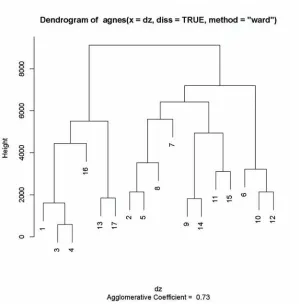
introduce an algorithm for feature selection that clusters attributes using a special metric and, then uses a hierarchical clustering for feature selection.
Clustering is an unsupervised learning pro-cess that partitions data such that similar data items are grouped together in sets referred to as clusters. This activity is important for condens-ing and identifycondens-ing patterns in data. Despite the substantial effort invested in researching cluster-ing algorithms by the data mincluster-ing community, there are still many difficulties to overcome in building clustering algorithms. Indeed, as pointed in Jain, Murthy and Flynn (1999) “there is no clustering technique that is universally applicable in uncovering the variety of structures present in multidimensional data sets.” This situation has generated a variety of clustering techniques broadly divided into hierarchical and partitional; also, special clustering algorithms based on a va-riety of principles, ranging from neural networks and genetic algorithms, to tabu searches.
We present an incremental clustering algo-rithm that can be applied to nominal data, that is, to data whose attributes have no particular natural ordering. In general, objects processed by clustering algorithms are represented as points in an n-dimensional space Rnand standard
Grossberg (1990). A seminal paper (Fisher, 1987) contains an incremental clustering algorithm that involved restructurings of the clusters in addition to the incremental additions of objects. Incre-mental clustering related to dynamic aspects of databases were discussed in Can (1993) and Can, Fox, Snavely, and France (1995). It is also notable that incremental clustering has been used in a variety of areas (see Charikar, Chekuri, Feder, & Motwani, 1997; Ester, Kriegel, Sander, Wimmer, & Xu, 1998; Langford, Giraud-Carrier, & Magee, 2001; Lin, Vlachos, Keogh, & Gunopoulos, 2004). Successive clusterings are constructed when adding objects to the data set in such a manner that the clusterings remain equidistant from the partitions generated by the attributes.
Finally, we discuss an application to metric methods to one of the most important pre-pro-cessing tasks in data mining, namely data dis-cretization (see Simovici & Butterworth, 2004; Butterworth, Simovici, Santos, & Ohno-Machado, 2004).
PArtItIons, MetrIcs, entroPIes
Partitions play an important role in data min-ing. Given a nonempty set S, a partition of S is a nonempty collection π = {B1, ..., Bn} such that
i≠j implies Bi∩ Bj = ∅, and:
1 .
n i i= B =S
We refer to the sets B1, ..., Bnas the blocks of π. The set of partitions of S is denoted by PARTS(S).
The set of partitions of S is equipped with a partial order by defining π ≤ σ if every block B
of π is included in a block C of σ. Equivalently, we have π ≤ σ if every block C of σ is a union of a collection of blocks of π. The smallest ele-ment of the partially ordered set (PART(S) ≤) is the partition aS whose blocks are the singletons {x} for x∈ S; the largest element is the one-block
partition wS whose unique block is S.
Example 1
Let S = {a, b, c, d} be a four-element set. The set PARTS(S) consists of the 15 partitions shown in Box 1.
{ } { } { } { }
{
}
{
{ } { } { }
}
{
{ } { } { }
}
{
{ } { } { }
}
{ } { } { }
{
}
{
{ } { } { }
}
{
{ } { } { }
}
{
{
} { }
}
{ } { }
{
}
{
{
} { }
}
{
{ } { }
}
{
{
} { }
}
{ } { }
{
}
{
{ } {
}
}
{
{
}
}
, , , , , , , , , , , ,
, , , , , , , , , , , ,
, , , , , , , , , , , ,
, , , , , , , , ,
a b c d a b c d a c b d a d b c
a b c d a b d c a b c d a b c d
a b c d a b d c a c b d a c d b
a d b c a b c d a b c d
Box 1.
Box 2.
{ } { } { } { }
Among many chains of partitions we mention that as shown in Box 2.
A partition σcovers another partition π (de-noted by π σ) if π ≤ σ and there is no partition
t such that π ≤ t ≤ σ. The partially ordered set
PARTS(S) is actually a lattice. In other words, for every two partitions π, σ ∈ PARTS(S) both inf{π, σ} and sup{π, σ} exist. Specifically, inf{π,
σ} is easy to describe. It consists of all nonempty intersections of blocks of π and σ:
{ }
{
}
inf , = B∩C B∈ ,C∈ ,B∩ ≠ ∅C .
We will denote this partition by π∩σ. The su-premum of two partitions sup{π,σ} is a bit more complicated. It requires that we introduce the graph of the pair π,σ as the bipartite graph G(π,σ) having the blocks of π and σ as its vertices. An edge (B,C) exists if B∩C≠∅. The blocks of the partition sup{π,σ} consist of the union of the blocks that belong to a connected component of the graph
G{π,σ}. We will denote sup{π,σ} by π∪σ.
Example 2
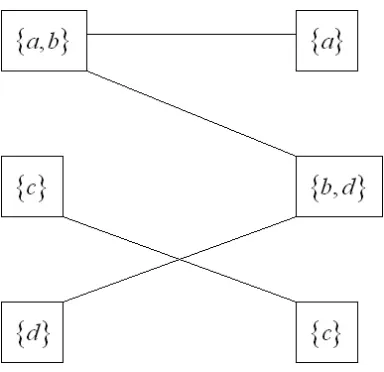
The graph of the partitions π = {{a,b}, {c}, {d}} and σ = {{a}, {b,d}, {c}} of the set S = {a, b, c, d} is shown in Figure 1. The union of the two
connected components of this graph are {a,b,d} and {c}, respectively, which means that π∪σ = {{a,b,d}, {c}}.
We introduce two new operations on partitions. If S,T are two disjoint sets and π ∈ PARTS(S), σ ∈ PARTS(T), the sum of π and σ is the parti-tion: π + σ = {B1,...,Bn, C1,...,Cp} of S∪T, where
π = {B1,...,Bn} and σ = {C1,...,Cp}.
Whenever the “+” operation is defined, then it is easily seen to be associative. In other words, if
S,U,V are pairwise disjoint and nonempty sets, and π∈ PARTS(S), σ ∈ PARTS(U), and t ∈PARTS(V), then (π+σ)+t = π+(σ+t). Observe that if S,U are disjoint, then aS + aU= aS∪U. Also, wS + wU is the partition {S,U} of the set S ∪ U.
For any two nonempty sets S, T and π ∈
PARTS(S), σ ∈PARTS(T) we define the product
of π and σ, as the partition π × σ {B × C |B∈ π, C∈ σ} of the set product B × C .
Example 3
[image:21.630.198.390.546.732.2]Consider the set S = {a1,a2,a3}, T = {a4,a5,a6,a7} and the partitions p = {{a1,a2},{a3}}, s = {{a4}{a5,a6}{a7}} of S and T, respectively. The sum of these partitions is: π + σ = {{a1,a2},{a3}, {a4}, {a5,a6}, {a7}} , while their product is:
π × s = {{a1,a2} × {a4}, {a1,a2} × {a5,a6}, {a1,a2} ×
{a7}, {a3} × {a4}, {a3} × {a5, a6}, {a3} × {a7}}.
A metric on a set S is a mapping d: S × S→ R≥0
that satisfies the following conditions:
(M1)d(x, y) = 0 if and only if x = y (M2)d(x,y) = d(y,x)
(M3) d(x,y) + d(y,z) ≥ d(x,z)
for every x,y,z∈ S. In equality (M3) is known as the triangular axiom of metrics. The pair (S,d) is referred to as a metric space.
The betweeness relation of the metric space (S,d) is a ternary relation on S defined by [x,y,z]
if d(x,y) + d(y,z) = d(x,z). If [x, y, z] we say that y is between x and z.
The Shannon entropy of a random variable X
having the probability distribution p = (p1,...,pn) is given by:
1 2
1
( ,..., ) log .
n
n i i
i
H p p p p
= =
∑
-For a partition π∈ PARTS(S) one can define a random variable Xπthat takes the value i whenever a randomly chosen element of the set S belongs to the block Bi of π. Clearly, the distribution of Xπ
is (p1,...,pn), where:
| | | | i i B p S = .
Thus, the entropy H(π) of π can be naturally de-fined as the entropy of the probability distribution of X and we have:
( )
21 | | | | log . | | | | n i i i B B H S S = = -
∑
By the well-known properties of Shannon entropy the largest value of H(π), log2 S , is obtained for
π = aS, while the smallest, 0, is obtained for π = wS.
It is possible to approach the entropy of partitions from a purely algebraic point of view that takes into account the lattice structure of
(PARTS(S)≤) and the operations on partitions that
we introduced earlier. To this end, we define the
β-entropy, where β>0, as a function defined on the class of partitions of finite sets that satisfies the following conditions:
(P1) If π1,π2∈ PARTS(S) are such that π1 ≤ π2, then Hβ(π2) ≤ Hβ(π1).
(P2) If S,T are two finite sets such that | S | ≤ | T|, then Hβ(aT) ≤ Hβ(aS).
(P3) For every disjoint sets S,T and partitions p ∈
PARTS(S) and σ∈PARTS(T) see Box 3.
(P4) If π∈ PARTS(S) and σ∈ PARTS(T), then
Hβ(π×σ) = j (Hβ(π), Hβ(σ)), where j : R≥0 → R≥0 is a continuous function such that j (x,y) = j (y,x), and j (x,0) = x for x,y∈ R≥0.
In Simovici and Jaroszewicz (2002) we have shown that if π = {B1,...,Bn} is a partition of S, then:
1
1
| |
1
( ) 1
| | 2 1 n i i B H S -= = - -
∑
In the special case, when b → 1 we have:
{ }
(
)
| | | | ( ) ( ) ( ) , | | | | | | | | S TH H H H S T
S T S T
+ = + +
+ +
1 2
1
| | | |
lim ( ) log
| | | | n i i i B B H S S → = = -
∑
This axiomatization also implies a specific form of the function j. Namely, if β≠ 1 it follows that
j (x,y) = x+y+(21-β –1)xy. In the case of Shannon
entropy, obtained using β = 1 we have j (x,y) =
x+y for x,y∈R≥0.
Note that if | S | = 1, then PARTS(S) consists of a unique partition aS = wS and Hβ (wS) = 0. More-over, for an arbitrary finite set S we have Hβ(π) = 0 if and only if π = wS. Indeed, let U,V be two finite disjoint sets that have the same cardinality. Axiom (P3) implies Box 4.
Since wU + wV = {U,V} it follows that Hβ (wU) = Hβ (wV) =0.
Conversely, suppose that Hβ (π) = 0. If π ≤
wS there exists a block B of π such that ∅ ⊂ B ⊂
S. Let q be the partition q = {B,S –B}. It is clear that π ≤ q, so we have 0 ≤ Hβ (q) ≤ Hβ(π) which implies Hβ (q) = 0. This in turn yields:
| | | |
1 0
| | | |
B S B
S S
-
+ - =
Since the function f(x) = xβ + (1–x)β – 1 is concave for b > 1 and convex for b < 1 on the interval [0,1], the above equality is possible only if B = S or if
B = ∅, which is a contradiction. Thus, π = wS. These facts suggest that for a subset T of S the number Hβ(πT) can be used as a measure of the purity of the set T with respect to the partition
π. If T is π-pure, then πT = wT and, therefore, Hβ
(πT) = 0. Thus, the smaller Hβ (πT), the more pure the set T is.
The largest value of Hβ (π) when p ∈ PARTS(S)
is achieved when π = aS; in this case we have:
{ }
(
)
1
( ) ( ( ) ( )) ,
2
U V U V
H + = H +H +H U V
Box 4.
1 1
1 1
( ) 1
2 1 | |
S H S - - = - -
GeoMetry of the MetrIc
sPAce of PArtItIons of fInIte
sets
Axiom (P3) can be extended as follows:
Theorem 1: Let S1,...,Sn be n pairwise disjoint finite sets,S =∏ Si and let p1,...,pn be partitions
of S1,...,Sn, respectively. We have:
1 1 | | ( ... ) ( ) ( ), | | n i n i i S
H H H
S = + + = +
∑
where q is the partition {S1,...,Sn}of S.
The β-entropy defines a naturally conditional entropy of partitions. We note that the definition introduced here is an improvement over our previ-ous definition given in Simovici and Jaroszewicz (2002). Starting from conditional entropies we will be able to define a family of metrics on the set of partitions of a finite set and study the geometry of these finite metric spaces.
Let π,σ ∈ PARTS(S), where σ = {C1,...,Cn}. The β-conditional entropy of the partitions π,σ
∈ PARTS(S) is the function defined by:
1
| |
( | ) ( ).
| | j
n j C j C H H S = =
∑
Also, we can write that which is seen in Box 5. In general, the conditional entropy can be written explicitly as seen in Box 6.
Theorem 2: Let π,σ be two partitions of a finite set
S. We have Hβ (p | s) = 0 if and only if σ ≤ π.
The next statement is a generalization of a well-known property of Shannon’s entropy.
Theorem 3: Let π, σ be two partitions of a finite set S. We have:
( ) ( | ) ( ) ( | ) ( ).
H ∧ =H +H =H +H
The β -conditional entropy is dually monotonic with respect to its first argument and is monotonic with respect to its second argument, as we show in the following statement:
Theorem 4: Let π, σ, σ ′ be two partitions of a finite set S. If σ ≤ σ ′, then Hβ (σ | π) ≥ Hβ(σ′| π) and Hβ (π | σ) ≤ Hβ(β | σ ′).
The last statement implies immediately that
Hβ (π) ≥ Hβ (π | σ ) for every π,σPARTS(S)
The behavior of β -conditional entropies with respect to the sum of partitions is discussed in the next statement.
Theorem 5: Let S be a finite set, and let π, q∈ PARTS(S) where q = {D1,...,Dh}. If σi∈ PARTS(D)
for 1 ≤ i ≤ h, then:
1
1
| |
( | ... ) ( | ).
| | i
h i
h D i
i D H H S = + + =
∑
If t = {F1,...,Fk}, σ = {C1,...,Cn} are two partitions of S and πi∈ PARTS(Fi) for 1 ≤ i ≤ k then:
1
1 | |
( ... | ) ( | ) ( | ).
| | i
k
i
k i F
i
F
H H H
S = + + = +
∑
López de Màntaras, R. (1991) proved that Shan-non’s entropy generates a metric d: S × S → R≥0 given by d(π,σ) = H(π | σ) + H(σ | π), for π,σ∈
PARTS(S). We extended his result to a class of
where π = {B1,...,Bm}.
1 1
1 1
| | 1 1 | |
( | ) ( )
| | j 2 1 | | | |
n n j j S C j j C C H H
S - S - S
= = = = - -
∑
∑
Box 5.where s = {C1,...,Cn}
1 1 1 | | | | 1 ( | ) , | | | | 2 1 m n
i j j
i j
B C C
metrics {dβ | β∈ R≥0} that can be defined by β -entropies, thereby improving our earlier results.
The next statement plays a technical role in the proof of the triangular inequality for dβ.
Theorem 6: Let π, σ, t be three partitions of the finite set S. We have:
( | ) ( | ) ( | ).
H ∧ +H =H ∧
Corollary 1: Let π, σ, t be three partitions of the finite set S. Then, we have:
( | ) ( | ) ( | ).
H +H ≥H
Proof: By theorem 6, the monotonicity of
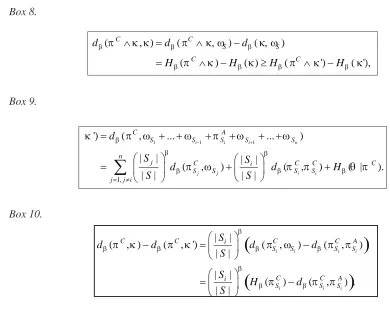
β-conditional entropy in itssecond argument and the dual monotonicity of the same in its first argument we can write that which is seen in Box 7, which is the desired inequal-ity. QED.
We can show now a central result:
Theorem 7:The mapping dβ: S × S→ R≥0 defined by dβ (π,σ) = Hβ (π | σ) + Hβ(σ | π) for π, σ∈
PARTS(S) is a metric on PARTS(S).
Proof: A double application of Corollary 1 yields Hβ(π | σ) + Hβ (σ t) ≥ Hβ (π | t) and
Hβ(σ | π) + Hβ (t | σ) ≥ Hβ (t | π). Adding these inequality gives: dβ(π, σ) + dβ (σ, t) ≥
dβ (π, t), which is the triangular inequality for dβ.
The symmetry of dβ is obvious and it is clear that dβ (π, π) = 0 for every β ∈PARTS(S).
Suppose now that dβ (π, σ) = 0. Since the values of β-conditional entropies are non-negative this implies Hβ (π | σ) = Hβ (σ | π)= 0. By theorem 2, we have both σ ≤ π and π ≤ σ, respectively, so
π=σ. Thus, dβ is a metric on PARTS(S). QED. Note that dβ (π, wS) = Hβ(π) and dβ (π, aS) =
Hβ(aS |π).
The behavior of the distance dβ with respect to partition sum is discussed in the next state-ment.
Theorem 8: Let S be a finite set, π, q∈ PARTS(S), where q = {D1,...,Dh}. If σi∈ PARTS(Di) for 1 ≤ i ≤ h then:
1
1 | |
( , ... ) ( , ) ( | ).
| | i
h i
h D i
i
D
d d H
S
=
+ + = +
∑
The distance between two partitions can be expressed using distances relative to the total partition or to the identity partition. Indeed, note that for π, σ ∈ PARTS(S) where π = {B1,...,Bm} and σ = {C1,...,Cn} we have:
1
1 ( , )
(2 1) | |
d
S
-=
-1 1 1 1
2 | | | | | |
m n m n
i j i j
i j i j
B C B C
= = = =
∩ -
-
∑∑
∑
∑
Box 7.
( | ) ( | ) ( | ) ( | ) ( | ) ( | ),
In the special case, when σ = wS we have:
1
1
1
( , ) | | | | .
(2 1) | |
m
S i
i
d B S
S -= = - -
∑
Similarly, we can write:
1
1
1
( , ) | | | | .
(2 1) | |
n
S j
j
d S C
S -= = - -
∑
These observations yield two metric equalities:
Theorem 9: Let π, σ∈ PARTS(S) be two parti-tions. We have:
( , ) 2 ( , ) ( , ) ( , )
( , ) ( , ) 2 ( , ).
S S S
S S S
d d d d
d d d
= ∧ -
-= + - ∧
It follows that for q, t∈ PARTS(S), if q ≤ t and we have either dβ (q, wS) = dβ (t, wS) or dβ (q,aS) = dβ
(t, aS) , then q = t. This allows us to formulate:
Theorem 10: Let π, σ∈ PARTS(S). The following statements are equivalent:
1. σ ≤ π
2. We have [σ, π, wS] in the metric space
(PARTS(S), dβ)
3. We have [aS, σ, π] in the metric space
(PARTS(S), dβ)
Metrics generated by β -conditional entropies are closely related to lower valuations of the upper semimodular lattices of partitions of finite sets. This connection was established Birkhoff (1973) and studied by Barthèlemy (1978), Barthèlemy and Leclerc (1995) and Monjardet (1981).
A lower valuation on a lattice (L, ∧, ∨) is a mapping v: L→R such that:
( ) ( ) ( ) ( )
v ∧ +v ∨ ≥v +v
for every π, σ∈ L. If the reverse inequality is satisfied, that is, if:
( ) ( ) ( ) ( )
v ∧ +v ∨ ≤v +v
for every π, σ∈ L then
v
is referred to as anupper valuation.
If v is both a lower and upper valuation, that is, if:
( ) ( ) ( ) ( )
v ∧ +v ∨ =v +v
for every π, σ∈ L then v is a valuation on L. It is known (see Birkhoff (1973) that if there ex-ists a positive valuation v on L, then L must be a modular lattice. Since the lattice of partitions of a set is an upper-semimodular lattice that is not modular it is clear that positive valuations do not exist on partition lattices. However, lower and upper valuations do exist, as shown next.
Theorem 11: Let S be a finite set. Define the
mappings vβ:PARTS(S) → R and wβ:PARTS(S) → R by vβ(π) = dβ(aS, π) and wβ(π) = dβ(π, wS), respectively, for σ ∈ PARTS(S). Then, vβ is a lower valuation and wβ is an upper valuation on the lattice (PARTS(S), ∧, ∨).
MetrIc sPlIttInG crIterIA for
decIsIon trees
The usefulness of studying the metric space of partitions of finite sets stems from the associa-tion between partiassocia-tions defined on a collecassocia-tion of objects and sets of features of these objects. To formalize this idea, define an object system as a pair T = (T, H), where T is a sequence of objects
and H is a finite set of functions, H = {A1,...,An}, where Ai: T → Di for 1 ≤ i ≤ n. The functions
Ai are referred to as features or attributes of the system. The set Di is the domain of the attribute
Ai; we assume that each set Ai contains at least to elements. The cardinality of the domain of attri-bute A will be denoted by mA. If X = (Ai
1,...,Ain) is
0
of t on is the sequence t[X] = (Ai
1(t),...,Ain(t)). The
partition πX defined by the sequence of attributes
is obtained by grouping together in the same block all objects having the same projection on
X. Observe that if X, Y are two sequences of at-tributes, then πXY = πX∧ πY.
Thus, if U is a subsequence of V (denoted by
U⊆V) we have πV ≤ πU.
For example, if X is a set of attributes of a table
T, any SQL phrase such as:
select count(*) fromTgroup byX
computes the number of elements of each of the blocks of the partition πX of the set of tuples of
the table T.
To introduce formally the notion of decision tree we start from the notion of tree domain. A tree domain is a nonempty set of sequences D
over the set of natural numbers N that satisfies
the following conditions:
1. Every prefix of a sequence σ∈ D also be-longs to D.
2. For every m ≥ 1, if (p1,...,pm-1, pm) ∈ D, then (p1,...,pm-1, q) ∈ D for every q ≤ pm.
The elements of D are called the vertices of D.
If u,v are vertices of D and u is a prefix of v, then we refer to v as a descendant of u and to u as an
ancestor of v. If v = ui for some i ∈ N, then we call v an immediate descendant of u and u an
immediate ancestor of v. The root of every tree domain is the null sequence λ. A leaf of D is a vertex of D with no immediate descendants.
Let S be a finite set and let D be a tree domain. Denote by Ρ (S) the set of subsets of S. An S-tree is a function T: D→ P(S) such that T(I) = S, and if u1,...,um are the immediate descendants of a vertex u, then the sets T (u1),...,T (um) form a partition of the set T(u).
A decision tree for an object system T = (T,H) is an S-tree T, such that if the vertex v has the de-scendants v1, …, vm, then there exists an attribute
A in H (called the splitting attribute in v) such that {T (vi) | 1 ≤ i ≤ m} is the partition AT( )v.
Thus, each descendant vi of a vertex v cor-responds to a value a of the attribute A that was used as a splitting attribute in v. If I =v1,...,vk=u is the path in T that was used to reach the vertex u,
Ai,...,Ak-1are the splitting attributes in v1,...,vk-1and
a1,...,ak-1 are the values that correspond to v2,...,vk,
respectively, then we say that u is reached by the selection Ai
1 = a1∧...∧Aik-1= ak-1.
It is desirable that the leaves of a decision tree contain C-pure or almost C-pure sets of objects. In
other words, the objects assigned to a leaf of the tree should, with few exceptions, have the same value for the class attribute C. This amounts to asking that for each leaf w of T we must have ( )
w
C S
H
as close to 0 as possible. To take into account the size of the leaves note that the collection of sets of objects assigned to the leafs is a partition k of
S and that we need to minimize:
| |
( ),
| | w
C w S w S H S
∑
which is the conditional entropy Hβ(πC | k). By
theorem 2 we have Hβ(πC | k) = 0 if and only if k ≤ πC, which happens when the sets of objects
assigned to the leafs are C-pure.
The construction of a decision tree Tβ(T) for an object system T = (T,H) evolves in a top-down manner according to the following high-level de-scription of a general algorithm (see Tan, 2005). The algorithm starts with an object system T = (T,H), a value of β and with an impurity threshold
e and it consists of the following steps:
1. If H ( SC)≤ , then return T as a one-vertex tree; otherwise go to 2.