arXiv:0906.3643v1 [cs.GT] 19 Jun 2009
Spanning connectivity games
Haris Aziz Oded Lashich Mike Paterson Rahul Savani
Abstract
The Banzhaf index, Shapley-Shubik index and other voting power indices measure the importance of a player in a coalitional game. We consider a simple coalitional game called the spanning connectivity game (SCG) based on an undirected, unweighted multigraph, where edges are players. We examine the computational complexity of com-puting the voting power indices of edges in the SCG. It is shown that computing Banzhaf values and Shapley-Shubik indices is #P-complete for SCGs. Interestingly, Holler indices and Deegan-Packel indices can be computed in polynomial time. Among other results, it is proved that Banzhaf indices can be computed in polynomial time for graphs with bounded treewidth. It is also shown that for any reasonable representation of a simple game, a polynomial time algorithm to com-pute the Shapley-Shubik indices implies a polynomial time algorithm to compute the Banzhaf indices. As a corollary, computing the Shap-ley value is #P-complete for simple games represented by the set of minimal winning coalitions, Threshold Network Flow Games, Vertex Connectivity Games and Coalitional Skill Games.
1
Introduction
interested in checking which connections are more important in maintaining connectivity and hence contribute more to social welfare.
Our model is based on undirected, unweighted and connected multigraphs. All the nodes are treated equally, and the importance of a edge is based solely on its ability to connect all the nodes. Using undirected edges is a reasonable assumption in many cases. For example, in a social network, relations are usually mutually formed.
We use a multigraph as a succinct representation of a simple coalitional game called thespanning connectivity game (SCG). The players of the game are the edges of the multigraph. The importance of an edge is measured by computing its voting power index in the game. Voting power indices including the Banzhaf index and Shapley-Shubik index are standard ways to compute the importance of a player in a coalitional voting game. Intuitively, the Banzhaf value is the number of coalitions in which a player plays a critical role and the Shapley-Shubik index is the proportion of permutations for which a player is pivotal.
The whole paper is concerned with computing solutions for SCGs. In Sec-tion 2, a summary of related work is given. In SecSec-tion 3, preliminary defini-tions related to graph theory and coalitional games are given, and we define SCGs. Section 4 presents hardness results for computing Banzhaf values and Shapley-Shubik indices. In Section 5, positive computational results for Banzhaf values and Shapley-Shubik indices are provided for certain graph classes. Section 6 presents a polynomial-time algorithm to compute Holler indices and Deegan-Packel indices. In Section 7, a summary of results is given and future work is discussed.
2
Related work
The study of cooperative games in combinatorial domains is widespread in operations research [12, 15]. Spanning network games have been examined previously [20, 24] but they are treated differently, with weighted graphs and nodes as players (not edges, as here). The SCG is related to the all-terminal reliability model, a non-game-theoretic model that is relevant in broadcasting [23, 11]. Whereas the reliability of a network concerns the overall probability of a network being connected, this paper concentrates on resource allocation to the edges. A game-theoretic approach can provide fair and stable outcomes in a strategic setting.
3
Preliminaries
3.1 Graph Theory
Definition 3.1. Amultigraph G:= (V, E, s) consists of a simple underlying graph (V, E) with a multiplicity function s : E 7→ N where N is the set of natural numbers excluding 0. Let |V| = n and |E| = m. For every underlying edgei∈E, we havesi edges in the multigraph. The multigraph
has a total ofM =P
i∈Esi edges.
Definition 3.2. A subgraph G′ = (V′, E′) of a graphG= (V, E) is a graph where V′ is a subset of V and E′ is a subset of E such that the vertex set of E′ is a subset of V′. A subgraph H is aconnected spanning subgraph of a graphGif it is connected and has the same vertex set as G.
3.2 Coalitional Game Theory
Definition 3.3. A simple voting game is a pair (N, v) with characteristic function v : 2N → {0,1} where v(∅) = 0, v(N) = 1 and v(S) ≤ v(T)
whenever S ⊆ T. A coalition S ⊆ N is winning if v(S) = 1 and losing
ifv(S) = 0. A simple voting game can alternatively be defined as (N, W) whereW is the set of winning coalitions.
For the sake of brevity, we will abuse the notation to sometimes refer to game (N, v) as v. For each connected multigraph (V, E, s), we define the SCG,
spanning connectivity game, (E, v) with playersE and valuation functionv, defined as follows forS⊆E:
v(S) =
1, if there exists a spanning tree T = (V, E′) such thatE′ ⊆S
It is easy to see that the SCG (E, v) is a simple game because the outcome is binary,v is monotone,v(∅) = 0 andv(E) = 1. We consider power indices and cooperative game solutions for the edges in the SCG.
Definition 3.4. A player i is critical in a coalition S when v(S) = 1 and
v(S\ {i}) = 0. For eachi∈N, we denote the number of coalitions in which
i is critical in game v by the Banzhaf value ηi(v). The Banzhaf Index of
playeriin game v is
βi=
ηi(v)
P
i∈Nηi(v)
.
The Shapley-Shubik index is the proportion of permutations for which a player is pivotal. For a permutation π of N, the π(i)th player is pivotal if coalition {π(1), . . . , π(i−1)} is losing but coalition {π(1), . . . , π(i)} is winning.
Definition 3.5. The Shapley-Shubik (SS) value is the function κ that as-signs to any simple game (N, v) and any voteria value κi(v) where
κi =
X
S⊆N
(|S| −1)!(n− |S|)!(v(S)−v(S\ {i})).
TheShapley-Shubik (SS) index of iis defined by
φi=
κi
n!.
The Banzhaf index and the Shapley-Shubik index are the normalized ver-sions of the Banzhaf value and the Shapley-Shubik value respectively. Since the denominator of the Shubik index is fixed, computing the Shapley-Shubik index and Shapley-Shapley-Shubik value have the same complexity. This is not necessarily true for the Banzhaf index and Banzhaf value.
4
Complexity of computing power indices
We define the problems of computing the power indices of the edges in the SCG. For any power index X (e.g. Banzhaf value, Banzhaf index, Shapley-Shubik index etc.) we define the problem SCG-X as follows:
Problem: SCG-X
Output: For the SCG corresponding to G, compute X for all the edges
We represent a communication network as a multigraph, where an edge represents a connection that may or may not work. An edge is said to be
operationalif it works. For a given graphG, the reliability Rel(G,{pi}) ofG
is the probability that the operational edges form a connected spanning sub-graph, given that each edge is operational with probabilitypifori= 1, . . . m.
Problem: Rational Reliability Problem
Instance: MultigraphG and pi∈Qfor all i, 1≤i≤m
Output: Compute Rel(G,{pi})
A special case of the reliability problem is when every edge has the same probability p of being operational. This is called the Functional Reliabil-ity Problem. A connected spanning subgraph with i edges will occur with probabilitypi(1−p)m−i.
Definition 4.1. Let Ni be the number of connected spanning subgraphs
withiedges. Then the required output of the Functional Reliability Problem is thereliability polynomial
Rel(G, p) =
m
X
i=0
Nipi(1−p)m−i.
Problem: Functional Reliability Problem
Instance: MultigraphG
Output: Compute the coefficients Ni of the reliability polynomial for all i,
1≤i≤m.
Ball [11] points out that an algorithm to solve the Rational Reliability Prob-lem can be used as a sub-routine to compute all the coefficients for the Func-tional Reliability Problem. Moreover he proved that computing the general coefficient Ni is NP-hard and therefore computing the rational reliability
of a graph is NP-hard. As we will see in Section 5, reliability problems have connections with computing power indices of SCG. We first prove that SCG-BANZHAF-VALUE is #P-complete.
Proposition 4.2. SCG-BANZHAF-VALUE is #P-complete even for
Proof. We present a reduction from the problem of counting connected span-ning subgraphs. SCG-BANZHAF-VALUE is clearly in #P because a con-nected spanning subgraph can be verified in polynomial time. It is known that counting the total number of connected spanning subgraphs is #P-complete even for simple, bipartite and planar graphs( [10], p. 305). We now reduce the problem of computing the total number of connected span-ning subgraphs to solving SCG-BANZHAF-VALUE. Take G= (V, E) with
nnodes andmedges. Transform graphGintoG′ = (V∪{n+1}, E∪{m+1}) by taking any node and connecting it to a new node via a new edge. Then the number of spanning subgraphs in G is equal to the Banzhaf value of edgem+ 1 in graph G′. This shows that SCG-BANZHAF-VALUE is #P-complete.
Similarly, SCG-SS is #P-complete.
Proposition 4.3. SCG-SS is #P-complete even for simple graphs.
Proof. LetNi be the number of connected spanning subgraphs of G withi
edges. We know that computingNi is NP-hard [11]. We show that if there
is an algorithm polynomial in the number of edges to compute the Shapley-Shubik index of all edges in the graph, then each Ni can be computed in
polynomial time.
We obtain graph G0 by the following transformation: for some node v ∈
V(G), we link it by a new edgexto a new nodevx. Then, by the definition
of the Shapley-Shubik value,Pm
r=0r!Nr(|E(G)|−r)! = Pm
r=0r!Nr′ =κx(G0),
where we writeN′
r forNr(m−r)!, for all r.
Similarly we can constructGi by adding a path Pi of length i to vx where
Pi has no edge or vertex intersection withG. Therefore
m
X
r=0
(r+i)!Nr′ =κx(Gi). (1)
Fori= 0, . . . , m, we get an equation of the form of (1) for eachGi. The
left-hand side of the set of equations can be represented by an (m+ 1)×(m+ 1) matrix A where Aij = (i+j−2)!. The set of equations is independent
The biggest possible number in the equation is less than (2m)! and can be represented efficiently. According to Stirling’s formula,m!≈√2πm mem
, the number (2m)! can be represented by km(log m) bits where k is a con-stant. We can use Gaussian elimination to solve the set of linear equations in O(m3
) time. Moreover, each number that occurs in the algorithm can also be stored in a number of bits quadratic of the input size (Theorem 4.10 [22]). Therefore SCG-SS is #P-complete.
A representation of a simple game is considered reasonable if, for a sim-ple game (N, v), the new game (N ∪ {x}, v′) where v(S) = 1 if and only if
v′(S∪{x}) = 1, can also be represented. Then the proof technique in
Propo-sition 4.3 can be used to show that for any reasonable representation of the simple game, a polynomial time algorithm to compute the Shapley-Shubik indices implies a polynomial time algorithm to compute the Banzhaf in-dices. This answers (positively) the question from [3] of whether computing Shapley-Shubik indices for a simple game represented by the set of minimal winning coalitions is NP-hard. As a corollary, we also strengthen or settle the complexity of a number of coalitional games. The proof in Proposition 4.3 can be slightly modified to prove that computing the Shapley-Shubik index (Shapley value in case of non-simple games) is #P-complete for a number of games:
Proposition 4.4. Computing Shapley value is #P-complete for
1. Simple game represented by its minimal winning coalitions
2. Threshold Network Flow Games [8]
3. Vertex Connectivity Games [9]
4. STSG (Single Task Skill Game), TCSG (Task Count Skill Game), WTSG (Weighted Task Skill Game), TCSG-T (Task Count Skill Game with thresholds) and WTSG-T (Weighted Task Skill Game with thresh-olds) [7]
(Task Count Skill Game) and WTSG (Weighted Task Skill Game) are gen-eralizations of the STSG (Single Task Skill Game).
5
Polynomial time cases
In this section, we present polynomial time algorithms to compute voting power indices for restricted graph classes including graphs with bounded treewidth. We first consider the trivial case of a tree. If the graph G = (N, E) is a tree then there is a total of n−1 edges and only the grand coalition of edges is a winning coalition. Therefore a tree is equivalent to a unanimity game. This means that each edge has a Banzhaf index and Shapley-Shubik index of 1
n−1. In the case of the same tree structure but
with multiple parallel edges, we refer to this multigraph as apseudo-tree.
Proposition 5.1. Let G= (N, E, s) be a pseudo-tree such that the under-lying edges are 1, . . . , m with multiplicities s1, . . . , sm. Then,
ηi1 =
m
Y
j=1
j6=i
(2sj −1), and soβ
i1 =
ηi1
Pm
k=1skηk1
. (2)
Proof. Note thatm=n−1 in this case. Suppose edgei1 is a parallel edge
corresponding to edge i in the underlying graph. Edge i1 is critical for a
coalition C if the coalition C contains no edges parallel to i1 but contains
at least one sub-edge corresponding to each edge other thani. The number of such coalitions is Qm
j=1
j6=i
(2sj−1), which gives (2).
Proposition 5.2. Let G= (N, E, s) be a pseudo-tree such that the under-lying edges are 1, . . . , m with multiplicities s1, . . . , sm where s = Pmi=1si. Then the Shapley-Shubik indices can be computed in time polynomial in the total number of edges.
Proof. Denote by er the coefficient ofxr in
Y
1≤j≤n−1
j6=i
Thener is the number of coalitions with r edges which include at least one
parallel edge for each underlying edgej excepti. Then, by definition of the Shapley-Shubik value, for 1≤k≤si,
κik(G) =
s−si X
r=n−2
err!(s−r−si)!.
Thus, the Shapley-Shubik indices can be computed in time polynomial in the total number of edges.
We now consider graphs with bounded treewidth. Note that trees and pseudo-trees hve treewidth 1.
Definition 5.3. For a graph G = (V, E), a tree decomposition is a pair (X, T), whereX ={X1, ..., Xn} ⊂2V, and T is a tree whose nodes are the
subsetsXi with the following properties:
1. S
1≤i≤nXi =V
2. For every edge (v, w) ∈E, there is a subset Xi that contains both v
andw.
3. IfXi and Xj both contain a vertex v, then all nodesXz of the tree in
the path betweenXi and Xj also containv.
Thewidth of a tree decomposition is the size of its largest setXi minus one.
Thetreewidth tw(G) of a graphGis the minimum width among all possible tree decompositions ofG.
Proposition 5.4. If the reliability polynomial defined in Definition 4.1 can be computed in polynomial time, then the following problems can be computed in time polynomial in the number of edges:
1. the number of connected spanning subgraphs;
2. the Banzhaf indices of edges.
1. By definition,Ni is the number of connected spanning subgraph with
iedges. If all coefficients Ni are computable in polynomial time, then
the total number of connected spanning subgraphs Pm
i=0Ni is
com-putable in polynomial time.
2. We know that ηi(G) = 2ωi(G)−ω(G) (See [17]) where ω(G) is equal
to the total number of winning coalitions andωi(G) is the number of
winning coalitions including playeri. Consider the graphGwhere the probability of edgeibeing operational is set to 1 whereas the probabil-ity of other edges being operational is set to 0.5. Then the reliability of the graph being connected is equal to the ratio of the number of connected spanning subgraphs that include edge ito 2M−1
, the total number of subgraphs that includei. Therefore, ωi(v) the number of
connected spanning subgraphs including edge i can be computed in polynomial time too.
Corollary 5.5. Banzhaf indices of edges can be computed in polynomial time for graphs with bounded treewidth.
Proof. This follows from the polynomial time algorithm to compute the reliability of a graph with treewidthk for some fixedk [2].
Definition 5.6. LetG= (V, E) be a graph with sourcesand sink t. Then
Gis a series-parallel graph if it may be reduced toK2 by a sequence of the
following operations:
1. replacement of a pair of parallel edges by a single edge that connects their common endpoints;
2. replacement of a pair of edges incident to a vertex of degree 2 other thansortby a single edge.
Graphs with bounded treewidth can be recognized in polynomial time [1]. Series-parallel graphs and 2-trees are well-known classes of graphs with con-stant treewidth. Other graph classes with bounded treewidth are cactus graphs and outer-planar graphs. We see that whereas computing Banzhaf values of edges in general SCGs is NP-hard, important graph classes can be recognized and their Banzhaf values computed in polynomial time.
results in the graph being disconnected. A graph class is hereditary if for every graph in the class, every subgraph is also in the class.
Proposition 5.7. If graph G belongs to a hereditary graph class, for which the reliability polynomial of a graph can be computed in polynomial time, then the Shapley-Shubik index of a bridge can be computed in time polynomial in the total number of edges.
Proof. Let graph G = (V, E) be a graph where edge k is a bridge which connects two components A = (VA, EA) and B = (VB, EB). Then |E| =
|EA|+|EB|+ 1. If the reliability polynomial of G can be computed in
polynomial time, then the reliability polynomial for each of the components
Aand B can be computed. Then the Shapley-Shubik index of playerk is:
φk(G) =
P|EA|
i=|VA|−1 P|EB|
j=|VB|−1Ni(A)Nj(B)(i+j)!(|EA|+|EB| −i−j)!
|E|! .
Our next result is that if the reliability of a simple graph can be computed then the Banzhaf indices of the corresponding multigraph can be computed. A naive approach would be to compute the Banzhaf values of each edge in a simple graph and then, for the corresponding parallel edges in the multigraph, divide the Banzhaf value of the overall edge by the number of parallel edges. However, as the following example shows, this approach is incorrect:
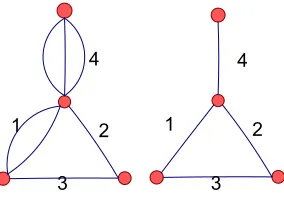
Example 5.8. Let G = (V, E, s) be the multigraph in Figure 1. Then,
η41(vG) = 10,η11(vG) = 14, andη2(vG) =η3(vG) = 28. Thereforeβ41(vG) =
10
3×10+2×14+28+28 = 5
57. Moreover, β11(vG) =
7
57 and β2(vG) =β3(vG) = 14 57.
If we examine the underlying graph of G′ in Figure 1, then η4(vG′ ) = 4 and
η1(vG′ ) = η2(vG′ ) = η3(v′G) = 2 giving β4(G′) = 2/5 and βi(G′) = 1/5 for
i= 1,2,3. Therefore, the Banzhaf values of edges in the underlying graph do not give a direct way of computing the Banzhaf values in the multigraph.
Lemma 5.9. If there is an algorithm to compute the reliability of the under-lying simple graph, then the algorithm can be used to compute the reliability of the corresponding multigraph.
Proof. Let G = (V, E, s) be a multigraph in which there are si parallel
Figure 1: Multigraph and its underlying graph
jth parallel edge of edge i is operational. In that case Rel(G, p) is equal to Rel(G′, p′), where G′ is the corresponding simple graph of G and the probabilitypi that edge iis operational is 1−Qjsi=1(1−pij).
We now prove in Proposition 5.10 that if there is an algorithm to compute the reliability of the underlying simple graph G, then it can be used to compute the Banzhaf indices of the edges in the corresponding multigraph ofG. It would appear that the proposition follows directly from Lemma 5.9 and Proposition 5.4. However, one needs to be careful that the reliability computed is the reliability of the overall graph. Example 1 shows that computing the Banzhaf values of the edges in the underlying simple graph does not directly provide the Banzhaf values of the parallel edges in the corresponding graph.
Proposition 5.10. For a multigraph Gand edgei, letG′ be the multigraph
where all the other edges parallel to edgeiare deleted. Then if the reliability of G′ can be computed in polynomial time, then the Banzhaf value of edge i in G can be computed directly by analysingG′.
Proof. Recall that G is a multigraph with a total of M edges. Given an algorithm to compute the reliability ofG′, we provide an algorithm to
com-pute the Banzhaf values of the parallel edges of edgeiin G. For graph G′, set the operational probabilities of all edges to 0.5 except i which has an operation probability of 1−0.5si. and compute the overall reliabilityr(G′)
of the graph. Then, by Lemma 5.9,ω(G) is 2Mr(G′).
Now for G′, set the operational probabilities of all edges to 0.5 except i
new probabilities be r′(G′). We see that r′(G′) is equal to ωi(G′)/2M−si.
Then ωi(G) = 2si−1ωi(G′) = 2M−1r′(G′). The Banzhaf value of i is then
2ωi(G)−ω(G). A similar approach gives Banzhaf values of other edges from
which all the Banzhaf indices can be computed.
6
Other power indices
Apart from the Banzhaf and Shapley-Shubik indices, there are other indices which are also used. Both the Deegan-Packel index [16] and the Holler index [21] are based on the notion of minimal winning coalitions. Minimal winning coalitions are significant with respect to coalition formation. The Holler index,Hiof a playeriin a simple game is similar to the Banzhaf index
except that only swings in minimal winning coalitions contribute toward the Holler index.
Definitions 6.1. Let Mi be{S ∈Wm:i∈S}. We define theHoller value
as|Mi|. TheHoller index (also called the public good index) is defined by
Hi(v) = |
Mi|
P
j∈N|Mj|
.
TheDeegan Packel index for player iin voting game v is defined by
Di(v) =
1
|Wm|
X
S∈Mi
1
|S|.
Proposition 6.2. For SCGs corresponding to multigraphs, Holler indices and Deegan-Packel indices can be computed in polynomial time.
Proof. We use the fact that the number of trees in a multigraph can be computed in polynomial time, which follows from Kirchhoff ’s matrix tree theorem [19]. Given a connected graphGwithnvertices, let λ1, λ2, ..., λn−1
be the non-zero eigenvalues of the Laplacian matrix of G (the Laplacian matrix is the difference of the degree matrix and the adjacency matrix of the graph). Kirchhoff proved that the number of spanning trees ofGis equal to any cofactor of the Laplacian matrix of G [19]: t(G) = 1nλ1λ2· · ·λn−1.
spanning tree and its Holler value is simply the total number of spanning trees. Ifiis not a bridge thenMi =t(G)−t(G\e). Moreover, since the size
of every minimal winning coalition is the same, namely (n−1), the Holler indices and Deegan Packel Indices coincide for an SCG.
7
Conclusion
This paper examined fairness-based cooperative game solutions of SCGs, for allocating resources to edges. In another recent paper, we have also looked at the computation of stability based cooperative game solutions of SCGs. A polynomial time algorithm is presented to compute the nucleolus. This is a surprising result considering that the standard power indices are NP-hard to compute and also that the SCG is not convex in general. Therefore, the nucleolus may be a better alternative for resource allocation in SCGs. We looked at the exact computation of power indices. In [5], an optimal randomized algorithm to compute Banzhaf indices and Shapley-Shubik in-dices with the required confidence interval and accuracy is presented. Since the analysis in [5] is not limited to a specific representation of a coalitional game, it can be used to approximate Banzhaf indices and Shapley-Shubik indices in SCGs.
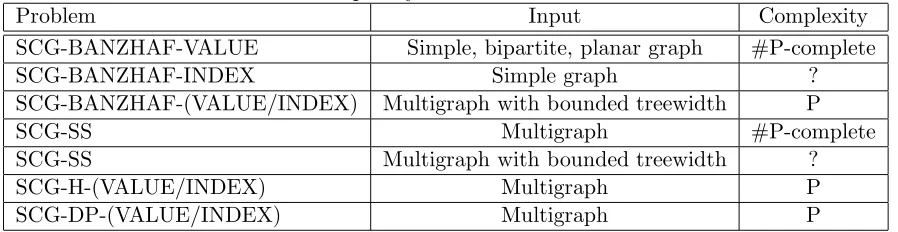
The results of the paper are summarized in Table 1. This framework can be extended to give an ordering on the importance of nodes in the graph [13]. To convert a resource allocation to edges to one on nodes, the payoff for an edge is divided equally between its two adjacent nodes. The total payoff of a node is the sum of the payoffs it gets from all its adjacent edges. This gives a way to quantify and compare the centrality or connecting role of each node. It will be interesting to understand the properties of such orderings, especially for unique cooperative solution concepts such as the nucleolus, Shapley-Shubik and Banzhaf indices.
Table 1: Complexity of SCGs
Problem Input Complexity
SCG-BANZHAF-VALUE Simple, bipartite, planar graph #P-complete
SCG-BANZHAF-INDEX Simple graph ?
SCG-BANZHAF-(VALUE/INDEX) Multigraph with bounded treewidth P
SCG-SS Multigraph #P-complete
SCG-SS Multigraph with bounded treewidth ?
SCG-H-(VALUE/INDEX) Multigraph P
SCG-DP-(VALUE/INDEX) Multigraph P
8
Acknowledgements
Partial support for this research was provided by DIMAP (the Centre for Discrete Mathematics and its Applications), which is funded by the UK EPSRC under grant EP/D063191/1. Rahul Savani also received partial support from EPSRC grant EP/D067170/1. Haris Aziz would also like to thank the Pakistan National ICT R&D Fund for funding his research.
References
[1] Stefan Arnborg, Derek G. Corneil, and Andrzej Proskurowski. Com-plexity of finding embeddings in a k-tree. SIAM J. Algebraic Discrete Methods, 8(2):277–284, 1987.
[2] Stefan Arnborg and Andrzej Proskurowski. Linear time algorithms for NP-hard problems restricted to partial k-trees. Discrete Appl. Math., 23(1):11–24, 1989.
[3] H. Aziz. Complexity of comparison of influence of players in simple games. In Proceedings of the Second International Workshop on Com-putational Social Choice (COMSOC 2008), pages 61–72, 2008.
[4] R. Bacher. Determinants of matrices related to the pascal triangle. J. Th´eor. des Nombres Bordeaux, 14:19–41, 2002.
2008. International Foundation for Autonomous Agents and Multiagent Systems.
[6] Yoram Bachrach and Jeffrey S. Rosenschein. Computing the banzhaf power index in network flow games. InAAMAS ’07: Proceedings of the 6th international joint conference on Autonomous agents and multia-gent systems, pages 1–7, New York, NY, USA, 2007. ACM.
[7] Yoram Bachrach and Jeffrey S. Rosenschein. Coalitional skill games. In AAMAS (2), pages 1023–1030, 2008.
[8] Yoram Bachrach and Jeffrey S. Rosenschein. Power in threshold net-work flow games. Journal of Autonomous Agents and Multi-Agent Sys-tems, 18(1):106–132, February 2009.
[9] Yoram Bachrach, Jeffrey S. Rosenschein, and Ely Porat. Power and stability in connectivity games. InAAMAS (2), pages 999–1006, 2008.
[10] R. A. Bailey. Surveys in Combinatorics. Cambridge University Press, 1997.
[11] Michael O. Ball. Computational complexity of network reliability anal-ysis: An overview. Reliability, IEEE Transactions on, 35(3):230–239, Aug. 1986.
[12] Peter Borm, Herbert Hamers, and Ruud Hendrickx. Operations re-search games: A survey. TOP: An Official Journal of the Spanish Society of Statistics and Operations Research, 9(2):139–199, December 2001.
[13] Ulrik Brandes and Thomas Erlebach.Network Analysis: Methodological Foundations. Springer, 2005.
[14] Yves Crama and Luc Leruth. Control and voting power in corporate networks: Concepts and computational aspects. European Journal of Operational Research, 178(3):879–893, 2007.
[15] Imma Curiel. Cooperative Game Theory and Applications: Cooperative Games Arising from Combinatorial Optimization Problems. Springer, 1997.
[17] Pradeep Dubey and Lloyd S. Shapley. Mathematical properties of the banzhaf power index. Mathematics of Operations Research, 4(2):99– 131, 1979.
[18] Piotr Faliszewski and Lane A. Hemaspaandra. The complexity of power-index comparison. In AAIM, pages 177–187, 2008.
[19] Chris Godsil and Gordon Royle. Algebraic Graph Theory. Springer, April 2001.
[20] Daniel Granot and Michael Maschler. Spanning network games. Inter-national Journal of Game Theory, 27(4):467–500, 1998.
[21] M.J. Holler. Forming coalitions and measuring voting power. Political Studies, 30(2):262271, 1982.
[22] Bernhard Korte and Jens Vygen. Combinatorial Optimization: Theory and Algorithms. Springer, Germany, 3rd edition, 2006.
[23] Leslie G. Valiant. The complexity of enumeration and reliability prob-lems. SIAM Journal on Computing, 8(3):410–421, 1979.
[24] Anne van den Nouweland, Stef Tijs, and Michael Maschler. Monotonic games are spanning network games. International Journal of Game Theory, 21(4):419–27, 1993.
HARIS AZIZ
Department of Computer Science, University of Warwick, Coventry CV4 7AL, United Kingdom.
ODED LACHISH
Department of Computer Science, University of Warwick, Coventry CV4 7AL, United Kingdom.
MIKE PATERSON
Department of Computer Science, University of Warwick, Coventry CV4 7AL, United Kingdom.
RAHUL SAVANI
Department of Computer Science, University of Warwick, Coventry CV4 7AL, United Kingdom.