City, University of London Institutional Repository
Citation
:
Meinzer, M. & Murphy, R. (2010). The tax gap at the core of the current financial
crisis. In: A. Watt & A. Botsch (Eds.), After the crisis: towards a sustainable growth model.
(pp. 130-134). Brussels: The European Trade Union Institute. ISBN 9782874521706
This is the published version of the paper.
This version of the publication may differ from the final published
version.
Permanent repository link:
http://openaccess.city.ac.uk/16538/
Link to published version
:
Copyright and reuse:
City Research Online aims to make research
outputs of City, University of London available to a wider audience.
Copyright and Moral Rights remain with the author(s) and/or copyright
holders. URLs from City Research Online may be freely distributed and
linked to.
City Research Online:
http://openaccess.city.ac.uk/
[email protected]
The tax gap
at the core of the current
financial crisis
and how to close it
Richard Murphy and Markus Meinzer
Tax Research UK and Jacobs University Bremen
Richard Murphy is a UK-based chartered accountant. He was visiting fellow at the Centre for Global Political Economy at the University of Sussex and an External Research Fellow at the Tax Research Institute, University of Nottingham. He founded the Tax Justice Network and is tax adviser to the UK TUC and many other NGOs, and has written widely on tax justice issues. He blogs frequently at www.taxresearch.org.uk/blog.
Markus Meinzer is a PhD student at Jacobs University Bremen and a consultant to the Inter-national Secretariat of the Tax Justice Network, compiling much of the data underlying the project ‘secrecy jurisdictions’ http://www.secrecyjurisdictions.com.
2002 2003 2004 2005 2006 2007 2008 2009 700
600
500
400
£ billions
Government spending Government income
A lack of tax revenue did not cause the current financial crisis. The lack of tax revenue caused by the current financial crisis is, however, the problem facing almost all governments, worldwide.
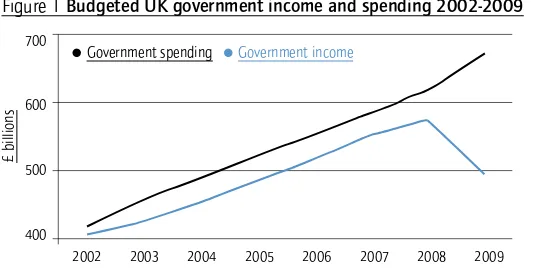
[image:3.420.56.326.102.236.2]The problem can be exemplified using figures for the UK. Budgeted UK government tax revenue and spending from 2002 to 2009 is shown in Figure 1.
Figure 1 Budgeted UK government income and spending 2002-2009
Source: HM Treasury web sites for the budget for each year noted: http://www.hm-treasury.gov.uk/bud_bud09_index.htm
What becomes readily apparent is that the current crisis in government financ
-ing is not a spend-ing related issue: it is a revenue related issue. It is the collapse in income that is at the core of our current fiscal crisis. If we wish to continue to enjoy the benefits of government spending, the means has to be found to restore government income when a ‘tax gap’ of £175 billion has opened up in the UK, and of similar proportion to GDP in other countries.
That ‘tax gap’ has four major components:
1. Income lost as a result of a downturn in economic activity: this is not the con
-cern of this paper;
2. Tax lost to tax avoidance which is seeking to minimise a tax bill without de
-liberate deception (which would be tax evasion or fraud) but contrary to the spirit of the law;
3. Tax lost to tax evasion which is the illegal non payment or under-payment of taxes, usually by making a false declaration or no declaration to tax authori
-ties, resulting in legal penalties if the perpetrator is caught; 4. Non payment of tax declared to be due, i.e. bad debt.
The second to fourth items on this list are the issues considered here. Estimates of the size of these tax gaps are rare, and subject to considerable dispute. Again tak
-ing the UK as an example, the likely gap is in the range £70 billion to £120 billion, that is between 40% and 68% of the current annual tax deficit. While the situa
There are a range of policy initiatives any government can and should take to tackle the tax gap at this time. These initiatives split into two parts. First, tax evasion and the non-payment of tax due must be tackled. This should be done by increasing the number of staff engaged by tax authorities to tackle these issues; this makes particular sense during a period of high unemploy
-ment. However, this logical course of action is contrary to policy of many cash-strapped governments. In the UK a significant number of tax offices are to be closed and staff made redundant, leading to low morale amongst remaining staff, chaos in tax administration and rising debt arrears. There is significant danger in this at a time when public services are under threat. Failure to col
-lect tax due undermines the relationship between state and citizen at a time when it will be under stress. Investment in tax collection and tackling tax eva
-sion is vital at this time.
Secondly, challenging tax avoidance is vital. This activity, unrecorded by government in the main because by definition it is legal, shifts the burden of tax payment in society, most especially from capital (and large companies that en
-gage it) onto labour and from the wealthy and self-employed onto employed la
-bour. The resulting perceptions of injustice are politically significant at this time. A wide range of measures are available to tackle tax avoidance, of which the following are a selection:
Create country by country reporting for multinational
corporations
Country by country reporting is a new form of accounting for multinational corporations promoted by civil society organisations. Discussion of country-by-country reporting is well advanced and it has been or is currently subject to active discussion by, amongst others, the International Accounting Standards Board, the Organisation for Economic Cooperation and Development and the European Parliament.
Country-by-country reporting differs from existing accounting in that it would require disclosure, without exception, of the following information by multina
-tional corporations in their accounts:
— The name of each country in which it operates;
— The names of all its companies trading in each country in which it operates; — Its profit and loss account for each country in which it operates, including de
-tails on third-party and intra-group sales, labour costs and head count, profit made and tax paid;
— A limited balance sheet for each country.
General Anti-Avoidance Principles
General Anti-Avoidance Principles are exactly what they sound like. They are laws that say that if a person puts a step or steps into a transaction or series of transactions for the main or sole purpose of reducing their tax liability, then that step is ignored in calculating their tax. Such laws exist and work in Australia, South Africa and even Jersey. Their power is in banning a means of tax abuse before a tax lawyer or accountant has thought it up. They have a strong deterrent effect and this is why they are important.
Automatic information exchange between tax authorities
In a global world it is easy for a tax payer from one state to hide their income in another jurisdiction, especially if the latter is a secrecy jurisdiction. Secrecy ju
-risdictions are places that intentionally create regulation for the primary benefit and use of those not resident in their geographical domain. That regulation is designed to undermine the legislation or regulation of another jurisdiction. To facilitate its use secrecy jurisdictions also create a deliberate, legally backed veil of secrecy that ensures that those from outside the jurisdiction making use of its regulation cannot be identified to be doing so.
Current measures to tackle this are based on what is called information ex
-change on request. It has a low deterrent effect because the level of information one tax authority must supply to another before a request for data can be made is considerable: very few requests are made as a result.
The European Union Savings Tax Directive is the best example of an em
-bryonic system for automatic information exchange where tax authorities send data to each other automatically to ensure that income hidden in tax havens is revealed. However, it is limited in geographic scope, is restricted only to interest income received by individuals, and includes loopholes that limit its effective
-ness. Using it as a precedent, we recommend the automatic supply of informa
-tion by the tax jurisdic-tion where a person who is resident in another tax juris
-diction has an interest in a financial structure – whether it be a bank account, company, partnership, trust or foundation – to that jurisdiction where they are recorded as resident for anti-money laundering legislation purposes. By law this data already has to exist, and this proposal would add essential transparency to the tax system that will shatter banking, corporate and trust secrecy.
Setting minimum tax rates for the well off
€100,000, meaning that, whatever allowances or reliefs are provided for in the tax system, a person’s tax bill cannot fall below this rate when compared to their gross income. Alternatively, and possibly more simply, a ceiling on allowances and reliefs can be set above which no one can claim more. The opportunity for tax avoidance is therefore reduced considerably.
---Further reading
---Irvin, G., D. Byrne, R. Murphy, H. Reed and S. Ruane (2009) In place of cuts: tax
reform to build a fairer society, London: Compass.
Murphy, R. (2007) A code of conduct for taxation, Basildon: Association for Ac
-countancy and Business Affairs / Tax Justice Network.
http://www.taxresearch.org.uk/Documents/TaxCodeofConductFinal.pdf; 3.2.2010.
Murphy, R. (2008) The missing billions. The UK tax gap, London, TUC.
http://www.tuc.org.uk/touchstone/Missingbillions/1missingbillions.pdf; 15.12.2009.
Murphy, R. (2009) Country-by-country reporting. Holding multinational cor
-porations to account wherever they are, Washington, DC: Task Force on Fi
-nancial Integrity and Economic Development.
http://www.financialtaskforce.org/wp-content/uploads/2009/06/Final_ CbyC_Report_Published.pdf; 15.12.2009.
Tax Justice Network (2008) Tax havens creating turmoil. Evidence submitted
to the Treasury Committee of the House of Commons by the Tax Justice Net
-work UK, Chesham: Tax Justice Network International Secretariat Ltd.