Isla Fraser,
1B.Sc.; Wolfram Meier-Augenstein,
1Ph.D.; and Robert M. Kalin,
1Ph.D.
Stable Isotope Analysis of Human Hair and
Nail Samples: The Effects of Storage on
Samples
ABSTRACT: When submitting samples for analysis, maintaining sample integrity is essential. Appropriate packaging must be used to prevent damage, contamination or loss of sample. This is particularly important for stable isotope analysis by isotope ratio mass spectrometry as this tech-nique is capable of detecting subtle differences in isotopic composition with great precision. In a novel study, scalp hair and fingernail samples were placed in five different types of packaging, routinely used in forensic laboratories and stored for 6 weeks and 6 months. Samples were subsequently cleaned and submitted for13C⁄12C,15N⁄14N,2H⁄1H and18O⁄16O analysis. Results from13C analysis indicate that type of packaging can cause slight
changes in13C abundance over time. Differences were noted in the15N isotope signatures of both hair and nail samples after 6-week storage, but not after 6 months. This apparent discrepancy could be a result of the packaging not being properly sealed in the 6 weeks study. Fewer differences were noted when analyzing samples for2H and18O abundance.
KEYWORDS: forensic science, isotope ratio mass spectrometry, hair, nails, storage, plasticizers, coatings
Isotope ratio mass spectrometry (IRMS) is becoming an estab-lished technique in the forensic profiling of samples including drugs, paints, and food products (1–5). With an increasing number of laboratories and institutes investing in new instruments the need to fully validate the method is now even greater than before. Sev-eral studies have demonstrated its potential as a tool for determin-ing the place of origin of livdetermin-ing humans, unidentified human remains, and the identification of disaster victims (6–10). In order to apply this technique in forensic investigations, factors that may potentially have a detrimental effect on measured isotopic signa-tures need to be explored.
In any situation where samples are submitted to a laboratory for analysis, maintaining the integrity of the samples is essential. Appropriate packaging and storage containers must be used to pre-vent contamination, evaporation or damage. This is particularly important when submitting samples for analysis by IRMS as this technique is capable of detecting minute changes in isotopic abun-dance. This communication investigates the effects of different types of packaging on isotopic sample integrity of hair and nail samples submitted for isotope analysis. Whilst actual packaging materials have been analyzed using IRMS (11,12), to the best of the author’s knowledge, no previous work has been carried out to investigate the effects of packaging itself on samples submitted for stable isotope analysis.
Once collected, samples are usually stored for varying amounts of time depending on urgency, resources available, etc. However, even after a case has been closed, samples are still retained for a period of time to allow for appeals and re-examination. For this reason, it is important samples are securely stored in containers that
will not compromise sample integrity—either through cross-con-tamination or leaching of substances from the packaging material itself.
Plasticizers found in plastic evidence bags, for example, could contribute to the isotope values measured. Modern plasticizers are manmade organic chemicals such as adipates and phthalates, which are added to a material to make it more pliable (13). Problems aris-ing from the leacharis-ing of plasticizers have been reported for di(2-ethyl-hexyl) phthalate (DEHP), a plasticizer found in PVC products such as medical blood bags. Jaegar and Rubin (14) found that DEHP leached into stored human blood. As DEHP is not cova-lently bonded to PVC it was found that it could migrate out of the plastic. Although subsequent studies (15) found that the effect was not harmful if the blood was stored for a limited period of time, this finding demonstrates the fact that the certain packaging materi-als can be detrimental to the sample being stored.
This study has been designed to determine whether or not certain types of packaging permit the entry of airborne particles into the container or traps moisture inside the packaging which could affect the integrity of the sample, and thus alter the isotope profile of the sample. In addition, the study hopes to establish whether there is any evidence of a change in the isotopic profile of samples because of an interaction between the packaging container and its contents. For example, water vapor or other chemicals may be absorbed onto the surface of the sample or migrate into the sample itself.
Materials and Methods
Having obtained ethical approval from the Office for Research Ethics Committees Northern Ireland (ORECNI), samples of scalp hair and fingernails (hereafter referred to as hair and nail) from the same subject were placed into each of the following packages: plastic self-seal bags, plastic eppendorff tubes, paper envelopes, pieces of tin foil, and crimp-sealed glass vials. Only one of each type of container was used at this time because the initial idea was to establish whether or not differences existed between different storage containers. Samples were stored for a period of 6 weeks in
1
Environmental Forensics and Human Health, Environmental Engineering Research Centre, Queen’s University Belfast, Belfast BT9 5AG, United Kingdom.
Preliminary data from this study have been presented in the form of a poster at the 2005 Forensic Isotope Ratio Mass Spectrometry network (FIRMS), Brands Hatch, United Kingdom.
Received 7 May 2006; and in revised form 15 Oct. 2006; accepted 24 June 2007.
1
Available online at: www.blackwell-synergy.com
a cool, dry laboratory cupboard. The same experiment was repeated a month later using samples collected from the same subject, but in this instance they were stored for a period of 6 months.
Ideally, samples for both the 6-week and the 6-month experiment should have been collected from the same subject at the same time. Unfortunately, it was not possible to collect the amount of material required to satisfy the needs of comprehensive isotope analysis (13C⁄12C,15N⁄14N, 2H⁄1H, and18O⁄16O) and both storage
experi-ments in one single collection. However, the subject whose hair and nails were collected for this study had not traveled or changed his diet during the sampling interval. Previous research by our group (6) has demonstrated the relatively low degree of intra-indi-vidual natural variability in stable isotope composition of hair and nail samples. The natural variation for d13C andd15N values from hair and nails of an individual residing in one location over a per-iod of 6 months was <1.5& whilst the natural variation of d18O
andd2H values was <3&and 10&, respectively.
Cleaning of Samples
After 6-week⁄6-month storage, all samples were cleaned accord-ing to a published standard procedure (8). In order to overcome problems regarding static electricity, once cleaned, all samples were ground using a SPEX CertiPrep
2 cryogenic freezer⁄mill (blen Creston Ltd, Stanmae, Middlesex, UK) using stainless steel vials and impactors. Samples were ground using the standard programme setting of a 15-minute precool followed by three grinding cycles of 2 min each at a rate of 10, where rate refers to the number of impacts per second. There was a 2-minute cooling period between each grinding cycle. Ground samples were easier to weighed out in small amounts into tin⁄silver capsules and the loss of sample during grinding was minimal (<10%). Results of comparative isotope analysis of ground versus unground samples were not significantly different, but grinding samples improved reproducibility of triplicate analysis, probably because of improved homogeneity. The cryogenic mill also permits the fine grinding of samples without the heat build-up generated by conventional grinding methods—thus avoid-ing potential isotopic fractionation through temperature changes.
Following grinding, samples were placed in glass vials, sealed and stored for a minimum of 7 days in a desiccator containing phosphorous pentoxide, to remove residual moisture traces from the samples. This was particularly important for hydrogen (H) and oxygen (O) isotope analysis as it is known that H and O exchange between moisture and exchangeable H’s and OH’s can have a sig-nificant effect on the measured isotope values of samples (16). All samples were exposed to the same environment after collection to ensure labile H-atoms prone to exchange would all reflect the same
2H level, i.e., that of ambient humidity in our laboratory. Samples
were therefore analyzed on a‘‘like-for-like’’basis, i.e., on the prin-ciple of identical treatment (PIT) (16).
Standards and reference materials used in the analysis of the samples were stored in the containers in which they were received from the suppliers, i.e., glass vials. Because these materials provide the means to express measured isotope ratios in values of the inter-nationally usedd-notation (Eq. 1), these materials were not subject of the storage experiment.
Bulk Isotope Analysis by EA-IRMS
Analysis of 13C and 15N—A Carlo Erba elemental analyzer (CN 1500) coupled to an ABCA isotope ratio mass spectrometer (EA-IRMS) (SerCon Ltd., Crewe, U.K.) was used for 13C⁄12C
and 15N⁄14N isotope ratio measurement of ground hair and nail
samples. Typically, 0.5 mg of sample was weighed into a tin capsule (Elemental Microanalysis) and introduced into the EA by means of a solid autosampler. The EA reactor tubes were self-packed and comprised of two quartz glass tubes filled with chro-mium (III) oxide and reduced copper for combustion and reduc-tion, respectively. Combustion and reduction reactor temperature was set to 1000C and 600C, respectively, while the postreactor GC column, filled with molecular sieve 5 , was kept at 80C for separation of evolved N2 and CO2. Data were processed
using proprietary software Calisto (SerCon Ltd, Crewe, U.K.). The run time per analysis was 530 sec. Measured 13C⁄12C and 15N⁄14N isotope ratios are expressed in the d-notation in parts
per thousand (&) (see Eq. 1) relative to the international stan-dards VPDB and AIR, respectively.
dð&Þ ¼ RSampleRStrd
RStrd
1000 ð1Þ
Analysis of2H and18O—Helium, carbon monoxide and hydrogen of at least 99.999% purity were purchased from Air Products (Crewe, U.K.) and BOC (Guilford, Surrey, U.K.), respectively. An internationally recognized isotope reference material (IAEA – CH-7) was obtained from the IAEA (Vienna, Austria).
A Thermo Finnigan DeltaPlusXP coupled to a High Temperature Conversion⁄Elemental Analyzer (TC⁄EA) (Thermo Electron Cor-poration, Bremen, Germany) was used for2H⁄1H and18O⁄16O
iso-tope ratio measurement of ground hair and nail samples. Typically, 0.2 mg of sample was weighed into a silver capsule and placed in a desiccator for a week before the samples are introduced into the TC⁄EA by means of a solid Costech Zero-Blank autosampler (Peli-can Scientific Ltd., Alford, U.K.). The reactor tube was self-packed and comprised of an AlsintTMceramic tube (Multilab, Newcastle, U.K.), containing a glassy carbon tube (HTW GmbH, Thierhaup-ten, Germany) filled with glassy carbon granulate, silver, and quartz wool. Reactor tubes were self-packed according to manufacturer’s packing recommendation for solid sample analysis. Reactor temper-ature was set to 1450C while the postreactor GC column was maintained at 90C. Helium pressure was set to 1.45 bars. Data were processed using Isodat NT software, version 2.0 (Thermo Finnigan, Basel, Switzerland). The run time per analysis was 350 sec. Measured 2H⁄1H and 18O⁄16O isotope ratios were
expressed as d-values in parts per thousand (&) relative to VSMOW.
Isotopic Calibration and Quality Control of EA-IRMS Measurement
13
C⁄12
C and 15N⁄14
N analysis—Each batch of samples was bracketed by a set of two certified laboratory standards of known isotopic composition. These two standards were leucine (d13C
VPDB=)30.52&) and glycine (d13CVPDB=)45.54&). At
regular intervals, system performance was cross-checked by running these two standards against an international standard, IAEA-CH-6 (d13C
VPDB=)10.4&). Typically, a batch analysis
drift corrected according to the deviation of the measured d-value from the knownd-value of the QC standards.
2
H⁄1
H and 18O⁄16
O Analysis—The working reference gas, H2
was calibrated against V-SMOW using an IAEA standard, IAEA-CH-7 polyethylene (d2H
VSMOW=)100.3&), as well as a certified
laboratory standard coumarin (d2HVSMOW= +62.56&). The H3+
factor was also calculated; H3+ions are generated by the impact of
H2+ ions and H2 molecules. As they have the same mass as the 1H2H+(HD+) ions their contribution to the ion count ofm⁄z3 has
to be accounted and corrected for. The H3+factor was determined
on reference H2 gas pulses (d2HVSMOW=)204.45&) of different
signal size and was found to be 3.9. A batch analysis comprised 10 samples run in triplicate, preceded and followed by a set of standards. This set consisted of two in-house standards and three international standards (IAEA-CH-7) as calibration controls at the beginning and end of the set. Four samples containing IAEA-CH-7 and two blank samples are analyzed in the middle of the run, splitting the samples in to two brackets of five samples analyzed in triplicate. Each batch is preceded and followed by a blank capsule. Measured d2H-values were normalized according to the method described by Coplen (17) with Z-factors (or ‘‘stretch’’ factors) typically being of the order of 1.02–1.03.
Results and Discussion
Two storage experiments were carried out, lasting 6 weeks and 6 months, respectively, to ascertain whether the packaging in which samples such as hair and nail are stored interferes with the isotope signature of the sample.
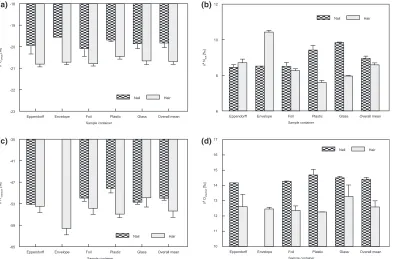
Results of 13C bulk stable isotope analysis after 6-week storage indicate that the type of packaging has no significant bearing on the results obtained (see Fig. 1a). Although the nail sample stored in foil had a slightly more depleted13C-value than the other sam-ples and the sample stored in the self-seal plastic bag had a more enrichedd13C-value, these differences are within the natural varia-tion expected for an individual living in a fixed locavaria-tion (1.5&). Explanations for these findings may be that the foil was not wrapped tight enough around the sample, allowing the sample to be contaminated. According to the European Aluminium Foil Asso-ciation and the Aluminium Federation Ltd. (personal communica-tion), standard domestic aluminum foil does not have a coating on its surface, however more specialized foils may have a polymer coating. As this may‘‘rub off’’ onto the sample being stored it is important that the foil is carefully selected. Similarly, self-seal plas-tic bags regularly contain plasplas-ticizers to keep the product soft and pliable; the presence of these additives may contribute to the isoto-pic signature of the sample. It was not possible to compare the nail sample stored in an envelope with the remaining samples as it was only analyzed once because of insufficient amount of sample. Bulk
13C isotope analysis of the hair samples indicated that the sample
stored in the self-seal plastic bag had a more enrichedd13C-value than the other samples although the isotopic shift is within the expected range.
Greater differences between the different storage methods are visible when observing the 15N values after a period of 6-week storage, as demonstrated in Fig. 1b. The nail samples stored in a glass vial and a plastic self-seal bag had more enrichedd15N-value compared to the other samples. In addition, the hair sample stored in the envelope was noticeably more enriched in d15N than the remaining samples. Although small, these isotope shifts are greater
(a) (b)
[image:3.585.101.494.435.694.2](c) (d)
FIG. 1—
5 The effect of packaging on the isotopic composition of hair and nails following 6-week storage. (a)d13C values of hair and nails, (b)d15N values of hair and nails, (c)d2
H values of hair and nails and (d)d18
O values of hair and nails. Results represent the mean of a triplicate analysis and error bars indicate standard deviation of replicate analyses of the same sample. The natural variation ford13C andd15N values from hair and nails of an individual residing in one location over a period of 6 months was <1.5&whilst the natural variation ofd18
than the variation expected from an individual living in a fixed location (1.5&). As a sample stored within an envelope is not completely isolated from the ambient air as with the other contain-ers, there is the possibility that the sample was exposed to humidity fluctuations and this could be responsible for the unusual result. In addition, the surfaces of some types of paper are coated, often with fine clay, to make it glossier and easier to print on—transfer of this substance to the sample may affect its isotopic signature.
After 6-week storage, the results of 2H analysis showed that all samples had an isotope value within the expected range (Fig. 1c). Due to insufficient sample, 2H analysis of nail stored within an envelope was not possible. As shown in Fig. 1d, the results indicate that there is no difference in the oxygen values obtained for either nail or hair samples after 6-week storage.
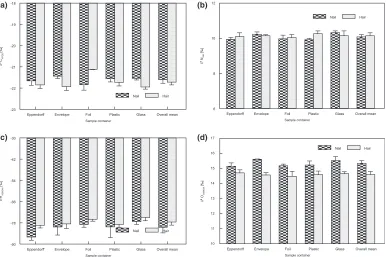
Not all the results recorded after 6-week storage was reproduced after 6 months. In agreement with the 6 week storage experiment, after 6-month storaged13C analysis indicated that there was no
sig-nificant difference between the samples (see Fig. 2a). However, unlike the 6-week experiment, no differences in 15N values were noted between any of the nail or hair samples after 6-month storage (see Fig. 2b). Following d2H analysis, the nail sample stored in an eppendorff had a more depleted value compared to the other sam-ples, however this shift did not exceed the natural variability expected (10&), as shown in Fig. 2c. Similarly, the hair samples stored in foil and the glass vial both had slightly enrichedd2H val-ues compared to the remaining samples, but these differences were not greater than natural variation expected. No differences were found when analyzing the nail and hair samples ford18O (Fig. 2d).
These results indicate that when carrying out d13C, d2H and
d18O analysis of samples, the type of storage container used has lit-tle bearing upon the results obtained because of the subsequent sample preparation protocol. More pronounced and significant
differences however are found when analyzing the same samples ford15N, although there is no consistent isotope shift from 6 weeks to 6 months. The results suggest that the storage container of choice is a glass vial with a securely crimped lid. Paper, plastic eppendorff tubes and plastic self-seal bags should be avoided because of the possible presence of additives and plasticizers which could alter the isotopic signature of the samples to be analyzed.
Conclusion
This study has highlighted the importance of selecting the correct storage container when collecting samples for stable isotope analy-sis. Although this particular investigation pertains to hair and nail samples, careful selection of a storage container is essential, irre-spective of the matrix to be analyzed. Although the effect of the packaging may be more pronounced for15N than13C,2H and18O, as demonstrated here, it would be good practice to conduct system-atic storage experiments on a variety of commonly encountered samples that could be submitted for isotope analysis. In addition, it is essential to ensure containers are securely ‘‘crimped’’ or closed and that packaging containing coatings or additives are avoided to maintain the integrity of samples.
Acknowledgments
The authors wish to thank all volunteers who have kindly donated samples. Thanks are due to Nicola Farmer for assis-tance with instrumentation and analyses. A PhD studentship awarded to IF by the Department of Education and Learning and financial supports from 14CHRONO (SPUR) and Environ-mental Forensics (EPSRC Platform) grants are gratefully acknowledged.
(a) (b)
[image:4.585.97.483.60.317.2](c) (d)
FIG. 2—
5 The effect of packaging on the isotopic composition of hair and nails following 6-month storage. (a)d13C values of hair and nails (b)d15N values of hair and nails (c)d2H values of hair and nails and (d)d18O values of hair and nails. Results represent the mean of a triplicate analysis and error bars indicate standard deviation of replicate analyses of the same sample. The natural variation ford13
C andd15
References
1. Jasper JP, Westenberger BL, Spencer JA, Buhse LF, Nasr M. Stable iso-topic characterization of active pharmaceutical ingredients. J Pharm Bio-med Anal 2004;35:21–30.
2. Carter JF, Sleeman R, Hill JC, Idoine F, Titterton EL. Isotope ratio mass spectrometry as a tool for forensic investigation (examples from recent studies). Sci Justice 2005;45:141–9.
3. Reidy LJ, Meier-Augenstein W, Kalin RM. 13C-Isotope ratio mass spec-trometry as a potential tool for the forensic analysis of white architec-tural paint: a preliminary study. Rapid Commun Mass Spectrom 2005;19:1899–905.
4. Kelly S, Heaton K, Hoogewerff J. Tracing the geographical origin of food: The application of multi-element and multi-isotope analysis. Trends Food Sci Technol 2005;16:555–67.
5. Meier-Augenstein W, Lui RH. Forensic applications of isotope ratio mass spectrometry. In: Yinon J, editor. Advances in forensic applica-tions of mass spectrometry. U.S.A.: CRC Press, 2004;149–80.
3
6. Fraser I, Meier-Augenstein W, Kalin RM. The role of stable isotopes in human identification: a longitudinal study into the variability of isotopic signatures in human hair and nails. Rapid Commun Mass Spectrom 2006;20:1109–16.
7. Sharp ZD, Atudorei V, Panarello HO, Fernandez J, Douthitt C. Hydro-gen isotope systematics of hair: archeological and forensic applications. J Archaeol Sci 2003;30:1709–16.
8. O’Connell TC, Hedges REM. Investigations into the effect of diet on modern human hair isotopic values. Am J Phys Anthropol 1999;108:409–25.
9. Katzenberg MA, Krouse HR. Application of stable isotope variation in human tissues to problems in identification. Can Soc Forens Sci J 1989;22:7–19.
10. Bol R, Pflieger C. Stable isotope (13C,15N and34S) analysis of the hair of modern humans and their domestic animals. Rapid Commun Mass Spectrom 2002;16:2195–200.
11. Montero S, Wiarda IW, de Joode IP, Van der Peijl G. LA-ICP-MS and IRMS investigations on packaging and duct tapes [abstract]. In: Lock C, editor. FIRMS 2005: the network developing forensic applications of stable isotope ratio mass spectrometry, March 9–10 2005; Brands Hatch, U.K. Fort Halstead, Kent: DSTL, 2005;19–20.
12. Carter JF, Grundy PL, Hill JC, Ronan NC, Titterton EL, Sleeman R. Forensic isotope ratio mass spectrometry of packaging tapes. Analyst 2004;129:1206–10.
13. http://www.plasticisers.org/index.asp?page=3
4
14. Jaegar RJ, Rubin RJ. Migration of a phthalate ester plasticizer from polyvinyl chloride blood bags into stored human blood and its localiza-tion in human tissues. N England J Med 1972;287:1114–8.
15. Racz Z, Pick J, Baroti K, Pinter J, Szabo J. Blood products stored in plastic bags: release of plasticizers from the bag material. Orv Hetil 1993;134:1581–6.
16. Bowen GJ, Chesson L, Nielson K, Cerling TE, Ehleringer JR. Treatment methods for the determination ofd2
H andd18
O of hair keratin by con-tinuous-flow isotope-ratio mass spectrometry. Rapid Commun Mass Spectrom 2005;19:2371–8.
17. Coplen TB. Normalization of oxygen and hydrogen isotope data. Chem Geol 1988;72:293–7.
Additional information and reprint requests: Isla Fraser, B.Sc.
Environmental Forensics and Human Health Environmental Engineering Research Centre Queen’s University Belfast