Foundations for Structured Programming with GADTs
Patricia Johann
Rutgers University, Camden, NJ, USA [email protected]
Neil Ghani
University of Nottingham, Nottingham, UK [email protected]
Abstract
GADTs are at the cutting edge of functional programming and be-come more widely used every day. Nevertheless, the semantic foun-dations underlying GADTs are not well understood. In this paper we solve this problem by showing that the standard theory of data types as carriers of initial algebras of functors can be extended from algebraic and nested data types to GADTs. We then use this obser-vation to derive an initial algebra semantics for GADTs, thus en-suring that all of the accumulated knowledge about initial algebras can be brought to bear on them. Next, we use our initial algebra semantics for GADTs to derive expressive and principled tools — analogous to the well-known and widely-used ones for algebraic and nested data types — for reasoning about, programming with, and improving the performance of programs involving, GADTs; we christen such a collection of tools for a GADT an initial al-gebra package. Along the way, we give a constructive demonstra-tion that every GADT can be reduced to one which uses only the equality GADT and existential quantification. Although other such reductions exist in the literature, ours is entirely local, is indepen-dent of any particular syntactic presentation of GADTs, and can be implemented in the host language, rather than existing solely as a metatheoretical artifact. The main technical ideas underlying our approach are (i) to modify the notion of a higher-order functor so that GADTs can be seen as carriers of initial algebras of higher-order functors, and (ii) to use left Kan extensions to trade arbitrary GADTs for simpler-but-equivalent ones for which initial algebra semantics can be derived.
Categories and Subject Descriptors D.3.3 [Programming Lan-guages]: Language Constructs and Features-Data types and struc-tures
General Terms Languages, Theory
1. Introduction
Generalized algebraic data types, or GADTs, are at the cutting edge of functional programming and are finding an ever-increasing number of applications. Types are traditionally used to guarantee that programs do not ‘go wrong’ by using data in inappropriate ways. GADTs extend this traditional use of types, allowing them to index, and thereby capture more sophisticated properties of, data types. Properties of interest may include the size or shape of data, the state of program components, or some invariant that the
Permission to make digital or hard copies of all or part of this work for personal or classroom use is granted without fee provided that copies are not made or distributed for profit or commercial advantage and that copies bear this notice and the full citation on the first page. To copy otherwise, to republish, to post on servers or to redistribute to lists, requires prior specific permission and/or a fee.
POPL’08, January 7–12, 2008, San Francisco, California, USA. Copyright c�2008 ACM 978-1-59593-689-9/08/0001. . . $5.00
data type is expected to satisfy. By encoding properties as types, GADTs provide a means of abstracting them into a form that com-pilers and other language tools can exploit. This makes proper-ties of programs that would otherwise be available only dynami-cally, if at all, statically checkable and analyzable, and thus makes progress toward closing what Sheard calls thesemantic gap be-tween what the programmer knows about a program and what the programming language allows to be stated. GADTs are especially useful when combined with higher-kinded types, as in (extensions of) Haskell, and with user-definable kinds, as inΩmega [Omega, Sheard et al. (2005)]. In such settings, GADTs can represent refine-ment types, witness types, existential types, and certain dependent types. GADTs are closely related to several other concepts, includ-ing first-class phantom types [Cheney & Hinze (2003)], equality-qualified types [Sheard & Pasalic (2004)], guarded recursive types [Xi et al. (2003)], and inductive families [Dybjer (1994)]. They can even be regarded as a variant of dependent types [McBride (2004), Xi & Pfenning (1999)] in which the distinction between types and values is maintained.
It is widely accepted that a good theory of data types requires principled foundations in order to provide expressive tools for structured programming with them. One of the most successful foundations for algebraic data types — such as the natural numbers, lists, trees — is that ofinitial algebra semantics. In initial algebra semantics, every data type is seen as the carrier of the initial algebra of a functor. The value of initial algebra semantics lies not only in its theoretical clarity, but also in that it supports principled structured programming techniques for data types including:
• Combinators which uniformly produce, uniformly consume, and otherwise capture commonly-occurring type-independent programming idioms for data types. Among the most significant of these are thebuildcombinator, which uniformly produces structures of a given data type; the structured recursion com-binatorfold, which uniformly consumes structures of a given data type; and themapcombinator, which applies a specified function to all data in a structure of a given data type.
• Church encodings for data types, which represent structures of data types as functions in the Girard-Reynolds polymorphic lambda calculus, the core formal calculus on which many func-tional languages are based. In addition to being interesting in their own right, Church encodings are the key to definingbuild combinators. Indeed, thebuildcombinator for each data type derives from the isomorphism between that data type and its Church encoding.
construct the intermediate structure introduced bybuildand immediately consumed by fold. Local program transforma-tions [Gill et al. (1993), Johann (2002), Svenningsson (2002)] based on fold/build rules can result in order-of-magnitude increases in program efficiency. They also open the way for de-veloping a so-calledalgebra of fusion.
•Generic programmingtechniques based on the observation that initial algebra semantics allows us to derive a singlegeneric foldcombinator, asinglegenericbuildcombinator, and a sin-glegenericfold/buildrule — each of which can be special-ized to any particular data type of interest.
Despite their ubiquity and utility, the semantic foundations of programming with GADTs are not well understood. In particular, there is currently no known initial algebra semantics for GADTs. From a theoretical standpoint, it is unsettling to think that our un-derstanding of data types in terms of initial algebras of functors is limited to algebraic and nested data types [Bird & Meertens (1998)], and not applicable to more advanced ones such as GADTs. But the lack of an initial algebra semantics for GADTs is also problematic from a programmer’s point of view, since it forestalls the principled derivation offolds,builds,fold/buildfusion rules, and other tools for structured programming with GADTs. Thus, for both the-oretical and practical reasons, the time has come to ask whether or not an initial algebra semantics for GADTs can be given.
This paper provides an affirmative answer to this question for covariant GADTs. The covariance restriction is very mild: it is the natural analogue of the standard restrictions to covariant algebraic data types and covariant nested data types which appear in the literature, and is also satisfied by virtually all GADTs which arise in practice. Moreover, covariance is central to the derivation of initial algebra semantics for algebraic and nested data types, since initial algebras of functors are taken, and functors are, by their very nature, covariant. The covariance restriction is similarly central to the derivation of initial algebra semantics for GADTs.1 We therefore speak simply of GADTs below, and leave the covariance restriction implicit.
With this understanding, we derive initial algebra packages for GADTs in any language which also supports universal and exis-tential type quantification. We use categorical tools as our main technical devices, and use Haskell to illustrate and make these cat-egorical techniques more accessible to the programming languages community. We offer two kinds of results:
•For those languages supporting formal parametric models, our results can be read as formal theorems about GADTs and their semantics. This is because the existence of a parametric model entails that existentially quantified types are interpreted as co-ends, that left Kan extensions are definable, and that initial al-gebras exist for all functors interpreting type constructors in the underlying language. The canonical candidate for a parametric model is the category of PERs [Bainbridge et al. (1990)]. •For languages not supporting formal parametric models, we
use category theory as a heuristic to guide the derivation initial algebra packages for GADTs. In this case, no formal proofs are claimed for the initial algebra packages, and all results about initial algebra packages must be verified independently.
As mentioned above, irrespective of the target language, we use Haskell to illustrate our categorical ideas. We stress, however, that we do not claim the existence of a parametric model for full Haskell. The existence of such a model is a standard assumption in the literature, but this assumption becomes increasingly speculative
1We do, however, expect the standard techniques for dealing with mixed
variance algebraic and nested data types to scale to mixed variance GADTs.
as Haskell is extended by more and more features. Thus, although we use Haskell to illustrate our ideas, we presently regard full Haskell as being in the second group of languages discussed above. In the remainder of this paper we assume that we have at our dis-posal a parametric model in the form of a categoryCwhose objects interpret the types of the target language and whose morphisms in-terpret its functions. Our first major result is
THEOREM1. Given a parametric model, every GADT has an ini-tial algebra semantics.
Theorem 1 is significant both theoretically and practically. On the one hand, it entails that GADTs can be understood entirely in terms of initial algebras and thereby extends the semantics of algebraic types to cover GADTs. This is advantageous, since it ensures that all of our knowledge about initial algebras can be brought to bear on GADTs. On the other hand, Theorem 1 is the key to structured programming with GADTs since it can be used to derive from every GADT, directly from its declaration, a collection of tools for structured programming with data of that type. Indeed, in Section 5 we use the initial algebra semantics of GADTs to give foldandbuildcombinators, Church encodings, andfold/build rules for GADTs, and to show that these constructs are worthy of the names, i.e., that they have properties analogous to those of the corresponding constructs for algebraic and nested data types. If we call such a collection of tools aninitial algebra package, then a second contribution of this paper is to show that
THEOREM2. Every GADT has an initial algebra package.
Note that this result holds even when no parametric model exists. The difficulty in deriving initial algebra semantics for GADTs is two-fold. The first issue is that, although the interpretation of a GADT is most naturally a functorC → C, such an interpretation turns out not actually to be possible. It is therefore not clear how to model GADTs as carriers of initial algebras of higher-order functors(C → C) → C → C. Our solution to this problem lies in modeling GADTs as carriers of initial algebras of higher-order functors(|C|→ C)→|C|→ C, where|C|is the discrete category derived fromC. The second issue is that an arbitrary GADT G has data constructors whose return types are not of the formG a for some type variable a, but rather are of the form G (h a). (The possible presence of a non-identityhis what distinguishes GADTs from nested types.) We solve this second problem by using left Kan extensions to show how to trade a GADT whose data constructors have return types of the formG (h a)for an equivalent one all of whose constructors have return types of the form G a. An initial algebra semantics for any GADT can be derived from the initial algebra semantics of the equivalent GADT obtained by transforming all of its constructors in this way.
with those papers, the ideas in this one can be understood even if one has no prior knowledge of Kan extensions.
In the course of our development we also give a constructive derivation of a third fundamental result, namely
THEOREM3.Every GADT can be reduced to one involving only the equality GADT and existential quantification.
Like Theorem 2, Theorem 3 does not require a parametric model. Yet in the presence of one it ensures that we can reason about GADTs by reasoning about the equality GADT and about existen-tial quantification. Although this result is implicit in the literature (see, e.g., [Sulzmann & Wang (2005), Sulzmann & Wang (2004)]), our reduction has the benefit of being local to the particular GADT under consideration, and so does not require manipulation of the entire host language. It therefore is not impacted by the addition or deletion of other language features. Furthermore, our reduction is independent of any particular syntactic presentation of GADTs. And it is easily implemented in Haskell, rather than existing solely as a metatheoretical artifact.
We make several other important contributions as well. First, we execute our program for deriving initial algebra semantics and packages for GADTs in a generic style by parameterizing our GADTs over the types occurring in them. While this incurs a cer-tain notational overhead, the inconvenience is outweighed by hav-inga singlegenericfoldcombinator,a singlegenericbuild op-erator, anda singlegenericfold/buildrule, each of which can be specialized to any particular GADT of interest. Secondly, while the theory of GADTs has previously been developed only for syn-tactically defined classes of GADTs, our development is not re-stricted to a particular syntactic definitional format for GADTs, but rather is based on the semantic notion of the carrier of the ini-tial algebra of a (in this case, higher-order) functor. Thirdly, this paper provides a compelling demonstration of the practical ap-plicability of Kan extensions, and thus has the potential to ren-der them more accessible to functional programmers. Finally, we give a complete implementation of our ideas in Haskell, available athttp://www.cs.nott.ac.uk/~nxg. This demonstrates their practical applicability, makes them more accessible, and provides a partial guarantee of their correctness via the Haskell type-checker. This paper can therefore be readbothas abstract mathematicsand as providing the basis for experiments and practical applications.
The remainder of this paper is organized as follows. In Section 2 we introduce GADTs, use Haskell (for which our abstract category
Cinterprets the kind*) as a target language to show that GADTs are not obviously functorsC → C, and discuss the difficulty this poses for deriving initial algebra semantics for them. In Section 3 we show that GADTs from a restricted class are semantically carriers of initial algebras of higher-order functors(|C|→ C) →|C|→ C (although, as just noted,not necessarily higher-order functors (C → C)→ C → C). We then use this observation to derive initial algebra semantics for such GADTs. In Section 4 we recall the derivation of initial algebra packages of structured programming tools for inductive types and recap the well-known categorical ideas which underlie them. In Section 5 we instantiate these ideas in the relevant category to derive initial algebra packages for GADTs from our restricted class. In Section 6 we extend our derivation to all (covariant) GADTs. We derive initial algebra packages for some GADTs from the literature in Section 7. In Section 8 we conclude and indicate our next step in this line of research.
2. The Problem
2.1 GADTsSyntactically, GADTs are generalizations of algebraic data types. An algebraic data type is a data type with the property that all
applications of its type constructor which occur in its declaration have precisely the same type variables as arguments.2Consider, for example, the data type of lists, realizable in Haskell as
data List a = Nil | Cons a (List a)
This declaration introduces the data constructorsNil :: List a andCons :: a -> List a -> List a. The type variables ap-pearing in the declaration of an algebraic data type are implicitly universally quantified; algebraic data types and their data construc-tors are thus polymorphic in general. Since every application of the type constructorListin the declaration ofList a— and thus in the types ofNilandCons— is of the formList afor the same type variablea, theListdata type is indeed algebraic.
GADTs relax the restriction on the types of data constructors of algebraic data types. Data constructors for a GADT can both take as arguments, and return as results, data whose types involve type instances of the GADT other than the one being defined. (By contrast, data constructors of nested types can take as arguments, butcannotreturn as results, data whose types involve instances of the nested type other than the one being defined.) For example, the following Haskell declaration defines the GADTTerm:
data Term a where Const :: a -> Term a
Pair :: Term a -> Term b -> Term (a,b) App :: Term (a -> b) -> Term a -> Term b As is customary, the types of the data constructors of this GADT are given explicitly. The data constructorPairtakes as input data of the instancesTerm aandTerm b, and returns as its result data of the instanceTerm (a,b) of theTermGADT. Similarly,App takes as input data of the instancesTerm (a -> b)andTerm a of the GADT, and return data of the instanceTerm b. Although it is not illustrated by this example, a single data constructor for a GADT can simultaneously take as inputandreturn as its result data of new instances of that GADT as well. As for algebraic and nested data types, all of the type variables appearing in the types of the data constructors of a GADT are implicitly universally quantified, so that the type parameterain the expressionTerm ais a “dummy” parameter used only to give the kind of the GADT type constructor Term. Using Haskell’s kind syntax, we could have instead written the above declaration asdata Term :: * -> * where ....
2.2 Are GADTs Haskell Functors?
The goal of this paper is to show that GADTs have initial algebra semantics. To have an initial algebra semantics, a GADTGmust have an interpretation as the initial algebra of a functor (see Sec-tion 4.2). SinceGis a type constructor, it is natural to try to model it as a functorC → Cwhich is the carrier of the initial algebra of a functor(C → C)→ C → C. The first question which arises is thus whether or not every GADT can be interpreted as a functorC → C. To answer this question, consider the situation in Haskell, where the categoryC interprets the Haskell kind*. Functors are imple-mented in Haskell as type constructors supportingfmapfunctions, as captured by the built-in type class
class Functor f where
fmap :: (a -> b) -> f a -> f b
The functionfmapis expected to satisfy the functor laws
fmap id = id
fmap (f . g) = fmap f . fmap g
stating thatfmappreserves identities and composition. But satisfac-tion is not enforced by the compiler: it is the programmer’s
respon-2There are different uses of the wordalgebraicin the literature. We use this
sibility to ensure that thefmapfunction for each Haskell functor, i.e., instance of Haskell’sFunctorclass, behaves appropriately.
IfGis to be a Haskell functor then it must support anfmap operation. Establishing thatTermis a Haskell functor, for example, would require a declaration
instance Functor Term where
fmap :: (d -> e) -> Term d -> Term e
The clause for terms of the formPair x ywould havef :: (b,c) -> e and fmap f (Pair x y) :: Term e. Keeping in mind thatfmap should change the data in a term while preserving its structure, we should have
fmap f (Pair x y) = Pair u v
for some appropriately typeduandv. But it is not clear how to achieve this sinceecannot be guaranteed to have a tuple structure. Even ifewereguaranteed to be of the form(b’, c’), we’d then havef :: (b,c) -> (b’,c’), but still no way to produce data of typeTerm (b’,c’)from onlyf :: (b,c) -> (b’,c’)and x :: bandy :: c. The problem stems from the fact thatfis not guaranteed to be a pair of functions. So it is not clear how to treat an arbitrary GADT in Haskell as a Haskell functor. It is thus not clear how to treat GADTs semantically as functors in general.
3. The Key Ideas
3.1 Recovering FunctorialityThe above considerations lead us to try to model a GADTGas a functorC� → C for a categoryC� distinct from the categoryC.
A natural candidate forC� is the category whose objects model
the (inhabited) types ofG. For the FinGADT from Example 1 in Section 7, for instance, the inhabited types are essentially the natural numbers. But for some GADTs, such asTerm, the inhabited types will be all types. So a simpler and more uniform approach is always to take the objects ofC�to be those ofC.
At first glance this seems to have gotten us nowhere, but we have not yet fully specified the category C�. In addition to specifying
the objects ofC�, we must also specify its morphisms. Since the
only functions between types that we know for sure can be lifted to functions between GADTs parameterized over those types are the identity functions, we simply takeC� to have as morphisms only the identities. That is, we take the categoryC� to be the discrete category derived fromC. Writing|C|for this category, we observe that every function from the objects of|C|toCis trivially afunctor
|C|→ C. We now turn our attention to showing that every GADT can be modeled as the carrier of the initial algebra of a functor (|C|→ C)→|C|→ C.
3.2 Basic GADTs and Higher-order Functors
To keep syntactic overhead to a minimum, and to highlight the key ideas underlying of our approach, we make some simplifying as-sumptions in this section about the syntax of GADTs. We show how to extend our approach to GADTs which do not satisfy these assumptions in Section 6. On the other hand, to emphasize that our approach is generic over all GADTs, as discussed in the introduc-tion, our notation explicitly parameterizes GADTs over the types from which they are constructed.
We say a GADTG f hisbasicif it has the form
data G f h a where
GCon :: f (G f h) a -> G f h (h a)
The covariance restriction mentioned in the introduction is captured by the requirement thatGdoes not appear inh, and thatfis an instance of the higher-order functor class which we now discuss. A higher-order functormaps functors to functors, and maps between
functors to maps between functors, i.e., natural transformations to natural transformations. In particular, higher-order functors on* can be implemented in Haskell by the following analogue of the built-inFunctorclass:
class HFunctor f where
ffmap :: Functor g => (a -> b) -> f g a -> f g b hfmap :: Nat g h -> Nat (f g) (f h)
That a higher-order functor maps functors to functors is captured by the requirement that anHFunctor — i.e., an instance of the HFunctor class — supports an ffmap function; that a higher-order functor maps natural transformations to natural transforma-tions is captured by the requirement that anHFunctorsupports an hfmapfunction. The type of natural transformations can be given in Haskell by
type Nat g h = forall a. g a -> h a
A parametric interpretation of theforallquantifier ensures that a function of typeNat g hcan be thought of as a uniform family of maps fromgtoh, so that the relevant naturality squares commute. While not explicit in the class definition above, the programmer is expected to verify that ifgis a Haskell functor, thenf gis also a Haskell functor. Moreover, like thefmapfunctions for functors, the hfmapfunctions are expected to preserve identities and composi-tion — here for natural transformacomposi-tions.
An example of a basic GADT is the following alternative pre-sentation of the GADTFinof finite sets from Example 1 in Sec-tion 7. Here,Eitheris the standard Haskell type for disjunctions, f g aisEither Unit (g a),h aisS a, andG f hisBFin.
data BFin a where
BFinCon :: Either Unit (BFin a) -> BFin (S a)
Now, ifG f his to be interpreted as the carrier of the initial algebra of a higher-order functor(|C|→ C) →|C|→ C, then in order forG f hand its data constructorGConto be well-kinded we should have in Haskell:
h :: |*| -> |*|
f :: (|*| -> *) -> |*| -> * G f h :: |*| -> *
We can tailor theHFunctorclass above to accommodate higher-order functors of kind(|*| -> *) -> |*| -> *. This amounts to eliminating theffmapfunction from the class definition, since every functor necessarily maps identities to identities. When work-ing with GADTs, we therefore use the followwork-ing specialized ver-sion of theHFunctorclass:
class HFunctor f where
hfmap :: Nat g h -> Nat (f g) (f h)
3.3 Initial Algebra Semantics for Basic GADTs
We seek to derive from the syntax ofG f ha higher-order functor (|C|→ C) →|C|→ Csuch that the carrier of its initial algebra interpretsG f h.
In a parametric model, the interpretation of the typef (G f h) a -> G f h (h a)ofGConis isomorphic to the interpretation of the typeLan h (f (G f h)) a -> G f h a, where
data Lan h g c = forall b. Lan (Eql (h b) c, g b)
is the Haskell representation of theleft Kan extension[MacLane (1971)] ofgalongh, andEqlis theequality GADT
data Eql a b where Refl :: Eql a a
Con-structing an element of type G f h c requires usingGCon, and thus finding a typebsuch that h b = c and giving an element of f (G f h) b to which GCon can be applied. The interpre-tation of G f h c is therefore isomorphic to the interpretation ofexists b. (h b = c, f (G f h) b). Writing this type as Lan h (f (G f h)) c captures this observation precisely — once we remember that existential type quantification is written using top-level universal type quantification in Haskell.
From this it follows that the interpretation ofG f his the carrier of the initial algebra of the higher-order functor interpretingK f h, whereK f his defined by
K f h g a = Lan h (f g) a
Unfortunately, we cannot simply use this specification in a Haskell type synonym, since this would render the partial application K f hunavailable for computations. We therefore make the fol-lowing data type declaration instead:
data K f h g a = forall b. HFunctor f => K (Eql (h b) a, f g b)
We can verify thatK f his indeed anHFunctorby observing that it is the composition off, which is anHFunctorby assumption, andLan h, which is anHFunctoras shown here:
instance HFunctor (Lan h) where hfmap k (Lan (p, v)) = Lan (p, k v)
Composition ofHFunctors can be coded in Haskell using
newtype (HFunctor g, HFunctor h) =>
HComp g h k a = HComp (g (h k) a)
The following instance declaration shows that the composition of twoHFunctors is again anHFunctor:
instance (HFunctor g, HFunctor h) => HFunctor (g ‘HComp‘ h) where
hfmap k (HComp t) = HComp (hfmap (hfmap k) t)
We can instantiate this declaration forLan handfto show that their composition is anHFunctor. But unfortunately, this causes a proliferation ofHComptype and data constructors throughout our code. To avoid this — and thus purely for cosmetic reasons — we give anHFunctorinstance declaration for the composition of Lan handfdirectly. We have
instance HFunctor f => HFunctor (K f h) where hfmap k (K (p, v)) = K (p, hfmap k v)
Thehfmapon the right-hand side of the definition in the instance declaration is the one forf.
SinceG f his inductively defined, we can see that the interpre-tation ofG f his the carrier of the initial algebra of the interpre-tation ofK f hby establishing that the interpretation ofG f his isomorphic to the interpretation of the type
data NG f h a where
NGCon :: K f h (NG f h) a -> NG f h a
This follows from the isomorphism between the interpretation of forall c. Lan h g c -> f cand the interpretation offorall c. g c -> f (h c)which holds for allh, g, andf. This isomor-phism can be coded in Haskell as
toLan :: (forall c. g c -> f (h c)) ->
Lan h g c -> f c toLan s (Lan (Refl, v)) = s v
fromLan :: (forall c. Lan h g c -> f c) -> g c -> f (h c) fromLan s t = s (Lan (Refl, t))
For our left Kan extensionK,toLanandfromLanspecialize to the following functions giving an isomorphism between the interpreta-tion offorall c. K f h g c -> k cand the interpretation of forall c. f g c -> k (h c):
toK :: HFunctor f => (forall c. f g c -> k (h c)) -> K f h g c -> k c toK s (K (Refl, v)) = s v
fromK :: HFunctor f => (forall c. K f h g c -> k c) -> f g c -> k (h c) fromK s t = s (K (Refl, t))
Thus, giving data appropriate for input toGConis equivalent to giv-ing data appropriate for input toNGCon. Since the data constructors of these types contain exactly the same information, they generate exactly the same GADT.
In light of the above, we can writeG f hasMu (K f h)where
newtype Mu f a = In (f (Mu f) a)
represents the carrier of the initial algebra of the interpretation of f. SinceG f his interpreted as the carrier of the initial algebra of the interpretation ofK f h, it admits an initial algebra semantics.
4. Semantic Foundations of Initial Algebra
Packages
In this section we first recall the derivation of initial algebra pack-ages for inductive types from [Ghani et al. (2003)], and then recap the well-known categorical ideas which underlie it. In the next sec-tion we show how to instantiate these same ideas in our higher-order setting to derive initial algebra packages for GADTs.
4.1 Initial Algebra Packages for Inductive Types
An inductive data type is a data type which can be interpreted as the carrier of the initial algebra of a functor, and aninductive data structureis a data structure of inductive type. It is well known [Ghani et al. (2005), Ghani et al. (2003), Takano & Meijer (1995)] that every inductive type has an associated initial algebra package. Iffis a Haskell functor, then the associated inductive typeM fand its associatedfold andbuildcombinators can be implemented generically in Haskell by3
newtype M f = Inn (f (M f))
fold :: Functor f => (f a -> a) -> M f -> a fold h (Inn k) = h (fmap (fold h) k)
build :: Functor f =>
(forall b. (f b -> b) -> b) -> M f build g = g Inn
As usual, the type of the polymorphic function argument tobuild gives the Church encoding forM f. Thesebuildandfold com-binators can be used to produce and consume inductive data struc-tures of typeM f. Moreover, iffis any Haskell functor,his any function of any typef a -> a, andgis any function of closed type forall b. (f b -> b) -> b, then the followingfold/build rule forM feliminates from computations structures of typeM f which are produced bybuildand immediately consumed byfold:
fold h (build g) = g h
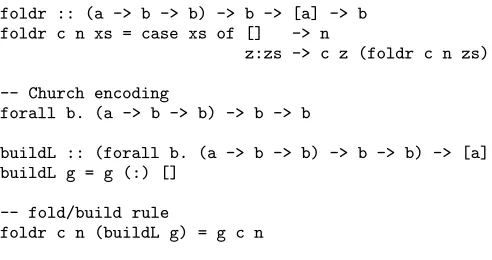
The familiar initial algebra package for list types [Gill et al. (1993)] is an instance of this scheme, as are the corresponding packages
3Unfortunately, we cannot use the same fixed point operator here as in
foldr :: (a -> b -> b) -> b -> [a] -> b foldr c n xs = case xs of [] -> n
z:zs -> c z (foldr c n zs)
-- Church encoding
forall b. (a -> b -> b) -> b -> b
buildL :: (forall b. (a -> b -> b) -> b -> b) -> [a] buildL g = g (:) []
-- fold/build rule
[image:6.612.54.300.69.199.2]foldr c n (buildL g) = g c n
Figure 1. Generic initial algebra package for list types.
foldT :: (a -> b) -> (b -> b -> b) -> Tree a -> b foldT l b t = case t of
Leaf x -> l x
Branch t1 t2 -> b (foldT l b t1) (foldT l b t2)
-- Church encoding
forall b. (a -> b) -> (b -> b -> b) -> b
buildT :: (forall b. (a -> b) ->
(b -> b -> b) -> b) -> Tree a buildT g = g Leaf Branch
-- fold/build rule
[image:6.612.55.292.234.395.2]foldT l b (buildT g) = g l b
Figure 2. Generic initial algebra package forTree.
for algebraic data types given in [Johann (2002)]. The former is given in Figure 1, while the initial algebra package for the non-list algebraic data type
data Tree a = Leaf a | Branch (Tree a) (Tree a)
of trees over data of typeais given in Figure 2.
It is the fact that inductive types are interpreted by carriers of initial algebras of functors that makes it possible to define initial algebra packages for them. In particular, this is what ensures that theirfolds are true folds, that their Church encodings really en-code them, and that theirfold/buildrules truly are correct. It’s what allows us to program with, and reason about programs involv-ing, inductive types. Section 4.2 explains the theory underlying this assertion and, at the same time, develops the semantic foundations for our derivation of initial algebra packages for GADTs; note that the material in Section 4.2.2 may be new even to those familiar with initial algebra semantics. Readers without the required background in category theory or whose main focus is not on the categorical foundations of initial algebra packages for advanced data types can safely omit this section and other categorical discussions in the pa-per since all of the relevant category-theoretic constructs used in this paper are implemented in Haskell. Readers who choose to do this will miss some of the motivations for the theory of GADTs, and some of the connections between the theory of inductive types and the theory of GADTs developed in this paper, but will miss no necessary facts. We stress that we do not attempt a complete recon-struction of all of category theory here, but instead introduce only those concepts that form the basis of our initial algebra approach to deriving principled programming tools for GADTs.
4.2 The Fundamental Theory
The key idea underlying initial algebra packages is the idea of initial algebra semantics. Within the paradigm of initial algebra semantics, every data type is interpreted as the carrierµF of the initial algebra of a suitable functorF :C → Cfor some suitable categoryC. In more detail, suppose we have fixed a categoryC. Analgebrafor a functorF : C → C(or, simply, anF-algebra) is a pair(A, h)whereAis an object ofCand h : F A → Ais a morphism ofC. Here,Ais called thecarrierof the algebra and
his called itsstructure map. As it turns out, theF-algebras for a given functorFthemselves form a category. In the category ofF -algebras, a morphism betweenF-algebras(A, h)and(B, g)is a mapf:A→Bsuch that the following diagram commutes:
F A F f ��
h
��
F B
g
��
A f ��B
We call such a morphism anF-algebra homomorphism.
Now, if the category ofF-algebras has an initial object — called aninitial algebra forF, or, more simply, aninitialF-algebra— then Lambek’s Lemma ensures that the structure map of this ini-tialF-algebra is an isomorphism, and thus that its carrier is a fixed point ofF. If it exists, the initialF-algebra is unique up to isomor-phism. We write(µF, in)for the initialF-algebra comprising the fixed pointµFand the isomorphismin:F(µF)→µF.
4.2.1 Folds
The standard interpretation of a type constructor is a functorF, and the standard interpretation of the inductive type it defines is the carrier of the initial algebra of F. Initiality ensures that there is a unique F-algebra homomorphism from the initialF -algebra to any otherF-algebra. The map underlying thisF-algebra homomorphism is exactly thefold forµF. Thus if(A, h)is any
F-algebra, thenfold h: µF →Amakes the following diagram commute:
F(µF)F(foldh)��
in
��
F A
h
��
µF foldh ��A
From this diagram, we see thatfold : (F A→A) →µF → A
and thatfold hsatisfiesfold h (in t) = h (F (fold h) t). This justifies the definition of thefoldcombinator given in Sec-tion 4.1. Furthermore, the uniqueness of the mediating morphism ensures that, for every algebra h, the map fold h is defined uniquely. This provides the basis for the correctness offold fu-sion for inductive types, which derives from the fact that if h
and h� are F-algebras and ψ is an F-algebra homomorphism
fromh toh�, then ψ .fold h = fold h�. But note that fold
fusion [Bayley (2001), Blampied (2000), Bird & Paterson (1998), Bird & Paterson (1999), Martin et al. (2004)] is distinct from, and inherently simpler than, thefold/buildfusion in this paper.
programming with inductive types. The practical consequence of this is that thebuildcombinators have been largely overlooked, treated as poor relatives of their correspondingfoldcombinators, and regarded as unworthy of fundamental study.
This situation was rectified in [Ghani et al. (2003)], where the standard initial algebra semantics was extended to support not onlyfoldcombinators for inductive types, but also Church encod-ings andbuildcombinators for them. Indeed, [Ghani et al. (2003)] considers the initialF-algebra to be not only the initial object of the category ofF-algebras, but also the limit of the forgetful func-tor from the category ofF-algebras to the underlying categoryC as well. We now summarize this result and its consequences, which we later apply to derive our combinators for GADTs.
IfF is a functor onC, then theforgetful functorUF mapsF -algebras to objects inCby forgetting theF-algebra structure. That is,UF maps anF-algebra(A, h)to its carrierA, and maps anF -algebra homomorphismf : A → B betweenF-algebras(A, h) and(B, g)to the morphismf : A → B inC. IfCis an object inC, then aUF-cone forCcomprises, for everyF-algebra(A, h), a morphismν(A,h) :C →AinCsuch that, for everyF-algebra mapf :A→B, we haveν(B,g)=f◦ν(A,h).
(A, h) f ��(B, g)
C ν(A,h)
��
����
���� ν(B,g)
��
� � � � � � � �
We write(C, ν)for this cone, and callC itsvertexand the mor-phismν(A,h)theprojectionfromCtoA. AUF-cone with vertex Ccan be thought of as having the type∀x.(F x→x)→C→x. AUF-cone morphismg : (C, ν) → (D, µ)betweenUF-cones (C, ν)and(D, µ)is a morphismg : C → DinCsuch that for anyF-algebra(A, h), we haveµ(A,h)◦g= ν(A,h). AUF-limit
is aUF-cone to which there is a uniqueUF-cone morphism, called themediating morphism, from any otherUF-cone. When they ex-ist,UF-limits are unique up to isomorphism. Moreover, no extra structure is required of eitherForCfor theUF-limit to exist — it simply comprises the carrier of the initialF-algebra together with the family ofF-algebra-indexedfoldfunctions.
In [Ghani et al. (2003)], the characterization of the initialF -algebra as both the above limitandthe initial object in the category ofF-algebras is called theextended initial algebra semantics. As shown there, an initialF-algebra has a different universal property as a limit from the one it inherits as an initial object. This alternate universal property ensures:
•For eachF-algebra, the projection from the vertex of theUF -limit (i.e., fromµF) to the carrier of thatF-algebra defines
fold: (F x→x)→µF →x.
•The unique mediating morphism from the vertex C of a
UF-cone to the vertex µF of the UF-limit defines build : (∀x.(F x→ x)→ C → x) →C →µF to bebuild g =
g in. This justifies the definition of thebuildcombinator given in Section 4.1.
•Correctness of thefold/buildrule follows from the fact that
foldh .buildg=g h, i.e., thatfoldafterbuildis a projection after a mediating morphism fromCtoµF, and is thus equal to the projection fromC to the carrier ofh. Taking Cto be the unit type proves the correctness, relative to the underlying semantics, of thefold/buildrule given in Section 4.1.
The extended initial algebra semantics thus shows that, given a parametric interpretation of universal quantification of types, there is an isomorphism between the interpretation of the type c -> M f and the interpretation of its generalized Church
en-codingforall x. (f x -> x) -> c -> x. The term “gener-alized” reflects the presence of the parameterc, which is absent in other Church encodings [Takano & Meijer (1995)], but is essential to the derivation ofbuildcombinators for GADTs. Choosingcto be the unit type gives the usual isomorphism between the interpre-tation of an inductive type and the interpreinterpre-tation of its usual Church encoding. This isomorphism comprises preciselyfold(up to order of arguments) andbuildfor the interpretation of that type. Writing
fold�m hforfoldh mwe have
fold� :: µF → ∀x.(F x→x)→x build :: (∀x.(F x→x)→x)→µF
From this we see that correctness of the fold/build rule for inductive types codes one half of the requirement thatbuild and
fold� are mutually inverse. A parametric model guarantees the existence of the interpretation of the Church encoding of a type constructor, which, by this isomorphism, guarantees the existence of the initial algebra for the interpretation of that type constructor. Genericbuild combinators and Church encodings for inductive types are given in [Takano & Meijer (1995)], but that paper does not show how to derivebuilds for fixed points of higher-order functors or how to interpret GADTs as such fixed points. Indeed, it doesn’t even mention GADTs.
5. Initial Algebra Packages for Basic GADTs
In this section we give Haskell implementations of the initial alge-bra packages for basic GADTs derived from the initial algealge-bra se-mantics developed for them in Section 3. From Section 3 we have that the interpretation of the basic GADTdata G f h a where
GCon :: f (G f h) a -> G f h (h a) is isomorphic to the interpretation of
data NG f h a where
NGCon :: K f h (NG f h) a -> NG f h a
which is the carrier of the initial algebra of the interpretation of K f h, where
data K f h g a = forall b. HFunctor f => K (Eql (h b) a, f g b) Instantiating the fundamental theory we get thefoldcombinator
foldNG :: (HFunctor f, Functor h) =>
Nat (K f h a) a -> Nat (NG f h) a foldNG m (NGCon u) = m (hfmap (foldNG m) u) the generalized Church encoding
(forall a. Nat (K f h a) a -> Nat c a)
and thebuildcombinator
buildNG :: HFunctor f => (forall a. Nat (K f h a) a -> Nat c a) -> Nat c (NG f h) buildNG g = g NGCon
forNG f h. Here, the instance ofhfmapin the definition offoldNG is the one for theHFunctor K f h. We have thefold/buildrule
foldNG m . buildNG g = g m
forNG f h. If we define
toNG :: HFunctor f => G f h a -> NG f h a toNG (GCon t) = NGCon (K (Refl, hfmap toNG t))
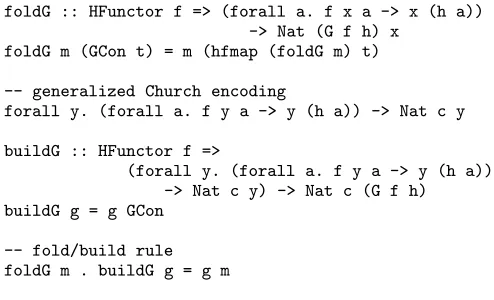
foldG :: HFunctor f => (forall a. f x a -> x (h a)) -> Nat (G f h) x
foldG m (GCon t) = m (hfmap (foldG m) t)
-- generalized Church encoding
forall y. (forall a. f y a -> y (h a)) -> Nat c y
buildG :: HFunctor f =>
(forall y. (forall a. f y a -> y (h a)) -> Nat c y) -> Nat c (G f h) buildG g = g GCon
[image:8.612.52.299.70.220.2]-- fold/build rule foldG m . buildG g = g m
Figure 3. Generic initial algebra package for GADTs.
then we have thattoNGandfromNGare Haskell codings of mutual inverses. We can therefore use these functions to derive from the initial algebra package for NG f h the one for G f h given in Figure 3. The derivation is based on the following definitions:
foldG :: HFunctor f => (forall a. f x a -> x (h a)) -> Nat (G f h) x foldG m t = foldNG (toK m) (toNG t)
buildG :: HFunctor f =>
(forall y. (forall a. f y a -> y (h a)) -> Nat c y) -> Nat c (G f h) buildG g = fromNG . (buildNG g’)
where g’ k = g (fromK k)
The instance of hfmapin the definition offoldG is the one for f. Note that foldG terminates since it is structurally recursive. Unwinding these definitions justifies the definitions in Figure 3.
6. More General GADTs
We have seen how a basic GADT, i.e., a GADT of the form
data G f h a where
GCon :: f (G f h) a -> G f h (h a)
can be reduced to a data typeNG f husing only existentials and theEqlGADT. We considered this special case first to highlight the basic ideas underlying our approach to initial algebra semantics for GADTs, as well as to avoid the cumbersome notation associated with arbitrary GADTs. In this section we show how the basic syntactic restriction can be lifted, and thus how our approach can be extended to arbitrary GADTs. Below, the covariance restriction entails thatGdoes not appear in anyhi, and that anyfiis a higher-order functor. The initial algebra package for theTermGADT from Section 2.1 appears in Section 7 below. There are four independent dimensions along which basic GADTs can be generalized.
6.1 GADTs with Non-Unary Data Constructors If we have a GADT of the form
data G f1 f2 h a where
GCon :: f1 (G f1 f2 h) a -> f2 (G f1 f2 h) a -> G f1 f2 h (h a)
then we can curryGConto derive a data constructor which takes one tupled argument. The above GADT is thus equivalent to:
data G’ f1 f2 h a where
GCon’ :: PrHFunctor f1 f2 (G’ f1 f2 h) a -> G’ f1 f2 h (h a)
wherePrHFunctor f1 f2is the higher-order functor given by
newtype PrHFunctor f1 f2 g a = PrHFunctor (f1 g a, f2 g a)
It is easy to check thatPrHFunctor f1 f2is anHFunctor. Thus we can reduce a GADT whose data constructor takes several inputs to one whose data constructor takes only a single input. An example of a GADT with a non-unary data constructor isTerm.
6.2 GADTs with More Than One Data Constructor
The presence of the different functorsh1andh2in the codomain types of the data constructors GCon1 and GCon2 of a GADT G f1 f2 h1 h2of the form
data G f1 f2 h1 h2 a where
GCon1 :: f1 (G f1 f2 h1 h2) a -> G f1 f2 h1 h2 (h1 a) GCon2 :: f2 (G f1 f2 h1 h2) a ->
G f1 f2 h1 h2 (h2 a)
entails that it is not possible to reduce a GADT with two data constructors to a GADT with one data constructor. Nevertheless, we can still show that a GADT with more than one data constructor can be reduced to a GADT using only existentials and theEql GADT, and also derive an initial algebra semantics for it.
The basic idea is to treat each data constructor individually. That is, we use the same technique as we used for single data constructor GADTs to convert the type of each data constructor of a GADTG f1 f2 h1 h2into a type whose codomain is of the formG f1 f2 h1 h2 a, and thus avoid the nesting of functors in the data constructors’ codomain types. Concretely, we transform the GADTG f1 f2 h1 h2into the following equivalent GADT:
data NG f1 f2 h1 h2 a where
NGCon1 :: K f1 h1 (NG f1 f2 h1 h2) a -> NG f1 f2 h1 h2 a NGCon2 :: K f2 h2 (NG f1 f2 h1 h2) a ->
NG f1 f2 h1 h2 a
The return types of the data constructors ofNG f1 f2 h1 h2are the same, and this GADT uses only existentials and theEqlGADT. The two data constructors can now be bundled into one in the usual way, so that the interpretation ofNG f1 f2 h1 h2is the carrier of the initial algebra of the higher-order functor interpreting
newtype SumKs f1 f2 h1 h2 g a
= Inl (K f1 h1 g a) | Inr (K f2 h2 g a)
It is not hard to check thatSumKs f1 f2 h1 h2 is indeed an HFunctor. We can therefore derive an initial algebra semantics, and hence an initial algebra package, forNG f1 f2 h1 h2. Us-ing toK and fromK, we can derive one for the original GADT G f1 f2 h1 h2as well. An example of a GADT with more than one data constructor is theFinGADT from Example 1 below.
6.3 GADTs with More Than One Type Parameter Consider a GADTG f h1 h2 a b
data G f h1 h2 a b where GCon :: f (G f h1 h2) a b ->
G f h1 h2 (h1 a b) (h2 a b)
with two type parameters. In Haskell, the kinds ofh1,h2,f, and G f h1 h2are
h1, h2 :: |*| -> |*| -> |*|
f :: (|*| -> |*| -> *) -> |*| -> |*| -> * G f h1 h2 :: |*| -> |*| -> *
althoughKmust be generalized to take two type arguments as input. This yields the definition
data BiK f h1 h2 g a b = forall c1 c2. BiHFunctor f => BiK (Eql (h1 c1 c2) a,
Eql (h2 c1 c2) b, f g c1 c2)
whereBiHFunctoris the generalization
class BiHFunctor f where
mhfmap :: MNat g h -> MNat (f g) (f h)
type MNat f g = forall c1 c2. f c1 c2 -> g c1 c2
of theHFunctor class to two type parameters which is required to capture the structure of f here. It is not hard to see that BiK f h1 h2is an instance of theBiHFunctorclass:
instance BiHFunctor f =>
BiHFunctor (BiK f h1 h2) where
mhfmap k (BiK (p, q, v)) = BiK (p, q, mhfmap k v)
The key universal property of the form of Kan extension captured byBiKis that there is an isomorphism between the interpretation of the type
forall a b. f g a b -> g (h1 a b) (h2 a b)
and the interpretation of the type
forall a b. BiK f h1 h2 g a b -> g a b
The GADTG f h1 h2 a bis thus equivalent to the GADT
data NG f h1 h2 a b where
NGCon :: BiK f h1 h2 (NG f h1 h2) a b -> NG f h1 h2 a b
for which an initial algebra semantics is easily given, since the interpretation ofNG f h1 h2is the carrier of the initial algebra of the interpretation ofBiK f h1 h2. An example of a GADT with more than one type parameter is theExprGADT from Example 3.
6.4 GADTs Whose Data Constructors Have More Than One Type Parameter
Consider a GADT of the form
data G f h a where
GCon :: f (G f h) a b -> G f h (h a b)
where the Haskell kinds ofh,f, andG f hare
h :: |*| -> |*| -> |*|
f :: (|*| -> *) -> |*| -> |*| -> * G f h :: |*| -> *
Without loss of generality, we may assume that the number of type variables appearing in the domain typef (G f h) a bofGCon is the same as the number appearing inGCon’s return type. We can treat a GADTG f hof this form by rewriting the type ofGCon in terms of the data typeKrepresenting left Kan extensions and the EqlGADT, althoughKmust be generalized to allowhto take more than one type argument as input. This yields the definition
data VK f h g a = forall c1 c2. VHFunctor f => VK (Eql (h c1 c2) a, f g c1 c2)
whereVHFunctoris the generalization
class VHFunctor f where
vhfmap :: Nat g h -> MNat (f g) (f h)
of theHFunctorclass which allowsfto return a type constructor parameterized over two type variables. It is not hard to see that VK f his an instance of theVHFunctorclass:
instance VHFunctor f => HFunctor (VK f h) where hfmap k (VK (p, v)) = VK (p, vhfmap k v)
The key universal property of the form of Kan extension captured byVKis that there is an isomorphism between the interpretation of the type
forall a b. f g a b -> g (h a b)
and the interpretation of the type
forall a. VK f h g a -> g a
The GADTG f h ais thus equivalent to the GADT
data NG f h a where
NGCon :: VK f h (NG f h) a -> NG f h a
for which an initial algebra semantics is easily given, as the inter-pretation ofNG f his the carrier of the initial algebra of the in-terpretation ofVK f h. An example of a (single parameter) GADT whose data constructor has more than one type parameter isTerm.4 In summary, our techniques extend from basic GADTs to GADTsG’of the form
G f1 ... fk h11 ... h1n ... hk1 ... hkn
wherenis the number of type argumentsG’takes, andG’is given as a list of data constructors with types of the form
fi G’ ai1 ... airi ->
G’ (hi1 ai1 ... airi) ... (hin ai1 ... airi)
As discussed above, any constructor taking several arguments can be exchanged for a constructor taking exactly one argument.
Thus for every data constructor of every GADT there is an appropriate Kan extension which can be used to trade that data constructor for one based on existentials and theEqlGADT, and from which an initial algebra semantics for the original GADT can be derived. Thus, the proliferation of different codings of Kan extensions, which seems a drawback at first, simply reflects the fact that Haskell does not have a proper polymorphic system of kinds. If it did, then only one polykinded Kan extension would be required and we would be able to present the general case from the start rather than a special case followed by a sketch of the general case.
7. Examples
In this section we show how to derive initial algebra packages for some familiar GADTs.
EXAMPLE1. Consider the GADT of finite sets [Sheard et al. (2005)] given by
data Z data S a
data Fin a where Fz :: Fin (S a)
Fs :: Fin a -> Fin (S a)
Note thatFin Zis empty. This GADT is equivalent to the GADT
4An alternative way to handle a data constructor such asAppwhich has
more type variables in its domain type than in its return type is to wrap the “extra” type variables in the domain type in an existential quantifier. This is justified by observing that a type of the formforall b. f b -> g, wherefis a type parameterized overbandgis a type in whichbdoes not appear, is equivalent to the type(exists b. f b) -> g. Combined with the tupling described in Section 6.1, this allows us to trade, for example, the
foldFin :: (forall a. f (S a)) ->
(forall a. f a -> f (S a)) -> Nat Fin f foldFin z s Fz = z
foldFin z s (Fs t) = s (foldFin z s t)
-- generalized Church encoding forall f. (forall a. f (S a)) ->
(forall a. f a -> f (S a)) -> Nat c f
buildFin :: (forall f. (forall a. f (S a)) -> (forall a. f a -> f (S a)) ->
Nat c f) -> Nat c Fin buildFin g = g Fz Fs
-- fold/build rule
[image:10.612.304.562.68.353.2]foldFin z s . (buildFin g) = g z s
Figure 4. Initial algebra package forFin.
data NFin a where
NFz :: Lan S One a -> NFin a NFs :: Lan S NFin a -> NFin a
which has initial algebra package
foldNFin :: (forall a. Lan S One a -> f a) -> (forall a. Lan S f a -> f a) ->
Nat NFin f foldNFin z s (NFz k) = z k
foldNFin z s (NFs t) = s (hfmap (foldNFin z s) t)
buildNFin :: (forall f.
(forall a. Lan S One a -> f a) -> (forall a. Lan S f a -> f a)
-> Nat c f) -> Nat c NFin buildNFin g = g NFz NFs
foldNFin z s . (buildNFin g) = g z s
The definitions offoldGandbuildGin Section 5 can be instanti-ated to give the initial algebra package in Figure 4 relative toFin.
EXAMPLE2.Consider again the GADTTerm[Sheard et al. (2005)]
data Term a where Const :: a -> Term a
Pair :: Term b -> Term c -> Term (b,c) App :: Term (b -> a) -> Term b -> Term a
from Section 2.1. This GADT is equivalent to
newtype Fst a b = Fst a
newtype HProd g a b = HProd (g a, g b) newtype Prod a b = Prod (a, b)
data HL f a b = HL (f (b -> a), f b)
data NTerm a where NConst :: a -> NTerm a
NPair :: VK HProd Prod NTerm a -> NTerm a NApp :: VK HL Fst NTerm a -> NTerm a
whereVKis defined as in Section 6.4. Note thatHProdandHLare instances of theVHFunctorclass:
instance VHFunctor HProd where
vhfmap k (HProd (u,v)) = HProd (k u, k v)
instance VHFunctor HL where
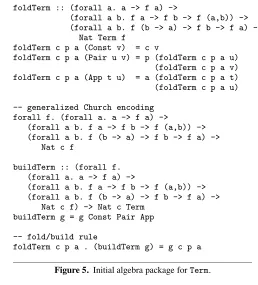
foldTerm :: (forall a. a -> f a) ->
(forall a b. f a -> f b -> f (a,b)) -> (forall a b. f (b -> a) -> f b -> f a) ->
Nat Term f foldTerm c p a (Const v) = c v
foldTerm c p a (Pair u v) = p (foldTerm c p a u) (foldTerm c p a v) foldTerm c p a (App t u) = a (foldTerm c p a t) (foldTerm c p a u)
-- generalized Church encoding forall f. (forall a. a -> f a) ->
(forall a b. f a -> f b -> f (a,b)) -> (forall a b. f (b -> a) -> f b -> f a) ->
Nat c f
buildTerm :: (forall f. (forall a. a -> f a) ->
(forall a b. f a -> f b -> f (a,b)) -> (forall a b. f (b -> a) -> f b -> f a) ->
Nat c f) -> Nat c Term buildTerm g = g Const Pair App
-- fold/build rule
[image:10.612.53.275.497.664.2]foldTerm c p a . (buildTerm g) = g c p a
Figure 5. Initial algebra package forTerm.
vhfmap k (HL (u,v)) = HL (k u, k v)
The GADTNTermhas initial algebra package
foldNTerm :: (forall a. a -> f a) ->
(forall a. VK HProd Prod f a -> f a) -> (forall a. VK HL Fst f a -> f a) ->
Nat NTerm f foldNTerm c p a (NConst v) = c v foldNTerm c p a (NPair t) =
p (hfmap (foldNTerm c p a) t) foldNTerm c p a (NApp t) =
a (hfmap (foldNTerm c p a) t)
buildNTerm :: (forall f. (forall a. a -> f a) ->
(forall a. VK HProd Prod f a -> f a) ->
(forall a. VK HL Fst f a -> f a) -> Nat c f) -> Nat c NTerm
buildNTerm g = g NConst NPair NApp
foldNTerm c p a . (buildNTerm g) = g c p a
The definitions offoldG andbuildGfrom Section 5 can be in-stantiated to give the initial algebra package in Figure 5 relative to
Term.
EXAMPLE3. Consider the GADT of polynomial expressions with variables of typeaand coefficients of typebgiven by
data Expr a b where Var :: a -> Expr a b IConst :: Int -> Expr a Int RConst :: Float -> Expr a Float
PProd :: Expr a b -> Expr a b -> Expr a b SIMul :: Expr a b -> Int -> Expr a b SRMul :: Expr a b -> Float -> Expr a Float
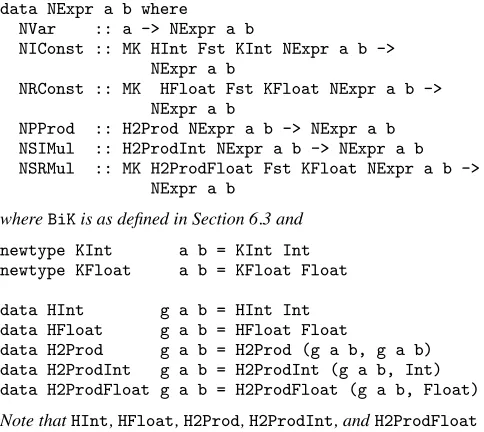
data NExpr a b where NVar :: a -> NExpr a b
NIConst :: MK HInt Fst KInt NExpr a b -> NExpr a b
NRConst :: MK HFloat Fst KFloat NExpr a b -> NExpr a b
NPProd :: H2Prod NExpr a b -> NExpr a b NSIMul :: H2ProdInt NExpr a b -> NExpr a b NSRMul :: MK H2ProdFloat Fst KFloat NExpr a b ->
NExpr a b
whereBiKis as defined in Section 6.3 and
newtype KInt a b = KInt Int newtype KFloat a b = KFloat Float
data HInt g a b = HInt Int
data HFloat g a b = HFloat Float
data H2Prod g a b = H2Prod (g a b, g a b) data H2ProdInt g a b = H2ProdInt (g a b, Int) data H2ProdFloat g a b = H2ProdFloat (g a b, Float)
Note thatHInt,HFloat,H2Prod,H2ProdInt, andH2ProdFloat
are instances of theBiHFunctorclass from Section 6.3. Indeed,
instance BiHFunctor HInt where mhfmap s (HInt t) = (HInt t)
instance BiHFunctor HFloat where mhfmap s (HFloat t) = (HFloat t)
instance BiHFunctor H2Prod where
mhfmap s (H2Prod (u,v)) = H2Prod (s u, s v)
instance BiHFunctor H2ProdInt where
mhfmap s (H2ProdInt (u,v)) = H2ProdInt (s u, v)
instance BiHFunctor H2ProdFloat where
mhfmap s (H2ProdFloat (u,v)) = H2ProdFloat (s u, v)
The GADTNExprhas initial algebra package
foldNExpr :: (forall a b. a -> f a b) ->
(forall a b. BiK HInt Fst KInt f a b -> f a b) -> (forall a b. BiK HFloat Fst KFloat f a b ->
f a b) ->
(forall a b. H2Prod f a b -> f a b) -> (forall a b. H2ProdInt f a b -> f a b) -> (forall a b. BiK H2ProdFloat Fst KFloat f a b ->
f a b) -> NExpr a b -> f a b
foldNExpr v i r p si sr (NVar t) = v t foldNExpr v i r p si sr (NIConst t) =
i (mhfmap (foldNExpr v i r p si sr) t) foldNExpr v i r p si sr (NRConst t) =
r (mhfmap (foldNExpr v i r p si sr) t) foldNExpr v i r p si sr (NPProd t) =
p (mhfmap (foldNExpr v i r p si sr) t) foldNExpr v i r p si sr (NSIMul t) =
si (mhfmap (foldNExpr v i r p si sr) t) foldNExpr v i r p si sr (NSRMul t) =
sr (mhfmap (foldNExpr v i r p si sr) t)
buildNExpr :: (forall f. (forall a b. a -> f a b) ->
(forall a b. BiK HInt Fst KInt f a b -> f a b) -> (forall a b. BiK HFloat Fst KFloat f a b ->
f a b) ->
foldExpr :: (forall a b. a -> f a b) -> (forall a. Int -> f a Int) ->
(forall a. Float -> f a Float) -> (forall a b. f a b -> f a b -> f a b) -> (forall a b. f a b -> Int -> f a b) -> (forall a b. f a b -> Float -> f a Float) -> forall a b. Expr a b -> f a b
foldExpr v i r p si sr (Var t) = v t foldExpr v i r p si sr (IConst t) = i t foldExpr v i r p si sr (RConst t) = r t foldExpr v i r p si sr (PProd t u) =
p (foldExpr v i r p si sr t) (foldExpr v i r p si sr u) foldExpr v i r p si sr (SIMul t n) =
si (foldExpr v i r p si sr t) n foldExpr v i r p si sr (SRMul t n) =
sr (foldExpr v i r p si sr t) n
buildExpr :: (forall f. (forall a b. a -> f a b) -> (forall a. Int -> f a Int) -> (forall a. Float -> f a Float) -> (forall a b. f a b -> f a b -> f a b) -> (forall a b. f a b -> Int -> f a b) -> (forall a b. f a b -> Float -> f a Float) ->
MNat c f) -> MNat c Expr
buildExpr g = g Var IConst RConst PProd SIMul SRMul
-- fold/build rule
[image:11.612.314.551.69.422.2] [image:11.612.54.296.73.289.2]foldExpr v i r p si sr . (buildExpr g) = g v i r p si sr
Figure 6. Initial algebra package forExpr.
(forall a b. H2Prod f a b -> f a b) -> (forall a b. H2ProdInt f a b -> f a b) -> (forall a b. BiK H2ProdFloat Fst KFloat f a b ->
f a b) -> MNat c f) -> MNat c NExpr buildNExpr g =
g NVar NIConst NRConst NPProd NSIMul NSRMul
foldNExpr v i r p si sr . buildNExpr g = g v i r p si sr
The definitions in Section 5 give the initial algebra package in Figure 6 relative to the original GADTExpr.
8. Conclusion and Future Work
domains, and on the use of left Kan extensions as a restructuring device. Our use of left Kan extensions here is reminiscent of their use in [Johann & Ghani (2007a), Johann & Ghani (2007b)] to de-rive initial algebra semantics for nested data types.
The foundations of GADTs and other advanced inductive con-structions have been considered from the type-theoretic perspec-tive; see, e.g., [Pfenning & Paulin-Mohring (1990)], which consid-ers inductive types in the Calculus of Constructions. This work gives fold combinators for GADTs, as well as Church encod-ings which are essentially the special case of our generalized Church encodings obtained by taking the parameter cto be the constantly 1-valued type constructor. The importance of gener-alised Church encodings is discussed in [Johann & Ghani (2007a), Johann & Ghani (2007b)]. The relationship between our work and that of Pfenning and Paulin-Mohring is the subject for future re-search, but we see our categorical approach as complementary to their type-theoretic one. Also, our use of left Kan extensions to trade GADT constructors for simpler nested type constructors provides a clean and concise derivation of the folklore result stat-ing that the essence of GADTs is existential quantification cou-pled with the equality GADT. Our treatment of the foundations of GADTsas GADTs, rather than as embedded within more general type theories, is fundamental to our results.
Our main direction for future work involves extending the re-sults of this paper from GADTs, which are indexed by types, to styles of indexed programming which allow more general indices. This paper and [Johann & Ghani (2007a), Johann & Ghani (2007b)] together make clear that the fundamental structure underlying the algebra of nested data types and GADTs is captured by functorial composition and its adjoints, namely left and right Kan extensions. The mathematical basis for generalizing this structure to encom-pass other forms of indexing is clear. We will therefore consider indexed programming in the context of fibrations.
Acknowledgments
Patricia Johann is supported in part by NSF grant CCF-0700341. Neil Ghani is supported in part by EPSRC grant EP/C511964/2.
References
[Bainbridge et al. (1990)] E. S. Bainbridge, P. J. Freyd, A. Scedrov and P. J. Scott. Functorial polymorphism.Theoretical Computer Science70(1) (1990), pp. 35–64.
[Bayley (2001)] I. Bayley. Generic Operations on Nested Datatypes. Ph.D. Dissertation, Univ. of Oxford, 2001. Athttp://web.comlab.ox. ac.uk/oucl/research/areas/ap/papers/bayley-thesis.pdf
[Blampied (2000)] P. Blampied. Structured Recursion for Non-uniform Data-types. Ph.D. Dissertation, Univ. of Nottingham, 2000. At
http://www.cs.nott.ac.uk/Research/fop/blampied-thesis .pdf
[Bird & Meertens (1998)] Bird, R. and Meertens, L. Nested datatypes. Proc., Mathematics of Program Construction, pp. 52–67, 1998. [Bird & Paterson (1998)] R. Bird and R. Paterson. de Bruijn notation as a
nested datatype.Journal of Functional Programming9(1) (1998), pp. 77–91.
[Bird & Paterson (1999)] R. Bird and R. Paterson. Generalised folds for nested datatypes.Formal Aspects of Computing11(2) (1999), pp. 200– 222.
[Cheney & Hinze (2003)] J. Cheney and R. Hinze. First-class phan-tom types. Athttp://www.informatik.uni-bonn.de/~ralf/ publications/Phantom.pdf
[Dybjer (1994)] P. Dybjer. Inductive Families.Formal Aspects of Comput-ing6(4), pp. 440–465, 1994.
[Gill et al. (1993)] A. Gill, J. Launchbury, and S. L. Peyton Jones. A short cut to deforestation. Proceedings, Functional Programming Languages and Computer Architecture, pp. 223–232, 1993.
[Ghani et al. (2005)] N. Ghani, P. Johann, T. Uustalu, and V. Vene. Monadic augment and generalised short cut fusion. Proceedings, International Conference on Functional Programming, pp. 294–305, 2005.
[Ghani et al. (2003)] N. Ghani, T. Uustalu, and V. Vene. Build, augment and destroy. Universally. Proceedings, Asian Symposium on Program-ming Languages, pp. 327–347, 2003.
[Johann & Ghani (2007a)] P. Johann and N. Ghani. Initial algebra seman-tics is enough! Proceedings, Typed Lambda Calculus and Applications, pp. 207–222, 2007.
[Johann & Ghani (2007b)] P. Johann and N. Ghani. Programming with Nested Types. Submitted, 2007.
[Johann (2002)] P. Johann. A generalization of short-cut fusion and its correctness proof.Higher-order and Symbolic Computation15 (2002), pp. 273–300.
[MacLane (1971)] MacLane, S. Categories for the Working Mathemati-cian. Springer-Verlag, 1971.
[Martin et al. (2004)] C. Martin, J. Gibbons, and I. Bayley. Disciplined efficient generalised folds for nested datatypes. Formal Aspects of Computing16(1) (2004), pp. 19–35.
[McBride (2004)] C. McBride. Epigram: Practical programming with de-pendent types. Proceedings, 5th International Summer School on Ad-vanced Functional Programming, 2004. Athttp://www.e-pig.org/ downloads/epigram-notes.pdf
[Omega] The Omega Download Page.http://web.cecs.pdx.edu/ ~sheard/Omega/index.html
[Pfenning & Paulin-Mohring (1990)] F. Pfenning and C. Paulin-Mohring. Inductively defined types in the Calculus of Constructions. Proceedings, Mathematical Foundations of Programming Semantics, pp. 209-228, 1990.
[Sheard et al. (2005)] T. Sheard, J. Hook, and N. Linger. GADTs + exten-sible kinds = dependent programming. Athttp://www.cs.pdx.edu/ ~sheard/papers/GADT+ ExtKinds.ps
[Sheard & Pasalic (2004)] T. Sheard and E. Pasalic. Meta-programming with built-in type equality. Proceedings, Logical Frameworks and Meta-languages, 2004. Athttp://homepage.mac.com/pasalic/p2/ papers/LFM04 .pdf
[Sulzmann & Wang (2004)] M. Sulzmann and M. Wang. A systematic translation of guarded recursive data types to existential types. At
http://www.comp .nus.edu.sg/~sulzmann/research/ms.html
[Sulzmann & Wang (2005)] M. Sulzmann and M. Wang. Translating generalized algebraic data types to System F. Manuscript, 2005. At
http://www.comp. nus.edu.sg/~sulzmann/manuscript/simple -translate-gadts. ps
[Svenningsson (2002)] J. Svenningsson. Shortcut fusion for accumulating parameters & zip-like functions. Proceedings, International Conference on Functional Programming, pp. 124–132, 2002.
[Takano & Meijer (1995)] A. Takano and E. Meijer. Shortcut deforestation in calculational form. Proceedings, Functional Programming Languages and Computer Architecture, pp. 306–313, 1995.
[Xi et al. (2003)] H. Xi, C. Chen, and G. Chen. Guarded recursive datatype constructors. Proceedings, Principles of Programming Languages, pp. 224–235, 2003.