City, University of London Institutional Repository
Citation
:
Kilbride, C., Perry, L., Flatley, M., Turner, E. and Meyer, J. (2011). Developing theory and practice: Creation of a Community of Practice through Action Research produced excellence in stroke care. Journal of Interprofessional Care, 25(2), pp. 91-97. doi:10.3109/13561820.2010.483024
This is the unspecified version of the paper.
This version of the publication may differ from the final published
version.
Permanent repository link:
http://openaccess.city.ac.uk/3281/Link to published version
:
http://dx.doi.org/10.3109/13561820.2010.483024Copyright and reuse:
City Research Online aims to make research
outputs of City, University of London available to a wider audience.
Copyright and Moral Rights remain with the author(s) and/or copyright
holders. URLs from City Research Online may be freely distributed and
linked to.
City Research Online: http://openaccess.city.ac.uk/ [email protected]
Developing theory and practice: creation of a Community of Practice through Action
Research produced excellence in stroke care
Cherry Kilbride¹, Lin Perry², Mary Flatley³, Emma Turner*, Julienne Meyer³
¹Centre for Research in Rehabilitation, Brunel University West London UK,
²University of Technology, Sydney, Australia,
³ City Community and Health Sciences, City University London UK
* Royal Free Hampstead NHS Trust, London UK.
Correspondence concerning this article should be addressed to Cherry Kilbride, Centre for
Research in Rehabilitation, Mary Seacole Building, Brunel University, Kingston Lane,
ABSTRACT
Much emphasis is placed on expert knowledge such as evidence based stroke
guidelines, but not enough attention is paid to the processes that are required to translate this
into delivery of everyday good care. This paperhighlights the worth of creating a Community
of Practice (CoP) as a means to achieve this. Drawing on findings from a study conducted
2000 - 2002 of the processes involved in establishment of a nationally lauded high quality
Stroke Unit, it demonstrates how successful development of a new service was linked to
creation of a CoP.
Recent literature suggests CoPs have a key role in the implementation of
evidence-based practice; this study supports this claim whilst revealing for the first time the practical
knowledge and skills required to develop this style of working. Findings also indicate that the
participatory and democratic characteristics of Action Research are congruent with the
collaborative approach required for the development of a CoP. The study is an exemplar of
how practitioner researchers can capture learning from changing practice, thus contributing to
evidence-based healthcare with theoretical as well as practical knowledge. Findings are
relevant to those developing stroke services globally but also to those interested in
evidence-based practice. (198)
Keywords:Community of Practice, Action Research, stroke, Stroke Unit,
INTRODUCTION
Stroke is a global health problem with the second highest death rate in the world
(Word Health Organisation [WHO], 2009); it is one of the largest single causes of long term
disability in the United States and United Kingdom (UK) (American Heart Association,
2009; Mead, 2009). With high mortality and morbidity rates it is essential that people who
experience stroke receive the best care possible. Patients treated on a Stroke Unit (SU) where
interventions are delivered by a specialist multidisciplinary team with expertise in stroke and
rehabilitation have better outcomes than those managed elsewhere (Intercollegiate Stroke
Working Party [ISWP], 2008; Stroke Unit Trialists’ Collaboration [SUTC], 2007).
Comprehensive evidence-based stroke care is not yet universally available (WHO, 2009).
Even in the UK with universal coverage by a public health system, inequalities continue
despite positive steps such as national stroke policies, evidence-based national stroke
guidelines and national multidisciplinary audits (National Sentinel Stroke Audits[NSSA]) to
benchmark quality of stroke care from acute through to rehabilitation and long-term care
(Department of Health [DH] 2001, 2007, 2008; Hoffman et al on behalf of the ISWP, 1998,
1999, 2002, 2004, 2006, 2008; ISWP, 2000, 2004, 2008; National Audit Office, 2005).
Substantial gains have been made in recent years but nevertheless there remains much to be
known about how good SU care is developed on the ground and why, despite national
evidence based policy, guidance and service delivery, some SUs are more successful than
others (DH, 2007; SUTC, 2007). The emphasis placed on expert knowledge, ‘knowing what’,
is only half of the story and if the challenge of providing best care for stroke is to be met,
more attention must be paid to practical knowledge, ‘knowing how’.
The term SU describes a system of complex inpatient care delivered by a coordinated
specialist multidisciplinary team with expertise in stroke and rehabilitation (Langhorne &
where specialist stroke services are well-developed, such as the UK, care is most frequently
delivered within geographically discrete units, a format which has demonstrated better
outcomes than other models, such as mobile stroke teams. Nonetheless, the essential elements
of good stroke care remain poorly understood (Langhorne & Pollock, 2002).
Communities of Practice (CoPs) have been suggested as one mechanism to promote
quality care. In essence, a CoP comprises a group of people who work along collegial lines,
share a concern or passion for something they do, and through regular interaction learn
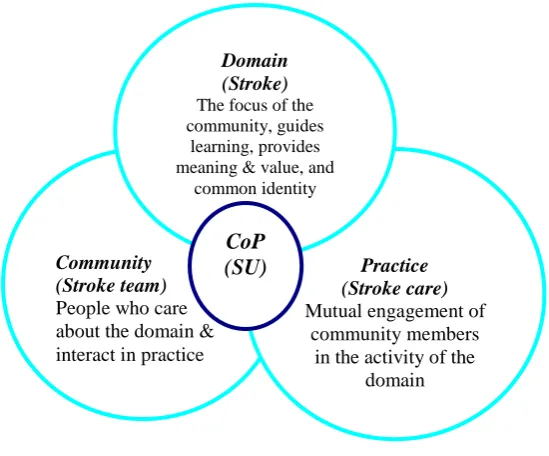
together how to do it better (Wenger et al., 2002). CoPs have three inter-related and
co-dependent key elements: that of domain, community and practice (Figure 1). They are rooted
in a social theory of learning, and hence learning is embedded within relationships and social
participation. Little is known about how CoPs are developed in practice, especially
multidisciplinary CoPs (Dobson & Fitzgerald, 2006). This study explains how excellence in
stroke care was achieved through the creation of a CoP, and hence makes a valuable
contribution to the developing knowledge base in this area.
METHODS
Research Setting
This study took place during 2000 – 2002 in a large UK NHS London teaching
hospital with an established reputation as a centre of excellence, providing regional, national
and international specialities including a tertiary neurosciences unit. Nonetheless, at project
commencement, care for patients with stroke was fragmented and uncoordinated across 18
wards; local and national audits demonstrated need for improvement. The drive to improve
stroke care came from a small self-established group of nursing, therapy and medical staff,
who were instrumental in identifying and implementing service development action cycles
more detail of activities initiated to support SU development). At project commencement
beds were opened and two wards designated as a stroke service (the SU), with staff drafted to
cover them. The project lead (CK) remained Head of Physiotherapy part-time; her ‘insider’
role in the project has been discussed elsewhere (Kilbride et al, 2005). Project supervisory
support was provided by co-authors JM, LP and MF.
Aims and Design:
This two-year case study (Kilbride, 2007; Kilbride et al., 2005) aimed to examine the
processes involved in the development of a new inpatient SU and identify key factors
influencing outcomes. As the study arose from a collaborative initiative by a
multi-disciplinary group of clinicians and managers with the dual objectives of effecting changes in
clinical practice and developing knowledge of the processes entailed, Action Research was
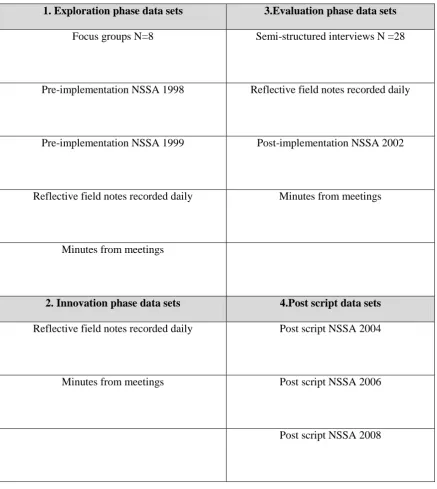
selected as the most appropriate methodology. As shown in Table 2 there were three main
phases to the study: exploration, innovation and evaluation. The post-script phase refers to
the period following the end of the formal study and the withdrawal of CK from the field. It
is added to indicate performance of the unit after conclusion of the ‘project’ phase of service
development.
Participants
The transient nature of this inner-city workforce meant that during the 23 months of
the study, excluding rotational doctors and students, 39 staff left and 40 joined the SU team.
All staff involved with delivery of the new stroke service participated in service development
processes and were the focus of participant observation field notes. It was not feasible to
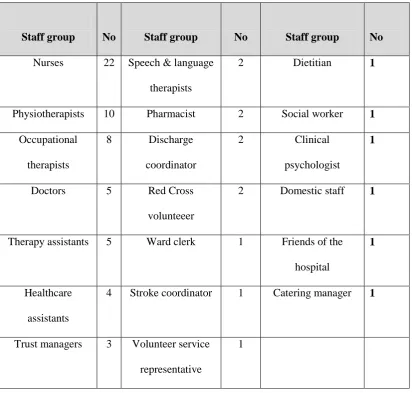
engage all staff in all forms of data collection so data were gathered from a convenience
3). Patient representation was obtained for the research steering group, and an ‘expert patient’
was recruited who supplied feedback to the team.
Data collection
A variety of methods were used to generate data, including individual interviews,
focus groups, and reflective field notes based on participant observations. Methods were
chosen to maximise the range of professional perspectives captured, including individual
viewpoints, joint constructions revealed by focus groups and snapshots of actual practice
from reflective field notes. Resource limitations restricted wider use of observation.
Documents such as policies and minutes from meetings were collated and analysed.
Qualitative data were collected by a single researcher (CK); other SU team members also
co-facilitated focus groups.
NSSA stroke audit data were used to track outcomes of change processes over time
(1998-2008). These data are reported elsewhere and not repeated here. They are referred to in
order to demonstrate that the development processes which are the focus of this paper
resulted in a high-quality, high-performance SU. Table 2 summarises the data collected
during each phase.
Data Analysis
Qualitative data were analysed thematically using a process of Immersion/
Crystallization. This is asystematic, iterative process whereby the researcher reads and
re-reads to immerse herself in the text, creating notes and coding text with intuitive
interpretations. Each re-reading entails seeking evidence for congruent and different
discussed with the co-authors, who also examined selected portions of transcripts. Textual
interpretation entailed development of consensus.
Quantitative data were extracted from six NSSA rounds, pre and post implementation
(Hoffman et al. on behalf of the ISWP, 1998, 1999, 2002, 2004, 2006, 2008) and analysed
descriptively; these data have been reported in more detail elsewhere (Health Service Journal
[HSJ], 2005; Kilbride, 2007).
Ethical Considerations
Ethical approval for the study was obtained from the Local Research Ethics
Committee prior to commencement. As taking part in an Action Research study brings
working practices under the spotlight this may pose ethical dilemmas that need active
management. Commitment to ethical practice meant continual review of the impact of
processes on staff involved, alongside continued negotiation of their involvement.
RESULTS
Process findings occurred alongside a pattern of consistent improvement in outcomes
as measured by successive NSSA reports (Hoffman et al. on behalf of the ISWP, 2002, 2004,
2006, 2008). These included organisational targets such as SU admission and waiting times,
and process indicators such as assessments and care planning. The stroke team received a
national award in 2005 in recognition of moving the service from the bottom 5% of NSSA
scores to become the top scoring service covered by the NSSA (the UK excluding Scotland)
within four years (HSJ, 2005). Consequently, findings reported here reflect processes
Key Emergent Process Findings
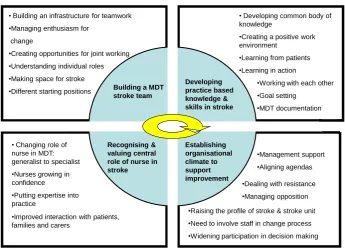
Four key inter-related themes emerged from the data: the importance of a) building a
multidisciplinary stroke team; b) developing practice based knowledge and skills in stroke
care; c) valuing the central role of the nurse in stroke care, and d) creating an organisational
climate for supporting improvement. Each impacted on the others, and development occurred
in a non-linear fashion. Themes and sub-themes are summarised in Figure 2 and illustrated
below using selected quotations. Highlighting key messages in relation to each of the four
themes shows how emergent findings can be interpreted as representing development of a
CoP. More details of these findings can be found in Kilbride (2007) and Kilbride et al.
(2005).
Building a stroke team
The establishment of a geographical SU was essential in bringing different
professionals together as a basis for building a stroke team; it provided a central hub
for connecting people and facilitated networking opportunities. Having a base allowed
people to build up relationships and created a space for stroke patients… (Focus
group 1)
Staff named the unit “STEP”, an acronym for Stroke Treatment for Every Person and this
helped others identify the distinct stroke team. However, as staff had been deployed to the SU
from different clinical areas as well as professional groups within the hospital their differing
backgrounds and experiences meant that just being relocated together would not achieve team
working. This was identified by early inter-professional disputes and territorial practices,
particularly between nurses and physiotherapists. More attention was needed on building a
It’s [teamwork] something that is built up over time…we were all trying to identify
our roles…trying our best to work together…we’ve done a good job on that
eventually…it was difficult in the beginning (Therapist 4)
The process of team building was undertaken in a number of ways. Firstly, an
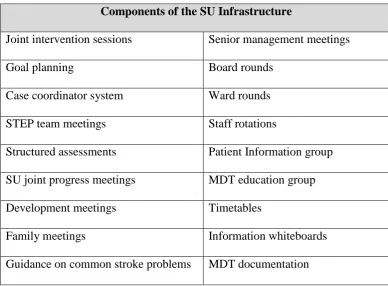
operational infrastructure (Table 1) provided a framework for ongoing unit activities.
Multi-disciplinary team (MDT) projects gave people the chance to get to know each other through
activities other than direct patient care. Projects included the design and printing of a local
stroke booklet for patients and carers, development of MDT patient records and organising a
Charity Ball. The weekly one-hour STEP meeting became a nucleus for teamwork; these
were different from standard MDT gatherings as they were not patient focussed or consultant
led. These meetings were attended by self-selected team members representing professions
involved with stroke care, were informal in that they often had no pre-arranged agenda but
were problem focussed. Initially it was difficult to persuade staff to take time out from
clinical work but this became a protected slot when staff saw what was achieved by having
time for service development.
Developing practice based knowledge and skills in stroke
Transferred from generalist neurology or elderly care settings, at the outset most staff
had little stroke specialist expertise; this educational deficit had to be addressed. A MDT
seminar series based on the national stroke guidelines was the starting point. Nurses
experienced greatest difficulty taking time away from the ward to attend training sessions; a
rota of therapists was drawn up to provide assistance on the unit to facilitate nursing
The education programme has been key, so we understand more, makes the job more
enjoyable, feels better because you know things. Knowledge and participation is the
trick (Nurse 8)
In addition a new stroke coordinator post was created and a senior experienced stroke nurse
appointed to provide a role model for nurses and a resource for the whole team.
As the SU became established, staff expressed positive comments about the unit as a
learning environment; staff were able to take advantage of everyday activities to enhance
informal development of stroke knowledge and skills. Sharing the space of the SU and with
improved team relationships, learning from working alongside each other was the strongest
theme in this subset of data.
Having different people together, we’ve been talking of different things, mixing ideas
so we have been learning together…we have different things to learn from each other
(Nurse 10)
Being ward based you may go and help a nurse reposition a patient…talk it
through…gives us the opportunity for both to ask and answer questions… (Therapist
14)
Development processes employed for the SU promoted experiential learning
opportunities, facilitated personal growth of knowledge and skills and helped embed this way
of working into everyday practice.
Recognising and valuing the central role of the nurse in stroke
As nurses are the only professionals present on a SU 24 hours, 7 days a week they are
ideally positioned to act as a hub for team activity but this role can only be taken up if they
have the requisite expertise to do so. SU nurses’ previous non-specialist work with stroke
…Before we used to do the caring, and we wouldn’t make any plans or goals to
achieve. We just nursed them to make them better (Nurse 3)
Nurses described how being able to concentrate on stroke enabled them to develop
domain-specific knowledge and expertise.
By having a stroke unit…we are focussing on one condition, one thing stroke…it
builds expertise…we become more knowledgeable (Nurse 5)
With increased skills and knowledge in stroke care along with improving team working, the
nurses developed from generalists in elderly care to stroke specialist nurses, and began to
claim a pivotal role within the team.
Establishing an organisational climate to support improvement
Clinical projects involving major service redesign require managerial assistance to
ensure success and sustainability; the appointment of a new senior manager and Head of
Therapy was invaluable in helping practitioners push forward the stroke agenda. These
individuals employed facilitatory ways of working, different to the command and control
style of management frequently documented in NHS middle managers (Farnham et al.,
2003).
As a general manager, I took a personal interest in stroke…it touched our family…it
became personally important to me…and my motivation… (Manager 1)
Findings indicated the growing profile of the SU and its staff within the hospital and
externally, and that this supported stroke service improvement. Opportunities to promote the
SU were actively sought by the STEP team.
Stroke is certainly a lot sexier than it was 12 months ago! The profile has been
Staff generally expressed optimism about active involvement in developing the SU, and
enthusiasm generated by being part of an improvement initiative helped drive initial plans
into action.
I have never been part of a team like this…being asked to come up with ideas and
then being allowed to run with them. I have had a great opportunity to influence
things…it is so motivating (Therapist 13)
A multidisciplinary stroke committee was developed, combining senior management and SU
clinicians. This became a medium to influence strategic development of the service and
strategically linked the SU horizontally and vertically within the organisation.
Taken altogether, these processes can be considered as representing development of a
CoP (Kilbride, 2007).
A Community of Practice
Project aims did not include creation of a CoP. There are few documented examples
of development of healthcare CoPs, especially comprised of more than single professional
groups. However, data analysis revealed similarities between study findings and processes
described in the literature, thus providing an explanatory framework for this case study.
Consequently, this study supports the claim that CoPs are important in the implementation of
evidence-based healthcare (EBHC; Fitzgerald et al., 2006). The three key elements of CoPs
(Figure 1) are discussed in turn in light of study findings.
Domain
The focus of this domain was improving care for people with stroke. Findings
indicated the geographical nature of the SU was a fundamental requirement of the project
proximity alone was not enough for practice development (Ferlie, 2006). Mutual engagement
of staff was required, via participatory interaction. Establishing a stroke specific domain
helped this process by defining the core purpose and importance of actions undertaken by
staff, thus providing common ground for shaping shared understanding as a basis for
collaborative working (Wenger et al., 2002).
This collective position and shared vision was core in helping overcome early
difficulties described in Building a stroke team, faced as individuals learned to work together.
It gave a focus to formal learning and an evolving common body of knowledge. Bringing
staff together in the domain was the starting point for the creation of a CoP with the mutual
goal of improving stroke care.
Having a stroke domain provided a peg upon which to raise the visibility of stroke
within the Trust. As in this study, SUs are often based within elderly care. Having the
designated space helped separate and promote the emerging specialist profile of the SU from
the surrounding generalist elderly care setting. Stroke care as a specialism became recognised
within the organisation, and this increased visibility was purposively strengthened by
activities that aimed to raise the profile and value of stroke, including a formal celebrity
opening of the unit (Kilbride, 2007; Kilbride et al., 2005). Wenger et al. (2002) suggests
formal launch with high level endorsement reinforces domain importance to managers, and
can bolster their support.
Important to the overall development of the CoP, profile-raising not only highlighted
the presence of the unit within the Trust and the specific health needs of stroke patients, but
enabled SU staff to enjoy successes such as the Trust Achievement of the Year team award.
Team members such as health care assistants also enjoyed sharing success through the
collective identity of the SU. As a result, staff felt they were part of something meaningful.
identities. Definition of self and identity is negotiated through what we do, and identity is
critical to having a voice (Wenger et al., 2002). Thus the stroke domain entailed building a
meaningful sense of shared identity that tied people beyond specific workplace exchanges
(Wenger, 1998; Wenger et al., 2002). However, bar naming the SU STEP, the team did not
knowingly set out to establish a distinct identity and the importance of the concept of identity
to the project was unexpected.
Community
A community is a group of people who care about a specific domain and together,
through interaction in practice activity, create the “social fabric of learning” (Wenger et al.,
2002 p.28). As elements of a CoP developed, they functioned synergistically, with
centralisation of inpatient stroke care to a specific domain providing the base for developing
the community. Individuals coming together in a community can be seen as both a form of
action and act of belonging that influences not only what we do but also how we interpret
ourselves; knowing, belonging and doing are inseparable in a CoP (Wenger, 1998).
Individual and group identities that emerged from being part of the SU contributed to a sense
of belonging to a particular community (Wenger, 1998); staff felt part of something that
mattered. Through participation in regular interactions such as joint patient interventions and
goal planning, staff began to build relationships that led to a sense of community and
development of social capital (Gersick et al., 2000; Whetten, 2001).
Social capital is expressed as the wealth or benefit that exists within a network of
individuals (Lesser, 2000), summed up by Field (2003 p.1) as “relationships matter”.
Through making and keeping connections such as those described in study findings, staff
capitalised on their shared endeavours. CoPs have been described as a vehicle for generating
build mutual confidence and obligation (Lesser & Storck, 2001). Social capital is linked to
behaviours such as trust and respect. The weekly STEP meeting presented one way for
members to show they could be trusted to act on agreed actions. As staff worked together in
joint patient sessions they learnt to consult with each other and share knowledge, further
building trust and respect. Relationships that foster interactions based on mutual trust and
respect give people a sense of belonging and help bind members together within a social
entity (Wenger, 1998; Wenger et al, 2002). The development of professional relationships
and social ties such as those that developed in this SU have been found to be important
reasons why people stay with an organisation (Cappelli, 2000), a key consideration for all
institutions. Hence, the creation of social capital during the development of this CoP may
have been a seminal feature of this SU success.
A key difference between a CoP and a conventional team lies in the structural format;
CoPs are based on collegial relationships rather than the hierarchical management structures
featured in many conventional teams (Bate & Robert, 2002). The collegial nature of SU
inter-professional relationships, including with medical staff, was repeatedly illustrated. Whilst
practitioners are often poor at recognising the management role in clinical practice change
(Fitzgerald & Dopson, 2006), within CoPs management is seen as helping align clinical with
political priorities (Wenger et al., 2002). This case study illustrated how inclusion of
management in the stroke community strengthened links between organisational levels and so
extended the shared meaning of best stroke care in the Trust (Coghlan & Brannick, 2005).
The inclusion of managers reduced the perceived distance between management and
clinicians, and flattened the local hierarchy. Further, the dual managerial and clinical
responsibilities of CK as lead investigator and Head of Physiotherapy provided opportunities
to work horizontally and vertically within the Trust acting as a boundary spanner, a term
Fitzgerald et al. (2002) describe this role as linking the academic or expert world to that of
the practitioner, helping to diffuse innovations and improve information flow.
Hence domain has been demonstrated as intrinsic to development of community, and
as much care is largely socially mediated (Harrison, 2001), community is fundamental to
practice.
Practice
Practice is present in the community through mutual engagement of members in the
domain activity. As such practice can be described as the result of collective learning and
reflective of the social relations and shared endeavour of the community (Wenger, 1998).
Practice activities presented ways to connect community members in pursuit of delivering
best stroke care to patients. For example, the newly-developed MDT documentation was seen
as more than a record of patient information, as reading other entries stimulated staff to
question, thereby creating opportunities to learn from each other. The weekly STEP meeting
provided space for reflection on action, a key aspect of practice –based learning (Coghlan &
Brannick, 2005). Elsey and Lathlean found creation of space was important in supporting
staff to “internalise and shape processes of change” (2006 p.171); Field and West (1995)
found failure to set aside time for regular meetings to encourage participation in structured
decision-making and managing change negatively impacted team-working and
communication.
Findings reported in Developing practice based knowledge and skills in stroke
showed accumulation of stroke knowledge was instrumental in developing a sense of practice
expertise in staff. However knowledge is more than just facts and theory, it also involves
This sense of knowing about practice can be developed, refined and defined in CoPs, where
shared understanding is core (Abrandt Dahlgren et al., 2004).
Creating an identity through the stroke domain contributed to the growing sense of
practice expertise for all staff, but particularly for nursing. Until nurses had sufficient
specialist skills and knowledge they were not able to play a full role in the community and
the rehabilitation process. This was significant as it has been suggested that if one profession
within a team lacks necessary expertise, it can adversely affect their participation and other
team members have to fill the gaps (Anstey, 2003). As the nurses developed stroke expertise
they were able to take up a central role within the community and further strengthen their
professional identity as specialist nurses. Thus learning had a transformational effect that
went beyond improving the individual knowledge base: “…learning transforms who we are
and what we can do, it is an experience of identity…a process of becoming”(Wenger, 1998,
p.215). Similar nursing role function was described by Thomas (1983), who described nurses
as the ‘glue’ that held teams together.
Practice also includes the development and use of frameworks, tools, ideas, language
and documents that help guide and build upon established knowledge (Lave & Wenger, 1991;
Wenger et al., 2002). Activities in the operational infrastructure (Table 1) such as the MDT
education seminars, documentation, protocols and joint assessments all helped promote a
shared language, further strengthening the concept of learning as a social process. As practice
is largely the enactment of stroke knowledge, the evidence base for stroke care at the Trust
became rooted in practice through the mutual engagement of community members in pursuit
DISCUSSION
National Stroke Guidelines recommend delivery of stroke care within SUs (ISWP,
2008), but a predominant focus on research outcomes has produced limited process-related
knowledge. It has been suggested that patients do better on a SU because staff work together
to deliver good care (SUTC, 2007; Langhorne, 1995); this is the first study to reveal the
practical processes required to develop such working relationships, in this case in the guise of
a CoP.
While this study did not set out to create a CoP, findings support the contention that in
this case study a high-quality stroke service was achieved through the creation of a
multi-disciplinary CoP. That the stroke team that was created was more than a team is indicated by
a number of departures from ‘usual’ team function such as the inclusion of a manager,
collegial rather than hierarchical or even functional relationships between members. Further,
this CoP was fundamentally self-established, being derived from staff who originally worked
in a dispersed service. Their own recognition of their domain and practice brought them
together to form the basis of a community.
These findings are timely as CoPs have been identified as having a central role within
local implementation of evidence into practice (Barwick et al., 2009; Dopson & Fitzgerald,
2006). Reporting seven UK evidence-based practice implementation studies, Dopson and
Fitzgerald (2006) found that CoPs were strongly influenced by professional affiliations, had
marked group identities, tended to be uniprofessional and liaised poorly with neighbouring
work groups. They commented that “…great effort is required to create a functioning
multidisciplinary Community of Practice” (Dopson & Fitzgerald, 2006 p.10). By contrast, in
this case study whilst inter-professional tensions were evident during early stages, the shared
purpose and focus of activities on improving care for stroke patients seemed to lessen issues
(Abbott, 1998). This is in line with findings of Egan & Jaye (2009): that inter-professional
competition can be decreased by focusing care on the patient, with consequently increased
give and take across professional boundaries. This shift in focus appeared to have been
achieved, at least during the ‘project’ stages of this service development and for some time
later, as judged by continued high performance in 2006 and 2008 NSSA rounds. However,
without detail of care processes post-project, continuing high achievement of key targets
presents limited perspectives of professional practice or patient experiences.
Research into CoPs in healthcare is comparatively new and limited (Li et al., 2009).
This study contributes the first empirical evidence about how this way of working with a
multidisciplinary focus may be achieved. Findings support the recommendation that social
perspectives of EBHC should be more widely recognised and utilised as it is through
development of these social processes that global evidence is converted, accepted and used as
local knowledge (Fitzgerald et al., 2006).
Findings also demonstrated the utility of Action Research as one way to promote the
collaborative working and learning that typifies a CoP. The democratic impulse in this
participatory form of inquiry (Meyer, 2006) is consistent with team working, and outcomes
suggest Action Research can engage staff in the shared need for change. Gajda and Koliba
(2007) support this view and postulate that the cyclical process of dialogue, decision making,
action and evaluation provides an observable link between learning within a CoP and its
capacity to manage and transfer knowledge.
As with all research this study has strengths and weaknesses. Representing processes
developed in one place and time in the UK, readers must judge for themselves the extent to
which findings may be transferrable to other settings, and beyond UK healthcare. This project
limited degree but greater user engagement would have allowed greater confidence in the
consumer-focus of the service.
The Action Research approach enabled an in-depth view of how stroke care was
implemented in a real life clinical setting, and the variety of methods allowed developments
to be examined from various perspectives. The first author’s “insider” role (Kilbride et al,
2005) enabled access to information that would not have been so readily available to an
external researcher. Whilst this arguably adds credibility to findings, the possibility of insider
bias cannot be ignored. To this end, critical skills in self-awareness, sensitivity and reflexivity
were important (Coghlan & Brannick, 2005), plus the supervision processes provided by
other authors.
CONCLUSION
This study set out to identify key factors which influenced outcomes; a number of
elements acting synergistically were probably central. Some are well-known, such as the
importance of top-down organisational engagement as well as bottom-up involvement; the
value of participatory and democratic ways of working to involve practitioners in change that
is meaningful to them as well as patients. Aspects that were not anticipated include the need
to pay attention to building and maintaining the team and its identity, including valuing
diversity and celebrating successes; the importance of developing relationships, trust and
social capital; the value of protected time for team members to reflect, plan and work together
across professional boundaries, and to make learning an everyday occurrence; the utility of
vertical and horizontal organisational links (boundary spanner roles). Benefit probably also
accrued by fostering a research culture in clinical practice with academic collaboration to
Further research is needed to explore whether what was achieved in this case study
through these methods can be replicated in different settings and with conditions other than
stroke. However, findings clearly indicate that creation of CoPs through use of Action
Research holds promise as a strategy to implement EBHC.
With thanks to the staff and patients who participated in this study, which was funded by a
grant from the Special Trustees of the Trust.
Declaration of interest: The authors report no conflicts of interest. The authors alone are
REFERENCES
Abbott, A. (1988). The system of professions: an essay on the division of expert labour.
Chicago and London: University of Chicago Press.
Abrandt Dahlgren, M., Richardson, B. & Sjostrom, B. (2004). Professions as communities of
practice. In J. Higgs, B. Richardson & M. Abrandt Dahlgren (Eds.), Developing
Practice Knowledge for Health Professionals (pp 71-88), Edinburgh: Butterworth
Heinemann.
American Heart Association (2009). Heart Disease and Stroke Statistics – 2009 update.
American Heart association: Dallas Texas.Anstey, K. (2003). The Nurse’s Role in
Promoting the Involvement of Older Patients and Informal carers in the assessment of
their Individual Continuing Health and Social Care Needs. Doctoral Thesis, City
University, London.
Barwick, M.A., Peters, J. & Boydell, K. (2009). Getting to Uptake: Do Communities of
Practice Support the Implementation of Evidence-Based Practice? Journal of the
Canadian Academy of Child and Adolescent Psychiatry, 18, 16-29.
Bate, S. P. & Robert, G. (2002). Knowledge Management and Communities of Practice in the
Private Sector: Lessons for Modernizing the National Health Service in England and
Wales. Public Administration, 80, 643-663.
Borkan, J. (1999). In B. Crabtree & W. Miller (Eds.), Immersion/Crystallization. Doing
Qualitative Research (pp.179-194). Thousand Oaks, CA: Sage.
Cappelli, P. (2000). A Market-Driven Approach to Retaining Talent. Harvard Business
Review, 78, 103-111.
Coghlan, D. & Brannick, T. (2005). Doing Action Research in Your Own Organization. 2nd
Department of Health. (2001). National Service Framework for Older People. London: The
Stationery Office.
Department of Health. (2007). National Stroke Strategy. London: The Stationery Office.
Department of Health. (2008). High Quality Care for All. NHS Next Stage Review Final
Report. London: The Stationery Office.
Dopson, S. & Fitzgerald, L. (2006). Knowledge to Action? Evidence-Based Health Care in
Context. Oxford: Oxford University Press.
Egan, T. & Jaye, C. (2009). Communities of clinical practice: the social organization of
clinical learning. Health, 13, 107-125.
Elsey, H. & Lathlean, J. (2006). Using action research to stimulate organisational change
within health services: experiences from two community-based studies. Educational
Action Research Journal, 14, 161-186.
Farnham, D., Horton, S. & White, G. (2003). Organisational Change and Staff Participation
and Involvement in Britain's Public Services. International Journal of Public Sector
Management, 16, 434-445.
Ferlie, E. (2006). Conclusion: From Evidence to Actionable Knowledge? In S. Dopson &
L.Fitzgerald, (Eds.), Knowledge to Action? Evidence-Based Health Care in Context
(pp. 182-197). Oxford: Oxford University Press.
Field, J. (2003). Social Capital (Key Ideas). London: Routledge.
Field, J. 92003). Social Capital (Key Ideas). London: Routledge.
Field, R. & West, M. A. (1995). Teamwork in primary health care: Perspectives from
practices. Journal of Interprofessional Care, 9, 123-130.
Fitzgerald, L. & Dopson, S. (2006) Professional Boundaries and the Diffusion of Innovation.
In S. Dopson & L. Fitzgerald (Eds.), Knowledge to Action? Evidence-Based Health
Fitzgerald, L., Ferlie, E., Wood, M. & Hawkins, C. (2002). Interlocking interactions,
the diffusion of innovations in healthcare. Human Relations, 55, 1429-49.
Fitzgerald, L., Dopson, S., Ferlie, E. & Locock, L. (2006). Knowledge in Action. In S.
Dopson & L. Fitzgerald (Eds.), Knowledge to Action? Evidence-based Healthcare in
Context (pp.155-181). Oxford University Press: Oxford.
Gajda, R. & Koliba, C. (2007). Evaluating the imperative of intra-organizational
collaboration: A school improvement perspective. American Journal of Evaluation,
28, 65-77.Gersick, C. J. G., Bartunek, J. M. & Dutton, J. E. (2000). Learning from
Academia: The Importance of Relationships in Professional Life. Academy of
Management Journal, 43, 1026-1044.
Gustavsson, B. (2004). Revisiting the philosophical roots of practical knowledge. In J. Higgs,
B. Richardson & M. Abrandt Dahlgren (Eds.), Developing Practice Knowledge for
Health Professionals (pp.35-50). Edinburgh: Butterworth Heinemann.
Harrison, S. (2001). Policy analysis. In N. Fullop, P. Allen, A. Clarke & N. Black (Eds.),
Studying the organisation and delivery of health services. Research methods
(pp.90-106). London: Routledge.
Health Service Journal (2005) HSJ Awards 2005 [Special Issue]. Health Service Journal,
115,17.
Hoffman, A., Lowe, D., Irwin, P. & Rudd, A. on behalf of the IntercollegiateStroke Working
Party. (1998). National Sentinel Audit of Stroke 1998. Report for site code 175.
Clinical Effectiveness and Evaluation Unit, London: RoyalCollege of Physicians.
Hoffman, A., Lowe, D., Irwin, P. & Rudd, A. on behalf of the IntercollegiateStroke Working
Party. (1999). National Sentinel Audit of Stroke 1999. Report for site code 175.
Hoffman, A., Lowe, D., Irwin, P. & Rudd, A. on behalf of the IntercollegiateStroke Working
Party. (2002). National Sentinel Audit of Stroke 2001/2. Report for site code 175.
Clinical Effectiveness and Evaluation Unit, London: RoyalCollege of Physicians.
Hoffman, A., Lowe, D., Rudd, A. & Down, C. on behalf of the IntercollegiateStroke
Working Party. (2004). National Sentinel Audit of Stroke 2004. Report for site code
230. Clinical Effectiveness and Evaluation Unit, London: RoyalCollege of
Physicians.
Hoffman, A., Down, C., Grant, R., Wurie, F., Lowe, D. & Rudd, A. on behalf of the
IntercollegiateStroke Working Party. (2006). National Sentinel Audit of Stroke 2006.
Report for site code 230. Clinical Effectiveness and Evaluation Unit, London: Royal
College of Physicians.
Hoffman, A., Wurie, F., Grant, R., Lowe, D. & Rudd, A. on behalf of the Intercollegiate
Stroke Working Party. (2008). National Sentinel Audit of Stroke 2008. Report for site
code 230. Clinical Effectiveness and Evaluation Unit, London: RoyalCollege of
Physicians.
Intercollegiate Stroke Working Party (2000). National Clinical Guidelines for Stroke.
London: Royal College of Physicians.
Intercollegiate Stroke Working Party (2004). National Clinical Guidelines for Stroke. 2nd Ed.
London: Royal College of Physicians.
Intercollegiate Stroke Working Party (2008). National Clinical Guidelines for Stroke. 3rd Ed.
London: Royal College of Physicians.
Kilbride, C.B. (2007). Inside the Black Box: Creating Excellence in Stroke Care through a
Community of Practice. Doctoral thesis, City University, London.
Kilbride, C.B., Meyer, J.M., Flatley. M. & Perry, L. (2005). Stroke Units: the implementation
Langhorne, P. (1995). What is a stroke unit? A survey of randomised trials. Cerebrovascular
Diseases, 5, 228-230.
Langhorne, P. & Pollock, A. in conjunction with the Stroke Trialists’ Collaboration. (2002).
What are the components of effective stroke unit care? Age and Ageing,31, 365-371.
Lave, J. & Wenger, E. (1991). Situated Learning. Legitimate peripheral participation.
Cambridge: Cambridge University Press.
Lesser, E. L. (2000). Leveraging Social Capital in Organizations. In E.L. Lesser, (Ed.),
Knowledge and Social Capital (pp. 3- 16). Boston: Butterworth Heinemann.
Lesser, E. L. & Storck, J. (2001). Communities of Practice and organizational
performance. IBM Systems Journal, 40, 831-841.
Li, L.C., Grimshaw, J.M., Nielsen, C., Judd, M., Coyte, P.C., & Graham, I.D. (2009).
Evolution of Wenger’s concept of community of practice. Implementation Science, 4,
11- 18.
Mead, G. (2009). Exercise after stroke. Is beneficial but how to best increase physical activity
is unknown. British Medical Journal,339: b 2795 doi:10.11.36/bmj.b2795.
Meyer, J. (2006). Action Research. In K. Gerrish & A. Lacey (Eds.), The Research Process
in Nursing (pp. 274-288). 5th edn. Oxford: Blackwell Publishing.
Miller, W. & Crabtree, B. (1992). Primary Care Research: A Multimethod Typology and
Qualitative Roadmap. In B. Crabtree & W. Miller (Eds.), Doing Qualitative Research
(pp.3-28).Newbury Park California: Sage.
National Audit Office. (2005). Reducing Brain Damage: Faster access to better stroke care.
London, National Audit Office.
Rogers, E. M. (1995). Diffusion of Innovations. New York: The Free Press.
Stroke Unit Trialists’ Collaboration. (2007). Organised inpatient (stroke unit) care for stroke.
Thomas, L. (1983) The youngest science: Notes of a medicine-watcher. New York: Viking
Press.
Wenger, E. (1998). Communities of Practice. Learning, meaning and identity. Cambridge:
Cambridge University Press.
Wenger, E., McDermott, R., & Synder, W.M. (2002). A Guide to Managing Knowledge.
Cultivating Communities of Practice. Boston: Harvard Business School Press.
Whetten, D. A. (2001). 2000 Presidential Address: What Matters Most. Academy
ofManagement Journal, 26, 176-178.
World Health Organisation. (2009). STEPwise approach to stroke surveillance. Available at
Components of the SU Infrastructure
Joint intervention sessions Senior management meetings
Goal planning Board rounds
Case coordinator system Ward rounds
STEP team meetings Staff rotations
Structured assessments Patient Information group
SU joint progress meetings MDT education group
Development meetings Timetables
Family meetings Information whiteboards
[image:29.595.81.470.96.382.2]Guidance on common stroke problems MDT documentation
Table 1: Components of the operational infrastructure implemented as part of the
Stroke Unit (SU) development process.
1. Exploration phase data sets 3.Evaluation phase data sets
Focus groups N=8 Semi-structured interviews N =28
Pre-implementation NSSA 1998 Reflective field notes recorded daily
Pre-implementation NSSA 1999 Post-implementation NSSA 2002
Reflective field notes recorded daily Minutes from meetings
Minutes from meetings
2. Innovation phase data sets 4.Post script data sets
Reflective field notes recorded daily Post script NSSA 2004
Minutes from meetings Post script NSSA 2006
[image:30.595.67.505.96.586.2]Post script NSSA 2008
Table 2: Summary of data collection in relation to study phases
Staff group No Staff group No Staff group No
Nurses 22 Speech & language
therapists
2 Dietitian 1
Physiotherapists 10 Pharmacist 2 Social worker 1
Occupational
therapists
8 Discharge
coordinator
2 Clinical
psychologist
1
Doctors 5 Red Cross
volunteeer
2 Domestic staff 1
Therapy assistants 5 Ward clerk 1 Friends of the
hospital
1
Healthcare
assistants
4 Stroke coordinator 1 Catering manager 1
Trust managers 3 Volunteer service
representative
[image:31.595.67.480.125.518.2]1
Figure 1: The three inter-related key elements of a Community of Practice Community
(Stroke team) People who care about the domain & interact in practice
Practice (Stroke care) Mutual engagement of
community members in the activity of the
domain Domain
(Stroke)
The focus of the community, guides
learning, provides meaning & value, and
common identity
Building a MDT stroke team
Developing practice based knowledge & skills in stroke
Recognising & valuing central role of nurse in stroke Establishing organisational climate to support improvement • Building an infrastructure for teamwork
•Managing enthusiasm for change
•Creating opportunities for joint working •Understanding individual roles •Making space for stroke •Different starting positions
• Developing common body of knowledge
•Creating a positive work environment
•Learning from patients •Learning in action
•Working with each other •Goal setting
•MDT documentation
• Changing role of nurse in MDT: generalist to specialist •Nurses growing in confidence
•Putting expertise into practice
•Management support •Aligning agendas
•Raising the profile of stroke & stroke unit •Need to involve staff in change process •Widening participation in decision making
•Dealing with resistance •Managing opposition
[image:33.595.115.461.122.372.2]•Improved interaction with patients, families and carers