S-TEAM Project deliverable 9a: Indicators of pupil opinion and teacher interactivity for inquiry-based science teaching
SCEPSATI (Science Classroom Environment Pupil Satisfaction & Achievement Instrument) & INQUIRACT
Allan Blake, Jim McNally & Colin Smith,
with David Combe, Nicola Jobson, Calver Main, Laura Waite
Department of Curricular Studies Faculty of Education University of Strathclyde
Glasgow
1. Introduction
1.1 Beginning teaching in context
In order to establish those practices which underpin a science teaching performance that combines pupil enthusiasm and creative classrooms, it will be necessary to uncover evidence of inquiry-based learning experiences in science that can provide a warrant for theory and practice that will assist new science teachers in recognising and developing opportunities for investigative activity. Remaining aware, however, of the recurring theme in contemporary educational research which suggests that learning to teach has an important affective
dimension associated with developing relationships and the formation of a teaching identity – a model of development which thus transcends atheoretical checklists of professional
standards or pedagogical steps – the nature of that evidence will necessarily be in the area of the formative development of new teachers‟ professional knowledge and understanding.
In the large scale study of newly qualified teachers undertaken in the Early Professional Learning (EPL) project1, which used ethnographic data as a basis for model building and testing in a correlational design (involving five quantitative indicators of new teacher development and a qualitative data set of interviews with 154 new teachers in 45 schools in Scotland and England), seven dimensions of early professional learning were identified: the
1 The Enhanced Competence-Based Learning in Early Professional Development (or EPL) project was a four year research project (2004-2008), part of the Teaching and Learning Research Programme funded by the Economic and Social Research Council of the UK (RES-139-25-0122);
2 emotional, relational, structural, material, cognitive, ethical, and temporal (McNally & Blake 2010). These revealed that the all encompassing process in learning to teach was about becoming a teacher; that is, gaining a preliminary self-as-teacher identity through
discernable, context-specific dimensions of experience, though mainly in the emotional and relational engagement with colleagues and pupils taught. As one new teacher succinctly put it, „the accent [… is] on actually functioning effectively as a person in a class‟.
Although investigations undertaken by the EPL project included, but did not focus in the particular on new teachers of science, the importance of the emotional and the relational in the beginning experience, the ontological over the epistemological, is echoed in the S-TEAM National Workshop Report for Scotland (Blake et al. 2010). Here, it is suggested that insofar as initial teacher education (ITE) may offer some prospect for cultivating students‟
enthusiasm for more innovative practices by way of the academe‟s predominant push for research, the necessary engagement by university departments with the realities of the teaching profession entails an understanding that new teachers‟ initial developmental task is in the order of becoming socially accepted within the school, the subject department, and, perhaps most especially, the classroom. According to a teacher educator at the workshop, new teachers must „win acceptance: they‟ve got to gain that status of being a teacher, and you [the new teacher] will do what you have to do to get that‟.
The ability of the S-TEAM project to either implement or increase inquiry-based science teaching activity in schools will, this suggests, likely depend on new teachers‟ perceptions of the legitimacy of knowledge generated, as well as where such knowledge is located. For example, when asked if they could identify the main constraints on teachers in introducing investigative activity into a lesson, a number of Postgraduate Diploma in Education (PGDE) students who were surveyed2 for the project reported a „lack of inventiveness, imagination‟; „No open questioning of pupils. They are required to submit correct answer‟; „Hassle – More bother than it‟s worth‟. It would be injudicious indeed to attempt to deduce from such
comments alone the likely effects, say, of the conservative forces of competitive performativity (Ball 2003) on the teachers concerned; nevertheless, a „certain degree of sadness‟ was expressed by teacher educators at the S-TEAM national workshop who had witnessed the enthusiasm with which some student teachers entered professional placement – the willingness to adopt „any methods that are suggested […] to motivate their pupils‟ – only to see it, „channelled down very narrow alleyways to conform to the principal teacher, or rather curriculum needs‟.
The experience of the workshop delegates was however that there are current examples of investigative science work in schools, and that these tend to be enjoyable for learners. A number of the respondents to the PGDE student survey commented on the positive atmosphere generated in the classroom as a result of the investigative activities that were
3 observed: „excitement, loud, buzzing‟; „created an AAAh! moment‟; „[pupils] enjoyed the challenge‟; „Lively! V. noisy lesson but students worked well & next few lessons benefited from them having done the investigation themselves‟. In the light of such comments, it may be worth noting the correlation between positive emotional engagement and more open ended thinking that has recently been identified (Hascher, 2009), as well as the collective
experience of fun in the classroom as being „something related to learning‟ (Gray 2010: 132). This affective dimension of learning is then important and points to the need for S-TEAM to develop indicators that can accommodate affective engagement, that can identify the „added value‟ in the advanced methods that the project seeks to promote, to thus exemplify scientific inquiry more clearly as a metacognitive goal for teachers and pupils, such that if „At the time [… the investigation may have] seemed noisy and pupils didn‟t get much out of it […] The next day the pupils performed very well!‟ (according to one survey response).
1.2 Curriculum and inquiry
While Tobin and McRobbie (cited in Van Driel et al 1998: 679) might dismiss as „cultural myths‟ such imperatives as the „transmission of knowledge and the maintenance of the rigor of the curriculum‟, a challenge for the S-TEAM project may still be in framing the benefits of investigative activity when, as it was suggested at the workshop,
you can‟t measure it through exam results; that‟s not really been seen to work in the past. So what is it that we are actually improving? Is it kids‟ engagement with
science? Is it kids‟ perceptions of science, or their conceptual understanding of things in science, or might it be that we are improving their ability to take exams? We don‟t really know, but we‟ve got to find some indicator of progress. Is it the school ethos that is being improved, is it a better kind of learning culture that is being encouraged? How can we measure that? Is it kids‟ own attitudes to learning? What is it that inquiry does that is good and how can we indicate that?
The curriculum and assessment background to promoting advanced methods in science education in Scotland comprises the Curriculum for Excellence (CfE) initiative (Scottish Government 2008). While still in its infancy, CfE is generally supportive and encouraging of investigative science lessons, the range of possible activities that could count as investigative, and in the diversity of the ways in which scientists work. There is however some concern about the relationship between the CfE and Scotland‟s portfolio of upper-secondary school examinations, as yet unspecified in policy, and thus leaving open to question the degree to which the new curriculum will continue to support investigations as it currently is. Over emphasis on summative assessment through grading and examinations tends to work against the spirit of investigative activity in the science classroom, a practice that depends on a more sophisticated formative approach.
4 intention to promote investigation/inquiry and creativity, could „crystallise‟ into typical assessment styles. Teaching would then be guided by this and genuine investigative activity would be unlikely to develop in the face of the relative certainty (for teachers) of more „direct‟ methods. It is however to the credit of Her Majesty‟s Inspectorate of education3
that they have recommended that the S-TEAM project avoids attempting to measure pupil
achievement or exam outcomes, and thinks instead, for example, „about teacher attitudes and how we could measure those: is teacher confidence in doing inquiry based work improving; has it improved as a result of CPD [continuing professional development], or ITE?; were gains of some kind made?‟ In thus designing indicators of inquiry, S-TEAM should avoid the large-scale, context-independent measurement of outcomes in science, which would likely require to be developed quantitative indicators crystallising around the experimental method, with statistical power enough to discern the effects of a global intervention by S-TEAM.
1.3 Indicators of inquiry
The efficacy of inquiry activity, we might speculate, is unlikely to be any more amenable to description by „predictive theory, universals, and scientism‟ (Flyvberg 2006: 224), than it is by exam results; and nor indeed should S-TEAM simply develop indicators whose foci are directed chiefly or implicitly towards internal and/or research evaluation and measurement. The conclusion of at least one teacher educator at the national workshop was,
that there is a need for some sort of evidence that [inquiry-based learning] can take place, that it is successful and the evidence doesn‟t need to be academic; and in fact you could maybe argue that academic evidence wouldn‟t make that much impact in teachers‟ practice, that it needs to be anecdotal to an extent, or from their peers, or from people they are working with, [evidence] that it actually is worth doing and it can deliver.
If the project is to compete with the concerns about assessment that have been expressed above, then its indicators should perhaps contribute to the learning of (new) teachers
(differentiated at the level of context and practice) through a capacity for the self-evaluation of the use of innovative methods by the individual practitioner in the classroom; that is to say, the proposed indicators might function also as formative instruments for teachers‟ own
professional development. This would be to take advantage of the fact that new teachers often make better sense of the language that colleagues and pupils use than they do of the official language of policy, research or professional standards (McNally et al. 2008). It would build also on the work of the EPL project, which found that participating teachers used results from
5 the project‟s classroom environment survey to effect self-evaluation, in some cases (as in the example from the teacher that follows) changing their practice according to their pupils‟ responses:
[the classroom environment survey] was quite helpful because it raised a couple of points about things that they [the pupils] were doing in class and how they were kind of doing them maybe differently. We were about to start on a new course for the second years and it hadn‟t quite been written yet, so with that class I sat down and spoke to them and said, „well you raised these things and I know that you don‟t like doing this or that‟. So we spoke about things and actually discussed what they would actually like to do and kind of based the new course roughly round that, which is something that we were planning to do anyway but didn‟t realise that they felt that strongly about it, so it was quite good to get input from them.
The narrative data from the EPL project reveals how new teachers think about children over the first few months of teaching. There is little mention of pupils‟ achievement or
performance in tests, but more discussion about getting to know and interacting with them in fairly fundamental and productive ways. This may provide the foundation from which S-TEAM can argue for „concrete, context-dependent‟(Flyvberg 2006: 224) knowledge exchange through the development of useable tools for teacher self-evaluation; that is, by supporting the learning of new teachers through practicable, research-based teaching that can uncover the educational quality of innovative classroom activities in contexts of meaningful practice (Elliot 2001).
2. Developing indicators of inquiry
2.1 Indicators of early professional learning
The development, presently, of two indicators of inquiry-based activity for S-TEAM originates in the methods of the EPL project. Six teacher-researchers of the EPL project undertook ethnographic research in their own schools during the 2004/5 academic year. Each followed the progress of a group of probationary teachers (in total, twenty-five) through the induction year in their own school. Data were gathered by observation of their working relationships with pupils and colleagues in the school and in a series of in-depth interviews.
Five important outcomes were identified from the analysis of data in this first phase of the project, for which the project‟s quantitative instruments of new teacher performance were designed. These were job satisfaction (JOBSAT), children‟s views on their learning
environment (CEPSATI), interaction with colleagues (INTERACT), teaching ability as judged by an external expert (EXJUDGE), and the development of pupils in classes taught as judged by colleagues (PDI). While these areas were broadly based on previous research and
6 emergent narrative evidence and practicability in the school setting. The resulting instruments were then piloted by the teacher-researchers in their own schools and thus further honed for their specific purpose. The five indicators were administered by the teacher-researchers in Scotland and by a project research fellow in England as a measure of learning outcomes in the second and third phases of data collection (2005/6 and 2006/7).Conformity to the EPL model of development was thus correlated with learning outcomes as measured in three rounds of data collection in each of these test phases (first secondary, then primary schools) by the five quantitative indicators4.
2.2 Early professional learning and inquiry-based science teaching activities
The evidence of the indicators was that beginning teachers (teachers in their first year)
interacted with a variety of significant others. One group was the pupils in classes they taught – predictably, perhaps, but also reassuringly – but at least as important in the data were colleagues that the beginners worked with. Such was the prominence of these relationships in the data that learning to teach, as we have explained, was better described as a process of becoming a teacher, a transition in which affective engagement with colleagues and classes taught was of paramount importance.
[image:6.595.68.532.454.585.2]The analysis of the project‟s job satisfaction survey revealed, for example, that it was the relational aspects of the job that provided the most positive job satisfaction, particularly relationships with pupils and colleagues (Boreham 2010: 114-115):
Table 1 Top 5 dimensions of the probationer’s job Rank Mean
score
SD N Job dimension
1 1.53 0.587 150 Recognition of your status as a teacher by pupils 2 1.66 0.901 150 Working relationships with colleagues
3 1.68 0.948 150 The support you get from your subject supporter or mentor (if applicable)
4 1.71 0.870 150 The support you get from other colleagues 5 1.72 0.698 150 Your relationship with pupils in the classroom
1 = very satisfied, 2 = satisfied, 3 = neither satisfied or dissatisfied, 4 = dissatisfied, 5 = very dissatisfied
Such was the dominance of the emotional-relational theme in both the narrative and numerical data of the EPL project, that it has since suggested to S-TEAM the potential efficacy of adapting the pupil opinion (CEPSATI) and interactivity (INTERACT) instruments for the purpose of addressing what is meant by becoming and effective in the context of science and science teaching. For example, it will be important to recognize public and parental concern with teacher effectiveness as leading to the attainment of pupils in science,
4
7 yet still examine what practices underpin a teaching performance that combines such teacher effects as pupil enthusiasm and understanding. The measurement of the science classroom environment is also undertaken in the knowledge that recent studies have identified the important contribution of pupil voice to professional development in teaching: for example, research on embedding pupil voice in the life of the school (Ruddock 2005); the use of pupils‟ ideas in teachers‟ practice (McIntyre et al. 2005); teacher perspectives on pupil voice (Bragg 2007); and evidence of the willingness of new teachers to use pupil opinion to effect self-evaluation (McNally et al. 2008). It is evident moreover that beginners learn about teaching in indirect and informal ways, and, in a much wider sense, through contact with teachers as persons outside the classroom, in „ad hoc interactions‟ within subject departments and informal conversations in staffrooms (e.g. Hargreaves 1992; Eraut 2004; Illeris 2004; McNally et al. 2009). The research thus behoves S-TEAM to tease out the tacit and implicit in practitioners‟ knowledge, to thus acquire a richer discourse about the becoming and learning of beginning teachers of science.
2.3 Adapting the indicators
Analysis of the data collected by CEPSATI (Classroom Environment Pupil Satisfaction & Achievement Instrument) and INTERACT verified the high face validity and evident utility of the indicators5. In order to adapt them now to the experience of beginning science teachers, two rounds of data collection were initiated: 1. the survey of 46 science student teachers in the Initial Teacher Education Programme at the University of Strathclyde, based on students‟ observations of investigative teaching activity during an initial two week professional
placement; 2. the collection of 28 critical evaluations of investigative activity completed by the same cohort of student teachers for the S-TEAM project and also submitted as part of their professional portfolios at the end of a second six week placement.
Of 82 PGDE Science students in the Department of Curricular Studies at the University of Strathclyde in 2009/10, 46 completed the S-TEAM „Questionnaire on Investigative Science in your Placement School‟. Based on observations gained from an initial two-week
professional placement, the questionnaire (see appendix 1) asked participants to: 1. Describe an example of investigative science that you observed or took part in; 2. Describe the
atmosphere in the classroom during the investigation (for example, what do you think the pupils got out of it?); 3. Describe an opportunity that was missed, but in which you could have supported investigative work; 4. Based on what you‟ve seen, what are the main constraints on or opportunities for introducing investigation into a lesson?
Of the students who completed the questionnaire, 30 provided examples of investigative activity that ranged from those which appeared to involve prescribed experimentation („Investigating osmosis using visking tubing and distilled H2O/sucrose solution‟) to more open-ended practical learning („school adopted “you choose” classes. This was a designated
5
8 double period for S1/S2. It allowed kids to do practical work with no coursework‟). The resulting atmosphere in the classrooms ranged from the underwhelming („they weren‟t as enthusiastic as I thought they would be‟), to interested („kids were interactive, not bored‟), to thoroughly enthused („100% engagement. “Hands on” has to be the way to teach science, with follow up “write ups” […] Kids love kit [equipment] & love to play with it‟). Twelve respondents suggested opportunities for (or enhancements to) investigative work („pupils asking great questions and teachers avoiding answering them or exploring them further‟), while the factors that were most often cited as barriers to introducing investigative work were time (n 27) and resources (n 9).
The critical evaluations that were collected broadly reflected the findings of the survey results, but in richer detail. A typical evaluation was:
The following account arose from an end-of-lesson plenary discussing a standard S1 investigation into the conversion of EP to EK using a ramp and small plastic „sledge‟. (The sledge is allowed to slide down the ramp from various heights (EP) and the distance travelled is used to give an indicator of EK.)
The pupils seemed to enjoy watching the sledge slide down the ramp onto the workbench (and occasionally onto the floor). They were enthusiastic when carrying out the practical and were keen to take more results than required! This interest and enthusiasm made them eager to take the investigation further.
During the plenary, one pupil asked, “What would happen if the sledge had wheels?”. This question was opened up to the class and the pupils were given a chance to talk it over. Most were able to predict that, if the sledge had wheels, it would have more EK as there would be less friction acting on the sledge‟s surface and slowing it down.
After discussing friction, the next question was, “What would happen if we put butter all over the ramp?”. As before, the class predicted that the sledge would have more EK as the butter on the ramp‟s surface would reduce friction and allow the sledge to travel faster.
Unfortunately, we could not carry out either of these extensions to the investigation as we ran out of time. We also had no wheels. And no butter;
and,
As part of my school experience in term 1, I conducted an investigation with my first year class at the end of the energy topic.
Pupils had been learning about different energy types throughout the energy topic and had also studied the conservation of energy. With this in mind the class had to conduct an investigation to determine if the time taken for 10 swings of a pendulum would change if the mass of the pendulum weight was changed.
9 about how we could investigate this problem and as a class we agreed how we would carryout the experiment and record results. Individually each pupil was responsible for making the hypothesis and conclusion.
Unfortunately this investigation was in the prescribed curriculum and was not triggered from the pupils, however during the investigation pupils did ask questions like: „what would happen if the length of the pendulum string is changed?‟ and „will height of swing affect the time for the swing?‟ Pupils then investigated these factors in their groups. This was a great opportunity to take the investigation away from the prescribed investigation.
Although this investigation was relevant to the energy topic and a great addition to the normal science lessons, it does not seem to be a good example of an investigation in „real-life contexts‟. It does however have appropriate emphasis on planning, collecting evidence, observing and measuring, recording and presenting, and interpreting and evaluating.
2.4 SCEPSATI (Science Classroom Environment Pupil Satisfaction & Achievement Instrument)
In keeping with the search for the more advanced methods that motivates the S-TEAM project, the purpose of the above exercises was to identify issues raised by student teachers in their initial encounters with examples of investigative work that were less associated with more routine practical work, such as measurement, specific techniques, or standard
experiments in a prescribed curriculum (though it was indicated that investigations may arise from such tasks), and which were rather more the result of a question asked by a pupil, or cases which incorporated a degree of open-endedness or an uncertainty of outcome, even if only for the pupil (McNally 2006).
The analysis of the data identified the following variables, reworded so as to be comprehensible to pupils in the classroom:
The teacher makes time during the topic for investigations. The class takes part in some practical work each week. The teacher gives me things to do during investigations.
I carry out investigations without needing help from the teacher. The teacher takes the lead in classroom investigations.
The teacher makes investigations fun.
I understand why I am doing an investigation.
I ask questions that cause investigations to take place.
Investigations involve me in practical work during the lesson. I understand the results of investigations that I take part in. I am interested in topics that involve investigations.
I am surprised by the results from investigations.
10 The investigations that I do are relevant to real life situations.
An instrument to measure pupils‟ opinions about the experience of investigative activity in the science classroom was constructed from the list of the above classroom dimensions, followed by a rating scale for each item: Almost always, Often, Sometimes, Hardly ever. The instructions were to indicate on this scale how frequently each item of experience occurred. Two further items were retained from the original CEPSATI6. „I do as well as I can in this class‟ was included as a further, potential dependent variable for the measurement of the „added value‟ in the investigative experience; „The teacher knows the class well‟ was included to reflect the importance in the research literature of the relational dimension in beginning teaching. At the end of the questionnaire space was provided for pupils‟
comments, as well as the opportunity to draw a picture of an investigative activity. Data on subject and year group, as well as gender, is also requested. The instrument takes
approximately 10 minutes to complete in class and is anonymous.
2.4.1 Pre-testing SCEPSATI
A focus group of four student teachers, each of whom had taken part in the earlier survey and evaluation, was assembled. In their opinion, the dimensions of investigative classroom activity were consistent with those used by the student teachers themselves when discussing practice (Gray et al. 2006). The group suggested a number of minor clarifications to four of the items, as well as to the instrument‟s instructions and layout.
At the time of writing, SCEPSATI is also subject to testing by six experienced teachers of science. To date, the instrument has been completed by a sample of 65 pupils in classes of two of these teachers.
[image:10.595.66.531.549.614.2]The sample breakdown is given in tables 2.1, 2.2 and 2.3.
Table 2.1 Breakdown of sample by subject
Subject No. %
Physics 48 73.8
General science 17 26.2
Total 65 100
Table 2.2 Breakdown of sample by year group
Year No. %
One 17 26.2
Two 16 24.6
Three 18 27.7
[image:10.595.66.530.645.709.2]
11
Five 10 15.4
Six 4 6.2
[image:11.595.66.532.155.218.2]Total 65 100
Table 2.3 Breakdown of sample by gender
Gender No. %
Girl 22 33.8
Boy 43 66.2
Total 65 100
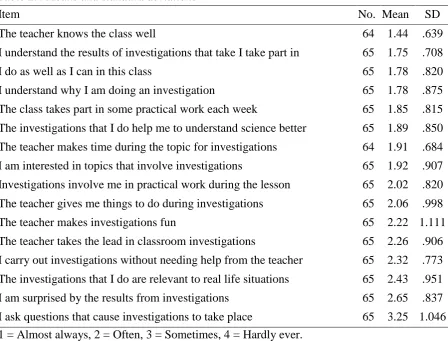
[image:11.595.74.523.371.712.2]Table 2.4 provides the means and standard deviations for all 16 dimensions. Despite the relatively small size of the sample, the low incidence of missing data provides preliminary evidence as to the utility of the instrument in the classroom setting. Broadly speaking, that the mean scores for all of the items fall within a spectrum of „almost always‟ to „sometimes‟ does suggest that investigative activity is a feature of those science classrooms surveyed, albeit that questions from pupils perhaps only occasionally generate such activity.
Table 2.4 Means and standard deviations
Item No. Mean SD
The teacher knows the class well 64 1.44 .639
I understand the results of investigations that take I take part in 65 1.75 .708
I do as well as I can in this class 65 1.78 .820
I understand why I am doing an investigation 65 1.78 .875
The class takes part in some practical work each week 65 1.85 .815
The investigations that I do help me to understand science better 65 1.89 .850
The teacher makes time during the topic for investigations 64 1.91 .684
I am interested in topics that involve investigations 65 1.92 .907
Investigations involve me in practical work during the lesson 65 2.02 .820
The teacher gives me things to do during investigations 65 2.06 .998
The teacher makes investigations fun 65 2.22 1.111
The teacher takes the lead in classroom investigations 65 2.26 .906
I carry out investigations without needing help from the teacher 65 2.32 .773
The investigations that I do are relevant to real life situations 65 2.43 .951
I am surprised by the results from investigations 65 2.65 .837
I ask questions that cause investigations to take place 65 3.25 1.046
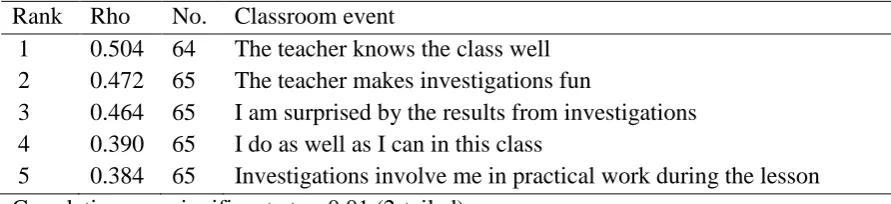
12 Rank order correlation coefficients were calculated (using SPSS 17.0). Factor analysis was not attempted however, because of the small sample size. Tables 2.5, 2.6 and 2.7 provide the top five correlations for the following classroom dimensions: „I do as well as I can in this class‟, „The teacher knows the class well‟, and „The investigations that I do help me to understand science better‟.
Table 2.5 Top five rank order correlations (Spearman’s rho) between classroom dimensions and ‘I do as well as I can in this class’
Rank Rho No. Classroom event
1 0.512 65 The teacher makes investigations fun
2 0.413 65 I am interested in topics that involve investigations
3 0.390 65 The investigations that I do help me to understand science better 4 0.364 65 I understand the results of investigations that take I take part in 5 0.352 65 I carry out investigations without needing help from the teacher Correlations are significant at p<0.01 (2-tailed).
Table 2.6 Top five rank order correlations (Spearman’s rho) between classroom dimensions and ‘The teacher knows the class well’
Rank Rho No. Classroom event
1 0.504 64 The investigations that I do help me to understand science better 2 0.484 64 The teacher gives me things to do during investigations
3 0.477 64 The teacher makes investigations fun
4 0.425 64 I am interested in topics that involve investigations
[image:12.595.66.512.519.621.2]5 0.404 64 Investigations involve me in practical work during the lesson Correlations are significant at p<0.01 (2-tailed).
Table 2.7 Top five rank order correlations (Spearman’s rho) between classroom dimensions and ‘The investigations that I do help me to understand science better’
Rank Rho No. Classroom event
1 0.504 64 The teacher knows the class well 2 0.472 65 The teacher makes investigations fun
3 0.464 65 I am surprised by the results from investigations 4 0.390 65 I do as well as I can in this class
5 0.384 65 Investigations involve me in practical work during the lesson Correlations are significant at p<0.01 (2-tailed).
13 We should be wary of course of reading too deeply into the meaning of these test results (the sample is drawn from two classrooms and from two subject disciplines only). It is however worth noting the presence of the affective and the relational7 in the model of investigative activity captured by the instrument, and the connection in particular of these dimensions to the sense that investigations help pupils to better understand science (table 2.7). That pupils could sometimes be surprised by the results of investigations (mean 2.65, SD 0.837), correlating with a better understanding of science, perhaps also suggests the presence of a degree of more open-ended practical learning in the sample of science classes questioned.
The findings of the EPL project provide evidence for the role of the emotional and the relational in the identity formation of the beginning teacher, a developmental task that depends on the establishment of a tentative reciprocal ontological security between teacher and pupil, the essence of which „lies in mutual knowledge and confidence in the classroom‟ (McNally & Blake, in press). Moreover, the conceptual basis for those components of confidence that might lead beginning science teachers to employ inquiry activity in their practice, to perhaps include a degree of open-endedness or an uncertainty of outcome in a given investigation, is also thought to depend on relational conditions experienced in the school (McNally 2006). If, as these preliminary results suggest, the emotional and relational dimensions remain central to the practice of investigative activities by experienced teachers, the challenge of employing advanced methods might yet prove to be all the greater for the beginner, and the case for evidence of their efficacy thus all the more vital as a result.
2.5 INQUIRACT
Preliminary discussions during the EPL project led to the view that the original INTERACT instrument ought not to be „just another questionnaire‟. This was not because of any aversion to questionnaires but because the project had settled on questionnaires for two of its other instruments (JOBSAT and CEPSATI). The project team therefore settled on a rudimentary, diary-style flow-chart instrument on the grounds that busy new teachers with priorities much more pressing and worthwhile than co-operating with researchers could record the day‟s most important socio-professional interactions in a couple of minutes – with the possibility of the instrument capturing more immediate or spontaneous data in contrast to a more conventional survey instrument, wherein respondents perhaps „recall their experiences in more reflective and arguably rationalised ways‟ (McNally et al. 2010: 17).
To achieve the redesign of the instrument for the purpose of recording inquiry-based activity in the science classroom, the codes that were generated by the analysis of the critical
evaluations of investigative activity completed by the student teachers for the S-TEAM project were categorised according to the following themes:
14 Resources required for the investigation
Reason for undertaking the investigation. Barriers to undertaking the investigation. Consequences of the investigation. Positive outcomes of the investigation. Negative outcomes of the investigation.
The foundation for INQUIRACT‟s quantitative measurement of performance thus mainly derives from the important dimensions of this preliminary qualitative database. Although the instrument has yet to be tested in practice, it should be emphasised that its measurements will reflect questions to which credible answers could be expected from busy new teachers, rather than theoretically-driven or literature-based dimensions (Gray et al. 2005). This also reflects the character of data collected by McNally (2006: 432), which suggests that if the question for example asks what factors inhibit inquiry-based science teaching practice, the possible responses may be, „not knowing where things are … being in an unfamiliar situation … knowing less than the pupils about something … not knowing the curriculum as a whole … no previous experience of investigating‟. Philosophically speaking, if, as Giddens (in Tucker 1998: 146) believes, the modern practice of science and technology is of itself a discourse that „encourages increasingly specialized expertise [… and] internally referential ways‟ of knowing the world, „whose unintended consequences create new types of manufactured uncertainty [… ranging] from self-identity to the potential of global catastrophe‟ (ibid.), then a more grounded understanding of the outcomes of the activities and interactions of science teachers could hardly appear more timely.
INQUIRACT was thus assembled for distribution in the form of pads, with a front-cover instruction sheet and 15 one-off investigative activity recording sheets. The instrument was subject to critique by the project‟s focus group of student teachers, with some modifications suggested as a result, mainly to the layout of the item boxes and occasional terminology. The consensus of the group was largely positive, although the design was seen to be more visually complex than had been thought by those of us who were more used to looking at it. The group‟s ideas for modifying this apparent complexity involved reducing the number of items within each thematic box (to thus also create more white space in appearance), or even reconfiguring the boxes into a more straightforward, linear arrangement. INQUIRACT has yet to be tested in practice; arrangements are however in place for teachers to test for feasibility in their schools, for themselves, and perhaps also with one or two new teachers, of which the modifications suggested will be a consideration.
3 Conclusion
15 some commentators, the instruments as described could represent the „alchemic translation‟ of language, deeds and action into numbers (Franzosi 2004: 563); for others still, a „Satanic perversion‟ of methods (Boyatzis 1998: xiii). We of the S-TEAM project might be as goodly a fellowship as ever takes the downward path. In her assessment of the value of lay
knowledge in informing research, Oliver (1998) is suspicious of the biasing of knowledge by the privileging of technical questions over relevant social or indeed contextual experience. The danger of introducing a subsequent layer of technical or statistical knowledge may be in appearing to direct discovery away from the concerns of practitioners, and towards the preoccupations of the researcher (Torrance 2004). In the words of one who understood the measurement of performance to be a state of mind as well as world, like the cage that goes in search of a bird (Kafka 1994), if you look hard enough at statistics you are likely to discover their significance.
The degree to which SCEPSATI and INQUIRACT might therefore function as formative indicators for new teachers‟ self-development, either as an intervention or in offering purchase on theory or practice, will continue to be explored and honed in testing. Evidence from interviews, observations, surveys, workshops, focus groups and the pre-testing of the instruments themselves has been included here to position their development within the range of knowledge and expertise provided by practitioners, to thus triangulate the significance of these same to the quantitative investigation of inquiry-based science teaching in early professional learning. As long as we continue to acknowledge the practical wisdom of the workplace, such that theories of development are grounded in empirical evidence from naturally occurring activities (Hennessey 1993), then perhaps we can claim that the evaluation of practice made possible by these instruments goes beyond any simple measurement of skill, fitness, or function. Students in initial teacher education might
recognise the evidence thus collected, hopefully not as the effects of remote theorising, but as a metacognition of inquiry methods themselves, which they tend not to receive in feedback from teachers during practice, which tends instead to emphasise teaching technique,
16 References
Ball, S. J. (2003) The teacher‟s soul and the terrors of performativity, Journal of Educational Policy, 18(2), 215-228.
Blake, A., Chambers, P., Findlay, M., Jeffrey, S., McNally, J., Smith, C., Souter, N. & Winter, J. (2010) Science-Teacher Education Advanced Methods National Workshop Report for Scotland: Giving Science Education a Lift. University of Strathclyde. Boreham, N. (2010) Job satisfaction among newly qualified teachers in Scotland. In J.
McNally & A. Blake (Eds) Improving learning in a professional context: A research perspective on the new teacher in school (pp. 107-120), London: Routledge.
Boyatzis, R. E. (1998) Transforming Qualitative Information: Thematic Analysis and Code Development, London: Sage.
Bragg, S. (2007) “But I listen to children anyway!” – teacher perspectives on pupil voice. Educational Action Research, 15(4), 505-518.
Elliott, J. (2001) Making Evidence-based Practice Educational. British Educational Research Journal, 27(5), 555-574.
Eraut, M. (2004) Informal learning in the workplace. Studies in Continuing Education 26(2), 247-73.
Flyvbjerg, B. (2006) Five Misunderstandings about Case-Study Research. Qualitative Inquiry, 12(2), 219-245.
Franzosi, R. P. (2004) Content Analysis. In M. Hardy and A. Bryman (Eds) Handbook of Data Analysis, London: Sage.
Gephart, Jr., R. P. (2006) Ethnostatistics and Organizational Research Methodologies: An Introduction. Organizational Research Methods, 9(4), 417-431.
Gray, P. (2010) Fun in theory and practice: new teachers, pupil opinion and classroom environments. In J. McNally & A. Blake (Eds) Improving learning in a professional context: A research perspective on the new teacher in school (pp. 121-136), London: Routledge.
Gray P., Blake A. & McNally J. (2006) She is the Best Teacher in the World. BERA, Warwick.
Gray, P., Boreham, N., Cope, P., Corbin, B., McNally, J., & Stronach, I. (2005) User
engagement and research design in the EPL Project. TLRP Annual Conference, Warwick. Hargreaves, A. (1992). Cultures of Teaching: A Focus for Change. In A. Hargreaves & M.
Fullan (Eds) Understanding Teacher Development (pp. 216-240), London: Cassell. Hascher, T. (2010) Learning and Emotion: perspectives from theory and research. European
Educational Research Journal, 9(1), 13-28.
Hennessy, S. (1993) Situated cognition and cognitive apprenticeship: Implications for classroom learning. Studies in Science Education, 22(1), 1-41.
Illeris, K. (2002) The three dimensions of learning. Leicester: Niace Publications. Kafka, F. (1994) The Collected Aphorisms. London: Penguin.
McIntyre, D., Pedder, D. and Rudduck, J. (2005) Pupil voice: comfortable and uncomfortable learnings for teachers. Research Papers in Education, 20(2), 149-168.
McNally, J. (2006) Confidence and Loose Opportunism in the Science Classroom: Towards a pedagogy of investigative science for beginning teachers. International Journal of Science Education, 28(4) 423–438.
17 McNally, J. & Blake, A. (in press) Miss,What‟s My Name? New teacher identity as a
question of reciprocal ontological security. Educational Philosophy and Theory. McNally J., Blake A., Corbin B. & Gray P. (2008) Finding an identity and meeting a
standard: connecting the conflicting in teacher induction. Journal of Education Policy. 23(3), 287-298.
McNally, J., Blake, A., Boreham, N., Cope, P., Corbin, B., Gray, P., & Stronach, I. (2010) The early professional learning of teachers: A model beginning. In J. McNally & A. Blake (Eds) Improving learning in a professional context: A research perspective on the new teacher in school (pp. 12-26), London: Routledge.
McNally, J., Blake, A., Reid, A. (2009) The informal learning of new teachers in school. The Journal of Workplace Learning, 21(4), 322-333.
Oliver, S. (1999) Users of health services: following their agendas. In S. Hood, B. Mayall and S. Oliver (Eds.) Critical Issues in Social Research: Power and Prejudice, Buckingham: Open University Press.
Rudduck, J. (2005) Consulting Pupils about Teaching and Learning: Teaching and Learning Research Briefing 5, TLRP: London.
Scottish Government (2008) Curriculum for Excellence: Building the Curriculum 3, a framework for learning and teaching, Edinburgh: The Scottish Government.
Torrance, H. (2004) Systematic Reviewing – the “call centre” version of research synthesis. Time for a more flexible approach. Paper presented to at ESRC/RCNB seminar on Systematic Reviewing, University of Sheffield.
Tucker, Jr., K. H. (1998) Anthony Giddens and Modern Social Theory. London: Sage. van Driel, J. H., Verloop, N. & de Vos, W. (1998) Developing Science Teachers‟
18
Appendix 1: Questionnaire on Investigative Science in your Placement School (QISPS)
PGDE/Joint honours__________________ Specialist Subject __________________
The following four questions are about your early impressions of investigative work in your placement school (please interpret the term ‘investigative’ broadly).
1. Describe an example of investigative science that you observed or took part in.
2. Describe the atmosphere in the classroom during the investigation (for example, what do you think the pupils got out of it?).
3. Describe an opportunity that was missed, but in which you could have supported investigative work.
4. Based on what you’ve seen, what are the main constraints on or opportunities for introducing investigation into a lesson?
If you are willing to take part in a brief research interview about your experiences, please provide your name and email address:__________________________________________ or contact Allan at [email protected] (all information will be kept strictly anonymous).