
Setting the stage for the reform of cohesion policy after 2013
78
0
0
Full text
(2) European Policies Research Centre University of Strathclyde 40 George Street Glasgow G1 1QE Tel: +44 141 548 3334 Fax: +44 141 548 4898. Author email: [email protected] [email protected] [email protected]. www.eprc.strath.ac.uk/eprc.
(3) Setting the stage for the reform of Cohesion policy after 2013. Preface This paper reviews the current state of the debate on EU budget and policy reform, and developments during 2009-10, focusing in particular on the future of Cohesion policy after 2013. The paper was prepared by the European Policies Research Centre (EPRC) under the aegis of EoRPA (European Regional Policy Research Consortium), which is a grouping of national government authorities from countries across Europe. The Consortium provides sponsorship for the EPRC to undertake regular monitoring and comparative analysis of the regional policies of European countries and the inter-relationships with EU Cohesion and Competition policies. EoRPA members currently comprise the following partners: Austria Bundeskanzleramt (Federal Chancellery), Vienna Finland Työ- ja elinkeinoministeriö (Ministry of Employment and Economy), Helsinki France Délégation à l'aménagement du territoire et à l'attractivité régionale (DATAR), Paris Germany Bundesministerium für Wirtschaft und Technologie (Federal Ministry for Economics and Technology), Berlin . Italy . Ministerium für Wirtschaft, Mittelstand und Energie des Landes Nordrhein-Westfalen (Ministry of Economics, SMEs and Energy of the Land of Nordrhein-Westfalen). Ministero dello Sviluppo Economico (Ministry of Economic Development), Dipartimento per lo sviluppo e la coesione economica (Department for Development and Economic Cohesion), Rome. Netherlands Ministerie van Economische Zaken (Ministry of Economic Affairs), The Hague Norway Kommunal-Og Regionaldepartementet (Ministry of Local Government and Regional Development), Oslo Poland Ministerstwo Rozwoju Regionalnego (Ministry of Regional Development), Warsaw Sweden Näringsdepartementet (Ministry of Enterprise, Energy and Communications), Stockholm United Kingdom Department for Business, Innovation and Skills, London The Scottish Government, Enterprise, Transport and Lifelong Learning Department, Glasgow. European Policy Research Paper, No. 77. i. European Policies Research Centre.
(4) Setting the stage for the reform of Cohesion policy after 2013. The research for this paper was undertaken by EPRC in consultation with EoRPA partners. It involved a programme of desk research and fieldwork visits among national and regional authorities in sponsoring countries and European institutions during Spring/Summer 2010. The paper has been drafted by Carlos Mendez, Professor John Bachtler and Fiona Wishlade. It draws on country-specific research contributed by the following research team: . Dr Sara Davies (Germany). . Dr Irene McMaster and Dr Katja Mirwaldt (EU12) together with country specialists. . Dr Martin Ferry (Poland). . Carlos Mendez (Portugal, Spain). . Dr Martin Ferry & Rona Michie (United Kingdom). . Dr Katja Mirwaldt and Frederike Gross (Luxembourg). . Frederike Gross (France). . Laura Polverari (Italy). . Frederike Gross and Dr Katja Mirwaldt (Belgium). . Viktoria Chorafa (Greece). . Professor Henrik Halkier (Denmark). . Heidi Vironen (Finland, Sweden). . Stefan Kah (Austria). . Professor Douglas Yuill (The Netherlands, Norway). . Dr Irene McMaster (Ireland). Many thanks to everyone who participated in the research. The European Policies Research Centre also gratefully acknowledges the financial support provided by Sponsors of the EoRPA Consortium.. Disclaimer It should be noted that the content and conclusions of this paper do not necessarily represent the views of individual members of the EoRPA Consortium.. European Policy Research Paper, No. 77. ii. European Policies Research Centre.
(5) Setting the stage for the reform of Cohesion policy after 2013. SETTING THE STAGE FOR THE REFORM OF COHESION POLICY AFTER 2013 TABLE OF CONTENTS EXECUTIVE SUMMARY.................................................................................... V 1.. INTRODUCTION .................................................................................... 1. 2. 2.1 2.2 2.3. THE CONTEXT FOR POLICY REFORM .......................................................... 3 Economic governance.......................................................................... 3 Political and institutional context ........................................................... 4 The Europe 2020 strategy..................................................................... 5. 3.. THE STATE-OF-PLAY ON EU BUDGET REFORM .............................................. 9 3.1 EU developments ............................................................................... 9 3.2 National developments .......................................................................11 3.2.1 Organisational preparations ..............................................................11 3.2.2 Budget positions ............................................................................13. 4.. COHESION POLICY SCENARIOS 2014+: ELIGIBILITY AND ALLOCATIONS .............. 21 4.1 2007-13 Criteria and coverage ..............................................................21 4.2 Post 2014 Criteria and coverage? ...........................................................25 4.3 Financial allocations ..........................................................................30 4.3.1 Convergence region allocations ..........................................................33 4.3.2 Cohesion Fund allocations ................................................................35 4.3.3 Outcomes and the impact of capping ...................................................36 4.3.4 Assessment ..................................................................................40. 5. COHESION POLICY DIRECTIONS 2014+: PERFORMANCE, PROCESS AND PERSPECTIVES ........................................................................................... 43 5.1 Reviewing performance across the EU .....................................................43 5.1.1 Learning from the past: the 2000-2006 ex-post evaluation .........................43 5.1.2 Informing thinking on the future: thematic studies..................................46 5.1.3 Mid-term achievements and lessons: Strategic Reporting...........................50 5.2 The reform process ...........................................................................51 5.3 EU perspectives: the Fifth Cohesion Report ..............................................54 5.4 National perspectives.........................................................................56 5.4.1 Strategic priorities .........................................................................56 5.4.2 Performance.................................................................................59 5.4.3 Strategic coherence ........................................................................62 5.4.4 Simplification ...............................................................................63 5.4.5 The role of the Commission ..............................................................65 6.. ISSUES FOR DISCUSSION ....................................................................... 67. European Policy Research Paper, No. 77. iii. European Policies Research Centre.
(6) Setting the stage for the reform of Cohesion policy after 2013. European Policy Research Paper, No. 77. iv. European Policies Research Centre.
(7) Setting the stage for the reform of Cohesion policy after 2013. SETTING THE STAGE FOR THE REFORM OF COHESION POLICY AFTER 2013 EXECUTIVE SUMMARY. This paper provides a review and assessment of the current state of the debate on the future of Cohesion policy. It begins, by setting out the context for reform in terms of economic governance, institutional changes and the policy priorities of Europe 2020. It then reviews the state-of-play of the budget debate, highlighting different national positions. For Cohesion policy, an analysis is provided of one of the key issues underlying Member State positions – their eligibility for Structural and Cohesion Funds, and the likely financial allocations, based on the latest Eurostat data. The political and policy dimensions of Cohesion policy reform are reviewed in detail, and the paper concludes with issues and questions for discussion.. Context for reform EU budget reform has been in a state of flux over the last year, with limited legislative progress since the end of the consultation process in late 2008. The economic crisis has dominated the EU agenda with important consequences for economic governance and new ideas on the use of EU budgetary conditionalities emerging. On the political and institutional front, the entry into force of the Lisbon Treaty (December 2009), the appointment of a new Commission and College of Commissioners (February 2010) and European Council agreement on the Europe 2020 strategy (March and June 2010) have set the stage for a new, critical phase of budgetary and policy reform. Of particular relevance is Europe 2020 - the overarching, long-term economic strategy for the European Union. It succeeds the renewed Lisbon Strategy for growth and jobs, and sets out three mutually reinforcing priorities of smart, sustainable and inclusive growth.. The state of play on EU budget reform The EU budgetary review process was launched by the Commission in September 2007 but, since the conclusion of the consultation, the Commission has made little public statement on the future of the EU budget. In November 2009, a leaked draft of a DG Budget Communication proposed that EU spending should be focused on three key axes: sustainable growth and jobs; climate and energy; and ‘global Europe’. With respect to Cohesion policy, the leaked paper recommended a concentration of resources on national convergence, and regional disparities within countries. It questioned the value of Regional Competitiveness & Employment (RCE) funding. However, the DG Budget non-paper attracted significant criticisms, especially from regional development institutional interests. Meanwhile, the process of preparing positions on the EU budget by other EU institutions has advanced over the past year. Virtually all Member States provided formal responses to the consultation, but there have been very few additional formal government statements or. European Policy Research Paper, No. 77. v. European Policies Research Centre.
(8) Setting the stage for the reform of Cohesion policy after 2013. position papers on budgetary reform published. Many Member States expect to develop clearer negotiating mandates in response to the Commission’s forthcoming budget paper.. Cohesion policy scenarios 2014+: eligibility and allocations Future eligibility scenarios under EU Cohesion policy on the basis of the latest statistical data and EU27 coverage reveals that there would be a significant shift in coverage, with the scope of the Convergence and Phasing-out regions considerably reduced and higher coverage under Phasing-in and RCE status. At a global level, Convergence coverage would fall from 31.7 percent to 24.4 percent of the EU27 population, with coverage concentrated in 15 rather than 18 Member States, as previously. Seven Member States would lose population coverage; two (Italy and Greece) would gain; the remainder would remain unchanged. Phasing-out coverage would be relatively marginal – fewer than 7 million population, compared with over 16 million in 2007-13. By contrast, Phasing-in coverage would increase, concentrated in a few countries, notably Germany and Spain. RCE coverage would remain heavily concentrated in EU15. Lastly, Greece would cease to be eligible for the Cohesion Fund, leaving only Portugal eligible among the EU15 Member States. The existing approach to Convergence region and Cohesion Fund allocations cannot be reapplied largely unchanged because the budget for these two strands of policy would exceed that for 2007-13, even though the eligible population is substantially smaller. Among the main options to address this are: to mechanistically reduce the Convergence allocation for all eligible regions to constrain the allocation within a fixed budget; to mechanistically reduce the Convergence allocation with different reduction coefficients for EU12 and EU15; or to reconfigure the capping approach. Whatever the scope for ‘tweaking’ the Berlin formula and the capping methodology, it is questionable whether the existing architecture for determining Cohesion policy allocations is robust enough to be rolled forward in such changed economic conditions.. Cohesion policy directions 2014+: performance, process and perspectives Looking forward at the substance of policy, the extensive investment in evaluation and other research has continued over the past year, with further insights on the performance of the policy supplemented by the first strategic reports from Member States. The Commission has also been mobilising debate on the future of the policy, particularly through the High-Level Group of Member States. The Fifth Cohesion Report is currently being finalised and is due for publication in November 2010. In addition to its analytical role in assessing the state of cohesion in the EU, the Report will bring together the conclusions of research and debate with a series of proposals for 2014-2020. At it heart is a conception of Cohesion policy as a delivery vehicle for achieving the Europe 2020 objectives of smart, inclusive and sustainable growth, while recognising the founding Treaty-based objective of cohesion. It will propose several ways for enhancing the European added value of the policy through greater concentration, conditionalities and a performance focus, and it will seek to streamline and simplify the delivery system.. European Policy Research Paper, No. 77. vi. European Policies Research Centre.
(9) Setting the stage for the reform of Cohesion policy after 2013. Interviews with national policy-makers reveal universal agreement on EU Cohesion policy being closely aligned with Europe 2020 and its key objectives. However, sufficient flexibility is also called for to adapt EU priorities to different domestic contexts. With regard to performance-enhancing measures, the use of financial conditionalities and incentives is generally viewed with scepticism, particularly because of methodological challenges. Reinforced monitoring and evaluation could be supported, but as long as the current devolved and needs-based approach is not disrupted. To improve the quality and utility of strategic reporting, national policymakers argue that the reports should concentrate on strategic issues and agreement should be sought on standard core indicators to allow comparison across countries, while the need for a more structured high-level debate in the Council has received mixed reactions. Institutional capacity is increasingly recognised as being critical to effective performance, but this is largely viewed to be a domestic concern. On the issue of strategic coherence between EU policies, national policymakers are supportive of proposals of a common strategic framework for cohesion policy, rural development policy and maritime and fisheries policy. A related priority is the need to agree on harmonised management rules, eligibility conditions and operational coordination between the Structural Funds and with other EU policies. More complementarity between the Structural Funds and Rural Development is a priority, but not all policymakers consider that rural development should be reintegrated into Cohesion policy. There is universal agreement on the need to simplify implementation rules and procedures, particularly concerning financial management and control. Other proposals with strong support include lighter administrative requirements for specific types of interventions or beneficiaries, a more flexible decommitment rule and the facilitation of partial closure. Resolving the burden of financial management, control and audit is also seen as the key issue for improving the role of the Commission within Cohesion policy and allowing it to adopt a more strategic stance. However, this would also require additional human resources, more training of Commission staff and more effective inter- and intra-DG coordination.. Issues for discussion A preliminary set of questions for discussion at the EoRPA meeting are: . What kind of changes to the Berlin formula for allocating Cohesion policy funding could be considered to stay within budgetary limits and ensure sufficiently wide political support?. . How should the approach to shared management of Cohesion policy evolve?. . What kind of conditionalities on Cohesion policy spending would be acceptable to Member States?. . What scope is there for widening the use of different financial instruments?. European Policy Research Paper, No. 77. vii. European Policies Research Centre.
(10) Setting the stage for the reform of Cohesion policy after 2013. European Policy Research Paper, No. 77. viii. European Policies Research Centre.
(11) Setting the stage for the reform of Cohesion policy after 2013. SETTING THE STAGE FOR THE REFORM OF COHESION POLICY AFTER 2013. 1.. INTRODUCTION. As the Fifth Cohesion Report is finalised, the stage is being set for the important, negotiation phase of Cohesion policy reform. The proposals for ‘a regional development strategy for 2020’ come at a critical time for the policy, which has been under internal and external pressure. As in 2004-05, several of the net payer Member States are concerned about the cost of their budget contributions, exacerbated by current public expenditure constraints in the wake of fiscal retrenchment. Cohesion policy, along with the Common Agricultural Policy, are the main areas of EU spending likely to be targeted for cutbacks. Within the European Commission, the launch of the Europe 2020 has given a high profile to new EU priorities for which extra funding is sought. As previous EoRPA papers have illustrated, 1 Cohesion policy has been under attack for its performance, especially the ambiguous evidence for the effectiveness of spending, the administrative complexity of management and implementation requirements, and the relatively high level of irregularities. All EU reform debates are protracted, but the recent discussions on reforming Cohesion policy have been longer than any hitherto. Hardly had the new 2007-13 programmes been launched in 2007 than the first consultation on the future of the policy was launched on the back of the future-oriented questions in the Fourth Cohesion Report. The independent Barca Report on the future of the policy was commissioned in late 2007, reporting in 2009, followed by an orientations paper from Commissioner Hübner and a reflections paper from Commissioner Samecki. Along the way, a Green Paper on territorial cohesion was prepared, and the biggest ever evaluation exercise was conducted by DG Regio to assess the effectiveness of the policy in 2000-06 along with a series of other studies to inform future thinking. The Fifth Cohesion Report, due for publication in November 2010, and the Cohesion Forum planned for March 2011, are two further important milestones. In addition to its analytical role in assessing the state of cohesion in the EU, the Report will bring together the conclusions of research and debate with a series of proposals for 2014-2020. At it heart is a conception of Cohesion policy as a delivery vehicle for achieving the Europe 2020 objectives of smart, inclusive and sustainable growth. It will propose several ways for enhancing the European added value of the policy through greater concentration, conditionalities and a performance focus, and it will seek to streamline and simplify the delivery system. However,. 1. For example, see: Bachtler J, Mendez C and Wishlade (2009) Challenges, Consultations and Concepts: Preparing for the Cohesion Policy Debate, EoRPA Paper 09/6, European Policies Research Centre, University of Strathclyde, Glasgow. Bachtler J, Mendez C and Wishlade (2009) Ideas for Budget and Policy Reform: Reviewing the Debate on Cohesion Policy 2014+, EoRPA Paper 09/5, European Policies Research Centre, University of Strathclyde, Glasgow.. European Policies Research Paper, No. 77. 1. European Policies Research Centre.
(12) Setting the stage for the reform of Cohesion policy after 2013. the conclusions have yet to be finalised – and some key issues, such as the relationship between the ERDF and ESF, have still to be agreed. The context for the Report will be provided by the results of the budget review to be published by the Commission in October 2010. In charting the priorities for future EU spending and mechanisms for revenue-generation, it will reveal the thinking shaping the proposals for the next Financial Perspective, due in Spring 2011. Followed by the legislative package for Cohesion policy in Summer 2010, the starting gun will have been fired for the negotiations on the EU budget for the post-2013 period. Against this backdrop, this paper provides a review and assessment of the current state of the debate on the future of Cohesion policy. It begins, in Section 2, by setting out the context for reform in terms of economic governance, institutional changes and the policy priorities of Europe 2020. Section 3 reviews the state-of-play of the budget debate, highlighting different national positions. Section 4 then focuses on one of the key issues underlying Member State positions – their eligibility for Structural and Cohesion Funds, and the likely financial allocations, based on the latest Eurostat data. The political and policy dimensions of Cohesion policy reform are the subject of Section 5, and the paper concludes with issues and questions for discussion in Section 6.. European Policies Research Paper, No. 77. 2. European Policies Research Centre.
(13) Setting the stage for the reform of Cohesion policy after 2013. 2.. THE CONTEXT FOR POLICY REFORM. EU budget reform has been in a state of flux over the last year, with limited legislative progress since the end of the consultation process in late 2008. The economic crisis has dominated the EU agenda with important consequences for economic governance and new ideas on the use of EU budgetary conditionalities emerging. On the political and institutional front, the entry into force of the Lisbon Treaty (December 2009), the appointment of a new Commission and College of Commissioners (February 2010) and European Council agreement on the Europe 2020 strategy (March and June 2010) have set the stage for a new, critical phase of budgetary and policy reform.. 2.1. Economic governance. Over the past year the fallout from the financial and economic crisis has dominated the EU agenda with important consequences for economic governance. A Greek debt crisis erupted in January when it was discovered that the country's deficits were twice as large as it had reported. This led to a fall in Greece’s sovereign debt rating and speculative attacks on the euro. Although initially hesitant to react, the EU Member States, the European Central Bank and the Commission responded with a strong and concerted package of initiatives to ensure financial stability, support growth and employment, and to strengthen the economic governance system of the EU: . a task force was set to reform EU and euro zone economic governance, comprised of EU27 Finance Ministers and chaired by European Council President Herman Van Rompuy (26 March 2010);. . an emergency aid mechanism for Greece was agreed worth €30 billion (11 April 2010);. . a stabilisation mechanism of €750 billion was set up to protect the euro (10 May 2010);. . and a Commission Communication proposed to strengthen EU economic governance, including reinforced ex-ante budgetary surveillance through early mutual surveillance and peer review of national budgets and tougher sanctions for countries breaking budget deficit and debt limits (12 May 2010). 2. With an eye on the future reform of Cohesion policy, the above-mentioned Commission Communication stated that “Cohesion policy should have a clearer role to play in supporting Member States actions to address structural weaknesses and competitiveness challenges….particularly with a view to strengthening institutional capacity and efficiency of public administrations.” It also called for more rigorous and stricter enforcement of. 2. European Commission (2010) Communication from the Commission to the European Parliament, the European Council, the Council, the European Central Bank, the European Economic and Social Committee and the Committee of the Regions, Reinforcing Economic Policy Coordination, COM(2010) 250 final, 12.5.2010, Brussels.. European Policies Research Paper, No. 77. 3. European Policies Research Centre.
(14) Setting the stage for the reform of Cohesion policy after 2013. existing conditionalities on the Cohesion Fund – as linked to breaches of the Stability and Growth Pact (SGP) - during the current financial perspectives. Further Commission thinking on these issues was set out in a follow-up Communication in June 2010. 3 It anticipated the establishment of ex-ante conditionalities for Cohesion policy in its future reform proposals, by linking Cohesion disbursements to structural and institutional reforms. Although not specified in the Communication, potential candidates are likely to include business regulation and, in the environment field, water pricing and user-charging policies, given the high volume of funding channelled into business support and basic water infrastructures. With respect to the fiscal corrective arm, a new system of financial sanctions and incentives was proposed to ensure compliance with SGP rules. These would apply to expenditure under Cohesion policy, the CAP and the Fisheries Fund. However, a qualification was noted in relation to the CAP and Fisheries Fund, by excluding the possibility of farmer and fisherman income being affected; conditionality on payments would target EU reimbursements to national budgets and Member States would have to continue to pay the farm and fisheries subsidies. Lastly, it suggested that other incentives could be set up, such as a performance reserve or the modulation of co-financing rates.. 2.2. Political and institutional context. After eight years of intense negotiation, the Lisbon Treaty finally came into force on 1 December 2009 following the second Irish referendum vote on 2 October 2009 and ratification by all EU27 Member States. The Treaty’s stated aim is “to enhance the efficiency and democratic legitimacy of the Union and to improve the coherence of its action.” Important changes were made to EU institutions and decision-making processes, most prominently an extension of Qualified Majority Voting (QMV) in the Council of Ministers; increased power for the European Parliament in the legislative process through extended co-decision with the Council of Ministers; and the creation of a President of the European Council (Herman Van Rompuy) and a High Representative of the Union for Foreign Affairs and Security Policy (Baroness Catherine Ashton) to present a common EU position on the world stage. The main implications of the Lisbon Treaty for Cohesion policy are two-fold. First, there is a new title on economic, social and ‘territorial’ cohesion. The concept of territorial cohesion is not defined and the traditional goal of reducing regional disparities has not changed, but a more specific reference to the regions deserving particular attention is included in the Treaty, namely: “rural areas, areas affected by industrial transition and regions which suffer from severe and permanent natural or demographic handicaps such as the northernmost regions with very low population density and island, cross-border and. 3. European Commission (2010) Communication from the Commission to the European Parliament, the European Council, the Council, the European Central Bank, the European Economic and Social Committee and the Committee of the Regions, Enhancing Economic Policy Coordination for Stability, Growth and Jobs – Tools for Stronger EU Economic Governance, COM(2010) 367/2, European Commission, Brussels.. European Policies Research Paper, No. 77. 4. European Policies Research Centre.
(15) Setting the stage for the reform of Cohesion policy after 2013. mountain regions.” Second, Cohesion policy legislation is now decided on the basis of codecision through the so-called ordinary legislative procedure, providing the Parliament with stronger decision-making power vis-à-vis the Council of Ministers across the entire legislative package of regulations. In September 2009, José Manuel Barroso was re-elected by the European Parliament for a second term of office as President of the European Commission. The appointment of a new College of Commissioners was interrupted due to the delayed ratification of the Lisbon Treaty, obliging Barroso to extend the mandate of the previous College pending Treaty approval. Following this, the European Parliament elected the new European Commission and College of Commissioners on 9 February 2010 for a four year period, including a representative of each of the 27 EU Member States. The Cohesion policy portfolios were taken up by Commissioner Johann Hahn, following Pamel Samecki’s six-month term in office at DG Regional Policy, and Commissioner László Andor, to replace Vladimir Spidla at DG Employment, Social and Equal Opportunities. The new Commission published its 2010 Work Programme at the end of March 2010, 4 setting out the key policy and legislative issues to be taken forward in the coming years. A particular emphasis was placed on the launch of the Europe 2020 strategy for sustainable growth and jobs (see below), enhancing the rights and security of European citizens, and strengthening Europe’s role on the world stage. These political priorities were reiterated in Barroso’s first ever ‘State of the Union’ address to the European Parliament (as foreseen in the Lisbon Treaty) in September 2010 on the programme for the year ahead, as well as reaching agreement on the Commission’s economic governance proposals and the launch of the negotiations on the EU budget. 5 Political change has also been evident in some Member States over the past year. Changes of government and a rise of more eurosceptic views have been witnessed in the UK (May), Sweden (September) and the Netherlands (where coalition negotiations are ongoing). By contrast, a new Czech coalition (July) has a more moderate eurosceptic stance than the previous government, while the Presidential elections in Poland (July) have strengthened the position of the existing pro-Europe government.. 2.3. The Europe 2020 strategy. Europe 2020 is the overarching, long-term economic strategy for the European Union. It succeeds the renewed Lisbon Strategy for growth and jobs, which was scheduled to end in 2010. Following a relatively quick public consultation, the Commission put forward its proposal for the EU 2020 strategy on 3 March 2010. 6 The strap-line objective is to “turn the. 4. European Commission (2010a) Communication from the Commission to the European Parliament, the Council, the European Economic and Social Committee and the Committee of the Regions, Commission Work Programme 2010, Time to act. 5. José Manuel Durão Barroso, President of the European Commission, State of the Union 2010, 7 September 2010, European Parlimament, Strasbourg.. 6. European Comission (2010b) Communication from the Commission, Europe 2020 A strategy for smart, sustainable and inclusive growth, COM(2010) 2020, Brussels, 3.3.2010. European Policies Research Paper, No. 77. 5. European Policies Research Centre.
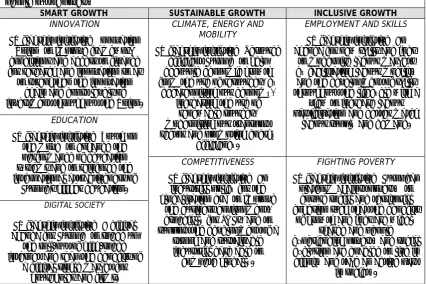
(16) Setting the stage for the reform of Cohesion policy after 2013. EU into a smart, sustainable and inclusive economy delivering high levels of employment, productivity and social cohesion”. To pursue this objective, three mutually reinforcing priorities have been set: Smart growth: developing an economy based on knowledge and innovation. Sustainable growth: promoting a more resource efficient, greener and more competitive economy. Inclusive growth: fostering a high-employment economy delivering social and territorial cohesion. In line with these priorities, five “headline targets” were defined to be adapted at national level and seven flagship initiatives were identified where joint action would be initiated on innovation, youth, the digital agenda, resource efficiency, industrial policy, skills and jobs and the fight against poverty (Figure 1). Figure 1: Overview of Europe 2020 HEADLINE TARGETS 1) Raise the employment rate of the population aged 20-64 from the current 69% to at least 75% 2) Achieve the target of investing 3% of GDP in R&D in particular by improving the conditions for R&D investment by the private sector, and develop a new indicator to track innovation 3) Reduce greenhouse gas emissions by at least 20% compared to 1990 levels or by 30% if the conditions are right, increase the share of renewable energy in our final energy consumption to 20%, and achieve a 20% increase in energy efficiency 4) Reduce the share of early school leavers to 10% from the current 15% and increase the share of the population aged 30-34 having completed tertiary education from 31% to at least 40%. 5) Reduce the number of Europeans living below national poverty lines by 25%, lifting 20 million people out of poverty SMART GROWTH SUSTAINABLE GROWTH INCLUSIVE GROWTH INNOVATION CLIMATE, ENERGY AND EMPLOYMENT AND SKILLS MOBILITY EU flagship initiative "Innovation EU flagship initiative "An EU flagship initiative "Resource agenda for new skills and jobs" Union" to improve framework efficient Europe" to help conditions and access to finance to modernise labour markets decouple economic growth for research and innovation so as by facilitating labour mobility from the use of resources, by to strengthen the innovation and the development of skills decarbonising our economy, chain and boost levels of throughout the lifecycle with a increasing the use of investment throughout the Union. view to increase labour renewable sources, participation and better match EDUCATION modernising our transport labour supply and demand. sector and promoting energy EU flagship initiative "Youth on efficiency. the move" to enhance the performance of education COMPETITIVENESS FIGHTING POVERTY systems and to reinforce the EU flagship initiative "An EU flagship initiative "European international attractiveness of industrial policy for the platform against poverty" to Europe's higher education. globalisation era" to improve ensure social and territorial DIGITAL SOCIETY the business environment, cohesion such that the benefits especially for SMEs, and to of growth and jobs are widely EU flagship initiative "A digital support the development of a shared and people agenda for Europe" to speed up strong and sustainable experiencing poverty and social the roll-out of high-speed industrial base able to exclusion are enabled to live in internet and reap the benefits of compete globally. dignity and take an active part a digital single market for in society. households and firms. Source: European Commission (2010a), Annex 1. European Policies Research Paper, No. 77. 6. European Policies Research Centre.
(17) Setting the stage for the reform of Cohesion policy after 2013. The Commission’s proposals were endorsed by the European Council in March 2010 - except for some of the headline targets which were subsequently agreed in June 2010 – providing the Commission with a mandate to draft economic policy and employment guidelines to steer the next round of National Reform Programmes. 7 The guidelines were integrated and formally agreed through a Council recommendation on economic guidelines 8 and a draft decision on employment guidelines, which is still awaiting Parliamentary assent (see Box 1). Box 1: The Europe 2020 Integrated Guidelines 1. Ensuring the quality and the sustainability of public finances 2. Addressing macroeconomic imbalances 3. Reducing imbalances in the euro area 4. Optimising support for research, development and innovation, strengthening the knowledge triangle and unleashing the potential of the digital economy 5. Improving resource efficiency and reducing greenhouse gases 6. Improving the business and consumer environment and modernising the industrial base in order to ensure the full functioning of the internal market 7. Increasing labour market participation and reducing structural unemployment 8. Developing a skilled workforce responding to labour market needs, promoting job quality and lifelong learning 9. Improving the performance of education and training systems at all levels and increasing participation in tertiary education 10. Promoting social inclusion and combating poverty. To encourage more effective delivery and increased ownership, the governance model for Europe 2020 includes three key innovations compared to the previous Lisbon strategy. First, the European Council is now clearly responsible for coordinating the process, on the basis of Commission proposals. Second, the Commission has a new ability to issue country specific recommendations and policy warnings. Third, the system of Member State reporting on the achievement of 2020 targets is more coordinated with the Stability and Growth Pact reporting system, the latter now including a legal obligation to report on macroeconomic and public finance reform. With the new Parliament and the Commission in place and the Treaty of Lisbon entering into force, the stage is now set for the critical debates and legislative process to proceed on the new financial perspective for the post-2014 period.. 7 European Commission (2010c) Recommendation for a Council recommendation on broad guidelines for the economic policies of the Member States and of the Union Part I of the Europe 2020 Integrated Guidelines, COM(2010) 193 final, 27.4.2010, Brussels; European Commission (2010d) Proposal for a Council decision on guidelines for the employment policies of the Member States Part II of the Europe 2020 Integrated Guidelines, COM(2010) 193 final, 27.4.2010, Brussels. 8. Council of the European Union (2010) Council Recommendation on broad guidelines for the economic policies of the Member States and of the Union, 11646/10, 7 July 2010, Brussels European Policies Research Paper, No. 77. 7. European Policies Research Centre.
(18) Setting the stage for the reform of Cohesion policy after 2013. The Europe 2020 strategy has received a mixed reaction in the consultation exercise and subsequent debates and media commentary. In the academic community, a prominent series of contributions have emphasised four key positive features in comparison to the Lisbon strategy. 9 . it provides a more comprehensive strategy with a clearer focus on the environmental (sustainable) and social (inclusive) dimensions of growth, as well as recognising the need for a stronger industrial policy;. . there is greater concentration and focus in the approach to target-setting;. . the improved and more coherent economic coordination between national budgetary policies and growth-enhancing policies is welcomed; and. . the use of specific country reports and recommendations should make poor performance more visible.. On the negative side, critics have argued that there has been a lack of informed assessment or evaluation of the preceding Lisbon strategy, particularly the reasons for nonachievement of the goals. There are also concerns that some mistakes may be replicated. For example, the strategy does not entail substantial innovation in terms of instruments and is arguably a window-dressing exercise, consisting of indicators where EU has limited power to add value. The targets are regarded as over-ambitious, especially given the challenging budgetary climate. Further, it fails to incorporate the impact of the short-term imperative of crisis exit strategies on the medium-term goals of the strategy and even contains contradictions, such as the limited priority given to financial regulation or a narrow interpretation of inequalities. Problems of coherence have also been cited: there has been inadequate reflection on the tensions and contradictions between different aims or within flagship initiatives, such as social cohesion versus growth or between employment flexibility and security. Lastly, several problems with the governance approach have been noted, particularly: the limited consultation on the document or space for involvement of stakeholders in implementation; the enhanced role of ECOFIN (Finance Ministers) at the expense of other sectoral Councils; and the lack of attention to how learning and genuine and effective scrutiny by peers can be stimulated.. 9. See the contributions by Annnete Bogardt and Francisco Torres, Phillipe Pochet, Iain Begg, Laszlo Csaba, Karel Lannoo, Luc Soete and Christian Egenhofer in: Intereconomics (2010) Forum on Europe 2020 — A promising strategy?, Volume 45, Number 3, May/June 2010, pp136-70.. European Policies Research Paper, No. 77. 8. European Policies Research Centre.
(19) Setting the stage for the reform of Cohesion policy after 2013. 3.. THE STATE-OF-PLAY ON EU BUDGET REFORM. 3.1. EU developments. The EU budgetary review process was launched by the Commission in September 2007 with a consultation paper, 10 stating that: “This budget review is unique, a once in a generation opportunity to make a reform of the budget and in the way we work”. The consultation was concluded as far back as late 2008 with the assertion that radical reform is necessary. A refocusing of spending on future challenges was considered necessary to shift the centre of gravity of the budget towards the priorities of competitiveness, environment and energy. A fair and transparent mechanism of contributions was also seen as important, replacing the current ‘web of corrections’. Flexibility was advocated, so that the budget has improved capacity to respond to evolving challenges. Since the conclusion of the consultation, the Commission has made little public statement on the future of the EU budget. However, in November 2009, a leaked draft of a DG Budget Communication gave some insight into the way that the Commission might be thinking. The paper proposed that EU spending should be focused on three key axes: sustainable growth and jobs – research, skills, convergence, innovation; climate and energy – energy efficiency, mitigation and adaptation; and ‘global Europe’ – poverty, migration management, neighbourhood cooperation. A stable budget of one percent of GNI was foreseen. The paper advocated a reform of EU financing, with the replacement of VAT by a new own resource and the phasing-out of all correction mechanisms (over time). Better delivery was envisaged through simplified procedures (including the delegation of financial control to Member States, more use of performance incentives such as conditionalities, and the differentiation of management/control requirements based on capacity. With respect to Cohesion policy, the leaked paper recommended a concentration of resources on national convergence, and regional disparities within countries. It questioned the of value of Regional Competitiveness & Employment (RCE) funding and mooted a possible redirection of RCE funding to areas like research, innovation and TENS as well as strengthened focus on cross-border cooperation. The possibility of extending the use of adjustment instruments in response to external shocks – economic crises, natural disasters, terrorism, public health emergencies - was discussed. Thematic concentration on a limited number of priorities was foreseen: human capital development; infrastructure connections between lagging areas and growth centres; climate and biodiversity investments (climate proofing); and research and innovation. Lastly, the paper made several proposals for improving delivery, potentially including a separation of the European Social Fund from the European Regional Development Fund, the creation of a ‘Single Strategic Framework’ for all Community funds under shared management (Cohesion, rural development, maritime), and more support for institutional capacity through know-how exchange and networks.. 10. European Commission (2007) Reforming the Budget, Changing Europe: A Public Consultation Paper in View of the 2008/2009 Budget Review, Communication from the Commission, Brussels, SEC(2007) 1188, 12.9.2007. European Policies Research Paper, No. 77. 9. European Policies Research Centre.
(20) Setting the stage for the reform of Cohesion policy after 2013. The DG Budget non-paper attracted significant criticisms, especially from regional development institutional interests such as the European parliament’s REGI Committee, the Conference of Peripheral & Maritime Regions, the Assembly of European Regions and other networks. The main objections were that the DG Budget proposals represented a de facto renationalisation of Cohesion policy; it would involve a downgrading of multi-level governance, with no recognition of regional and local issues/interests or involvement, and the downgrading of Objective 2 would potentially ‘exclude’ c.200 regions from the policy. The separation of ESF from Cohesion policy was also seen as counterproductive. In response to such criticisms, President Barroso rapidly disassociated himself from the paper. Since then, the publication of the official Communication has been repeatedly delayed – first from Spring 2010 to the Summer, then to early Autumn and now to October. Reports suggest that the scope for radical reform has diminished, largely because of the political turbulence caused by the economic crisis. Of course, there is always a bias towards the ‘status quo’ in EU budgetary negotiations given that budget agreements require unanimity, and the current fiscal constraints in major EU economies limit the scope for more spending. Nevertheless, in the context of the ambitious Europe 2020 proposals, the budget review will play an important role in charting the priorities for future EU spending which will be formally put proposed by the Commission in July 2011. Meanwhile, the process of preparing positions on the EU budget by other EU institutions has advanced over the past year. In the European Parliament, a new committee was set up for this purpose in July 2010. Named the ‘Special Committee on the Policy Challenges and Budgetary Resources for a Sustainable European Union after 2013’ (SURE), the committee’s mandate includes six key tasks: to define Parliament's priorities for the EU's next long-term budget framework, in both political and budgetary terms; to estimate how much money the EU will need to achieve its objectives; to define the duration of the next long-term budget framework (this has traditionally been seven years but MEPs want to adjust it to match the mandates of the Parliament and the Commission); to propose a structure for future long-term budget frameworks; to draw up guidelines on how resources should be distributed within and between different parts (“headings”) of the EU budget; and to specify the link between a reform of the EU's financing system and a review of expenditure, so as to provide the Budgets Committee with a basis for the forthcoming MFF negotiations. A first meeting took place in July 2010 to elect the committee’s chair (Jutta Haug, S&D, Germany) rapporteur (Salvador Garriga Polledo, EPP, Spain) and four vice chairs (Anne Jensen, ALDE, Denmark; Jan Olbrycht, EPP, Poland; Konrad Szymański ECR, Poland; and Helga Trüpel, Greens/EFA, Germany). Working meetings began in September, but draft European Policies Research Paper, No. 77. 10. European Policies Research Centre.
(21) Setting the stage for the reform of Cohesion policy after 2013. reports are not anticipated till 2011. Looking at specific areas of expenditure, however, an indication of the Parliament’s future stance on the agriculture heading can be seen from a resolution on the future of the CAP, approved at a plenary sitting on 9 July 2010. On the basis of an own-initiative report by the agriculture committee, the resolution essentially defends the current approach, arguing for continuity rather than change: maintaining the current share of the EU budget and co-financing approach; and continuing with some market measures as a safety net, the Single Farm and the Less-Favoured Area Payments, and flexible spending entitlements that are fully community-financed. The Committee of the Regions preparatory work has also stepped up a gear. A formal opinion on the future EU budget is imminent. Among the key expected proposals are that a 10 year financial framework (that is, 5+5 approach) be adopted and for there to be flexibility to reallocate up to 25 percent of the budget after five years. 11 Like the Parliament, the Committee of the Regions has also issued an opinion the future of the CAP with a supportive stance on the level of EU expenditure. Specifically, it calls for “a consolidated and reinforced budget that is up to the challenges and issues to be addressed.” 12. 3.2. National developments. The development of Member State thinking on the post-2014 financial perspectives was prompted by the EU budgetary review. Virtually all of the Member States provided formal responses to the consultation, concluded with a major conference in Brussels in November 2008. Beyond these contributions, there have been very few additional formal government statements or position papers on budgetary reform published. However, internal consultation and coordination processes have advanced and many Member States expect to develop clearer negotiating mandates in response to the Commission’s forthcoming budget paper.. 3.2.1 Organisational preparations The process of developing a national position on EU budget reform is often led by a Finance or Treasury Ministry with varying degrees of input from other Ministries (particularly those responsible for managing EU funding) through existing inter-ministerial coordination forums and channels (e.g. Finland, Ireland, Netherlands). . For instance, in Finland discussions have progressed within the Budget Department’s EU Unit at the Ministry of Finance. Politically contentious issues are resolved in the so-called Agenda Leader Group (which gathers representatives at. 11. Committee of the Regions press Release (2010) EU budget review: regions will continue to play key role, agree Bresso and Lewandowski, 19 July 2010, Committee of the Regions, Brussels: http://www.cor.europa.eu/pages/PresentationTemplate.aspx?view=detail&id=dcd3c76f-7729-4edda884-50a36982ff1b 12. Committee of the Regions (2010) Own-Initiative Opinion, The Future Of The Cap After 2013: http://coropinions.cor.europa.eu/CORopinionDocument.aspx?identifier=cdr\nat-v\dossiers\nat-v003\cdr127-2010_fin_ac.doc&language=EN European Policies Research Paper, No. 77. 11. European Policies Research Centre.
(22) Setting the stage for the reform of Cohesion policy after 2013. the level of heads of departments) and final decisions will be formalised in the EU Ministerial Committee. In other cases, a Foreign Affairs or External Relations Ministry plays a more significant role in coordinating the process, given their general responsibility for EU policy coordination. . In Italy, the lead is taken by the Ministry of Foreign Affairs, which prepared the national contribution to the budget review consultation and has begun developing this work further through inter-ministerial meetings in late March 2010 with representatives from the Presidency of the Council of Ministers, the Ministry of Economy and Finance, the Ministry of Agriculture, the Department for Community Policies and the Department for Development Policies.. . In Poland, the Ministry of Foreign Affairs is taking the lead on the formulation of the government position, now that the Office for European Integration (which led the role for the previous financial perspective) has been incorporated into the Ministry.. . In Spain, the DG for Integration and Coordination of General and Economic Affairs of the State Secretariat for European Affairs (Ministry of External Cooperation) coordinates the government’s EU budget reform position in cooperation with officials and technical experts from other Ministries (particularly the Ministry of Economy and Finance and the Ministry of Agriculture) which have been meeting in an Inter-Ministerial Committee for EU Affairs or engaging in informal contacts.. Greater political oversight is evident in other countries, sometimes involving direct links to heads of state. . In Austria, the process is led by the Treasury, but the work is closely coordinated with the Ministry of Foreign Affairs and the Federal Chancellery. . In France, the process is managed by the President and the Prime Minister together with the Budget Directorate of the Budget Ministry and the General Secretariat for European Affairs which is directly affiliated to the Prime Minister.. The setting up of dedicated committees or working groups on specific aspects of budgetary reform is indicative of the increasing attention being devoted to the development of more detailed positions on the post-2013 financial perspectives. . In Italy, a working group was set up in mid-2010 to assess the implications of the budgetary review for net balances in more detail.. . Similarly, the recent preparatory work in France has focused on modelling the main scenarios for the different budget headings, involving dedicated meetings between the Ministry of Agriculture and DATAR.. European Policies Research Paper, No. 77. 12. European Policies Research Centre.
(23) Setting the stage for the reform of Cohesion policy after 2013. . In the case of Ireland, a high-level consultative committee on CAP reform has been set up by the Department of Agriculture and submissions on CAP reform from the public and interest organisations have been invited.. . The forthcoming EU Presidency in Poland is seen as an important milestone for Polish authorities in the budget debate and working groups on Cohesion policy have been set up to prepare for this in the Ministry of Regional Development. Parliamentary input to the budgetary review process is another distinctive feature of recent developments in some countries. . On the request of the Prime Minister, a report on budgetary reform was produced by the French Parliament’s European Affairs Committee in May 2010 to steer strategic thinking, based on a broad consultation process with a broad array of stakeholders at different levels. 13. . A similar process is underway in Spain through the creation of a temporary parliamentary committee in March 2010 to examine the reform of the EU budget along with the implications for the CAP and Cohesion policy.. As noted, most Member States have not issued further formal position papers beyond the budgetary review consultation responses and it is evident that the intention in many cases is to “wait-and-see” what the Commission will propose in its budget paper before reacting. In line with this timetable, an official French position is expected in November 2010, following intensive work after the summer break, and an Italian memorandum on the EU budget and Cohesion policy is expected soon. In other cases, responses to EU policy developments will only be undertaken if this proves necessary (e.g. Germany, Spain). Political attention has been diverted to more pressing domestic matters elsewhere. Linked to managing the banking crisis and public sector staff cuts, Ireland’s Department of Finance is under considerable pressure and the position on the EU budget has not advanced to any great extent since the budgetary review.. 3.2.2 Budget positions Turning to the substantive content of EU budgetary reform, initial Member State views have been systematically reviewed elsewhere on the basis of the consultation responses. 14 These positions have not changed significantly since then, and very few new ideas have been proposed. According to the national policymakers interviewed, the main issues that have. 13. Lequiller P (2010) Rapport de Pierre Lequiller, auprès de Monsieur Michel Mercier, Ministre de l’espace rural et de l’aménagement du territoire et de Monsieur Pierre Lellouche, Secrétaire d’Etat chargé des affaires européennes.. 14. Bachtler J, Mendez C and Wishlade F (2008) Ideas for Budget and Policy Reform: Reviewing the Debate on Cohesion Policy 2014+, EoRPA Paper 08/4, European Regional Policy Research Consortium, EPRC, University of Strathclyde, Glasgow; Bachtler J, Mendez C and Wishlade F (2009) Challenges, Consultations and Concepts: Preparing for the Cohesion Policy Debate, EoRPA Paper 09/6, European Regional Policy Research Consortium, EPRC, University of Strathclyde, Glasgow. European Policies Research Paper, No. 77. 13. European Policies Research Centre.
(24) Setting the stage for the reform of Cohesion policy after 2013. dominated internal discussions relate to the size of the EU budget, the added value of expenditure and future policy priorities. Opposing views on the size of the EU budget were already evident in the budget consultation responses. On the one hand, Greece, Poland and Portugal emphasised the need for the EU budget to have sufficient resources, warning (in the case of the Polish submission) that budget reductions will reduce responsiveness to changing needs. On the other side, some of the net contributors called for a “leaner” budget with substantial reprioritisation of expenditure (Sweden and the UK) while Austria and the Netherlands explicitly called for total spending to remain constant at a level of 1 percentage of EU GNI, the capping level which had been defended by the group of six net budget contributors in the previous financial perspective. Since the budget consultation, Germany has adopted a similar stance by calling for a 1 percent ceiling on the EU budget in the federal government’s coalition agreement of October 2009. 15 The French contribution to the budget consultation was silent on the question of scale, but interviews with government officials suggest that the ambition is to keep the budget within the current limits, a view which is also reflected in the French Parliament’s report on the future of the budget. This states that, as a net contributor to the EU budget, France ‘is probably prompted, in a context of generalised pressure on public finances of Member States, not to support a significant increase’ of the EU budget as compared to its current level. 16 Following a meeting between the French Budget Minister Francois Baroin and the German Finance Minister Wolfgang Schäuble on 24 August 2010, Commission proposals for budgetary increases in 2011 (including future proposals for a new EU-wide tax that could fall on bank transactions or air travel 17) were strongly criticised by the Ministers for being out of line with the austerity measures being implemented across EU Member States in the challenging fiscal climate. 18 This economic realism is echoed by recent Ministerial statements in Spain, a country which is likely to become a net contributor for the first time and faces a drastic squeeze on public finances. In a Parliamentary hearing on budget reform, 19 the Secretary of State for Finance and Budgets noted that the government will continue to advocate a ‘strong Europe and a strong budget’ as in the past, but also acknowledged that it is unlikely that the budget will increase given the current financial context. Tensions about the increasing net payer burden in Finland have been at the core of a recent informal document produced by the. 15 CDU, CSU and FDP (2009) Growth. Education. Unity, The Coalition Agreement between the CDU, CSU and FDP for the 17th legislative period, p165. 16. Ibid, p.41. 17. Pignal S (2010) Brussels proposes ‘eurotaxes’ to fund EU, Financial Times, August 9 2010, London.. 18. Euractiv.com (2010) France, Germany at odds with Brussels over budget, 25 August 2010: http://www.euractiv.com/en/priorities/france-germany-odds-brussels-over-budget-news-497151 19. Commision Mixta para la Unión Europea (2010) Comparecencias del señor Secretario de Estado de Hacienda y Presupuestos para informar en relación con la materia objeto de estudio de la ponencia sobre el marco presupuestario de la Unión Europea 2013-2020 y su impacto sobre la reforma de la política agraria común y sobre las políticas de cohesión. Sesión Núm. 39, 25 de Mayo 2010, Palacio del Congreso de los Diputados, Madrid.. European Policies Research Paper, No. 77. 14. European Policies Research Centre.
(25) Setting the stage for the reform of Cohesion policy after 2013. government, concerns which seem to be shared in Italy given the increased attention being placed on the modelling of future scenarios. An even harder stance has been adopted by the new UK Prime Minister David Cameron who has called for the budget to be reduced over time in the context of recent debates about the annual budget for 2011. In a joint press conference with Danish Prime Minister Lars Lokke Rasmussen in August 2010, Cameron stated that “as we reduce our deficits at home, I think it’s very important, as we were discussing, that we both argue to make sure that the European budget over time is reduced rather than increased.” 20 With respect to expenditure, one of the main conclusions from the consultation was the universal support among Member States for decisions on future EU policies to be based on their European added value, although interpretations of what this meant in practice varied or were simply not provided. Linkages to the new Europe 2020 strategy are increasingly being used as a justification in this respect. . In Finland, a recent government paper advocates a more ‘modern’ approach entailing, for instance, activities which would result in more added value, and a better linkage to the components proposed in Europe 2020, particularly competitiveness, R&D and innovation dimensions.. . The German government’s coalition agreement of October 2009 expresses its commitment to the Lisbon Treaty objective of transforming the EU into the world’s most competitive economic area and states that EU expenditure must be seen in this context including more resources from the Structural Funds being dedicated to this objective. 21. The ramifications of Europe 2020 for existing EU policy priorities are a cause for concern in some countries. . An updated Polish position paper on Cohesion policy defends the policy’s central contribution to Europe 2020 objectives and argues that it should therefore “keep its prominent place in the EU budget.” 22 This was reiterated by the Polish President, Bronislaw Komorowski, who argued for maintaining Cohesion policy funding: “it is so important to make solidarity real, to make development levels more equal." 23. 20 Transcript of a press conference given by Prime Minister David Cameron and the Danish Prime Minister Lars Lokke Rasmussen in London, on 12 August 2010: http://www.number10.gov.uk/news/speeches-and-transcripts/2010/08/press-conference-with-thedanish-prime-minister-54498 21. Ibid, p.165. 22. Position of the Government of the Republic of Poland on the future of Cohesion Policy after 2013 “Cohesion Policy as an efficient, effective and territorially differentiated response to EU development challenges” Adopted by the Council of Ministers on 18th August 2010. 23. Grajewski M (2010) Polish leader urges EU to keep generous aid funds, Reuters, 1 September 2010.. European Policies Research Paper, No. 77. 15. European Policies Research Centre.
(26) Setting the stage for the reform of Cohesion policy after 2013. . Recent government speeches in Spain have emphasised that Europe 2020 strategy should not lead to a reduction in spending on traditional policies (both the CAP and Cohesion policy), but that ‘quality’ should be the core principle informing future spending grounded on the ‘added value’ and ‘complementarity’ generated for the EU and for individual Member States. 24 Four elements are emphasised: o. the ability to contribute to common EU objectives, notably competitiveness, economic, social and territorial cohesion and sustainable development;. o. positive externalities on energy supply and security, external security and the internal market;. o. the potential to encourage greater Member States participation in EU policies and especially those which contribute to convergence, competitiveness and sustainability;. o. and multiplier effects on domestic investments and synergies with resources mobilized at the level of Member States.. Diverging views on the appropriate level of funding for the core areas of agricultural and cohesion expenditure were evident from the budget review consultation. On the Common Agricultural Policy, two opposing camps can be identified. On the one hand, there are countries that want to see the retention of a strong CAP, like France and Greece. Recent statements by ministers and senior officials in Spain indicate that they share this position, 25 and bilateral talks with Poland suggest that there is consensus with Spain on CAP reform. 26 Concerns about the future of the single farm payment are particularly salient in Ireland, where a high-level consultative committee on CAP reform has recently been set up. By contrast, a drastic reduction in the CAP budget was proposed by the UK and Denmark, including a reprioritisation towards rural development and the provision of public goods. The UK line was reiterated during the new coalition government’s first ministerial visit to Brussels in May 2010, where the UK Minister for Agriculture and Environment suggested that the financial crisis should help to focus Member States minds on the need for radical reform and could increase the number of British allies. 27 The debate on the CAP has intensified over the past year. A large public consultation on the future of the CAP concluded with a conference on 19-20 July 2010, where the Agriculture. 24. Commision Mixta para la Unión Europea (2010) op.cit.. 25. Miniserio de Medio Ambiente y Medio Rural y Marino (2010) Elena Espinosa defiende la fortaleza para la PAC post 2013 por el carácter estratégico de la agricultura europea, Gabinete de Prensa, 10 June 2010, Madrid.. 26. Ministry of Agriculture and Rural Development (2010) ‘Polish-Spanish talks’, Press Release, 14.05.2010, Ministry of Agriculture and Rural Development, Warsaw.. 27. European Voice (2010) UK hopes for CAP reform support, 17 May 2010, European Voice, Brussels.. European Policies Research Paper, No. 77. 16. European Policies Research Centre.
(27) Setting the stage for the reform of Cohesion policy after 2013. Commissioner recognised that the policy needed to change. CAP payments based on historic production levels needed to be replaced by a more equitable method of payments. Both the consultation and conference argued in support for CAP to be providing modern public goods, to be supporting ‘high nature value’ farming and to be adapted to different territorial needs and conditions. 28 At the most recent informal meeting of agriculture ministers (September 2010), the background working paper argued the “need for a strong CAP” on the basis that a common agricultural policy at European level was regarded as preferable to Member State policies. 29 Further, there was a desire to keep rural development support separate from Structural Funds: “there is a general view that the two pillars of the CAP should be maintained and that the rural development fund should not be merged with the cohesion funds. However, the relationship between the two pillars should be clarified and their coherence and coordination should be strengthened bearing in mind the need for better coherence and coordination with other EU policies”. This was supported by a joint Franc-German position paper issued in advance of the informal meeting which supported the current two pillar structure and opposed national co-financing within Pillar 1. 30 In the area of Cohesion policy, Member States views on the appropriate level of funding for Cohesion policy are equally divided. The Dutch consultation submission explicitly called for cuts in spending, while Sweden and the UK argued for a reprioritisation of spending towards other policies. By contrast, most of the EU12 responses expressed resistance to cuts arguing that cohesion remains a fundamental and overarching objective for the Union. Italy and Spain also support an adequately resourced Cohesion policy, notwithstanding their net payer status. Decisions on the overall scale of funding for Cohesion policy are closely connected to several inter-related issues concerning eligibility and the policy architecture of Objectives. On eligibility, the question is whether there should be a concentration of funding on poorer Member States and/or regions, as argued in the consultation submissions by Estonia, Sweden, UK, Czech Republic and Romania, or an all-region approach, as emphasised by the submissions of Finland, France and Germany. The (former) UK government’s position was reiterated recently: 31 “Where Member States have the institutional structures and financial strength to develop and pursue their own policies, they should be enabled to do so within a common EU strategic framework. Consequently Structural Funds in the richer Member States should be phased out.”. 28. Public goods centre stage at the CAP post 2013 Conference, Institute for European Environmental Policy, News briefing on the future of the CAP, IEEP, London, 30 July 2010.. 29. European Council (2010) Choosing today for a stronger CAP tomorrow, Informal meeting of the Ministers of Agriculture, La Hulpe, Belgium, 19-21 September 2010, Council of the European union, Brussels, 13452/10.. 30. Franco-German Position on Future of the CAP Released, Institute for European Environmental Policy, News briefing on the future of the CAP, IEEP, London, 23 September 2010. 31 Department of Works and Pensions (2010) Memorandum to the House of Lords European Union Committee, Making it work: the European Social Fund, Minutes of Evidence, 2 February 2010, House of Lords, London.. European Policies Research Paper, No. 77. 17. European Policies Research Centre.
(28) Setting the stage for the reform of Cohesion policy after 2013. On the other hand, interviews with national policy-makers across the EU suggest that there is strong support for the current regional approach, concentrating on the Convergence objective on the basis of the well-established threshold of 75 percent of EU GDP per capita. It appears that Finland is relatively isolated in arguing for supplementary criteria to be used to determine funding allocations (e.g. on demographic change). Increasing consensus is evident in relation to the idea of modulating Convergence funding for transition regions immediately above the 75 percent threshold. While some policymakers disagree with this informally, the latest Council conclusions on Cohesion policy recall the “experiences from the applied transitional regimes and notes that possible discussion should consider existing transitional regimes, inter alia in order to seek similar treatment of regions in similar situations, which also allow programmes to be organised effectively.” 32 Germany, Greece and Spain are particularly keen on transitional support given the major funding cuts anticipated from the loss of Convergence status for several regions (see Section 4), a view which is supported by Poland in its updated position paper on Cohesion policy 33 as well the European Parliament and the Committee of the Regions. 34 A proposal that has been floated in EU circles is that there should be ‘sliding zones’ in the range 75-90 percent of EU GDP per capita, with a sliding scale of support. On the other hand, this could lead to an expansion of the Cohesion policy budget, which would conflict with net payer countries’ budgetary concerns. The future of the Regional Competitiveness and Employment Objective is less certain, not least given the ongoing criticism about its added value and the related calls for a national approach to eligibility. However, the indications are that a significant number of countries would resist the renationalisation of the Objective. France has advocated an EU-wide approach for all regions, reiterated in the earlier-cited parliamentary report on budgetary, policy and diplomatic grounds: from a budgetary perspective, it is the funding tranche with the greatest rate of return for France; politically and policy-wise, it is considered important to maintain a sizeable contribution of Structural Funds to the development strategies of all French regions as a withdrawal might lead to questions over the future of the State-region contracts; and, diplomatically, it is considered necessary to be in line with the majority view of the Member States, notably Germany, as well as the European Parliament. National policy-makers from other member States have also defended the objective (e.g. Finland, Italy, Poland), although recognising that cuts may be necessary (Germany) or that more thought needs to be given to how the Objective can generate positive incentives effects or spillover effects on Convergence regions (Spain). A proposal raised in a Council Presidency. 32. Council of the European Union (2010) Council conclusions on the Strategic Report of 2010 by the Commission on the Implementation of the Cohesion Policy Programmes, 3023rd Foreign Affairs Council meeting, 14 June 2010, Luxembourg. 33. Position of the Government of the Republic of Poland on the future of Cohesion Policy after 2013 “Cohesion Policy as an efficient, effective and territorially differentiated response to EU development challenges” Adopted by the Council of Ministers on 18th August 2010 34. Report on Green Paper on Territorial Cohesion and the state for the debate on the future reform of Cohesion policy, A6-0083/2009, 20.2.2009; Opinion of the Committee of the Regions on the ‘Fifth progress report on economic and social cohesion’ C 76, 31.3.2009, Official Journal of the European Union, Luxembourg.. European Policies Research Paper, No. 77. 18. European Policies Research Centre.
(29) Setting the stage for the reform of Cohesion policy after 2013. paper for the informal meeting of regional policy ministers in February 2010 is the introduction of tranches within the Objective to reflect the significant differences in development across the competitiveness regions by allowing differentiation in the allocation of resources within the objective and the eligible investments. 35 Finally, the continuation of the European Territorial Cooperation Objective has universal support across the Member States. The above-cited Presidency paper suggests that there is sufficient consensus across the Member States for the Objective to be financially reinforced, but only if agreement can be reached on clearly defined financial allocation criteria - between Member States and cooperation zones, and between different fields or levels of territorial cooperation (cross-border, transnational and interregional). 36. 35. Spanish Council Presidency (2010) Orientation document for the debate on the future of Cohesion Policy, Informal Meeting of Ministers of Regional Policy, February 19th 2010, Zaragoza. 36. Ibid, p5. European Policies Research Paper, No. 77. 19. European Policies Research Centre.
(30) Setting the stage for the reform of Cohesion policy after 2013. European Policies Research Paper, No. 77. 20. European Policies Research Centre.
Figure
+7
Related documents