City, University of London Institutional Repository
Citation
: Jones, S., Maiden, N. and Karlsen, K. (2007). Creativity in the Specification of
Large-Scale Socio-Technical Systems. Paper presented at the Conference on Creative Inventions, Innovations and Everyday Designs in HCI, 13 - 14 Jun 2007, London.This is the unspecified version of the paper.
This version of the publication may differ from the final published
version.
Permanent repository link:
http://openaccess.city.ac.uk/2803/Link to published version
:
Copyright and reuse:
City Research Online aims to make research
outputs of City, University of London available to a wider audience.
Copyright and Moral Rights remain with the author(s) and/or copyright
holders. URLs from City Research Online may be freely distributed and
linked to.
City Research Online: http://openaccess.city.ac.uk/ [email protected]
CREATIVITY IN THE SPECIFICATION OF LARGE-SCALE
SOCIO-TECHNICAL SYSTEMS
Sara Jones, Neil Maiden, Kristine Karlsen
Centre for HCI Design, City University, London EC1V 0HB, UK saraj, cc559, [email protected]
The need for creativity in the development of new products and
processes is increasingly acknowledged. However, there is less
agreement and understanding regarding the ways in which to go about
this. Work in the Centre for HCI Design over the past 5 years has
addressed the fundamental question of how we can develop more
innovative socio-technical systems, and in particular, has focussed on
what can be done at the requirements stage to facilitate this. Our main
approach has been to involve key project stakeholders in what we call
‘creativity workshops’, which are run as part of our RESCUE
requirements process. So far, this has been applied mainly in the
development of large-scale and complex socio-technical systems in
the domain of air traffic control. In this paper we present an overview
of our experiences to date in running creativity workshops, a summary
of lessons learnt, and a preview of some future work.
Introduction
complexity of developing systems in this domain, while at the same time allowing scope for change and innovation within safe limits – what we might call ‘safe creativity’.
Creativity workshops and the RESCUE requirements process
RESCUE is a concurrent engineering process in which different modelling and analysis processes take place in parallel. The concurrent processes are structured into 4 streams which focus on understanding human activity in the current system, modelling goals for actors in the future system, working with use cases which define the future system, and managing requirements for the future system.
Creativity workshops are run early in the process and sit between these four streams, drawing input from early models of actors and use cases for the future system, and providing output which is used in particular to help specify use cases and identify requirements for the future system. Some of the most important outputs from such workshops are storyboards embodying creative ideas inspired by the workshop, and used by those who write use cases and requirements as part of the future system specification. An example of one such storyboard is shown in figure 1. The output from the RESCUE process as a whole is usually a high-level specification of requirements, and a set of design ideas from the creativity workshop (including those embodied in the storyboards) which can be carried through into the later stages of the project.
Figure 1. Rich storyboard generated during one of the MSP creativity workshops
design each workshop period to encourage one of the 3 basic types of creativity identified by Boden – exploratory, combinational and transformational creativity (Boden, 1998). Thirdly, we design each period to encourage 4 essential creative processes reported by Poincare: preparation, incubation, illumination and verification (Poincare, 1952).
A two-day workshop is usually composed of 4 half-day creativity periods, each structured in the way described in figure 2. In each period we use a different creativity technique to encourage different types of creativity. For example, in one period we might use analogical reasoning to encourage exploratory creativity, or storyboarding to encourage combinational and transformational creativity.
Workshop period
Diverge
Converge
Preparation Incubation Illumination Verification
Encourage exploratory, combinatorial or transformational
creativity Model
[image:4.595.178.418.231.324.2]Revised model
Figure 2. The basic structure of one creative period during a RESCUE creativity workshop
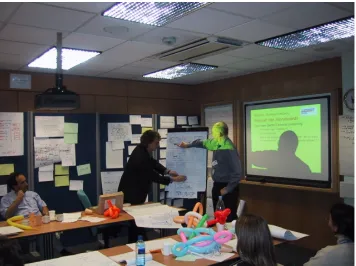
A relaxed atmosphere is maintained throughout each workshop. Figure 3 shows a scene from early in one of our workshops, shortly after a balloon modelling session, used to get participants into a playful frame of mind.
[image:4.595.121.477.424.690.2]Overview of previous workshops
The RESCUE team has so far facilitated 12 creativity workshops in the air traffic, policing and self-directed learning domains to discover and document future system requirements and design ideas. Three one-day workshops were held at Eurocontrol in 2001 to discover new requirements for CORA-2, a socio-technical system to support the resolution of conflicts between aircraft on collision courses (Maiden et al, 2004a). In 2002, two half-day workshops were run with the UK’s Police IT Organisation to discover new requirements and opportunities to exploit biometric technologies in policing (Pennell and Maiden, 2003). In 2003, one two-day creativity workshop was run with Eurocontrol to discover new requirements and ideas for DMAN, the departure management system for major European airports such as Heathrow and Charles de Gaulle (Maiden et al, 2004b). Three two-day workshops were also run to discover operational concepts and requirements for Eurocontrol’s new Multi-Sector Planning (MSP) system (Maiden and Robertson, 2005). In 2005, a 2-day workshop was run as part of the EASM project, aimed at developing an airspace management system to enable more effective and longer term planning of UK and European airspace use (Maiden et al, 2007). In 2006, we ran a 2 day workshop for the VANTAGE project, aimed at discovering requirements for a new system to reduce the environmental impact of aircraft movements at regional UK airports. Finally, in 2007, we ran a 2 day workshop for the APOSDLE, a large European project aimed at developing a self-directed learning environment for knowledge workers.
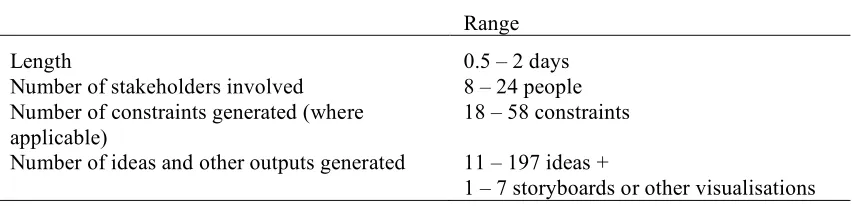
[image:5.595.85.511.431.534.2]Table 1 provides an overview of basic information relating to these workshops. Techniques we have used to stimulate creative thinking include brainstorming, constraint identification and removal, analogical reasoning with domains such as textile design, fusion cooking and music composition, and combinational creativity with random stimuli.
Table 1. Overview of RESCUE creativity workshops run to date
Range
Length 0.5 – 2 days
Number of stakeholders involved 8 – 24 people Number of constraints generated (where
applicable)
18 – 58 constraints
Number of ideas and other outputs generated 11 – 197 ideas +
1 – 7 storyboards or other visualisations
Evaluation of outcomes
After two of the more recent workshops (for EASM and APOSDLE), we have attempted to evaluate the creativity of ideas generated. Our interest, as requirements engineers, is in ideas which are novel to the project, or the domain in which we are working – somewhere in between what Boden (1998) defined as P-creative (i.e. novel with respect to the individual) and H-creative (novel with respect to the whole of previous history). We developed a simple framework to review each idea using two criteria derived from Sternberg’s (1999) definition of creativity as “the ability to produce work that is both novel (i.e. original, unexpected) and appropriate (i.e. useful, adaptive concerning task constraints)”. In (Maiden et al, 2007), we report how we worked with two EASM experts to review the novelty of ideas generated during the creativity workshop as well as their impact on the final requirements specification. 30% of the ideas generated during the workshop were seen as novel and 76% were judged to have had an impact on the specification. After the APOSDLE workshop, we asked all workshop participants to rate the ideas generated using the 4 different techniques employed during the workshop. On average 23% of all the ideas generated were rated as both novel and important, whereas 17% were rated as neither novel nor important.
Future work
Further experiments with creativity workshops
We are currently organising more creativity workshops with a view to investigating the effects of different media on the creativity of participants. In the past, we have used mainly physical artefacts in our creativity workshops - pens, paper, cards, scissors, string etc. We are now interested to investigate the possibilities afforded by digital tools and media (such as electronic whiteboards, software tools for modeling the pros and cons of alternative approaches to constraint removal, and online libraries of digital images), in terms of stimulating creativity in our workshops, over and above what physical tools can provide.
Stimulating creativity in scenario walkthroughs
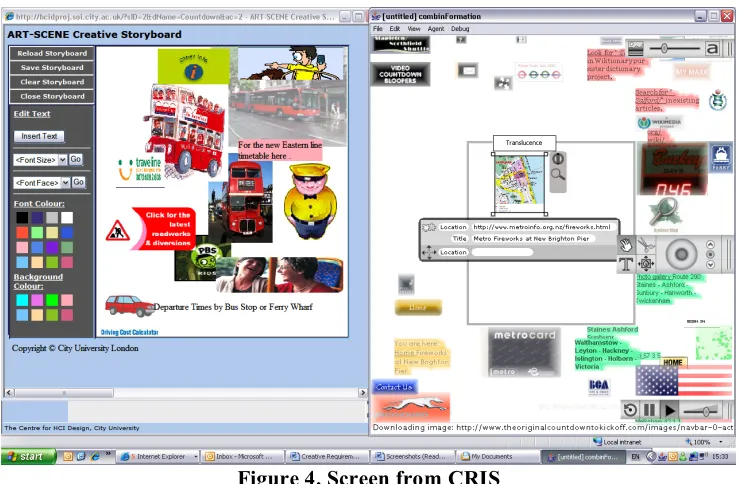
In addition to our experiments with creativity workshops, we have also begun an investigation into the effects of introducing creative stimuli into scenario walkthroughs carried out in the context of the RESCUE process. We have developed a tool called CRIS (Creative Requirements Innovation Space), which features a creative space that allows users to import images and text from anywhere on the web to create an “inspiration board”, using images or text that inspire users to think of new requirements, or just simply remind them of a requirement they knew of, but had not yet articulated. Figure 4 shows a screen from CRIS which includes creative stimuli generated by a tool called combinFormation
(http://ecologylab.cs.tamu.edu/combinFormation/) on the right, and on the left an inspiration
Figure 4. Screen from CRIS
References
Daupert, D., 2002, The Osborn-Parnes Creative Problem Solving manual. From
www.ideastream.com/create
Boden, M. A., 1998, ‘Creativity and artificial intelligence’ Artificial Intelligence, 103, 347 – 356.
Maiden N., Robertson S. & Gizikis A., 2004a, ‘Provoking Creativity: Imagine What Your Requirements Could be Like’, IEEE Software21(5), 68-75.
Maiden N.A.M., Manning S., Robertson S. and Greenwood J., 2004b, ‘Integrating Creativity Workshops into Structured Requirements Processes’, Proceedings of Designing
Interactive Systems (DIS 2004), Cambridge Mass, ACM Press, 113-122.
Maiden N.A.M. & Robertson S., 2005, ‘Integrating Creativity into Requirements Processes: Experiences with an Air Traffic Management System’, in Proceedings of the
International Symposium on Requirements Engineering (RE05), IEEE CS Press. Maiden N.A.M., Ncube, C. and Robertson, S., 2007, ‘Can Requirements Be Creative?
Experiences with an Enhanced Air Space Management System’, to appear in
Proceedings of the International Conference on Software Engineering (ICSE07), ACM Press.
Pennell L. & Maiden N.A.M., 2003, ‘Creating Requirements – Techniques and Experiences in the Policing Domain’, Proceedings of the International Workshop on Requirements Engineering Foundations for Software Quality (REFSQ’2003), June 2003, Velden Austria.
Poincare H., 1952, ‘Science and Hypothesis’, Dover Press.