City, University of London Institutional Repository
Citation
:
Simpson, A. (2008). Professional backup. Nursing Standard, 22(38), pp. 62-63. doi: 10.7748/ns2008.05.22.38.62.p4171This is the accepted version of the paper.
This version of the publication may differ from the final published
version.
Permanent repository link:
http://openaccess.city.ac.uk/7310/Link to published version
:
http://dx.doi.org/10.7748/ns2008.05.22.38.62.p4171Copyright and reuse:
City Research Online aims to make research
outputs of City, University of London available to a wider audience.
Copyright and Moral Rights remain with the author(s) and/or copyright
holders. URLs from City Research Online may be freely distributed and
linked to.
City Research Online: http://openaccess.city.ac.uk/ [email protected]
Simpson, A. (2008) Professional backup. Nursing Standard, 22(38), 62-63.
Mental Health Carers Alan Simpson Nursing Standard
Providing care for a friend or relative with mental health problems can have
significant impacts on family life and finances, on work and career
opportunities, on friendships and social relations, and on personal health and
wellbeing. But being a carer to a close relative or friend can also provide
positive experiences and elicit enormous personal rewards.
It is now recognised that carers play a key part in the lives of many people
with mental health difficulties. An extensive range of legislation, policies and
guidelines make clear the statutory requirement and expectation that mental
health staff should consider and address the needs of mental health carers as
an integral part of service delivery across all settings. Yet despite this, support
for mental health carers frequently remains low.
As a result, engaging with carers in practice or as a researcher can be an
emotional and challenging experience as carers often take the opportunity to
offload understandable anger and frustration at the challenges they have
faced while rarely being heard, understood or consulted by professional staff.
Around half the six million carers in the UK provide regular and substantial
support to a friend, partner or relative with a mental health problem or with
both mental and physical illness. Up to two million children provide care in the
family home, most of them unsupported. Most would benefit from information,
involvement and support.
Researchers at City University, London were commissioned by the Supporting
Carers Better Network, a project of the national charity Together: Working for
Wellbeing, to identify the content and design of an education and training
programme that would help mental health staff better address the needs of
Focus groups were conducted with various stakeholders, including carers,
carer support workers, service users, clinicians, managers and academic staff. Literature covering carers’ needs, experiences and perspectives, family
work, family therapy and psychosocial interventions was reviewed and a
survey of organisations providing health and social care education
undertaken.
The findings from this study provide a strong argument that a wide-ranging
and comprehensive education and training programme is required in order to
enable mental health staff to inform, involve and support families and carers
of people with mental health problems.
Education on the importance of working in partnership with families should be
provided to all mental health students and trainees throughout their
preregistration professional education. This education should be
supplemented with visits to and placements with families, carer support workers and carers’ centres and organisations.
Continuing professional development and post-registration training should
then be utilised to ensure that the mental health workforce is able and
motivated to ensure that all mental health services are family-friendly and
sensitive to the needs of families and carers, and able to provide intensive
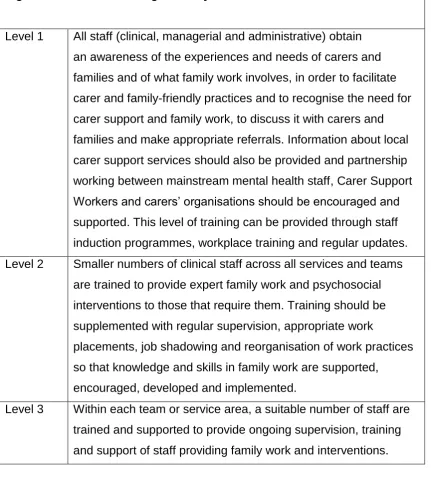
family work and interventions to those that require it. This requires three
different but interlinked levels of training (See Figure 1):
Carers, carer trainers, carers’ organisations, carer support workers and
mental health service users should all be involved in the design, delivery and
evaluation of any education and training, which needs to be underpinned by
The Ten Essential Shared Capabilities (Hope 2004). Training must address
the development and confident delivery of a range of communication skills
and information sharing identified within the study as central in supporting
Figure 1: Levels of training in family work
Level 1 All staff (clinical, managerial and administrative) obtain
an awareness of the experiences and needs of carers and
families and of what family work involves, in order to facilitate
carer and family-friendly practices and to recognise the need for
carer support and family work, to discuss it with carers and
families and make appropriate referrals. Information about local
carer support services should also be provided and partnership
working between mainstream mental health staff, Carer Support Workers and carers’ organisations should be encouraged and
supported. This level of training can be provided through staff
induction programmes, workplace training and regular updates.
Level 2 Smaller numbers of clinical staff across all services and teams
are trained to provide expert family work and psychosocial
interventions to those that require them. Training should be
supplemented with regular supervision, appropriate work
placements, job shadowing and reorganisation of work practices
so that knowledge and skills in family work are supported,
encouraged, developed and implemented.
Level 3 Within each team or service area, a suitable number of staff are
trained and supported to provide ongoing supervision, training
and support of staff providing family work and interventions.
However, there is ample evidence in the literature on training in family work
and psychosocial interventions that providing education and training alone is
insufficient to bring about lasting change in clinical practice. There are too
many barriers and restrictions to prevent all but the most determined of staff
to carve out a space in which to work with families.
strategy that includes explicit support throughout all levels of health and social
care organisations. Consequently, we have drawn on the experiences and
recommendations of successful programmes and projects to identify key
factors that help establish, develop and maintain family-focused services and
greater support for carers (see Figure 2).
Figure 2: Key structural factors required to establish, develop and
maintain family-focused services and greater support for carers
Establish a service users’ and carers’
forum
Establish a steering group and
detailed strategy for change
Appoint a credible, skilled person to
lead developments
Appraise the work priorities and
organisation of workload in teams Identify family work and carers’
‘champions’ within teams
Prepare and support senior and
middle managers to support changes
Establish good links between different
service areas, with carer support workers and carers’ organisations
Target GPs and primary health care
teams, so that staff are aware of
family and early intervention services
for people with mental health
problems, their families and carers Deliver a comprehensive education
and training programme and provide
regular supervision in family work
The full report with an extensive literature review, a summary of key
legislation and policies and accounts from carers and others can be
downloaded free from: http://www.citypsych.com/docs/Carersfinal.pdf
References:
Hope, R. (2004) The Ten Essential Shared Capabilities: A framework for the
whole of the mental health workforce. London: NIMHE.
Simpson, A. & Benn, L. (2007) Scoping exercise to inform the development of
a National Mental Health Carer Support Curriculum. London: City
Dr Alan Simpson is a research fellow and lecturer in City Community and
Health Sciences, City University, London.