Th e An t a e u s Colu m n* :
D igit a l libr a r ie s a nd t h e fu t u r e of t h e libr a r y pr ofe ssion .
D igit a l libr a r ie s a nd t h e fu t u r e of t h e libr a r y pr ofe ssion .
Abst r a ct
Purpose of t his paper To argue t hat unique cont em porary cult ural shift s are leading t o a new form of librar ianship t hat can be charact erised as ‘post m odern’ in nat ure, and t hat t his form of professional specialism w ill be increasingly influent ial in t he decades t o com e.
Design/ m et hodology/ approach A t heoret ical piece based on ideas from cult ural hist ory.
Findings That post m odern LI S concept s will be a vit al new st rand t o professional pract ice, but t hey w ill m ost likely subsist alongside m ore fam iliar concept s of pract ice w hich have proved readily applicable in t he early years of ‘first wave’ web t echnologies.
Research lim it at ions/ I m plicat ions
These are purely concept ual approaches t o library and inform at ion science and need t o be invest igat ed evident ially.
Pract ical im plicat ions The change from ‘first w ave’ web t echnologies t o Web 2.0 inform at ion t echnologies m ay have a great er im pact on fut ure t echniques in digit al librarianship t han t he change from print t o t he first elect ronic libr aries in t he 1990’s.
What is original/ value of t he paper?
This library and inform at ion science paper is
dist inct ive in t hat it borrow s original ideas from t he Hum anit ies t o offer an underst anding of LI S pract ice in t he cont ext of broad ‘cult ural t heory’, rat her t han in t he narrower cont ext of change in m echanical and t echnological processes.
Pa pe r t ype : Concept ual paper
Ke yw or ds: Libraries; librarianship; inform at ion services; hist ory; post m odernism .
I n t r odu ct ion
Library and inform at ion science ( LI S) pract it ioners are oft en asked whet her t he advent of digit al library t echnologies t hreat ens t heir professional exist ence. The w eary librar ian m ay w ell find it difficult t o respond polit ely – faced w it h t heir users’ im placable dem ands for great er t radit ional book provision, as w ell as t he t echnical com plexit ies of sat isfying t hose sam e users’ needs for elect ronic dat abases or digit al full t ext on t op of print , t he t hought of being t hrust int o early ret irem ent by a
com plet e aut om at ion of library services seem s t oo good t o be t rue. The easiest response is, ‘bring it on – and sooner rat her t han lat er! ’
Nevert heless, it ’s w ort h pausing in t he m idst of our fant asy of w elcom e, im m inent redundancy t o cont em plat e t he nat ure of t his perceived t hreat from digit al
t echnology. We can t hen perhaps respond m ore int elligent ly t o vague guesses about t he fut ure of t he profession from superficially engaged out siders.
Th e Libr a r ia n a s fa ile d com pu t e r
The essence of t he laym an’s percept ion of librarians is t o see us as ‘failed com put ers’. I n t his dism issive vision of t he librarian, w hat w e do is essent ially m echanical, and as t he m echanics of inform at ion t echnology get bet t er, so are t he skills of t radit ional librarians rendered ever m ore unnecessary. One day “ it ’ll all be on t he ‘net ’ ” and t he librarians w ill all be down at t he dole office, alongside t he lam p-light ers, draym en and blacksm it hs.
Thus far, how ever, t here is no such sign of com plet e and t ot al revolut ion. Print libr ary resources are st ill popular w hile digit al library services are in escalat ing dem and ( Joint , 2004) . And t hese newer services need t o be support ed by LI S professionals wit h specialised digit al library skills.
This is not t o deny t hat t here is an ebb and flow in t he librarian labour m arket – for exam ple, t here are t oday m any fewer print - based com pany libraries em ploying t radit ional special librarians. But in com pensat ion t here are now new post s for syst em s librarians, com pany inform at ion m anagers and knowledge m anagem ent gurus, all roles in w hich LI S pract it ioners can and do t hrive.
So t he idea t hat ‘When com put ers succeed, librarians m ust fail’ is nonsense.
Librarians are not failed com put ers. There are cert ain key com ponent s t hat rem ain in place in bot h t he t radit ional library and digit al library environm ent , which in t urn m eans t hat t he LI S profession has evolved across t he print - digit al div ide t o deal wit h t hose const ant , ongoing feat ures in t oday’s changed, largely hybrid inform at ion environm ent . These const ant s can be briefly described as follow s:
• Regardless of form at , inform at ion obj ect s ( books, j ournals, web pages, pdfs) do exist .
• They are describable.
• They are collect able and m ust be put int o ordered collect ions.
• They are preservable and need t o be preserved t o m aint ain t he cont inuit y of knowledge.
• These feat ures m ake t he library accessible.
Cu lt u r a l cha n ge ve r su s t e ch nologica l cha n ge
libr ary w hich is in fact m ore challenging t o t he values of t he profession t han t he argum ent t hat t echnical advances supersede hum an skills.
This view challenges us t o t hink of t he cont em porary inform at ion revolut ion in cult ural t erm s rat her t han t echnological t erm s. I f w e t hink back t o t he previous inform at ion revolut ion, w hen print ed t ext displaced t he m anuscript , t hen t he econom ics of ‘t he inform at ion indust ry’ did see a great deal of labour m arket
displacem ent . How ever, had t he ‘Financial Tim es’ run a Renaissance edit ion, it w ould have said t hat em ploym ent levels in t he inform at ion indust ry rem ained high, w it h opport unit ies in m oveable t ype print ing m opping up st ruct ural unem ploym ent in t he labour m arket for m anuscript clerks. So in a sense, one form of hum an im pact of a revolut ionar y, but purely t echnical change, w as rat her lim it ed.
By cont rast , t he higher level im pact of changed inform at ion t echnology on Medieval-Renaissance cult ure was seism ic. Megabyt es of profound t ext ual analysis have chart ed t he w ay in which w ider access t o t he print ed Bible in m ore readily available t ranslat ions m eant t hat t he fait hful individual could decide t heir t heology for
t hem selves, in a direct personal dialogue w it h God w hich w as firm ly Biblical in it s aut horit y.
This is not t he place t o provide a brief chronicle of t he rise of print , Prot est ant ism and t he birt h of capit alism . But a sim plist ic rehearsal of t he com m onplaces of Medieval- Renaissance hist ory does give a hint of how t o view cont em porary digit al libr ary change. That is, not as a change in m echanical and t echnological processes, but as a fundam ent al change in social beliefs, viewed in t erm s of bot h cult ural t heory and cult ural pract ices.
Ch a n ge m a na ge m e nt
I t is a t ruism t o st at e t hat t echnological change m akes new t hings possible and old t hings no longer possible. The m ore difficult challenge is t o m ake value j udgem ent s about t he nat ure of t hese changes, saying whet her what is lost was bet t er t han what replaces it , and vice versa. A devout Rom an Cat holic t heocrat living during t he Count er Reform at ion w ill probably have view ed new inform at ion t echnology as a failure in religious- hum an t erm s, while grudgingly acknow ledging it s success in narrowly t echnical t erm s. The m ost im port ant j udgem ent rem ains hum an and cult ural. I f one believes t hat a t echnological im provem ent has led t o t he splint ering of t he t rue Church and t he wider prevalence of sin, t hen one m ust believe t hat t hat new t echnology has failed in every im port ant sense.
The next st ep in t his argum ent is t hus t o challenge t he rat her com placent and self-congrat ulat ory view of t he digit al librarian who sees t heir successful creat ion of a new digit al library in t he im age of t he old print libr ary, as a t rium ph of change m anagem ent . By cont rast , in m any w ays such ‘facsim ile’ digit al librar ies are m er ely reincarnat ions of old m edia, repressing t he int rinsic nat ure of new digit al m edia in order t o m ake change m anageable. I n t his vision of I T change, digit al librarians are like effect iv e Count er Reform at ion Jesuit s, w it h Cranm er’s Prayer Book unprint ed and unpublished, and Henry Tudor st ill happily undivorced. But w e have t o ask, for how m uch longer is such a st at us quo preservable?
Th e in t e r im digit a l libr a r y
This school of t hought sees t he cont em porary digit al librar y as j ust an int erim
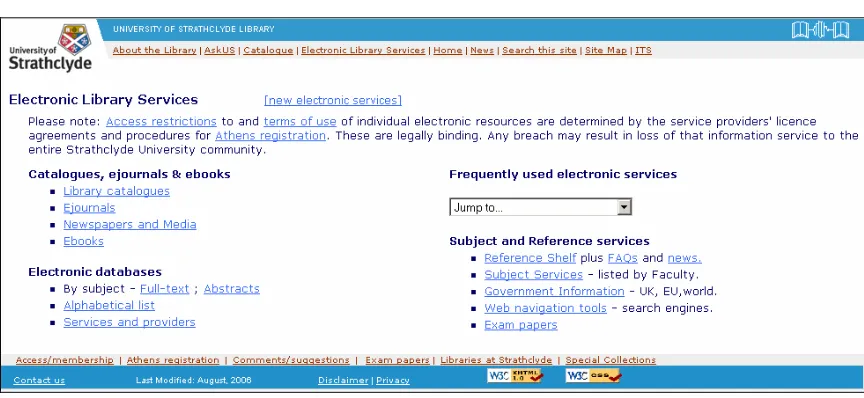
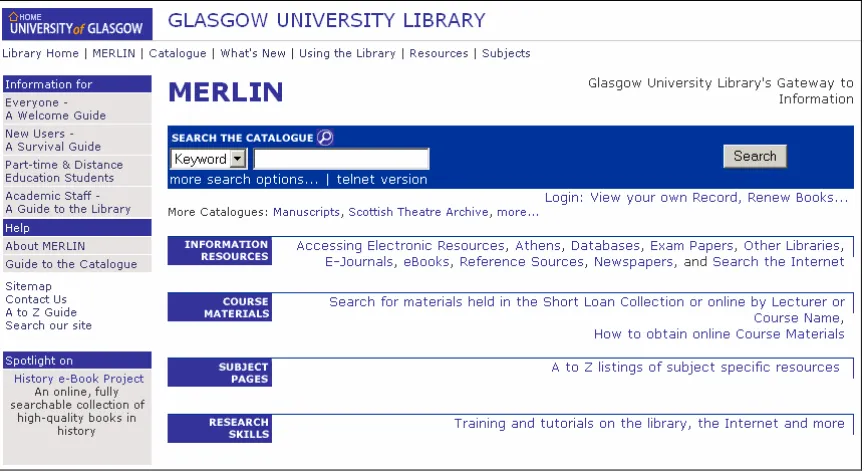
int erim digit al library ar e reproduced below ( see Appendix) – each is a collect ion of services t hat are closely m odelled on t he t radit ional print library. The bibliographic form s are t he sam e ( books and j ournals) : t hey j ust have an “ e- ” in front of t hem . The t ools used t o find t hem are t he sam e ( cat alogues) : t hey j ust have t he word “ online” in front of t hem . Som e t hings are significant ly different : alt hough each t ext ual docum ent has a classificat ion num ber, t his does not m echanise t he ret rieval of t he t ext – you don’t have t o go t o a shelf locat ion t o find t he inform at ion obj ect . The obj ect is pulled t hrough t he hyperlink ont o t he screen. So it ’s ‘t he sam e old sam e old’, but fast er. However, we really m ove back t o t he past when we see t he full t ext on t he screen – it ’s m ore oft en t han not a pdf, an exact facsim ile of t he print original, like a fly preserved in am ber.
The cult ural t heorist s who crit icise t his int erim digit al librar y m odel point out t hat t he use of print libr ary devices for a non- print m edium service is hardly designed t o ext ract t he m axim um value inherent in t he new m edium . Digit al inform at ion is not t he sam e as print inform at ion – init ially it ’s quit e helpful t o pret end t hat it is, because t he t wo can be seen as sim ilar and we can fam iliarise ourselves wit h t he new by reusing old m odels. But sim ilar is not t he sam e – and t he m ost int erest ing aspect s of any new t echnology are t he aspect s w hich are dissim ilar from w hat w ent before.
So t he cult ural crit ics of t he int erim digit al library see it as a based on a m et aphor derived from past m odels of inform at ion use, a m et aphor applied slavishly and lit erally t o m ake a new m edium usable in it s early days. I t is like t he first t elevision new s broadcast s, which consist ed of a single t alking head in a dinner suit gazing fixedly int o a cam era, reading a script . These program m es were reusing t he m ent al im age of what a radio broadcast was – a voice reading int o a m icrophone. Aft er a w hile it becam e clear t hat a radio broadcast was not lit erally t he sam e as a t elevision new s broadcast . Having t hrow n off t he inherent lim it at ions of t he radio m et aphor, t he way was open t o achieve t he visual cornucopia of a present - day news broadcast , in w hich t he t alking head serves m erely as punct uat ion t o t he t ot alit y of t he
inform at ion flow .
I n t he eyes of cult ural t heorist s, t his aspect of t he ‘provisionalit y’ of t he int erim digit al librar y is quit e forgivable. None of us is clever enough im m ediat ely t o underst and t he new on it s own t erm s, and it ’s pract ical t o use old not ions t o m ake init ial sense of new t hings. How ever, what is less forgivable is w hen conservat ive professions insist on lim it ed im plem ent at ions of new t echnologies because t o exceed t hese lim it at ions w ould in som e w ay loosen t heir cont rol of an est ablished and ent renched sit uat ion.
So, in t his crit ique, t he com m ercial publisher and digit al librarian act in an unholy alliance t o keep t he digit al library m odel close t o t he print library m odel. Tradit ional inform at ion obj ect s m ust be cont inued because t hey are discret e, ownable and t radeable: t he art icle, t he chapt er, t he j ournal, t he book. I f necessary, digit al right s m anagem ent soft w are should be added t o keep t he usabilit y of t he inform at ion obj ect exact ly in line wit h t he usabilit y of t he t radit ional print inform at ion obj ect . Again, t here are good reasons for t his. I n t he post - m anufact uring knowledge
econom y, a fair ret urn for one’s int ellect ual propert y has never been m ore im por t ant , or et hically j ust ifiable, even t hough I P m ay now be largely virt ual in nat ure.
inform at ion obj ect is const rained. Sim ilarly, libr arians see an inform at ion obj ect t hat exist s j ust as previous obj ect s have done, t hat is describable j ust like previous obj ect s, and t hat is st orable and preservable in t he sam e w ay t oo. Or so w e t hink.
Th e Five t h e se s of Lou gh bor ough ?
I t seem s as if t he int erim digit al library m ay be nearing it s ‘Mart in Lut her’ m om ent , t he m om ent when som eone nails a set of t heses in prot est t o a virt ual door, in order t o overt urn t he conservat ive prem ises underlying digit al library services. I t ’s quit e likely in fact t hat a num ber of us are undergoing our ow n m ini- Mart in Lut her m om ent s at present .
I n t he Sum m er of 2006, a workshop at t he eLit conference in Loughborough on t he cult ural im pact of m obile com m unicat ion t echnologies, led by John Traxler of Wolverham pt on Universit y had a few such m om ent s ( Traxler, 2006) . Much of t he w orkshop was concerned w it h t he enum erat ion of t he new educat ional and social benefit s of m obile t echnologies, but t he librar ians am ongst t he workshop were quick t o point out t he downsides. Undoubt edly t he t ake- up of m obile com m unicat ion devices has led t o new form s of group ident it y, new t ypes of social knowledge being const ruct ed, and in a universit y cont ext , could creat e an ideal const ruct ivist learning environm ent w it h few of t he form al const raint s of t radit ional, physical learning spaces.
The problem for t he librarians at t he w orkshop w as t hat t his new , socially
const ruct ed learning didn’t look m uch like a t radit ional short loan collect ion. And w e m ade it clear t hat t his wasn’t j ust a problem for t he librarians faced by rows of em pt y short loan shelves – in what sense did t hese new socially dynam ic learning environm ent s creat e knowledge t hat was usable as a sequence of discret e obj ect s, which could be described, cont ained and preserved? The idea behind t his librar ian challenge was not sim ply t o say, ‘What do we do wit h t hese learning environm ent s?’, but also t o say, ‘What do you, t he inform at ion producers and users, do in t erm s of accessing learning m at erials w hen you creat e but do not describe, cont ain and cont rol t he out put s of such environm ent s?’
So, t he libr arians present wished t o em phasise t o t he m obile t echnologist s t he dangers of losing cert ain key t radit ional st rengt hs of our academ ic cult ure: t he st oring, cont inuit y and shareabilit y of learnt know ledge. Unfort unat ely for t he
libr arians, t he cult ural t heorist s of m obile educat ional t echnology w ere not w orried:
‘I n a post m odern cult ure, t he grand cont inuous sequence of a single, m onolit hic narrat ive of know ledge and learning m ay sim ply be lost . Or it m ay not . Just don’t w orry about it t oo m uch. We’ll have t o see.’
This w as follow ed by a perplexed silence from t he librar ians in t he w orkshop.
Th e ne w digit a l libr a r y
To sum up t herefore, t he proponent s of a new digit al order radically at variance w it h t he old print - based order would say t hat t he five definit ive feat ures of t he new m odel are as follows:
• There are no t radit ional inform at ion obj ect s on t he int ernet wit h det erm inat e form at s or det erm inat e qualit ies: t he only inform at ion obj ect and inform at ion form at on t he int ernet is ‘ephem era’.
• A hypert ext collect ion cannot be select ively collect ed because each inform at ion obj ect is infinit e and infinit y cannot be cont ained.
• The problem of digit al preservat ion is like clim at e change: it is m an- m ade and irreversible, and m eans t hat m uch digit al dat a is ephem er al; but unlike
clim at e change, it is not necessarily cat ast rophic.
• Thus, t here is no such t hing as a t radit ional library in a post m odern world. Post m odern inform at ion set s are j ust as accessible as t radit ional librar ies, but wit hout possessing any of t he t radit ional feat ures of a library: t here are no form at s, no descript ions, no hope of collect ion m anagem ent , no realist ic possibilit y of preservat ion. And t hey w ork fine.
What evidence leads som e t hinkers t o t his very ext rem e view of t he digit al inform at ion order? There m ust be com pelling reasons t o dism iss so m uch digit al libr ary provision as no m ore t han t em porary and based on nost algic, derivat ive print libr ary m odels? Here is a sum m ary of t his case against t radit ion and t he t radit ional role of t he librarian, as enunciat ed by an im agined single voice t hreading t oget her t he post m odern argum ent s of t he eLit 2006 workshop:
The im possibilit y of form at s
“ First ly, t he applicat ion of bibliographic form at s t o digit al resources doesn’t really w ork. Cert ainly, a pdf facsim ile of an original can be described in t hose t erm s, but users don’t like pdfs. Wherever an alt ernat ive choice of pdf and ht m l is given for a full t ext download, st at ist ics show t hat users prefer t he ht m l. Pdfs are t oo big t o be easily usable, and m ost of t heir cum bersom e size is caused by t he need t o replicat e t he print original. Ht m l is bet t er com pressed, and doesn’t look like a print original. I t hint s at t he real nat ure of t he web, as som et hing free from const raint by print equivalent s.
“ Furt herm ore, m ost bibliographic form at t ypes are m et aphors, not lit eral form at t ypes. The very t erm , ‘web page’ is a m et aphor. A page is a det erm inat e physical t hing, wit h each page in a book being like every ot her page. A web page can be any size you like, even wit hin t he sam e web sit e. Moreover, apart from not having a set physical ext ent , it doesn’t have a set inform at ional cont ent eit her. I t ’s hypert ext ual, so it s cont ent invokes t he cont ent of ot her pages, which becom e part of t he sam e page. I n t hat sense t he w hole int ernet is a single inform at ion obj ect wit h a single page. What sort of bibliographic form at analysis can subdivide it ? Only one w hich dist ort s t he nat ure of t he obj ect it analyses. Not m uch of an analysis t hen, is it ?
“ Bibliographic form at descript ions also rely on inform at ion obj ect s having qualit ies. Most set qualit ies in a w eb page don’t t ell you anyt hing very useful. The quant it at ive descript ive dat a such as print paginat ion and size don’t have equivalent s. A web sit e can be subdivided int o varying page num bers, but know ing t he num ber of t hem doesn’t help you grasp t he nat ure of t he sit e or help you m anage t he cont ainm ent or preservat ion of t he sit e ( how m any pages are t here in a dat abase- driven web sit e? Who cares?) . Even t he quant it y of byt es of a digit al inform at ion obj ect ’s file size are of quest ionable value – you can recom press t he file a num ber of t im es over for w hat ever t echnical reason, t hus changing it s file size t ot ally, and it m ay or m ay not affect t he value of t he obj ect as an inform at ion resource, alt hough a dat a st orage m anager m ight be grat eful for knowing such fact s about t he dat a.
“ The im possibilit y of bibliographic descript ion
when you t ry and cat alogue, say, t he BBC w eb sit e in t erm s of MARC fields like 100/ aut hor, 245/ t it le, 260/ publisher? Well, t he aut hor of t he whole sit e has t o be t he BBC, since web pages can be effect ively anonym ous at t he page level. What does t ext enclosed by t he t it le t ags in t he head of t he hom e page say? The t it le is ‘The BBC’. Ok, well let ’s add t he publisher det ails – it looks like t he BBC published it t oo. So you have t hree dist inct fields each wit h t he sam e indist inguishable m et adat a cont ent in it . I n what sense is t hat creat ing a usable and inform at ive cat alogue record? Not all t he web sit es you want t o describe are as difficult as t his, but
cat aloguing st andards have t o fit everyt hing or not hing – you cannot have a st ore of inform at ion w here som e cont ent is cat alogued rat her m eaninglessly and ot her dat a is cat alogued broadly in line w it h t radit ional norm s.
“ The im possibilit y of collect ion m anagem ent
“ The highest level of collect ion m anagem ent is t he legal deposit collect ion of a
nat ional libr ary service. I t is at t his level t hat t he com m it m ent of a nat ional cult ure t o t he com prehensive aggregat ion of t he t ot alit y of it s inform at ion obj ect s has t o be m easured. How ever, t he digit al nat ional out put of any count ry t hat flow s ont o t he int ernet is beyond com prehensive collect ion, for a num ber of reasons. At any one t im e, t he m ass of inform at ion defies collect ion, so t hat a represent at ive sam ple has t o be t aken. And even w it hin t hat represent at ive sam ple, t he const ant changing and updat ing of a web sit e m eans t hat it can only be sam pled across t im e at
represent at ive int ervals.
“ So it ’s quit e possible t hat t he wrong m at erial will be select ed, m at erial t hat is not t ruly represent at ive of t he st at e of t he nat ional int ernet at t he t im e. And t he select ive nat ure of snap- shot s t hrough t im e also leads t o dist ort ion. The idea of a subj ect ively select ive nat ional elect ronic deposit collect ion is at variance wit h t he ent ire t radit ion of obj ect ive, com prehensive legal deposit collect ions.
“ Above all, hypert ext cannot be select ively st ored. Each hyperlink refers t o ot her m at erial w hich has t o be archived w it h t he referring m at erial - ot herw ise you end up w it h a com prehensive collect ion of ‘linkrot ’. The only select ive hypert ext ual collect ion w hich w ill m ake sense t hrough t im e is one which includes and m aint ains all t he hypert ext in t he world.
“ The im possibilit y of digit al preservat ion
Even if one could collect t he whole int ernet , could one preserve it ? The st ory t o dat e of digit al preservat ion is not opt im ist ic. Think of t he hubrist ic creat ion of t he BBC’s Dom esday Book video disks t owards t he end of t he Twent iet h Cent ury ( B.B.C., 2002) . These video disks at t em pt ed t o do for t he present what William t he
Conqueror’s records of his new ly acquired kingdom did for t he 11t h cent ury, creat e a com prehensive pict ure of life in t he UK, but one t hat w ould last longer t han t he t housand years of t he Anglo- Norm an original.
“ However, t hese BBC disks were t o digit al preservat ion what t he Tit anic was t o m arit im e engineering. Just as t he unsinkable ship sank on it s m aiden voyage, so did t he ult im at e digit al account of t he Brit ish nat ion expire w it h t he out m oded
t echnology t hat support ed it . The lifespan in years of t hese disks never even m ade it int o double figures.
I t em s such as Medline ( t hat is, I ndex Medicus t ransform ed int o a digit al obj ect ) have survived as large, dist inct inform at ion ent it ies w it h an unbroken t hread of digit al cont ent t hat m eans t he sam e as it did when first creat ed. The cost s t hat have been ploughed int o t he reinvent ion of plat form s for such dat abases are quit e st aggering. I t would be prohibit ive for such resources t o be spent on anyt hing ot her t han a few core digit al collect ions t hat really defined our hist ory and cult ure.”
M ode r n ism a n d post m ode r n ism
So where does t hat leave us wit h t he fut ure of librar ianship?
The idea of t he post m odern digit al library is clearly very different from t he int erim digit al library. I t t akes m any of t he problem s t hat t hreat en t he cohesion of t he int erim digit al library and says t hat t hese are not problem s, t hey are evidence of a change in t he nat ure of our cult ure, which is based on t echnologies w hich sim ply facilit at e cult ural act ivit y in a different way. The m ist ake is t o t ry and m ake t hese new cult ural out put s look like t he old ones. I f we do t ry and m ake t he new resem ble t he old, w e w ill be m issing t he point .
The int erim digit al library t hus bears t he sam e relat ionship t o t he open digit al net works of t he int ernet t hat m odernist cult ure does t o post m odern cult ure. Modernist cult ure w as and is ‘dual’ in nat ure: on t he one hand it is apparent ly radical, but on t he ot her it rem ains deeply conservat ive and ordered under it s shocking veneer. I t s surface reflect s cont em porary chaos, but it s deeper st ruct ure unifies and orders t he fragm ent at ion. Definit ive m odernist w orks such as Joyce’s ‘Ulysses’, T.S. Eliot ’s ‘The Wast e Land’, or Schoenberg’s discordant piano pieces, all creat ed an im pression of t he ult ra- avant - garde, while cherishing a deeper st ruct ure based on wholly t radit ional principles ( ‘Ulysses’ uses Classical m yt hology, ‘The Wast e Land’ sacram ent al Christ ian grail m yt hs, and Schoenberg’s harm onic rigour is
ent irely derived from Haydn and Mozart ) . Modernism wasn’t t hat m odern at all really, despit e it s apparent claim t o be a t ot ally new depart ure from previous cult ural form s.
Sim ilar ly, t he m odernness of t he int erim digit al libr ary isn’t t hat cut t ing edge at all really. Under it s avant - garde elect r onic veneer lie t he ordering principles of t he print library, despit e claim s t hat it s digit al form at s are a radically new inform at ion t ype. The t rue digit al library w ill be a post m odern library, one in which what you see is w hat you get : a consist ent accept ance of sm all scale, inoffensively unordered form s, wit hout cum bersom e big st ruct ures. The t rue nat ure of t he post m odern inform at ion order is even now not clear t o us, but it seem s t o be t he dynam ic behind phenom ena such as Web 2.0, in w hich int eract ive t ools such as Skype, YouTube and MySpace* facilit at e social net working, and t he anarchic st orage and unrest rained dist ribut ion of cont ent , bot h legal and possibly illegal, predom inat e.
Th e ne w m e die v a lism
One way of t rying t o charact erise t he nat ure of a post m odern inform at ion order is t o see it as, in som e w ays, a ret urn t o a m edieval, pre- renaissance m odel of cult ural product ivit y and underst anding. The t it le of Paul Maharg’s w ork, “ ‘Borne back ceaselessly int o t he past ’: Glossa, hypert ext and t he fut ure of legal educat ion” ( Maharg, 2006) m akes t he link bet ween digit al inform at ion t echnology and m edieval educat ional t echnology explicit , albeit t ent at ively:
“ I f hypert ext can seem t o exem plify m any aspect s of t he glossed lit erat ure of t he t hirt eent h cent ury, t he analogy bet ween m edieval page and w ireless w eb m ust surely be a t enuous one. And yet I am not sure t hat t his is t he case. “
Unt il t he out lines of post m odern cult ural form s becom e m ore dist inct , t he best one can do is suggest t enuous parallels. So it is im port ant t o be careful: t he t em pt at ion t o com pare t he pre- Renaissance and t he post m odern m ay be caused by our
desperat ion t o find a previous period very different from our own t hat can give us insight int o t he new and equally dist inct period t hat w e are glim psing on t he horizon. The fut ure and t he past have always been seen as different from t he present , but t hat hardly m akes t hem equivalent .
So w hat real parallels can we suggest bet ween t he post m odern and t he pre-Renaissance fram e of m ind?
I f we are convinced of t he im possibilit y of digit al preservat ion, t hen t he fact t hat we have a t enuous hold on our ‘collect ions’ creat es a sense of insecurit y and
evanescence. The sense of t he fragilit y of t he world’s glories and t he im m inent loss of eart hly possessions at t he Day of Judgem ent - including t he disappearance of docum ent ed know ledge and any cont inuit y of a t ext - based civilisat ion - seem s bot h definit ively m edieval and represent at ively post m odern.
When evanescent , cult ure becom es geographically dist inct as w ell as t em porary. I t isn’t around long enough t o becom e pervasive, but don’t worry about t hat – t he t rue post m odernist know s t hat ‘localness’ is everyt hing. I n j ust t he sam e way, m uch m edieval cult ural out put w as int ended for local consum pt ion because t he indust rial t echnology t o spread ident ical docum ent sim ulacra of t hat out put int o a ‘nat ional m arket ’ did not exist . Having w rit t en m usic for use in one place, such as t he local cat hedral of his local archbishop, t he m edieval com poser accept ed t hat t he audience for such divine com posit ion w as lim it ed t o t he congregat ion and clergy.
Above all, cult ure w as fundam ent ally oral and socially com m unicat ed: low levels of lit eracy and t he cost of docum ent s and t ext s m eant t hat t he closest t he devout would com e t o t he word of God was t o hear it rat her t han t o read it . Theology w as serm onised and verbalised from t he pulpit , t hen com m it t ed t o m em ory. I n such an oral cult ure, t he definit iveness of t he writ t en t ext crum bles and each t ext becom es a unique ent it y, individually or socially recreat ed in t he repeat ed act of consum pt ion.
Perhaps t his t oo is a feat ure of post m odern cult ure and learning. The argum ent t hat our m edia- based cult ure is essent ially oral not w rit t en, and t hat t he prim acy of t he w rit t en w ord is giving w ay t o a new ‘oralit y’ – t hat is, t o t he speech of act ors, present ers and broadcast ers on screen rat her t han t he serm onising of priest s - creat es som e sort of clear parallel wit h t he pre- Gut enberg era of oral Christ ian cult ure. The penet rat ion of st ream ing video and w eb- cast ing int o t he educat ional sphere is sim ply a recognit ion of t his cult ural shift : if a new generat ion possesses great er m edia lit eracy t han print lit eracy, such an evolut ion is not int rinsically ant i-educat ional. Rat her, it is a revival of t he older cult ural t radit ions which w ere rem arkably enduring and successful. However, an essent ial aspect of such oral cult ure is t hat m uch of it is t ransit ory, because of it s undocum ent ed nat ure.
Th e im pa ct on LI S pr a ct ice
collect and organise t he ent ire docum ent ed out put of our cult ure. I f t he argum ent s above have som e t rut h ( t hough not necessarily com plet e validit y) m uch of our professional effort s t o im pose a realist - m odernist m odel on our library pract ice will fail.
Thus, at t em pt s t o creat e an elect ronic equivalent t o print legal deposit w ill be doom ed t o failure in som e fundam ent al sense. I f elect ronic deposit is legally
com pulsory, t hen t he nat ional elect ronic library w ill face unsolvable conundrum s such as t hose list ed above under t he sect ion ‘t he im possibilit y of collect ion m anagem ent ’. These can be put int o very specific det ail. For exam ple, for a virt ual nat ional deposit syst em t o work well t here m ust be a law of elect ronic legal deposit . Such a law m ust be in harm ony w it h exist ing copyright law , and, in t he UK, m ust conform t o t he dem ands of m oral right s legislat ion, which says t hat t he int egrit y of t he original m ust be preserved.
For t he int egrit y of an original w eb sit e t o be preserved, t he hyperlinks m ust be preserved. But t o preserve t he hyperlinks accurat ely, t he whole w eb of links which t he original w eb sit e invokes m ust be preserved, w hich, we have not ed, is an infinit ely ex panding pract ical im possibilit y. So t he int egrit y of t he original m ust be sacrificed in order t o give t he fut ure som e idea of what t he docum ent ed digit al past was like. This clear ly breaches t he m oral r ight s of t he aut hor of t he w eb sit e t hat is t o be deposit ed.
But how can a law of com pulsory legal deposit t hen com pel t he com m issioning of illegal act s ( breaches of m oral right s) ? A law of legal elect r onic deposit is t hen like a nat ional law t hat com pels cit izens t o drive fast er t han t he legal speed lim it or t o sm oke illegal drugs. I t is self- cont radict ory and im possible, because it is an
im posit ion of a form of LI S pract ice from an old m odel of cult ural product ivit y ont o a fundam ent ally new one, where know ledge is cont ingent , evolut ionary and evasive. This old LI S m odel needs t o be ‘re- t heorised’, j ust as Newt onian Physics had t o evolve int o Quant um Theory, in recognit ion of t he fact t hat super- sm all part icles sim ply w eren’t physically locat ed where New t onian Physics said t hey should be!
Even at t he level of libr ary design, t here are lessons for us t o learn in const ruct ing new buildings against t his background of cult ural shift . I f w e accept t hat learning is increasingly socially const ruct ed, t hen a library space t hat is a good learning space has t o recognise t his fact . So w e have t o t hink long and hard about what const it ut es a good post m odern libr ary archit ect ure. The t hinking behind a post m odern st ruct ure such as t he Salt ir e Cent re at Glasgow Caledonian Universit y ( Wat son, 2006) gives us som e good insight s int o t he way t he pract ical m at t er of library- learning- space can be handled in a cont em porary Universit y. We have t o build library buildings t hat m ake sense in t erm s of st at em ent s such as:
“ all learning is conversat ion”
“ t hinking is not hing but t alking t o yourself inside”
“ t he ent ire cam pus is an int eract ive, social learning ( or research) device,”
all of which underline how post m odern academ ic discourse is bot h a lit eral and m et aphorical ret urn t o a seem ingly out dat ed form of oral cult ure.
knowledge – t he researcher sim ply const ruct s t heir knowledge at a different level of sophist icat ion and originalit y. A building w hich facilit at es t his process m ay need less space for t he cont ainm ent of st ock and m ore space for t he act of learning – m eaning t hat it m ay not be t hat m uch of a t radit ional library at all.
Con clu sion
At a t im e of large scale change, it is reassuring t o use big ideas t o give ‘t ot al’ explanat ions of where we are heading as a profession. However, realit y is very unforgiving t o big ideas, and t ends t o blunt t heir clean out lines w it h t he hard edges of everyday fact .
So it would be foolhardy t o abandon t he cherished t enet s of an est ablished vocat ional m indset t o charge off in pursuit of revolut ionary new visions of
professional pract ice. Nevert heless, t he purist not ion of a new form of cult ure, based on int ernet - based digit al t echnologies, and quit e different from what has preceded it is a pow erful one, w it h im port ant lessons for t he w ay inform at ion professionals underst and t heir present and fut ure roles.
I t is doubt ful w het her any of us is w illing t o accept t he idea of a new cult ure t hat is based on t he idea of perpet ual am nesia. I t m ay have been valid for a m edieval craft sm an t o creat e beaut iful finishes on cat hedrals which t he congregat ion could not see in t he know ledge t hat only t hey and God could appreciat e t hem . I f all such art ist ry is t ransient and unknow able t o t he m aj orit y of hum ankind, t hen t he fact t hat an all- seeing and all- know ing deit y w ill appreciat e and et ernally preserve a
t ranscendent m em ory of one’s work is am ple consolat ion ( m aking divinit y perhaps t he ult im at e virt ual reposit ory?)
However, t he post m odern age is one denuded of such m et aphysical beliefs, and t he m ost im port ant m ot ivat ion for creat ivit y and t he generat ion of know ledge is hum an-cent red: we creat e so t hat one’s int ellect ual propert y can be appreciat ed by as m any people as possible, This m ust also involve consum pt ion by t hose who follow us, w hich in t urn im plies t hat t he concept of social m em ory is indispensable. Hum an recept ion rat her t han divine recept ion m at t ers above all ( and heavenly rat es of ret urn on digit al right s are dist inct ly t oo int angible for m ost of us! ) .
So if t he biggest challenge for t he fut ure of t he LI S profession is not t he digit al libr ary t hat is a facsim ile of t he print , but t he new digit al order, wit h it s social
soft ware, int eract ive net works, and free- wheeling at t it ude t o st orage and dist ribut ion of cont ent , t hen w e have a lot of t hinking t o do. For so m uch of t he m om ent um behind virt ual learning focuses on using such t echnologies in t he service of t radit ional learning, w e can hardly ignore w hat is going on before our very eyes.
The t ask for librar ians is t o acknowledge t he academ ic significance of leaning
environm ent s such as Ardcalloch ( Maharg, 2004) , which creat e a virt ual sim ulat ion of t he w orld of legal pract ice in which know ledge is assem bled t hrough experience, but like a law yer’s day t o day experience can be lost t he m om ent t he experience ceases. As one LI S analyst of post m odern inform at ion problem s has said,
“ you need t o have a st rat egy w hich is flexible … t he post m odern world is a world of const ant change. Resources can appear and disappear wit h
So t he m odern librar ian can rest assured of t he place of t heir facsim ile digit al library for t he t im e being, but w e now have t o look for volunt eers t o rise t o t he challenge of post m odern librar ianship. I s anyone w illing t o st ep forw ard?
Nicholas Joint
Cent re for Digit al Library Research/ Andersonian Library
Universit y of St rat hclyde.
*N ot e s
Skype. < ht t p: / / w w w .skype.com / int l/ en- gb/ > ( accessed 9/ 10/ 2006)
YouTube. < ht t p: / / www.yout ube.com / > ( accessed 9/ 10/ 2006)
MySpace. < ht t p: / / www.m yspace.com / > ( accessed 9/ 10/ 2006)
Re fe r e n ce s
Ardcalloch w ebsit e ( 2006) .
< ht t p: / / ww w.ardcalloch.ggsl.st rat h.ac.uk/ int roduct ion/ > ( accessed 9/ 10/ 2006)
B.B.C. ( 2002) Digit al Dom esday book unlocked.
< ht t p: / / new s.bbc.co.uk/ 1/ hi/ t echnology/ 2534391.st m > ( accessed 9/ 10/ 2006)
Eliot , T.S. ( 1922) The Wast e Land. I n: The Crit er ion: a Quart erly Review. London: Cobden Sanderson Lim it ed, 1922 - . ( Reprint ed: London: Faber and Faber, 1967)
Joint , N. ( 2004) Use of t radit ional print collect ions is declining, so m any people say... ( Edit orial) Library Review 53: 6 pp. 295- 296.
Joyce, Jam es ( 1922) Ulysses. Paris: Shakespeare and Com pany.
Lut her, Mart in. ( 1517?) [ Disput at ions: t he Ninet y Five Theses of Mart in Lut her] Disput at io D. Mart ini Lut her Theologi, pro declarat ione virt ut is indulgent iarum . ( M.D.XVI I .) . Wit t enberg? [ English t ranslat ion at : ]
< ht t p: / / www.gut enberg.org/ et ext / 274 > ( accessed 9/ 10/ 2006)
Maharg, Paul. ( 2004) Virt ual firm s: t ransact ional learning on t he web. The Journal of t he Law Societ y of Scot land.
< ht t p: / / www.j ournalonline.co.uk/ art icle/ 1001154.aspx > ( accessed 9/ 10/ 2006)
Maharg, Paul. ( 2006) 'Borne back ceaselessly int o t he past ’: Glossa, hypert ext and t he fut ure of legal educat ion. Paper present ed t o t he Brit ish and I rish Law, Educat ion and Technology Associat ion ( BI LETA) Conference, 2006.
< ht t p: / / zeugm a.t ypepad.com / Maharg_BI LETA_art icle_2006.doc > ( accessed 9/ 10/ 2006)
Oddy, Pat ( 1997) Who dares, wins: librar ies and cat alogues for a post m odern world. Library Review 46: 5 pp. 307 – 317.
Schoenberg, Arnold. ( 1911- 1931) Klavierst ücke, op 19, op 23, op 25, op 33a & 33b. I n: Säm t liche Werke ( Mainz, 1966–)
< ht t p: / / w w w .usc.edu/ libraries/ archives/ schoenberg/ asi.ht m > ( accessed 9/ 10/ 2006)
Traxler, John [ Chair] ( 2006) Lit eracies for t he inform at ion m obile societ y: Mobile t echnologies ( Round t able discussion: eLit 2006 conference, Universit y of
Loughborough)
< ht t p: / / www.lboro.ac.uk/ library/ eLit 2006/ parallelsessions.ht m l# session4 > ( accessed 9/ 10/ 2006)
Wat son, L. ( 2006) Designing learning spaces for t he 21st cent ury ( present at ion) . < ht t p: / / w w w .j isc.ac.uk/ uploaded_docum ent s/
Designing learning spaces for t he 21st Cent ury - Les Wat son.pdf > ( accessed 9/ 10/ 2006)
Appe ndix .
[image:14.612.90.522.355.554.2]Two int erim facsim ile digit al libraries:
Fig. 2. Merlin < ht t p: / / m erlin.lib.gla.ac.uk/ >