DDSM-IDEA: A Versatile Dual-Mode Distributed Demand Side Management
Integrated Development Environment
Kasim Al-Salim Ivan Andonovic Craig Michie
Electronic and Electrical Eng. Dept., University of Strathclyde, Glasgow, UK {kasim.al-salim, i.andonovic, c.michie} @ strath.ac.uk
Abstract – The ever-increasing demand for power has stimulated the development of a range of Demand Side Management (DSM) strategies that match end user consumption to the available mix of generation. The challenge of evaluating the performance of such schemes is massive since practical deployments are costly and hence flexible software evaluation/development environments become an attractive alternative. This paper details a versatile Distributed Demand Side Management Integrated Development Environment with multi-agent support (DDSM-IDEA), a platform to develop, execute, and evaluate the performance of various agentless and agent-based DSM and DDSM algorithms offering a spectrum of different resources, agents, and tools bundled into one package. The IDE platform includes a robust habitual demand profile generation module based on personal activity profiles, manual and automatic appliance control, and instantaneous demand disaggregation which in addition to its other capabilities and resources, makes it a more complete solution. The DDSM-IDEA is tested and several DSM and DDSM strategies are implemented and evaluated.
Keywords: Demand Side Management, Power Management, Integrated Development Environments, Multi-Agent Systems, Simulation.
I.INTRODUCTION
The growing demand for power consumption has resulted in a series of blackouts which have affected the lives of millions of people, one of the most notable being the 2012 Indian blackout which impacted 670 million consumers for 2 days [1]. To mitigate such damaging scenarios, one approach centres on managing and rescheduling demand [2], and identifying more efficient appliances and techniques since deploying more power generation is less desirable due to its high cost and long construction time. The trend towards Demand Side Management (DSM) has been fuelled by the fact that demand is not flat but characterised by several peaks during certain times of the day as a consequence of routine human daily activities [3]. The result is that utility companies must provide generation just for peak load periods which occur during a limited period of time every day. Thus managing this peak by for example, rescheduling is an attractive approach. Demand Side Management centres mainly on flattening the demand by disaggregating and rescheduling component loads and its effectiveness has led to a plethora of research [4] [5] to name just a few.
Simulators are important tools and domestic load profiles are important foundation in any successful simulation. Different load modelling techniques can be found in
literature, [6] has presented a survey of such ones. Researchers have even extended some of these techniques such as [7] who included a plethora of appliances into his model and other have combined some of them to produce new ones such as [8] who has combined active occupancy patterns and daily activity profiles to produce a one minute high resolution demand model. Many factors have different levels of influence upon the generated load profile, [9] have studied the influence of house type, social category, water heating type, bedrooms number, age of head of household, household composition, and cooking type on domestic demand yet there are many to count for. Accounting for all factors is very hard and produces very complex models that considered not practical for many applications.
agentless, providing the ability to check on-the-fly the effect of changing the operational status of an appliance on overall demand, providing the ability to disaggregate demand at any moment and finds out causes of certain phenomena in it. These are the contributions of this paper and the real merits of the proposed development environment.
This paper proposes the so-called a Distributed Demand Side Management Integrated Development Environment with Agents abbreviated as DDSM-IDEA, a flexible; highly scalable platform; supporting several types of generation, appliances, sensors, agents, algorithms, yet it is simple to use, and capable of evaluating the performance of traditional agentless DSM and agent-based distributed DSM (DDSM) strategies. This development environment has a built-in residential load profile generator capable of generating four different load profiles based on a real-life personal activity profiles supported by socio-economic dimension in the sense that it takes into consideration the size of families, their economic status, house layout in addition to its ability to include environmental parameters such as temperature and humidity as well as seasonal variations. The DDSM-IDEA is highly scalable as it can generate load profiles for residential areas ranging from one house to full residential quarters. It has the ability to include several sources of generation e.g. diesel and renewables with different size and capacities ranging from small domestic through to multi-megawatt types. In addition it offers the user the ability to control all appliances (both ON/OFF and proportionally through a thermostat) manually and algorithmically.
The paper is organized as follows: Section II presents the DDSM-IDEA design philosophy, operational requirements, and structure. Section III describes the DDSM-IDEA implementation covering its Graphical User Interface (GUI), load models, and agent types. Section IV describes the results of implementing different traditional DSM and DDSM algorithms. Finally, Section V highlights future work and summarises conclusions.
II. DESIGN PHILOSOPHY AND STRUCTURE
A. Design Philosophy
The main motivation for DDSM-IDEA is to provide a socio-economic-based, simple to handle, clear to understand all-in-one development environment capable of supporting ordinary and distributed DSM algorithm verification and validation. The platform relies on load models based on human behaviour which requires the generation of a wide spectrum of personal load profiles as a function of specific human traits viz. men, women, elderly, teenagers, children, and babies. The platform gives the user the freedom to choose from a wide spectrum of resources (agents, generation type, appliances, algorithms, personal profiles, houses structures) organized as dedicated groups. The combination of features and controls allows different DSM, DDSM, and Supply-Demand Matching (SDM) approaches to be designed and evaluated. The platform has these
capabilities: Accurate demand generation capability based on the People-Appliances-Rooms (PAR) trinity; Full-set appliance ON/OFF and proportional control for direct control of different household appliances each one with its suitable control mechanism; Control through power source voltage reduction; DSM and DDSM algorithm selection and evaluation; demand composition analysis through a full-spectrum pin-and-analyse pointing mechanism; power generation setting; Graphics zoom capability; plotting results and validating them through comparison with reference systems using two plotting panels; both have 2D and 3D plotting capabilities; plotting windows control capabilities such as docking graphs, colour overriding, and graphics hold, window clearing, Plots merging …etc.; demand profile generation; economic level specification; house specification; multi-format alphanumeric tabular data display; and weather change for exercising seasonal effects on various implemented DSM and DDSM algorithms. B. DDSM-IDEA Structure
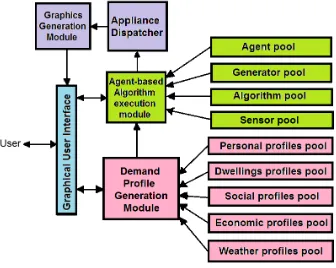
[image:2.612.348.516.408.542.2]Guided by these requirements DDSM_IDEA was designed, its functional block diagram is shown in Fig. 1 and implemented using Matlab. The heart of the DDSM-IDEA platform is its Control Engine which has access to a generator pool hosting the available generation facilities, a pool hosting five types of agents: House, Generation, Utility, and Wireless Sensor and Actuator Network (WSAN), and Administrative agents; a library of DSM,DDSM,and demand
Figure 1. DDSM-IDEA functional block diagram.
graphical user interface (GUI). All appliances are controlled by an appliance dispatcher, the output of which is displayed in the GUI display area. DDSM-IDEA is implemented on Windows7 machines and requires 8 Gigabytes of RAM.
III.IMPLEMENTATION
A. The Graphical User Interface
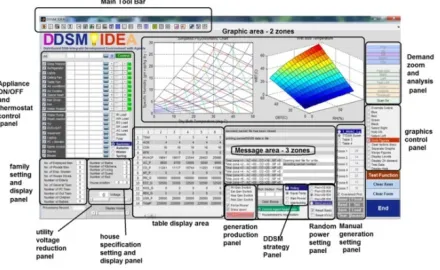
[image:3.612.325.544.130.249.2]The DDSM-IDEA GUI has a cockpit-like interface displayed on one screen (Fig. 2), giving the user full control over the platform. The Appliance control panel is on the far left, on top is the twin plotting area while the table and message screens are located beneath them.
Figure 2. DDSM-IDEA graphical user interface
The algorithm and generation controls are located in the lower part of the GUI. Finally the GUI is equipped with a menu bar located at the upmost part on the left. An interesting feature is a ‘test button’ serving as a general button to run any code under test during any development period.
B. Load Models
To construct sound load models, an empirical approach is followed. Houses are assumed to have kitchens, bathrooms, bedrooms, living rooms, and guest rooms. The number of each type of rooms varies between families and depends on their financial status. Families can comprise a combination of 10 different types of members: 2 types of men, 2 types of women, 3 types of teenagers, 1 type of elderly people, and finally children and babies. Available appliances include 32 types of the most common ones. The load profile generation process starts by defining the daily activities of each type of individuals, fixing the times of repetitive behaviour and taking into account the season since this factor has the most significant impact on the amount of needed power to perform a certain daily activity e.g., taking a shower in the summer take less power (lights only) than in winter (lights and water heater). All activities are mapped over the house profile taking into consideration appliance usage. By aggregating all daily power requirements of individual families, the overall residential quarter load can be calculated. It is worth noting that some of the personal activities are compound, i.e., they
consist of more than one activity e.g. eating which includes washing hands and cooking which includes multiple washing operations. Fig. 3 illustrates example routine activities while Fig. 4 depicts a daily profile of a typical employed man.
[image:3.612.68.288.232.367.2]Figure 3. A graph showing implemented activities
Figure 4. Daily profile of a typical employed man
C. DDSM-IDEA Agents
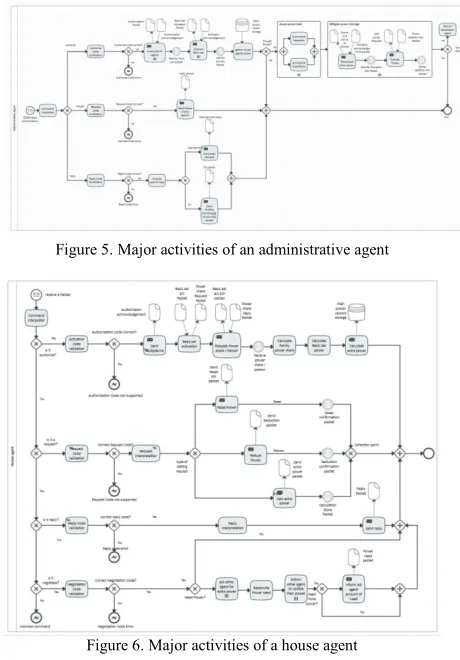
Agents are recruited from an agent pool which hosts five types of agents: house, generator, utility, WSAN, and administrative. House agents are responsible for managing dwellings, people, and appliances; Generator agents are responsible for generation facilities; Utility agents are used to interface with the utility; WSAN agents are responsible for sensing parameters such as temperature and humidity and turning appliances ON and OFF; finally, the Administrative agent is responsible for orchestrating all other agents according to the selected algorithm. Fig. 5 shows a view of the major activities of an administrative agent while Fig.6 shows the same for a house agent. Both of these figures are taken when both agents were recruited in the example discussed in Section IV and are drawn using Business Process Model and Notation (BPMN) [18]. The reason for using this notation is its ability to display activities in a more dynamic manner.
[image:3.612.325.542.282.404.2]Figure 5. Major activities of an administrative agent
Figure 6. Major activities of a house agent
[image:4.612.316.554.150.399.2]between 10 agents; the result is shown in Fig. 7. This game is a valuable negotiation testing tool in which each agent selects a number and conceals it from others. The remaining agents start to ask a series of questions resulting in determining the hidden number. The ‘thickness’ of each line represents the number of requests-replies carried out at each stage; thicker lines mean more negotiations. The use of a test scheme does not eliminate the continuous validation of the
Figure 7. Agent ‘Hangman’ test
platform correct functionality. Fig. 8 displays agent activity chart revealing the inter-agent negotiation between an administrative agent and 10 house agents while Fig. 9 shows the packet exchange map between the administrative agent and 10 house agents both of them are during power shortage coverage scenario. Note that the DDSM-IDEA packet structure has two separate fields one used as a command category field and the other as a command description field. As a final point, agent type and complexity have strong
effect on the platform’s performance, e.g. increasing the complexity of house gents will degrade platform’s performance significantly due to their multitude while the influence of doing the same to an administrative agent is trivial. The maximum number of agents that has been tried on the platform so far is five hundred agents.
Figure 8. Agent activity chart
Figure 9. Packet exchange map showing major some activities in PANDA
IV.RESULTS
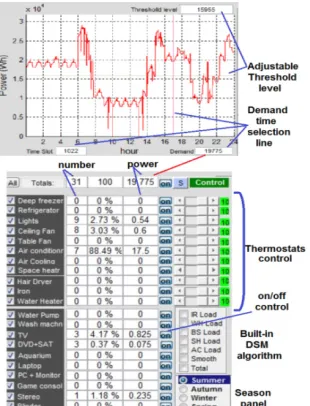
A. Agentless DSM and demand disaggregation
[image:4.612.97.260.504.606.2]Figure 10. Demand disaggregation and analysis
[image:5.612.77.277.413.703.2]Figure 11. Demand reduction through lights dimming
Figure 12. Peak clipping by load shifting
Figure 13. A demand clock showing daily power consumption
B. DDSM Case Study: the PANDA System
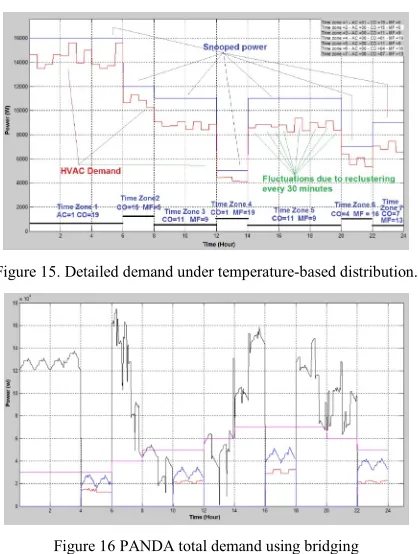
To reveal the true potential of the DDSM-IDEA platform a DDSM system referred to as Power Appeasement aNd Demand Aggregation (PANDA) system is developed [19]. PANDA is a multi-agent HVAC clustering system capable of performing DDSM as well as SDM operations, developed to mitigate the cyclic blackout burden on residential areas through powering essential daily life appliances using surplus standby power snooped from neighbouring generation facilities. The powered appliances are essential forming the base load together with the optimum blend of three different types of HVAC appliances (air conditioners, air coolers, and mist fans). Each dwelling has the right to use one HVAC appliance at any moment, the type depending on the available snooped power. Houses, generators, and HVAC appliances are grouped in clusters and cluster heads are assigned to the first two. The HVAC cluster composition changes according to the available surplus standby power. Five types of agents were recruited as above and a substantial amount of PANDA activity is achieved through inter-agent negotiation. Three different HVAC appliance distribution strategies viz. Polling, Temperature–triggered and Bridging are used to allocate power to dwellings. In Fig. 14 the red graph shows a typical summer demand with air conditioning in a hot country (Iraq1, in this case); the black graph shows the amount of surplus standby power available at every hour during the day. The magenta graph shows the HVAC load after activating the Polling (fair distribution) mechanism. Finally the blue graph shows the total supplied power to customers (base load + clustered HVAC). Fig.15 shows the snooped power (blue) requirement and clustered HVAC profiles under the Temperature-triggered scheme (red). The black line shows seven different snooped power levels that had changed during that day.
Figure 14. PANDA total demand under the fair distribution mechanism.
Lastly, Fig. 16 displays intermittent power utility during a cyclic blackout (black), snooped power (magenta), clustered HVAC demand (red) and total supplied power (blue).
V. FUTURE WORK AND CONCLUSIONS
A. Future Work
[image:5.612.328.536.471.587.2]Figure 15. Detailed demand under temperature-based distribution.
Figure 16 PANDA total demand using bridging
be developed; fine tuning of the personal activity profiles to yield more accurate daily demand profiles; adding guest and patient personal profiles; studying the platform’s performance when the number of input quantities grows towards its maximum limits; more sensing capabilities such as motion detection to enhance the ability to predict in more accurate way the behaviour of dwellers and the dwelling’s occupancy; calculating the effect of appliance position on overall demand profile; and Lastly adding house constructional specifications to predict its response as well as the response of all appliances in it.
B. Conclusions
A versatile agent-based integrated development environment for the design and evaluation of distributed and local demand side management strategies has been introduced. The IDE is a dual-mode platform capable of executing agentless DSM and agent-based DDSM algorithms. In the agent-based mode it utilizes different types of agents and provides a range of resources such as appliances, algorithm, profiles, agents, and generation. This resource mix provides users with flexibility the ability to add more. Socio-economic factors are also taken into consideration and are made adjustable. The DDSM-IDEA offers full control over every appliance it hosts, including both ON/OF and Proportional (through a thermostat) control. All controls, table, message billboards, and plotting areas are arranged on one screen for navigation convenience. The platform has been tested with a dedicated benchmarking routine and several DSM and DDSM activities has been implemented on it successfully.
REFERENCES
[1] Wikipedia, “List of major power outages,” Wikipedia Foundation Inc., 23 11 2013. [Online]. Available: http://en.wikipedia.org/wiki/List_o f_major_ power_outages. [Accessed 24 11 2013].
[2] J. Hong, The Development. implementation,and application of demand side management and control (DSM+c) algorithm for integrating micro-generation system within built environment, Glasgow: University of Strathclyde, 2009.
[3] C. C. Cheng, Electricity demand-side management for an energy efficient future in China: technology options and policy priorities, MASSACHUSETTS: Massachusetts Institute of Technology, 2005. [4] M. F. F. Baba, “Smart Grid With ADSL Connection For Solving Peak
Blackouts In West Bank,” in First international conference on
renewable energies and vehicular technology, Hammamet, 2012. [5] Y. W. Chen, X. Chen and N. Maxemchuk, “The Fair allocation of
power to air conditioners on a smart grid,” IEEE Transactions on
Smart Grid, vol. 3, no. 4, pp. 2188 - 2195, 2012.
[6] L. G. Swan and V. I. Ugursal, “Modeling of end-use energy
consumption in the residential sector: A review,” Renewable and
Sustainable Energy Reviews, vol. 13, p. 1819–1835, 2009.
[7] J. K. Gruber and M. Prodanovic, “Residential energy load profile
generation using a probabilistic approach,” in UKSim-AMSS 6th
European Modelling Symposium, Valetta, 2012.
[8] I. Richardson, M. Thomson, . D. Infield and C. Clifford, “Domestic
electricity use: A high-resolution energy demand,” Energy and
Buildings, vol. 42, no. 10, p. 1878–1887, 2010.
[9] i. McLoughlina, A. Duffya and M. Conlonb, “Characterising domestic electricity consumption patterns by dwelling and occupant
socio-economic,” Energy and Buildings, vol. 48, p. 240–248, 2012.
[10] D. B. Crawley, J. W. Hand, M. Kummert and B. T. Griffith, “Contrasting the capabilities of building energy performance
simulation programs,” Building and Environment, vol. 34, no. 4, pp.
661-673, 2008.
[11] C. J. E. Castle and A. T. Crooks, “Principles and concepts of agent-based modeling for developing geospatial,” University College of London (UCL), Working Papers Series, Paper 110., London, 2006. [12] Z. Zhou , . J. H. Chow and W. Chan, “Agent-based simulation of
electricity markets - a survey of tools,” Artif. Intell. Rev, vol. 28, pp.
305-342, 2007.
[13] N. Arshad, U. Ali and F. Javed, “A highly configurable simulator for
assessing energy usage,” in Mediterranean green energy forum, Fes,
Morocco, 2013.
[14] J. Venkatesh, B. Aksanli, J.-C. Junqua, P. Morin and T. S. Rosing, “HomeSim: Comprehensive, Smart, Residential Electrical Energy
Simulation and Scheduling,” in International Green Computing
Conference, Arlington, 2013.
[15] T. K. Wijaya, D. Banerjeey, T. Ganuy, D. Chakrabortyy, S. Battacharyay, T. Papaioannou, D. P. Seetharamy and K. Aberer, “DRSim: A Cyber Physical Simulator for Demand Response Systems,” in IEEE SmartGridComm Symposium, Venice, Italy, 2013.
[16] N. Gudi, W. Lingfeng, V. Devabhaktuni and S. S. S. R. Depuru, “A demand-side management simulation platform incorporating optimal
management of distributed renewable resources,” in IEEE/PES Power
Systems Conference and Exposition (PSCE), Phoenix, AZ, USA, 2011. [17] K. Keerthivasan , V. Sharmila Deve, L. Krishnaveni, J. Jerome and R.
Ramanujam, “Power Simulators – A Survey,” International journal of
Electrical and Electronic Systems Research, vol. 5, pp. 57-66, June 2012.
[18] O. M. G. OMG, Business Process Model and Notation (BPMN), massachusetts, USA: Object Management Group, 2009.
[19] K. Al-Salim, I. Andonovic and C. Michie, “A Cyclic blackout
mitigation system,” in IEEE International Energy Conference