City, University of London Institutional Repository
Citation
:
Francis, J., Tinmouth, A., Stanworth, S., Grimshaw, J. M., Johnston, M., Hyde,
C., Brehaut, J., Stockton, C., Fergusson, D. and Eccles, M. P. (2009). Using theories of
behaviour to understand transfusion prescribing in three clinical contexts in two countries:
Development work for an implementation trial (protocol). Implementation Science, 4, 70 - ?.
This is the unspecified version of the paper.
This version of the publication may differ from the final published
version.
Permanent repository link: http://openaccess.city.ac.uk/1932/
Link to published version
:
Copyright and reuse:
City Research Online aims to make research
outputs of City, University of London available to a wider audience.
Copyright and Moral Rights remain with the author(s) and/or copyright
holders. URLs from City Research Online may be freely distributed and
linked to.
Open Access
Study protocol
Using theories of behaviour to understand transfusion
prescribing in three clinical contexts in two countries: Development
work for an implementation trial
Jill J Francis*
1, Alan Tinmouth
2,3, Simon J Stanworth
4, Jeremy M Grimshaw
2,
Marie Johnston
5, Chris Hyde
4, Charlotte Stockton
6, Jamie C Brehaut
7,
Dean Fergusson
2and Martin P Eccles
8Address: 1Health Services Research Unit, University of Aberdeen, UK, 2Clinical Epidemiology Programme, Ottawa Hospital Research Institute and
Department of Medicine, University of Ottawa, Canada, 3Canadian Blood Services, Ottawa, Canada, 4NHS Blood & Transplant, John Radcliffe
Hospital, Headington, Oxford, UK, 5Department of Psychology, University of Aberdeen, UK, 6Centre for Medical Statistics and Health Evaluation,
University of Liverpool, UK, 7Clinical Epidemiology Programme, Ottawa Hospital Research Institute and Department of Epidemiology and
Community Medicine, University of Ottawa, Canada and 8Institute of Health and Society, Newcastle University, UK
Email: Jill J Francis* - [email protected]; Alan Tinmouth - [email protected];
Simon J Stanworth - [email protected]; Jeremy M Grimshaw - [email protected]; Marie Johnston - [email protected]; Chris Hyde - [email protected]; Charlotte Stockton - [email protected]; Jamie C Brehaut - [email protected];
Dean Fergusson - [email protected]; Martin P Eccles - [email protected] * Corresponding author
Abstract
Background: Blood transfusion is an essential part of healthcare and can improve patient outcomes. However, like most therapies, it is also associated with significant clinical risks. In addition, there is some evidence of overuse. Understanding the potential barriers and enablers to reduced prescribing of blood products will facilitate the selection of intervention components likely to be effective, thereby reducing the number of costly trials evaluating different implementation strategies. Using a theoretical basis to understand behaviours targeted for change will contribute to a 'basic science' relating to determinants of professional behaviour and how these inform the selection of techniques for changing behaviour. However, it is not clear which theories of behaviour are relevant to clinicians' transfusing behaviour. The aim of this study is to use a theoretical domains framework to identify relevant theories, and to use these theories to identify factors that predict the decision to transfuse.
Methods: The study involves two steps: interview study and questionnaire study. Using a previously identified framework, we will conduct semi-structured interviews with clinicians to elicit their views about which factors are associated with waiting and further monitoring the patient rather than transfusing red blood cells. Interviews will cover the following theoretical domains: knowledge; skills; social/professional role and identity; beliefs about capabilities; beliefs about consequences; motivation and goals; memory, attention, and decision processes; environmental context and resources; social influences; emotion; behavioural regulation; nature of the behaviour. The interviews will take place independently in Canada and the UK and involve two groups of physicians in each country (UK: adult and neonatal intensive care physicians; Canada: intensive care physicians and orthopaedic surgeons). We will: analyse interview transcript content to select
Published: 24 October 2009
Implementation Science 2009, 4:70 doi:10.1186/1748-5908-4-70
Received: 12 March 2009 Accepted: 24 October 2009
This article is available from: http://www.implementationscience.com/content/4/1/70
© 2009 Francis et al; licensee BioMed Central Ltd.
Implementation Science 2009, 4:70 http://www.implementationscience.com/content/4/1/70
relevant theoretical domains; use consensus processes to map these domains on to theories of behaviour; develop questionnaires based on these theories; and mail them to each group of physicians in the two countries. From our previous work, it is likely that the theories will include: theory of planned behaviour, social cognitive theory and the evidence-based strategy, implementation intention. The questionnaire data will measure predictor variables (theoretical constructs) and outcome variables (intention and clinical decision), and will be analysed using multiple regression analysis. We aim to achieve 150 respondents in each of the four groups for each postal survey.
Background
Blood transfusionBlood transfusion is an essential part of modern health-care, and can improve patient outcomes. However, like most therapies, it is also associated with significant clini-cal risks [1]. It is also a scarce and costly resource [2]. There is published evidence of variation and suboptimal clinical transfusion practice in all aspects of transfusion. For example, there is ongoing evidence of large differences between hospitals and clinical teams in the use of red cell transfusions (and other blood products) for the same sur-gical procedures with no clear explanation based on clin-ical factors, e.g., pre-operative haemoglobin, peri-operative blood loss [3]. In a large multicentre study of Canadian intensive care unit (ICU) patients transfused over a two-year period, the percentage of patients trans-fused varied from 20% to 54% across 11 different centres [4]. A recent regional audit in the UK in patients undergo-ing primary hip replacement surgery showed a range of 23% to 58% in the proportion of patients who were trans-fused [2]. The majority of patients who were transtrans-fused received only one or two units of blood, and most were discharged with a haemoglobin concentration above 10 g/dl. If they had not been transfused, they would still have had a haemoglobin concentration above 8 g/dl, which would not be expected to impair postoperative recovery [5]. Some teams even carry out major procedures without blood transfusion by attention to patient care throughout the peri-operative period [6]. The combination of algo-rithms for blood management and restrictive transfusion thresholds may in these situations offer a more effective approach to blood conservation than the implementation of single interventions such as autologous transfusion [7].
Changing transfusion practice
Variation in the use of blood suggests the potential for a reduction in blood usage without having a negative impact on patient care. Many different forms of behaviour change interventions are used in current clinical practice by hospitals and blood transfusion services worldwide with the aim of changing transfusion practice, including the dissemination of guidelines, retrospective or prospec-tive audits, educational events, and algorithms for blood prescribing [8,9]. A systematic review found that all
inter-ventions for the reduction of transfusion studied in clini-cal trials seemed to be effective, with a reduction in inappropriate transfusions of 12% to 83% [8] and of 9% to 77% for the total number of units transfused [9]. How-ever, there were significant limitations to the quality of this evidence. Most of the studies were uncontrolled before-and-after studies that are prone to secular changes, maturation bias, and bias in favour of the intervention. Most were single-centre studies, and many were per-formed more than 10 years ago. The universal success in the published studies raises the possibility of publication bias. These concerns about the true effectiveness and the durability of the effect of these interventions were raised by one study, which reported a return to the baseline rate of transfusions three months after the completion of the intervention, and a follow-up report from another study [10,11] that reported a return to previous transfusion practice. Finally, none of the studies formally reported cost-effectiveness comparisons.
Implementation research
(specific clinical decisions) of individual clinicians, as ultimately it is the individual clinician who decides much of the face-to-face health care.
The use of behavioural theory in changing the behaviour of healthcare professionals
While the effectiveness of interventions varies across dif-ferent clinical problems, contexts, and organisations, studies in general have provided scant theoretical or con-ceptual rationale for their choice of intervention [16] and only limited descriptions of the interventions and contex-tual data.
The UK Medical Research Council (MRC) has proposed a framework for developing and evaluating complex inter-ventions [17,18]. The revised framework [18] gives prom-inence to the development of the intervention, which includes identifying the evidence base, identifying or developing theory, and modelling the process or out-comes. We interpret these three research activities for implementation research as follows:
1. Identifying the evidence base encompasses two distinct components in implementation research: verification of an evidence-practice gap (i.e., would quality of health care be improved if clinicians' behaviour changed?), and iden-tification of specific evidence-based behaviour change techniques ('active ingredients') that are likely to lead to change.
2. Identifying or developing theory is essential for under-standing the likely mechanisms of behaviour change. This informs questions such as how best to deliver and opti-mise the techniques.
3. Modelling the process or outcomes involves an empiri-cal investigation by which the theorised pathways that change or maintain the current behaviour are tested in a real or simulated clinical context. Results of this investiga-tion feed back into the evidence base relating to the behaviour change techniques as well as confirming, dis-confirming, or developing theory.
The MRC framework thus proposes a systematic, theory-and evidence-based approach to the identification of the 'active ingredients' for achieving professional behaviour change. By using a theoretical basis to identify determi-nants of behaviour and to select behaviour change inter-ventions, the chances of finding a significant improvement in response to a specific set of interventions should increase, thereby reducing the number of costly tri-als evaluating different implementation strategies. Addi-tionally, this approach should allow for the combination of complementary techniques, and possibly identification
of clinical contexts that require different approaches to target different groups of physicians.
However, this first requires the selection of an appropriate theoretical framework. A number of psychological theo-ries have been used to explore the factors associated with the behaviours of health care practitioners, e.g., the theory of planned behaviour (TPB) [19] and social cognitive the-ory [20]. Psychological theories are numerous, and, in order to rationalise their use, a consensus group of UK health psychologists derived 12 theoretical 'domains' that incorporated all relevant theories, and that could be used to investigate the implementation of evidence-based prac-tice [21]. A Table reproducing these domains and the the-oretical constructs they include is shown in Additional File 1. These theoretical domains offer a comprehensive list of potentially relevant constructs for the behaviour of transfusing. They include factors such as local protocols, management policies, and resources available in the local context. Based on these constructs, it may be possible to adopt a systematic approach to selecting appropriate the-ories.
Clinical Contexts
Implementation Science 2009, 4:70 http://www.implementationscience.com/content/4/1/70
and created a network of interested neonatologists. Orthopaedic surgery remains one of the largest users of red blood cells, as hip and knee replacement surgeries are relatively common procedures which have a high risk of anaemia. Yet there is little evidence to guide transfusion practice in orthopaedic surgery. However, at least one large randomized controlled trial in hip fracture patients is underway in the US with expected completion in 2009 [5].
UK and Canadian blood services
The NHS blood and transplant (NHSBT) service is respon-sible for managing all the products and services, including promoting blood, tissue, and organ donation to the pub-lic; managing the supply of blood to hospitals in England and Wales; and working with hospital staff to promote the safe and appropriate use of blood. The Canadian Blood Services (CBS) performs many similar functions for nine provinces and three territories in Canada. Both the NHSBT and the CBS work at the hospital, regional, and national levels to promote appropriate use of blood and blood products. As such, they are critical partners in the UK and Canada for the development and testing of inter-ventions to optimize transfusion practice.
The clinical evidence base to support more restrictive transfusion practice is fairly new and, to our knowledge, there have been no investigations of the factors that might hinder or facilitate change in clinicians' transfusion behaviour in these clinical contexts. To provide an oppor-tunity to make cross-country comparisons while investi-gating a broad range of clinical contexts, we decided to design parallel studies in two clinical contexts in each country (Canada and the UK) and to select one clinical context (adult intensive care) for investigation in both countries.
Aims and Objectives
The aim of the study is to use constructs from psycholog-ical theories to identify factors that predict the decision to transfuse. The objectives are:
1. To conduct semi-structured interviews (based on the theoretical domains framework) with transfusion pre-scribers in two clinical contexts in both the UK and Can-ada, to identify theoretical constructs (and therefore psychological theories) relevant to the use of red blood cells.
2. To develop a questionnaire based on the identified the-ories.
3. To conduct separate postal questionnaire surveys of intensive/critical care physicians and neonatal physicians in the UK, and intensive/critical care physicians and orthopaedic surgeons in Canada.
4. To identify the psychological constructs that, within a theoretical framework, predict the decision by neonatal and critical care consultants and orthopaedic surgeons to transfuse red blood cells (as opposed to continuing to monitor the patient).
Methods
Clinical settingWe will work with two groups of clinicians in each coun-try -- intensive/critical care physicians and neonatal physi-cians in the UK and intensive/critical care physiphysi-cians and orthopaedic surgeons in Canada. Physicians in intensive care are significant users of red blood cells, and there has been a landmark trial in which mortality was compared in two groups of patients randomised to receive red cells at a more or less restrictive haemoglobin trigger threshold [25,26]. In the UK, there is an evolving network of critical care physicians across Scotland, Wales, Northern Ireland, and England who have supported the ATTICS study (which demonstrated a narrowing but persistent gap in clinical practice and the evidence for red cell transfusions in critical care patients) [27-29] in Scotland and the inten-sive care study of coagulopathy (ISOC) (which described the current practice of frozen plasma transfusions in criti-cal care patients [30]) in all four countries. It is expected that the heightened awareness of transfusion generated through these studies will facilitate a high response rate to the questionnaires planned in this survey. Similarly in Canada, there is a well established critical care research network (Canadian critical care trials group), which has carried out much of the seminal work on blood transfu-sions including the TRICC [26] and TRIPICU [32] trials evaluating restrictive transfusion triggers in adult and pae-diatric patients, respectively.
Interview study
We will conduct interviews with clinicians from each clin-ical area, including physicians at regional centres/aca-demic/teaching and district/community hospitals. Although convenience sampling will be used, participants will also be selected in such a way as to ensure diversity of age, gender, and hospital size so as to maximise the range of views expressed. Although the sample will thus not nec-essarily be representative, we will nevertheless identify a wide range of views for consideration in the design of the questionnaire.
domains: knowledge; skills; social/professional role and identity; beliefs about capabilities; beliefs about conse-quences; motivation and goals; memory, attention, and decision processes; environmental context and resources; social influences; emotion; behavioural regulation; nature of the behaviour. We will not necessarily use these techni-cal terms but will phrase the issues appropriately for the clinical context (see Additional File 1).
These interview sessions will be conducted by a trained interviewer. The sessions will be tape recorded and tran-scribed for analysis. We anticipate interviewing up to 10 clinicians from each group. The total number of inter-views will be determined by the time it takes to reach data saturation such that no further specific beliefs will be gathered by additional interviews.
The interview transcripts will be analysed in two stages. In stage one, we will identify all domains in which clinicians report a wide range of beliefs or in which clinicians report problems when making the decision to watch and wait rather than transfuse red cells (This paper is now pub-lished [33]). A domain will be considered 'relevant' if fre-quently mentioned responses indicate that it might affect the decision to transfuse or not. The specific beliefs within each domain will also be coded. In stage two, the specific beliefs in each of the relevant domains will be used to identify constructs in the following manner. Independent judges will use the list of beliefs (from the stage one anal-ysis) and a list of constructs included in each theoretical domain (Additional File 1) to match the beliefs with the constructs. The identified constructs from the relevant domains will be discussed by the research team to agree the theoretical models that represent these constructs. If the identified constructs represent part of a theory, and are not represented in other identified theories, then the entire theory will be included for operationalising in the questionnaire study.
Questionnaire study Study design
The predictor variables will be the constructs within the psychological theories selected in the interview study. The outcome variables will be behavioural intention and sim-ulated behaviour for 'watching and waiting instead of transfusing red blood cells.'
Questionnaire content
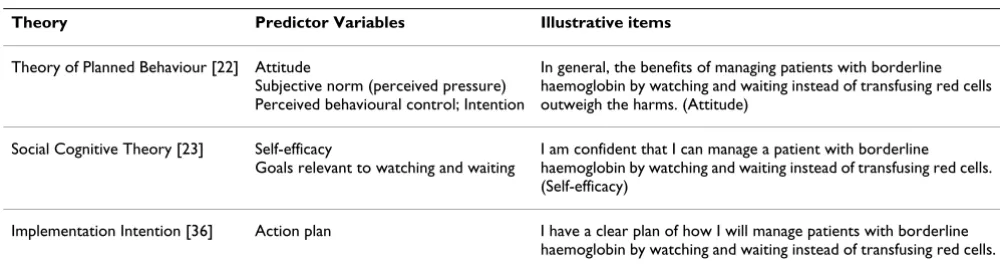
Based on the interview study results, we will use the theo-ries that most clearly represent the construct domains identified and that can be operationalised in a question-naire format. From our previous work, it is likely that the following theories (that have been evaluated in other health care settings) will be included: the TPB [19], social cognitive theory [20] and the evidence-based strategy, implementation intention [34]. These theories have been examined thoroughly in other health care settings, they include explanatory factors that are amenable to change, and they include non-volitional components which assume that individuals do not always have complete con-trol over their actions (e.g., the impact of insufficient financial resources). Table 1 contains examples of the var-iables within the theories and example questions, and Additional File 3 shows an example of a finished instru-ment used for the UK study of intensive care consultants.
Measures
[image:6.612.53.553.569.704.2]To evaluate behavioural intention (to watch and wait instead of transfusing red blood cells) and its possible pre-dictors, the questionnaire will include questions with multi-item scales to assess elements of the identified psy-chological theories. Responses will be elicited using a seven-point Likert scale. The content for these questions assessing specific beliefs regarding the practice of watch-ing and waitwatch-ing rather than transfuswatch-ing with red blood cells will be derived from standard practice (e.g., [19,35]) and from the interviews.
Table 1: Examples of likely relevant theories, the variables within the theories, and questionnaire items for the behaviour of managing patients with borderline haemoglobin by watching and waiting instead of transfusing red cells.
Theory Predictor Variables Illustrative items
Theory of Planned Behaviour [22] Attitude
Subjective norm (perceived pressure) Perceived behavioural control; Intention
In general, the benefits of managing patients with borderline haemoglobin by watching and waiting instead of transfusing red cells outweigh the harms. (Attitude)
Social Cognitive Theory [23] Self-efficacy
Goals relevant to watching and waiting
I am confident that I can manage a patient with borderline haemoglobin by watching and waiting instead of transfusing red cells. (Self-efficacy)
Implementation Intention [36] Action plan I have a clear plan of how I will manage patients with borderline
Implementation Science 2009, 4:70 http://www.implementationscience.com/content/4/1/70
We will use three proxy measures of behaviour -- strength of intention, 'direct estimation' of intention, and simu-lated behaviour (see Additional File 3).
The questionnaire will measure simulated behaviour. A number of clinical scenarios will be developed for each clinical group. The clinical scenarios will use different combinations of patient characteristics (e.g., diagnosis, co-morbidities, and laboratory results), and for each sce-nario, physicians will be asked to report their clinical deci-sion about whether to transfuse. Examples of scenarios are attached (Additional File 3).
Sampling procedure
With permission from the relevant professional societies, we will select a random sample of names from lists of practising consultants in each country.
Implementation of the postal questionnaires
A covering letter, which will explain the purpose and nature of the study, will be included with the initial copy of the questionnaire. The letter will explain the impor-tance of completing the questionnaire, outline how the results will be used, and ensure the confidentiality of the responses. A reminder letter will be sent at week two with an additional copy of the questionnaire.
Analysis and sample size
The questionnaire data will allow us to assess the relation-ships between predictor (theoretical constructs) and three outcome measures (strength of intention, direct estima-tion of intenestima-tion, and simulated behaviour). These rela-tionships will be assessed using multiple regression analysis. Sample size calculations for the multiple regres-sion analysis depend on the number of cases per predictor variable [36]. A minimum sample size of 50 + 8 m is required, where m is the number of predictor variables required for the multiple regression analysis. To test indi-vidual predictors, a sample size of 104 + m is required. We estimate approximately 12 predictor variables, which will require 146 respondents to test for multiple correlations, and 116 to test individual predictor variables. We will aim to achieve 150 respondents for each of the two surveys in each country (i.e., 600 respondents in all). Assuming a response rate of 50%, we will send the questionnaire to 300 consultants in each group. To maximise the response rate, a customised letter inviting consultants to participate will be signed by a clinical member of the research team who is well known within each clinical specialty. As the consultant groups in each of the countries are close-knit professional bodies, we expect a high level of support for this work and thus reasonably high response rates.
Project advisory group
We will establish a project advisory group in each country that will contain clinical as well as academic
representa-tives and international collaborators. It will meet at inter-vals dictated by the work.
International comparisons
The studies in the two countries will be run independently through the steps outlined previously. By using methods in common, we will have the opportunity to compare results for physicians working in similar clinical settings in two different countries, and working in two different clinical settings within the same country.
We will use multivariate analysis of variance to compare mean scores on each construct (e.g., to identify any differ-ences between national or clinical context in intention), and multiple regression approaches to identify whether national or clinical context adds to the prediction of intention and simulated behaviour. Specifically, we will investigate the following comparisons: intensive care con-sultants (UK and Canada); intensive care concon-sultants and orthopaedic surgeons (within Canada); intensive care consultants and neonatologists (within UK). This will add an important dimension to the interpretation of the results of this project as it will enable us to identify whether relevant domains, theories, and patterns of pre-diction converge or diverge across different health care systems and clinical contexts.
Discussion
This study will be based on a theoretical domains frame-work that is derived from theories of behaviour to identify relevant theories, and use the theories to predict intention and simulated behaviour.
The questionnaire study will identify the psychological constructs that predict the decision by clinicians to trans-fuse red blood cells (as opposed to continuing to monitor the patient). Identifying the predictors of generalised intention about transfusing (or not) and simulated behav-iour (i.e., the decision whether or not to transfuse given a specific clinical scenario) will inform the development of interventions to increase evidence-based behaviour in these clinical contexts. It is therefore important to identify whether the prediction of intention is an appropriate basis for interventions to change actual behaviour.
Intention has been defined as 'indications of how hard people are willing to try, or how much effort they are plan-ning to exert, in order to perform a behavior' [19]. A pre-requisite of this approach is that the interim endpoint (e.g., measure of intention) must be predictive of real world outcomes. This is the case for behavioural intention in non-clinical populations as demonstrated by reviews of both observational and experimental studies. Godin and Kok [37] reported averaged correlations between inten-tion and different health-related behaviours ranging from 0.35 to 0.56 (i.e., intention was accounting for between 12% and 31% of the variance in behaviour). Armitage and Connor [38], from 63 independent studies reporting pro-spectively measured behavioural data, reported that the TPB variables that directly influence behaviour (intention and perceived behavioural control) accounted for a simi-lar proportion of the variance in behaviour. When behav-iour measures were self-reported, the TPB accounted for more of the variance in behaviour than when behaviour measures were objective or observed. A meta-analysis of 10 meta-analyses by Sheeran [39] reported that intention accounted for almost one-third of the variance in behav-iour. Finally, Webb and Sheeran [40] reviewed experi-mental studies to relate change in intention to change in behaviour. From meta-analysis of 47 experimental tests of the intention-behaviour relationship, they concluded that a 'medium-to-large' change in intention leads to a 'small-to-medium' change in behaviour. Eccles et al. [41] and Godin et al. [42] have demonstrated that a similar rela-tionship is apparent in the smaller number of available studies of healthcare professional behaviour. These reviews demonstrate that there is a reliable, but not per-fect, relationship between stated intention and behaviour.
Considerable research effort has been directed to address-ing the 'intention-behaviour gap,' and two approaches have been proposed. One addresses the variability of the link by focusing on moderators of the intention-behav-iour relationship, such as intention certainty and attitudi-nal versus normative control [43,44]. According to this approach, it is possible to predict which individuals will enact their intentions (e.g., those whose intentions are attitudinally controlled). A second approach focuses on
mediators of the intention-behaviour relationship, or processes that might be regarded as 'post-intentional,' such as implementation intention [34]. This approach identifies processes that assist individuals to enact their intentions, thereby minimising the size of the intention-behaviour gap. Our approach will allow us to explore both approaches.
Future work
This study corresponds to specific aspects of the UK's revised MRC framework for developing complex interven-tions [18], namely, identifying relevant theory and mod-elling process and outcome. The results of this project will be used to develop one or more interventions to change clinicians' behaviour. These will be piloted and then tested in a multi-site cluster randomised controlled trial.
Competing interests
The authors declare that they have no competing interests.
Authors' contributions
AT, SJS, MPE, and JMG conceived the study and, with CH, acquired funding. JJF, MJ, JMG, and MPE were theoretical and methodological advisers. All authors advised on clin-ical and methodologclin-ical issues, provided ongoing critique and approved the final version of the manuscript.
Additional material
Acknowledgements
This study was funded by the Department of Health for England and the Canadian Blood Services. We thank the participants for generously sharing
Additional file 1
Theoretical domains and their component constructs from psychologi-cal theories used to understand transfusion prescribing (from ‘Psycho-logical’ Theory Group)
Click here for file
[http://www.biomedcentral.com/content/supplementary/1748-5908-4-70-S1.doc]
Additional file 2
Theoretically-informed topic guide (core questions to elicit views within each theoretical domain, with follow-up prompts for guidance if needed) as used in interviews with critical care consultants for the UK study
Click here for file
[http://www.biomedcentral.com/content/supplementary/1748-5908-4-70-S2.doc]
Additional file 3
Postal questionnaire used in UK study of intensive/critical care con-sultants.
Click here for file
Implementation Science 2009, 4:70 http://www.implementationscience.com/content/4/1/70
their views. Jill Francis is 50% funded by the Chief Scientist Office of the Scottish Government Health Directorates. Jeremy Grimshaw holds a Can-ada Research Chair. Alan Tinmouth is supported by a Canadian Blood Serv-ices/Canadian Institutes of Health New Investigator Award. Dean Fergusson is supported by a Canadian Institutes of Health New Investigator Award. The views expressed are not necessarily those of the funding bod-ies. We thank Dr Rafat Islam for her contribution in developing the inter-view topic guide for the Canadian study.
References
1. Serious Hazards of Transfusion: Serious Hazards of Transfusion scheme. Annual report 2004. Manchester, UK 2005.
2. Murphy MF, Stanworth SJ: Transfusion Practice. In Global perspec-tives in Transfusion Medicine Edited by: Lozano M, Contreras M, Blajch-man M. AABB Press; 2006.
3. The Sanguis Study Group: Use of blood products for elective surgery in 43 European hospitals. Transfusion Medicine 1994,
4(4):251-268.
4. Hutton B, Fergusson D, Tinmouth A, McIntyre L, Kmetic A, Hebert PC: Transfusion rates vary significantly amongst Canadian medical centres. Can J Anesth 2005, 52(6):581-590.
5. Carson JL, Terrin ML, Magaziner J: Anemia and postoperative rehabilitation. Can J Anesth 2003, 50:S60-S64.
6. Carless P, Moxey A, O'Connell D, Henry D: Autologous transfu-sion techniques: a systematic review of their efficacy. Trans-fusion Medicine 2004, 14(2):123-144.
7. Slappendel R, Dirksen R, Weber EW, Schaaf DB van der: An algo-rithm to reduce allogenic red blood cell transfusions for major orthopedic surgery. Acta Orthop Scand 2003,
74(5):569-575.
8. Wilson K, MacDougall L, Fergusson D, Graham I, Tinmouth A, Hebert PC: The effectiveness of interventions to reduce phy-sicians' levels of inappropriate transfusion: what can be learned from a systematic review of the literature. Transfusion 2002, 42(9):1224-1229.
9. Tinmouth A, Macdougall L, Fergusson D, Amin M, Graham ID, Hebert PC, Wilson K: Reducing the amount of blood transfused: a sys-tematic review of behavioral interventions to change physi-cians' transfusion practices. Arch Intern Med 2005,
165(8):845-852.
10. Tobin SN, Campbell DA, Boyce NW: Durability of response to a targeted intervention to modify clinician transfusion prac-tices in a major teaching hospital. Med J Aust 2001,
174(9):445-448.
11. Tuckfield A, Haeusler MN, Grigg AP, Metz J: Reduction of inappro-priate use of blood products by prospective monitoring of transfusion request forms. Med J Aust 1997, 167(9):473-476. 12. Grimshaw J, Ward J, Eccles M: Getting research into practice. In
Oxford handbook of public health practice Edited by: Penchon D, Guest C, Melzer D, Gray JA. Oxford: Oxford University Press; 2001. 13. Grimshaw JM, Thomas RE, MacLennan G, Fraser C, Ramsay CR, Vale
L, Whitty P, Eccles MP, Matowe L, Shirran L, Wensing M, Dijkstra R, Donaldson C: Effectiveness and efficiency of guideline dissem-ination and implementation strategies. Health Technol Assess 2004, 8(6):.
14. Bero LA, Grilli R, Grimshaw JM, Harvey E, Oxman AD, Thomson MA:
Closing the gap between research and practice: an overview of systematic reviews of interventions to promote the imple-mentation of research findings. The Cochrane Effective Practice and Organization of Care Review Group[see com-ment]. BMJ 1998, 317(7156):465-468.
15. Foy R, Eccles MP, Jamtvedt G, Young J, Grimshaw JM, Baker R: What do we know about how to do audit and feedback? Pitfalls in applying evidence from a systematic review. BMC Health Serv Res 2005, 5(50):.
16. Davies P, Walker A, Grimshaw J: Theories of behaviour change in studies of guideline implementation. Proceedings of the British Psychological Society 2003, 11(1):120.
17. Campbell M, Fitzpatrick R, Haines A, Kinmonth AL, Sandercock P, Spiegelhalter D, Tyrer P: Framework for design and evaluation of complex interventions to improve health. BMJ 2000,
321(7262):694-696.
18. Craig P, Dieppe P, Macintyre S, Michie S, Nazareth I, Petticrew M, Medical Research Council G: Developing and evaluating
com-plex interventions: the new Medical Research Council guid-ance. BMJ 2008, 337:a1655.
19. Ajzen I: The theory of planned behaviour. Organisational Behav-iour and Human Decision Processes 1991, 50:179-211.
20. Bandura A: Health promotion from the perspective of social cognitive theory. Psychology & Health 1998, 13:623-649. 21. Michie S, Johnston M, Abraham C, Lawton R, Parker D, Walker A,
'Psychological Theory' Group: Making psychological theory use-ful for implementing evidence based practice: a consensus approach. Quality & Safety in Health Care 2005, 14(1):26-33. 22. Kirpalani H, Whyte RK, Andersen C, Asztalos EV, Heddle N,
Blajch-man MA, Peliowski A, Rios A, LaCorte M, Connelly R, Barrington K, Roberts RS: The Premature Infants in Need of Transfusion (PINT) study: a randomized, controlled trial of a restrictive (low) versus liberal (high) transfusion threshold for extremely low birth weight infants. J Pediatr 2006,
149(3):301-307.
23. Bell EF: Randomised trial of liberal versus restrictive guide-lines for red blood cell transfusions in preterm infants. Pedi-atrics 2005, 115:1685-91.
24. Murray N: A multi-centre prospective observational study of platelet transfusion practice in neonates with severe throm-bocytopaenia. ASH Annual Meeting Abstracts 2006, 108(11):. 25. Department of Health: Better blood transfusion: Safe and
appropriate use of blood. In Health Services Circular HSC2007/001 Anonymous London, UK; 2007.
26. Hébert PC, Wells G, Martin C, Tweeddale M, Marshall J, Blajchman M, Pagliarello G, Schweitzer I, Calder L: A Canadian survey of transfusion practices in critically ill patients. Transfusion Requirements in Critical Care Investigators and the Cana-dian Critical Care Trials Group. Crit Care Med 1998,
26(3):482-487.
27. Hébert PC, Wells G, Blajchman MA, Marshall J, Martin C, Pagliarello G, Transfusion Requirements in Critical Care Investigators, Canadian Critical Care Trials Group: A multicenter, randomized, control-led clinical trial of transfusion requirements in critical care.
N Engl J Med 1999, 340:409-417.
28. Walsh TS, Garrioch M, Maciver C, Lee RJ, MacKirdy F, McClelland DB, Kinsella J, Wallis C, Audit of Transfusion in Intensive Care in Scotland Study Group: Red cell requirements for intensive care units adhering to evidence-based transfusion guidelines.
Transfusion 2004, 44(10):1405-1411.
29. Walsh TS, Lee RJ, Maciver CR, Garrioch M, MacKirdy F, Binning AR, McClelland DB, Audit of Transfusion in Intensive Care in Scotland (ATICS) study group: Prevalence of anaemia at discharge from the intensive care unit: the impact of evidence-based trans-fusion practice. Intensive Care Medicine 2006, 32(8):1206-1213. 30. Walsh TS, McClelland DBL, Lee RJ, Garrioch M, Maciver CR, McArdle
F, Crofts SL, Mellor I, ATICS Study Group: Does documented ischaemic heart disease influence the observed threshold haemoglobin concentration for red cell transfusions in inten-sive care units? British Journal of Anaesthesia 2005, 94(4):445-452. 31. Watson DM, Smethurst HR, Walsh TS, Lee RJ, Davidson H,
Stan-worth SJ: A prospective survey of 'coagulopathy' and FFP use at 29 Intensive Care Units in the United Kingdom. Transfusion 2008, 48(Supplement):26A.
32. Lacroix J, Hébert PC, Hutchison JS, Hume HA, Tucci M, Ducruet T, et al.: Transfusion strategies for patients in pediatric intensive care units. NEJM 2007, 356(16):1609-19.
33. Francis J, Stockton C, Eccles MP, Johnston M, Cuthbertson BH, Grim-shaw JM, Hyde C, Tinmouth T, Stanworth SJ: Evidence-based selection of theories for designing behaviour change inter-ventions: Using methods based on theoretical construct domains to understand clinicians' blood transfusion behav-iour. British Journal of Health Psychology 2009, 14:625-646.
34. Gollwitzer PM: Implementation intentions: Strong effects of simple plans. American Psychologist 1999, 54:493-503.
35. Francis J, Eccles MP, Johnston M, Walker AE, Grimshaw JM, Foy R, Kaner EFS, Smith L, Bonetti D: Constructing questionnaires based on the theory of planned behaviour. A manual for health services researchers Newcastle upon Tyne: Centre for Health Services Research, Univer-sity of Newcastle upon Tyne; 2004.
Publish with BioMed Central and every scientist can read your work free of charge "BioMed Central will be the most significant development for disseminating the results of biomedical researc h in our lifetime."
Sir Paul Nurse, Cancer Research UK
Your research papers will be:
available free of charge to the entire biomedical community
peer reviewed and published immediately upon acceptance
cited in PubMed and archived on PubMed Central
yours — you keep the copyright
Submit your manuscript here:
http://www.biomedcentral.com/info/publishing_adv.asp
BioMedcentral 37. Godin G, Kok G: The theory of planned behavior: a review of
its applications to health-related behaviors. American Journal of Health Promotion 1996, 11:87-98.
38. Armitage CJ, Conner M: Efficacy of the theory of planned behav-iour: a meta-analytic review. British Journal of Social Psychology 2001, 40:471-499.
39. Sheeran P: Intention-behavior relations: A conceptual and empirical review. In European Review of Social Psychology Edited by: Stroebe W, Hewstone M. John Wiley & Sons Ltd; 2002:1-36. 40. Webb TL, Sheeran P: Does Changing Behavioural Intention
Engender Behaviour Change? A meta-analysis of the experi-mental evidence. Psychol Bull 2006, 132(2):249-268.
41. Eccles MP, Hrisos S, Francis J, Kaner E, Dickinson HO, Beyer F, John-ston M: Do self-reported intentions predict clinicians' behav-iour: a systematic review. Implementation Science 2006, 1(28):. 42. Godin G, Bélanger-Gravel A, Eccles M, Grimshaw J: Healthcare
professionals' intentions and behaviours: A systematic review of studies based on social cognitive theories. Imple-mentation Science 2008, 3(36):.
43. Sheeran P, Abraham C: Mediator of moderators: temporal sta-bility of intention and the intention-behavior relation. Person-ality & Social Psychology Bulletin 2003, 29:205-215.