R E S E A R C H A R T I C L E
Open Access
Implementation of surgical debriefing
programs in large health systems:
an exploratory qualitative analysis
Mary E. Brindle
1,2*, Natalie Henrich
1, Andrew Foster
3, Stanley Marks
4, Michael Rose
5,6, Robert Welsh
7and William Berry
1Abstract
Background:The role of the“debrief”to address issues related to patient safety and systematic flaws in care is frequently overlooked. In our study, we interview surgical leaders who have developed successful strategies of debriefing within a comprehensive program of quality improvement.
Methods:Semi-structured interviews of four implementation leaders were performed. The observations, beliefs and strategies of surgical leaders are compared and contrasted. Common themes are identified related to program success and failure. Quality and safety researchers performed, coded and categorized the interviews and coordinated the analysis and interpretation of the results. The authors from the four institutions aided in interpretation and framing of the results.
Results:The debriefing programs evaluated were part of comprehensive quality improvement projects. Seven high-level themes and 24 subthemes were identified from the interviews. Themes related to leadership included early engagement, visible ongoing commitment and enforcement. Success appeared to depend upon meaningful and early debriefing feedback. The culture of safety that promoted success included a commitment to open and fair communication and continuous improvement.
There were many challenges to the success of debriefing programs. The loss of institutional commitment of resources and personnel was the instigating factor behind the collapse of the program at Michigan. Other areas of potential failure included communication issues and loss of early and meaningful feedback.
Conclusions:Leaders of four surgical systems with strong debriefing programs report success using debriefing to improve system performance. These findings are consistent with previously published studies. Success requires commitment of resources, and leadership engagement. The greatest gains may be best achieved by programs that provide meaningful debriefing feedback in an atmosphere dedicated to open communication.
Keywords:Checklist, Debriefing, Team training, Crew resource management, Implementation, Surgery, Quality improvement
* Correspondence:[email protected]
1Ariadne Labs at Brigham and Women’s Hospital and the Harvard TH Chan School of Public Health, Boston, MA, USA
2Department of Surgery and Community Health Sciences, University of
Calgary, Affiliate Faculty, Ariadne Labs, Alberta Children’s Hospital, 2888 Shaganappi Trail NW, Calgary, AB T2N0Z6, Canada
Full list of author information is available at the end of the article
Background
Since the publication of“To Err is Human”in 1999,
med-ical error has been acknowledged as a major contributor to
the burden of illness in the United States (US) [1].
Prevent-able complications in surgery contribute significantly to this burden. Over the last 17 years, the quality and safety of surgery in the United States has been addressed through several interventions. One prominent tool developed to improve patient safety is the World Health Organization
(WHO) surgical safety checklist [2]. The WHO checklist is
a communication tool that involves participation of the surgical team to review issues of surgical safety at three time points: at a sign-in prior to administration of the anesthetic, at a time-out prior to the incision and at a
sign-out or“debrief”at the end of the case. Implementation of
the WHO Checklist was associated with dramatically im-proved outcomes in an international trial published in
2009 [2]. Since the publication of these findings, the
check-list has been broadly adopted and incorporated into US hospital accreditation with the expectation that this would lead to national improvement in surgical safety.
Despite a concerted, national effort, the burden of
medical error in the US remains troublingly high [3].
Follow-up studies of the WHO surgical safety checklist were less promising than the initial trial, and the man-dated use of the surgical checklist failed to move the needle of surgical morbidity and mortality within large
health systems such as that in Ontario, Canada [4].
These findings suggest that strategies that reduce surgi-cal morbidity within the controlled settings of a trial may fail in the complicated real world. Success or failure of the checklist in improving outcomes closely relate to
meaningful compliance [5]. Despite widespread
institu-tional reports of high compliance, audits of checklist use reveal that most hospitals fail to complete the checklist, with very few institutions completing a true team-based
“debrief” or“sign out” at the end of the checklist [6,7].
The potential role of the “debrief” to address issues
re-lated to individual patient safety and systematic flaws in
care is almost always overlooked and undervalued [6,8].
The“debrief”within a three-part surgical safety
check-list is alternatively referred to as a “sign-out”. These
terms are used interchangeably in most checklists and
within this paper. However, the use of the term“debrief”
emphasizes additional communication beyond acknow-ledgement of the tasks performed by the nursing team at the end of the surgical case. This additional communica-tion typically addresses safety, equipment and efficiency issues arising during the case and identifies opportun-ities for improvement.
In contrast to many hospitals that have struggled with checklist implementation, there are a few notable insti-tutions have used the surgical checklist effectively to im-prove quality and safety and continue to do so. Many of
these successful institutions have specifically focused on the debriefing aspect of the checklist to address
system-atic issues of safety, efficiency, and communication [9,
10]. In our study, we interview surgical leaders from four
centers across the United States who have developed successful strategies of debriefing within a comprehen-sive program of quality improvement. We examine three institutions that have maintained these programs and one institution where this program has failed.
Through a thematic analysis of these interviews, we explore effective strategies, the role of leadership, bar-riers and facilitators, as well as contextual factors that present stumbling blocks and opportunities for medical leaders looking to improve system efficiency and strengthen the role of debriefing in their hospital.
Methods
This study was reviewed by the Harvard Ethics Board and judged to be exempt from ethics review.
Study design
This study presents a thematic analysis of interviews of surgical leaders at four US institutions. The observa-tions, beliefs and strategies of surgical leaders as reflected in their statements are compared and con-trasted. Common themes related to program success and failure are identified. Three quality and safety re-searchers who are not members of the institutions under study generated the study design, performed, coded and categorized the interviews and coordinated the analysis and interpretation of the results. The authors represent-ing the four institutions aided in interpretation and framing of the results.
Selection of target hospitals
To identify four institutions, a series of searches of the grey literature through Google search engine, word of mouth, emails and phone calls as well as searches using medical search engines were performed. The aim of these searches was not to be exhaustive but rather to identify representative programs that had developed a debriefing protocol with a strategy of process improve-ment in mind. One of the four target hospitals (McLeod) was known to the lead authors of this study (MB, WB). This program was also asked to identify any additional programs they were aware of that had adopted a similar strategy for debriefing.
Four centers that are geographically and administra-tively distinct were identified: Beaumont (Michigan),
McLeod (South Carolina), Madigan (Washington),
Interviews
Medical and administrative leaders were contacted by both email and telephone at each site and asked if they would be willing to undergo a formal interview by telephone. We identified one key medical leader from each site.
A script for a semi-structured interview was created through an iterative process. An initial script was gener-ated, piloted on quality and safety research colleagues and revised. The script was used as a guide for the interview but was not rigidly followed to allow for spontaneous dis-cussion of elements not addressed within the script.
The areas of assessment that were targeted in the inter-views were defined by two members of the research team (MB and WB). These included: motivation/rationale for the debriefing initiative, contextual factors, role of local leaders, implementation process, functionality, evolution/ sustainability, buy-in and reinforcement. In addition, the impact of the debriefing strategy on process and safety outcomes, team-work and communication was assessed. Each interview was performed by telephone using a web-based recording program and transcribed.
Transcribed interviews were reviewed by the pri-mary interviewer alongside the original recording to ensure accuracy.
Analysis
Using NVivo, a software program designed for qualita-tive analysis, the transcribed interviews were coded ac-cording to themes. These themes were identified through two-stage process including deductive themes based in part on the predetermined questions and ductive themes that emerged from the content of the in-terviews. Each line of transcribed text was reviewed for ideas, concepts and reflections which were categorized by thematic codes. Each new idea or concept was assigned to an existing thematic code or a new code was created. At the end of coding all the interviews, each interview was reviewed again to ensure consistent cod-ing across interviews. Codcod-ing was performed by a scod-ingle reviewer. After coding, code validation was performed by a second qualitative expert who reviewed the content and coding themes for consistency. If discrepancies in coding were determined, discussion among the authors was performed until consensus was achieved. The coded themes were reviewed and broad categories encompass-ing these themes were created.
Narratives were collected within thematic groupings. Common observations were reviewed and discussed by the research team including the clinician leaders who had been interviewed from each site. The elements that were com-monly linked to success were categorized; the challenges encountered by each program were, likewise, categorized.
The program at Beaumont, Michigan, was examined as a separate case study. The threats to the success of
the Michigan program that eventually lead to its collapse were identified.
How these threats might be prevented or mitigated were reviewed and are presented within the discussion.
All narratives are presented as verbatim. Any changes that are provided for clarification are presented in square brackets.
Results
The four implementation leaders interviewed had de-veloped their strategies within four very different health systems.
Madigan is an Army Medical Center in Washington that performs roughly 10,000 surgeries a year and has 220 inpatient beds. Madigan is staffed by 54 surgeons, 12 anesthesiologists and 49 certified registered nurse anesthetists (CRNAs). Dr. Andrew Foster is Chief of Anesthesia at Madigan and was a physician leader who took on a primary role in creating and maintaining the debriefing program at Madigan.
Memorial Health is a large public health system in Southern Florida including five hospitals with a total of 1858 beds and 62 ORs staffed by 545 surgeons, 101 an-esthesiologists and 53 anesthesia assistants as well as 112 CRNAs. Dr. Stanley Marks is a surgeon and Chief Medical Officer for Memorial Health, who developed a comprehensive approach to patient quality and safety that has been instituted across Memorial Health.
McLeod Health is a large private health system includ-ing seven hospitals in South Carolina. McLeod regional center completes 19,000 cases a year and has 489 beds. The OR is staffed by 125 surgeons, 12 anesthesiologists and 50 CRNAs. Dr. Michael Rose is an anesthesiologist and Vice President of Surgical Services at McLeod Re-gional Medical Center and has helped lead a state-wide initiative to improve Surgical Safety in South Carolina.
Beaumont is a large public health system including eight hospitals and performing more than 50,000 surger-ies every year in Michigan. The system is staffed by 600 surgeons, 84 anesthesiologists and 145 certified regis-tered nurse anesthetists. Dr. Robert Welsh is Vice Chief of Surgical Services at Beaumont Hospital- Royal Oak and developed the program of surgical debriefing for surfacing safety defects at Beaumont Hospital.
In analyzing the interviews of these leaders, seven high-level themes were identified with an additional 24 sub-themes that fell within the high-level umbrella sub-themes.
Figure 1 illustrates the broad thematic categories as
well as the subcategories.
Implementation of the debriefing program
teams and executive leadership. These leaders are pas-sionate, articulate and deeply committed.
Team training
Each of the four programs we present used a team train-ing approach as the structural framework on which their programs were built. Different programs used different team training platforms. Two of these programs adopted
the formal team training program TeamSTEPPS™
(Memorial Health and Madigan) [11] while two program
adapted team training programs from non-surgical spe-cialties. McLeod adapted an airline safety model from FedEx while Beaumont adapted the Keystone ICU
team-based quality improvement strategy [12]. Common
ele-ments to all these programs included a strong focus on teamwork, communication and clinical leadership all with a goal of improved patient safety. Standardization was im-portant both within single centers as well as between cen-ters operating as part of a single health system.
Role of debriefing within a larger program of quality improvement
Although each interviewee reported that debriefing was part of a much larger implementation strategy at their centers, they acknowledged that the debriefing offered a very specific, crucial contribution to quality improve-ment. For each program, the debrief aims to identify and address flaws in the system and improve patient safety and system function. Education, piloting, stakeholder in-volvement and feedback are involved at all centers as strategies used to design and implement programs.
Operationalization of the debrief
The operationalization of the debrief differed from site to site. The debriefing is generally run by nurses but sometimes this responsibility rests with the surgeon. Participation of all members of the surgical team is an expectation in all programs. The physical form of the de-brief itself is not consistent. While McLeod and
Michigan use paper systems, Memorial uses an estab-lished electronic system and Madigan is working with an electronic system that is being revamped. Many of these systems rely on an administrator who categorizes the is-sues identified in the debrief, assigns tasks to address the issues and provides feedback regarding the plan and eventual resolution. These programs have all reported tremendous value from their programs in teamwork and communication, satisfaction and measures of efficiency
and patient safety [9,10,13,14].
Factors key to program success: leadership
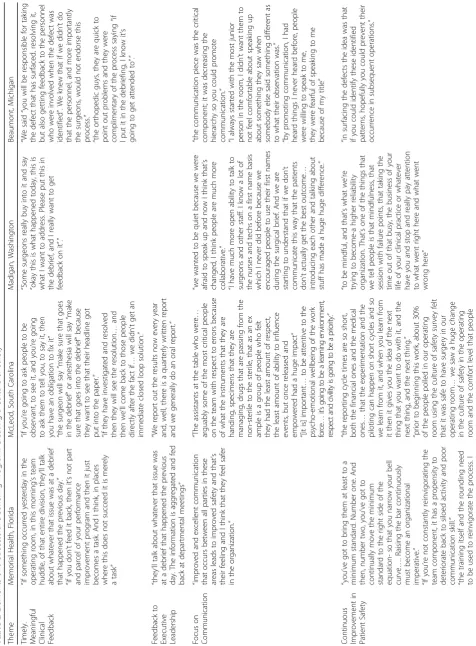
All four interviewees identified executive leadership as important in both creating and maintaining programs
(Table 1). Early leadership participation in establishing
and prioritizing the program, ongoing on-site engage-ment as well as the creation of enforceengage-ment measures all represent different ways in which the administrative leadership helped to support programs.
Early, aggressive administrative engagement
At each site, the highest levels of administrative leadership played an important role at the outset of implementation. At Madigan and at MacLeod, executive leadership provided the initial impetus for program development, giving clin-ician leaders an opportunity to create a process with strong administrative support. In Florida, the executive was con-vinced by local physician leaders and subsequently made the program a priority. In Michigan, there was strong en-dorsement of a debriefing program that was established by clinician leaders. The leadership commitment required was
described by Dr. Stanley Marks: “the army has to be your
senior leaders… the senior leaders have to embrace it and have to continue to train it and live it”.
Executive experience with quality improvement (not necessarily in surgery)
[image:4.595.57.540.89.239.2]programs of system improvement, many executive leaders had experience in other system-wide quality im-provement strategies. Individual experiences ranged from experience in the flight industry, work within the commercial industry as well as direct involvement with medical quality and safety. Dr. Michael Rose described the quality improvement experience of one of their hos-pital board members:
“His job had been with [a large national
manufacturing company…that had a very high work force injury rate and very high workforce turnover from poor morale; and the last major project that he did with [the company]…was coming in and creating a culture of safety…. I think they got up to something like 1,000 days without an injury before they had their first one which was relatively minor but it was the turnaround on their culture of safety and their injury rates, so he was quite an expert in general execution in the cultural aspects and the kind of seriousness and support that you needed from leadership when you took on an effort like this.”
Ongoing, visible, on-site administrative involvement The programs that remained successful all reported strong ongoing engagement of leadership. At McLeod and Memorial health, this engagement took the form of executive staff being physically present in the operating rooms and other areas where clinical care takes place. This physical presence performed two functions, 1) keeping the executive staff aware and more directly connected with the issues faced by the front-line staff, and 2) reinforcing to the front-line staff the genuine commitment of the institution to the process. Dr. Michael Rose summarized the importance of this onsite
presence;“the ability to reach out to senior people, up to
and including board members and have them engage at that level with staff as a point of emphasis on the import-ance of the work is part of the ‘secret sauce’ here”. In
Memorial Health Care and McLeod, the ongoing direct involvement of the highest levels of executive staff remained an important part of the program long after the original implementation.
Institutional mandates
An institutional mandate has helped to maintain the
debriefing programs at Memorial Health and at
Madigan. At Memorial Health, participation in team training was directly tied to the privileging of staff while the military structure at Madigan allowed reinforcement to be tied to military promotion and discipline. The
leadership at McLeod engaged staff participation
through repeated and direct communication between
administration and frontline staff. Using an institutional mandate as a method of achieving participation was
described by Stanley Marks; “I believe that leadership,
number one, mandates it and stands behind that mandate. If a member of the medical staff doesn’t take the course and cooperate with the policies, they can’t op-erate here.” Dr. Andrew Foster described a similar
approach at Madigan “It was very important to us to
have senior leaders there that said,‘this is what we are going to do, and it really isn’t an option not to partici-pate in this’.”
Factors key to program success: creating a culture of safety
Developing a culture of safety and using meaningful feed-back to generate a pattern of continuous improvement are
common themes that arose during the interviews (Table2).
Creating and maintaining a“just culture”dedicated to
sur-gical safety involved a focus on empowering sursur-gical nurses and encouraging open communication.
Empowerment and“Leveling the Playing Field”
Each of the leaders interviewed acknowledged that the traditional hierarchical approach to communication posed a threat to patient safety. Leveling the playing field allowed all members to recognize and report threats to patient safety and improve communication. Dr. Michael
Rose described this process as giving voice to“a group of
people who felt they had the least amount of respect, the least amount of ability to influence events, but once re-leased and empowered, had a huge impact”.
Empowering nurses means providing them with sup-port from the highest levels of administration. Dr. Andrew Foster describes the structure of support at
Madigan in Washington: “… we have empowered our
nurses and techs to say ‘hey, we’re not bringing this pa-tient back until we’ve talked; because number one I’ve been empowered to speak up if I see a safety issue; and number two I’ll go to my leadership, I’ll go to your lead-ership as a matter of fact.’”
Creating an atmosphere of open communication was often described as a responsibility that rested with the surgeon; who would invite input from all members on things that could have been done better. To emphasize that everyone’s voice was valued, the surgeon would first ask those who were traditionally less likely to speak up. Dr. Robert Welsh is a clinician leader who exemplifies
this approach: “Even if it was a medical student in the
Table
2
Elements
of
a
Successful
Debriefing
Program:
Creating
a
Culture
of
Safety
(Continued)
Theme
Memo
rial
Healt
h,
Flo
rida
McLe
od,
South
Carol
ina
Mad
igan,
Wash
ington
Beaum
ont,
Michi
gan
think
that
if
you
train
once
and
forg
et
it
,
you
will,
at
best
,
have
a
task
.
But
if
you
reinvigorate
that
learning
so
that
it
’
s
don
e
every
day
and
becomes
part
of
the
culture
of
the
organization
”
“
although
I
think
we
’
ve
don
e
pretty
we
ll,
I
’
m
totall
y
of
the
opini
on
that
we
ha
ve
to
continu
e
…
this
is
a
work
in
progr
ess...
and
we
will
ha
ve
to
cont
inue
to
stay
focused
in
this
area
if
we
expect
cont
inued
improve
ment.
”
had:
safe
ty
mattere
d,
that
someb
ody
was
listen
ing,
someb
ody
would
do,
som
ebo
dy
woul
d
act
Feedback on debriefing issues to stakeholders
Feedback on the issues raised in the debrief was com-monly regarded by the clinical leaders as the cornerstone to successful debriefing. Providing caregivers with early and meaningful feedback on identified problems gave the participants the satisfaction of seeing their problems recognized and prioritized, allowed repetitive issues to be addressed and gave the participants faith that the de-brief achieved a purpose. Dr. Robert Welsh reported that even the surgeons who were resistant, became fans of
the process:“they were complimentary of the process
say-ing,‘if I put it in the debriefing, I know it’s going to get attended to’”. Feedback provided to the executive also
provided an additional way in which leadership could be further engaged in process improvement.
Focusing a system on continual improvement is a strong part of creating a culture that focuses on surgical safety. The process is described by Dr. Stanley Marks: “you’ve got to continually move the minimum standard to the right side of the equation so that you narrow your bell curve…. Raising the bar continuously must become an organizational imperative”.
Challenges to the debriefing program
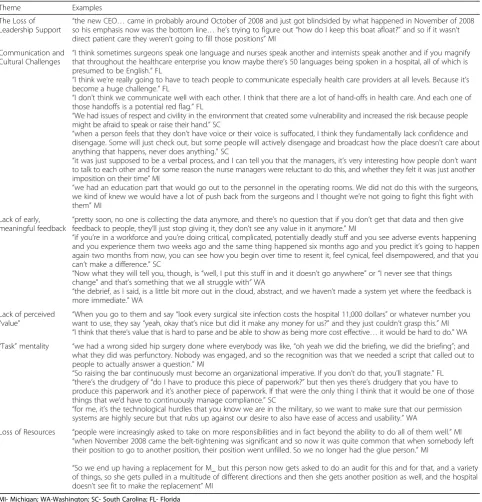
Each of the leaders interviewed spoke about challenges that they had encountered in the process of implement-ing the debriefimplement-ing program and challenges that pose a
constant threat to ongoing performance (Table3).
The loss of leadership support and resources were concrete threats to the ongoing effectiveness of these programs. In Michigan, Dr. Welsh describes the change in leadership as coinciding with a change in institutional
priorities: “the new CEO… came in probably around
October of 2008 and just got blindsided by [the economic downturn] in November of 2008 so his emphasis now was the bottom line…he’s trying to figure out ‘how do I keep this boat afloat?’”
In addition, breakdowns in communication lead to the reluctance of disempowered team-members to speak up and lead team members to disengage with the process.
Dr. Stanley Marks provided an illustration of the wide-spread issues with communication in health care
sys-tems: “I think sometimes surgeons speak one language
and nurses speak another and internists speak another and if you magnify that throughout the healthcare enter-prise you know maybe there’s 50 languages being spoken in a hospital, all of which is presumed to be English.”
Dr. Michael Rose described the feelings of disillusion-ment that lead to disengagedisillusion-ment in a system that fails to
achieve an atmosphere of open communication:“when a
person feels that they don’t have voice or their voice is suffocated, I think they fundamentally lack confidence and disengage. Some will just check out, but some people will actively disengage and broadcast how the place
doesn’t care about anything that happens, never does anything.”
Providing early meaningful feedback was frequently identified as a key to team members valuing the check-list. When feedback was no longer reliably provided, leaders recognized that this represented a great threat to meaningful participation with degeneration of the
debriefing and the entire checklist into a “task” or
complete abandonment.
Dr. Michael Rose describes the dangers of the lack of
meaningful feedback:“if you’re in a workforce and you’re
doing critical, complicated, potentially deadly stuff and you see adverse events happening and you experience them two weeks ago and the same thing happened six months ago and you predict it’s going to happen again two months from now, you can see how you begin over time to resent it, feel cynical, feel disempowered, and that you can’t make a difference.”
Beaumont hospital, Michigan: Why did it fail?
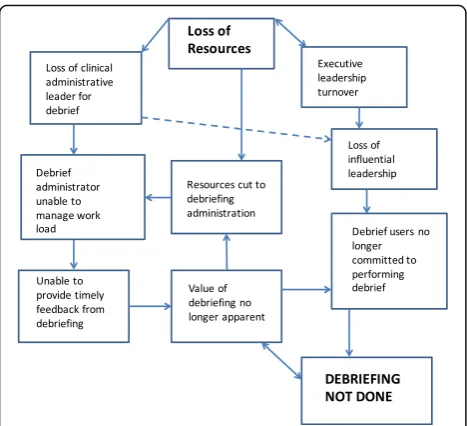
Beaumont hospital faced many of the same challenges that other programs faced. Unlike these programs, the system eventually collapsed. An examination of the pro-cesses that eventually led to the program’s failure
illus-trates the fragility of these systems (Fig.2).
Dr. Robert Welsh identified the financial crash of 2008 as being the catalyst for the program’s collapse. This oc-curred at the same time as a change in executive leader-ship. Although executive leadership had supported the program, their involvement was at more of an arms-length than the other programs we have examined and this leadership change further distanced the leadership from the debriefing program. The economic advantages of a debriefing program were not easy illustrated and op-erated based on costs saved or avoided rather than rev-enue generated. Robert Welsh describes how the economic impact of 2008 affected the administration’s views on revenue generation and cost-savings:
“They don’t see that costs avoided are worth considering as much as…“how did I negotiate a contract or save money?”or“what did I do to increase the income?”… the averted cost was just not something that they were willing to recognize. When you go to them and say‘look every surgical site infection costs the hospital 11,000 dollars’or whatever number you want to use, they say
‘yeah, okay that’s nice but did it make any money for us?’and they just couldn’t grasp this.”
providing feedback. Once this process was no longer performed adequately, those using the checklist no lon-ger saw the value of the process and stopped participat-ing in this. This loss of feedback was regarded by Dr. Welsh as the key aspect that led the program to collapse: “…pretty soon, no one is collecting the data anymore, and there’s no question that if you don’t get that data and then give feedback to people, they’ll just stop giving it; they don’t see any value in it anymore.”
With the change in the executive leadership, the voiced institutional support of the program was also missing and the clinician leaders of the debriefing pro-gram no longer had the support of the administration and the culture of safety was no longer a prevalent force.
Discussion
[image:11.595.58.541.98.601.2]Improving surgical safety through debriefing is a complex endeavor. Although the role of debriefing is acknowledged
Table 3The Challenges Encountered in Developing and Maintaining a Debriefing Program
Theme Examples
The Loss of
Leadership Support “
the new CEO…came in probably around October of 2008 and just got blindsided by what happened in November of 2008 so his emphasis now was the bottom line…he’s trying to figure out“how do I keep this boat afloat?”and so if it wasn’t direct patient care they weren’t going to fill those positions”MI
Communication and Cultural Challenges “
I think sometimes surgeons speak one language and nurses speak another and internists speak another and if you magnify that throughout the healthcare enterprise you know maybe there’s 50 languages being spoken in a hospital, all of which is presumed to be English.”FL
“I think we’re really going to have to teach people to communicate especially health care providers at all levels. Because it’s become a huge challenge.”FL
“I don’t think we communicate well with each other. I think that there are a lot of hand-offs in health care. And each one of those handoffs is a potential red flag.”FL
“We had issues of respect and civility in the environment that created some vulnerability and increased the risk because people might be afraid to speak or raise their hand.”SC
“when a person feels that they don’t have voice or their voice is suffocated, I think they fundamentally lack confidence and disengage. Some will just check out, but some people will actively disengage and broadcast how the place doesn’t care about anything that happens, never does anything.”SC
“it was just supposed to be a verbal process, and I can tell you that the managers, it’s very interesting how people don’t want to talk to each other and for some reason the nurse managers were reluctant to do this, and whether they felt it was just another imposition on their time”MI
“we had an education part that would go out to the personnel in the operating rooms. We did not do this with the surgeons, we kind of knew we would have a lot of push back from the surgeons and I thought we’re not going to fight this fight with them”MI
Lack of early, meaningful feedback
“pretty soon, no one is collecting the data anymore, and there’s no question that if you don’t get that data and then give feedback to people, they’ll just stop giving it, they don’t see any value in it anymore.”MI
“if you’re in a workforce and you’re doing critical, complicated, potentially deadly stuff and you see adverse events happening and you experience them two weeks ago and the same thing happened six months ago and you predict it’s going to happen again two months from now, you can see how you begin over time to resent it, feel cynical, feel disempowered, and that you can’t make a difference.”SC
“Now what they will tell you, though, is“well, I put this stuff in and it doesn’t go anywhere”or“I never see that things change”and that’s something that we all struggle with”WA
“the debrief, as I said, is a little bit more out in the cloud, abstract, and we haven’t made a system yet where the feedback is more immediate.”WA
Lack of perceived
“value” “
When you go to them and say“look every surgical site infection costs the hospital 11,000 dollars”or whatever number you want to use, they say“yeah, okay that’s nice but did it make any money for us?”and they just couldn’t grasp this.”MI “I think that there’s value that is hard to parse and be able to show as being more cost effective…it would be hard to do.”WA “Task”mentality “we had a wrong sided hip surgery done where everybody was like,“oh yeah we did the briefing, we did the briefing”; and
what they did was perfunctory. Nobody was engaged, and so the recognition was that we needed a script that called out to people to actually answer a question.”MI
“So raising the bar continuously must become an organizational imperative. If you don’t do that, you’ll stagnate.”FL “there’s the drudgery of“do I have to produce this piece of paperwork?”but then yes there’s drudgery that you have to produce this paperwork and it’s another piece of paperwork. If that were the only thing I think that it would be one of those things that we’d have to continuously manage compliance.”SC
“for me, it’s the technological hurdles that you know we are in the military, so we want to make sure that our permission systems are highly secure but that rubs up against our desire to also have ease of access and usability.”WA
Loss of Resources “people were increasingly asked to take on more responsibilities and in fact beyond the ability to do all of them well.”MI “when November 2008 came the belt-tightening was significant and so now it was quite common that when somebody left their position to go to another position, their position went unfilled. So we no longer had the glue person.”MI
“So we end up having a replacement for M_ but this person now gets asked to do an audit for this and for that, and a variety of things, so she gets pulled in a multitude of different directions and then she gets another position as well, and the hospital doesn’t see fit to make the replacement”MI
as an important part of surgical safety, debriefing is rarely performed in institutional audits of checklist compliance
[5,7]. We have examined four programs that have
effect-ively instituted debriefing systems to improve patient safety and the overall effectiveness of the health system. The leaders of these systems have commonly identified strong executive leadership involvement, meaningful and early feedback and a culture of safety and continuous im-provement as keys to their success. Each program recog-nizes ongoing threats to the success of their programs. These threats are those of resources (financial and personnel), the loss of meaningful and early feedback, and the perseverance of traditional hierarchies resulting in the failure to achieve fair and open communication. In the case of Michigan’s debriefing program, a loss of resources was the catalyst to the eventual collapse of the debriefing program primarily when meaningful feedback was no lon-ger provided to the surgical teams.
Debriefing is well-established in many high-acuity disciplines where it contributes to a culture of commu-nication, reflection and continuous improvement. The American Heart Association strongly promotes the use
of debriefing to improve the running of codes [15].
Studies of debriefing after codes demonstrate improved team communication as well as improved performance
measures and clinical outcomes. [16–19]. Similar results
are seen when debriefing is applied to trauma care [17,
20]. The four interviewees in our study all pointed to
numerous ways in which debriefing in surgery contrib-uted to improved clinical care, patient safety, communi-cation, attitudes and efficiency at their institutions. Although patient safety is the priority for each of these programs, the debriefing also offered an opportunity to
improve performance measures related to process-expanding the potential value of the program and acting, in part, as a Trojan Horse to introduce important safety alongside those measures that improve the business-side of surgical systems. Published results from Madigan, Washington specifically show improvement in operating
room efficiency [10] while the program at Beaumont
found numerous communication and equipment issues
that improved with the use of debriefing [9]. In
institu-tional publications and presentations, the Memorial Health System in Florida reported improvements in communication, measures of satisfaction, teamwork and
safety culture [14] while McLeod Health reported
im-provement in surgical mortality, a decrease in patient safety events and an improvement in measures of
satis-faction and attitudes surrounding safety [13].
There is no simple answer as to why debriefing is not adopted routinely after surgical procedures. Qualitative studies through surveys and interviews suggest multiple reasons including logistical challenges and a perceived
lack of value [6,8]. The logistical challenges relate to the
different times at which team members’ roles conclude
in surgical procedures and the competing require-ments of circulating nurses who are frequently tasked with running the debriefing. The perception that debriefing lacks value relates to the fact that some el-ements are redundant, other elel-ements may not be directly applicable to the care of the patient and is-sues arising in the debrief are not addressed or valued
by the institution [8].
The lack of a strong culture of surgical safety likely contributes to the devaluing of the debriefing both by the institution and by the team members who directly participate in the care of the patient.
The interviewees from each of the four sites recog-nized that an immediate tangible value of the checklist would best ensure that the surgical team would partici-pate in debriefing. Often this meant addressing concerns
that impacted the teams’ ability to perform its job
effi-ciently in addition to other issues related to improving performance. The fact that issues of equipment and process could be corrected and the surgical team could experience the immediate benefits of participation, gave them a greater commitment to the process.
[image:12.595.57.291.86.299.2]culture of an institution requires a comprehensive strategy in which team training may play a critical role.
When quality and safety tools are applied without an institutional strategy for ongoing implementation, they are likely to fail. This can be seen in studies of surgical safety checklist that do not specifically involve
imple-mentation strategies [4,21]. When the checklist is
intro-duced as a tool to facilitate communication within a broader institutional strategy, the impact can be
tremen-dous [22]. Programs that succeed in developing
debrief-ing programs to improve surgical safety must remain committed to ongoing improvement and a commitment to communication.
There are many threats to the ongoing success. At Beaumont Hospital in Michigan, the loss of resources was devastating to the debriefing program as key posi-tions were defunded. It is possible that if the executive administration valued the program more either econom-ically or within a stronger institution-wide culture of safety, economic scarcity might not have had the same impact. Stanley Marks at Memorial Health in Florida reflected that the value of the program is so engrained within the institutional culture that it is not likely to be impacted by scarcity. But maintaining the institutional culture takes work. Even in programs like Memorial Health, Stanley Marks refers to the constant threat of
degeneration into a“task”mentality.
Conclusions
The value of the debriefing systems established by four sur-gical centers in diverse settings across the United States is tremendous. Even in Beaumont, where the system failed, there remains a strong commitment by clinician leaders to re-establish the program. The fragility of these systems ex-posed by the collapse at Beaumont underlines the import-ance of strong executive involvement, a reliable system of meaningful feedback and prioritization of communication within a system designed to constantly improve.
Abbreviations
US:United States; WHO: World Health Organization
Acknowledgements
The authors thank James Sachetta who helped to arrange and record interviews and Ali MacRobie for transcribing the interviews.
Funding
This project was done without funding support.
Availability of data and materials
All data generated or analyzed during this study are included in this published article [and its supplementary information files].
Authors’contributions
>MB Designed the study, developed the interview scripts, performed the interviews, coded the interviewer responses, analyzed the responses and generated the manuscript. NH Helped develop the interview scripts and the approach to data coding as well as data abstraction, aided in framing the results and revising the manuscript. AF, SM, MR, RW identified key themes
and provided information from each of the four centers, they aided in interpreting and framing the results. Each author aided in manuscript revision. WB conceptualized the study and developed the study design. He aided in manuscript revision. All co-authors have reviewed the manuscript and approve of it in its final form.
Ethics approval and consent to participate
This study was reviewed by the Harvard Ethics Board and judged to be exempt from ethics review as it was judged to be“minimal risk”for participating subjects. Each participant was offered the opportunity for anonymity within the study but each participant asked that they be identified. Informed consent was obtained from all participants prior to being interviewed.
Consent for publication
Written informed consent including consent for publication of identifying information was obtained from all participants.
Competing interests
The authors declare that they have no competing interests.
Publisher’s Note
Springer Nature remains neutral with regard to jurisdictional claims in published maps and institutional affiliations.
Author details
1Ariadne Labs at Brigham and Women’s Hospital and the Harvard TH Chan School of Public Health, Boston, MA, USA.2Department of Surgery and Community Health Sciences, University of Calgary, Affiliate Faculty, Ariadne Labs, Alberta Children’s Hospital, 2888 Shaganappi Trail NW, Calgary, AB T2N0Z6, Canada.3Department of Anesthesia and Operative Services, Madigan Army Medical Center, Tacoma, WA, USA.4Memorial Healthcare System, Fort Lauderdale, FL, USA.5McLeod Health, Florence, SC, USA. 6Department of Surgery, University of South Carolina School of Medicine,
Columbia, USA.7Beaumont Health-Royal Oak, Royal Oak, MI, USA.
Received: 19 November 2016 Accepted: 14 March 2018
References
1. Kohn LT, Corrigan JM, Donaldson MS. To Err is Human: Building a Safer Health System. In: Kohn LT, Corrigan JM, Donaldson MS, editors. To Err is Human. Washington (DC): Building a Safer Health System; 2000. 2. Haynes AB, Weiser TG, Berry WR, Lipsitz SR, Breizat AH, Dellinger EP, et al. A
surgical safety checklist to reduce morbidity and mortality in a global population. N Engl J Med. 2009;360(5):491–9.
3. Makary MA, Daniel M. Medical error-the third leading cause of death in the US. BMJ. 2016;353:i2139.
4. Urbach DR, Govindarajan A, Saskin R, Wilton AS, Baxter NN. Introduction of surgical safety checklists in Ontario, Canada. N Engl J Med. 2014;370(11):1029–38. 5. van Klei WA, Hoff RG, van Aarnhem EE, Simmermacher RK, Regli LP, Kappen TH, et al. Effects of the introduction of the WHO“Surgical Safety Checklist” on in-hospital mortality: a cohort study. Ann Surg. 2012;255(1):44–9. 6. Vogts N, Hannam JA, Merry AF, Mitchell SJ. Compliance and quality in
administration of a Surgical Safety Checklist in a tertiary New Zealand hospital. N Z Med J. 2011;124(1342):48–58.
7. Vats A, Vincent CA, Nagpal K, Davies RW, Darzi A, Moorthy K. Practical challenges of introducing WHO surgical checklist: UK pilot experience. BMJ. 2010;340:b5433. 8. Bergs J, Lambrechts F, Simons P, Vlayen A, Marneffe W, Hellings J, et al.
Barriers and facilitators related to the implementation of surgical safety checklists: a systematic review of the qualitative evidence. BMJ Qual Saf. 2015;24(12):776–86.
9. Bandari J, Schumacher K, Simon M, Cameron D, Goeschel CA, Holzmueller CG, et al. Surfacing safety hazards using standardized operating room briefings and debriefings at a large regional medical center. Jt Comm J Qual Patient Saf. 2012;38(4):154–60.
10. Porta CR, Foster A, Causey MW, Cordier P, Ozbirn R, Bolt S, et al. Operating room efficiency improvement after implementation of a postoperative team assessment. J Surg Res. 2013;180(1):15–20.
12. Pronovost P. Interventions to decrease catheter-related bloodstream infections in the ICU: the Keystone Intensive Care Unit Project. Am J Infect Control. 2008; 36(10):S171. e1–S. e5.
13. Rose MK, T. The Role of Behaviors and Talent in Patient Safety and Organizational Culture. 2015.
14. Marks SWL J, Greenfield A, Berlin RE, Kadis J, Doss R. Surgical Team Debriefing and Follow-UP: Creating an Efficient, Positive Operating Room Environment to Improve Patient Safety. Florida: Memorial Healthcare System; 2014. 15. American Heart Association. Highlights of the 2015 American Heart Association.
Dallas, Texas: Guidelines update for CPR and ECC; 2015.
16. Andreatta P, Saxton E, Thompson M, Annich G. Simulation-based mock codes significantly correlate with improved pediatric patient
cardiopulmonary arrest survival rates. Pediatr Crit Care Med. 2011;12(1):33–8. 17. Crowe C, Bobrow BJ, Vadeboncoeur TF, Dameff C, Stolz U, Silver A, et al.
Measuring and improving cardiopulmonary resuscitation quality inside the emergency department. Resuscitation. 2015;93:8–13.
18. Wolfe H, Zebuhr C, Topjian AA, Nishisaki A, Niles DE, Meaney PA, et al. Interdisciplinary ICU cardiac arrest debriefing improves survival outcomes*. Crit Care Med. 2014;42(7):1688–95.
19. Dine CJ, Gersh RE, Leary M, Riegel BJ, Bellini LM, Abella BS. Improving cardiopulmonary resuscitation quality and resuscitation training by combining audiovisual feedback and debriefing. Crit Care Med. 2008;36(10):2817–22. 20. Berg GM, Hervey AM, Basham-Saif A, Parsons D, Acuna DL, Lippoldt D.
Acceptability and implementation of debriefings after trauma resuscitation. J Trauma Nurs. 2014;21(5):201–8.
21. Ko HC, Turner TJ, Finnigan MA. Systematic review of safety checklists for use by medical care teams in acute hospital settings–limited evidence of effectiveness. BMC Health Serv Res. 2011;11:211.
22. Treadwell JR, Lucas S, Tsou AY. Surgical checklists: a systematic review of impacts and implementation. BMJ Qual Saf. 2014;23(4):299–318.
• We accept pre-submission inquiries
• Our selector tool helps you to find the most relevant journal • We provide round the clock customer support
• Convenient online submission • Thorough peer review
• Inclusion in PubMed and all major indexing services • Maximum visibility for your research
Submit your manuscript at www.biomedcentral.com/submit