R E S E A R C H A R T I C L E
Open Access
Algorithms to identify COPD in health
systems with and without access to ICD
coding: a systematic review
Holger Gothe
1,2*, Sasa Rajsic
1, Djurdja Vukicevic
1, Tonio Schoenfelder
2, Beate Jahn
1, Sabine Geiger-Gritsch
1,
Diana Brixner
3, Niki Popper
1,4,5, Gottfried Endel
6and Uwe Siebert
1,7,8,9Abstract
Background:Chronic obstructive pulmonary disease (COPD) causes significant morbidity and mortality worldwide. Estimation of incidence, prevalence and disease burden through routine insurance data is challenging because of under-diagnosis and under-treatment, particularly for early stage disease in health care systems where outpatient International Classification of Diseases (ICD) diagnoses are not collected. This poses the question of which criteria are commonly applied to identify COPD patients in claims datasets in the absence of ICD diagnoses, and which information can be used as a substitute. The aim of this systematic review is to summarize previously reported methodological approaches for the identification of COPD patients through routine data and to compile potential criteria for the identification of COPD patients if ICD codes are not available.
Methods:A systematic literature review was performed in Medline via PubMed and Google Scholar from January 2000 through October 2018, followed by a manual review of the included studies by at least two independent raters. Study characteristics and all identifying criteria used in the studies were systematically extracted from the publications, categorized, and compiled in evidence tables.
Results:In total, the systematic search yielded 151 publications. After title and abstract screening, 38 publications were included into the systematic assessment. In these studies, the most frequently used (22/38) criteria set to identify COPD patients included ICD codes, hospitalization, and ambulatory visits. Only four out of 38 studies used methods other than ICD coding. In a significant proportion of studies, the age range of the target population (33/38) and hospitalization (30/ 38) were provided. Ambulatory data were included in 24, physician claims in 22, and pharmaceutical data in 18 studies. Only five studies used spirometry, two used surgery and one used oxygen therapy.
Conclusions:A variety of different criteria is used for the identification of COPD from routine data. The most promising criteria set in data environments where ambulatory diagnosis codes are lacking is the consideration of additional illness-related information with special attention to pharmacotherapy data. Further health services research should focus on the application of more systematic internal and/or external validation approaches.
Keywords:COPD, Chronic obstructive pulmonary disease, ICD code, Patient identification, Case finding, Epidemiology, Prevalence, Incidence, Claims data, Routine data, Administrative data, Secondary data
© The Author(s). 2019Open AccessThis article is distributed under the terms of the Creative Commons Attribution 4.0
International License (http://creativecommons.org/licenses/by/4.0/), which permits unrestricted use, distribution, and
reproduction in any medium, provided you give appropriate credit to the original author(s) and the source, provide a link to the Creative Commons license, and indicate if changes were made. The Creative Commons Public Domain Dedication waiver (http://creativecommons.org/publicdomain/zero/1.0/) applies to the data made available in this article, unless otherwise stated. * Correspondence:[email protected];
1Department of Public Health, Health Services Research and Health
Technology Assessment, Institute of Public Health, Medical Decision Making and Health Technology Assessment, UMIT–University for Health Sciences, Medical Informatics and Technology, Eduard Wallnoefer Zentrum 1, A-6060 Hall i.T., Austria
2Medical Faculty“Carl Gustav Carus”, Technical University Dresden,
Loescherstrasse 18, D-01307 Dresden, Germany
Introduction
Chronic obstructive pulmonary disease (COPD) is a condition characterized by constriction of the airways, and persistent shortness of breath that interferes with normal breathing. The disease develops over a long period of time and is not fully reversible [1]. COPD is a cause of significant morbidity and mortality. Globally, it is estimated that about three million deaths were caused by the disease in 2015 (i.e., 5% of all deaths globally that year) [2]. The World Health Organization (WHO) reported that COPD was the third cause of mortality worldwide in 2016 [3]. If a COPD diagnosis is made earlier in the progression of the disease, there is a greater potential to reduce further lung damage [4]. For this reason, the identification of COPD patients in early stages of the disease is of great interest for the social health insurance system. Accurate estimates of COPD prevalence are essential for the implementation of strategies for detection and disease management.
The identification of patients suffering from COPD through routine insurance data for a correct measurement and estimation of disease epidemiology and burden of dis-ease turns out to be difficult for various reasons. It is well known that most COPD cases are caused by tobacco con-sumption over long time periods, but this information, as other life-style-related variables, is generally not available in routine claims datasets. Another reason is underreport-ing, since there is a very large population of undiagnosed patients with this disease and individuals are undertreated, especially in early stages. In the United Kingdom, for example, there are approximately 835,000 individuals with a diagnosis of COPD, while over 2,200,000 individuals are estimated to be living with undiagnosed COPD [5].
The most commonly practiced approach to filter affected beneficiaries from large datasets (e.g., claims databases) is to apply filter algorithms referring to the International Classification of Diseases (ICD) system, a standard tool in clinical medicine, epidemiology, and health management. Epidemiologists use the ICD system to monitor the inci-dence and prevalence of diseases and disorders, gaining an insight in the possible health situation of populations and countries. Medical practitioners and clinicians use ICD to identify and to document diseases or other health conditions which can subsequently be archived in health administrative databases and health records. These datasets offer the foundation for the reporting on national mortality and morbidity statistics by WHO Member States. Furthermore, ICD is used for reimbursement purposes and for decision-making re-garding resource allocation by many countries [6].
Identifying COPD patients in the absence of ICD codes in a large dataset is challenging, as it requires the combination of other suitable identifiers, which may be included in the data, such as pharmacy based health
plans (PBMs) in the US, South Africa, or in Europe. For example, in the Austrian outpatient system the ICD code is not available in routine data, and therefore identifying COPD patients via medical claims is even more difficult. Thus, the Main Association of Austrian Social Insurance Institutions (“Hauptverband der österreichischen Sozial-versicherungsträger”) likely uses advanced mathematical methods to identify COPD patients with available rou-tine data.
Aim
The goals of this study are to summarize previously reported methodological approaches to identify COPD patients through routine data, and to compile potential surrogate criteria for the identification of COPD patients when ICD codes are not available.
Methods
Information sources
A systematic literature review was performed in Medline via PubMed and Google Scholar, followed by a manual review of the included studies. Medline via the PubMed interface was used to conduct separate literature searches in the English or German language from January 2000 through October 2018. The systematic literature search was performed with the following algorithm: (“ epidemi-ology”OR“prevalence”OR“incidence”) AND (“COPD”OR “chronic obstructive pulmonary disease”) AND (“claims data”OR“routine data”OR“administrative data”).
To ensure maximum completeness of the search, we performed a reference list search of the included studies for additional relevant citations via Google Scholar. We did not search the Internet to assess available grey litera-ture. Each included study was summarized narratively and presented in evidence tables with regard to the study aim, datasets used and the identification criteria for COPD patients. In studies where sensitivity analysis of the algorithm regarding the correct identification of COPD was performed, these results were reported.
Literature screening process, inclusion and exclusion criteria
The title and abstract screening was conducted by three authors (SR, DV, SG), based on predetermined selection criteria (see below). In case of incongruence, a fourth assessor (HG) made a final decision on the eligibility of a publication. The full-text articles of selected studies were further reviewed by at least two authors and in-cluded if they met all inclusion criteria.
was used, and (4) identification criteria for COPD were clearly explained.
Studies were excluded if they primarily reported on diseases other than COPD or if the addressed interven-tion (e.g., thoracic surgery) was irrelevant. We excluded all studies enrolling pre-diagnosed COPD patients, for whom there was no need to show any identification algorithms, as these studies would not help answer our research question. Similarly, publications were excluded if the COPD identification algorithms were not revealed in the text, or if they consisted only of a study protocol.
Data extraction and reporting
We extracted descriptors of the studies and related pub-lications as well as characteristics commonly used for the description of COPD populations. We pre-defined the following data to be extracted from the publications: author(s), year of publication, publication title, country of conduct of the study, dataset(s) used, age range, ICD codes, hospitalization data, ambulatory visit data, phys-ician claims data, ambulatory pharmacotherapy, spirom-etry data, oxygen therapy data, COPD-related surgical procedure, and algorithm of COPD diagnosis. Data extraction was performed by one assessor and validated by a second assessor.
Existing risk of bias tools such as the Cochrane risk of bias tool for randomized controlled trials [7], the Newcastle-Ottawa Quality Assessment Form for Cohort Studies [8], and the ROBINS-I tool for assessing risk of bias in non-randomized studies of interventions [9] are not applicable to studies using administrative data analyses. Until now, no well-accepted specific tools for these kinds of studies are available; we therefore used the method of algorithm validation within our studies to judge the risk of bias. Specifically, the risk of bias was appraised by classifying the studies into two risk groups: (1)“low risk of bias”if the used algorithm was validated against a reference standard with sensitivity and specifi-city greater than 70% and (2) “high risk of bias” if the algorithm was not validated or sensitivity was lower than 70%.
The review was conducted according to PRISMA -Preferred Reporting Items for Systematic Reviews and Meta-Analyses [10]. Results are reported as standardized narrative summaries of the included studies and as an evidence table for the identification criteria utilized in the included studies. The different instruments, methods, and algorithms to identify COPD patients, the databases used and related challenges are discussed in detail.
Results Included studies
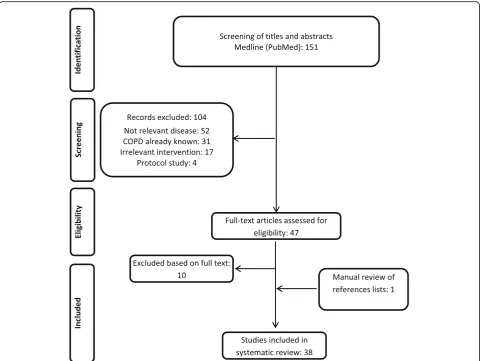
The search yielded 151 hits in Medline via PubMed, with the last update in October 2018. After title and abstract
screening, 104 papers were excluded for the following rea-sons: 52 studies addressed a disease other than COPD, in 31 studies patients were identified without disclosing the algorithm or because the patients’ COPD status was known at the beginning of the study, 17 studies described an irrelevant intervention or condition (e. g., COPD not in the focus of the analysis) and four studies were protocols only. Search via Google Scholar did not yield any citations beyond the Medline search, while the hand search of the included studies reference lists revealed one more study, which was included (Mapel et al. 2006 [11]).
Forty-seven papers were included for full-text screen-ing (see Fig.1), 10 of them were excluded due to the fol-lowing reasons: Two publications (Chu et al. 2010 [12], Schneider et al. 2009 [13]) were excluded, because they focused on general aspects of COPD or chronic diseases. Thus, both publications do not specify which algorithms were used for the identification of COPD patients from the datasets. Eight studies were excluded, because they used ICD codes only (Albrecht et al. 2016 [14]; Fortin et al. 2017 [15]; Schwarzkopf et al. 2016 [16]), or because they only reported the study protocol (Josephs et al. 2017 [17]), or because they did not differentiate between asthma and COPD (Marrie et al. 2016 [18]; Oelsner et al. 2016 [19]). One publication was excluded, because it duplicated another publication (Vozoris et al. 2016 [20]), and one study was excluded, because it investi-gated a different disease (Pollmanns et al. 2018 [21]). Finally, 38 studies were included in the review as one study was identified by hand search.
Included studies predominantly reflect the situation of North American countries: United States (n = 17) and Canada (n = 17). Four studies reported on the COPD identification process in Europe: United Kingdom (n = 1); Italy (n= 2) and France (n= 1) (Tables1and2).
This review covers a publication period of 16 years as the first study was published in 2003 (Hansell et al.). In the first 8 years (2003–2010), nine articles were pub-lished, while in the next 8 years (2011–2018), 29 studies (76.3%) were published.
The classification into high and low risk of bias accord-ing to the performed validation of algorithm, resulted in 15 studies with“low risk of bias”due to a validated algo-rithm with a sensitivity and specificity higher than 70%, whereas 23 studies either did not use a validated algorithm (n = 14) or the validation of their algorithm revealed a sensitivity lower than 70% (n= 8) or missing data limited validation (n= 1) (Tables1and2).
Identification criteria used in the included publications
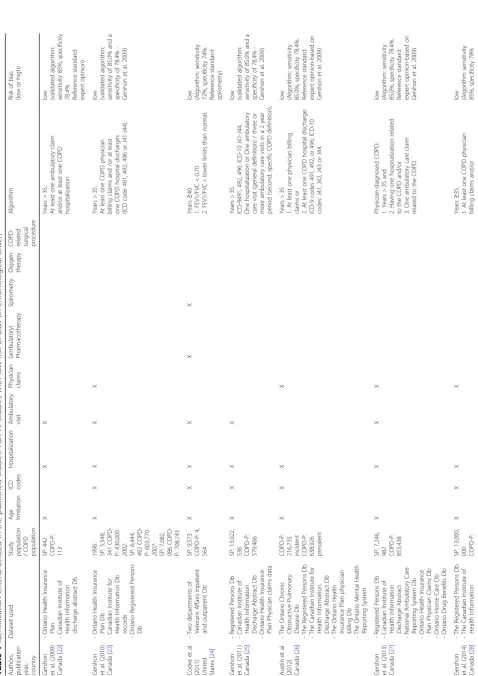
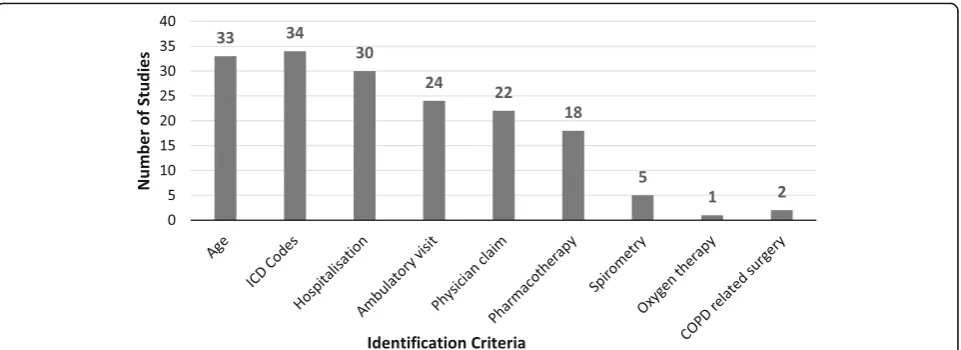
process, while four studies used other methods. In a sig-nificant proportion of studies hospitalization data (30 of 38) and the age range of the target population (33 of 38) were provided. Gershon et al. (2009) [22] and Gershon et al. (2013) [27] used age limitation, and one or more hospitalizations or ambulatory claim as indicators for COPD; while Dalal et al. (2011) [43] used age range and pharmacotherapy claim. Ambulatory data were included in 24 studies, physician claims in 22 studies, and 18 stud-ies stated some kind of pharmaceutical data. Only five studies used spirometry data as part of the identification process and one study used information about home oxygen use (Fig. 2. Criteria used for identification of COPD in the studies). Different combinations of these indicators were used in order to identify COPD patients in assessed studies, showed in Tables 1 and 2. Studies that report on the validity of using a specific approach or algorithm to identify COPD patients carry a correspond-ing indication in the last column of Tables1and2.
The most common combination of identification criteria (22 out of 38 studies) included ICD codes,
hospitalization, and ambulatory visits. The next most common combination (12 out of 38 studies) was adding physician claims to the former three criteria. The next adjoining indicator added to one of these two combina-tions was a prescription claim.
Studies using identification criteria other than ICD codes
Gershon et al. (2009) [22] and Gershon et al. (2013) [27] used other methods than ICD coding. Both studies published by Gershon et al. used an age limitation and one or more claims for hospitalization or ambulatory care as indicators for COPD. Dalal et al. (2011) [43] and Raymakers et al. (2017) [57] used age range and pharma-cotherapy claims.
Gershon et al. (2009) [22] conducted a validation study for population-based administrative COPD definitions. For this validation, two Canadian data sources were used. The first database was the Ontario Health Insur-ance Plan, which contains hospital and outpatient claims for populations in Ontario (including information on la-boratory tests, physicians visit, and diagnostic imaging).
[image:4.595.58.541.87.448.2]Table 1 Identification criteria utilized in the published studies. Part A: Studies with low risk of bias (in chronological order)
Authors, publication year, country
Dataset
used
Study population /COPD population Age limitation ICD codes Hospita lization Am bulatory vis it Physici an claims (ambulatory) Pharmacothe rapy Spirometr y Oxygen therapy COPD- related surgical procedure
Algorithm Risk of bias (low or high) Gershon et al. (2009) Canada [ 22 ] -Ontario Health Insura nce Plan -Canadi an Institute of Health Information discharge abstract Db SP: 442 COPD-P: 113 X X X Years > 35. At least one ambulatory cl aim and/or at least one COPD hospitalization low (validate d algorith m: sensitiv ity 85%, specificity 78.4%. Refe rence standa rd: exp ert op inion) Gershon et al. (2010) Canada [ 23 ] -Ontario Health Insura nce Plan Db -Canadi an Institute for Health Information Db records -Ontario Registered Persons Db 1996: SP: 5,548, 341 COPD-P: 430,000 2002: SP: 6,444, 492 COPD-P: 603,770 2007: SP: 7,082, 086 COPD-P: 708,743 X X X X X Years > 35. At least one COPD ph ysician billing cl aims and /or at least one COPD hospital discharges (ICD code 491, 492, 496 or J41-J44). low (validate d algorith m: sensitiv ity of 85.0% and a spec ificity of 78.4% -Gershon et al. 2009) Cooke et al.
(2011) United States
[ 24 ] -Two department s of Veterans Affairs inpatient and outpat ient Db SP: 9,573 COPD-P: 4, 564 X X X X X X Years ≥ 40 1. FEV1/FVC < 0.70 2. FEV1/FVC < lower limits than normal. low (Algor ithm: sensitivity 72%, specificity 74%. Refe rence standa rd: spiro metry) Gershon et al. (2011) Canada [ 25 ] -Register ed Person s D b -Canadi an Institute of Health Information Discharge Abstract Db -Ontario Health Insura nce Plan Physi cian claims data SP: 13,022,
536 COPD-P: 579,466
X X X X Years > 35. ICD-9491, 492, 496; ICD-10 J41-J44. One hospitalization or One ambulato ry care visit (gener al definiti on) / three or more ambulatory care visits in a 2 year period (second, spec ific COPD definit ion). low (validate d algorith m: sensitiv ity of 85.0% and a spec ificity of 78.4% -Gershon et al. 2009) Austin et al. (2012) Canada [ 26 ] -The Ontario Chronic Obstructive Pulmona ry Disease Db -The Registered Persons Db -The Canadian Institute for Health Information, Discharge Abstract Db -The Ontario Health Insurance Plan ph ysician billing Db -The Ontario Mental Health Reporting System
COPD-P: 216,735 incident COPD-P: 638,926 prevalent
X X X X Years > 35 1. At least one ph ysician billing claims or 2. At least one COPD hospital discharge: ICD-9 code s 491, 492, or 496; ICD-10 codes: J41, J42, J43 or J44. low (Algor ithm: sensitivity 85.0%, specificity 78.4%. Refe rence standa rd: exp ert op inion-based on Gershon et al. 2009) Gershon et al. (2013) Canada [ 27 ] -Register ed Person s D b -Canadi an Institute of Health Information Discharge Abstract -National Ambulatory Care Reporting System Db -Ontario Health Insura nce Plan Physi cian Claims Db -Ontario Home Care Db -Ontario Drug Bene fits Db SP: 7,246,
982 COPD-P: 853,438
[image:5.595.62.541.55.732.2]Table 1 Identification criteria utilized in the published studies. Part A: Studies with low risk of bias (in chronological order) (Continued)
Authors, publication year, country
Dataset
used
Study population /COPD population Age limitation ICD codes Hospita lization Am bulatory vis it Physici an claims (ambulatory) Pharmacothe rapy Spirometr y Oxygen therapy COPD- related surgical procedure
Algorithm Risk of bias (low or high) Discharge Abstract Db -The Ontario Health Insurance Plan Phys ician Claims Db 807,046 2. At least one COPD hospital discharge as per the following codes: 491, 492, 496 I CD-9 or J41, J42, J43, J44 ICD-10 when compar ed with clinica l evaluat ion) Gershon et al. (2015) Canada [ 29 ] -The Registered Persons Db -The Canadian Institute of Health Information Discharge Abstract -The Ontario Health Insurance Plan Phys ician Claims Db -Ontario Registrar Genera l Death Db SP: 7,626,
745 COPD-P: 836,139
X X X X X Years > 35 COPD: ICD-9 and ICD-10 1. At least one COPD physic ian billing claims
and/or 2.At
least one COPD hospital discharge. low Algori thm: sensitivity 85.0%, specificity 78.4%. Refe rence standa rd: exp ert op inion (based on Gershon et al. 2009). Crighton et al. (2015) Canada [ 30 ] -The Registered Persons Db -The Canadian Institute of Health Information Discharge Abstract Db -The Ontario Health Insurance Plan Phys ician Claims Db -National Ambulatory Care Reporting System Db SP: NA COPD-P: 722,494 X X X X X Years ≥ 35. 1. One or more COPD hospitalizations
and/or 2.One
Table 1 Identification criteria utilized in the published studies. Part A: Studies with low risk of bias (in chronological order) (Continued)
Authors, publication year, country
Dataset
used
Study population /COPD population Age limitation ICD codes Hospita lization Am bulatory vis it Physici an claims (ambulatory) Pharmacothe rapy Spirometr y Oxygen therapy COPD- related surgical procedure
Algorithm Risk of bias (low or high) (3) The Canadian Insti tute of Health Information Discharge Abstract database (4) the National Ambulatory Care Reporting System Data were linked using unique encoded identifie rs Lee et al. (2017) Canada [ 34 ] data from the Elect ronic Medical Record Administrative data Linked Database (EMRALD®) SP: 5,889 COPD-P: 364 X X X X years ≥ 35 several electr onic medical record algorithms; the one with best validation results included: 1. Three or mo re physician billing codes for COPD per year; 2. Documentatio n in the cumulative patient profile (CPP); 3. Tiotropium prescription ; or ipratropium (or its formulations) prescriptio n and 4. A COPD billing code low (validati on against an abstracte d patient chart reference standard: sensitiv ity of 76.9% (95% CI:72.2 – 81.2), spec ificity of 99.7% (99.5 – 99.8) McGuire et al. (2017) Canada [ 35 ] -Ministry of Health of British Columbia administrative databases on provincially funded heal th services. PharmaNet dat a on all medicatio ns -Data on deaths (from death certificates) SP: 50,021 COPD-P: 594 X X X ICD-9 code s 491, 492, 493.2, 496, or ICD-10 codes J43 or J44 in hospital/outpatient ph ysician visit data. Primary outco me: first COP D hospitalization low (used an algorit hm which was validated against a clinical reference standard by Gershon et al. 2009) Westney et al. (2017) United States [ 36 ] -Medicaid Analytic eXtract (MAX) file from Centers for Medicare and Medi caid Services SP: NA COPD-P: 291,978 X X X X Years 18 – 64 1. ICD − 9 codes 491.0, 491.1, 491.2, 491.8, 492.xx, 493.2, 494.xx, 496.xx
and 2.One
As part of a physician claims, the ICD code was pro-vided (ICD-9 codes: 491–492, 496 and ICD-10 codes: J41, J43-J44). The second database contained administra-tive and clinical data for each hospital visit, coded with ICD-10 (the Canadian Institute of Health Information discharge abstract database). Reference standard diagno-ses of each patient were associated with their health administrative record using the insurance number. Fur-thermore, using the concept of diagnostic test evalu-ation, reference standard diagnoses were compared to the predefined COPD definitions and analyzed.
In total, 442 medical charts were used in this study, of which 113 medical charts belonged to COPD patients. An expert panel of two pulmonologists examined patients` charts and COPD has reliably been diagnosed by pulmon-ary function tests. The most sensitive health administrative COPD definition (sensitivity 85.0%, specificity 78.4%) refer-ring to expert opinion and clinical diagnosis included one or more ambulatory claims and/or one or more COPD hospitalizations.
A highly specific COPD definition, with sensitivity of 57.5% and specificity of 95.4%, included the following criteria:
– Patients aged≥35 years with one or more
hospitalizations, or three or more ambulatory care visits for COPD within a two-year time period (definition 1). When the time period was increased to 3 years, specificity remained the same (95.4%), but sensitivity increased to 59.3% (definition 2). The algorithm with the most sensitive definition of COPD (sensitivity of 85.0% and specificity of 78.4%) was one or more hospitalizations, or one or more ambulatory care visits for COPD within an unspecified time period (definition 3).
– ICD-9 codes: 491, 492, 496; ICD-10 codes: J41-J44 [22].
In their later published papers, Gershon and colleagues used definition 3 with the most sensitive definition of COPD as described above (sensitivity of 85.0% and specificity of 78.4%) [23, 27–29]. In one study they also used the highly specific COPD definition 1 (one hospitalization or one or more ambulatory care claim for COPD in adults aged ≥35 years) with sensitivity of 57.5% and specificity of 95.4% [25]. Gershon’s definition 1 with 95.4% specificity (95%CI 92.6–97.4%) and 57.5% sensitivity has also been used by other authors analyzing administrative claims data [52,54].
Dalal et al. (2011) [43] performed a study to estimate the impact of cardiovascular disease on costs and health-care utilization in a COPD population in the United States. The data was obtained from the IMS Lifelink claims database, including pharmacy and medical data (demographic data, prescription records, outpatient and
inpatient procedures and diagnoses). In total, 9188 patients were analyzed.
Raymakers et al. (2017) [57] investigated the associ-ation of statins use with all-cause mortality in patients with COPD. The authors used various administrative and health databases. COPD patients were identified as 50 years old or older, with three or more medication prescriptions (anticholinergic or a short-acting beta agonist) in a one-year period. In total, 39,678 patients were analyzed.
Studies using identification criteria including ICD codes
In 34 of 38 studies, ICD-9 or ICD-10 codes were used to identify COPD patients. The characteristics of these studies are displayed in Tables1and2. Thirteen of these studies report on the validity of the identification approach or algorithms they applied (see last column of Tables1and2).
Hansell et al. (2003) [37] performed a study to exam-ine the validity of routexam-ine data sources on COPD and asthma in the United Kingdom (UK). The authors used national data from different sources to obtain informa-tion about general practiinforma-tioner contacts, symptoms, mortality, and emergency hospital admissions. The Gen-eral Practice Research Database, which is a commercially available database of information on general practice diseases and prescriptions in UK, yielded information about inhalers prescribed in primary care and about earlier or current COPD diagnosis [37].
Wilchesky et al. (2004) [38] performed a study determin-ing sensitivity and specificity of the diagnoses derived from claims data in Canada. Diagnoses were obtained from the medical records of approximately 15,000 patients (used as the“gold standard”) and were compared to the diagnoses in the administrative database of this sample. Sensitivity and specificity were analyzed for the following two methods of COPD identification: (1) recorded diagnosis from the physician claims, and (2) using physician claims diagnostic codes in the year preceding the study [38].
of COPD, using ICD-9 codes 490–492 and 496, were obtained [39].
Mapel et al. (2006) [11] developed an identification algorithm for the undiagnosed COPD patients using administrative claims data of Lovelace Health Plan, a health maintenance organization serving New Mexico, USA. Patients with new COPD diagnosis during the study period were matched by sex and age to as many as three control subjects. In order to identify preclinical COPD, authors captured all outpatient encounters, hospitalizations, and outpatient pharmacy prescription fills with a time period of 2 years prior to COPD diagno-sis. COPD patients were recognized if they were aged
≥40 years with one or more records of COPD diagnosis (ICD-9 codes: 491, 492, and 496) listed on discharge. In the study population of about 41,500 patients, the devel-oped algorithm had 60.5% sensitivity and 82.1% specifi-city. The reference standard for this analysis was a COPD diagnosis extracted from medical records, based on ICD codes [11].
In 2010, Mapel et al. [42] performed another study to determine if outpatient pharmacy claims can be used for identification of COPD patients (≥40 years, one or more outpatient or inpatient claims, ICD-9 codes: 491–492, 496). To identify drugs that were related to COPD in the years before the diagnosis, a conditional logistic regression model was built with COPD status as the dependent variable and sex, age, and medication use as independent variables. In order to validate the rithm, it was used in two other databases. The final algo-rithm identified patients with a specificity of 70.5% and a sensitivity of 60.6%. The reference standard was at least one inpatient or at least two outpatient claims with a COPD diagnosis in the medical records, based on ICD codes [42].
Mapel et al. (2011) [44] performed a cross-sectional administrative claims data analysis to study a new meth-odology of COPD identification in a large managed care database in the USA. The information was obtained from a dataset of 19 health plans across the USA, about 7.8 million cases. COPD patients were recognized if they fulfilled one of the following three criteria: (1) 40 years or older, plus one emergency room visit or one hospitalization with COPD (491, 492, 496) listed as a discharge diagnosis; or (2) 40 years or older, plus two COPD professional claims with different dates of service; or (3) 40 years or older, plus a COPD-related surgical procedure (e.g., lung volume reduction) [44].
Akazawa et al. (2008) [40] assessed the economic bur-den of undiagnosed COPD by comparing costs and healthcare utilization in a sample of matched controls (N= 81,322) and newly diagnosed COPD patients (N= 28,968) in the 1 year period preceding the initial diagno-sis. United Healthcare provided pharmacy and medical
claims data for this study. COPD was identified using the following three criteria: (1) hospital or emergency department claim with a COPD diagnosis code: 491– 492, 496; (2) physician claims with a COPD diagnosis, with another claim having the same code but a different date of service; or (3) physician claims containing a COPD ICD-code and drug-based algorithms [40].
Heins-Nesvold et al. (2008) [41] evaluated the similarity of documented healthcare utilization with patient-reported use, wants and needs in the US. For this reason, two data sources were utilized: (1) managed care adminis-trative database, which includes medical and pharmacy claims data of 7782 cases, and (2) a survey mailed to 1911 Minnesota COPD patients. Patients were identified as
≥40 years old, continuous enrolment during study period, at least one claim with a diagnosis of COPD (ICD-9 codes: 491–492, 496) [41].
Cooke et al. (2011) [24] developed a predictive model using administrative data to identify COPD patients. Data was obtained from the US Department of Veterans Affairs, including outpatient and inpatient databases, pharmacy records, demographic data, and primary ICD-9 codes (4ICD-91–492, 493.2, and 496), providing a study population of about 9600 individuals. COPD was defined as (1) FEV1/FVC ratio less than 0.70 (indicates COPD) and (2) FEV1/FVC ratio at the lower limits of normal. In total, 4564 had an FEV1/FVC < 0.70. The best model additionally included ≥6 albuterol (a short-acting beta agonist) metered dose inhalers,≥3 ipratropium (an anti-cholinergic) metered dose inhalers,≥1 outpatient ICD-9 code, ≥1 inpatient ICD-9 code, and age. This model reached a sensitivity of 72% and a specificity of 74%, compared to spirometry as a gold standard [24].
Following their analysis published in 2011, in 2012 Dalal et al. [45] assessed in a cohort of 1936 patients whether initiation of a fixed dose combination therapy (fluticasone propionate/salmeterol combination (FSC)), compared to continued or new anticholinergic (AC) therapy, has an impact on the subsequent exacerbations occurrence following an initial exacerbation. Data were obtained from a US healthcare database, the Ingenix Impact National Benchmark database, which includes demographic data, inpatient, outpatient, laboratory re-sults and pharmacy claims. A claim with IDC-9 codes of 491–492 and 496 was considered to represent a diagno-sis of COPD [45].
with expert opinion as the reference standard (Gershon et al. 2009), the algorithm had a sensitivity of 85.0% and a specificity of 78.4%. A COPD case was only considered an incident case of COPD when the indi-vidual patient did not have any COPD claims during the last 5 years [26].
Make et al. (2012) [46] documented and evaluated medication use patterns for COPD patients. Based on guidelines, medication use and adherence, as well as care indicators were analyzed. Data was obtained from the PharMetrics database, which contains 19 health plans across the United States. COPD patients were identified if they were 40 years or older and fulfilled any of the follow-ing criteria: (1) an emergency room visit or hospitalization with ICD-9: 491–492, 496; or (2) two professional COPD claims with different service dates; or (3) a COPD-related surgical procedure [46].
Gini et al. (2013) [47] performed a study to estimate the prevalence of COPD, ischemic heart disease, heart failure and diabetes mellitus (DM). They compared the derived estimates with the Italian National General Prac-titioners’ Medical Record Database and national health survey prevalence estimates. Analyzed data based on the VALORE project was obtained from four sources: (1) hospital discharge records using ICD-9 codes, (2) drug dispensing records using ATC codes (Anatomical, Therapeutic, Chemical Classification System codes) for drug classification, (3) disease-specific exemption from co-payment using ICD-9 codes, and (4) Inhabitant Registry, providing demographic information (sex, year of birth) and identifier of the doctor in charge. The ana-lyses show that for COPD patients the estimates from administrative data were within the confidence intervals of the survey estimates in four regions [47].
Macaulay et al. (2013) [48] studied a COPD severity pre-diction model, with the Geisinger Health System (GHS) data. Claims data captured resource use (hospital, medical and pharmacy claims) both in and outside of GHS. Elec-tronic health records included present and predicted values of spirometry. Patients with COPD ICD-9 code (491, 492, or 496) and electronic health record spirometry results were selected. Using the Global Initiative for Chronic Obstructive Lung Disease (GOLD) guidelines and spirometry, patients were classified into three groups (se-vere/very severe, mild/moderate and GOLD-unclassified). In order to categorize COPD severity, a regression model was developed using data from 3 months before and after the last spirometry. COPD severity was predicted for 62.7% of patients with a sensitivity of 50.0, 52.2, and 77.5%, and a specificity of 90.5, 80.0 and 70.4%, for severe/ very severe, mild/moderate and GOLD-unclassified, re-spectively. The reference standard was COPD diagnosis (using ICD-9 codes) and electronic health record results from at least one spirometry test [48].
Yawn et al. (2013) [49] performed a study to establish associations between the use of inhaled corticosteroids (ICS) in patients with a new COPD diagnosis and a dose-related increase in the risk of pneumonia. They used US claims databases, and examined drug prescrip-tions and medical claims from two MarketScan® data-bases (Commercial Claims and Encounters, Centers for Medicare and Medicaid Services Supplemental and Coordination of Benefits, with information on clinical utilization, expenditures, and enrolment in inpatient or outpatient services). Included patients had a diagnosis of COPD (ICD-9491, 492, and 496). The study sample consisted of 135,445 patients. Identification of patients was based on COPD-related emergency department visits or admissions, or at least two office visits related to COPD [49].
Dore et al. (2014) [50] performed a study among initia-tors of a LABA to evaluate the accuracy of claims data for classifying COPD and prevalent asthma. The Norma-tive Health Information Database was used (United-Health Care, USA). ICD-9 codes (491.2, 492.8, and 496) were observed. The National Drug Codes were used for drug identification. All cases had COPD or asthma ICD-9 code on claims in the period from the 6 months prior to the index date. A random sample of medical records was used to verify the diagnoses from each of the four following categories of patients (in total, 370 patients): (1) one or more claims for asthma – ICD-9493, (2) at least one claim for COPD–ICD-9: 491.2, 492.8, 496, (3) claims for both COPD and asthma, (4) without a claim for COPD or asthma. Having at least one COPD claim in the 6 months before the index date resulted in a posi-tive predicted value (PPV) of about 82%, among recipients of inhaled anticholinergic drugs, men and older patients, the PPV was more than 90% [50].
Erdem (2014) [51] analyzed the prevalence of chronic illnesses within the Medicare fee-for-service users in the USA. Data were used from the Chronic Conditions Pub-lic Use Files (PUFs). Administrative data for all Medicare fee-for-service users can be found in PUFs. Among all available data in the PUFs, COPD is also included. Algo-rithms that search for a certain ICD-9 code, Current Procedural Terminology, or the Healthcare Common Procedure Coding System in the beneficiary’s Medicare fee-for-service claims was used as the indicator [51].
Table 2 Identification criteria utilized in the published studies. Part B: Studies with high risk of bias ( n = 23, in chronological order) Autho rs, publi cation year, coun try Datase t used Stud y popu lation / COP D popu lation Age limitat ion ICD cod es Hosp itali zation Ambul atory visit Physici an claims (ambulatory) Pharmac otherapy Spirom etry O xyge n the rapy COPD
-related surgical proced
Table
2
Identification
criteria
utilized
in
the
published
studies.
Part
B:
Studies
with
high
risk
of
bias
(
n
=
23,
in
chronological
order)
(Co
ntinued)
Autho
rs,
publi
cation
year, coun
try
Datase
t
used
Stud
y
popu
lation
/
COP
D
popu
lation
Age limitat
ion
ICD cod
es
Hosp
itali
zation
Ambul
atory
visit
Physici
an
claims
(ambulatory) Pharmac
otherapy
Spirom
etry
O
xyge
n
the
rapy
COPD
-related surgical proced
ure
Algo
rithm
Risk
of
bias
(lo
w
or
high)
(2006
)
United States
[
11
]
Health
Pla
n,
a
health mainten
ance
organization serving
Ne
w
Mexico
COP
D-P:
2129
Any
pat
ient
with
one
or
more
claims
records
wit
h
C
O
P
D
diagn
osis
(491,
492,
496). Excl
uded:
ICD-91
40
–
208,
494,
405,
500
–
519,
173,
174,
185.
(algori
thm
:
low
sensitivity
60.5
%,
spec
ificity
82.1
%.
Refere
nce
stan
dard:
COP
D
dia
gnosis
abs
tracted
from
me
dical
reco
rd,
based
on
ICD
cod
es.)
Akaz
awa
et
al.
(2008)
United States
[
40
]
-Un
ited
Health
care
claims
data
(medical
and
pharmac
eutical)
SP:
81
,322
COP
D-P:
28,
968
X
X
X
X
X
Years
≥
40
.
1.
Inpatient
hospi
tal
or
emer
gency
roo
m
bill
with
a
dia
gnosi
s
with
ICD
cod
e:
491,
492,
496;
or
2.
Physi
cian
claims
with
a
COPD
diagn
osis
and
a
second
COP
D-related
medi
cal
claim
with
a
separ-ate
date;
or
3.
Physi
cian
claims
with
a
COPD
diagn
osis
with
pharm
acy
claim
for
cert
ain
medi
cation.
high (no
validation
of
algorithm)
Hein
s-Nesvol
d
et
al.
(2008)
United States
[
41
]
-Mana
ge
d
care
administrative Db
(Me
dical
and
pharm
acy
administrative claims
data,
Midwest health)
-Mai
led
sur
vey
to
COP
D
patients
in
Minnes
ota
SP:
NA
COP
D-P:
7782
X
X
X
X
X
X
X
X
Cas
es
were
ident
ified
through
enrol
ment,
pharm
acy
an
d
medi
cal
files.
2.
Years
≥
40
3.
At
least
one
claim
with
a
COPD
diagn
osis
4.
Claim
wit
h
the
COP
D
associated
diagn
osis
initiate
d
from
a
“
medical
”
place
of
service.
high (no
validation
of
Table 2 Identification criteria utilized in the published studies. Part B: Studies with high risk of bias ( n = 23, in chronological order) (Co ntinued) Autho rs, publi cation year, coun try Datase t used Stud y popu lation / COP D popu lation Age limitat ion ICD cod es Hosp itali zation Ambul atory visit Physici an claims (ambulatory) Pharmac otherapy Spirom etry O xyge n the rapy COPD
-related surgical proced
ure Algo rithm Risk of bias (lo w or high) Mapel e t al. (2010 ) United States [ 42 ] -Lo velace Health Pla n SP: 10 ,904 COP D-P: 2707 X X X X X Years ≥ 40 . COP D: ICD-9 cod e 491, 492, 496. Conti nuously enrol led for 2 years prior to index date, one inpatient or two out patient claims with COP D-relat ed ICD cod e and Na-tiona l dru g COP D-related code. high (algori thm : spec ificity 70.5 %, but low sensitivity 60.6 %. Refere nce stan dard: COP D dia gnosis in a me dical reco rd) Dalal et al. (2011 ) United States [ 43 ] -IM S Lifelink Db SP: NA COP D-P: 9188 X X Years ≥ 40 PD mai nten ance medi cation pharm acy claim , spec ially inhaled cortico steroids, long-acting be ta-agonis ts, anti cholin-ergic s, an d/or fixe d-dose combi natio n regim es. high (no validated alg orithm) Mapel e t al. (2011 ) United States [ 44 ] -U S managed
care administrative claims
data (multiple heal th plans) Comm ercial insuran ce: SP: 7, 671, 018 CO PD-P: 42,565 Medi care insuran ce: SP: 11 5,652 COP D-P: 8507 X X X X X X 1. Years ≥ 40; one inpatient COP D hospi talization or emer gen cy depart ment vis it (ICD 491, 492, 496);
or 2.Years
Table
2
Identification
criteria
utilized
in
the
published
studies.
Part
B:
Studies
with
high
risk
of
bias
(
n
=
23,
in
chronological
order)
(Co
ntinued)
Autho
rs,
publi
cation
year, coun
try
Datase
t
used
Stud
y
popu
lation
/
COP
D
popu
lation
Age limitat
ion
ICD cod
es
Hosp
itali
zation
Ambul
atory
visit
Physici
an
claims
(ambulatory) Pharmac
otherapy
Spirom
etry
O
xyge
n
the
rapy
COPD
-related surgical proced
ure
Algo
rithm
Risk
of
bias
(lo
w
or
high)
fluticasone propi
onate/
salme
terol
combi
natio
n
within
1
mon
th
after
an
index
event
COP
D
IDC-9
code:
491,
492
an
d
496
Make
et
al.
(2012
)
United States
[
46
]
-PharM
etrics
D
b
including
12,4
million
cove
red
lives
Comm
ercial
insuran
ce:
SP:
7.
671,
018 COP
D-P:
42,
565 Medi
care:
SP:
11
5,652
COP
D-P:
8507
X
X
X
X
X
X
Years
≥
40
.
Any
of
the
followi
ng:
1.
One
inpatient
COP
D-relat
ed
hospi
talization
or
one
emer
gency
de-partment
visit
(ICD-9:
491,
492,
496)
2.
Two
prof
essional
COP
D
claims
(diff
erent
se
rvice
dates
)
3.
Surgi
cal
proc
edure
related
to
the
COP
D
listed
on
a
facility
or
profes
sional
claim
.
At
least
one
filled
presc
ription
for
drug
dur
ing
the
study
period
was
enou
gh
to
cons
ider
the
patie
nt
as
to
be
taki
ng
me
dication.
Main
tenanc
e
COP
D
pharm
acothe
rapy:
LAB
A,
SAAC,
LAAC
,
theo
phyllin
e
and
inhale
d
cortico
steroids.
SABA
was
cons
idered
symp
tomat
ic
medi
cations
.
high (no
validated
alg
orithm)
Gini
et
al.
(2013
)
Italy
[
47
]
-Ho
spital
discha
rge
records
SP:
11
,656
COP
D-P:
NA
X
X
X
X
Ident
ificat
ion
of
COP
D
patients
was
performed
with
use
high (no
validation
of
Table 2 Identification criteria utilized in the published studies. Part B: Studies with high risk of bias ( n = 23, in chronological order) (Co ntinued) Autho rs, publi cation year, coun try Datase t used Stud y popu lation / COP D popu lation Age limitat ion ICD cod es Hosp itali zation Ambul atory visit Physici an claims (ambulatory) Pharmac otherapy Spirom etry O xyge n the rapy COPD
-related surgical proced
ure Algo rithm Risk of bias (lo w or high)
-Drug dispensing records
-Diseas e-spe cific exempt ion from co-payment to health care -Inh abitant Regist ry of: Hosp ital dis charge records (I C D cod es: 490 – 49 2; 49 4, 496); dru g dispe nsation records (A TC code); gen eral physician data (ICD code: 490 – 49 2, 49 4, 496). Macau lay et al. (2013) United States [ 48 ] -Geis inger Health Syst em (GHS) SP: NA COP D-P: 2028 X X X X X X COP D ICD-9 codes: 491, 492 or 49 6 . Resu lts from at le ast one spirometer test Refere nce standard: COP D diagnosis (usi ng ICD-9 cod es) and electr onic heal th record results from at least one spirometry test . high Val idation o f COP D severity Code : low se nsitivity, high spec ificity only for se vere/very se vere cate gory) Yawn et al. (2013 ) United States [ 49 ] MarketScan® D b : 1. Co mmer cial Claims and Encount ers 2. CM S Supplementa l and Coordi nation of Benefits SP: 1, 669, 546 COP D-P: 135,44 5 X X X X X Years ≥ 45 . COP D: ICD -9 cod es: 491, 492 or
496. 1.Admis
Table
2
Identification
criteria
utilized
in
the
published
studies.
Part
B:
Studies
with
high
risk
of
bias
(
n
=
23,
in
chronological
order)
(Co
ntinued)
Autho
rs,
publi
cation
year, coun
try
Datase
t
used
Stud
y
popu
lation
/
COP
D
popu
lation
Age limitat
ion
ICD cod
es
Hosp
itali
zation
Ambul
atory
visit
Physici
an
claims
(ambulatory) Pharmac
otherapy
Spirom
etry
O
xyge
n
the
rapy
COPD
-related surgical proced
ure
Algo
rithm
Risk
of
bias
(lo
w
or
high)
fibros
is
and
lung
cance
r.
Dore
et
al.
(2014
)
United States
[
50
]
-Norm
ative
Health Information
Db
(UnitedH
ealth
Care)
SP:
NA
COP
D-P:
225,07
9
LAB
A
Use
rs
X
X
X
Years
>
20.
COP
D:
ICD-9491.2,
492.8,
496.
-Top
3
variables
predictive
for
COP
D
confirm
ation:
65
or
older,
inhaled
antichol
iner
gic
drug
and
radio
logic
exami
natio
n
of
the
chest
-Claim
for
COPD
Only
:
medi
cations
,
prescrib
er
spec
ialty,
diagn
oses,
spirometer proced
ure.
high (Vali
dation
of
alg
orithm
agai
nst
me
dical
reco
rds
–
low
se
nsitivity)
Erdem (2014
)
United States
[
51
]
-Chro
nic
Condi
tions
Public
Use
Fi
les
(Center
s
for
Medicare
and
Medicaid Services)
SP:
NA
COP
D-P:
NA
X
X
X
COP
D:
ICD-9
cod
e,
CPT-4
cod
e
or
the
HCP
CS
code.
high (no
validated
alg
orithm)
Vozoris et
al.
(2014)
Canad
a
[
52
]
-O
ntario
Hea
lth
Insuranc
e
Plan
claims
Db
-Canad
ian
Institute
for
Health Information Discharge Abstra
ct
Db
-O
ntario
Menta
l
Health Reporting System
-Nation
al
Ambulatory Care
Report
ing
System
Db
SP:
NA
COP
D-P:
177,35
5
X
X
X
X
X
Years
>
66.
COP
D:
At
le
ast
thre
e
amb
ulatory
claims
for
COP
D
within
2
years
,
or
at
least
one
COP
D
hospi
talization
high Alg
orithm:
spec
ificity
95.4
%,
low
se
nsitivity
57.5
Table
2
Identification
criteria
utilized
in
the
published
studies.
Part
B:
Studies
with
high
risk
of
bias
(
n
=
23,
in
chronological
order)
(Co
ntinued)
Autho
rs,
publi
cation
year, coun
try
Datase
t
used
Stud
y
popu
lation
/
COP
D
popu
lation
Age limitat
ion
ICD cod
es
Hosp
itali
zation
Ambul
atory
visit
Physici
an
claims
(ambulatory) Pharmac
otherapy
Spirom
etry
O
xyge
n
the
rapy
COPD
-related surgical proced
ure
Algo
rithm
Risk
of
bias
(lo
w
or
high)
-Sam
e-Day
Su
r-gery
Db
-Re
gistered
Persons
D
b
-O
ntario
Drug
Benefit
claim
s
Db
Aldrich et
al.
(2015)
United States
[
53
]
-Cent
er
for
Medicare
and
Medicaid Services encount
er
SP:
26
,927
COP
D-P:
20,
945
X
X
X
X
X
Years
40
–
79
.
COP
D
diagnose
s
defin
ed
by
using
two
pre
viously
publi
shed
algorithms
(St
ein
et
al.
2012,
Map
el
et
al.
2011).
1.
Mapel:
one
or
more
COP
D
hospi
talization
or
emer
gen
cy
depart
ment
vis
it
(ICD-9
491,
492,
496)
or
at
least
tw
o
profes
sional
claim
s
(diff
erent
se
rvice
dates
)
2.
Alter
natively,
a
primary
disc
harge
COP
D
diagnosis
(ICD-9
491.21)
throu
ghout
the
same
period
of
time
followi
ng
algorit
hm
four
defin
ed
by
Stein
et
al.
high Val
idity:
low
se
nsitivity
62%
and
posi
tive
pre
dictive
valu
e
of
80%
for
identifie
d
COP
D.
Refere
nce
stan
dard:
COP
D
dia
gnosis
in
review
ed
me
dical
reco
rd
Vozoris et
al.
(2015)
Canad
a
[
54
]
-O
ntario
Drug
Benefit
Db
-O
ntario
Hea
lth
Insuranc
e
Plan
Db
-Canad
ian
Institute
for
Health Information Discharge Abstra
ct
Db
-Nation
al
Comm
unity
dwell
ing:
107,10
9
Lon
g-term
care resident: 16,207
X
X
X
X
X
Years
≥
66
.
COP
D
diagnosis
algorithm
used
three
or
more
COP
D
amb
ulatory
claims
within
a
period
of
2
years
or
at
le
ast
one
COP
D
hospi
talization
(speci
ficity
95
.4%,
sen
sitivity
57.5%)
1.
Three
or
more
high Alg
orithm:
spec
ificity
95.4
%
[95%
CI
92.6
–
97.4
%];
low
sensitivity
57.5
%
[95%
CI
47.9
–
66.8
Table
2
Identification
criteria
utilized
in
the
published
studies.
Part
B:
Studies
with
high
risk
of
bias
(
n
=
23,
in
chronological
order)
(Co
ntinued)
Autho
rs,
publi
cation
year, coun
try
Datase
t
used
Stud
y
popu
lation
/
COP
D
popu
lation
Age limitat
ion
ICD cod
es
Hosp
itali
zation
Ambul
atory
visit
Physici
an
claims
(ambulatory) Pharmac
otherapy
Spirom
etry
O
xyge
n
the
rapy
COPD
-related surgical proced
ure
Algo
rithm
Risk
of
bias
(lo
w
or
high)
Ambulatory Care
Report
ing
System
Db
-O
ntario
Menta
l
Health Reporting System
-Sam
e-Day
Su
r-gery
Db
-O
ntario
Canc
er
Regist
ry
-Data
base
of
Ontario
adu
lts
with
physician-diagnose
d
con-gestive
heart
failure
-Re
gistered
Persons
D
b
amb
ulatory
claims
for
COP
D
within
2
year
period
or
2.
One
or
more
hospi
talization
s
for
COP
D
3.
Medication
records.
Lafo
rest
et
al.
(2016)
France
[
55
]
-the
Pe
rmanent
Sample
of
Health Insuranc
e
Benefici
aries
(EGB):
a
1/97th
random
sam
ple
of
the
Frenc
h
National
Clai
ms
Data beneficiaries (SNIIRAM
)
with
individ
ual
linkage betwee
n
primary (ambulatory) and
se
condary
(hospital)
care
SP:
42
37
COP
D-P:
4237
X
X
X
X
years
≥
45
1.
COP
D
rel
ated
hospi
talization
(ICD-10
codes
J4
1,
J4
2,
J44
and
J96.
1..
The
J96.0
was
accept
ed
as
prim
ary
diagnosis
only
if
J43
or
J44
were
presen
t)
2.
Long-t
erm
disease
status
for
COP
D
(ICD-1
0
codes
J4
1,
J42,
J44
and
J9
6.1)
3.
Bronch
odilator
dru
gs
(LABA
,
SABA,
LAM
A,
SAMA
,
xant
hines,
an
d
SAMA
/SAB
A
fixe
d
combi
natio
ns.
high (no
validation
of
algorithm
agai
nst
clinic
al
refe
rence
stan
dard)
Price
et
al.
(2016
)
United States
[
56
]
Clinformatics
™
Data
Mar
t
retrosp
ective
claims
database:
-inc
lude
me
dical
claims
(primary
and
se
condary
care),
SP:
93
,980
COP
D-P:
6687
X
X
X
X
years
4
–
64
1.
Diagnosis
of
COP
D
and/or
2.
Exercis
e
induced
bronc
hocons
triction
recorded
at
an
y
time
and
3.
At
least
one
high (no
validation
of
algorithm
agai
nst
clinic
al
refe
rence
stan
Table
2
Identification
criteria
utilized
in
the
published
studies.
Part
B:
Studies
with
high
risk
of
bias
(
n
=
23,
in
chronological
order)
(Co
ntinued)
Autho
rs,
publi
cation
year, coun
try
Datase
t
used
Stud
y
popu
lation
/
COP
D
popu
lation
Age limitat
ion
ICD cod
es
Hosp
itali
zation
Ambul
atory
visit
Physici
an
claims
(ambulatory) Pharmac
otherapy
Spirom
etry
O
xyge
n
the
rapy
COPD
-related surgical proced
ure
Algo
rithm
Risk
of
bias
(lo
w
or
high)
-pharm
acy
claims
and
-lab
oratory
test
results
presc
ription
for
albut
erol
Raym
akers
et
al.
(2017)
Canad
a
[
57
]
-Pharm
aNet
prescrip
tion
data
-Disch
arge
Abstra
ct
Database
-Bri
tish
Columb
ia
Vital
Statistics Deaths
-The
reg
ional
health
authorit
y
and
cen
sus
neighborh
ood
income
dat
a
-Phy
sician
billing
data
from
the
provincially administered univers
al
insuranc
e
program
SP:
39
,678
COP
D-P:
41,
602
X
X
years
≥
50
1.
Three
or
more
presc
riptions
(antich
olinergi
c
or
a
short
-acting
b
e
ta
agonis
t)
in
a
12-mont
h
period
Index
date:
the
date
of
rece
ipt
of
the
first
presc
ription
high (no
validation
of
algorithm
agai
nst
clinic
al
refe
rence
stan
dard)
Turner
et
al.
(2018
)
United States
[
58
]
-Hea
lthCo
re
Integrated Researc
h
Database
-Medi
cal
records
SP:
2,
219,
034 COP
D-P:
17,
156
X
X
X
X
X
years
≥
40
1.
≥
2
COP
D
diagn
oses
(ICD-9
CM
cod
es
491,
492,
496), 2.≥
2
COP
D-related
proc
edures,
3.
≥
3
Gener
ic
Prod
uct
Ident
ifier
(COPD
medi
cation
presc
ription
fills
)
and
4.
≥
2
Current
Proce
dural
Term
inolog
y
codes
for
spiro
metr
y
tests
high me
dical
reco
rd
review
:
COP
D
conf
irmation
by
pe
rsistent
airflow obst
ruction
FEV1
/FVC
<
0.70
at
symp
tom
bas
eline;
but
mi
ssing
data
cons
trained
COP
D
iden
tification
The
next-to-last
column
on
the
right
gives
the
identification
criteria
based
on
the
statements
contained
in
the
publication
SP
Study
population,
COPD
COPD-P
population,
Db
Database,
NA
Not
available;
see
also
list
of
code 491.21 as discharge diagnosis. Any mentioned COPD diagnosis was explored in order to evaluate the validity of the COPD labelling based on a reference standard of COPD diagnosis in medical records. The sensitivity was 62% and the positive predictive value was 80% for CMS-identified COPD [53].
Crighton et al. (2015) [30] analyzed the epidemiology of COPD and associated health service use in Canada [30]. Four databases were used: (1) The Registered Persons Database, (2) The Canadian Institute of Health Information Discharge Abstract Database, (3) The On-tario Health Insurance Plan Physician Claims database, and (4) the National Ambulatory Care Reporting System databases. Patients included were≥35 years. COPD was identified by: (1) one or more hospitalization related to COPD, and/or (2) one ambulatory claim with ICD-9 code 491, 492, 496 or ICD-10 code J41, J42, J43, J44. This case definition had a 85.0% sensitivity and 78.4% specificity when using physicians’ clinical evaluation as reference standard [30].
Laforest et al. (2016) [55] investigated the frequency and effect of specific comorbidities on all-cause mortal-ity in COPD patients. The Permanent Sample of Health Insurance Beneficiaries, a random sample of the French National Claims Data beneficiaries (SNIIRAM) with link-age between ambulatory and hospital care, was used to se-lect the cohort. COPD patients were identified as (1)≥45 years of age, with (2) a COPD-related hospitalization (ICD-10 codes J41, J42, J44 and J96.1, while the J96.0 code was accepted only in the presence of J43 or J44), (3) presence of a long-term disease status for COPD (patient suffering from severe chronic conditions), and (4) bron-chodilator drugs [55].
Price et al. (2016) [56] examined the comparative ef-fectiveness of albuterol inhalers with and without inte-grated dose counter for patients with asthma or COPD using US claims data (Clinformatics TM Data Mart
database). This database contains medical claims on both primary and secondary health care, laboratory test results, and pharmacy claims. Patients from four up to 64 years of age, having at least one consultation, ED visit, prescription for albuterol, or inpatient admission with COPD diagnosis, were included [56].
Romanelli et al. (2016) [32] estimated the prevalence of COPD using administrative databases. The authors used the city’s hospital discharge register and the cause-specific mortality register as data sources; clinical char-acteristics were obtained from hospital or outpatient medical records. COPD patients were identified as 40 years or older, with a primary or secondary COPD diag-nosis at hospital discharge (ICD-9: 490, 491, 492, 494, 496), or with a COPD diagnosis in hospital or outpatient medical record, or with a FEV1/FVC less than 0.70, or finally COPD as a cause of death. The positive predictive value for COPD in the hospital discharge register was 80.2%, for clinical diagnoses in inpatient medical charts 82.4%, outpatient 81.8, and 90.9% in the cause-specific mortality register. Spirometry had a positive predictive value for COPD of 88% [32].
Lee et al. (2017) [34] performed a study to determine if the COPD patients could be accurately identified using the data available in Electronic Medical Record. Authors used data from the Electronic Medical Record Adminis-trative data Linked Database (EMRALD®) in Ontario. Several COPD algorithms were investigated, as well as their predictive values. An algorithm using the docu-mentation in the cumulative patient profile had a PPV of 95%, and detected 56% of COPD patients. When COPD billing codes (491, 492 or 496) and medication prescrip-tions (tiotropium, ipratropium, salbutamol or combina-tions) were included in the algorithm, PPV was 98% with a 52% sensitivity. Algorithms using a combination of more elements from Electronic Medical Record led to a higher sensitivity than when used separately, and a
[image:20.595.59.540.87.262.2]