City, University of London Institutional Repository
Citation
:
Bai, Y., Khoylou, A., Debs, M., Shi, S., Fabian, M., Sun, T., Grattan, K. T. V. &
McKinnon, B. (2014). Dielectric Properties and Numerical Modelling of Microwave Heating of
Portland Cement/Fly Ash Blends. Paper presented at the 34th Cement and Concrete
Science Conference, 14-16 Sep 2014, Sheffield, UK.
This is the accepted version of the paper.
This version of the publication may differ from the final published
version.
Permanent repository link:
http://openaccess.city.ac.uk/17175/
Link to published version
:
Copyright and reuse:
City Research Online aims to make research
outputs of City, University of London available to a wider audience.
Copyright and Moral Rights remain with the author(s) and/or copyright
holders. URLs from City Research Online may be freely distributed and
linked to.
34th Cement and Concrete Science Conference Paper Number 207 14-16 September 2014
University of Sheffield
Dielectric Properties and Numerical Modelling of Microwave
Heating of Portland Cement/Fly Ash Blends
A. Khoylou, M. Debs, S. Shi and Y. Bai*,
Department of Civil, Environmental and Geomatic Engineering, University College London, U.K. M. Fabian, T. Sun and K.T.V. Grattan
School of Engineering and Mathematical Sciences and City Graduate School, City University London, U.K. B. McKinnon
Industrial Microwave Systems Ltd, UK (* Corresponding author: [email protected])
ABSTRACT
Due to its volumetric heating mechanism, microwave is increasingly being recognized as a potential alternative low-energy heating technique for curing cementitious products. However, its heating capacity, among other factors, heavily relies on the dielectric properties of the raw materials, which, in turn, can be affected by moisture content, temperature and the degree of hydration. Unfortunately, current understanding on these issues is still very limited. Consequently, it is difficult to predict the heating profile of the cementitious products heated in microwave, even though a good knowledge of this is essential to optimize the microwave operation condition in order to ensure the quality of cementitious products.
In this paper, the dielectric properties of Portland cement/fly ash blends were investigated during a 24-hour hydration period under 25oC, 40oC and 60oC at a frequency of 2.45GHz. The Portland cement was replaced by fly ash at the levels of 0% and 55% by weight at water-to-binder ratios of 0.25 and 0.35, respectively. Setting times were also measured in order to interpret the changes of the dielectric properties at different stages of hydration. Based on the obtained dielectric properties data, heating models were developed using two different software packages, namely, ANSYS and COMSOL, which were then validated by the heating profiles obtained in a tailored microwave system using FBG sensor and thermal imaging techniques. It showed that both simulated results overestimated the real temperature within the sample. However, COMSOL can give a better prediction of the overall temperature profile, whilst ANSYS is more reliable in predicting single temperature. Further investigation is still needed in order to identify which modelling technique is the best option for predicting both the temperature profile and the temperature within cementitious materials cured under microwave.
1. INTRODUCTION
The manufacture of Portland cement (PC) is an energy intensive process with large amount of CO2
emitted into the atmosphere. For every tonne of PC produced, 0.83 tonne of CO2 is emitted. Fly ash
(FA), a by-product from thermal power plant can be used as a partial replacement to PC, which can result in lower levels of CO2 emission. For each
tonne of FA, the embodied CO2 is only 10kg
(Hammond and Jones, 2008). However, low early strength is associated with high FA levels in concrete. Conventional thermal oven is, therefore, usually used to gain sufficient early strength, which, unfortunately, is energy intensive.
Microwave heating is an alternative heating solution to conventional thermal oven heating for curing concrete products due to its volumetric heating mechanism, thus, higher early strength can
be obtained at low energy consumption (Wu et al., 1987, Bai et al.). Under the alternating electromagnetic field of microwave, the dipolar molecules vibrate and, thus, generate frictions between the molecules, which can convert microwave energy into heat energy instantly and volumetrically.
Although all the components in concrete, such as water, cement and aggregate, are dielectric materials, their capacity in absorbing microwave energy differs. This leads to the difference in temperature change in cementitious materials and consequently, the difference in strength development due to different temperature profile formed. Dielectric properties (ε*) govern the
interaction between microwave and dielectric materials, which is expressed as: ε*=ε’-jε’’. The
2
material. The loss factor, ε’’, represents the ability
of a material to convert the electromagnetic energy to heat energy. (Metaxas and Meredith, 1983). Therefore, the measurement of dielectric properties is crucial for predicting the heating potential of cementitious materials under microwave.
On the other hand, the non-uniform temperature profile associated with microwave heating, i.e. the presence of hot and cold spots, and the shortage of dielectric data of various cementitious materials become the main obstacles facing the wider industrial application of microwave curing technique in construction industry (Knoerzer et al., 2006). Modelling the temperature profile formed under microwave curing provides a powerful tool for concrete industry and microwave manufacturers to simulate the heating process of different cementitious products under microwave (Boldor and Sabliov, 2011) which can then be used to optimize the microwave process parameters and microwave oven design in order to minimize the heating non-uniformity whereby to achieve optimal mechanical properties of cementitious materials with no compromise to the durability.
In this paper, the effect of water to cement ratio, curing temperature and FA replacement levels on the dielectric properties were studied respectively and two comprehensive models were developed to predict temperature profile and single temperature of microwave cured PC and PC/FA blends.
2. EXPERIMENTAL
2.1 Materials
The cement used was CEM I 42.5 supplied by Quinn Cement. Fly ash used in this study was supplied by Drax Power Station, North Yorkshire. The dielectric properties of cement paste sample were investigated during the first 24-hour hydration period at a frequency of 2.45 GHz.
The PC was replaced by FA at the levels of 0% and 55% by weight respectively. The water-to-cement (w/c) ratios used in this study were 0.25 and 0.35. Setting time study (both initial and final setting times) was carried out with an automatic Vicat in order to interpret the changes observed in the dielectric properties at different stages of hydration. 2.2 Tests and sample preparation
The mixing of paste and the setting time test were carried out according to BS EN 196-3.
Agilent E5071C network analyser along with an Agilent 85070E dielectric probe was applied to measure the dielectric properties.
A water bath was used to maintain the curing temperature at 40oC and 60oC.
A FLIR E60bx thermal camera was used to capture the thermal image of the cross section of the microwave cured sample. Fibre Bragg grating (FBG) temperature sensor was embedded in the sample in order to monitor the temperature at the centre-point of the specimen.
3. RESULTS AND DISCUSSION
3.1 Dielectric properties and setting time
[image:3.595.316.533.328.371.2]Table 1 shows the dielectric properties of the raw materials (i.e. water, PC and FA) used in this study under 2.45 GHz. As expected, water is a dielectric material with much higher dielectric constant and loss factor than both PC and FA, which is expected to dominate the dielectric properties of different pastes to be investigated below.
Table 1 Dielectric properties of raw materials
εr’ εr’’
Water (25oC) 77.13 9.15
PC 3.41 0.01
FA 4.18 0.06
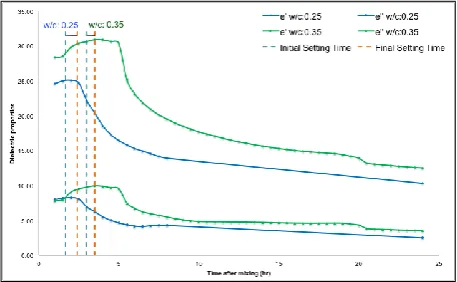
Figure 1 shows the evolution of the dielectric properties (ε*) of PC pastes at water-to-cement ratio of 0.25 and 0.35 over time after mixing. It can be seen that both the dielectric constant (ε’) and the loss factor (ε’’) of PC pastes increased with the increase of w/c ratio. For the PC paste with w/c ratio of 0.25, both of the ε’’ and ε’ decreased remarkably after final setting. This indicates that the transformation of the free water into bound water would reduce cementitious materials’ capacity in absorbing microwave energy since it is the free water which has a much higher dielectric properties (Jumrat et al., 2011).
Fig. 1 Effect of w/c ratio on the dielectric properties of PC paste
[image:3.595.311.540.539.680.2]the ε* at 60o
C is higher than that at 40oC – it is not clear at this stage the reason behind this phenomenon. Further study is still needed.
Fig. 2 Effect of curing temperature (25oC, 40oC, 60oC) on the dielectric properties of PC paste
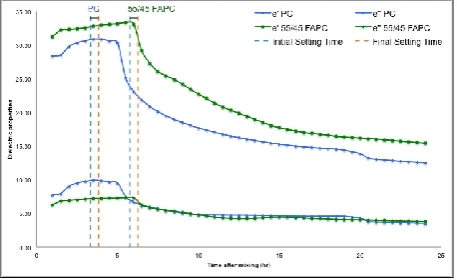
Figure 3 shows the evolution of ε* of PC paste and 55/45 FA/PC blend over time after mixing. Overall, the ε’ and the ε’’ in both samples decreased over time. At the initial stage, the ε* of both samples was high, which can be attributed to the high ionic concentrations in the fresh pastes due to the dissolution of ions from the cement particles as well as the ease of mobility of the charges due to the availability of free water. This period is known as the dormant period and where the chemical composition of the aqueous changes is very little so that the properties are upheld until the final setting time (Makul et al., 2010). It can be further observed that there is a decrease of ε* over time. The coincidence of the drop of both ε’ and ε’’ at almost the same time is a testament of chemical activity in the system, notably an irrotational binding of charges and a decrease in the ionic concentration (Schwarz et al., 2007).
Fig. 3 Effect of replacement of FA on the dielectric properties of FA/PC blend paste (w/c: 0.35)
3.3 Modelling and validation
Computer modeling gives the opportunity to simulate any curing conditions and processing parameters under microwave, which can be used to optimize the curing process and the design of microwave systems. Based on the data obtained from the dielectric properties study, heating models were developed using two different software
[image:4.595.57.287.103.244.2]packages, namely, ANSYS and COMSOL, which were then validated by the heating profiles obtained in a tailored microwave system through FBG sensor and thermal imaging techniques.
Figure 4 shows the three dimensional geometry of the microwave oven and a cubic sample (the shadowed cross-section indicates the location of simulated and validated area). A PC paste sample with a w/c ratio of 0.35 was selected to compare the reliability of the two numerical models. It was supposed that the PC paste sample was cured in the microwave oven after initial setting.
a) 3D model geometry b) Cubic sample layout
of microwave oven (50mm×50mm×50mm)
Fig. 4 Schematic diagram of microwave oven and PC sample
Figure 5 shows the cross-sectional temperature distribution of the simulation results. It can be seen that COMSOL shows a roughly radiant temperature distribution and the highest temperature is located in the core around 77oC, whilst ANSYS shows an irregular temperature distribution and the hottest spot is found in the corner around 90oC.
[image:4.595.314.539.216.328.2]
a) ANSYS b) COMSOL
Fig. 5 Simulation results
[image:4.595.310.539.438.558.2] [image:4.595.57.286.503.643.2]4
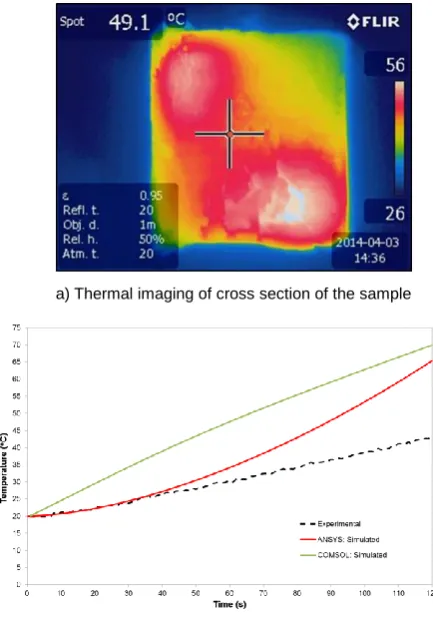
40 seconds after heating. After the first 40 seconds, ANSYS also showed better correlation with the real data than COMSOL. Therefore, it can be concluded that, although ANSYS is less reliable in predicting the overall heat pattern, it is more reliable in predicting the temperature within the specimen. However, it should be noted that in the current study, both models were developed without considering the thermo-physical and chemical changes during the microwave curing. Further study is still needed in order to identify which modelling technique is more suitable for predicting both the heating pattern and the temperature within cementitious materials cured under microwave.
a) Thermal imaging of cross section of the sample
[image:5.595.53.270.224.538.2]b) Comparison between FBG data and simulation results
Fig. 6 Validation of simulation results by experiment data
4. CONCLUSIONS
With the increase of water-to-cement ratio, both the dielectric constant and loss factor increased, which could facilitate the conversion of the microwave energy into heat energy. However, increasing curing temperature would not benefit the absorption of microwave energy by cementitious materials.
Both simulated results overestimated the real temperature in the sample. However, COMSOL can give a better prediction of the overall temperature pattern, whilst ANSYS is more reliable in predicting temperature. Further investigation still needs to be carried out in order to identify which modelling technique is the best option for predicting both the temperature profile and the temperature
within cementitous materials cured under microwave.
Acknowledgements
The authors are grateful to the Technology Strategy Board (TSB) U.K. for providing the funding for this project. Special thanks are given to IMS U.K. for the design and manufacture of the tailored microwave oven and City University London (CUL, UK) for the manufacture of the tailored FBG sensor used in this project. The PC and FA are supplied by Quinn Cement and Drax Power Station, respectively.
REFERENCES
BAI, Y., SHI, S., WANG, Y. L., LI, H. & XU, D. L. Hydration and Strength Development of High Volume Fly Ash/Porland Cement Blend Manufactured with Room, Thermal and Microwave Curing Methods. The 33rd Cement and Concrete Science Conference, 2-3 September, 2012-3 University of Portsmouth, England, UK.
BOLDOR, D. & SABLIOV, C. 2011. Thermal Processing of Foods Control and Automation, John Wiley & Sons, Ltd.
HAMMOND, G. & JONES, C. 2008. Inventory of carbon and energy (ICE). University of Bath. HEWLETT, P. C. 1998. Lea's Chemistry of Cement
and Concrete, John Wiley & Sons Inc.
JUMRAT, S., CHATVEERA, B. & RATTANADECHO, P. 2011. Dielectric properties and temperature profile of fly ash-based geopolymer mortar. International Communications in Heat and Mass Transfer,
38, 242-248.
KNOERZER, K., REGIER, M. & SCHUBERT, H. 2006. Microwave heating: A new approach of simulation and validation. Chemical Engineering & Technology, 29, 796-801. MAKUL, N., KEANGIN, P., RATTANADECHO, P.,
CHATVEERA, B. & AGRAWAL, D. K. 2010. Microwave-assisted heating of cementitious materials: Relative dielectric properties, mechanical property, and experimental and numerical heat transfer characteristics.
International Communications in Heat and Mass Transfer, 37, 1096-1105.
METAXAS, A. C. & MEREDITH, R. J. 1983.
Industrial microwave heating London, London : Peregrinus on behalf of the Institution of Electrical Engineers.
SCHWARZ, N., DUBOIS, M. & NEITHALATH, N. 2007. Electrical conductivity based characterization of plain and coarse glass powder modified cement pastes. Cement & Concrete Composites, 29, 656-666.