City, University of London Institutional Repository
Citation
:
Xu, Q., Gong, P. & Chen, T. (2014). Concatenated LDPC-TCM coding for
reliable storage in multi-level flash memories. 2014 9th International Symposium on
Communication Systems, Networks and Digital Signal Processing (CSNDSP), pp. 166-170.
doi: 10.1109/CSNDSP.2014.6923818
This is the accepted version of the paper.
This version of the publication may differ from the final published
version.
Permanent repository link:
http://openaccess.city.ac.uk/8192/
Link to published version
:
http://dx.doi.org/10.1109/CSNDSP.2014.6923818
Copyright and reuse:
City Research Online aims to make research
outputs of City, University of London available to a wider audience.
Copyright and Moral Rights remain with the author(s) and/or copyright
holders. URLs from City Research Online may be freely distributed and
linked to.
City Research Online:
http://openaccess.city.ac.uk/
[email protected]
Concatenated LDPC-TCM Coding for Reliable
Storage in Multi-Level Flash Memories
Quan Xu, Pu Gong and Thomas M. Chen
School of Engineering and Mathematical Sciences City University London
Northampton Square, London EC1V 0HB, United Kingdom Email:{Quan.Xu.1, Pu.Gong.1, Tom.Chen.1}@city.ac.uk
Abstract—In this paper, we present an efficient fault tolerant
solution that concatenates trellis coded modulation (TCM) with an outer low-density parity-check (LDPC) code for multi-level per cell (MLC) flash memory. Traditional flash coding systems em-ploy simple hard-decisions based codes, such as Bose-Chaudhuri-Hocquenghem (BCH) codes, that can correct a fixed, specified number of errors. Thanks to the Bahl, Cocke, Jelinek, and Raviv (BCJR) algorithm, the TCM decoder within the proposed design can provide soft decisions which make it possible to use the more powerful LDPC codes. Moreover, the error-correction performance is further improved since TCM can well decrease the raw error rate of MLC and hence relieve the burden of outer LDPC code. The effectiveness of concatenated LDPC-TCM systems has been successfully demonstrated through computer simulations.
I. INTRODUCTION
Error correction codes (ECC) have become an important approach to enhance the data reliability of MLC flash mem-ory. Due to the fact that flash systems only provide hard information to its decoders, simple algebraic codes such as BCH codes are generally employed in current design practice. As the storage density of MLC flash increases however, there is growing need for more advanced ECC techniques. LDPC codes are well known for their ability to approach the capacity limit in the additive white Gaussian noise (AWGN) channel, but LDPC codes are typically decoded with soft information. To realize the benefits of LDPC decoding in flash memory, researchers are trying to extract the soft information from the sensing outputs of flash systems [1, 2].
Trellis coded modulation is a powerful means for achieving coding gain in digital communication systems. Several studies have attempted to apply TCM to flash systems. Lou and Sundberg were among the first to use coded modulation in multilevel memories, but they did not consider outer ECC and sensing quantization [3]. Sun et al. successfully demonstrated that TCM can help to improve the performance of flash coding system, but they were focusing on short Hamming and con-volutional codes [4]. Concatenation of TCM and BCH coding have been proposed, considering both the coded modulation and outer codes design [5]. However, the Viterbi algorithm was chosen to perform TCM decoding, which still results in hard decisions. In addition, 5-level MLC flash memory considered in the work is not readily available in the current market.
This paper investigates concatenated TCM and LDPC codes
for flash memory that is modeled with pulse-amplitude mod-ulation (PAM) plus Gaussian noise. We demonstrate that with the coded modulation, the storage reliability can be increased with the same signal-to-noise ratios (SNR). Furthermore, by performing the maximum a posteriori probability (MAP) decoding, we obtain soft information from TCM demodulator that can be utilized for LDPC decoding. Compared to flash memory with BCH coding, significant performance improve-ment of the concatenated system has been observed.
The rest of this paper is organized as follows. Section II concisely summarises the related background knowledge for understanding the topics in the forthcoming sections. In Sec-tion III, the proposed LDPC-TCM coding scheme is described and elaborated in detail. Theoretically achievable Asymmetric Coding Gain of the concatenated system is analysed in Section IV. Section V provides simulation results demonstrating the benefits of the proposed mechanism. The conclusion and further issues are drawn in Section VI.
II. BACKGROUNDS
In this section, we briefly present the basics of NAND flash memory, Trellis Coded Modulation, and LDPC codes based on related works [2, 5–9]. The readers are referred to these literatures and references therein for detailed discussions on flash memory structures and related LDPC coding techniques.
A. NAND flash memory structure
Each NAND flash memory cell comprises a metaloxide semiconductor field effect transistor (MOSFET) with a float-ing gate [2]. The amount of charges stored durfloat-ing writ-ing/programming in the floating gate is quantized toΩlevels to expresslog2Ωbits of information.
The probability density function of the variation of threshold voltage in MLC flash memory cell is usually modeled by a Gaussian distribution. In this work, we assume an i.i.d. (independent and identically distributed) Gaussian threshold voltage for each level of the memory cell [1, 3]. Therefore an m-level flash cell is equivalent to anm-PAM communication system with additive white Gaussian noise. As an example, the threshold voltage distribution of 2 bits per cell flash memory are depicted in Fig. 1 which shows four distributions representing the memory levels with mean values ofP Vi for
11 10 00 10
PV0 R1 PV1 R2 PV2 R3 PV3 Treshold voltage
Vmax
Fig. 1. The approximate Flash memory cell threshold voltage distribution model
B. Low Density Parity Check Codes
Low-density parity check code has been developed by Gallager [6] in the early 1960’s. An LDPC code is defined as the null space of a parity check matrix H with the following structural properties: (1) each row consists of ρ “ones”; (2) each column consists of η “ones”; (3) the number of “ones” in common between any two columns, denotedζ, is no greater than 1; (4) both ρandη are small compared to the length of
the code and the number of rows in H. Since ρ and η are
small, H has a small density of “ones” and hence is a sparse matrix.
The class of LDPC codes have held the attention of cod-ing theorists in the past decade not only because of their near-capacity performance on data transmission and storage channels, but also because their decoders can be implemented with manageable complexity. In addition to introducing LDPC codes, Gallager also provided a decoding algorithm that is typ-ically near optimal. Since that, other researchers have indepen-dently discovered several related algorithms, albeit sometimes for different applications. The class of decoding algorithms are collectively termed “message passing” algorithms since their operation can be explained by the passing of messages in graph-based model of LDPC codes. Generally, message passing decoders use soft reliabilities about the received bits; conversely, a quantization of the received information or hard decisions can degrade the performance of an LDPC code.
C. Trellis Coded Modulation
In digital communication, Trellis Coded Modulation is an attractive solution for improving band limited communication systems. This technique evolves from the end of 1970’s, when Ungerboeck [7] addressed the issue of bandwidth expansion by combining coding and modulation. According to him, “redundancy” is now provided by using an expanded signal set and the coding is done directly on the signal sequences. TCM is highly efficient, i.e. high coding gain and little descending data rate by coding and error correction, and more efficient especially for multilevel modulation.
The output signal sequences of TCM systems are usually decoded by the Viterbi Algorithm (VA) [8], which computes the most-likely input sequence (i.e., performs hard-output detection). For concatenated LDPC-TCM system, however, the soft decisions are required. Among the approaches that can generate soft information, the BCJR algorithm achieves optimum soft-output performance, while being well-suited
K=7, rate½ code
n-1bits 1 bit
n-2 bits 2 bits
n bits
outer LDPC encoder
Trellis Coded Modulation
Demodulation
outer LDPC
decoder MAP decoder
LLRs b
b
y
2nlevels/cell
[image:3.595.51.298.106.181.2]flash memory array
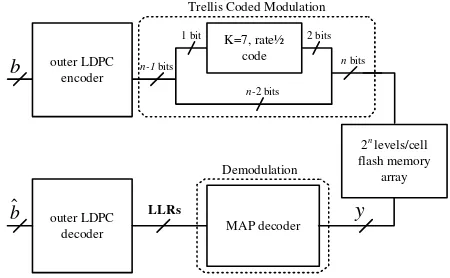
Fig. 2. Block diagram of TCM LDPC coding system
for hardware implementation. Thus, we consider the BCJR algorithm in our design.
III. CONCATENATEDLDPC-TCM CODINGSYSTEM
This sections provides detailed descriptions of the proposed concatenated LDPC-TCM coding system illustrated in Fig. 2. The analysis and verification will be presented in Section IV and V. Firstly, some redundancy is added to the information bit stream b by the LDPC encoder, and then the bit stream is passed to the TCM module after serial/parallel conversion. After being processed at the TCM module, the coded data bits are then programmed to the flash memory array. The threshold voltage within each MLC cell are sensed and quantized during the reading process, and the quantized value y is utilized in TCM demodulation and LDPC decoding.
For ease of practical implementation, we adopt the industrial standard pragmatic approach to TCM [8] (this approach will be referred to as the pragmatic TCM for convenience in the rest of the paper). In the design here,n−1 encoded bits are
to be stored in one memory cell, among which n−2 bits
are stored directly while 1 bit is fed to a constraint-length 7 (64 states), rate1/2convolutional code. The outputnbits are stored in 2n levels; as a result, the number of storage levels
per cell must increase from2n−1 to2n.
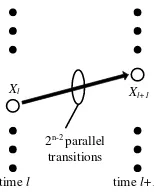
Let Xl denote the trellis state at time l; the coded 2 bits
can be decided by the state transition from Xl toXl+1. For
the mapping of pragmatic TCM, 2 coded bits choose a cell voltage level within a subconstellation according to the Gray code, andn−2uncoded bits choose the subconstellation lex-icographically, thus there are in total2n−2 parallel transitions for given two coded bits, as shown in Fig. 3. Consider the pragmatic TCM on 8-level MLC for example, “111”, “110”, “100”, “101”, “011”, “010”, “000” and “001” are mapped to the voltage levelsP V0,P V1,P V2,P V3,P V4,P V5,P V6
andP V7, respectively.
[image:3.595.324.549.109.248.2]Xl Xl+1
2n-2 parallel
transitions
[image:4.595.130.207.104.200.2]time l time l+1
Fig. 3. State transitions in pragmatic TCM
decoder, which generates soft information of each bit, in terms of log-likelihood ratios (LLRs), to the following LDPC decoder.
Suppose the demodulator receives y = (y0, y1, . . . , yL−1) from each page of the memory block, whereylis the quantized
voltage sensed from one memory cell, and let cl denote the
expected n-bit symbol along with the transition from timelto timel+ 1. For each bitcl,k, k= 1,2, ...n, the LLR is defined
as
LLR(cl,k) = ln
Pr(cl,k= 1|y)
Pr(cl,k= 0|y)
(1)
As a demodulated noisy valueyl is received from the flash
channel with AWGN noise with variance σ2, the likelihood
function becomes
p(yl|Xl, Xl+1) = 1
σ√2πexp
−|yl−cl|
2
2σ2
(2)
The BCJR algorithm finds the a posteriori probabilities using the forward and backward recursions, respectively, as:
α(Xl+1) =
X
Xl
α(Xl)γ(Xl→Xl+1) (3)
β(Xl+1) =
X
Xl+1
β(Xl+1)γ(Xl→Xl+1) (4)
where the values forα(X0)andβ(XL)should be determined
according to the initial conditions, and γ(Xl →Xl+1)is the
branch metric that is given by
γ(Xl→Xl+1)
=
(
Pr(Xl+1|Xl)p(yl|Xl, Xl+1), valid transition;
0, invalid transition.
(5) The first term in the above equation corresponds to the a prior probability of the transition,(Xl→Xl+1), which is known at
the TCM encoder. The a posteriori probability of cl is given
by
Pr(cl|y) =
X
Λl(cl)
α(Xl+1)β(Xl)γ(Xl→Xl+1) (6)
where Λl(cl) denotes the set of the state transitions,(Xi →
Xi+1), for givencl. With the calculated probabilities of all the
symbols in the trellis, we can further obtain the a posteriori probability of each bit and the corresponding LLRs.
IV. THEORETICALANALYSIS OFCODEDMODULATION IN
FLASHMEMORY
It is well known that the error performance of TCM systems in terms of SNR is measured by the free Euclidean Distances, where SNR is defined as the ratio between the average signal power, Es, and the average noise power,2σ2. Assuming the
mean value of the threshold voltage at erase level(P V0)is 0,
the programming voltage at the highest level becomesVmax
(see Fig. 1), and the peak powerEpequalsVmax2 . In this work,
both the TCM and non-TCM systems use the same peak power for fair comparisons.
Let M represent the number of levels in a MLC flash
memory, the minimum squared Euclidean distances (MSED) which equals the programming voltage difference between two adjacent levels and the mean value of each level can be expressed as
d2
min=
V2
max
(M −1)2 (7)
and
P Vi =
Vmax
M −1i, i= 0,1,2..., M−1. (8)
The average powerEsis calculated as
Es= 1
M
M−1
X
i=0
(P Vi)2. (9)
Substituting (7) and (8) into the above equation, we obtain
Es=
V2
max(2M−1) 6(M−1) =
(M −1)(2M−1)
6 d
2
min (10)
With the flash channel model presented in Section II-A, the SNR is given by
SNR(dB) = 10 log10
Es
2σ2 (11)
As for the TCM system, the free squared Euclidean distance
d2
f ree [8] is given by
d2f ree= 2(2dmin)2+ (df−4)(dmin)2=d2min(df+ 4) (12)
wheredf is a factor that depends on the convolutional codes
used, and is equal to 10 for the constraint-length 7 (64 states) convolutional code of pragmatic TCM [8]. Substituting (7) into the above equation,d2
f ree can be rewritten as
d2f ree= 14V2
max
(M −1)2 (13)
The asymptotic coding gains (ACG) [7] (achieved at high SNR) of the proposed system is computed as
ACG= 10 log10
d2
f reeEs/non−tcm
d2
minEs/tcm
!
Substituting (7), (10) and (13) into the above equation and
noting that the values of M for non-TCM and TCM system
are 2n−1 and2n respectively, we obtain
ACG= 10 log10
14(2n−1−1)
2n+1−1
(15)
Increasing the number of flash memory cell levels reduces the Euclidean distances between the multiple levels; never-theless, the trellis coded modulation could offer a coding gain that overcomes such disadvantage and further improve performance over the non-TCM system. In the next section, we will observe this error performance improvement versus the derived SNR.
V. PERFORMANCEEVALUATION
For purpose of comparison, we briefly present the asymp-totic coding gain achieved for M-PAM modulation [8], which is generally used in digital communication with a similar model as Fig. 1.
ACG= 10 log10
4×M
2−4
M2−1 ×
7 8
= 10 log10
7(22n−1−2)
22n−1
(16)
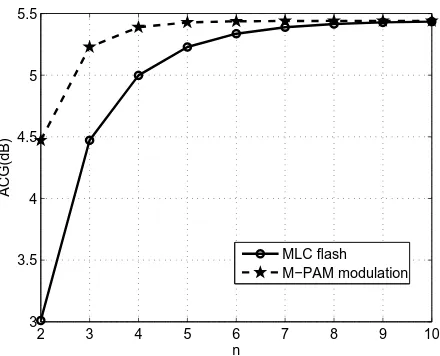
where nbecomes the number of bits per transmitted symbol corresponding to the bits per cell in MLC flash memory. Fig. 4 shows that the value of ACG increases with n and the M-PAM modulation achieves higher gain than flash memory at certain value ofn. The reason is because the average energies have been normalized to unity in the transmitter of digital communication systems, while the peak energies rather than average energies are normalized in flash memories. In the current market, 4-level and 8-level MLC are the prevalent flash storage media, so these two types were chosen to be used in the following simulations. As shown in Fig. 4, for TCM system on 8-level MLC, the asymptotic coding gain can be achieved as much as 4.5 dB in SNR.
To evaluate performance improvements due to the LDPC-TCM concatenated coding provided in Fig.2, we consider two flash memory systems which have the same page length of 4K bytes but using 4-level and 8-level MLC respectively. BCH coding and standard Gray mapping are applied in the first system while LDPC coding and the pragmatic TCM mapping are used in the second one. We store the same size of information bits that are randomly generated into these two memory systems and compare the bit error rate (BER) after reading and decoding.
For the error correction codes, we first design a rate-0.927 (17664, 16384) structured LDPC code [10] whose parity-check matrix is specified by a triangular plus dual-diagonal form to lower the error floor and encoding complexity. Additionally, the bipartite graph of the LDPC code used has been con-structed to be free of cycle-4 with the bit-filling algorithm. Min-sum decoding algorithm is used to carry out LDPC code decoding. For the purpose of comparisons, we also consider a
2 3 4 5 6 7 8 9 10
3 3.5 4 4.5 5 5.5
n
ACG(dB)
[image:5.595.322.542.115.293.2]MLC flash M−PAM modulation
Fig. 4. Asymptotic Coding Gain of TCM for MLC flash memories and M-PAM modulation
[n, k, t] = [16383, 15200, 85] binary BCH code with the same
rate-0.927.
Fig. 5 shows the raw BER performance of the flash systems without ECC. Comparing to the flash system using 4-level MLC, the coding gain (CG) of TCM flash system using 8-level MLC is about 3.4 dB at the bit error probability of10−6. For the flash system at very low bit error probability (say less than
10−9), the coding gain will reach the asymptotic coding gain of 4.5 dB that was derived earlier. In practical flash memories, the stored information (associated with cell threshold voltages) is usually sensed and quantized during the reading, so we assume two types of uniform sensing quantization schemes in our simulations: 16 levels and 32 levels, labelled as TCM-16Q and TCM-32Q, respectively. Performance loss has been observed after applying quantization to the TCM flash system. However, it still demonstrates a substantial performance im-provement compared to the raw BER of 4-level flash system, as shown in Fig. 5.
15 16 17 18 19 20 21 22 10−7
10−6 10−5 10−4 10−3 10−2 10−1
Signal−to−Noise Ratio(dB)
Bit Error Rate
[image:6.595.311.536.114.292.2]4Level−RAW TCM−16Q TCM−32Q TCM−Inf
Fig. 5. Simulation results for flash systems without outer ECC
15 16 17 18 19 20
10−7 10−6 10−5 10−4 10−3 10−2 10−1
Signal−to−Noise Ratio(dB)
Bit Error Rate
4Level−Raw BCH−4Lev LDPC−TCM−32Q LDPC−TCM−Inf
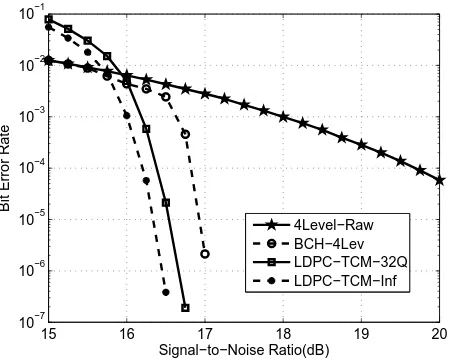
Fig. 6. Performance comparisons of concatenated LDPC-TCM and BCH coding systems((17664, 16384)LDPC code and (16383, 15200)BCH code)
too coarse.
VI. CONCLUSIONS
An error-correction scheme of concatenated LDPC-TCM coding for MLC flash memory is proposed. Compared to the flash coding system that provides hard-decisions and employs BCH codes only, results show remarkable BER performance improvements from the system equipped with (17664, 16384) LDPC codes and industrial pragmatic TCM. In this paper, we have also derived mathematical formulations to quantitatively analyse the asymmetric coding gain achieved in flash channels. BCJR algorithm is performed and associated with TCM, which has been demonstrated to be an alternative of converting the hard-decisions into soft-decisions. To further improve our work, better quantization schemes for memory sensing should be considered while designing the error correction system.
15 15.5 16 16.5 17 17.5
10−7 10−6 10−5 10−4 10−3 10−2 10−1
Signal−to−Noise Ratio(dB)
Bit Error Rate
[image:6.595.47.272.115.293.2]BCH−TCM−16Q LDPC−TCM−16Q LDPC−TCM−32Q BCH−TCM−32Q
Fig. 7. Performance comparisons of concatenated LDPC-TCM and BCH-TCM coding systems
REFERENCES
[1] J. Wang, T. Courtade, H. Shankar, and R. Wesel, “Soft information for LDPC decoding in flash: mutual-information optimized quantization,” in IEEE Globecom, Dec. 2011, pp. 1–6.
[2] G. Dong, N. Xie, and T. Zhang, “On the Use of Soft-Decision Error-Correction Codes in NAND Flash Mem-ory,” IEEE Trans. on Circuits and Systems I: Regular
Papers, vol. 58, no. 2, pp. 429–439, 2011.
[3] H.-L. Lou and C.-E. Sundberg, “Coded modulation to increase storage capacity of multilevel memories,” in
IEEE Globecom, 1998, pp. 3379–3384.
[4] F. Sun, S. Devarajan, K. Rose, and T. Zhang, “Multilevel flash memory on-chip error correction based on trellis coded modulation,” in 2006 IEEE Int. Symp. on Circuits
and Systems (ISCAS 2006), May 2006.
[5] S. Li and T. Zhang, “Improving multi-level NAND flash memory storage reliability using concatenated BCH-TCM coding,” IEEE Trans. on VLSI Systems, vol. 18, no. 10, pp. 1412–1420, Oct. 2010.
[6] R. Gallager, “Low-density parity check codes,” IRE
Trans. Information Theory, pp. 21–28, Jan. 1962.
[7] G. Ungerboeck, “Trellis-coded modulation with redun-dant signal sets Part I: Introduction,” IEEE Com. Mag., vol. 25, no. 2, pp. 5–11, 1987.
[8] A. Viterbi, J. Wolf, E. Zehavi, and R. Padovani, “A pragmatic approach to trellis-coded modulation,” IEEE
Com. Mag., vol. 27, no. 7, pp. 11–19, July 1989.
[9] L. Bahl, J. Cocke, F. Jelinek, and J. Raviv, “Optimal decoding of linear codes for minimizing symbol error rate,” IEEE Trans. on Info. Theory, vol. 20, no. 2, pp. 284–287, Mar. 1974.
[10] Z. He, P. Fortier, and S. Roy, “A class of irregular LDPC codes with low error floor and low encoding complexity,”
[image:6.595.48.275.340.519.2]