INTERNATIONAL DESIGN CONFERENCE - DESIGN 2016
Dubrovnik - Croatia, May 16 - 19, 2016.HUMOUR PROCESSES FOR CREATIVE ENGINEERING DESIGN
G. Hatcher
1, W. Ion
1, R. Maclachlan
1, A. Wodehouse
1, B. Simpson
2and M. Sheridan
31
Design Manufacture and Engineering Management, University of
Strathclyde, Glasgow, UK
2
Strategy and Organisation, University of Strathclyde, Glasgow, UK
3English, University of Strathclyde, Glasgow, UK
Keywords:
humor, design process, ideation, creativity
1. Introduction
1.1 Design creativity
There is a continuous demand for engineering companies to be more innovative in the development of new products and services. The product design process, in particular the early, divergent phase of idea generation, provides an opportunity to apply creative thinking to engineering. Ideas can be considered creative if they are both novel and useful [Amabile 1983].
To help enhance creativity during the idea generation phase, a great many methods and tools have been developed. The most commonly referred to is brainstorming, a group activity that requires a deferment of judgement and encourages participants to build on each other’s ideas [Osborn 1953]. However, in practice, many design teams do not adhere to the brainstorming rules [Rickards 1999, Matthews 2009], and there is much debate over the overall effectiveness of team brainstorming as a creativity method, when compared, for example, to individual ideation [Paulus 2000, Howard, Culley et al. 2011]. The brainstorming method has been described as ‘paradigm preserving’- a safe method that does not change the participants’ perspectives [McFadzean 1998]. Attempts to reinvigorate the brainstorming process have included the use of creative stimuli, either random or linked to the engineering problem [Chakrabarti 2006, Howard, Culley et al. 2011]. By providing a stimulus from which designers can begin to generate ideas, imaginations are stretched and the problem may be viewed from a different perspective [McFadzean 1998].
Other design creativity methods that regularly appear in the literature include SCAMPER and TRIZ, which offer a more structured and logical approach to problem-solving. Like the use of creative stimuli, these methods encourage designers to view the problem from a different perspective. In a study of the effectiveness of the three creativity methods, SCAMPER and TRIZ were found more effective in generating ‘useful’ ideas, however brainstorming was overall the most creative [Chulvi, González-Cruz et al. 2013].
It has been widely recognised that there is a link between humour and creativity [Koestler 1964, Treadwell 1970, Cade 1982, Isen, Daubman et al. 1987]. For example Ziv [1976] found that students who listened to a humorous recording performed significantly better on a creativity test, and several studies have found participants who perform well in ‘sense of humour’ tests will also perform better in creativity testing [Humke and Schaefer 1996]. Koestler [1964] observed that the cognitive process involved in joke-writing is similar to creative idea generation. Both humour and design creativity require a person to think from different perspectives, and make connections between seemingly unrelated ideas and concepts.
Laughter and humour are uniquely human experiences, and most people would view themselves as having a ‘sense of humour’ [Martin and Lefcourt 1984]. Unlike other creative methods that have been developed to change perspectives during idea generation, it is possible that humour-based processes will draw on more natural patterns of thinking.
To date the link between humour and design thinking has rarely been applied to an engineering design context. The aim of this research is to explore the use of humour constructs to enhance creativity in the early phase of the engineering design process. This paper will focus on the analogies between humour creation processes and design engineering processes, and identify a variety of possible ways in which the process of creating humour may be applied to design idea generation, and, ultimately, be used to solve complex engineering problems.
2. Humour Constructs and Processes
2.1 Humour theories
For centuries, philosophers have reflected on what it is that makes humans laugh. Today there are a number of recognised humour theories, including:
Relief theory: humour arises from a release of emotional or nervous energy, when psychological tension is reduced [Freud 1960, Kirkmann 2006].
Incongruity theory: humour arises from non-obvious connections, when two seemingly
incompatible frames of reference unexpectedly overlap [Koestler 1964, Hillson and Martin 1994, Ritchie 1999, Mihalcea 2007].
Benign-violation theory: humour arises when something threatens our sense of how the world ‘ought to be’, yet the threatening situation is benign [McGraw and Warren 2010].
Incongruity is possibly the broadest and most commonly referred to construct in humour studies literature [Ritchie 1999]. Also, it would appear that incongruity theory is the most closely analogous with engineering design. Gero [1996] presents a creative design process that is based on an analogy with humour creation. Like incongruous humour, designs are selected or rejected based on whether they are both unexpected and understandable. Yi et al. [2013] also discuss the similarities between humour creation and the creative design process. They observe that both involve making non-obvious connections between seemingly unconnected ideas. In both cases, the final product (or joke) meets the requirements in a way that is novel or surprising.
For example, a ‘bladeless fan’ may initially sound like an oxymoron, but through the technical resolution of the idea, a novel, feasible and valued product is realised (Figure 1). From this perspective, the product’s surprising yet familiar functionality could be likened to humour resolution as expected through incongruity theory. Similarly, the concept of ‘moulded oil’ bearings contradicts our assumption that oil is a fluid, yet is fully resolved when we understand that the solution is an oil-based lubricant suspended in resin, which brings together the benefits of oil and dry lubrication to bearing design [NSK 2010].
(Figure 1). Such products may be literally more humorous than the most innovative solutions, but they do not resolve all technical or user requirements.
Figure 1. A creative incongruous product [Dyson 2016] and a humorous product [Kawakami 1996]
2.2 Humour creation processes
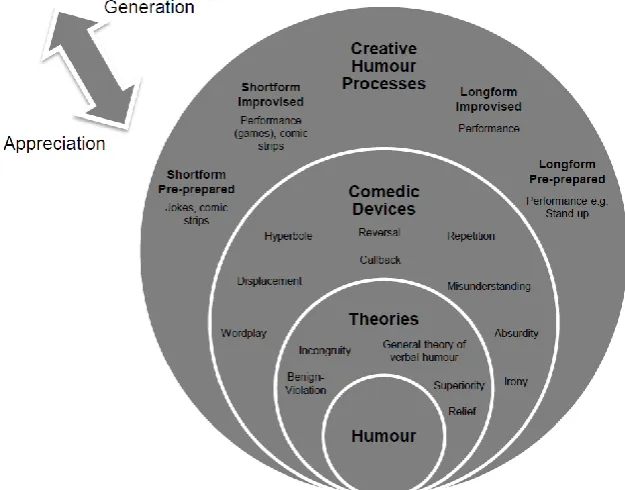
Humour can be created and delivered in a variety of ways. This study has focussed attention on two alternative performance methods: improvised (or unplanned) humour and scripted (or pre-planned) humour. Figure 2 provides an overview of the various constructs and processes explored.
Improvised humour (often referred to as ‘improv’ or ‘impro’) is a style of performance where comedic ideas are spontaneously created and explored ‘in the moment’, without any preparation or planning. There is a strong emphasis on teamwork and the importance of building on ideas through the use of ‘yes, and’ thinking- the rule of always accepting and adding to other team-members’ proposals [Halpern, Close et al. 1994, Johnstone 2012, Besser, Roberts et al. 2013, Fotis 2014]. The teaching of improvisational theatre was pioneered by Viola Spolin, who developed a workshop procedure involving a series of shortform exercises or ‘games’ with predetermined rules [Spolin 1963]. Over time these ideas were developed into various longform structures- the performance of a series of scenes where the rules are created in the moment [Halpern, Close et al. 1994, Besser, Roberts et al. 2013]. These scenes will usually be inspired by an ‘opening’, often a shortform group game or monologue prompted by a one-word suggestion from the audience. In a popular longform structure known as ‘The Harold’, participants are also encouraged to find interesting and surprising connections between the different scenes [Halpern, Close et al. 1994, Fotis 2014]. Traditional jokes are discouraged in improvisation; instead humour should arise from following the rules of the game and creating humorous situations [Besser, Roberts et al. 2013].
Unlike improvised humour, scripted humour such as a sketch show or stand-up comedy routine is pre-prepared, and honed and rehearsed over time. Attardo [2001] describes stand-up performance as ‘a highly artificial, scripted genre’. Stand-up comedians may employ various comedic devices such as repetition, wordplay and callbacks to heighten the humour of their script, and rehearse routines to develop humorous performance techniques [Murray 2010, Schwarz 2010]. The creation process is typically an individual and personal one; however there are many training courses and clubs that have developed a pedagogy for stand-up comedy [Double 2000]. One such example is ‘Bright Club’. Founded at University College London and now widespread across the UK, Bright Club work in collaboration with groups of academics to develop stand-up comedy performances based on their research.
a single story with no pre-planning [Norris 2011], similar to the ‘6-3-5 brainwriting’ method. Like performed improvisation, humour often arises from the unusual connections and associations that participants make during the process.
Figure 2. Humour constructs and processes explored as part of the study
3. Humour and design
While the concept of implementing humour constructs to the engineering design process remains largely unexplored, there have been a small number of studies on the use of humour in the creative design process.
Kudrowitz [2010] noted the link between shortform improvisation games and the associative thinking that benefits idea generation. They carried out an improvisation workshop with students, professional designers and improvisational comedians, and found that on average the comedians were significantly more productive and creative in their idea generation than the designers. Similarly, influenced by incongruity theory, Ludden et al. [2012] explored the use of sensory incongruities to design surprising novelty products (rubber ducks and deodorants). In these cases, the literal amusement the solutions created was prioritised over technical innovation.
Ludovice et al. [2013] also highlighted the potential in improvisational comedy, but identified the shortfall in relying on humorous ideas to solve complex engineering problems. They adapted the improvisation-based Sweeney model for innovation [Sweeney 2004] to suit technical engineering challenges.
Wodehouse et al. [2014] conducted a study of humour and brainstorming methods. Firstly by attempting to induce a humorous atmosphere, and secondly by applying a jocular structure to the brainstorming process, using an analogy of incongruity theory and Morphological Analysis [Pugh 1991]. The results indicated that a brainstorming structure modelled on humour generation could improve fluency and originality of ideas.
professionals and students, Gerber [2009] reflected on the use of improvisation in interaction design. It was posited that improvisation can be used to reinforce the rules of brainstorming. Medler and Magerko [2010] discuss the implications of adopting theatre improvisation techniques in design, in comparison to more commonly prescribed role-playing techniques. They argue that improvisation encourages group cohesion and the generation of novel ideas, but performs poorer in group focus and the generation of practical ideas. In the Encyclopedia of Humour Studies, it is suggested that improvisation techniques such as ‘yes, and’ can be used to develop product features as well as incite enthusiasm and fun into the design process [Attardo 2014].
The use of humour in science and engineering communication has also been discussed in the literature. Pilcher [2010] discusses the rising popularity of science communication in British comedy, with inclusion of comedians at science festivals and the emergence of groups such as Bright Club. Pinto et al. [2013] developed a series of comedy shows with postgraduate researchers which were received with positivity. In this study, the scientists found joke-writing and confidence on stage to be the most challenging aspects of the humour creation process.
4. Mapping humour and engineering design processes
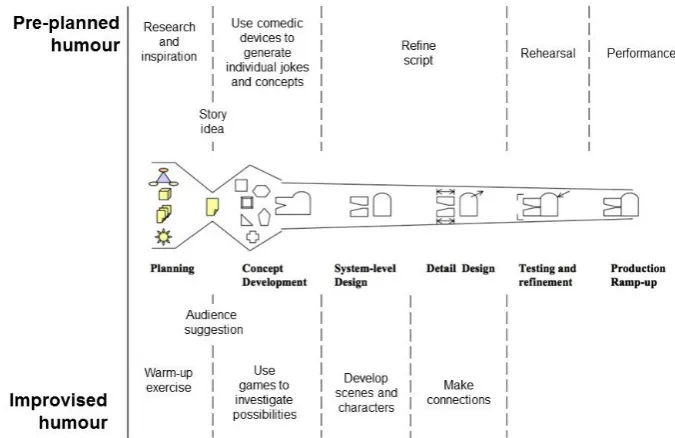
The engineering design process, as outlined by Ulrich and Eppinger [2008] follows five key steps from the initial mission statement: concept development, system level design, detail design, testing & refinement and production ramp-up. From a top-level perspective, Figure 3 illustrates how the creation and/or performance processes of both longform improvisation and longform pre-planned (e.g. stand-up) comedy could be mapped against this process.
Firstly, analogies can be made with longform improvisation. Participants begin with a ‘mission’, or audience suggestion. They then use a shortform improvisation game or monologue to investigate the possibilities within that suggestion (divergent thinking). Participants will then develop a variety of scenes and characters, and eventually attempt to find interesting and surprising connections between them. However, because the improvisation is the performance itself, there is no further refinement of ideas, suggesting comedy improvisation techniques are most suited to the earlier stages of the design process, when divergent thinking is most valued.
Figure 3. Scripted and improvised humour mapped against an engineering design process (adapted from Ulrich and Eppinger, 2008)
There are also analogies to be made between the general principles of improvisation and the principles of design ideation. Gerber [2009] observes that improvisation can be used to reinforce the rules of brainstorming, such as withholding judgement, generating large quantities of ideas and building on the ideas of others. The benefits of introducing elements of acting and performance to the design process, either through improvisation, role-playing or ‘bodystorming’ have also been discussed in [Burns, Dishman et al. 1994, Oulasvirta, Kurvinen et al. 2003, Boess 2006, Medler and Magerko 2010].
According to Besser et al. [2013], the key to longform improvised comedy scenes is to very quickly establish a ‘base reality’ (the who, what and where) and identify the ‘game’- the unusual thing that makes the scene humorous. It is then the participants’ mission to heighten that game, thus heightening the humour. Participants not performing in the scene can ‘edit’ at any time, and immediately a completely new scene begins. Similarly, designers could aim to identify ‘the unusual thing’, or the feature that makes an idea innovative, and develop it further (Figure 4). This method could inspire a new approach to brainstorming, with less emphasis on quantity of individual ideas and more emphasis on ‘heightening’ (or developing) collaborative concepts. While fewer ideas may be generated overall, this approach could ensure ideas are elaborated and the possibilities within them are explored in more depth before being rejected. Furthermore, the problem of ‘design fixation’ is often quoted in the brainstorming literature. While this approach would lead to a temporary fixation on one idea, the ‘editing’ feature ensures that the slate is regularly wiped clean, creating space for a highly divergent range of ideas overall.
An initial trial of this method suggests that using both ‘yes, and’ thinking and heightening can rapidly generate solutions to design problems. Firstly, two participants (A and B) were presented with an unfamiliar design brief (similar to the short story or monologue that could serve as an opening to an improvised comedy):
Problem: Teaching children to swim in a deep pool. Current solution: swimming platforms. Problem with current solution: 1. Very small - no room for children to explore their own skills whilst they wait their turn. 2. Often travels away from edges - vulnerable for non-swimmers 3. Storage.
The participants created a ‘base reality’ for the concept by conducting a ‘yes, and’ brainstorm:
A: The solution could be a string of rubber rings.
A: Yes, and they are connected to a winch
B: Yes, and the rings are colour-coded according to swimming ability
A: Yes, and children can use them to do simple training exercises while waiting their turn
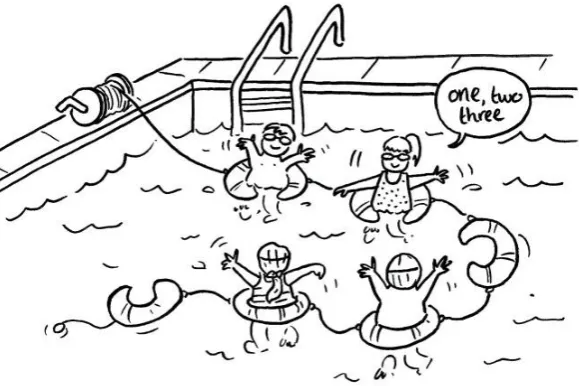
By this point the participants had built up a comprehensive image of the concept (Figure 5) and it was decided that the ‘unusual thing’ had been found. Continuing with ‘yes, and’ thinking, the brainstorming now focussed on ‘heightening’ the idea of a product that enabled self-led exercises:
B: Yes, and the rings could feature simple, visual guides for the children to follow
A: Yes, and the colour system could be used to pair up more experienced swimmers with children who are new to the exercises
B: Yes, and parents could be trained to supervise
[image:7.595.164.436.264.388.2]At this stage the scene could be ‘edited’ and a new brainstorm would begin.
Figure 4. Design ideation process modelled on the Upright Citizen’s Brigade improvisation method [Besser et al. 2013]
Figure 5. The 'base reality' of a solution for children's swimming lessons, created using 'yes, and' brainstorming
[image:7.595.147.437.438.631.2]Table 1. Application of comedic devices to concept generation
Comedic device Engineering design application
Hyperbole: taking an extreme viewpoint [Koestler 1964, Schwarz 2010]
Ideas that exaggerate product features
Irony: expressing the opposite of the true meaning [Attardo 2014]
Ideas that fulfil opposite specifications
Displacement: focussing on the less important details [Koestler 1964]
Ideas that focus disproportionately on the minor details or features of the product Reversal: leading the audience down one path then
suddenly changing direction [Murray 2010]
Ideas that reverse the direction of group ideation (thus reducing ‘design fixation’)
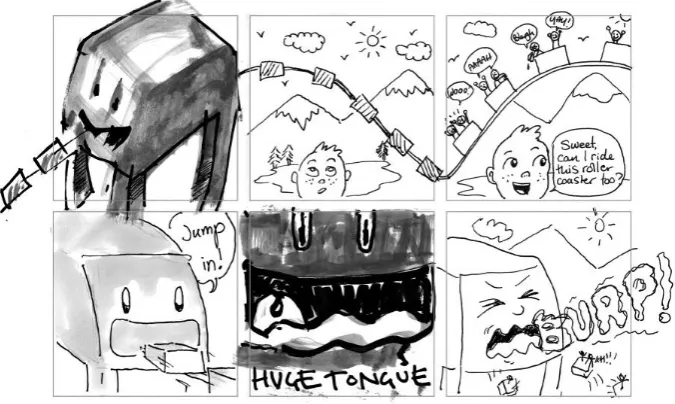
Considering the potential application of comics and cartoons to the design process, there are a number of recognised benefits to sketching during idea generation. Sketches not only allow designers to record ideas for future reference, the process of sketching can also reveal unintended or surprising features or configurations [Goldschmidt 1991, Goldschmidt 2003] and can be used by designers to enhance and reinterpret ideas [Van der Lugt 2005]. When comparing the outputs from a ‘brainsketching’ and conventional brainstorming activity, Van der Lugt [2002] found that while brainsketching resulted in fewer ideas overall, more connections were made between the ideas. The possibility of incorporating humorous sketching into the design process through the ‘comic jam’ method was explored with a group of nine professional and semi-professional cartoonists. The cartoonists were given a random product name as a stimulus and asked to improvise a six panel story (Figure 6). Exactly how this method could be adapted to facilitate effective idea generation remains to be resolved, however early observation suggest the unusual connections and associations made during the comic jam could lead to the discovery of innovative solutions.
Figure 6. Example of a ‘comic jam’ created from the stimulus 'ticket machine'
5. Conclusion
While the link between humour with creativity has been discussed extensively in the literature, and there have been some attempts to introduce humour to the product design process, there have been very few empirical studies of how humour constructs can be used to enhance engineering creativity and solve complex engineering design problems.
[image:8.595.129.467.406.608.2]and methods that could enhance engineering creativity, by encouraging designers to look at engineering problems from different perspectives and generate more innovative ideas. This paper has discussed just some of these opportunities.
An initial trial with a product design problem would suggest that principles and processes associated with improvised humour, such as ‘yes, and’ brainstorming, hold high potential for the development of new approaches to engineering creativity. Improvisation facilitates spontaneous, divergent thinking and building on others ideas. Unlike conventional brainstorming, these ideas are rapidly explored in depth and mined for unusual patterns and connections. Further work is required to determine if improvisation could be utilised to solve complex engineering problems.
The incorporation of humorous sketching and storytelling through the use of comic strip creation processes has also been explored. This method requires further refinement to establish whether comic strips could be effectively utilised to help designers make unusual and surprising connections between ideas. The possibilities of developing idea generation methods modelled on pre-planned humour, such as stand-up comedy creation processes will also be explored further.
In addition to humour creation processes, this study will also consider the use of humour as a creative stimuli in engineering brainstorming. Like other creative stimuli, humour could be used to encourage designers to view the problem from different perspectives. Furthermore, humour can act as a stress-reliever, and could be used as a tool to ease the stress of creative problem-solving, bringing designers into a mental state that is conducive to creativity [Yi, Nguyen et al. 2013].
Early exploratory work has suggested that an improvisation-based approach to idea generation has the potential to enhance creativity in the early phase of the design process. However, further work is required to determine how such humour creation processes may be remodelled to facilitate complex engineering problems, and how possible challenges may be overcome, such as managing design engineers’ possible apprehension over performance-based methods. The study will continue to explore the links between humour constructs and engineering creativity through a series of initial trials, followed by the development of an industrial workshop structure from which creative outputs can be measured.
Acknowledgement
This work was supported by the Engineering and Physical Sciences Research Council (EPSRC) grant number EP/N00597X/1. The research data associated with this paper will be available from the University of Strathclyde KnowledgeBase at: http://dx.doi.org/10.15129/7a8c5e1e-988b-4f32-ba9a-0ad8c01c0dc6, from May 2017 onwards, after the cessation of an embargo period.
References
Amabile, T. M. (1983). "The social psychology of creativity: A componential conceptualization." Journal of personality and social psychology 45(2): 357.
Attardo, S. (2001). Humorous texts: A semantic and pragmatic analysis, Walter de Gruyter. Attardo, S. (2014). Encyclopedia of humor studies, SAGE Publications.
Besser, M., I. Roberts and M. Walsh (2013). The Upright Citizens Brigade Comedy Improvisation Manual. New York, Comedy Council of Nicea LLC.
Boess, S. (2006). Rationales for Role playing in design. Wonderground, the Design Research Society Conference, Lisbon Lisbon.
Burns, C., E. Dishman, W. Verplank and B. Lassiter (1994). Actors, hairdos & videotape—informance design. Conference companion on Human factors in computing systems, ACM.
Cade, B. W. (1982). "Humour and creativity*." Journal of Family Therapy 4(1): 35-42.
Chakrabarti, A. (2006). Defining and supporting design creativity. DS 36: Proceedings DESIGN 2006, the 9th International Design Conference, Dubrovnik, Croatia.
De Bono, E. (1989). Six thinking hats, Taylor & Francis.
Double, O. (2000). "Teaching Stand-Up Comedy: a mission impossible?" Studies in Theatre and Performance 20(1): 14-23.
Dyson. (2016). "Dyson air multiplier." Retrieved 09/03/16, from
https://www.dyson.co.uk/fans/fansandheaters/medialibrary/Files/Brochures/Fans/fanCommercialUK.pdf. Eberle, R. F. (1972). "Developing imagination through scamper*." The Journal of Creative Behavior 6(3): 199-203.
Fotis, M. (2014). Long Form Improvisation and American Comedy: The Harold, Palgrave Macmillan. Freud, S. (1960). Jokes and their Relation to the Unconscious. London, Routledge & Kegan Paul Ltd. Gerber, E. (2009). Using improvisation to enhance the effectiveness of brainstorming. Proceedings of the SIGCHI Conference on Human Factors in Computing Systems, ACM.
Gero, J. S. (1996). "Creativity, emergence and evolution in design." Knowledge-Based Systems 9(7): 435-448. Goldschmidt, G. (1991). "The dialectics of sketching." Creativity research journal 4(2): 123-143.
Goldschmidt, G. (2003). "The backtalk of self-generated sketches." Design Issues 19(1): 72-88.
Halpern, C., D. Close and K. Johnson (1994). Truth in comedy: The manual of improvisation, Meriwether Publishing.
Hillson, T. R. and R. A. Martin (1994). "What's so funny about that?: The domains-interaction approach as a model of incongruity and resolution in humor." Motivation and emotion 18(1): 1-29.
Howard, T. J., S. Culley and E. A. Dekoninck (2011). "Reuse of ideas and concepts for creative stimuli in engineering design." Journal of Engineering Design 22(8): 565-581.
Humke, C. and C. E. Schaefer (1996). "Sense of humor and creativity." Perceptual and Motor Skills 82(2): 544-546.
Isen, A. M., K. A. Daubman and G. P. Nowicki (1987). "Positive affect facilitates creative problem solving." Journal of personality and social psychology 52(6): 1122.
Johnstone, K. (2012). Impro: Improvisation and the theatre, Routledge. Kawakami, K. (1996). 101 Un-Useless Japanese Inventions, WW Norton & Co.
Kirkmann, A. (2006). "Contemporary Linguistic Theories of Humour." Folklore 33: 27-58. Koestler, A. (1964). The act of creation. London, Hutchinson & Co Ltd.
Kudrowitz, B. M. (2010). Haha and aha!: Creativity, idea generation, improvisational humor, and product design. PhD, Massachusetts Institute of Technology.
Ludden, G. D., B. M. Kudrowitz, H. N. Schifferstein and P. Hekkert (2012). "Surprise and humor in product design." Humor 25(3): 285-309.
Ludovice, P., L. Lefton and R. Catrambone (2013). "Humorous Improvisation Tailored for Technical Innovation." ASEE Southeast Section Conference.
Martin, R. A. and H. M. Lefcourt (1984). "Situational humor response questionnaire: Quantitative measure of sense of humor." Journal of personality and social psychology 47(1): 145.
Matthews, B. (2009). "Intersections of brainstorming rules and social order." CoDesign 5(1): 65-76. McCloud, S. (2011). Making comics, Harper Collins.
McFadzean, E. (1998). "Enhancing creative thinking within organisations." Management Decision 36(5): 309-315.
McGraw, A. P. and C. Warren (2010). "Benign violations making immoral behavior funny." Psychological Science 21(8): 1141-1149.
Medler, B. and B. Magerko (2010). The implications of improvisational acting and role-playing on design methodologies. Proceedings of the SIGCHI Conference on Human Factors in Computing Systems, ACM. Mihalcea, R. (2007). The multidisciplinary facets of research on humour. WILF, Springer.
Murray, L. (2010). Be a Great Stand-up: Teach Yourself, Teach Yourself.
Norris, K. (2011). "Improvising Artists Drawn to Comic Jam." Retrieved 03/12/15, 2015, from http://www.npr.org/2011/02/22/133955169/Improvising-Artists-Drawn-To-Comic-Jam. NSK (2010). Molded-Oil Bearings.
Osborn, A. F. (1953). Applied imagination, principles and procedures of creative thinking. New York, Charles Scribner's Sons.
Oulasvirta, A., E. Kurvinen and T. Kankainen (2003). "Understanding contexts by being there: case studies in bodystorming." Personal Ubiquitous Comput. 7(2): 125-134.
Paulus, P. (2000). "Groups, teams, and creativity: The creative potential of idea‐generating groups." Applied psychology 49(2): 237-262.
Pilcher, H. (2010). "Communication: A better class of heckle." Nature 467(7315): 530-530.
Pinto, B., D. Marçal and S. G. Vaz (2013). "Communicating through humour: A project of stand-up comedy about science." Public Understanding of Science 0(0): 1-18.
Rickards, T. (1999). "Brainstorming revisited: a question of context." International journal of management reviews 1(1): 91-110.
Ritchie, G. (1999). Developing the incongruity-resolution theory. Proceedings of the AISB 99 Symposium on Creative Language: Humour and Stories.
Schwarz, J. (2010). Linguistic aspects of verbal humor in stand-up comedy.
Spolin, V. (1963). Improvisation for the theater: A handbook of teaching and directing techniques. Evanston, Northwestern University Press.
Sweeney, J. (2004). Innovation at the speed of laughter: 8 secrets to world class idea generation, Aerialist Press. Treadwell, Y. (1970). "Humor and creativity." Psychological reports 26(1): 55-58.
Ulrich, K. T. and S. D. Eppinger (2008). Product design and development, Tata McGraw-Hill Education. Van der Lugt, R. (2002). "Brainsketching and how it differs from brainstorming." Creativity and innovation management 11(1): 43-54.
Van der Lugt, R. (2005). "How sketching can affect the idea generation process in design group meetings." Design studies 26(2): 101-122.
Wodehouse, A., R. Maclachlan and J. Gray (2014). "The best form of medicine? Using humour to enhance design creativity." International Journal of Design Creativity and Innovation 2(3): 125-141.
Yi, H., T. A. Nguyen and Y. Zeng (2013). "Humour and Creative Design: Twins or Partners?" Journal of Integrated Design and Process Science 17(4): 81-92.
![Figure 1. A creative incongruous product [Dyson 2016] and a humorous product [Kawakami 1996]](https://thumb-us.123doks.com/thumbv2/123dok_us/1528697.105456/3.595.178.424.106.265/figure-creative-incongruous-product-dyson-humorous-product-kawakami.webp)