City, University of London Institutional Repository
Citation: Gillanders, D.T., Bolderston, H., Bond, F.W., Dempster, M., Flaxman, P.,
Campbell, L., Kerr, S., Tansey, L., Noel, P., Ferenbach, C., Masley, S., Roach, L., Lloyd, J., May, L., Clarke, S. & Remington, B. (2014). The Development and Initial Validation of the Cognitive Fusion Questionnaire. Behavior Therapy, 45(1), doi: 10.1016/j.beth.2013.09.001This is the accepted version of the paper.
This version of the publication may differ from the final published
version.
Permanent repository link: http://openaccess.city.ac.uk/8562/
Link to published version: http://dx.doi.org/10.1016/j.beth.2013.09.001
Copyright and reuse: City Research Online aims to make research
outputs of City, University of London available to a wider audience.
Copyright and Moral Rights remain with the author(s) and/or copyright
holders. URLs from City Research Online may be freely distributed and
linked to.
The development and initial validation of The Cognitive Fusion Questionnaire
David T Gillandersa*, Helen Bolderstonb, Frank W. Bondc, Maria Dempsterd, Paul E. Flaxmane, Lindsey Campbelld, Sian Kerrd, Louise Tanseyf, Penelope Noelg, Clive
Ferenbachh, Samantha Masleyd, Louise Roacha, Joda Lloydc, Lauraine Mayc, Susan Clarkei, Bob Remingtonb
*Corresponding author
aUniversity of Edinburgh, School of Health in Social Science, Teviot Place, Edinburgh,
United Kingdom, EH8 9AG, [email protected], Tel: +44(0)131651 3946 b School of Psychology, University of Southampton, United Kingdom, SO17 1BJ.
c Institute of Management Studies, Goldsmiths, University of London, New Cross, United
Kingdom, SE14 6NW.
d Clinical Psychology, Royal Cornhill Hospital, Aberdeen, United Kingdom, AB25 2ZH. e Dept. of Psychology, City University London, United Kingdom, EC1R 0JD.
f Orchard Clinic, Royal Edinburgh Hospital, Edinburgh, United Kingdom, EH10 5HF. g Clinical Psychology, 7 Dudhope Terrace, Dundee, United Kingdom, DD3 6HG.
h Sir George Sharp Unit, Cameron Hospital, Leven, Fife, United Kingdom, KY8 5RR i The School of Health and Social Care, Bournemouth University, Bournemouth, United
Kingdom, BH1 3LT.
Acknowledgements: We are very grateful to George Deans, Morag Taylor and Sam
Aitcheson, NHS Grampian; Kevin Power, NHS Tayside; Mark Ramm, Sarah Gillanders and Louise McNeil, NHS Lothian; Alan Harper, Kathryn Quinn, NHS Fife; David Whitty, Dorset
Health Care University NHS Foundation Trust; Nick Maguire, University of Southampton, and Ken Laidlaw, University of Edinburgh. The ACT workplace intervention study was
Disclosure Statement
There are no conflicts of interest declared Abstract
Acceptance and Commitment Therapy (ACT) emphasizes the relationship a person has with their thoughts and beliefs as potentially more relevant than belief content in predicting the emotional and behavioral consequences of cognition. In ACT, ‘defusion’ interventions aim to
‘unhook’ thoughts from actions and to create psychological distance between a person and their thoughts, beliefs, memories and self-stories. A number of similar concepts have been
described in the psychology literature (e.g. decentering, metacognition, mentalization and mindfulness) suggesting converging evidence that how we relate to mental events may be of critical importance. Whilst there are some good measures of these related processes, none of
them provides an adequate operationalization of cognitive fusion. Despite the centrality of cognitive fusion in the ACT model, there is as yet no agreed measure of cognitive fusion.
This paper presents the construction and development of a brief, self-report measure of cognitive fusion: The Cognitive Fusion Questionnaire (CFQ). The results of a series of studies involving over 1800 people across diverse samples show good preliminary evidence
of the CFQ’s factor structure, reliability, temporal stability, validity, discriminant validity, and sensitivity to treatment effects. The potential uses of the CFQ in research and clinical
practice are outlined.
Key words: Cognitive-Behavior Therapy, Acceptance and Commitment Therapy,
Measurement, Questionnaires, Cognitive Fusion, Mindfulness
Introduction
Acceptance and Commitment Therapy (ACT) is a form of cognitive behavioral
elsewhere, interested readers are directed to Hayes, Strosahl and Wilson (2011). Briefly, the
ACT model describes 6 overlapping processes (willingness, defusion, contact with the present moment, clarity of values, committed actions and a flexible repertoire of perspective
taking skills known as ‘self as context’) that lead to psychological flexibility.
In the ACT model, distancing from thoughts is known as ‘cognitive defusion’ and its counter process is ‘cognitive fusion’: the tendency for behavior to be overly regulated and
influenced by cognition. When ‘fused,’ a person acts on thoughts as though they are literally true, cognitive events come to dominate behavior and experience over other sources of
behavioral regulation, and he or she becomes less sensitive to direct consequences. An example of this is when a person with social anxiety is dominated by self-focused attention, negative evaluations of the self and such cognitive events have a strong tendency to regulate
overt behaviors (such as entering social situations). In contexts of fusion, thoughts are taken literally; the anxious person simply is socially inept, rather than seeing these self-evaluations
as mental events. Fusion refers to the relationship a person has with his or her own cognitive events, on a continuum from fused (dominated by, entangled, believed, taken literally) to defused (experienced as mental events and not necessarily needing to be acted upon). In
ACT, the purpose of defusion is to afford greater choice of behavior, such that the socially anxious person could choose to enter the feared situation, even when they are fearful and
their mind is predicting the worst.
Cognitive defusion overlaps with but is distinct from other processes of the ACT model. Willingness describes a behavioral stance that is open to unpleasant private events
and a letting go of attempts to control or avoid their form, frequency or intensity. Contact with the present moment refers to flexible awareness of experience in the here and now,
organized in relation to self-content (e.g., what one believes about oneself). It relies on the
more basic process of cognitive defusion, and involves a shift from experiencing self-content and ‘the self’ in a relationship of equivalence, to the self as ‘containing’ self-content, be it
positive or negative.
Experimental and clinical work in ACT has often operationalized fusion using the proxy construct of ‘believability of thoughts’. Such an operationalization suffers from
focusing merely on the content of one’s thought and so represents only a narrow aspect of fusion. A broader behavioral operationalization includes dominance of cognitive events in a
person’s experience, inability to view cognitive events from a different perspective, reacting emotionally to thoughts, behavior being highly regulated by cognitive events, attempts to control thinking, over-analysis of situations, evaluating and judging thought content, as well
as aspects of literality and believability.
Cognitive defusion is similar to a number of existing concepts within psychological
therapies, namely: decentering (Fresco, Moore, van Dulmen & colleagues, 2007; Safran & Seagal, 1990), metacognitive awareness (Teasdale et al., 2002; Wells, 2008), mindfulness (Bishop et al., 2004), and mentalization (Bouchard et al., 2008; Fonagy & Target, 1997) It is
also distinct from thought-action fusion (TAF: Shafran, Thordarson & Rachman, 1996), despite the similarity in name.
Decentering or ‘metacognitive awareness’ refers to the capacity to take a detached view of one’s thoughts and emotions (Fresco et al., 2007; Teasdale et al., 2002; Wells, 2008; 2009). Decentering has long been part of cognitive therapy, though initially it was as a
precursor to cognitive modification (Hollon & Beck, 1979). Recent analyses of Mindfulness Based Cognitive Therapy (MBCT: Segal, Williams & Teasdale, 2002) suggest decentering
(2007, p. 448) define decentering as “…the capacity to take a present-focused,
non-judgmental stance in regards to thoughts and feelings and to accept them” (Our italics). Fresco et al. also note (p. 236) that an important “facet” of decentering is self-compassion,
and, indeed, there are items representing this facet in Fresco et al.’s measure of decentering, the Experiences Questionnaire (EQ). The ACT model of psychological flexibility separates out the processes of defusion and acceptance, whereas decentering collapses them. In
addition, from an ACT perspective, self-compassion is not a quality of defusion, rather, it emerges from four of the psychological flexibility processes described above: defusion,
acceptance, self-as-context, and present-moment awareness. Thus, decentering (or
metacognitive awareness) is similar to defusion, though fusion is more narrowly defined and more behaviorally operationalized, in that the function of defusion is greater choice of action,
rather than the disruption of cognitive patterns.
Despite the similarity in name, Thought Action Fusion (TAF: Shafran et al., 1996)
describes biased metacognitive belief content (e.g. thinking of something bad happening will make it more likely to happen) rather than the shift in perspective that is suggested by other terms such as decentering, metacognitive awareness, or fusion / defusion.
Arising from the psychodynamic or developmental tradition in psychology is the notion of reflective function or mentalization (Fonagy & Target, 1997; 2002), which is the
capacity of a developing child to understand the mental states of itself and others. Whilst awareness of one’s own mental states may overlap with the notion of cognitive fusion / defusion, mentalization is a broader construct related to affect regulation and attachment (see
Gumley, 2010 for an overview).
Finally, mindfulness (e.g. Mindfulness Based Stress Reduction, [MBSR] Kabat-Zinn,
‘classic’ ACT defusion exercise ‘Leaves on the Stream’ (Hayes et al., 2011, pp. 255 - 258.)
This begins with a focus on the present moment (akin to mindfulness of the breath and of the body, sounds etc.) before using imagery (of thoughts as leaves floating on a stream) that
deliberately creates a shift in the relation between cognitive events and the self. From an ACT perspective, however, mindfulness is an emergent quality of the four psychological flexibility processes (noted above) that also produce self-compassion. Thus, defusion forms a
key component of both decentering and mindfulness, but in order to produce the psychological qualities of those latter two constructs, ACT maintains that additional
processes need to occur. In addition, mindfulness is often seen either as a method of stress reduction (as in MBSR) or to facilitate decentering (as in MBCT) or as an end in itself, rather than in the service of potentiating valued, goal directed action, which is the explicit function
of defusion in ACT.
In summary, there are a number of constructs that overlap with cognitive fusion,
suggesting that a number of therapy approaches have considered aspects of how we relate to our own mental experience to be important in understanding mental disorder and behavioral function. Whilst there is overlap between these concepts and fusion, the construct of fusion is
a more narrowly defined process that contributes to other psychological qualities such as decentering and mindfulness. In addition, central to the construct is that the purpose of
stepping back from cognitive events is to facilitate taking action that is consistent with one’s values, rather than to disrupt negative thinking styles, change metacognitive beliefs or reduce stress.
There are some existing scales that have been developed to measure cognitive fusion and defusion. The Believability of Anxious Feelings and Thoughts Scale (BAFT: Herzberg et
measures a relatively narrow conceptualization of fusion. In addition, it is content specific to
anxiety disorders, giving it less relevance as a generic measure of cognitive fusion. The Avoidance and Fusion Questionnaire for Youth (AFQ-Y: Greco, Lambert &
Baer, 2008) measures avoidance and fusion in children and adolescents and appears to have adequate psychometric properties in adult populations (Fergus et al., 2012). The scale, though, assesses several ACT processes (notably fusion and avoidance) and so cannot be
regarded as a distinct measure of cognitive fusion.
An early ACT study (Zettle & Hayes, 1987) operationalized defusion by
incorporating a ‘believability’ scale into the existing ‘frequency’ scale of the Automatic Thoughts Questionnaire (ATQ: Hollon & Kendal, 1980). This measure has adequate psychometric properties (Zettle, Rains & Hayes, 2011). It is however, a further example of
how cognitive fusion has been operationalized along the relatively narrow dimension of believability. Furthermore, its items reflect cognitive content in depression, limiting its use as
a generic measure of cognitive fusion.
Finally, a very recent addition to the available measures of cognitive defusion is the Drexel Defusion Scale (DDS: Forman et al., 2012). It shows a theoretically coherent factor
structure, good psychometric properties and a coherent pattern of convergent and divergent validity, in a clinical and non-clinical sample. The DDS has four potential limitations,
however. Firstly, the scale provides an extended instruction set that describes what is meant by the term defusion. This could be problematic because it potentially equates the act of fused responding with the understanding of the concept of defusion. Secondly, the scale
presents 10 brief vignettes in which respondents rate how likely they imagine they would be to defuse in various situations, rather than to report on their actual experiences of defusing in
sensations, emotions and cravings as well as thoughts around specific situations (e.g. social
anxiety, loss / sadness and anger) meaning the items are content specific and, thus, lack generality.
In summary, some scales have been developed to measure cognitive fusion but they tend to be content specific, operationalized in a narrow way, may confound measurement with understanding and contain priming effects. The present research therefore aimed to
develop a brief, self-report measure of cognitive fusion of sufficient quality and flexibility in terms of item content and psychometric properties to facilitate it’s use in a variety of settings
(clinical, community, laboratory), with many different populations.
The studies reported here describe the construction and development of the Cognitive Fusion Questionnaire (CFQ), the examination of its factor structure in a non-clinical sample,
followed by item reduction (Study 1). Study 2 further examines the factor structure of the CFQ across a wider range of samples, using confirmatory factor analysis (CFA). Study 3
examines the concurrent, divergent and incremental validity of the CFQ via relationships with a wide range of other measures of psychological processes and functioning. Study 4 reports internal and test-retest reliability and the ability of the CFQ to distinguish between
different samples of participants. Study 5 reports an evaluation of the CFQ’s sensitivity to treatment and mediation of treatment outcome in an intervention designed to reduce cognitive
fusion. Method
Item Development
Items were generated by DG, HB, MD and FB, based on expert knowledge and practice of ACT and Relational Frame Theory (RFT: Hayes, Barnes-Holmes, & Roche,
(2006), fusion was considered to be a uni-dimensional construct, representing a continuum
from fusion to defusion, with a wide variety of behavioral manifestations. Each item was worded to express a specific instance of fusion or defusion and to be as concrete and
behaviorally operationalized as possible. Hence the complete set of items addressed a broad functional definition of fusion made up of the many forms that fusion can take, including: believability of thoughts (two items: e.g. I believe the thoughts that pop into my head); taking
thoughts literally (four items: e.g. My thoughts are facts); reacting emotionally to thoughts (three items: e.g. My thoughts cause me distress or emotional pain); behavior being governed
by thoughts (five items: e.g. I get so caught up in my thoughts I’m unable to do the things I most want to do); trying to control thoughts (four items: e.g. I need to control the thoughts that come into my head); over analyzing situations (four items: e.g. I overanalyze situations
to the point where it is unhelpful to me); evaluating thought content (four items: e.g. I make judgments about whether my thoughts are good or bad); dominance of cognition in a person’s
experience (six items: e.g. Its such a struggle to let go of upsetting thoughts, even when I know letting go would be helpful); perspective taking (six items: I find it easy to view my thoughts from a different perspective); and detached awareness of thoughts (six items: e.g.
My thoughts just come and go and I’m not too attached to them). These later items are examples of defusion responses and are reverse scored. A total of 44 items were generated.
ACT experts (committee members of the British Association for Behavioural & Cognitive Psychotherapy ACT Special Interest Group) were asked to comment on and rate how well these items represented cognitive fusion and defusion. Nine committee members
provided feedback on item clarity and suggested adaptations to some items. A number of items were reworded based on this feedback. Items that received a modal rating of
draft of the CFQ. This first draft containing 42 items (26 fusion, 16 defusion) was examined
in study 1 (see Table 1 for the full list of items). Samples
Several samples were recruited to test different aspects of the CFQ. In some cases samples were recruited for other projects and where samples shared similar characteristics (e.g. healthy community dwelling adults) these samples were combined opportunistically.
These samples are described below.
Sample 1: A young adult sample was recruited (predominantly students and associates
of the chief investigators [MD & DG]). The sample comprised 592 participants: 174 were male (29.4%) and 418 were female (70.6%); 381 participants (64.4%) were aged between 17-24 years; 173 (29.2%) were aged between 25-34 years; 21 (3.5%) were aged between 35-44
years; 8 (1.4%) were aged between 45-55years; and, 9 (1.5%) were over 55 years old. Sample 2: Sample 2 was another convenience sample, collected for 3 different
studies, whose data were opportunistically pooled. These were all community dwelling healthy adults and included a sub sample of UK Prison Service Officers recruited for another study by LM and JL. Sample 2 comprised 447 adults. There were 247 women (55.4%) and
200 men (44.6%). Their ages ranged from 18 to 77, with a mean of 38 years (SD = 13). The age, gender ratio and CFQ score were not significantly different in any of the three
subsamples that make up sample 2 (Mean Age: 34.8 – 39.6 years, SD: 11 – 13.5 years, F
(3,444) =2.28, p=. 08, ns; Gender Ratio [% female]: 48% - 58%, λ = 1.06, p = .29; Mean CFQ score: 18.92 – 20.17, SD: 7.72 – 9.82, F (2,445)=.710, p=.49, ns). One of the subsamples was
recruited for a study specifically to examine the test-retest reliability of the CFQ (n=82, 58% female, mean age: 41, SD: 13.8) and is equivalent to the other participants in sample 2 in
between these methods of administration on the final CFQ score (Online mean: 20.16 [SD:
7.72], Paper mean: 19.71 [SD: 8.03], t(255) = .485, p = .63)
Sample 3: Participants were volunteers for an ACT based worksite psychological
skills training / stress management program as part of another study led by PF. They were recruited from two large public sector organizations in the UK: a governmental organization and a healthcare organization. This sample included 242 people, 188 (78%) of whom were
female. Age ranged between 20 and 69 years old, with a mean age of 41 years (SD: 10 years).
Sample 4: Participants in sample 4 were recruited from National Health Service Mental Health Services across the UK, as part of other studies by HB, SK, SM, PN and DG. They represent a broad sample of different mental health difficulties. 129 (60%) were
recruited from specialist settings, such as services for people with eating disorders,
community mental health teams and a personality disorders service, whereas 86 (40%) were
recruited from primary care psychological services. All participants were referred by treating clinicians (psychologists, nurses, psychiatrists) who confirmed the presence of psychological disorder. Participants were excluded on the basis of primary problem relating to alcohol or
substance misuse, and conditions such as significant learning disability, head injury or
dementia. Sample 4 comprised of 215 individuals, aged 17 to 68, with a mean age of 40 years
(SD: 13); 136 of these participants (63.3%) were female. Despite the diverse sources of recruitment for this sample, the subsamples did not differ in terms of age or CFQ total score (Specialist mean age: 40.35 years, SD: 12.89, Primary Care mean age: 38.58, SD: 12.69, t (213)
=.933, p = .35, ns; Specialist CFQ: 34.57, SD: 8.31, Primary care CFQ: 33.91, SD: 7.70, t (213) =.59, p = .55, ns), suggesting equivalence across these diverse samples. Types of
self-esteem, complicated grief reactions, personality disorders, recovery from psychotic
experiences including bipolar disorder and schizophrenia. These diagnoses were assessed by clinician diagnosis rather than structured clinical interview. Sample 4 was considered a broad
sample of the range of mental health problems presenting in United Kingdom NHS mental health services and was designed in this way because of the hypothesized transdiagnostic relevance of cognitive fusion.
Sample 5: Sample 5 comprised 133 people (72% female) recruited for a study of adjustment processes in people with multiple sclerosis by CF and DG. The sample ranged in
age from 21 to 75, with a mean age of 49 years (SD =11). Participants were recruited from specialist NHS neurological services. Diagnosis of MS was confirmed by the referring physician. Individuals who were deemed by the referring clinician to be too cognitively
impaired to provide informed consent or respond to the study questionnaires were not recruited.
Sample 6: Sample 6 was recruited for a separate study of the relationship between cognitive fusion, rumination, metacognitive beliefs and depression by SK and DG. The sample comprises of people with current major depressive disorder (MDD): (n=26, 58%
female, mean age: 42.35 years, SD: 12.8,), people recovered from MDD (n= 21, 57% female, mean age: 41.67 years, SD: 10.95), and people who have no history of depressive episode
(n=27, 59% female, mean age: 44.11 years, SD: 11.92). Current and lifetime depression status was confirmed by Structured Clinical Interview for DSM [SCID: First, Spitzer,
Gibbon, & Williams, 1996]. The three groups were equivalent in terms of age and gender and
differed significantly in terms of current mood, as measured by the Centre for
Epidemiological Studies Depression Scale [CESD: Radloff, 1977]. Participants for currently
recruited through community groups and services. Sample 6 was used to test the incremental
validity of the CFQ in predicting depression, compared to established predictors such as rumination and metacognitive beliefs.
Sample 7: Sample 7 consisted of 219 caregivers of people with dementia, recruited for a separate study into caregiver distress by LR and DG. 144 (66%) of the caregivers were female, the mean age of sample 7 was 68.6 years (SD: 11.5 years), with a range of 31 to 95
years. 87% of the sample were caring for a spouse with dementia, the remainder were adult children of the care recipient. 88% were living with the person with dementia.
Regardless of sample, all participants gave informed consent and all studies followed codes of conduct for research with human participants as detailed by the British
Psychological Society (BPS, 2009) and the universities and NHS Trusts that were sponsoring
the research. All studies received approval from the relevant university ethics committees (University of Edinburgh, Goldsmiths, University of London, City University, or
Southampton University). In addition, Local NHS Research Ethics Committees approved all research that sampled participants from NHS settings and equivalent ethical procedures were followed in other settings.
Data screening and treatment of missing data
In all samples data were screened at the individual item level to confirm that each
item had responses covering the full range of the response format, and that responses were normally distributed. Missing data analysis showed low levels of missing data. Where individuals missed less than 3 items on the CFQ, these missing items were prorated based
upon their scores for the other CFQ items. Where an individual had 3 or more items missing on the CFQ, they were excluded from further analysis. Across all samples, only 19 cases
studies, the default list wise deletion option in SPSS was chosen as the most pragmatic way
of dealing with missing data. In list wise deletion, cases with missing data are simply removed from that analysis, reducing sample size. Samples were analyzed separately for
some studies and combined for other studies, these are described for each of the studies and sample size is given for each analysis.
Study 1: Exploratory Factor Analysis and Item Reduction in a Non-Clinical Sample
Participants
Participants were as described above for Sample 1.
Measures
Participants completed a paper and pencil form of the CFQ, containing 42 items. They answered on a seven point Likert scale with the same instructions and response format as the
final version of the CFQ (see appendix). Analysis
The goal of this exploratory analysis was to identify one or more latent variables underlying the observed variables; as a result, we conducted a common factor analysis (CFA) (Floyd & Widaman, 1995) and determined the number of factors to extract through parallel analysis
(Horn, 1965), which is a very accurate factor extraction procedure (Zwick & Velicer, 1986). We used an oblique rotation (Promax), as we expected that these factors would be elements
of a higher order factor, cognitive fusion (Nunnally, 1978), and therefore should be significantly correlated.
Results
Prior to exploratory factor analysis (EFA), 11 items with an item-total correlation of less than .04 were omitted (Nunally & Bernstein, 1994). For the remaining 31 items, the
Bartlett's test of sphericity ( 2 = 5666.42, df = 465, p<.001) also indicated that the data were
suitable for factor analysis.
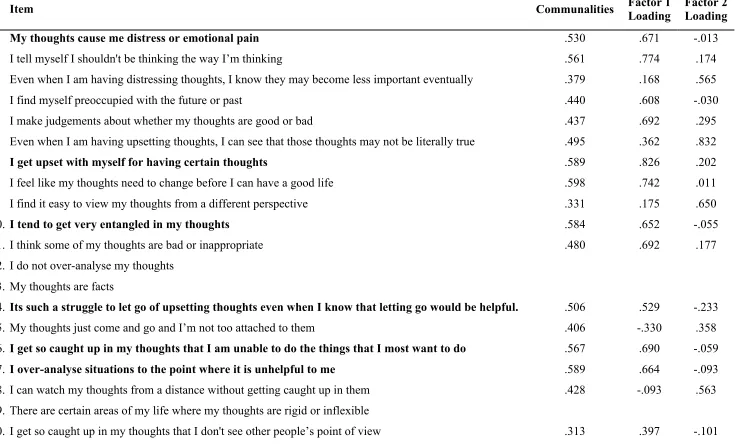
Insert Table 1 here
Based upon the results of parallel analysis, we retained three factors. To define the factors, we inspected the matrices and eliminated any item that had a loading below .4 (two
items) on any of the three factors or a loading of .4 or above on more than one factor (Ferguson & Cox, 1993).
Results indicated that no items loaded greater than .4 on the third factor, the highest loading being .266. Additionally, the third factor had an eigenvalue of .83 and explained only 2.67% of the variance. As a result, we forced a two-factor solution, using the same extraction
and rotation procedures on the remaining 29 items. The first factor had an eigenvalue of 9.95 and it accounted for 34.3% of the variance; the second had an eigenvalue of 2.67 and it
accounted for 9.19% of the variance. Following this second EFA we continued to refine the scale using increasingly stringent factor loadings. Final loadings were >.55 on one factor and no item loading >.25 on the second factor. This resulted in 14 items. Inspection of these items
suggested some redundancy in content areas, as well as one item possibly reflecting the ACT process of present moment awareness more than fusion. 4 items were omitted, resulting in a
scale of ten items. The KMO measure of sampling adequacy for these items was acceptable at .871, as was Bartlett’s test of sphericity (Chi-Square: 1543.42, df = 45, p<.001) The final EFA of these ten items resulted in Factor 1 having an eigenvalue of 4.145, explaining 41.5%
of the variance, and Factor 2 having an eigenvalue of 1.83, accounting for 18.3% of the variance. Factor 1 comprised 7 positively worded items and Factor 2, three reverse scored
adequate in terms of their Cronbach’s alpha reliability of .71. The factors were relatively
weakly correlated (r = -.21). A series of correlational analyses, regression analyses and confirmatory factor analyses (not reported) showed that the three reverse scored items did not
significantly add to the overall scale’s psychometric properties. The decision was made to omit these three reverse scored items. The 7 items retained in the final scale are highlighted in bold in Table 1; this item scale is used in all other studies reported here. The
seven-item scale is scored as a total score, with higher numbers reflecting greater fusion. Study 2: Confirmatory Factor Analysis and Invariance of Factor Loadings
Sample 2, 3, 4, 5 and 7 were used to explore the CFQ’s factor structure. Analytic Plan
Data were analyzed using AMOS version 19 (Arbuckle, 2006). Our primary goal in
conducting CFA was to confirm the unifactorial structure of the CFQ, across a more diverse range of samples. For each sample, covariance matrices were used to analyze the
measurement models, and maximum likelihood estimation was used to assess their fit.
As the chi-square ( 2) statistic is very sensitive to sample size and may overestimate
the lack of model fit (Bollen, 1989), we selected 5 additional indicators, based upon Bollen (1989), Hu and Bentler (1999), and Jackson, Gillaspy and Purc-Stephenson (2008). The first
was the normed chi-square (NC), which is the chi-square value divided by the degrees of
freedom ( 2/df). Consistent with Bollen (1989), we specified a value of 3 or less as
indicating good model fit. The other fit indicators were: the root-mean-square error of
approximation (RMSEA), the iterative fit index (IFI), the comparative fit index (CFI) and the
standardized root mean residual (SRMR). Hu and Bentler (1998) suggest that cut off values of less than .06 for RMSEA, less than .08 for SRMR and greater than .95 for the CFI and IFI are indicative of good model fit.
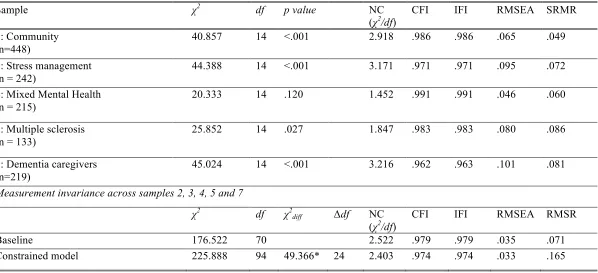
Table 2 shows the results of CFA across these diverse samples. The normed
chi-square shows good fit in 3 of 5 samples, with the other two being close to the cut off value of 3 or less. The CFI and IFI show excellent fit across all samples. The RMSEA shows good fit
in 2 of 5 samples, with the other three values being within the range described as
‘acceptable’, and the RMSR shows good fit in 2 of 5 samples. There is no specific pattern suggesting that one sample is poorly fitting the model across each of the indices. The overall
pattern of fit indices shows a good fit across diverse samples. Study 2 therefore confirms the CFQ as unifactorial.
Insert Table 2 Here
In order to determine the extent to which the 7 items of the CFQ assess cognitive fusion in a similar manner across the different samples, we compared the relative fit of two
models across Samples 2, 3, 4, 5 and 7. The first allowed the 7 unstandardized factor loadings to vary, and the second placed equality constraints on those loadings. If the constrained
model does not generate a significantly worse fit than the unconstrained model, the items are likely to be assessing the same construct in a comparable way (Byrne, 2001; 2004). We did not place equality constraints on estimates of the factor variances, since these are known to
vary across groups even when the indicators are measuring the same construct in a similar manner (Kline, 2005; MacCallum & Tucker, 1991). As can be seen in the final lines of Table
2, the NC, RMSEA, RMSR, CFI and IFI values of the baseline model suggest a very good solution. When we placed equality constraints on the factor loadings and error covariances,
there was a significant decrement in goodness of fit (as assessed by the 2
diff test) suggesting that the factor loadings are not strictly invariant across these five very different samples. The
other fit indices still suggest that even the constrained model is an adequate fit. Further work is required in future studies to explore responses to the CFQ in different samples.
The construct validity of the CFQ was assessed via correlation with different
measures, across the different samples. Measures were chosen according to four domains, firstly: due to their specific relevance to the ACT model (e.g. the Acceptance & Action
Questionnaire II, a measure of psychological inflexibility, [AAQ-II: Bond et al., 2011]; The Valued Living Questionnaire, a measure of success at pursuing valued life goals, [VLQ: Wilson, Sandoz, Kitchens & Roberts, 2010]). Secondly: the relationship of fusion to related
constructs such as trait mindfulness, (e.g. Southampton Mindfulness Scale, [SMS: Chadwick et al., 2008], Five Facet Mindfulness Scale [FFMQ: Baer, Smith, Hopkins, Krietemeyer &
Tony, 2006; Baer et al., 2008], Kentucky Inventory of Mindfulness Skills [KIMS; Baer, Smith, & Allen, 2004], cognitions and appraisals (Automatic Thoughts Questionnaire [ATQ; Hollon & Kendall, 1980]), thought control strategies and other metacognitive aspects (i.e.
Thought Control Questionnaire [TCQ: Wells & Davis, 1994], Ruminative Response Style Questionnaire [RSQ: Nolen-Hoeksema & Jackson, 2001], and Positive Beliefs about
Rumination Scale, [PBRS: Watkins & Moulds, 2005]). Thirdly, the relationship of fusion to important outcomes such as distress, symptoms of depression or anxiety (e.g. Beck
Depression Inventory II [BDI-II, Beck, Steer & Brown, 1996]; Hospital Anxiety and
Depression Scale [HADS: Zigmond & Snaith, 1983]; Centre for Epidemiological Study of Depression Scale, [CESD: Radloff, 1977] Clinical Outcomes in Routine Evaluation
[CORE-OM; Evans, 2000], The Symptom Checklist 90 – Revised [SCL-90-R: Derogatis, 1994], The General Health Questionnaire [GHQ-12: Goldberg, 1992], The Personality Diagnostic Questionnaire [PDQ-4: Hyler, 1994], Maslach Burnout Inventory [MBI: Schaufeli, Leiter,
Maslach, & Jackson, 1996], Warr-Daniels Affective Wellbeing Scales [WDAS & WDDS: Warr, 1990; Daniels, 2000; Mäkikangas, Feldt, & Kinnunen, 2007]. Fourthly, the relationship
WHOQOL Group, 1998]. Divergent validity was investigated via correlation with socially
desirable responding: Balanced Inventory of Desirable Responding Impression Management Scale [BIDR-IM: Paulhus, 1991].
It was predicted that the CFQ would correlate with measures of related constructs such as psychological inflexibility, use of thought control strategies, metacognition and frequency of negative automatic thoughts. Furthermore, CFQ scores should also correlate
with measures of distress, anxiety, low mood, burnout and psychological problems. The CFQ should also correlate negatively with measures of well-being, quality of life, mindfulness, and
successful pursuit of important life goals. It was further predicted that CFQ scores would not correlate with social desirability.
Incremental validity was examined in three studies, using the methods outlined by
Haynes and Lench (2003). In the first of these (Kerr, 2011), the CFQ was added as the final step in a multiple regression predicting depressed mood (Centre for Epidemiological Study of
Depression Scale, [CESD: Radloff, 1977]) after first adding constructs that are well established in the prediction of depression such as positive metacognitive beliefs about rumination (Positive Beliefs about Rumination Scale, [PBRS: Watkins & Moulds, 2005]) and
rumination, (Response Styles Questionnaire [RSQ: Nolen-Hoeksema & Jackson, 2001]), in a sample of people with major depression, people recently recovered from depression and
people who have never been depressed. In the second study (Ferenbach, 2011), the CFQ was added as the final step in a multiple regression predicting distress (Hospital Anxiety & Depression Scale, [HADS: Zigmond & Snaith, 1983]) in people with multiple sclerosis, after
first adding well-established predictors of distress such as appraisals of helplessness (Illness Cognitions Questionnaire - Helplessness Scale [ICQ-H: Evers et al., 2001]) and
Officers to investigate the incremental validity of the CFQ to predict scores on a standardized
measure of distress [GHQ12: Goldberg, 1992] in the second step of a regression, after the AAQII had been added.
It was predicted that the CFQ would demonstrate incremental validity by adding to the variance explained by well-established constructs in predicting key outcomes.
Participants
The different samples and subsamples described above completed different packages of measures. The sample size involved in each correlation is provided.
Insert Table 3 here
Results
Table 3 shows the correlations between the CFQ and other study measures. The CFQ
correlated highly and in predicted directions with measures of psychological inflexibility, mindfulness, rumination, distress, burnout and frequency of automatic thoughts. The CFQ
also showed moderate correlations with measures of quality of life and life satisfaction, and showed small yet significant correlations with positive beliefs about rumination, use of thought control strategies and with successful valued living. Although a small sample, the
CFQ did not correlate significantly with socially desirable responding, indicating preliminary divergent validity. These results indicate that the CFQ has good construct validity and
preliminary evidence for divergent validity. Given the strong correlations between the CFQ and the AAQII, and the CFQ and the RSQ, these relationships deserved further investigation. Firstly, we would predict that the CFQ would be a better predictor of thinking related
constructs than the AAQII. This was tested by examining dependent correlations between CFQ, AAQII and Thought Control Strategies in the student sample. The difference in
AAQII - TCQ r = .14; CFQ - AAQII r = .75, t (163) = 2.251, p =.0129). The relationships
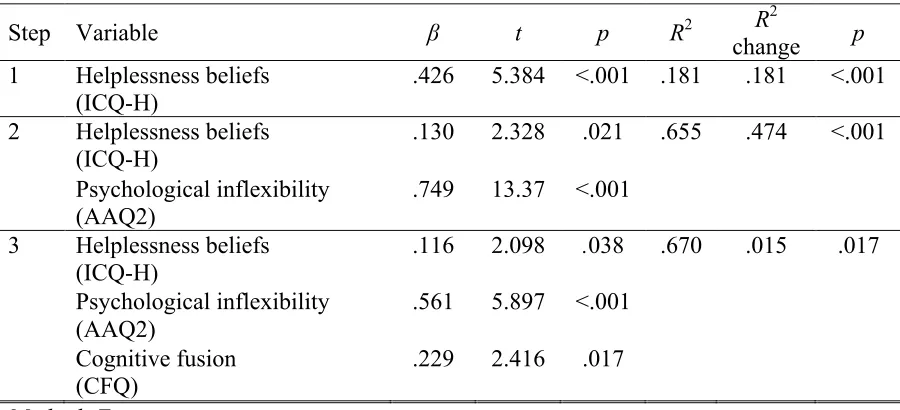
between these constructs were also explored in a series of incremental validity analyses (Table 4).
Insert Table 4 here
In the sample of Prison Officers, psychological inflexibility (AAQII) is strongly predictive of psychological distress (GHQ12). The CFQ shows additional incremental
validity, predicting an additional 5% of the variance in distress. Table 4 also shows the investigation of the relationship between rumination, metacognitive beliefs, CFQ and
depression, Interestingly, although positive beliefs about rumination correlate with depression (r = .23, p <.05), the metacognition construct no longer has predictive value when rumination is added at step 2. Cognitive fusion by contrast does significantly improve prediction of
depressive symptoms, even after much of the variance has been predicted by known
constructs. In people with multiple sclerosis, appraisals of helplessness are a strong predictor
of distress. Psychological inflexibility as measured by the AAQ-II further adds to the prediction of distress. The CFQ continues to significantly improve prediction of distress in MS, even after much of the variance has been accounted for by helplessness beliefs and
psychological inflexibility.
Study 4: Criterion Validity, Internal Consistency, and Test-Retest Reliability
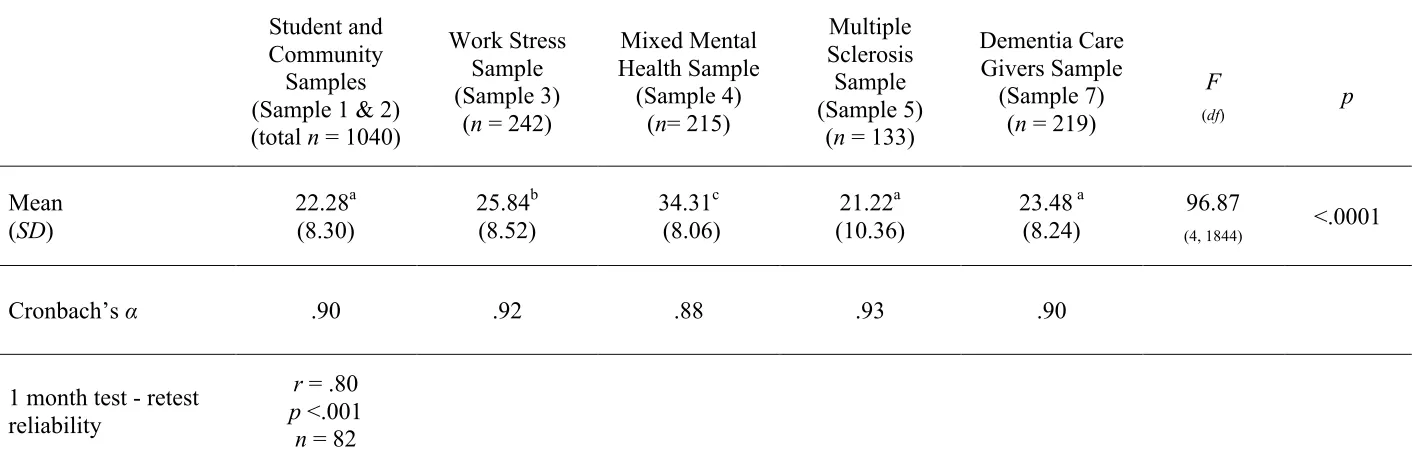
The CFQ was predicted to differ significantly between psychologically distressed and non-distressed samples. Samples 1 – 7 were used to compare the means between the different samples, adding to its validity and providing normative data for future comparisons in
clinical and research settings. Results
other groups are significantly different from each other. This demonstrates that the CFQ can
discriminate between people who have psychological disorders and those who do not and can distinguish between people seeking help for work related stress and those with more
diagnosable psychological disorders.
Insert Table 5 here
A subset of sample 2 (n = 82) completed the CFQ on two occasions separated by an average
of 4 weeks. There was a strong correlation between CFQ total scores on these two occasions (Mean T1: 19.38 [SD:8.41], Mean T2: 18.49 [SD: 8.87], r = .81, p <.001), suggesting good
temporal stability for the CFQ in a community sample. Table 5 also shows the excellent internal reliability of the CFQ in each of the different samples.
Study 5: Sensitivity to Treatment
A subset of participants from sample 3 who completed a well validated ACT-based workplace training program (led by PF) was used to investigate sensitivity to treatment. The
intervention is as described in Flaxman and Bond (2006; 2010a&b). Participants in the ACT and control groups completed the CFQ and a well-validated measure of psychological distress (the GHQ-12) at the same three time points over a five month evaluation period:
immediately prior to the intervention, two months after two initial ACT sessions, and three months after the final ACT session.
The program used mindfulness and defusion exercises to strengthen present moment awareness, reduce struggle with unwanted thoughts and emotions, defuse from unhelpful cognitive content (particularly thoughts that interfere with personally valued behavior), and
contact a sense of self that is distinct from psychological content. These strategies were used to help participants to pursue increasingly larger patterns of valued action, even in the
passengers on the bus; I’m having the thought that....; and practicing awareness of the process
of thinking as it unfolds.
For the present study, we first analyzed data provided by 49 ACT participants and 70
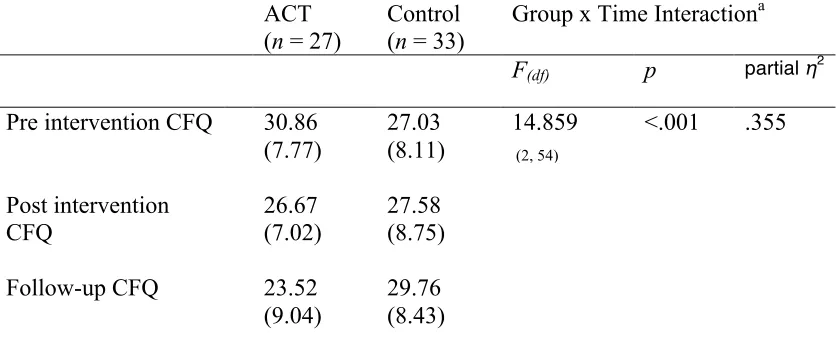
waitlist control participants who completed the CFQ and GHQ-12 at all three time points. Next, we examined CFQ scores at each time point for a subset of participants (27 ACT, 33 controls) identified as probable cases of minor psychiatric disorder (based on their
pre-intervention GHQ-12 caseness score). Finally, we employed a bootstrapping procedure (Preacher & Hayes, 2008) to examine the degree to which any observed improvements in
mental heath in the ACT group were statistically mediated by a reduction on the CFQ. For the mediation analysis, change on the CFQ was assessed between pre and post intervention while change on the GHQ-12 was assessed from preintervention through to follow-up.
Results
Table 6 shows that the CFQ is sensitive to the effects of an ACT intervention that targets
cognitive fusion.
Insert Table 6 Here
The effect of ACT treatment on the CFQ was statistically significant, with an effect size
(partial η2) of .150, representing a large effect (Cohen, 1988, p. 283) For the subgroup of participants who were classified as probable cases of minor psychiatric disorder prior to
receiving the ACT intervention, it is notable that the effect of ACT treatment was even stronger (partial η2 = .355). This finding supports the view that ACT interventions may be particularly beneficial for those individuals who are more distressed (Flaxman & Bond,
2010c)
To examine whether change on the CFQ mediated the impact of the ACT intervention
accelerated confidence intervals (BCa CIs). A statistically significant indirect (i.e. mediation)
effect is indicated when the upper and lower bound of these corrected CIs do not contain zero. Age, gender, employing organization, and pre-intervention GHQ-12 scores were
entered as covariates. To avoid duplication, we report the results of the mediation test conducted on the entire sample only (ACT = 49, control = 70).
The results of this analysis showed that the beneficial effect of the ACT program on
mental health was statistically mediated by a reduction in cognitive fusion. Specifically, the bootstrapped confidence intervals confirmed the presence of a statistically significant indirect
effect of Group (i.e., ACT vs. control) on pre-intervention to follow-up decrease on the GHQ-12 via the pre to post intervention reduction found on the CFQ: boot estimate = 1.28, SE = .57, BCa CI = .40, 2.68. To fully test the directionality of this mediation model, we also
performed an equivalent analysis, in which the change in CFQ was entered as the dependent variable, with change in the GHQ as the mediator. Changes in distress (GHQ-12) did mediate
the effect of ACT intervention on the CFQ, showing that the causal status of cognitive fusion as a mediator of ACT intervention is yet to be fully established.
Discussion
The results from this series of studies demonstrate that the CFQ is a brief and
psychometrically sound measure of cognitive fusion. Unlike the population-specific measures
of fusion found in the ACT literature, the CFQ offers an assessment of fusion with cognition in general. Given the wide application of ACT-based interventions, we believe the generic nature of the CFQ holds considerable potential for clinicians and researchers interested in
assessing this core psychological process.
The CFQ demonstrated excellent internal consistency and good test-retest reliability.
predicted patterns of relationships with a range of other relevant constructs. Preliminary
findings suggest the CFQ possesses adequate divergent validity, in that it is not associated with socially desirable responding. Incremental validity was demonstrated in three studies.
The CFQ predicted distress in prison officers, over and above the contribution of
psychological inflexibility. In predicting depressive symptoms the CFQ added to variance explained by rumination and metacognition. The CFQ also added to the prediction of distress
in people with multiple sclerosis, compared to helplessness beliefs and psychological inflexibility. These studies suggest the CFQ has adequate incremental validity in relation to
cognitive content measures and existing measures of related constructs from the ACT model. Finally, there is preliminary evidence that the CFQ is sensitive to changes occurring from a skills-based intervention that targets the process of cognitive fusion and that such changes
may mediate the intervention’s effect on distress.
The correlation between the CFQ and other constructs deserves some further
consideration. For instance, the CFQ and AAQ-II are highly correlated (ranging from .72 to .87). This may be due to item overlap, as the AAQ-II contains items that may be
representative of cognitive fusion (e.g. ‘I worry about not being able to control my worries
and feelings’). In addition, the AAQ-II has been described as a measure of psychological inflexibility (Bond et al., 2011, p. 678), and cognitive fusion is one component of
psychological inflexibility. Thus we would expect strong correlations between the component processes and a general measure of psychological inflexibility such as the AAQ-II. The observed strong correlations between the CFQ and the AAQ-II are therefore consistent with
the predictions of the ACT model.
An alternative interpretation is of course, that the process of cognitive fusion and the
CFQ measuring psychological inflexibility in relation to cognitions, and the AAQ-II
measuring that same construct in relation to a broader range of psychological events.
Measures of the same construct can have different utility in different contexts. For example,
the AAQ-II and the Work AAQ are seen as measuring the same construct (psychological inflexibility), but the latter predicts work-related variables (e.g., job motivation) better than does the former (Bond, Lloyd & Guenole, 2013). The CFQ should therefore be a stronger
predictor than the AAQ-II in contexts where psychological inflexibility is assessed with regards to cognition (e.g. around intrusive thoughts, beliefs about the self, repetitive thinking
etc.). The dependent correlations around use of thought control strategies and the incremental validity analyses in relation to rumination would suggest preliminary support for this
interpretation.
As part of our investigation of the relationship between the CFQ and the AAQ-II we undertook exploratory factor analysis of the CFQ and AAQ-II items in samples 1, 2, 3, 4, and
5. In samples 1, 2 and 4 the items of the CFQ and AAQ-II load onto two separate factors, according to their scale of origin. In samples 3 and 5, all the items load onto a single factor. This suggests that in some samples these two measures may be aspects of the same construct,
whilst in other samples the two constructs are more clearly separable. Though the
relationship between the AAQ-II and the CFQ remains open to further study, what is clear at
this early stage is that the development of the CFQ will make on-going investigation into the nature of relationships within the ACT model feasible in a way that has not been the case to date.
The CFQ also showed strong correlations with depressed mood (r = .85) particularly in the sample of depressed, recovered and never depressed participants (sample 6). Further
between these measures (r = .23 - .58). It is also of note that in sample 7, caregivers of people
with dementia, the correlation between CFQ and CESD is more modest (r = .66). This suggests that the strong correlation between CFQ and depression is only evident at levels of
depressed mood that meet diagnostic criteria for Major Depression. ACT theory suggests that cognitive fusion is the dominance of verbal relations over direct experience in controlling behavior, and its function in the context of depressed mood is to ‘fix the problem of
depression’. Paradoxically, this overthinking and lack of action would be predicted to intensify depressed mood and the correlational data presented is consistent with these
theoretical predictions.
There was also a strong correlation between the CFQ and ruminative response style [RSQ: Nolen-Hoeksema & Jackson, 2001]; again this was most evident for the currently
depressed group. Rumination is a ‘passive focus on one’s symptoms of distress and on the possible causes and consequences of these symptoms,’ (Nolen-Hoeksema & Jackson, 2001,
p. 37) It has been shown to be a construct of particular importance to the onset and
maintenance of depression, though has also been related to binge eating (Nolen-Hoeksema, Stice, Wade and Bohon, 2007) and to alcohol misuse (Nolen-Hoeksema and Larson, 1999;
Nolen-Hoeksema and Harrell, 2002) (for a review see Nolen-Hoeksema, Wisco and Lyubomirsky, 2008). Given the well-established body of research on the importance of
rumination, it is important to understand how the constructs of rumination and cognitive fusion relate to each other and how they might relate to and influence other variables, such as behavior and mood. As part of that effort, and in addition to the incremental validity analysis
reported, we also used data from a Spanish translation study of the CFQ (Romero-Moreno, Márquez-González,Losada, Gillanders, and Fernández-Fernández, under review) to factor
factors according to their scale of origin. This would suggest that these items are measuring
related but different constructs. We anticipate that the same pattern would be seen in the English language CFQ.
What further distinguishes cognitive fusion from rumination is that the CFQ has shown its consistent pattern of associations with a wide range of constructs (mindfulness, psychological flexibility, use of thought control strategies, distress, successful valued living,
quality of life, life satisfaction, burnout, job satisfaction) and across very diverse populations and contexts (work site stress management interventions, prison officers, students, healthy
adults, dementia caregivers, people with multiple sclerosis, people with common mental health problems, people with severe mental illness, and people with personality disorders). Future research should continue to investigate how the CFQ relates to important and well
established constructs such as rumination and how they each influence other variables. The CFQ may have an important role to play in future model testing and clinical
research. According to the ACT model, fusion is a key mediator in the relationship between cognitive content and action. The CFQ provides a means for testing this hypothesis. In addition, the ability to specifically track changes in fusion in response to interventions may
be useful to clinicians monitoring treatment progress and to researchers in testing hypotheses relating to the proposed mediating mechanisms of therapies.
In the development of the CFQ we generated items based on a broad
conceptualization of fusion and defusion, reflecting the many ways in which this process manifests. The final CFQ is relatively narrow in comparison, though this has been derived by
the empirical data. The CFQ still represents a broader conceptualization of fusion than the more narrowly defined proxy measures of ‘believability’ that have been used in investigating
A number of methodological limitations should be taken into consideration. In terms
of sample limitations, all of the study samples had a majority of female participants, and no children or adolescents. All participants were residents of the United Kingdom. Test-retest
reliability with a clinical sample is not yet established and longitudinal studies are needed to determine the predictive value of the CFQ in the development and course of psychological disorder. In sample 4 (the mixed mental health sample), treating clinicians confirmed the
presence of a psychological disorder, based on clinical evaluation rather than standardized diagnostic interviews and therefore we do not know the exact forms of psychological or
psychiatric disorders present in that sample.
Whilst these studies show preliminary evidence of the CFQ’s construct and
incremental validity, it is of note that its relationship to constructs such as decentering has not
yet been investigated. This is a limitation of the current set of studies and future research should address the incremental validity and the predictive value of the CFQ in comparison to
measures such as the Experiences Questionnaire [EQ: Fresco et al., 2007] for a range of outcomes. We would predict that the theoretical focus in fusion on behavioral regulation by cognitive events would suggest that the CFQ might more successfully predict behavioral
responses to cognitive events whilst the EQ may be a better predictor of depressive relapse than the CFQ.
The CFQ instructions were deliberately written to be generic and not time specific, in order to produce a broad, general measure of fusion. However, lack of contextual cues for responding might limit the measure in other ways, making it less sensitive to change over
shorter time periods. Development of an alternative version of the CFQ with different time instructions may be useful for some laboratory contexts.
for example thoughts about cancer, heart disease or other focus. Whilst adequate
investigation of the psychometric properties of such adaptations would be required, the CFQ would be likely to be a good basic structure upon which to develop such new scales.
A further limitation of the current studies is that we have not yet shown that CFQ scores alter in response to specific defusion interventions and do not change to the same degree in response to interventions that are not designed to target fusion. Similarly, our initial
studies show that the CFQ is responsive to an intervention that contains defusion elements, within a typical multi-faceted ACT intervention. We do not yet know how specifically these
interventions target fusion or other ACT processes. The development of the CFQ, however, does now help the scientific and clinical community to design studies that can test such component dismantling hypotheses. In addition, future research should determine the
relationship between the CFQ and other experimental methods of assessing fusion
behaviorally and implicitly, such as the Implicit Relational Assessment Procedure (IRAP:
Barnes-Holmes, Barnes-Holmes, Stewart and Boles, 2010). Finally, the results of the mediation study do not conclusively demonstrate that the ACT stress management
intervention works via defusion. It is possible that reductions in distress led to reductions in
fusion, rather than vice versa. Future intervention studies with more frequent assessment would be required to establish causal mediation.
The CFQ has a wide range of potential uses. In clinical practice it’s brevity allows it to be included in an intake assessment with ease, and to be used repeatedly to track changes, whilst it’s simplicity of language makes it accessible to a wide range of people. The generic
aspect of the measure allows it to be used in a wide range of settings, such as mental health, physical health, guidance and coaching as well as training settings. The CFQ performs well
References
Arbuckle, J. L. (2006). Amos (Version 19) [Computer Program]. Chicago: SPSS.
Baer, R. A, Smith, G. T., & Allen, K. B. (2004). Assessment of mindfulness by self-report: the Kentucky inventory of mindfulness skills. Assessment, 11(3), 191–206.
doi:10.1177/1073191104268029
Baer, R. A., Smith, G. T., Hopkins, J., Krietemeyer, J., & Toney, L. (2006). Using self-report assessment methods to explore facets of mindfulness. Assessment, 13(1), 27-45.
doi:10.1177/1073191105283504
Baer, R. A., Smith, G. T., Lykins, E., Button, D., Krietemeyer, J., Sauer, S., Walse, E., Duggan, D, & Williams, J. M. (2008). Construct validity of the five facet mindfulness questionnaire in meditating and non-meditating samples. Assessment, 15(3), 329-42. doi:10.1177/1073191107313003
Barnes-Holmes, D., Barnes-Holmes, Y., Stewart, I., & Boles, S. (2010). A sketch of the Implicit Relational Assessment Procedure (IRAP) and the Relational Elaboration and Coherence (REC) model. The Psychological Record, 60, 527–542.
Beck, A. T, Steer, R. A., & Brown, G. K. (1996). Manual for the Beck Depression Inventory-II. San Antonio, TX: Psychological Corporation.
Bishop, S. R., Lau, M., Shapiro, S., Carlson, L., Anderson, N. D., Carmody, J., Segal, Z. V., Abbey, S., Speca, M., Velting, D., & Devins, G. (2004). Mindfulness: A proposed
operational definition. Clinical Psychology: Science and Practice, 11, 230–241.
Bollen, K. A. (1989). Structural equations with latent variables. New York: Wiley.
Bond, F. W., Hayes, S. C., Baer, R. A., Carpenter, K. M., Guenole, N., Orcutt, H. K., Waltz, T., Zettle, R. D. (2011). Preliminary Psychometric Properties of the Acceptance and Action Questionnaire–II: A Revised Measure of Psychological Inflexibility and Experiential Avoidance. Behavior Therapy, 42(4), 676-688. doi:10.1016/j.beth.2011.03.007
Bond, F.W., Lloyd, J. & Guenole, N. (online Jan 2013). Preliminary psychometric properties of the work-related acceptance and action questionnaire. Journal of Occupational and Organizational Psychology. doi: 10.1111/joop.12001
Bouchard, M. A., Target, M., Lecours, S., Fonagy, P., Tremblay, L.-M., Schachter, A., & Stein, H. (2008). Mentalization in adult attachment narratives: Reflective functioning, mental states, and affect elaboration compared. Psychoanalytic Psychology, 25(1), 47–66.
doi:10.1037/0736-9735.25.1.47
BPS. (2009). Code of Ethics and Conduct. Leicester, U.K: British Psychological Society.
Byrne, B. M. (2004). Structural Equation Modeling: Testing for Multigroup Invariance Using AMOS Graphics: A Road Less Traveled. Structural Equation Modeling: A Multidisciplinary Journal, 11(2), 272–300. doi:10.1207/s15328007sem1102_8
Chadwick, P., Hember, M., Symes, J., Peters, E., Kuipers, E., & Dagnan, D. (2008). Responding mindfully to unpleasant thoughts and images: Reliability and validity of the Southampton mindfulness questionnaire (SMQ). British Journal of Clinical Psychology, 47(4), 451-455.
Cohen, J. (1988). Statistical power analysis for the behavioral sciences. Hillsdale, NJ: Erlbaum.
Daniels, K. (2000). Measures of five aspects of affective well being at work. Human Relations, 53, 275-294. doi:0018-7267(2000)53:2.
Derogatis, L. R. (1994). SCL-90-R: Administration, scoring and procedures manual. Minneapolis: National Computer Systems Inc.
Diener, E., Emmons, R. A., Larsen, R. J., & Griffin, S. (1985). The satisfaction with life scale. Journal of Personality Assessment, 49, 71-75.
Evans, C. (2000). CORE!: Clinical Outcomes in Routine Evaluation. Journal of Mental Health, 9(3), 247–255. doi/abs/10.1080/jmh.9.3.247.255
Evers, A. W. M., Kraaimaat, F. W., van Lankveld, W., Jongen, P. J. H., Jacobs, J. W. G., & Bijlsma, J. W. J. (2001). Beyond unfavorable thinking: the illness cognition questionnaire for chronic diseases. Journal Of Consulting And Clinical Psychology, 69(6), 1026 – 1036.
Fergus, T. A, Valentiner, D. P., Gillen, M. J., Hiraoka, R., Twohig, M. P., Abramowitz, J. S., & McGrath, P. B. (2012). Assessing psychological inflexibility: the psychometric properties of the Avoidance and Fusion Questionnaire for Youth in two adult samples. Psychological assessment, 24(2), 402–8. doi:10.1037/a0025776.
Ferenbach, C. (2011). The Process Of Psychological Adjustment To Multiple Sclerosis: Comparing The Roles Of Appraisals, Acceptance, and Cognitive Fusion. Unpublished manuscript, University of Edinburgh. Available at: http://hdl.handle.net/1842/6289
Ferguson, E. & Cox, T. (1993). Exploratory Factor Analysis: A Users’Guide. International Journal of Selection and Assessment, 1: 84–94. doi: 10.1111/j.1468-2389.1993.tb00092.x
First, M. B., Spitzer, R. L., Gibbon, M., & Williams, J. B.W. (1996). Structured Clinical Interview for DSM-IV Axis 1 Disorders. New York State Psychiatric Institute: New York.
Flaxman, P. E., & Bond, F. W. (2006). Acceptance and commitment therapy in the
workplace. In R. A. Baer (Ed.), Mindfulness-based treatment approaches. San Diego, CA: Elsevier.
acceptance processes in clients: Illuminating the theory and practice of change. Oakland, CA: New Harbinger.
Flaxman, P. E., & Bond, F. W. (2010b). A randomised worksite comparison of acceptance and commitment therapy and stress inoculation training. Behaviour Research and Therapy, 48(8), 816-20. doi:10.1016/j.brat.2010.05.004
Flaxman, P. E., & Bond, F. W. (2010c). Worksite stress management training: moderated effects and clinical significance. Journal of Occupational Health Psychology, 15(4), 347–58. doi:10.1037/a0020522
Floyd, F. J., & Widaman, K. F. (1995). Factor analysis in the development and refinement of clinical assessment instruments. Psychological Assessment, 7, 286-299. (Serial publication #79)
Fonagy, P., & Target, M. (1997). Attachment and reflective function: Their role in self-organization. Development and Psychopathology, 9, 679–700.
Fonagy, P., & Target, M. (2002). Early intervention and the development of self–regulation. Psychoanalytic Inquiry, 22, 307–335.
Forman, E. M., Herbert, J. D., Juarascio, A. S., Yeomans, P. D., Zebell, J. a., Goetter, E. M., & Moitra, E. (2012). The Drexel Defusion Scale: A New Measure of Experiential Distancing. Journal of Contextual Behavioral Science. 1, 55-65. doi:10.1016/j.jcbs.2012.09.001
Fresco, D. M., Moore, M. T., van Dulmen, M. H. M., Segal, Z. V., Ma, S. H., Teasdale, J. D., & Williams, J. M. G. (2007). Initial psychometric properties of the experiences questionnaire: validation of a self-report measure of decentering. Behavior Therapy, 38(3), 234–46.
doi:10.1016/j.beth.2006.08.003
Fresco, D. M., Segal, Z. V., Buis, T., & Kennedy, S. (2007). Relationship of posttreatment decentering and cognitive reactivity to relapse in major depression. Journal of Consulting and Clinical Psychology, 75(3), 447–55. doi:10.1037/0022-006X.75.3.447
Goldberg, D. (1992). General Health Questionnaire (GHQ-12). Windsor, UK: NFER-Nelson.
Greco, L. A Lambert, W., & Baer, R. A. (2008). Psychological inflexibility in childhood and adolescence: development and evaluation of the Avoidance and Fusion Questionnaire for Youth. Psychological Assessment, 20(2), 93–102. doi:10.1037/1040-3590.20.2.93
Gumley, A. (2010). The developmental roots of compromised mentalization in complex mental health disturbances of adulthood: an attachment-based conceptualisation. In G. DiMaggio and P. H. Lysaker (Eds.) Metacognition and severe adult mental disorders: From research to treatment. Routledge: Hove.
Hayes, S. C., Barnes-Holmes, D., & Roche, B. (2001) Relational Frame Theory: A Post Skinnerian account of language and cognition. New York: Plenum Press.
Hayes, S. C., Strosahl, K., D., & Wilson, K. G. (2011). Acceptance and Commitment Therapy (2nd Edition): The process and practice of mindful change. New York: Guilford Press.
Haynes, S. N., & Lench, H. C. (2003). Incremental validity of new clinical assessment measures. Psychological assessment, 15(4), 456–66. doi:10.1037/1040-3590.15.4.456
Herzberg, K. N., Sheppard, S. C., Forsyth, J. P., Credé, M., Earleywine, M., & Eifert, G. H. (2012). The Believability of Anxious Feelings and Thoughts Questionnaire (BAFT): A Psychometric Evaluation of Cognitive Fusion in a Nonclinical and Highly Anxious Community Sample. Psychological Assessment. doi:10.1037/a0027782
Hollon, S. D., & Beck, A. T. (1979). Cognitive therapy of depression. In P. C. Kendall & S. D. Barlow (Eds.), Cognitive-behavioral Intervention: Theory , Research, and Procedures (pp. 153-203). New York: Academic Press.
Hollon, S. D., & Kendall, P. C. (1980). Cognitive self-statements in depression:
Development of an automatic thoughts questionnaire. Cognitive Therapy and Research, 4, 383-395.
Horn J. L. 1965. "A rationale and a test for the number of factors in factor analysis." Psychometrika. 30: 179–185
Hu, L. T., & Bentler, P. M. (1998). Fit indices in covariance structure modelling: Sensitivity to underprameterized model misspecification. Psychological Methods, 3, 424-453.
Hyler, S. E. (1994). Personality Questionnaire, PDQ-4+. New York: New York State Psychiatric Institute.
Jackson, D. L., Gillaspy, J. A., & Purc-Stephenson, R. (2009). Reporting practices in confirmatory factor analysis: an overview and some recommendations. Psychological Methods, 14(1), 6-23. doi:10.1037/a0014694
Kaiser, H. F. (1974). Analysis of factorial simplicity. Psychometrika, 39, 31-36.
Kabat-Zinn, J. (1990). Full Catastrophe Living: Using the Wisdom of Your Body and Mind to Face Stress, Pain, and Illness. (p. 467). New York, Delacorte Press.
Kerr, E. S. (2011). Investigation of the relationship between depression, rumination, metacognitive beliefs and cognitive fusion. Unpublished Manuscript, University of Edinburgh. Available at: http://hdl.handle.net/1842/5626
Kline, R. B. (2005). Principles and Practice of Structural Equation Modelling (3rd Edition), New York, Guilford Press.
Mäkikangas, A., Feldt, T., & Kinnunen, U. (2007). Warr’s scale of job-related affective well-being: A longitudinal examination of its structure and relationships with work characteristics. Work & Stress, 21, 197-219.
Marsh, H. W. (1986). The bias of negatively worded items in rating scales for young children: A cognitive-developmental phenomenon. Developmental Psychology, 22, 37-49.
Nolen-Hoeksema, S., & Harrell, Z.A. (2002). Rumination, depression, and alcohol use: Tests of gender differences. Journal of Cognitive Psychotherapy, 16, 391–403.
Nolen-Hoeksema, S., & Jackson, S. (2001). Mediators of the gender difference in rumination. Psychology of Women Quarterly, 25, 37–47.
Nolen-Hoeksema, S., & Larson, J. (1999). Coping with loss. Mahwah, NJ: Erlbaum.
Nolen-Hoeksema, S., Stice, E., Wade, E., & Bohon, C. (2007). Reciprocal relations between rumination and bulimic, substance abuse and depressive symptoms in female adolescents. Journal of Abnormal Psychology, 116, 198–207.
Nolen-Hoeksema, S., Wisco, B. E., & Lyubomirsky, S. (2008). Rethinking Rumination. Perspectives on Psychological Science, 3, 400-424.
Nunnally, J. C. (1978). Psychometric theory (2nd ed.). New York: McGraw-Hill.
Nunnally, J. C. & Bernstein, I. H. (1994). Psychometric theory (3rd ed.). New York: McGraw-Hill.
Paulhus, D. L. (1991). Measurement and control of response bias. In J. P. Robinson, P. R. Shaver, & L. S. Wrightsman (Eds.), Measures of personality and social psychological attitudes. San Diego, CA: Academic Press.
Preacher, K. J., & Hayes, A. F. (2008). Asymptotic and resampling strategies for assessing and comparing indirect effects in multiple mediator models. Behavior Research Methods, 40(3), 879–891. doi:10.3758/BRM.40.3.879
Radloff, L.S. (1977). The CES-D scale: A self-report depression scale for research in the general population. Applied Psychological Measurement, 1, 385– 401.
Romero-Moreno, R., Márquez-González, M.,Losada, A., Gillanders, D. T., & Fernández-Fernández, V. (under review). Cognitive fusion in dementia caregiving: psychometric properties of the Spanish version of the Cognitive Fusion Questionnaire. International Psychogeriatrics.
Safran, J. D., & Segal, Z. V. (1990). Interpersonal process in cognitive therapy. New York: Basic Books.