Theses Thesis/Dissertation Collections
11-11-2011
Relics
Rex KalehoffFollow this and additional works at:http://scholarworks.rit.edu/theses
This Thesis is brought to you for free and open access by the Thesis/Dissertation Collections at RIT Scholar Works. It has been accepted for inclusion in Theses by an authorized administrator of RIT Scholar Works. For more information, please [email protected].
Recommended Citation
Rochester Institute of Technology
A Thesis Submitted to the Faculty of
The College of Imaging Arts and Sciences
In candidacy for the degree of
Masters of Fine Arts
Relics
By
Rex Kalehoff
Final Approvals
Chief Adviser: Rich Tannen __________________________________
Date: ___________________
Associate Adviser: Andy Buck __________________________________
Date: ___________________
Associate Adviser: Elizabeth Kronfield __________________________________
Date: ___________________
Associate Adviser: Bill Middleton __________________________________
Date: ___________________
Chair Person: Don Arday __________________________________
Dedication
To my family.
Table of Contents
Approvals……….II Dedication……….III Table of Contents………IV
Abstract……….V
Preface ……….VI Manifesto……….VIII
Introduction……….1
The Work:
Vessels and Chair……….6 Buffalo Cart ……….13
Godking……….25 Iceman……….35
Three Whale Vertebrae……….42
Conclusion……….50
Works Cited……….56
Abstract
Preface
It is with great satisfaction that I am submitting this MFA Thesis report in conjunction with my Thesis exhibition, entitled ‘RELICS’. I am delighted to have this opportunity to share more about the development and meaning behind this body of work.
Over the past 10 years, I have made numerous trips to Australia and South East Asia, from one month to over one year in duration. There were several motives driving those trips, including study, family, work, and travel, however, they also proved to be periods of my most significant research and personal discovery. Those experiences have been the primary source for this thesis work.
Along the way, several factors have added to my developing awareness of the world, teaching me about diversity, history, ecology, geography, and the natural environment. In this written thesis, I will discuss how these elements of my experience inspired and pertain to my work. I will provide anecdotal accounts, and cite several additional literary sources. It is my hope that this thesis will convey the unique perspective of a man living as a modern day explorer and artist, and open meaningful discussion on the associated subject matter. For readers who are interested in the technical aspects of the work, an elaborate description of the methods and processes employed for each sculpture, are included in the write-up for each piece.
Manifesto
1. I am an artist. Creativity is vitality. Give life to art.
2. Clarity and order in my work and environment. Simplicity.
3. Demonstrate care and respect with my chosen materials. Know stone and wood.
4. Honor traditional techniques. Consider the masters of the past. Create a new vision.
5. Combine fine craft with meaningful concepts and content-driven art.
6. Work in devotion to the natural environment. Bring nature to others.
7. Think like a Purist. Embrace authenticity.
8. Work for the self, in service to others. Connect with people.
9. Remain free and curious.
Introduction
Relics
The word “relics” brings to mind images of mysterious artifacts from another time and culture. I picture archeological sites and the remnants of ancient civilizations from around the world, and imagine what the world was like during those times. “Relics” are fragments of the past, which portray pieces of human history on earth. When viewed in the context of modern society, the remains of past cultures can offer great insight into the way we live today. The monumental stone sculptures of Easter Island, for example, are reminders of a culture that once flourished, but failed to endure the depletion of its own resources. In his book, ‘Collapse’, Jared Diamond argues that the rapid deforestation of Easter Island led to its depopulation, and the collapse of its society. I think of the continuing impact of the over-exploitation of natural resources in the world today, and I draw a connection to the destructive patterns of past cultures.
In the same way, this thesis, entitled ‘RELICS’, examines remnants of past societies and reveals examples of great successes and failures throughout history, which raises questions about our current ways of life. We are presently in a time of constant fear and war, environmental degradation is rampant, and unsustainable manufacturing processes and technologies continue to advance rapidly. Through an investigation of historical references and symbols, this thesis addresses some of these issues presently affecting the shared experience and future of our world-nation.
Research
my artistic practice, and this thesis emerges from a combination of my interest in ancient cultures and my growing concern for the ecological state of the world.
My world travels began when I was 20 years old. I went to study sculpture in Sydney, Australia, and I was literally spellbound by its unspoiled natural beauty. Abundant were beaches with no footprints, natural rock pools I could drink from, and wildlife I had never seen before. I developed a love for nature and a passion for life that heightened my awareness of the world. Since then, I have revisited many times, and spent a total of three years in Australia, to further explore its stunning coastline and wilderness areas. I received formal training in Australian botanical studies, geology, and at the same time uncovered a startling history of the human exploitation of the landscape. What I witnessed were some of the most pristine and wild places on Earth, which were, sadly, under constant threat of human impact. I joined local environmental groups, including artists, designers and craftspeople, and began creating artworks having to do with the paradoxical relationship between nature and culture. My experiences in Australia have consistently been times of great intimacy with the earth, and have significantly informed my thesis work.
Symbols
‘RELICS’ consists of five sculptures, handcrafted in wood, each one a contemporary representation of an object from the ancient world. Drawn from my own studies and observations stated above, each object is a symbol, rather than a re-creation of an original artifact. My intention is to provide visual imagery, which reminds us of the past, speaks of the present, and asks us to contemplate our future, and that of the planet. Touching upon issues of impermanence, I aim to create a platform from which to look outside of ourselves and consider our impact upon the Earth, and our own survival. In an attempt to speak to the widest audience, the objects I have selected should be recognizable to everyone, regardless of age, culture, or background, and readers and viewers are invited to examine the works with regards to their own cultural background or personal history.
Wood
The Work
Vessels & Chair
Vessels & Chair
Part of my MFA coursework was to design and make a chair. A chair is truly a utilitarian object, but my aim was to look beyond traditional notions of chair design. At the time, I was very much trying to integrate my sculptural interests into different forms of furniture. For this chair project, I came up with Vessels & Chair. It was this project that shifted the way I thought about furniture and sculpture, and it became the catalyst for the rest of my thesis work.
Development
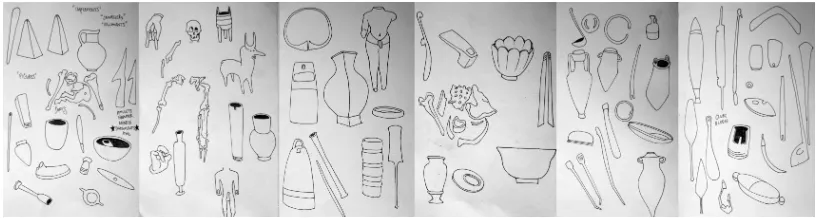
[image:16.612.103.515.528.637.2]I began the design process for this project with a visual study of ancient artifacts from around the world. I collected images from my own photographs, as well as Archeology and National Geographic magazines, and then made freehand line drawings of a variety of tools, vessels, figures, weapons, skeletal remains, and ritual objects (fig. 1). These line drawings then triggered ideas of chairs made from assembling those objects. The idea of carving numerous artifacts in wood excited me, but I couldn’t justify arranging those objects into the form of a chair.
fig. 1: Original line drawings of various artifacts
artifacts! I focused in on associations of containment, ritual, and daily use, and chose to include only a group of jars and vessels, with the chair, which would be designed with reference to indistinguishable ancient origins: eccentric proportions, bold lines and forms, and an enigmatic presence.
I then needed to consider how I should represent these ancient items, often damaged, cracked, or weathered in appearance. My aesthetic intentions were to create clean flawless surfaces, and perfect forms, so a faux-ancient look was out of the question. I thought of archeological sites, and how objects are often discovered only after digging, and left half-buried to preserve their fragile state. My solution was to recreate this scenario. I would create a base that represented the ground in which the chair and the objects were buried. Further sketches followed and I had the final design, where the ground/base was contained in the footprint of the chair, and the vessels lay scattered beneath the seat (fig. 2). The piece became a small section out of an archaeological site. I was reminded of my own visits to Ban Chiang’s 5000 year-old burial sites in northeastern Thailand, displaying the original 1970’s dig, where jars, weapons and skeletal remains were discovered.
Time & Culture
The objects themselves beg explanation. The stature of the chair could suggest a figure of power, yet there are only common vessels beneath it, as opposed to weapons or ornate objects. The chair could speak about a domestic realm, or just as easily, it could be a ritual or burial site. The five vessels, of different proportions and functions, become a symbol for the presence of an unknown culture. They represent the utilitarianism of simple everyday objects. What more can these objects imply? As the title infers, the chair wasn’t the object. Instead, it became an element in a larger composition, laden with content. In this way, it was exciting that this piece was more than just a chair, however, the functionality definitely heightened the conceptual implications in this piece. It is utilitarian but can stand alone as sculpture.
Vessels & Chair speaks of an ancient time and hints at the preservation of ancient artifacts. It is ancient but its surfaces are pristine and its edges are sharp. There is no sign of use or sense of age. It is a thing out of its time, but it is timeless. It speaks of cultures, but is cultureless. These anachronistic and enigmatic qualities strengthened this piece and carried through to the rest of my thesis work.
Technical Notes
fig. 3: Taper jig
The 1 ¾ inch solid seat included 4 massive hand-cut integral thru-tenons, which fit snugly into huge square mortises cut into the back of the chair with a 1-inch wide flat chisel (fig. 4). I created a frame for the front of the chair by long-grain gluing the parts, which included the legs, the front edge of the seat, and the front face of the base. I chose to miter the front of the seat so the grain would wrap around the front of the chair, giving the piece a more solid and pronounced appearance. Through trial and error, I fit side faces to the compound angles of the base, joined them with mortise and tenons, and then created a top face for the base, which also needed to be mitered and notched out perfectly around the two front legs.
fig. 4: Hand-cut mortises in the tapered chair back
assured the piece would be functional. Although the chair tilted back and to the side, it was counterbalanced in the base, and could safely be sat in.
To create the vessels, I laminated several 2-inch thick off-cuts of mahogany door stock to make nice solid blanks for the lathe. After turning and sanding, (fig. 5 & 6) the challenge was to carve away at the vessels so they would sit flush on the base at desired angles. This part was especially important to create the illusion of the objects being half-buried. I determined the angles I needed to cut and marked it on each vessel. I then made a simple yet effective jig, which was essentially a wooden frame that I could use to stabilize the vessel by screwing the waste material into the frame and cutting the angle on the bandsaw. In some cases the vessel wrapped around two sides of the base, which required some trial and error to fit. The precision contact points are what made the illusion believable. To secure the vessels, I screwed them firmly to the base from the underside, completely invisible and removable.
fig. 5 & 6: Turning the vessels
Achievements
culture and time, I was able to tap into significant experiences of my own, yet Vessels & Chair successfully made reference to other cultures in a way that did not single out any one culture or group.
With this piece, I had made a huge shift from making abstract works to purely representational work. I enjoyed that people could recognize the objects and create their own story about them, or read and add to mine. I learned that I could speak with a more universal language, creating images of familiar objects.
Buffalo Cart
Buffalo Cart
Buffalo Cart was created in response to Vessels & Chair. The tone had been set, and the references to time and culture in this next piece were imminent. My thesis committee challenged me, this time, to create another work that was rooted in function, but could speak like sculpture. After the chair project, I wanted to look beyond the domestic realm of furniture and functionality and speak with a more loaded and unexpected image. I thought of my own encounters with objects in the ancient world, and recalled the commonly seen buffalo cart, from South-East Asia. This was a perfect symbol, emanating references to history and utility, and the technical demands to build it were challenging and suitable for a substantial thesis piece.
Ancient Implement
Domestication of Animals and Food Production
The domestication of animals was a huge evolutionary step towards the modernization of societies. Buffalo Cart refers to the use of draught-animals, like oxen or buffalo, which brought greater productivity and efficiency to growing and transporting crops. In the book ‘Guns, Germs, and Steel’, Jared Diamond speaks about four distinct ways that livestock could feed more people: by supplying meat, milk, and fertilizer, and by pulling plows. Societies that possessed domesticated animals not only began to set up agricultural systems, but also stored food, fed more people per acre, and with a higher birth rate, achieved a higher population density. Diamond continued on to say, “The resulting surpluses, and (in some cases) the animal-based means of transporting those surpluses, was a prerequisite for the development of settled, politically centralized, socially stratified, economically complex, technologically innovative societies.” (92) Interestingly, the aboriginal Australians never acquired food production methods, or domesticated animals for agricultural means, and so remained a hunter-gatherer society.
Observations
Buffalo Cart is a life-size representation of an historic agricultural tool, and is accompanied by a yoke and cowbell. Standing in the presence of this piece almost brings the viewer back in time; it is another anachronism, clearly from an ancient period. The cart stretches across the room at more than 11 ½ feet long, with the wheels standing more than 5 feet tall. To personify this object, it stands proud and capable; its sound construction is visually striking, and really adds to these qualities. The curved bed of the cart is wide and accepting of any cargo. The joints and load-bearing elements are strong and solid, and the massive hubs and underside structure further suggest it would have handled significant loads. Everything about its construction speaks of function and utility. The cart’s potential to perform excessive duties is unquestionable.
However, based on its appearance, Buffalo Cart’s associated functionality is in great contrast to the surface and aesthetic qualities of this piece. It is almost too clean and precious to do the type of work mentioned above. Meticulously crafted entirely in white oak, with only wooden joinery, and no nails or screws, the unfinished natural surfaces glow in uniformity and freshness. At a closer glance, each surface is finely worked, revealing subtle detailing and modest shaping. Each and every member of the entire cart has been softly chamfered or faceted, blurring the line between natural wear and aging, and the intentional marks of the maker. The piece is in pristine condition, yet almost appears slightly used, and abandoned.
The yoke and the bell are highly indicative of the presence of a beast of burden. These elements lay arbitrarily on the floor at the foot of the cart, as if they were left there in preparation, to be strapped to some animal. The yoke would be used to connect two oxen or buffalo to the shaft of the cart, and the bell would keep the owner alert of the animals’ whereabouts. The surfaces and edges of these objects are as crisp and clean as the cart, and are also built to function.
So where are the buffalo? Interestingly, Buffalo Cart is possibly more suggestive of the absence of the buffalo, than it is about the buffalo. Along with the absence of the buffalo, goes the absence of its function. Is this a sign of a by-gone era? This brings me back to one more compelling point, concerning the scale of the cart and the absence of the buffalo. The grand presence of Buffalo Cart, along with its durable construction, is convincing, and we can visualize putting the cart to work behind two live buffalo. However, real live buffalo are much larger than this cart could accommodate, making this a “miniature buffalo cart”. Adding to the enigmatic qualities of this work is the thought of two pygmy-buffalo standing next to it.
Developing a Model
proportions, work out subtle details, and measure and place each member in relation to the other parts.
[image:27.612.151.463.132.337.2]fig. 7: Original model of Buffalo Cart
First and foremost, I wanted this cart to be functional. Although it was a sculpture,
Buffalo Cart was to be made well, and actually work. Its ability to function, would in fact add significant content to the piece. To achieve a structurally sound, working cart, would require quality timber, thoughtful engineering, and decent craftsmanship.
Technical Notes
The building of Buffalo Cart was a slow and steady year-long process. I had never taken on the challenge of building something so large before, and its structural demands called for careful consideration. I was happy to take my time building this piece, as it was new territory for me to be working in this way.
Constructing the wheels of the cart, alone, was an extremely demanding process, and the relative proportions of the wheel parts to the cart were important to be consistent with the overall form of the piece. I created the rims of the wheels with octagonal frames held together with spline joints (fig. 8), so the hubs and spokes could be dropped into dados in the side of the rim of each wheel (fig. 9)
fig. 9: Hub and spokes dropped into dados in the rim of the wheel
Heavy 3-inch thick, 9-inch diameter hubs were laminated with quarter-sawn stock of white oak, and turned on the lathe, following the hub-profile I had made in my full-scale drawings. A channel was created in the outer rim of the hub to house the base of the spokes, an essential part of the construction to create the clean and refined appearance in an area of the piece that was so complex with structural requirements. Each of the 32 spokes were shaped identically, tapering in width and thickness, and joined to the wheel and hub with integral tenons. After gluing up all the parts for the wheels, I was astonished at how solid they were.
Interestingly, my method of constructing the wheels probably differed greatly from traditional ways. However, I think this contradiction actually potentially adds to the story and enigma of this piece. The final detailing on the wheel included tapering the thickness of the rims and slightly doming the tread of the wheel.
structure, I dropped the front and rear cross members into the top of the steam-bent parts, and joined another two cross members to the underside, for added stability towards the center of the frame.
fig. 10: clamping the steamed wood and steel strap to the form to achieve the curved side rails
The stationary axle was housed inside a pair of massive stabilizers, which connected the axle and wheels to the bed of the cart. Therefore, the wheels would spin around the axle, as opposed to the axle spinning inside the stabilizers. Only the ends of the axle were turned on the lathe, leaving a shoulder for the hub to butt up against, for added stability. The square mid-section of the axle added structural integrity to its length, but for aesthetic purposes, I cut an octagonal cross section into it.
The stabilizers, cut out of 2-inch thick slabs, were laminated in sections, so as to leave a precisely measured square void in the center of each one, to accommodate the exact dimensions of the midsection of the axle. Two more notches cut into the top edge of the stabilizers, also fit snugly around the two middle cross members of the cart frame. They not only became the load-bearing elements of the cart, but also added significant strength to the whole, in the triangulation of the joints.
the curve of the tapering shaft nicely, and minimize grain run-out. For added strength, I made a plan to create somewhat of an A-frame, for the single central shaft of this cart. The length of the shaft needed to extend through the body of the cart, to provide enough leverage for pulling and turning, so I decided to join the two ends of the A-frame to the stationary axle and mid-cross member, which were already very sturdy, and this would add even more bulk and strength to the whole structure.
During the glue up, I included hidden dowel joints through the material, for added integrity. Stylizing the cart in my own way, I applied various hand-shaping techniques to add subtle details around these parts, including copious chamfered edges around the axle and its housing components, and the gently sloping faceted top edge of the shaft. To complete the work on the frame, I added floorboards to the bed, which flexed and locked into place, with rabbets and registration pins within the frame.
Finally, the cart was finished, so I slipped the wheels onto the axle, and saw it standing for the first time! The final step was to create the hubcaps and self-locking end-caps, which would stabilize the side-to-side rocking of the wheels, and lock the wheels to the axle. These parts were all turned on the lathe, and when placed on the axle, locked together with a tapered thru-tenon, or wedge, which penetrated through the end-caps and axle.
Achievements
The completion of Buffalo Cart was an achievement I am extremely proud of. It was the well-thought out and controlled methods of my process that ensured its success. The level of difficulty and complexity I overcame, in this piece alone, has given me the confidence to confront great challenges in the future.
Aesthetically, this work was a great accomplishment, definitely inheriting the ancient refined qualities. Not only was the structure sound, but each and every element of its construction was considered in the appearance of the whole sculpture, resulting in a stunning showpiece. The subtle faceting, modest detailing, and controlled edge treatments were consistent throughout the cart, the yoke, and the bell, making each object unmistakable elements of a group.
The buffalo cart was a successful symbol as well. Its associations were wide and could vary from person to person, and culture to culture. There is something about a cart with big wheels that everyone can identify with. While constructing Buffalo Cart, many observers viewed it in interesting ways, suggesting it could be a Roman chariot, or even a rickshaw. I support the varied interpretations’ of the viewers, as it gives me an opportunity to learn from others.
Godking
Godking
While progress on Buffalo Cart was an ongoing challenge, in terms of its structural demands and scale, I was able to work through designs for other projects at the same time. With no plan or image in my mind of what I wanted to make, I set my own parameters for my next sculpture: to create an object that had lost its function. Drawing on themes of time and impermanence, and looking at sculpture of ancient cultures, I developed my next piece, entitled Godking.
Sculpture
Across cultures of the ancient world, images of ancestors, gods, pharaohs, kings, and enlightened beings have been sculpted to immortalize or embody that being, and strike faith, inspiration, fear or worship into its devotees. Carved, cast, or hand-built, these images represented someone of great significance or power. The figurative works and statuary of the ancient Greeks, Egyptians, or Mayans come to mind, and while living in South East Asia, I observed, first-hand, the remains of countless Buddha and Hindu statues, in their original architectural settings. I made frequent visits to historic ruins like Sukkhothai and Ayuthaya in Thailand, and Cambodia’s temples of Angkor.
Observations
Godking represents a mysterious fragment of an ancient figurative sculpture. All that remains is a pair of pudgy bare-feet, standing flat on a base. The rest of the figure, above the ankles, is missing, so there is no indication of who the figure was. Sculptures like this often broke somewhere below the knees, which was the weakest point in a top-heavy stone figure. Many different forces may have caused such breakages.
Extending from beneath the base is a long tapering square member. Historically, stone statues would have been stabilized with large tenons, integral to the base, which would fit into a secondary base. Here, it props up the object at an odd angle, and raises questions of what it is and what its purpose is. The base has a chamfer on the underside, further evidence that suggests it fit snugly into some larger base. However, existing only as a broken fragment of a larger component, this object has, in effect, lost its function.
The feet are unadorned and unassuming, in a frontal position, with the left foot slightly in front of the right. The toes are almost all the same length, sculpted with clean hard edges, and they curl distinctly at the tips. These details must have been significant to those who created and worshiped this figure, but where is the rest of it? Who is it, and who made it? The rims of the ankles, where the breaks occurred, are clean and softly faceted, almost like glass - a striking contrast to the interior surfaces of the feet, slightly textured.
Perishable
Godking is an image of an ancient figurative sculpture, which in itself, speaks of a lost art form. It represents something which would have originally been carved out of solid stone, however, Godking is hollow-constructed and carved in wood, a material that deteriorates and disappears quickly, contrasting greatly to the permanence of stone. In fact, at all the ancient sites I visited, anything made of wood, including wooden houses or wooden architectural elements, had all rotted away hundreds of years ago, so all that remained were the stone and brick structures. Furthermore, a hollow stone is unprecedented. Only in monumental works were there hollow stone sculptures, such as the Greek Colossus, which was built from brick-layered blocks of marble, and then carved. Despite its monumentality, or suggestion thereof, Godking is perishable and transient.
Destruction of Culture
Although very tranquil, this image is a strong reference to war and destruction. It implies the end of an era - a symbol destroyed by those in opposition to the original figure or the message it stood for. It is a remnant of war as much as it is a remnant of civilization. War brings about a destruction of culture, physically and intellectually, affecting the architecture, art, environment, and charisma of the cultures involved.
Black Market
New York City’s Metropolitan Museum of Art has been a source of wonder and inspiration for me since I was young. One issue we don’t think of too often, when we view artifacts in museums, is how the objects were acquired in the first place. Were all the objects bought or obtained legally? Was there bloodshed? Where are all the other artifacts that are not in the collections of museums? Godking makes a reference to the global Black Market distribution of ancient and cultural artifacts. While the historical value of such objects is priceless, their monetary value has ensured an underground market driven by crime. In many cases, as in the looting of the temples of Angkor, rare or highly sought after sculptures were stolen in times of abandonment, war, and ignorance. The ancient tombs of Egypt, as well, are infamous for having been looted of their artifacts and treasures. It is a subject of deep inquiry, and controversy, but is an issue that I ponder.
Devoted
Climate
Surprisingly, the Khmer civilization came to an abrupt and mysterious end. It is fascinating how Fagan relates this downfall to climate change, another major issue still affecting the world today. “The kingdom was balanced on a carefully engineered system fed by the annual monsoon rains.” (209) He describes a society that reached a critical mass, too vulnerable to drought, stating, “The Khmer had created a fragile, totally artificial environment that was ultimately as unsustainable as it was magnificent.” (211) Their glorious cities were abandoned, and swallowed by the jungle, and the god-king lived on only in stone representations.
Technical Notes
To begin my process for this Godking, I sculpted a 1/8-scale model in oil clay, to work out the forms, proportions and details in the piece (fig. 11). There was to be a good deal of carving in this work, as well as some interesting engineering considerations, to achieve the final results. Following the proportions in the model, I made full-scale drawings of the front, side, and top of the piece, which I would transfer to the wood.
I envisioned another monochromatic piece as my goal, so I chose to use mahogany for its consistent grain pattern and even tones. I also love mahogany for its carving qualities. I selected 2-inch thick stock and laminated the different parts of the sculpture in four sections: the feet, the upper base, the lower base, and the tenon.
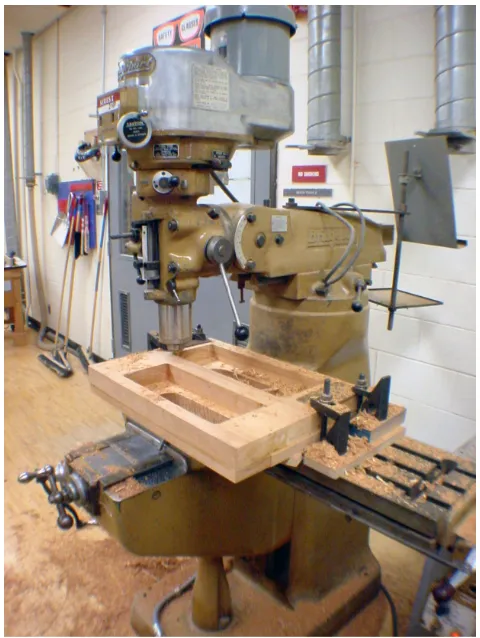
[image:40.612.187.427.359.678.2]There was a process of construction here, which was quite interesting in comparison to the way ancient figure sculptures typically would have been made. My design and construction decisions were based much on the use of wood, as opposed to stone, as well as keeping a consistent grain appearance. Each of the four parts were worked separately, and then joined. The feet were hollowed out and shaped by mallet and chisel. The two halves of the base were milled on the Bridgeport Milling Machine (fig. 12), to lower the level of the top of the base, and also to hollow out both halves of the inside of the base. The tenon, laminated out of short grain blocks, to match the grain of the feet and base, required steel rod reinforcements inserted through its top.
My aim was to make all the pieces appear as one solid integral whole, without seams, which is why the level of the top of the base was milled down slightly around the footprint, raising the footprint, effectively (fig. 13). To create a clean contact point between the feet and the base, I used a small flush cutting Japanese saw blade, on the surface of the base, and then carefully chiseled away the waste off the feet. Slight undercuts around the edges of the feet and deeper spaces under the toes, made the transition convincing.
fig. 13: Footprint milled into the top of the base
I was a bit unsure about how to address the broken surface around the ankles. I did not like the idea of creating a faux-break, but I also could not “break” the wood in a way that I could control and refine my results. However, the “break” was a necessary part of the image, as the whole concept was about the object being broken. So I decided the best way was to create a surface that attracted as little attention to itself as possible. I achieved this with a very wide-sweep gouge, by cutting large and very low-angled facets that minimized busy textures and reflections.
the base, and sanded the entire surface of the piece one final time. I finished the piece with several penetrating coats of Danish Oil.
fig. 14: Separate components of Godking ready to be glued
Achievements
I was very pleased with the results of Godking. It could have been carved out of a solid block of wood, however, I would not have achieved the same results. For a work of non-functional sculpture, there was a great deal of engineering involved in it’s making, which enriched the piece in every way. In other words, its hollow design and well-considered construction added alluring visual details, as well as significant conceptual references, heightening the experience for the viewer. The finely worked mahogany was successful in taking away the literalness of the piece actually representing an ancient and broken object; ancient refined describes the way the surfaces were worked. These aspects of the process were extremely intriguing for me, as the maker.
Iceman
Iceman
Thoughts about my next sculpture began after a conversation with studio mates about climate change and global warming. I contemplated how these issues related to the themes of time and culture, and began thinking of the possibilities of future archeological findings, as a result of warming temperatures and melting ice. I came up with Iceman, which focused on the human remains, this time, as opposed to utilitarian or functional objects, from past societies. I remembered observing an ancient burial site in Sri Satchanalai, Northern Thailand, and while developing this piece, I recalled the presentation of this excavation: each skeleton emerged from an individual platform of solid earth.
Preserved
Cultureless
This sculpture, however, does not give us any information about the frozen corpse, and there is no narrative. The figure has no sexual, cultural, or personal identity, and there is nothing visible that places it in any group, geographical location or time period. Clothing cannot be distinguished from skin, and skin cannot be distinguished from bone. It is simply human, and that is how we can identify with this figure. There are no objects in the image to add to the story, either. So who is this and how did they become frozen in the ice? This is for viewers to imagine and decide for themselves.
Global Warming
I do not intend to argue any moral standpoint, although I support awareness of these issues. I believe we are currently living in a time of a great shift in our technologies, production methods, and energy consumption, in which we will attempt to adapt to the trends in changing climatic conditions. Iceman invites the viewer to investigate these concepts further.
Frontier
Iceman speaks of geological time, and refers to ice ages, which have occurred frequently and naturally on the planet. Earlier generations of man have, in fact, lived through such climatic shifts, and adapted to changing conditions. I am interested in the potential discoveries of ancient cultures that could be made if glaciers and ice caps actually continue to recede. As the planet warms, and the ice melts, I believe more of the Earth’s history will be revealed, including remnants of unknown settlements, artifacts, and plant and animal remains, that have been hidden and preserved for thousands of years. I can imagine the discovery of an ancient man who walked Antarctica when its climate was habitable. Iceman suggests that a new frontier of archeology is to be found in the ice!
Technical Notes
The block of ice was made with massive 3-inch thick boards, edge-joined on only long grain surfaces to create the long hollow box, with all the grain oriented lengthwise. The light and creamy tones of the top and side surfaces contrasted subtly to the slightly darker tones and textures of the end-grain surfaces, which created a pleasing element in the block. During the model-making stage, I decided the piece would be more interesting if the block of ice appeared to be melting and sinking into the floor. I achieved this in the basswood block by cutting a long angle lengthwise along one side, and widthwise along another side, making one corner of the box lower than the rest. This completed the melting block of ice.
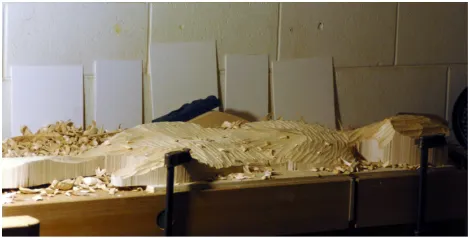
[image:48.612.190.424.464.583.2]Referring back to my clay model, I made full-scale drawings, outlining the top and side view of the emerging figure. Using these drawings as guides, I determined the actual dimensions of the boards I would need to prepare, and how to orient them for lamination of the main portion of the figure (the head, torso, and right leg), and the additional buried body parts (the hand, the elbow, the knee, and the feet). Each part was band-sawed and secured to its own MDF work surface, with double-sided tape. These sacrificial work surfaces would prevent any damage to my workbench while carving so close to the defining edge of the piece (fig. 16).
fig. 16: Carving the rib cage and head on a sacrificial work surface
and cleanly, particularly across the end-grain. Through the process of carving, I discovered that the gouge-texture perfectly portrayed the visceral qualities of an ancient and decaying body, without looking faux-old. I left long, sweeping marks across the abdomen, chest, and groin, and left smaller detailed facets on bony areas like the skull, knees, and hip (greater trochanter and iliac crest) (fig. 17 & 18). Furthermore, by creating this texture, the surface retained qualities of a controlled and refined process that adhered to my ancient refined aesthetic. I shaped the other parts in the same way, and removed them from their sacrificial work surfaces.
fig. 17 & 18: Details of the gouge texture
I brought the parts back to the jointer, to true up their bottom surfaces, and took a light pass, removing only 1/32-inch, and created a 1/16-inch flat band around the entire bottom edge with a fine rasp. While gluing the figure and its parts to the block, each part was located and locked into place with registration pins, or dowels. This method assured a clean and controlled glue-up. I was careful to wipe up any excess glue with a wet cloth.
[image:49.612.93.523.258.438.2]form. I considered ebonizing or bleaching the piece, and giving it a glossy, icy, surface, but decided against an artificial coloring or faux-effect. I needed a clear finish that wouldn’t darken the wood or emphasize the color contrast of the end-grain. My solution was Minwax Polyacrylic finish, rubbed on, then rubbed off and buffed. This slightly penetrating wax sealed the wood with a matte surface, and preserved the creamy tones of the basswood, leaving a clear strong form.
Achievements
The great achievements in this piece were in its concept and its integration into the theme of this thesis. Iceman, a representation of human remains, was a successful departure from the previous three works mentioned earlier, all of them manmade elements of ancient history. As the works developed one by one, and the concept of the thesis evolved, I became less and less concerned with the utilitarian aspects of the work, and more concerned with the conceptual implications of the objects and symbols I was using.
The creation of Iceman was unproblematic, and the results were satisfying. In discussing with my committee, we all agreed upon the decision to present the piece on the floor, as it put more distance between the work and the viewer, making the figure look smaller and more fragile. The figure’s scale and relationship to the block also worked well, as if it were a section cut out of the ice. The simplicity and shape of the melting block, perfect but imperfect, contrasted beautifully with the texture of the corpse. Furthermore, the corpse, clearly giving a sense of mortality and death, was not gruesome or even unpleasant in anyway, making this piece accessible to all. It is not a representation of any one culture and it is not a narrative of anyone’s specific history;
Three Whale Vertebrae
Walnut
Three Whale Vertebrae
Up to this point, ‘RELICS’ consisted of a wide range of objects, and brought up a variety of topics and issues. As I mentioned earlier, my approach had become more to do with the imagery and content relevant to the theme of the thesis, and was no longer limited by the inclusion of utility and function. For my final piece, I was careful to avoid redundancy, and attempted to bring forth one more fitting example of an entirely different object and subject. I came up with Three Whale Vertebrae, drawing from personal memories of encounters with whales and whalebones.
Encounter With Giants
Why are whales so captivating? When we see them we are awestruck by their size and grace, and when they move, it is like poetry. These ancient creatures seem wise and gentle, and touch the hearts of the people who encounter them. They mysteriously emerge from the depths and disappear into the vastness of the sea, and if we are lucky to catch a glimpse, it is unforgettable. I have witnessed several whale sightings, all of them along the east coast of Australia. I recall following two southern right whales, from a cliff top vantage point in Noosa National Park, Queensland. Even from afar, I could sense their great size and majesty, as they rolled and surfaced beneath me. This close connection to nature has been part of the magic I identify with, in Australia.
Observations
However, further investigation makes it clear that these are biological and skeletal, in nature, and in fact, are life-size representations of three huge whale vertebrae. Their scale is impressive, and gives the viewer a sense of how large these animals really are.
Their surfaces are slightly textured yet burnished, their edges are crisp, and their color is a variation of deep browns. The three vertebrae are unaccompanied by any other objects or, interestingly, other whale parts. Again, there is no narrative or indication of what circumstances left them in this way, but there are certainly several concepts we can explore that are associated with this image. Approaching Three Whale Vertebrae, it is as if the viewer were approaching the remains of a beached or hunted whale. Images of remote, wild, ocean beaches come to mind, as well as early whaling stations, littered with carcasses and whalebones.
Ecofact
Conflict
Three Whale Vertebrae also touches on the controversial subject of whaling and the uninhibited slaughtering of some of the earth’s most magnificent creatures. The history of the whaling industry is a startling one that has seen populations of whales drop to near-extinction. Modern whaling practices of the late 19th Century, saw the invention of
the exploding harpoon and newer, larger, and faster vessels, which escalated the problem (Simmonds 121). These anthropocentric tendencies are symbolic of the ignorance that has degraded and devastated much of the natural world.
In his book, ‘The Third Chimpanzee: The Evolution and Future of the Human Animal’, Jared Diamond discusses the self-destructive trends of humans that destroy the environment and spur mass extinctions of species. He states that overhunting is the most detrimental (358). This predicament finally touched the conscience of the world in the 1970’s, which sparked an international ban on commercial whaling in 1986. With an understanding that ethical values differ immensely between cultures, it is still disheartening that some countries, like Japan, Norway and Iceland, still hunt and trade whale parts for various purposes.
Tasmania
Derwent River (Hughes 121). “The Fisheries, as sealing and whaling were collectively known, were of an abundance hardly imaginable today. The Southern Oceans were a vast undisturbed sanctuary for the black whale, the sperm whale, and the fur seals.” (Hughes 331) Today, whales are protected in Australian waters, as several species still migrate there from Antarctica each year, to breed and calve.
Global Warming
Mentioned above, Three Whale Vertebrae is suggestive of the death or extinction of whales. In a fascinating way, this image and concept can be linked to global warming, as well. In ‘The Weather Makers’, Tim Flannery talks in depth about the great changes in climate that are presently occurring in Antarctica, from which there is a ripple-effect of problems within the ecosystem. He talks about the decline in the base of the food chain – microscopic plankton – which cold-water krill thrive on. Many penguin, seal, and whale species are dependent upon a krill diet. Referring to studies of the British Antarctic Survey, Flannery writes, “The reduction in krill numbers coincided so closely with the reduction of sea ice over time as to leave little doubt that climate change is a profound threat to the world’s most productive ocean, and to the largest creatures that exist and which feed there.” (97)
Technical Notes
skeletal forms, so I chose walnut, as opposed to bleaching a lighter-toned wood to mimic the whiteness of bone. I figured the earthiness of dark walnut better served my “ancient refined” concept, drawing on the tonal qualities of naturally decaying organic matter, to speak of history and aging.
fig. 19 & 20: Clay model of Three Whale Vertebrae
It required a great deal of material to make all three vertebrae, and it was important for each of them to share the same appearance and surface qualities. The first and greatest challenge was to find enough walnut of consistent color and grain pattern, (which varies tremendously in this species). Another characteristic of walnut, which did not necessarily work in my favor, is the prevalent sapwood, which shows as highly contrasting light brown or yellow bands. Those issues aside, but acknowledged, I acquired all the wood I needed at once, from a single batch of sawn logs, selected for uniformity. Because I had all the material to create all three vertebrae simultaneously, I did just that, which allowed for a methodical and efficient process.
[image:56.612.135.484.175.310.2]vertebrae. This was necessary to provide enough long-grain glue surface between the two parts.
After gluing, the joints were clean and tight, and the three vertebrae were whole and solid, and ready to be shaped. Reductive carving, with a mallet and chisel, is my preferred method of shaping, and these three massive forms proved to be a lot of enjoyable physical work. I carved out the vertebral canal, which is the large hole below the spinous process, and sculpted the mamillary and transverse processes, which are the small protuberances on each side of the vertebral canal, and the long horizontal “wings”, respectively. I made use of a Kutzall grinding wheel on a 4-inch angle grinder, to remove much of the hard end-grain within the mass of vertebral body, and did the more refined shaping with a large rasp. I finished off the whole surface by hand with a fine rasp, leaving a faint texture in the wood, and finally, applied several coats of Danish oil.
Achievements
Three Whale Vertebrae was a great accomplishment in many ways. Technically, it went very smoothly, and after the lamination process was complete, this piece was especially enjoyable to create. I am an avid carver, and once the parts were all joined and glued, I spent hours with the three forms, shaping them with a mallet and gouge - my favorite tools. I love the physical aspects of hand-carving large pieces, as well as the more refined discipline of modeling form. Creating an accurate clay model, and translating it to the full-scale drawings, was crucial in realizing the forms in wood. The lamination procedure took patience and determination, but produced a solid piece to carve. The mortise and tenon joinery was an interesting element in this piece, making the irregular proportions structurally sound.
pleased to have found a way to share my own love of whales, while providing a striking image along with stirring discussion topics, still related to time and culture. Conceptually loaded, Three Whale Vertebrae is a portrayal of many serious issues, presented in a way that was not too graphic or imposing in a negative way.
While developing this sculpture, there were some interesting questions and potential directions for the piece to take. The clay model was originally a larger group of objects, which included several ribs, flipper bones, and a scapula. As I began the piece, I knew it would be a great undertaking to create all the bones in the time allotted. I chose to start with the vertebrae, as they were the most intriguing forms. Ultimately, I decided that I would not include the other bones, as the piece might become too literal, and cliché – an arbitrary pile of bones. Three Whale Vertebrae leaves room for question, as to what the objects even are. There was also some consideration about adding a harpoon or some whaling tools, but that idea died quickly, as it was definitely too literal, cliché, and too opinionated. My thoughts on the subject matter were shared to begin a dialogue, but the image was not intended to encourage a point of view.
Completing my final piece was an achievement in itself. I should mention that the completion of Three Whale Vertebrae coincided with the final stages of the conclusion of
Conclusion
The Exhibition
The exhibition for ‘RELICS’, took place in a large converted warehouse space, on Canal St. in downtown Rochester. It included two enormous rooms, broken up by huge 3-foot columns throughout the space, and a few wall partitions. I shared the space and opening night reception with three other MFA candidates and their work - Jesse Bickel and her
‘IN DREAMS’, Jesse Walp’s ‘SUBURBAN DIVIDE’, and the playful furniture of Sun Hee Oh. Each of us had utilized wood in distinct ways to convey our individual thesis concepts, and it was a clean and professional presentation on the part of all four of us involved. We divided the space equally, so that we each had a large area of our own, uninterrupted by each other’s work. We cleaned up the floors and the walls, and each set up our own track lighting within the exposed pipes running through the ceilings. With grey floors and white brick walls, and all of the works individually lit from above, it was a perfectly stark space in which the viewers could experience the essence of the works with no other distractions. We called the space Canal Street Gallery.
Buffalo Cart was the entrance piece to the entire gallery, occupying a partitioned off room near the doorway. My other four pieces – Vessels & Chair, Godking, Iceman, and Three Whale Vertebrae - were set up in the back room, in a space framed by columns and partitions. There was ample space to completely walk around each of the works, and their lighting was positioned so each piece was highlighted and separated visually by darkness. The natural wood tones glowed in the grey-scale environment, enhancing the experience for viewers.
Our opening night was on Saturday, April 19th, 2008, and there was a huge turnout of
The Work
Each sculpture included in this thesis was an individual achievement, as described in each write-up. As a group, ‘RELICS’ delivered a compelling and cohesive body of work, encompassing an array of engaging imagery. It was a welcome and successful departure, for me, from the more abstract minimalist work I was doing prior to the creation of
Vessels & Chair. The clean, crisp, and controlled craftsmanship I developed in my previous work, however, stuck with me, and translated very nicely into my current representational approach. In fact, it all integrated beautifully into the development and application of the ancient refined concept and aesthetic, which was a major element in this work. It was most interesting how the making of a furniture piece led to a transition into representational sculpture and the creation of ‘RELICS’.
I intend to continue this exploration of representational sculpture, in future work. I will pursue the use of universal symbols and imagery, no longer limited by objects from the ancient world. I believe I can make my work even more engaging, and enigmatic, by combining more unrelated imagery, in interesting and unexpected ways. I foresee a lot of freedom and potential along this path.
Skills
knowledge. The ways in which I developed my design process, problem solving skills, and conceptual approach, will stay with me throughout my career, and may be applied to any project, in any material.
The making of ‘RELICS’ provided a time for me to become more familiar and versatile with wood as a sculptural medium, covering a variety of concepts. At the same time, I have come to really appreciate and know wood as a craftsman. I developed a greater love for the material, and sensitivity while working it, understanding that careful craftsmanship raises the status and value of a work of art. I will continue to persist in developing my practice of merging sculpture with fine craft.
Wood
During the creation of ‘RELICS’, my committee posed the question, “Why wood?” Could the sculptures speak the same message if they were made in any other material? Would another material be more appropriate? How did wood strengthen the concept of each piece? These were all valid questions, and I recognized that the material choice did add content, however, I decided that wood was not necessarily driving the content of this work. Instead, wood was the unifying element in this diverse group of objects. Wood brought the ideas to life, and this relationship, of the perishable representing the ancient, was a fascinating one.
Wood enhanced the work in other ways, as well. Its appealing presence of nature, and tactility, invited and encouraged real and imagined interaction. In itself, wood is cross-cultural. Its tones are familiar and its history speaks a language of function, art, and making, in every culture around the world, which allowed great accessibility to these sculptures.
Final Thoughts
I look upon the completion of ‘RELICS’ with a tremendous sense of achievement and pride. Technically, aesthetically, and conceptually, this body of work succeeded in bringing through my best abilities and efforts. I demonstrated control and knowledge of the material, formation of original ideas, as well as intellectual development and conceptual depth – aspects of my artistic practice that I will continue to build on and carry forth into my future work.
Through this exploration, I have come to better understand how I can express my deepest passions and concerns through making art. I intend to continue living and travelling abroad, engaging with cultures and the natural environment in ways that teach me about the world, and inspire my creative work. I strive for a balanced awareness of things, and an open-minded perspective, as I examine and define my own cultural and personal identity.
Works Cited
Diamond, Jared. Collapse: How Societies Choose to Fail or Succeed. New York: Penguin, 2005. Print.
- - -. Guns, Germs, and Steel. New York: W.W. Norton & Company, 1999. Print. - - -. The Third Chimpanzee. New York: Harper Collins, 1992. Print.
Fagan, Brian. The Great Warming. New York: Bloomsbury Press, 2008. Print. - - -. The Long Summer. New York: Basic Books, 2004. Print.
Hughes, Robert. The Fatal Shore: The Epic of Australia’s Founding. New York: Vintage Books, Random House, 1988. Print.
Rudenko, S. I. The Ancient Culture of the Bering Sea and the Eskimo Problem. Toronto: University of Toronto Press, 1961. Print.