City, University of London Institutional Repository
Citation
:
Pawar, P. S., Rajarajan, M., Dimitrakos, T. and Zisman, A. (2014). Trust
Assessment Using Cloud Broker. In: Zhou, J., Gal-Oz, N., Zhang, J. and Gudes, E, (Eds.),
Trust Management VIII. IFIP Advances in Information and Communication Technology, 430.
(pp. 237-244). Springer. ISBN 9783662438121
This is the accepted version of the paper.
This version of the publication may differ from the final published
version.
Permanent repository link:
http://openaccess.city.ac.uk/4487/
Link to published version
:
Copyright and reuse:
City Research Online aims to make research
outputs of City, University of London available to a wider audience.
Copyright and Moral Rights remain with the author(s) and/or copyright
holders. URLs from City Research Online may be freely distributed and
linked to.
Trust Assessment
Using
Cloud Broker
Pramod S. Pawar1,2, Muttukrishnan Rajarajan1, Theo Dimitrakos2, Andrea Zisman3
1
City University London, London EC1V 0HB, United Kingdom
British Telecommunications, Adastral Park, Ipswich IP5 3RE, United Kingdom
{pramod.s.pawar, theo.dimitrakos}@bt.com 3
The Open University, Walton Hall,Milton Keynes MK7 6AA, UK
Abstract. Despite the advantages and rapid growth of Cloud computing, the cloud environments are still not sufficiently trustworthy from a customer’s perspective. Several challenges such as specification of service level agreements, standards, security measures, selection of service providers and computation of trust still persists, that concerns the customer. To deal with these challenges and provide a trustworthy environment, a mediation layer may be essential. In this paper we propose a cloud broker as a mediation layer, to deal with complex decision of selecting a trustworthy cloud provider, that fulfils the service requirements, create agreements and also provisions security. The cloud broker operates in different modes and this enables a variety of trust assessments.
Keywords: cloud trust, cloud broker, multi-cloud, reputation
1
Introduction
Despite the advantages and rapid growth of cloud computing, most organizations still continue with their concerns about trust and security of cloud providers. Several challenges [1] such as specification of SLAs, standards, security measures, selection of service providers and computation of trust still persists, implying that the cloud environments are still not sufficiently trustworthy from customer’s perspective. To deal with the challenge of identifying dependable cloud service providers for the ser-vice, cloud marketplaces are gaining popularity and allow consumers to select provid-ers that best match their requirements. However, their complex requirements and the numerous choices available to the consumer make it difficult to decide on a provider to host their service. In addition, their concern about the trustworthiness of the pro-viders remains unanswered. The cloud characteristics [2] such as elasticity and the complex deployment models like multi-cloud and federated clouds create major chal-lenges in trust assessment of cloud providers. A unanimous trust assessment across all deployment architecture may not be suitable, this creates a compelling requirement to have a suitable separate trust assessment for every deployment architecture.
An independent mediation layer capable of performing variety of trust assessment to evaluate the cloud providers b) An evaluation framework that is trusted enough such that malicious providers cannot manipulate the evaluation process c) An evaluation of cloud providers based on fine-grained QoS parameters together with consumer feed-backs, recommendations and additional distinguishing parameters that relate to the cloud computing environments [1]. Due to the complexity of service requirements and difficulty of trustworthiness evaluation of the cloud providers, third parties like cloud brokers can play an important role to assist the consumer in selecting an appro-priate provider and also assist in deployment of the service.
The work presented in this paper was developed under the FP7 EU-funded project called OPTIMIS [3]. This paper, proposes the trust evaluation of the cloud providers with the use of OPTIMIS Cloud Broker (CBR) as a mediation layer. As a first step towards integration of trust and reputation systems in cloud environment, a set of parameters beyond QoS are identified that includes: SLA, Compliance, interoperabil-ity, geographical location of data centers, deployment models, security measures, user recommendations and feedbacks[1]. The trust model[4], [5] cohesively works with the cloud broker in different modes using SLA and cloud characteristic parameters for evaluating the trustworthiness of the providers, and is robust against malicious group of entities performing reputation based attacks. The OPTIMIS cloud broker supports SLA, compliance with data protection and locations, multi-cloud and federated cloud deployments, security as value additions and integrates trust model enabled with SLA monitoring and user ratings in terms of feedback for the service used.
The remaining paper is structured as follows. Section 2 describes the different modes of operation of cloud broker. Section 3 describes type of trust in each of the cloud broker modes. Section 4 provides trust evaluation using cloud broker. Section 5 provides the related work and finally, section 6 provides the concluding remarks.
[image:3.595.128.476.471.626.2]2
Cloud Broker Service
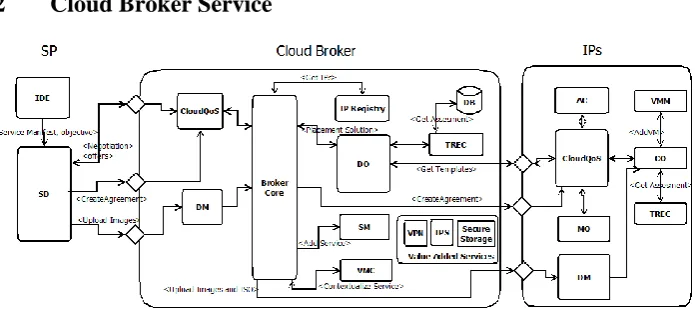
Fig. 1. High level component architecture of the Cloud Broker
This paper considers the OPTIMIS Cloud Broker (CBR) [3] for assessing trust of the Infrastructure Providers(IP). The OPTIMIS Cloud Broker (CBR) as shown in Fig. 1
for the consumer’s service deployed via cloud broker and also performs Trust, Risk, Eco-efficiency and Cost (TREC) assessment. Details of the components and the mul-ti-cloud deployment process is available from the OPTIMIS toolkit website[6].
2.1 Cloud broker modes of operation
The OPTIMIS cloud broker has the capability to operate in four different modes: a) cloud service recommendation b) cloud service intermediation c) cloud service aggregation and d) cloud service arbitrage. Cloud broker used in cloud service rec-ommendation mode enables the user to get recommendations from the cloud broker about the most suitable cloud infrastructure provider for hosting their service, based on the degree of Trust, Risk, Eco-efficiency and Cost (TREC). The cloud broker as a
recommender reduces the effort from the consumer to identify a suitable cloud service provider for its service. However the actual deployment of the service to the cloud infrastructure is performed by the consumer after obtaining deployment solution from the cloud broker. Cloud broker used as cloud service intermediation provides man-agement functionalities like Value Added Services (VAS) that are cloud provider spe-cific, which may be essential for the consumer’s service that is deployed in the cloud provider environment. As an intermediary, the cloud broker also takes complete re-sponsibility of the consumer’s/user’s services to identify the most suitable IP based on TREC, then performs the deployment on the selected IP, and then manages smooth functioning of the service during its operational stage. The use of cloud broker as
cloud service aggregation provides management functionalities for multi-cloud de-ployment and operation of a service by combining services from multiple cloud infra-structure providers. The cloud broker also provides VASs that are independent of cloud providers. Cloud broker used as cloud service arbitrage can be considered as dynamic aggregation wherein the multi-cloud deployment of consumer service is dynamically decided based on the service requirements. In this mode of operation, the cloud broker system decomposes the service requirements at component level and negotiates with multiple cloud providers for each of the service components to formu-late an optimized deployment solution taking into account the basic service require-ments as well as additional requirerequire-ments such as TREC, compliance and security.
3
Trust Assessment using Cloud Broker
This section describes the trust assessments performed using the different modes of cloud broker. Table 1 summarizes the feature provided by cloud broker in different modes of operation. Analysis of the summary information reveals that cloud broker in
cloud service recommendation mode is only responsible to provide the deployment solution which determines that a standard trust model with cloud specific characteris-tics is sufficient for trust assessment of the cloud providers. Cloud broker as cloud service intermediation additionally provides value added services like security service and as for a comprehensive trust assessment it is essential to evaluate security reputa-tion of the cloud provider. The cloud broker as cloud service aggregation/arbitration
Deployment Solution
Deployment of Service
Provider specific VAS
Provider Independent VAS
Static Multi-cloud deployment
Dynamic multi-cloud
Recommender X
Intermediary X X X
Aggregator X X X X X
Arbitrage X X X X X X
Table 1. Features for cloud broker used in different modes
3.1 Cloud broker as cloud service recommendation
In this mode of operation the consumer interacts with cloud broker only for getting the deployment solution to identify the trustworhty cloud providers and takes the responsibility of deployment. In this mode the cloud broker uses the trust model as proposed in Pawar et al.[4], [7]. The Trustworthiness of an cloud Infrastructure Pro-vider (IP) is modelled using opinion obtained from three different computations, namely (i) compliance of SLA parameters (SLA monitoring), (ii) service provider satisfaction ratings (SP ratings), and(iii) service provider behaviour (SP behaviour).
The SP behaviour is defined in terms of the credibility [16] for each of the SP based on the feedback provided. In addition to the credibility, the trust model is compli-mented with early filtering to reduce the impact of malicious feedback providers [7]. The cloud broker uses this trust model to provide recommendations about the cloud providers. The trustworthiness (T) of an IP is modelled as below:
T=Expectation (W(SPB SPR )Ʌ SLA) (1)
W(SPB SPR )ɅSLA=(WSPB WSPR ) Ʌ WSLA (2)
where WSLA, WSPR, WSPB are opinions obtained from the SLA monitoring (SLA), SP
ratings (SPR), and SP behavior (SPB) values, respectively. The symbol Ʌ is the con-junction operator used to combine the opinions, and is the discounting operator
used as the recommendation operator.
3.2 Cloud broker as cloud service intermediation
received from monitoring ii) Enterprise User Rating(EUR): Ratings provided by the enterprise user for satisfaction of the security features provided by cloud service providers. The trustworthiness (T) of cloud IP is given as:
T = Expectation (WM Ʌ WEUR) = Expectation (WM Ʌ EUR) (3)
Where WM Ʌ EUR = (b M Ʌ EUR, d M Ʌ EUR, u M Ʌ EUR, a M Ʌ EUR).
3.3 Cloud broker as cloud service aggregation/arbitration
The cloud broker used as cloud service aggregation/arbitration is capable of devis-ing multi-cloud deployment solution based on user requirements. This enables the cloud broker to perform trust assessment for a group of providers. Consider that the deployment solution provided contains two target cloud providers. Let T1 and T2 be
the trust computed for the first and the second cloud provider. The individual trust-worthiness T1 and T2, of the cloud provider are computed based on the parameters, SLA monitoring, SP rating and SP behavior, as described in Section 3.1. The global trust or the group trust for the cloud provider computed by the broker is as follows:
T12 = (W1/(W1 + W2)) T1 + (W2/(W1 + W2)) T2 (4)
Where W1and W2 are weights assigned for trust computed for each of the cloud
providers such that W1+ W2 = 1.
4
Evaluation
This section evaluates the trust assessment performed using cloud broker as a cloud service recommendation. The Trust model is evaluated using a simulation with a typi-cal simulation run of 250 iterations, a total of 100 SP nodes and one cloud broker node trying to evaluate a single IP. This paper uses categorized groups of malicious feedback provider and two metrics as considered as in [8]. The malicious groups are:
complementary, exaggerated positive and exaggerated negative. The SP nodes are tagged with one of the four categories: normal group (G1), exaggerated positive group (G2), exaggerated negative group (G3) and complementary group (G4). The experi-ments use different ratios G1:G2:G3:G4 of SP nodes. The remaining section is as follows: Section 4.1 demonstrates the trust model robustness due to credibility use in trust model. Section 4.2 demonstrates sensitivity of the model to uncertainty.
4.1 Average credibility decreases with time
con-sidering its previous credibility and then the average credibility is computed for each group G1, G2, G3 and G4. The result in Fig. 2 shows that the average credibility for the malicious node groups G2, G3 and G4 decreases drastically within a few itera-tions and then remains low throughout rest of the iteraitera-tions. This result indicates that malicious node achieve low credibility with time and that the feedbacks provided by the malicious nodes will have a low influence on the reputation computation since the feedbacks provided by these malicious nodes are weighted less.
Fig. 2. : Average Credibility for different groups of SPs. G1:G2:G3:G4 is 70:10:10:10
4.2 Sensitivity to uncertainty
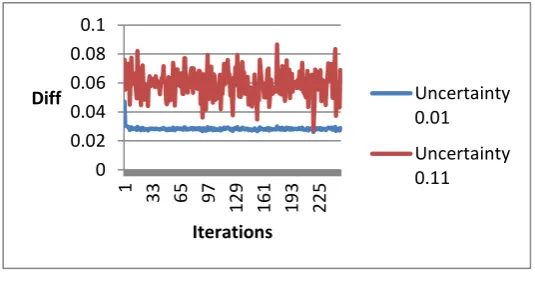
Fig. 3. :Diff for different levels of uncertainty by the feedback providers
It is important to consider the feedback providers confidence in their feedback about trustee. The aim of this experiment is to check if the confidence value of the feedback
0 0.02 0.04 0.06 0.08 0.1
1 33 65 97
12
9
16
1
19
3
22
5
Diff
Iterations
Uncertainty 0.01
[image:7.595.169.437.487.628.2]provider has any impact on robustness of the model. For this experiment, keeping the reliability trust provided by feedback provider constant, it is executed for two cases of uncertainty for the feedback provided. In the first case a high uncertainty is main-tained as u=0.11, while for the second case the uncertainty is reduced to 0.01. In both cases the malicious nodes ratio of 70:30:0:0 is considered for the experiment. It is observed from Fig. 3 that the trust model is sensitive to uncertainty in the feedback value provided. Smaller the uncertainty, the corresponding diff value would be small. This result validates that with increase in evidence available, uncertainty in the feed-back value reduces and the system robustness increases.
5
Related Work
Trust and reputation have been the focus of research for several open systems and the rapidly growing cloud computing technology also appreciates the importance of trust in the cloud computing environment. This is partially observed through the trust and reputation systems that have being discussed in [3], [4], [7], [9]. In OPTIMIS [3], trust is one of the core component used by SP, along with risk, eco-efficiency and cost for evaluating the IP for their service. Alhamad et al. [9] proposes a trust model for cloud computing based on the usage of SLA information and provides a high level architecture capturing major functionalities required. Pawar et al.[4][7] include SLA compliance information to model trust and also proposed a trust model based on cloud characteristics supported with credibility and early filtering mechanism to reduce the impact of malicious feedback providers. Significant research exists in the area of brokers used in various areas of computer science. Cloud brokers [1], [10] are also gaining popularity to identify dependable cloud service providers. The importance of cloud brokerage is also emphasized by Gartner research [11], which defines different types of brokerage. In line with Gartner research [11], Nair et al.[10] propose the use of cloud broker as 1) cloud service intermediation 2) cloud service aggregation and 3)
cloud service arbitrage and provide an abstract architecture for the brokerage. The OPTIMIS cloud broker architecture, is in line with the concepts defined in [10] and [11]. In addition, it supports trust assessment, matching of consumer requirements, establishing agreements and also provides value added services such as security.
6
Conclusion and Final Remark
Acknowledgement
This work has been partially supported by the EU within the 7th Framework Pro-gramme under contract ICT-257115 - Optimized Infrastructure Services (OPTIMIS).
References
1. S. M. Habib, S. Ries, and M. Muhlhauser, “Cloud Computing Landscape and Research Challenges Regarding Trust and Reputation,” 2010, pp. 410–415.
2. P. Mell and T. Grance, “The NIST Definition of Cloud Computing,” Httpcsrcnistgovpubli-cationsnistpubs800-145SP800-145pdf, Sep. 2011.
3. A. J. Ferrer, F. Hernández, J. Tordsson, E. Elmroth, A. Ali-Eldin, C. Zsigri, R. Sirvent, J. Guitart, R. M. Badia, K. Djemame, W. Ziegler, T. Dimitrakos, S. K. Nair, G. Kousiouris, K. Konstanteli, T. Varvarigou, B. Hudzia, A. Kipp, S. Wesner, M. Corrales, N. Forgó, T. Sharif, and C. Sheridan, “OPTIMIS: A holistic approach to cloud service provisioning,”
Future Gener. Comput. Syst., vol. 28, no. 1, pp. 66–77, Jan. 2012.
4. P. S. Pawar, M. Rajarajan, S. K. Nair, and A. Zisman, “Trust Model for Optimized Cloud Services,” in Trust Management VI, vol. 374, T. Dimitrakos, R. Moona, D. Patel, and D. H. McKnight, Eds. Springer Berlin Heidelberg, 2012, pp. 97–112.
5. P. S. Pawar, S. K. Nair, F. El-Mousaa, T. Dimitrakos, M. Rajarajan, and A. Zisman, “Opinion Model Based Security Reputation Enabling Cloud Broker Architecture,” pre-sented at the CloudComp 2012 - 3rd International Conference on Cloud Computing, Vien-na, Austria, 2012.
6. “OPTIMIS Toolkit | Home - Cloud, but better.” [Online]. Available: http://www.optimistoolkit.com/. [Accessed: 15-Apr-2014].
7. P. S. Pawar, M. Rajarajan, T. Dimitrakos, and A. Zisman, “Trust Model for Cloud Based on Cloud Characteristics,” in Trust Management VII, Springer, 2013, pp. 239–246. 8. C. Jia, L. Xie, X. Gan, W. Liu, and Z. Han, “A Trust and Reputation Model Considering
Overall Peer Consulting Distribution,” IEEE Trans. Syst. Man Cybern. Part Syst. Hum., vol. 42, no. 1, pp. 164–177, 2012.
9. M. Alhamad, T. Dillon, and E. Chang, “SLA-Based Trust Model for Cloud Computing,” in 2010 13th International Conference on Network-Based Information Systems (NBiS), 2010, pp. 321–324.
10. S. K. Nair, S. Porwal, T. Dimitrakos, A. J. Ferrer, J. Tordsson, T. Sharif, C. Sheridan, M. Rajarajan, and A. U. Khan, “Towards Secure Cloud Bursting, Brokerage and Aggrega-tion,” in 2010 IEEE 8th European Conference on Web Services (ECOWS), 2010, pp. 189– 196.