1
Maintenance scheduling for multi-component systems with hidden failures
Bin Liu a,*, Ruey-Huei Yeh b, Min Xie a,c, Fellow, IEEE, Way Kuo a, Fellow, IEEE
a Department of Systems Engineering and Engineering Management,
City University of Hong Kong, Kowloon, Hong Kong
b Department of Industrial Management,
National Taiwan University of Science and Technology, Taipei, Taiwan
c Shenzhen Research Institute, City University of Hong Kong, Shenzhen, China
* Corresponding author. Email: [email protected]
Abstract
This paper develops a maintenance policy for a multi-component system subject to hidden
failures. Components of the system are assumed to suffer from hidden failures, which can only
be detected at inspection. The objective of the maintenance policy is to determine the inspection
intervals for each component such that the long-run cost rate is minimized. Due to the
dependence among components, an exact optimal solution is difficult to obtain. Concerned with
the intractability of the problem, a heuristic method named “base interval approach” is adopted
to reduce the computational complexity. Performance of the base interval approach is analyzed
and the result shows that the proposed policy can approximate the optimal policy within a small
factor. Two numerical examples are presented to illustrate the effectiveness of the policy.
Key words: Hidden failure, multi-component system, maintenance optimization,
inspection-replacement policy, base interval approach
1. Introduction
With the integration of technologies, modern systems are often complex systems consisting of
2
neglected when making maintenance decisions. Optimal maintenance strategy for an individual
component may not necessarily remain optimal for a system consisting of multiple dependent
components. If no dependence exists among components, maintenance strategy for
multi-component systems is identical with that for a single-multi-component systems (Wang, 2002).
Dependency among components however brings a lot of challenges to multi-component
maintenance optimization (Gustavsson et al, 2014; Phan & Zhu, 2015; Liu et al, 2015).
In the literature, two strategies have been widely used to deal with the multi-component
maintenance issue, namely, group maintenance and opportunistic maintenance (Nicolai &
Dekker, 2008). Group maintenance implies that multiple components are replaced in groups at
predetermined times (Xiao et al, 2016). Vu et al (2014) proposed a dynamic group maintenance
strategy for multi-component systems. Gao et al (2015) proposed a dynamic interval
maintenance policy, which is more effective in reducing unnecessary maintenance actions
compared with periodic preventive maintenance. Opportunistic maintenance occurs in the case
that components are maintained when a maintenance opportunity arises, e.g., unexpected system
shutdown. Pandey et al (2016) proposed a preventive maintenance scheduling model where
maintenance actions are implemented during system breakdown. Recently, more advanced
maintenance policies (e.g., condition-based maintenance) have been applied for multi-component
systems (Camci, 2009). Liu et al (2014) proposed a value-based maintenance policy for
multi-component systems with degrading multi-components. In the work of Tian & Liao (2011), a condition
based maintenance strategy with proportional hazards model was developed for multi-component
systems.
Although numerous maintenance policies for multi-component systems have been proposed in
literature, most of the models focus on catastrophic or sudden failures (failures that are
self-announcing). However, in many cases, failures are not self-announcing, that a failure remains
dormant before being exposed by inspection techniques or other system disturbances. This type
of failure is referred to as hidden failure or soft failure (Ye et al, 2014; Ye & Xie, 2015; Wang et
al, 2016). Hidden failure itself does not lead to system breakdown, but the existence of hidden
failure may cause performance loss during system operation. Hidden failure is very common in
modern systems, particularly in stand-by redundant systems and protection systems (Xiao & Ye,
3
component outages and even spread power system disturbances. Cheng et al (2013) pointed out
that hidden failure of relay protection system is the main contributor of cascading failures and
blackouts.
A common practice to deal with hidden failure is to implement an inspection policy to detect
the existence of hidden failures (Lam & Banjevic, 2015). Based on the interval between two
consecutive inspections, inspection policy can be classified into two types: periodic inspection
and sequential inspection (non-periodic). A common practice in industry is to implement
periodic inspection at constant intervals, due to its feasibility and applicability. In literature, there
exist plentiful research works on dealing with hidden failures. Wang & Pham (2011) investigated
a multi-objective maintenance optimization for systems with dependent competing risks of
degradation wear and random shocks. Ahmadi & Kumar (2011) studied cost based risk of system
with hidden failures, where the optimal inspection and restoration intervals are determined based
on the cost criterion. He et al (2015) considered an imperfect inspection policy for system subject
to hidden failures, in which the interval of imperfect inspection interval and the number of
imperfect inspections are determined so as to achieve an optimal maintenance strategy. Liu et al
(2017) proposed a condition-based maintenance policy for a system with age- and
state-dependent operating cost, where the side effect of degradation is investigated.
Although numerous studies have accommodated to hidden failures, most focus on
maintenance/inspection policy for a single-component system. However, modern systems are
usually subject to multiple hidden failures. For example, a protection system contains multiple
components such as transducer and relays, and hidden failure may occur in any of the
constituents. It is thus necessary to investigate hidden failure in a multi-component context. Yet
few efforts have been devoted to multiple-component maintenance policy with hidden failures.
Zhu et al (2016) established a multi-level maintenance model for a system with multiple failure
modes. Taghipour & Banjevic (2011) developed a periodic inspection policy for a repairable
system, where the components are subject to hidden failures. In that work, the optimal inspection
interval was applied for all the components. Huynh et al (2014) proposed a multi-level
maintenance policy, where the system was intervened at both the component and the system
level. Long-run cost rate was minimized by jointly optimizing the inspection interval and
4
components are inspected simultaneously or a common metric is used for all the components.
However, as the components in the system vary in degradation process and maintenance cost, it
is more desirable to apply different maintenance metrics for heterogeneous components.
In this paper, we aim to develop a maintenance policy for a multi-component system subject to
hidden failures. The objective of this study is to determine the inspection intervals for each
component such that the long-run cost rate is minimized. Here, we focus on the effect of
economic dependence since economic dependence is the most common interaction in a
multi-component system. With respect to the maintenance optimization of the multi-multi-component system,
the difficulty lies in the computational complexity. Actually, optimization of multi-component
maintenance scheduling with economic dependence has been proven to be an NP-complete
problem (Levi et al, 2014). To deal with the intractability of this problem, we adopt a heuristic
method named “base interval approach” on the basis of Laggoune et al (2009) and Hopp & Kuo
(1998). The base interval approach reschedules the inspection interval of each component as an
integer multiplier of a base interval, so as to share the common downtime cost and reduce
maintenance cost. In addition, we investigate the performance of the base interval approach,
where the effectiveness of proposed approach is demonstrated both analytically and numerically.
The remainder of this paper is organized as follows. Section 2 describes the problem and
formulates the maintenance model. Maintenance policy using base interval approach is proposed
in Section 3 and performance analysis of the approach is presented in Section 4. Numerical
examples are presented in Section 5. Finally, concluding remarks and future discussions are
given in Section 6.
Notations
I
C Common downtime cost due to inspection
i d
c Downtime cost per unit time of component i
i I
c Inspection cost of component i
i r
c Replacement cost of component i
i d
5
( )
G Long-run cost rate of the system
( )
i
G Long-run cost rate of component i, without considering the common cost
i
k Integer multiplier, indicating the rescheduled inspection interval of component i
i=1,2,…,n Component index
d
N (t) Number of system shutdown due to inspection till time t
i I
N (t) Number of inspections of component i till time t
n Number of components
( )
i
R t Reliability function of component i at time t
i
S Length of a renewal cycle of component i
i
T Time to failure of component i
i
Mean time to failure of component i
Base inspection interval
i
Inspection interval of component i
2. Maintenance model formulation
2.1 General description and assumptions
Consider a he system consisting of multiple non-identical components. Each component
suffers an underlying deteriorating process and fails randomly according to specific lifetime
distribution. The components are non-repairable; if a component is found to have failed, it has to
be replaced by a new one. Note that although the components are restored to the
‘as-good-as-new’ condition after replacement, the whole system is not perfectly maintained except that all the
components are replaced simultaneously.
An inspection-replacement policy is implemented on each component. The components are
inspected at periodic intervals with the individual inspection cost cIi. When an inspection is
performed on a component, the whole system has to be shut down, which incurs a common
downtime cost CI. The common cost due to inspection can be shared when multiple inspections
are carried out simultaneously. Without loss of generality, it is assumed that the set-up cost and
6
detected at inspection, the associated component is replaced immediately. During the period of
hidden failures, additional cost is incurred due to performance loss of the component, denoted as
i d c .
In terms of constructing a realistic model, the following assumptions are made:
1. Failure of a component is not self-announcing; it can only be revealed at inspection.
2. Inspection can be implemented on each component; inspection on a component is perfect.
When a failure occurs, it can always be discovered at the next inspection.
3. A common cost is incurred at each inspection time, which can be shared when multiple
inspections are carried out simultaneously. The assumption of constant common cost is
reasonable when multiple maintenance crews are available to inspect the components.
4. Only economic dependence exists between components. Structural dependence and
stochastic dependence are not considered.
5. The component is non-reparable; only replacement is applicable when a failure is
revealed on a component. Replacement is instantaneous and restores the component to
the ‘as-good-as-new’ condition.
6. Deterioration of a component remains unchanged during inspection.
2.2 Cost model
Consider a system consisting of n heterogeneous components. Let i, i=1,2,…,n, be the
inspection intervals for component i. The cost items can be divided into two categories. One is
the component-level cost, which is related to specific component and varies for different
components. The other category is the system-level cost, which is irrelevant to the component
and can be shared by multiple maintenance actions.
Component-level cost: component inspection cost ciI , component replacement cost cri ,
performance loss (due to hidden failures of components) cost per unit time i
d c .
System-level cost: common downtime cost due to inspection CI.
For an individual component i, one has to pay the associated cost at time t,
( ; ) i i( ; ) i i( ; ) i i( ; )
i i I I I i r r i d d i
7
where i is the inspection interval of component i, Hi is the total cost of component i
incorporating the common downtime cost, i
I
N is the cumulative number of inspections for
component i, N tri( ; )i is the cumulative number of replacement for component i, and i( ; )
d i T t
is the cumulative downtime of component i. However, for a multi-component system, there may
be cases that the common cost has already been shared by other components (e.g., due to
inspection of other components). If this happens all the time, then we can neglect the common
cost CI. In such cases, the corresponding cost of a component at time t is
H ti( ; )i c N tiI Ii( ; )i c N tri ri( ; )i c T tdi di( ; )i (2) As shown in Eq (1) and (2), the total maintenance cost can be reduced if multiple components
are inspected simultaneously. As the common cost can be shared when performing inspections
together, it is of interest to schedule inspections in groups so that multiple inspections can be
implemented at one scheduled inspection time. However, on the other hand, rescheduling the
inspection time incurs additional cost. As we will see in the following sections, each component
has its optimal inspection interval so as to minimize the individual long-run cost rate. If the
inspection interval is postponed or advanced in order to share common downtime cost CI ,
additional cost is incurred compared with the minimal cost obtained at the optimal inspection
interval. We have to consider this tradeoff when grouping multiple components to share the
common downtime cost. An optimal policy should balance the potential benefit and the
associated additional cost.
If the components are inspected with intervals 1, 2,...,n, the long-run cost rate of the system
is expressed as
1 2
1 2
( , ,..., ) 1
( ; ) ( ; , ,..., )
= lim
n
n
i i d n I
i t
H t N t C
G
t
(3)
where N td( )is the number of system shutdown till time t. Obtaining an optimal solution of Eq (3)
is difficult due to the economic dependence among components. Indeed, optimization of Eq (3)
is an NP-hard problem as the number of combinations increases exponentially with the number
8
that can provide a near optimal solution. In the following, we adopt base interval approach to
deal with the computational complexity.
3. Maintenance policy with base interval approach
Base interval approach was initially proposed to solve the joint replacement issue of an aircraft
engine (Hopp and Kuo, 1998). It was inspired by the power-of-two replenishment policy in
inventory management (Jackson et al, 1985). Laggoune et al (2009) applied the base interval
approach in opportunistic maintenance for a continuously operating system. The basic idea of
base interval approach is to find a base interval such that the common cost is charged at every
time units and the component is inspected at some integer multipliers of the base interval, ki .
In other words, at least one component is inspected in each multiple of . Under this scenario,
our objective is to find the optimal base interval and a set of integers
k ii, 1, 2,...,n
such thatthe long-run cost rate of the system is minimized. The optimization problem is formulated into
1 2
1
, , ,...,
( ; ) min lim
. . 0, , 1, 2,...,
n
n
i i
i I
k k k t
i H t k
C t
s t k Z i n
(4)
where Z denotes the set of positive integers.
A natural way to calculate the long-run cost rate is to use the renewal cycle theorem and
compute the expected cost rate in a renewal cycle of the system (Zhang et al, 2015). However, in
the present case, a renewal cycle occurs only when all the components are replaced
simultaneously, which takes extremely long time or even never occurs. Hence, it is difficult or
even impossible to compute the long-run cost rate function based on renewal cycle theorem.
However, by observing the cost structure of Eq (4), we can decompose the objective function
from system level into component level, and then apply the renewal cycle theorem individually.
As we can see, the objective function contains two terms: the first term,
1
lim n i( ; i ) / i
t
H t k t, is9
component. By taking advantage of the cost structure, we proceed to study the individual optimal
maintenance policy so as to reduce the computational complexity.
3.1 Individual optimal maintenance policy
In this section, we formulate a cost model for an individual component and obtain the optimal
individual inspection interval. When a component is replaced at inspection, the component is
restored to the ‘as-good-as-new’ state, which constitutes a renewal cycle (Liu et al, 2016).
According to the renewal cycle theorem, the individual long-run cost rate is given as
( ; ) [ ( )]
( ) lim
[ ]
i i i i
i i t
i
H t E H S
G
t E S
where Si is the length of a renewal cycle of component i. Denote Ti as the failure time of
component i. Let R ti( )be the reliability function of the component and ( )
i
T
F t be the cumulative
density function (cdf) of the failure time. For notational simplicity, we denote the number of
inspection in a renewal cycle and the downtime in a renewal cycle for component i as NIi and Tdi,
instead of N SIi( )i and T Sdi( )i . NIi is related to the failure time and the inspection interval, which
is denoted as NIi Ti/i (Badia et al, 2001). The expectation of i
I
N is calculated as
1
1 0
[ ] ( 1)
( ) ( 1) ( )
i i
i
I i i i
j
T i T i i i
j j
E N jP j T j
j F j F j R j
The length of a renewal cycle depends on i
I
N and i, according to the assumption that
replacement can only be carried out at inspection. We have Si NIii and the associated
expectation E S[ ]i i
j0R ji( i)(Peng et al, 2010). The component downtime is the periodbetween occurrence of a failure and replacement (end of a renewal cycle), Tdi NIiiTi. The
expectation is
0
[ di] i i( i) i
j
E T
R j , where i is the mean time to failure (MTTF) of thecomponent. Based on the above discussion, the expected cost in a renewal cycle can be obtained
10
0 0
[ i ( )]i id i i( i) i ri iI i( i)
j j
E H S c R j c c R j
.The long-run cost rate is then formulated as
0 0 ( ) [ ( )] ( ) [ ] ( )
i i i
d i r I i i
j i
i i
i i d
i
i i i
j
c c c R j
E H S
G c E S R j
(5)Proposition 1. If cdii cir ciI, there exists optimal inspection interval i* such that the
long-run cost rate reaches its minimum. Otherwise, *
i
. Mathematically,
*
*
: ( ) / 0 , if
, otherwise
i i i
i i i i i d i r I
i
dG d c c c
The detailed proof is shown in the Appendix.
Proposition 1 implies that if cdii cri ciI, it is beneficial to inspect the system with the
inspection interval *
i
; otherwise, inspection is unprofitable and we should resort to other
maintenance policies. In this study, we consider the case that the condition of cidi cri ciI can
always be satisfied; otherwise, the maintenance problem is trivial and makes no sense. This
assumption is plausible as the downtime cost is relatively high for modern complex systems and
the inspection cost is becoming lower with the development of inspection techniques. The
condition in Proposition 1 is equivalent to i (cIi cri) /cdi , which implies that whether an
optimal inspection interval exists or not can be easily judged by comparing the MTTF of a
component with a constant value.
3.2 Selection of ki
Based on the previous discussions, we can sketch Gi( )i as shown in Fig 1. Since the system
is inspected at some integer multiples of the base interval , the optimal ki should be either
*
/
i
11 * * 0 0 * * * * * 0 0 * ( / ) ( / )
/ , if
/ ( / ) / ( / )
/ , otherwise
i i i i i i
d i r I i i d i r I i i
j j
i i
i i i i i i
j j
i
c c c R j c c c R j
k R j R j
(6)Therefore, once the base interval is given, the optimal inspection intervals for each component
can be easily obtained. The objective is reduce to find the optimal base interval *such that the
long-run cost rate of the system, ( )G , is minimized, i.e.,
* *
0 0
0 * * * *
1 1
0 0
( / ) ( / )
min ( )
/ ( / ) / ( / )
i i i i i i
d i r I i i d i r I i i
n n j j i I d i i
i i i i i i
j j
c c c R j c c c R j
C
G c
R j R j
(7) [image:11.612.96.538.76.161.2]where the operator (xy)min( , )x y .
Fig 1 Sketch of Gi( )i
Optimal solution of Eq (7) can be obtained by a simple search algorithm, described as follows:
1. Initialization: For each component, compute the individual optimal inspection interval
*
i
,i1, 2,...,n.
12
3. Determine ki for each component, according to Eq (6).
4. Compute the value of G( ) according to Eq (7).
5. Increase for a small increment, repeat step 3-4. Stop until max
i*:i1, 2,...,n
.6. Output the minimal G*( ) and the associated *.
The time complexity of the algorithm is O n
. Compared with the traditional approaches suchas rolling horizon approach and brute-force search approach, the proposed base interval approach
shows the advantage of computational effectiveness.
4. Performance analysis
Now that we have described the base interval policy, we proceed to analyze the effectiveness
of the policy. A natural way to achieve this purpose is to compare the cost value obtained by our
approach with the optimum value. However, for the present case, the optimal solution is difficult
to obtain. Hence, instead, we demonstrate the effectiveness of our policy by comparing the upper
bound of our approach with the lower bound of the optimal solution.
4.1 Lower bound of the optimal solution
The idea of obtaining a lower bound is to allocate the maintenance cost of the whole system
on individual components. Let
t ll, 1, 2,...
denote the time when the system is shut down dueto inspection, where l is the number index of system shutdown. Let tl
i
x be the action for
component i at time tl, where
0, if no inspection is performed for component at
1, if inspection is performed for component at
l l
t i
l i t x
i t
Let ( ) be the indicator function, where for any 0,
0, 0
( )
1, 0
if if
With the notations defined above, we can transform the problem of minimizing system
long-run cost rate into finding the optimal tl*
i
13 1 1 ( ; ) min lim l tl i n n t
i i i I
i i
t x
H t x C
t
(8)It is straightforward to have (Atkins & Iyogun, 1987)
1 1
l l
n n
t t
i i i
i i x x
where i 0, i 1, 2,...,n , and
1 1
n i i
. Then, the lower bound of can be readilyobtained as
1 1 1 ( ; ) lim ( ; ) lim l l n n ti i i i I
i i
t
t n
i i i i I
t i
H t x C
t
H t x C
t
(9)For notational simplicity, denote
( ; )
, lim
l
t
i i i i I
i i i t
H t x C
t
so that
1 ,
n
i i i i
. Eq (9) implies that the lower bound can be decomposed into nsingle-unit cost items, with the common constraints
ni1i 1 and i 0. For component i, ateach inspection time, the individual inspection cost ciI and common shutdown cost iCI are
charged; at the end of a renewal cycle of the component, the individual replacement cost cri and
component downtime cost c Tid di are incurred. Therefore, for a fixed i, i
i, i
is equivalentto the individual long-run cost rate of component i, with additional common downtime cost iCI
14
* * 0 0arg min ,
( )
arg min
( )
i
i
i i i i i
i i i
d i r I i I i i
j i
d
i i i
j
c c c C R j
c R j
(10)Eq (10) implies that if i 0 is given for component i, an optimal inspection interval i*
ican be readily obtained. Let
* *
, |
i i i
i i i i i
, the tightest lower bound becomes
* 1 max i n i i i
s.t. 1 1 n i i
, i 0, i 1, 2,...,nBased on the above discussions, the optimization problem in Eq (8) is transformed into finding
optimal allocation (iCI) of the common downtime cost to each component so that the lower
bound reaches its maximum. In the work of Hopp & Kuo (1998), it was observed that the lower
bound increases when allocating higher percentages of the system intervention cost to
components with smaller replacement interval. Here, we follow the similar procedure and assign
higher proportion of the common cost to components that are inspected more frequently.
Without loss of generality, relabel the number of components according to their individual
optimal inspection intervals. Component with a smaller inspection interval is associated with a
smaller index. Assuming that the common downtime cost CI is allocated to components
1, 2,..., , with the corresponding fraction i, where
1 i 1
i
. The inspection interval ofcomponent i is for i1, 2,..., and i* for i 1,2,...,n. Then, the lower bound of the
system’s long-run cost rate is given as
*
1 1
( ) ( )
n I
i i i
i i
C
LB G G
15
Followed by the above discussions, we first analyze the upper bound of the base interval policy for an individual component, as shown in Lemma 1.
Lemma1. For an individual component, the base interval policy for component i is guaranteed
to have a cost at most
*
/
i i i
times of the optimal solution.
The detailed proof is shown in the Appendix. Generally, the optimal individual inspection
interval i* is much less than the MTTF of the component i (as shown in the numerical
examples), which indicates that the proposed base interval policy can perform quite well
individually. Based on the individual analysis from Lemma 1, we can conclude the upper bound
of the system long-run cost rate, as shown in Proposition 2.
Proposition 2. The upper bound of the base interval policy is at most
*
sup i i /i:i1, 2,...,n times of the lower bound.
The detailed proof is shown in the Appendix. Proposition 2 indicates that the base interval
policy is guaranteed to approximate the optimal solution within a small factor.
For the problem of multi-component maintenance with hidden failures, the most intuitive
approaches are the individual inspection policy and common inspection policy (Taghipour &
Banjevic, 2011). It is interesting to compare the performance of the base interval approach and
the extant two approaches. Obviously, the base interval approach always outperforms the
common inspection policy. This is due to the fact that the base interval approach is actually a
generalization of the common inspection policy. For any determined base interval , if all the ki
are set to 1, then the base interval approach is reduced to the common inspection policy.
On the other hand, the advantage of base interval approach over the individual inspection
policy highly depends on the common downtime cost CI. If the common downtime cost is low,
the additional cost of rescheduling the inspection intervals may overwhelm the shared cost,
which implies the disadvantage of the base interval approach. This leads to another interesting
issue that under what condition the base interval approach outperforms the individual inspection
policy. In addition, for some components, the penalty cost due to rescheduling may exceed the
common downtime cost, though not usual in reality, then it would be optimal to remain the
16
intervals of other components are rescheduled. The proposed base interval approach can be
further improved by determining which components should be rescheduled and which should
remain unchanged.
5. Numerical examples
In this section, two examples are presented to illustrate the effectiveness of the base interval
approach. For the first example, we consider a 3-component system, where each component
follows an exponential lifetime distribution. In the second example, the proposed maintenance
policy is applied in a centrifugal compressor of a catalytic reforming unit.
5.1 An illustrative example with a 3-component system
A system consisting of three components is used to illustrate the base interval approach. The
components are assumed to follow an exponential lifetime distribution, with the reliability
function R ti( )exp(it), where i is the failure rate of component i, i1, 2,3. At first, we
analyze the optimal inspection policy for an individual component. Based on the discussion in
Section 3.1, we have
0 [ ] ( ) 1 i i i i i
I i i
j
e
E N R j
e
(11)By substituting Eq (11) into Eq (5), long-run cost rate is expressed as
[ ( )]
( )
[ ] i i
i i
i d i i d
r I r
i
i i i i
i d
i i i
c c
c c c
E H S
G c
E S e
(12)
The optimal inspection can be obtained by setting the derivative of to 0, i.e.,
2 2 ( 1) ( ) 0 i i i i
i d i i d
r i i I r
i
i i i
i i i
c c
c c c
G e
(13)
17
*
: ( 1) i i 0
i i
i d i i d
i i r i i I r
i i
c c
c c c e
, where
i
i i d
r I i
c
c c
The parameters of the failure rate and cost items are listed in Table 1. By use of numerical
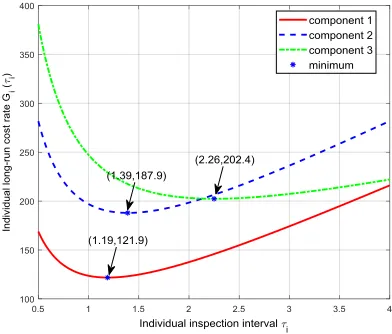
methods, the individual optimal inspection interval is obtained as 1* 1.19, 2*1.39, 3* 2.26,
and the corresponding optimal individual long-run cost rate is respectively *
1( ) 121.91
G ,
*
2( ) 187.92
G , G3*( )3 202.4. In addition, we plot the variation of individual long-run cost
[image:17.612.65.546.284.378.2]rate Gi (i ) with respect to the individual inspection interval i , as shown in Fig 2.
Table 1 Parameters of component-specific failure rate and cost items
Component Failure rate
i
MTBFi
Replacement cost
i r c
Inspection cost
i I c
Downtime costcdi
1 0.02 50 200 70 5000
2 0.05 20 420 115 2500
[image:17.612.203.399.414.581.2]3 0.1 10 640 150 750
Fig 2 Variation of Gi (i )with i
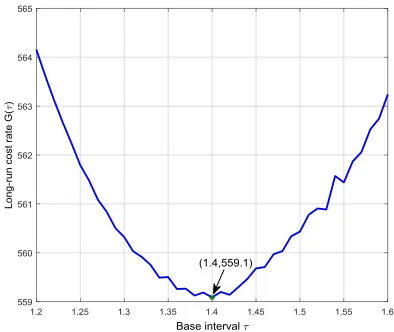
With regard to the whole system, the common downtime cost is set as CI 60 . The
relationship between G( ) and is given in Eq (7). Fig 3 shows how the long-run cost rate
( )
G changes with the base interval . As we can see, when the base interval is 1.4, the
18
1 1
k ,k2 1,k3 2. The result implies that based on the base interval approach, when we
inspect component 1 every k1 1.4 unit time, component 2 everyk2 1.4 unit time, and
component 3 every k3 2.8 unit time, we have the optimal maintenance policy. Table 2 shows
the comparison of the base interval approach, the individual inspection policy and the common
inspection policy (Taghipour & Banjevic, 2011). The result shows that the proposed base
[image:18.612.204.401.229.395.2]interval approach dominates the other policies.
Fig 3 Variation of ( )G with respect to
Table 2 Comparison of the rescheduled inspection policy, the individual inspection policy and common inspection policy
Component inspection interval 1 2 3 Cost rate
Individual inspection policy 1.19 1.39 2.26 692.2
Common inspection policy 1.69 1.69 1.69 562.9
19
In addition, Proposition 2 implies that the upper bound of the base interval policy is at most
*
sup i i /i:i1, 2,3 1.226 times of the lower bound. Here, the lower bound is
calculated as LB = 556.4. The long-run cost rate obtained by the base interval approach is
actually 1.005 times of the lower bound, which indicates that the base interval approach performs
quite effectively.
We are interested in the value of the common downtime cost CI, since CI characterizes the
economic dependence among components and affects the necessity of performing base interval
approach. Sensitivity analysis is carried out on CI to find out how CI influences the optimal
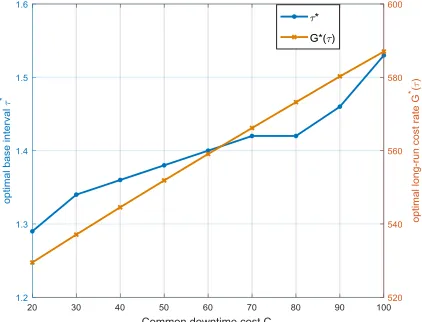
base interval and the optimal long-run cost rate. Fig 4 shows how the optimal inspection interval
*
and the associated long-run cost rate G*( ) vary with different CI . As can be observed,
*
( )
G increases monotonically with CI and * shows a non-decreasing trend. This can be
explained by the fact that the long-run cost rate G( ) consists of two items: one is related to the
common cost, and the other is determined by the individual cost rate. When the common cost CI
increases, the cost item CI / has an increasing effect on G( ) . Therefore, the optimal base
[image:19.612.206.417.460.621.2]interval increases with CI to reduce the number of system shutdowns.
20
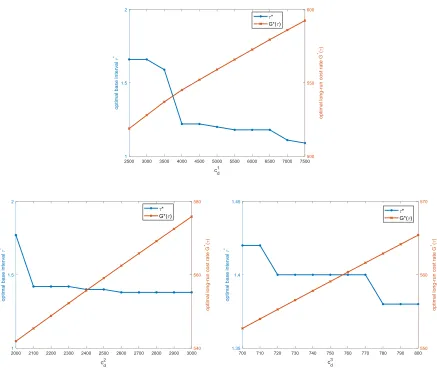
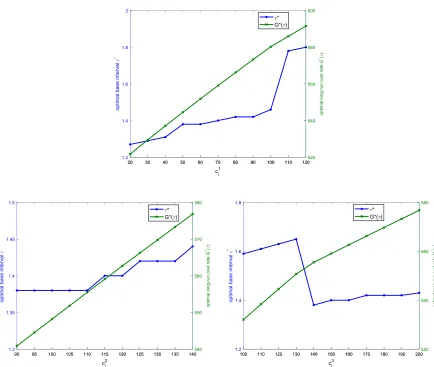
Fig 5 Variation of *
and G*( ) in terms of individual downtime costCdi
(a) component 1 C1d (b) component 2 Cd2 (c) component 3 Cd3
Additionally, Fig 5 presents the variation of * and G*( ) in terms of the individual downtime
cost Cdi . Obviously, the optimal long-run cost rate G*( ) shows a monotone increasing trend
with Cdi . The optimal inspection interval *, however, presents a non-increasing trend. This is
due to the fact that a more frequent inspection takes effect in reducing the downtime cost. With
the increase of the individual downtime cost, a smaller inspection interval is expected to balance
21
Fig 6 Variation of *
and G*( ) in terms of individual inspection cost CIi
(a) component 1 C1I (b) component 2 CI2 (c) component 3 CI3
Fig 6 investigates the effect of individual inspection cost on the optimal maintenance policy.
For component 1 and component 2, the optimal inspection interval * shows a non-decreasing
trend. The optimal maintenance policy calls for a larger inspection interval so as to balance the
tradeoff of an increased inspection cost. However, component 3 shows a non-conform trend. *
increases for CI3(100,130) and CI3(140, 200) respectively. However, there is a drop-off for
3
(130,140)
I
C . This is due to the fact that the integer multiplier k3 varies for CI3(130,140). In
the present setting, k3 increases from 1 to 2 when CI3 changes from 130 to 140. Although the
optimal base interval decreases, the inspection interval of component 3 still increases, due to the
22
5.2 Application in refinery centrifugal compressor
In this section, we apply the base interval inspection policy to a centrifugal compressor of a
catalytic reforming unit. A centrifugal compressor is an essential constitute of a catalytic
reforming unit, which plays a vital role in oil refinery. As reported in Laggoune et al (2009), a
compressor dysfunction may cause pressure loss in the reforming unit and consequently lead to
performance loss of the system. In addition, the centrifugal compressor is responsible for
pre-heating and providing air to guarantee that the unit operates under proper condition. A
centrifugal compressor comprises multiple components, such as sheathing, tightness and so on.
Here, we assume that the components of a compressor operate in a redundant mode, where
failure of a component is not self-evident. The base interval inspection policy is adopted to
[image:22.612.68.550.366.613.2]reduce the maintenance cost and enhance system performance.
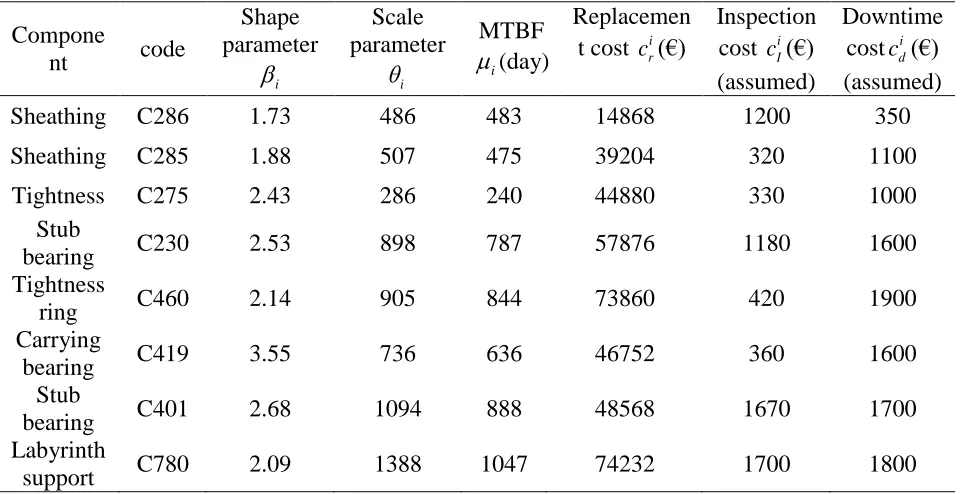
Table 3 Component-specific Weibull parameters and cost items
Compone
nt code
Shape parameter
i
Scale parameter
i
MTBF
i
(day)
Replacemen
t cost i
r c (€)
Inspection
cost i
I c (€)
(assumed)
Downtime
cost i
d c (€)
(assumed)
Sheathing C286 1.73 486 483 14868 1200 350
Sheathing C285 1.88 507 475 39204 320 1100
Tightness C275 2.43 286 240 44880 330 1000
Stub
bearing C230 2.53 898 787 57876 1180 1600
Tightness
ring C460 2.14 905 844 73860 420 1900
Carrying
bearing C419 3.55 736 636 46752 360 1600
Stub
bearing C401 2.68 1094 888 48568 1670 1700
Labyrinth
support C780 2.09 1388 1047 74232 1700 1800
The compressor consists of eight components, wherein each component is associated with a
code, as shown in Table 3. The components are assumed to follow a two-parameter Weibull
23
where i is the scale parameter and i is the shape parameter. Table 3 gives the value of
Weibull parameters and the associated cost items of each component. The shape parameter i
and the scale parameter i are obtained from the study of Laggoune et al (2009), where failure
data were sampled to estimate the two parameters. The cost parameters related to inspection and
hidden failure are introduced for illustration purpose, including the individual inspection cost i
I c
and the individual downtime cost cid.
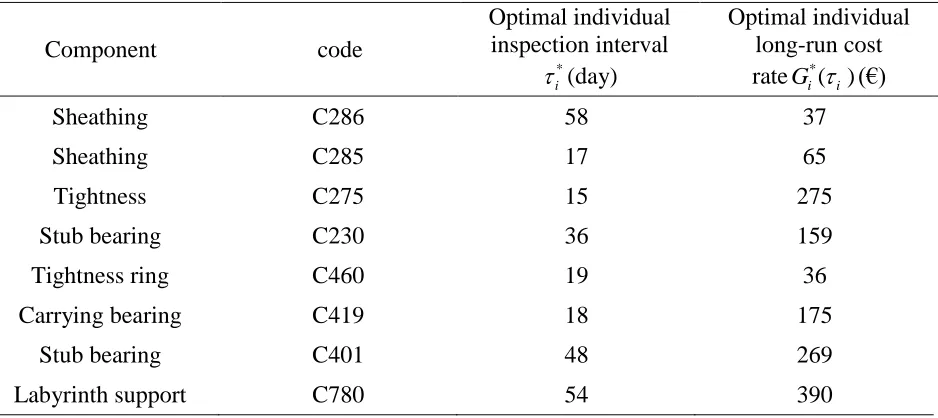
Based on the discussions in Section 3.2.1, we obtain the optimal inspection interval *
i
and the
associated long-run cost rate Gi*( )i for each component, as shown in Table 4. For the purpose
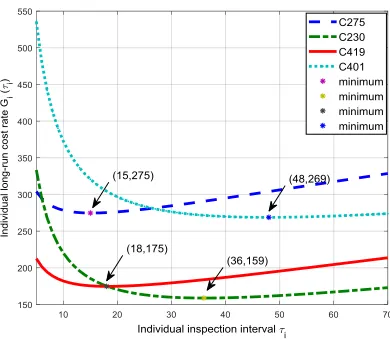
of illustration, we also plot the variation of Gi(i ) with respect to i . Four components are
selected for illustration: tightness (C275), stub bearing (C230), carrying bearing (C419) and stub
[image:23.612.76.545.388.597.2]bearing (C401). Fig 7 shows how Gi (i ) varies with i of the four components.
Table 4 Optimal inspection policy for individual component
Component code
Optimal individual inspection interval
*
i
(day)
Optimal individual long-run cost
rate *
( ) i i G (€)
Sheathing C286 58 37
Sheathing C285 17 65
Tightness C275 15 275
Stub bearing C230 36 159
Tightness ring C460 19 36
Carrying bearing C419 18 175
Stub bearing C401 48 269
24
Fig 7 Plot of individual long-run cost rate
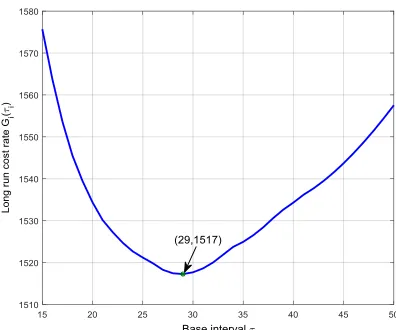
The common downtime cost is given as CI = €2500. According to Eq (7), the variation of
long-run cost rate G( ) with respect to the base interval is plotted in Fig 8. From Fig 8, the
minimum long-run cost rate of €1517, obtained at the optimal base interval *29days. After
obtaining the optimal base interval *, we can determine the integral multiple ki for each
component. The result is shown in Table 5. By comparing the results of Table 5 with the optimal
individual inspection interval, it is observed that the inspection period of stub bearing (C230) is
shifted in advance, the inspection period of sheathing (C286) remains unchanged, and the
inspection period of other components are postponed. Proposition 2 implies that the upper bound
of the base interval policy is at most sup
i i*
/i:i1, 2,..,8
1.201 times of the lowerbound. In this section, the lower bound can be computed as LB = 1501. The long-run cost rate
25
Fig 8 Variation of ( )G with respect to base interval
Table 5 Optimal inspection interval for base interval policy
Component code kiassociated with
optimal base interval
Optimal inspection
interval ki (days)
Sheathing C286 2 58
Sheathing C285 1 29
Tightness C275 1 29
Stub bearing C230 1 29
Tightness ring C460 1 29
Carrying bearing C419 1 29
Stub bearing C401 2 58
Labyrinth support C780 2 58
Furthermore, in order to investigate how the components are grouped with various base
interval , we plot ki with respect to in Fig 9. When increases from 15 to 50 days, ki of the
components show a non-increasing trend. When is no less than 41 days, ki reduces to 1 for
1, 2,...,8
i , which implies that all the components are inspected at the same time. Note that we
only plot ki of four components (C286, C230, C401 and C780). ki of the other four components
[image:25.612.71.548.343.538.2]26
Fig 9 Plot of ki with respect to base interval
Fig 10 shows how the optimal base interval * and the optimal long-run cost rate G*( ) vary
with the common downtime cost CI. When CI increases from €500 to €4500, *
( )
G increase
monotonically from €1434 to €1582. In addition, the optimal base interval *
shows an
increasing trend with CI , changing from 9 to 26 days. The result indicates that common
downtime cost has a significant influence on the optimal inspection policy. It is therefore
suggested that maintenance engineers or managers should take into account the common cost
(interactions among components) when making maintenance decisions for a multi-component
system.
[image:26.612.209.418.496.660.2]27 6. Conclusions
This paper develops a maintenance policy for multi-component systems subject to hidden
failures. Failure of a component can only be detected at inspection and a failed component is
replaced once the failure is revealed. Different from previous works where an optimal inspection
interval is applied for the whole system, we obtain the optimal inspection interval for each
component. Concerned with the difficulty of the optimization problem, a heuristic method named
base interval approach is adopted to reduce the computational complexity. Upper bound of the
policy is analyzed, followed by two numerical examples. It is illustrated that that the base
interval policy can approximate the optimal policy within a small factor. The result of a
numerical example shows that our approach outperforms the individual inspection policy and the
common inspection policy.
The proposed maintenance strategy can be applied in various complex systems such as power
generators and processing facilities, especially for systems with a high common downtime cost.
One advantage of the proposed maintenance policy lies in its feasibility and applicability in
industry. Maintenance crews only need to inspect the components at fixed intervals and replace
the failed components, while no other tricky implementations are required.
Future research can be conducted by extending the present inspection-replacement policy into
a more general maintenance context. For example, consider a multi-component reparable system
where various maintenance actions such as minimal repair and imperfect maintenance are
allowed. In addition, if the components of the system follow a continuously degrading process
and the degrading state can be observed by inspection devices, one can integrate the concept of
base interval approach into condition-based maintenance and develop a more efficient
maintenance policy.
Acknowledgement
28 References
Ahmadi, A., & Kumar, U. (2011). Cost based risk analysis to identify inspection and restoration
intervals of hidden failures subject to aging. IEEE Transactions on Reliability, 60(1), 197-209.
Atkins, D., & Iyogun, P. (1987). A lower bound on a class of coordinated inventory/production
problems. Operations Research Letters, 6(2), 63-67.
Badia, F. G., Berrade, M. D., & Campos, C. A. (2001). Optimization of inspection intervals
based on cost. Journal of Applied Probability, 38(4), 872-881.
Camci, F. (2009). System maintenance scheduling with prognostics information using genetic
algorithm. IEEE Transactions on Reliability, 58(3), 539-552.
Cheng, Y., Chen, X., Ren, J., Xuan, X., & Li, X. (2013). Study on hidden failure of relay
protection in power system. IEEE Annual International Conference on Cyber Technology in
Automation Control and Intelligent Systems, Nanjing, China, 434-439.
Gao, Y., Feng, Y., Zhang, Z., & Tan, J. (2015). An optimal dynamic interval preventive
maintenance scheduling for series systems. Reliability Engineering & System Safety, 142, 19-30.
Gustavsson, E., Patriksson, M., Strömberg, A. B., Wojciechowski, A., & Önnheim, M. (2014).
Preventive maintenance scheduling of multi-component systems with interval costs. Computers
& industrial engineering, 76, 390-400.
He, K., Maillart, L. M., & Prokopyev, O. A. (2015). Scheduling Preventive Maintenance as a
Function of an Imperfect Inspection Interval. IEEE Transactions on Reliability, 64(3), 983-997.
Hopp, W. J., & Kuo, Y. L. (1998). Heuristics for multi-component joint replacement:
Applications to aircraft engine maintenance. Naval Research Logistics, 45(5), 435-458.
Huynh, K. T., Barros, A., & Berenguer, C. (2015). Multi-Level Decision-Making for The
Predictive Maintenance of-Out-of-: F Deteriorating Systems. IEEE Transactions on Reliability,
29
Jackson, P., Maxwell, W., & Muckstadt, J. (1985). The joint replenishment problem with a
powers-of-two restriction. IIE Transactions, 17(1), 25-32.
Laggoune, R., Chateauneuf, A., & Aissani, D. (2009). Opportunistic policy for optimal
preventive maintenance of a multi-component system in continuous operating units. Computers
& Chemical Engineering, 33(9), 1499-1510.
Lam, J. Y. J., & Banjevic, D. (2015). A myopic policy for optimal inspection scheduling for
condition based maintenance. Reliability Engineering & System Safety, 144, 1-11.
Levi, R., Magnanti, T., Muckstadt, J., Segev, D., & Zarybnisky, E. (2014). Maintenance
scheduling for modular systems: Modeling and algorithms. Naval Research Logistics (NRL),
61(6), 472-488.
Liu, B., Wu, J., & Xie, M. (2015). Cost analysis for multi-component system with failure
interaction under renewing free-replacement warranty. European Journal of Operational
Research, 243(3), 874-882.
Liu, B., Wu, S., Xie, M., & Kuo, W. (2017). A condition-based maintenance policy for
degrading systems with age-and state-dependent operating cost. European Journal of
Operational Research, 263(3), 879-887.
Liu, B., Xie, M., Xu, Z., & Kuo, W. (2016). An imperfect maintenance policy for
mission-oriented systems subject to degradation and external shocks. Computers & Industrial
Engineering, 102, 21-32.
Liu, B., Xu, Z., Xie, M., & Kuo, W. (2014). A value-based preventive maintenance policy for
multi-component system with continuously degrading components. Reliability Engineering &
System Safety, 132, 83-89.
Nicolai, R. P., & Dekker, R. (2008). Optimal maintenance of multi-component systems: a
review (pp. 263-286). Springer London.
Pandey, M., Zuo, M. J., & Moghaddass, R. (2015). Selective maintenance scheduling over a
finite planning horizon. Proceedings of the Institution of Mechanical Engineers, Part O: Journal
30
Peng, H., Feng, Q., & Coit, D. W. (2010). Reliability and maintenance modeling for systems
subject to multiple dependent competing failure processes. IIE Transactions, 43(1), 12-22.
Phan, D. T., & Zhu, Y. (2015). Multi-stage optimization for periodic inspection planning of
geo-distributed infrastructure systems. European Journal of Operational Research, 245(3), 797-804.
Taghipour, S., & Banjevic, D. (2011). Periodic inspection optimization models for a repairable
system subject to hidden failures. IEEE Transactions on Reliability, 60(1), 275-285.
Tian, Z., & Liao, H. (2011). Condition based maintenance optimization for multi-component
systems using proportional hazards model. Reliability Engineering & System Safety, 96(5),
581-589.
Vu, H. C., Do, P., Barros, A., & Berenguer, C. (2014). Maintenance grouping strategy for
multi-component systems with dynamic contexts. Reliability Engineering & System Safety, 132,
233-249.
Wang, H. (2002). A survey of maintenance policies of deteriorating systems. European Journal
of Operational Research, 139(3), 469-489.
Wang, H. K., Huang, H. Z., Li, Y. F., & Yang, Y. J. (2016). Condition-Based Maintenance With
Scheduling Threshold and Maintenance Threshold. IEEE Transactions on Reliability, 65(2),
513-524.
Wang, Y., & Pham, H. (2011). A multi-objective optimization of imperfect preventive
maintenance policy for dependent competing risk systems with hidden failure. IEEE
Transactions on Reliability, 60(4), 770-781.
Xiao, L., Song, S., Chen, X., & Coit, D. W. (2016). Joint optimization of production scheduling
and machine group preventive maintenance. Reliability Engineering & System Safety, 146, 68-78.
Xiao, X., & Ye, Z. (2016). Optimal design for destructive degradation tests with random initial
31
Yang, F., Meliopoulos, A. S., Cokkinides, G. J., & Binh Dam, Q. (2006). Effects of protection
system hidden failures on bulk power system reliability. Proceedings of the 38th Annual North
American Power Symposium, 517-523.
Ye, Z., Revie, M., & Walls, L. (2014). A Load Sharing System Reliability Model With Managed
Component Degradation. IEEE Transactions on Reliability, 63(3), 721-730.
Ye, Z. S., & Xie, M. (2015). Stochastic modelling and analysis of degradation for highly reliable
products. Applied Stochastic Models in Business and Industry, 31(1), 16-32.
Zhang, M., Gaudoin, O., & Xie, M. (2015). Degradation-based maintenance decision using
stochastic filtering for systems under imperfect maintenance. European Journal of Operational
Research, 245(2), 531-541.
Zhu, W., Fouladirad, M., & Berenguer, C. (2016). A level maintenance policy for a
multi-component and multifailure mode system with two independent failure modes. Reliability
Engineering & System Safety, 153, 50-63.
Appendix
1. Proof of Proposition 1.
( )
i i
G can be rewritten as
( )
( ) i i
i i d i U
G c
,
where
0 0
( )i di i ri iI i( i) / i( i)
j j
U c c c R j R j
.After some simplifications, U( )i is expressed as U( )i cIi
cdiicri
/
j0R ji( i) .Obviously,
0 i( i)
j R j
is a decreasing function of i and0
lim ( ) 1
i
i i j R j
. Supposethatcdii cri cIi, then we have ( ) , (0, )
i
i i d i
G c . Moreover, lim 0 ( ) 1
i
i i j R j
impliesthat lim ( )
i
i i i d
G c
, leading to the conclusion that
*