EPRC
First signs of growth: progress with
the 2014-20 programmes
IQ-Net Review Paper 38(1)
Heidi Vironen and Timothée Lehuraux
European Policies Research Centre School of Government & Public Policy
University of Strathclyde 40 George Street Glasgow G1 1QE United Kingdom
Tel: +44 (0) 141 548 3672 Fax: +44 (0) 141 548 4898
Email: [email protected]
The place of useful learning
IQ-Net (Improving the Quality of Programme Management) promotes exchange of experience on the management and implementation of Structural Funds programmes among managing authorities and intermediate bodies. The network is managed by the European Policies Research Centre (University of Strathclyde, Glasgow) under the direction of Professor John Bachtler, Stefan Kah and Dr Laura Polverari. The research for this paper was undertaken by EPRC in preparation for the 40th IQ-Net meeting held in Prague, Czech Republic on 9-11 May 2016. The paper was written by Heidi Vironen and Timothée Lehuraux.
The paper is the product of desk research and fieldwork visits during Spring 2016 to national and regional authorities in EU Member States (notably partners in the IQ-Net Consortium). The field research team comprised:
Stefan Kah (Austria, Slovenia)
Dr Arno van der Zwet (Belgium)
Dr Vinko Muštra (Croatia)
Dr Marie Feřtrová, Dr Lucie Jungwiertová (Czech Republic)
Lise Smed Olsen (Denmark)
Heidi Vironen (Finland, Sweden)
Timothée Lehuraux (France)
Dr Sara Davies (Germany)
Dr Eleftherios Antonopoulos (Greece)
Dr Martin Ferry (Poland)
Dr Carlos Mendez (Portugal, Spain)
Viktoriya Dozhdeva (Portugal)
Dr Martin Plešivčák (Slovakia)
Rona Michie (United Kingdom)
EPRC thanks all those respondents from national and regional authorities and other organisations who participated in the research. EPRC also gratefully acknowledges the financial support provided by participating Member States and regions, whose contributions are co-financed by technical assistance from the European Structural Funds. The author is also grateful for helpful advice and feedback on earlier drafts of this paper from the IQ-Net research team, particularly Rona Michie who contributed to drafting the paper. Also, support with formatting of the paper from Alyson Ross. The report is, however, the responsibility of the authors alone.
The partners in the IQ-Net network are as follows:
Austria
ÖROK Secretariat
Belgium
Enterprise Agency Flanders
Croatia
Ministry of Regional Development & EU Funds
Czech Republic
Ministry of Regional Development
Denmark
Danish Business Authority
Finland
France
Commissariat Général à l'Égalité des Territoires (CGET)
Germany
Nordrhein-Westfalen (North Rhine-Westphalia), Ministry for Business, Energy, Industry, SMEs and the Craft Sector, EU Affairs Unit
Greece
Management Organisation Unit of Development Programmes S.A.
Poland
Marshal Office of the Pomorskie Region
Portugal
Agency for Development and Cohesion (ADC)
Spain
País Vasco (Basque Country), Provincial Council of Bizkaia, Department of Economy and Finance
Slovakia
Central Coordination Body, Government Office of the Slovak Republic
Slovenia
Government Office for Development and European Cohesion Policy
Sweden
Swedish Agency for Economic and Regional Growth (Tillväxtverket)
United Kingdom
Department of Communities and Local Government Scottish Government
Welsh European Funding Office
For further information about IQ-Net, and access to the full series of IQ-Net Papers, please visit the IQ-Net website at: http://www.eprc.strath.ac.uk/iqnet/
To cite this paper, please use the following: Vironen H and Lehuraux T (2016) ‘First signs of growth: progress with the 2014-20 programmes’ IQ-Net Review Paper 38(1), European Policies Research Centre, University of Strathclyde, Glasgow.
Disclaimer
First signs of growth:
progress with the 2014-20 programmes
TABLE
OF
CONTENTS
EXECUTIVE SUMMARY ... 1
1. PROGRAMME IMPLEMENTATION ... 3
1.1 Themes ... 3
1.2 Results-orientation ... 5
1.3 Overview ... 6
2. PROGRAMME MANAGEMENT CHALLENGES ... 7
2.1 Contextual changes ... 7
2.2 Programme flexibility and the management of the refugee crisis ... 8
2.3 Implementing ex-ante conditionalities ... 11
2.4 Management and control systems ... 13
2.5 Programme revisions ... 14
3. MONITORING AND EVALUATION ... 15
3.1 Monitoring ... 15
3.2 Evaluation ... 17
3.2.1 State of play ... 17
3.2.2 Structural arrangements to ensure high quality evaluation ... 19
4. PROGRESS WITH NEW INSTRUMENTS ... 20
4.1 Territorial approaches ... 20
4.1.1 Progress in implementation ... 20
4.1.2 Challenges in implementation ... 20
4.2 Financial instruments ... 22
4.2.1 Progress in implementation ... 22
4.2.2 Challenges in implementation ... 23
5. FINALISATION AND CLOSURE OF THE 2007-13 PROGRAMMES ... 24
5.1 Payments ... 24
5.2 Closure ... 28
COUNTRY/PROGRAMME ABBREVIATIONS
Country Abbreviation
Austria AT
Belgium BE
Belgium (Vlaanderen) Vla
Croatia HR
Czech Republic CZ
Czech Republic (Integrated Regional Operational Programme) CZ IROP
Denmark DK
Finland FI
France FR
Germany DE
Germany (Nordrhein-Westfalen) NRW
Greece GR
Poland (Pomorskie) Pom
Portugal PT
Slovakia SK
Slovenia SI
Spain ES
Spain (País Vasco (Bizkaia)) Biz
Sweden SE
United Kingdom UK
United Kingdom (England) Eng
United Kingdom (Scotland) Sco
EXECUTIVE SUMMARY
During the period Autumn 2015 to Spring 2016, implementation has progressed and project generation and selection have started in earnest across the IQ-Net programmes.
The focus has shifted towards project generation and selection and early data on demand are promising. Proactive approaches with regard to applications have been praised for their efficiency. A rise in more complex projects (ITIs, major projects) has been observed, associated with more demanding administrative management and a change in project applicants.
Demand is expected to increase across all themes, including as a result of MAs’ efforts. R&I and SME competitiveness have emerged as themes with highest demand, although firm conclusions are difficult to draw given the early stages of implementation.
The results-orientation has become more embedded, but its technical implementation remains challenging (indicator compatibility with project activities…) as it was during the programme preparation phase. Similar struggles are anticipated regarding the collection of indicator data at the programme level.
Although launched, programmes are subject to changing circumstances and pending arrangements. Internal (elections) and external changes (the migrant crisis) open to the doors to discussions on elements previously agreed upon. Within programmes, arrangements in discussion range from the on-going settlement of the ex-ante conditionalities to finalisation of management and control systems, and programme adjustments based on early monitoring data.
Elections and the emergence of the migrant crisis have raised questions on choices in terms of OP strategy, as well as Cohesion policy governance. Conversely, domestic regulations have also been passed in order to set up a suitable legal environment for OP implementation.
The ex-ante conditionalities continue to be completed, with a high number of pending Action Plans. Difficulties relate to the multi-sectoral nature of the conditionalities and the high level of coordination required between and within the Commission, national and regional authorities.
In most cases, the management and control systems are expected to be finalised by the summer of 2016. Designation procedures (complex, unclear) and control-related dispositions (anti-fraud measures) are the main source of delays and echo complaints raised during the last IQ-Net conference.
Some programme managers are planning or anticipating revisions of programmes to adapt them to the needs and efficiency criteria issued from monitoring data.
Following a stage of comprehensive adaptation to new requirements for 2014-20, most monitoring systems are now operating. Some arrangements are still pending regarding e-Cohesion compliance, and difficulties have also been reported regarding output indicators.
As stated above, the focus on results has been understood. Most evaluation plans have been approved and first evaluations (on implementation processes) have been launched. IQ-Net programme managers have put effort into preparing the forthcoming mid-term reviews (coordination between administration and evaluations; publication of guidelines).
The take up of new forms of fund delivery seems to require more effort than the embedment of the intervention logics, needing adaptation from both administrative staff and project applicants.
Most territorial strategies have not yet launched their first call for projects. Where this has been the case; the demand is below the expected levels. Delays are associated with additional steps required (i.e. the necessity to designate Intermediate Bodies) on the supply side, and additional complexity on the demand side (thematic diversity, bigger projects). ITIs that implement Integrated Sustainable Urban Development tend to be more advanced than other territorial approaches.
Similar slow progress has been reported with financial instruments. Only some IQ-Net programmes have launched FIs or procurement for fund managers, whereas many are finalising implementation options. Concerns, as previously reported, focus on insufficient legal clarity and certainty, while publication of Commission guidance has been delayed. In addition, the appropriateness of ESIF-FIs has in some cases been questioned against a background of improved liquidity in private markets.
In order to meet the deadline for the closure of 2007-13 programmes, MAs are making financial and administrative adjustments.
In most IQ-Net programmes, payment rates are above the EU28 average. In some countries, changes in programmes are being implemented in order to accelerate fund absorption and achieve full absorption (increase in co-financing rate, transfer between priority axes). Phasing of projects to transfer funding commitments from one programming period to another, has only been discussed in two cases.
1. PROGRAMME IMPLEMENTATION
The programme implementation cycle is at different stages across the EU28. Following the negotiations and the adoption of the PAs and OPs by the Commission, pending issues remain, particularly concerning the fulfilment of the ex-ante conditionalities. Therefore, in practice, programming-related discussions with the Commission are not entirely over. At the same time, the focus has firmly shifted to project generation and selection activities, although programmes are at very different stages. While some have moved onto launching projects relatively recently, others have progressed further and have adopted (or are planning to adopt) changes to their OPs and PAs based on early monitoring data.
1.1 Themes
Early indications on demand for the various Cohesion policy themes are mixed, reflecting the fact that programmes are at different stages of the implementation cycle. Some examples of successful and challenging themes can be noted based on the project generation activities carried out thus far.
RTDI (TO1) and SME competiveness (TO3) have been mentioned as well-performing themes. The familiarity with these themes not least due to their importance in past programme period has been a helpful factor ensuring high demand.
However, the division between successful and challenging themes is not a clear cut, as some themes have simply not performed according to expectations. There are examples of themes that are relatively new, but have nonetheless resulted in high demand. For instance, in the Czech Republic, two calls focussing on social enterprises have surpassed expectations despite the fact that this is a relatively new theme. On the contrary, programme managers have experienced problems in relation to more ‘established’ themes. For instance, in Poland (Pomorskie) there have been specific challenges concerning TO3 and TO1, such as:
TO3 has been limited by legal restrictions on support to large enterprises; Detailed Commission requirements concerning TO1;
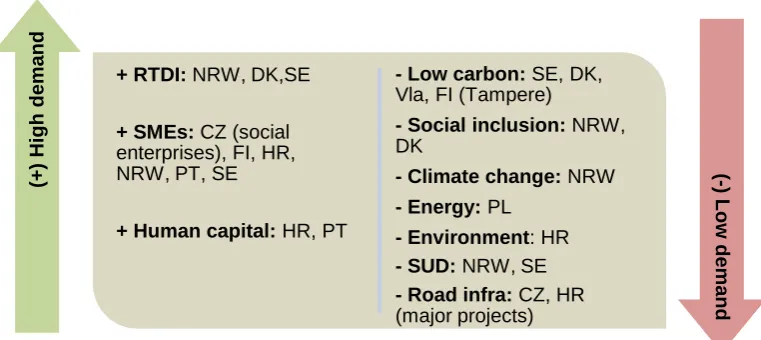
Figure 1: Demand for themes in the IQ-Net programmes: (+) high, (-) low
Challenges have been reported in relation to low carbon (TO4) and social inclusion (TO9) objectives, both of which are prioritised themes in 2014-20 with earmarked funding.1 The lack of previous experience, existing domestic funding sources (e.g. funding for themes similar to TO9) and domestic legislative frameworks are just some factors that have contributed to the low level of demand. However, experiences concerning the same theme can vary, with some programmes reporting no problems with the theme (e.g. Croatia). Sometimes, implementation varies within the same country, as noted in the case of Finland (see Box 1).
Box 1: Contrasting experiences under TO4 in Finland
Contrasting experiences under TO4: In Finland, the regions have had contrasting experiences regarding demand under TO4. While generating applications on renewable energy or circular economy themes has not
been a problem in the Helsinki-Uusimaa region, the situation has been somewhat different across the country. The national average of allocated ERDF funding to applications under these themes has been 16 percent, while in the Helsinki-Uusimaa region, the figure is 40 percent. Common project proposals in Helsinki-Uusimaa are concerned with the recycling of building material, textiles, as well as different water supply projects.
In addition, themes such as sustainable urban development (SUD) have been reported as challenging. In Sweden, this has been due to the fact that there are very different structures in place across the programmes, which in turn has led to difficulties in ensuring cooperation at national level. There is also evidence that demand for TOs supported in the past period has fallen. For instance, in the Czech Republic, demand for support of reconstruction of selected roads has been slow as this was intensively supported at the end of the 2007-13 programming period.
1
20 percent of ESF has been earmarked in all regional categories for TO9. For TO4, 20 percent of ERDF has been earmarked in more developed regions, 15 percent in transition regions and 12 percent in less developed regions.
+ RTDI: NRW, DK,SE
+ SMEs: CZ (social enterprises), FI, HR, NRW, PT, SE
+ Human capital: HR, PT
- Low carbon: SE, DK, Vla, FI (Tampere)
- Social inclusion: NRW, DK
- Climate change: NRW - Energy: PL
The general expectation is that demand will pick up as programme implementation progresses and programme authorities and beneficiaries become more familiar with the ‘new’ themes. However, selected programmes2 have aimed to facilitate the demand for the different themes by:
Organising targeted awareness-rising activities (e.g. events); Carrying out closer monitoring of the preparedness of projects; Extending deadlines for calls;
Eliminating potential constraints that were identified in previous rounds; and
Defining future calls more clearly and by involving relevant specialists in the design of calls with the expectation of attracting more applications.
1.2 Results-orientation
Another key component in the implementation of 2014-20 programmes is the results focus and the need to ensure that project applications take into consideration the logic of intervention and their contribution to programme objectives.
There are some indications that beneficiaries are more familiar with the concept of results-orientation than in the past. The new electronic application systems in place have been helpful in ensuring that applicants comply with all the relevant requirements. This has been supplemented by continued efforts by programme managers in providing relevant advice and guidance and in agreeing on indicators/targets in project award decisions so that applicants know the achievements expected. Furthermore, many programmes include applicant groups, such as researchers and businesses, who are used to thinking in terms of outputs and results.
Nonetheless, there is a need for continued actions to remind beneficiaries of the importance of results and on setting realistic targets. Indeed, due to the novelties of the 2014-20 period, such as the introduction of the ITI and consequently the emergence of new beneficiaries (at least in some instances), some actors may still not be fully aware of the need to have results indicators.
The difficulty is therefore not the results-orientation per se, but the understanding of the individual indicators. Despite the fact that the intention of the results indicators is to provide a better understanding of the effects of Structural Funds interventions in Member States, the current outlook is not entirely promising in this respect. The development of the indicators has been problematic, as many outputs have been difficult to measure. The guidance from the Commission has not been helpful in all instances, particularly where immaterial investments are concerned. There are also no clear arguments on why certain targets are sufficient in the context of Cohesion policy or why unsuccessful projects cannot be included as results. Consequently, the finalised indicators for 2014-20 have in many instances turned out to be complex or artificial.
A further difficulty is to translate the measurement of results at the programme level, particularly where the projects and the total programme funding are small compared to the size of the regional economy. Hence, the interpretation and the collection of the indicator data are viewed to be a challenge. Some programme managers have even noted that although the indicators used in 2007-13
2
Ferry M (2015) ‘New OPs, new instruments: progress with the 2014-20 programmes’, IQ-Net Review Paper
programme period were largely focussed on gathering data on created jobs and employment, they provided more information than the ‘reformed’ indicators in the 2014-20 period.
1.3 Overview
Project generation is well under way and early indications on demand are promising. Amongst IQ-Net programmes, first project generation activities (e.g. project calls, direct awards, global grants etc.) started in 2014 (FI, NRW, PT), with most programme managers launching project activities in the course of 2015 (CZ IROP, Eng, GR, HR, Pom, Sco, SE, SK, Wal). As reported in IQ-Net Review Paper 37(1), programme managers have established different initiatives to boost project generation by focussing on various demand (capacity of beneficiaries) and supply side (capacity of programme authorities focussing on efficiency, transparency, coordination) measures.3
Thus far, project uptake has been either high or satisfactory (with some variation across the different priority axes and instruments), with no IQ-Net programme reporting low demand. The established measures have thus been successful in that there are no reported changes needed (see Box 2).
Concerning the demand side measures, the proactive approach of encouraging the discussion of ideas and/or use of a multi-phased application processes have been praised as good practice examples. Despite the fact that such processes can be onerous exercises for the programme authorities, they have generally been found to increase the capacity to prepare good applications, while at the same time minimising the (final) project refusals. Overall, IQ-Net programme managers have noted commitment to the existing approaches, supported by various communication activities such as meetings, seminars, bulletins and websites.
Box 2: Successful demand side measures to boost project generation
Ensuring results-orientation in applications: In Denmark, the Capital Region is highlighted as a good example, because applicants are offered individual meetings to
discuss the design of their project application to ensure results-orientation.
Saving time for beneficiaries: In the Helsinki-Uusimaa region, the two-phased application process has been praised for its time efficiency in particular. Applicants do not need to
invest time in developing a formal application unless the idea (first phase) is successful. Although the authorities have to respond to each submitted idea in writing (c. 100-130
ideas are submitted during the first phase), there are clear signs that the quality of the applications has improved. The two-staged application process has also reduced the
number of follow-up questions from the applicants.
Expectations are also high regarding the different supply side measures currently in place, which are aimed to ensure capacities amongst the programme authorities in project generation activities. For instance, in Slovenia, the MA is hopeful that the bottom-up principle of cooperation within the established strategic development partnerships between the public and private sector and
3
other stakeholders will improve the quality of the selected projects. Further efforts have also been placed on the planning phase of the instruments (public calls, operations etc.).
The challenge in the 2014-20 period has been the substantial rise in complex and integrated projects (e.g. ITIs, other major projects or those which cover more than one category of region), which have added additional phases to the process of project selection and appraisal. Consequently, this has placed more demands both on the programme authorities and the beneficiaries. Following the increase in the number of larger and more complex projects, some programmes have experienced also changes in the project applicant groups. For instance, in the Tampere region in Finland, programme managers have noted the dominance of larger cities, development companies and universities. With the merger of many higher education institutes in Finland, the applicant groups are not only larger but also fewer. The exception to this is under the ITI strategy, where the programme managers from the Helsinki-Uusimaa region have noted that they are receiving applications also from smaller associations, which are not normally present under the mainstream calls.
2. PROGRAMME MANAGEMENT CHALLENGES
2.1 Contextual changes
Programme implementation has progressed with a degree of uncertainty in the external environment.
Recent or planned elections and the consequent changes in government can lead to formal or informal strategic reviews of the ESIF programmes, although the exact implications remain to be seen:
In Croatia, although no significant changes have been forthcoming to date, the new government elected in November 2015 may lead to changes in the OPs, specifically concerning the Integrated Territorial Investment strategies (ITIs).
In France, elections of Regional Governments in December 2015 have brought about a change of leadership for half of the ERDF and ESF programmes (The merger of regions has led to the reduction of the number of MAs, but not of regional OPs. A political shift in one region can have changed the leadership of 2-3 OPs). This may have an impact on project selection during the course of the period. However, some aspects of programme implementation that had been postponed until after the elections (i.e. launch of Financial Instruments) have speeded up since.
In the United Kingdom, elections in May 2016 (Sco, Wal) had an impact on programme implementation, due to pre-election period limits on decision-making e.g. on public procurement.
and central government and for the longer-term conceptualisation of regional policy aims and objectives.
IQ-Net countries have also adopted new domestic legislation in order to facilitate or organise the implementation of ESIF programmes.
In the Czech Republic, a New Act on Public Procurement is in discussion. Its main benefits consist of ensuring compliance with the ‘acquis communautaire’, and developing a culture of public procurement. This is, inter alia, expected to ease the implementation of financial instruments.
Slovakia has also passed a series of national acts with a view to setting up the national legal framework for ESIF implementation: on public procurement; on financial instruments financed by ESI Funds; and on State aid.
EU level decisions have also had a direct and indirect impact on domestic OP management in two instances:
An EU Regulation4 was adopted last year in order to address the liquidity issue that challenges the implementation of ESIF programmes in Greece. An additional pre-financing amount worth 3.5 percent of the ESIF and EMFF OPs for the entire period will be paid in 2015 and 2016 to all OPs in Greece except the Youth Employment Initiative and the Territorial Cooperation programmes.
In Slovakia, the Government is expected to submit a request for the revision of its OP on Integrated Infrastructure in order to allow the combination of ESIF and the recently introduced European Fund for Strategic Investment (EFSI) in a motorway construction project.
EU level policies have also encroached on the domestic management of ESIF programmes in the field of new emerging challenges, such as the management of the refugee crisis.
2.2 Programme flexibility and the management of the refugee crisis
The Commission has encouraged Member States to consider the opportunities for using ESIF in addressing the refugee crisis. With respect to the ESF, this concerns various social integration measures, while the role of ERDF can be broader covering e.g.: health, education, housing and childcare infrastructure; regeneration of deprived urban areas; actions to reduce spatial and educational isolation of migrants; and business start-ups.5
However, in most countries, ESIF OPs are not expected to be mobilised in order to manage the refugee crisis, for strategic, operational and regulatory reasons.
4
Regulation (EU) 2015/1839 of the European Parliament and of the Council of 14 October 2015 amending Regulation (EU) No 1303/2013 as regards specific measures for Greece.
5
European Commission (2015) Panorama, Inforegio, winter 2015, No. 55, pp. 20-21. Available at:
Some programme managers are not facing a refugee crisis in their country, therefore the use of additional funding from Cohesion policy does not appear as relevant.
For some others, Cohesion policy is not viewed as an appropriate mechanism. There are concerns that Cohesion policy would become an increasingly generalised pot of funding, which would weaken its original purpose. In terms of timing, some note the emergency nature of the crisis differs from the medium-term programming logic of ESI Funds.
Other instruments at the EU level are deemed to be more relevant (e.g. AMIF6 , ISF7
, FEAD8) to provide a short-term response that fits with the emergency context, while Cohesion policy is built for longer-term responses.
Applying funds to the crisis for longer-term integration could bring difficulties in programme implementation, such as programme changes. Programme managers are reluctant to engage in such processes, particularly outside the mid-term programming cycle.
In addition, doubts have been raised about the eligibility for ESIF support, and particularly ESF-co-funded projects. Refugees are only eligible once they are granted the official status of refugee, in other words until they get legal access to the job market. This limits the capacity of Cohesion policy to contribute to the management of the crisis.
Programmes managers have also explored options to articulate Cohesion policy in this new context, seeking complementarity between Cohesion policy and existing instruments. Suggested arrangements include:
ESIF can provide indirect support and therefore eligibility issues can be avoided, through its inclusion objective, by supporting activities likely to involve refugees that would set up favourable conditions for integration i.e. leisure activities, training, language learning or co-financing key infrastructure including housing and social infrastructure, and in emergency cases reception centres.9
Sweden has experimented with this by promoting support structures and facilitating entrepreneurship among new arrivals (i.e. incubators targeted at new arrivals and risk capital investments related to integration and diversity issues).
Programme changes can be avoided by broadening the target groups for the priorities and for the project generation activities. Some programme managers are looking into broadening the target groups for their calls (e.g. Sweden, lle de France) to include refugees, or have launched additional calls to benefit refugees (e.g. Southern Denmark, Greece). In
6
Asylum, Migration, and Integration Fund (AMIF) covers short-term needs by supporting the enhancement of reception capacities, integration projects for migrants, and the compliance of asylum procedures with EU rules, including fair and effective return strategies. Its budget for 2014-20 amounts to €3 billion.
7
The Internal Security Fund (ISF) includes two main pillars on the control of external borders and the fight against organised crime and terrorism, in a cross-border cooperation approach. Its budget amounts to €3.8 billion for 2014-20.
8
The Fund for European Aid to the Most Deprived (FEAD) funds the provision of essential goods (food, clothing, sleeping bags, etc.) and the implementation of social inclusion measures. It has a budget of €3.8 billion for 2014-20.
9
Nordrhein-Westfalen, a priority combines sustainable urban development and social inclusion, and includes a focus on socially disadvantaged groups.
More can be done in the short-term by improving fund coordination. Sweden has taken active initiatives in this regard (see Box 3). In France, the MA of the National ESF OP and coordinating body for ESF takes part in AMIF’s thematic committees to ensure complementarity and to avoid double-funding.10
Regulatory changes. The Swedish Government is planning to make a proposal to the Commission to either reinterpret or make an amendment to Article 98.2 in EU regulation 1303/2013 so that it would become easier to have ESF investments within ERDF co-financed projects, and vice versa. This option would not require the reallocation of funds, but would give increased opportunities to directly work with measures that facilitate the reception of refugees in both funds.
Box 3: Fund coordination in Sweden
In Sweden, the MAs of the ESIF (namely ESF-rådet, Jordbruksverket and Tillväxtverket) view that there is a continued need to take shared responsibility in the development of their programmes and issues touching upon the refugee crisis. The MAs are organising regional meetings in the course of spring 2016. The aim is to have joint discussions on how they can complement their respective activities and to strengthen cooperation with regional and national actors in order to make a difference in the refugee reception process. This process will be monitored, analysed and reported on an ongoing basis to the joint groups and committees which lead the fund coordination work. The coordination process is expected to facilitate the identification of possibilities in different programmes, as well as the introduction of changes to programmes.
Outside the IQ-Net network, it is worth noting the decision by the Brussels-Capital Region in Belgium to reallocate €7.3 million of ERDF from its financial instruments (100 percent of FIs allocation) to support Doctors of the World’s actions as part of the management of the refugee crisis.
10
In the event of non-fulfilment,
possible suspension of
payments
-EAC info in PA and OPs
-Action plans may be drafted
2.3 Implementing ex-ante conditionalities
An ongoing part of the ‘post-programming’ stage has been the fulfilment of the ex-ante conditionalities (EACs). The assessment of the applicability and fulfilment of the EACs takes the following steps:
The current ongoing issue has been the adoption of action plans where the criteria for the EACs have not been fulfilled by the Member States and/or the regions by programme submission. Across the EU28, a total of 781 separate action plans have been launched, of which 470 were due to be completed by the end of 2015 and 311 by the end of 2016 (see Figure 2).11
11
Gilland M, de Keersmaecker S, Dimovne Keresztes E and Weber A (2016) State of play in completion of action plans to fulfil ex ante conditionalities in the European Structural and Investment Funds' programmes.
MS self-assessment
COM assessment
Solving disagreements
between COM and MS
Figure 2: ESIF action plans in place in the Member States
Source: Adapted from Gilland M, de Keersmaecker S, Dimovne Keresztes E and Weber A (2016) State of play in completion of action plans to fulfil ex ante conditionalities in the European Structural and Investment Funds' programmes.
The completion of the EACs is behind target. By the end of 2015, only 19 percent of the action plans were completed.12 The reported difficulties with the fulfilment of the EACs are varied:
Different conditions imposed on Member States. In some instances, it has been felt that the Commission has imposed conditions in a rather arbitrary manner and practiced an unequal treatment of programmes (e.g. in Greece in the context of the EAC 1.2 on research infrastructure). Financial suspensions have been used to ensure fulfilment in Greece, although this has not been practiced concerning the same EAC in other countries.
Limited consideration of Member State’s suggestions. In Greece, there is the view that the Commission has been reluctant to consider adjustments suggested by the Greek authorities, for instance, regarding criteria for the national infrastructure strategy. Furthermore, the action plan for public procurement was also extended, with issues to which Greece was opposed.
Multi-sectoral nature of the EACs makes the fulfilment process lengthy and complex. Despite the fact that the MA of the IROP in the Czech Republic is not directly responsible for any of the EACs, some of the EACs concern directly the implementation of the IROP (e.g. 9.2 policy inclusion of Roma and 0.4 public procurement). In Croatia, fulfilling the EAC 7.1 on transport has been a long process, not least due to the engagement of a wide range of stakeholders.
Lack of coordination on the EACs. Greece has also faced additional delays due to the lack of coherence and coordination between the Cohesion policy conditionalities and the conditionalities imposed under the financial assistance programme. There have also been inter-institutional issues with different bodies at the Commission having responsibility for different elements of the EACs and consequently different understandings on what the EACs should entail.
12
Gilland M et al. (2016) Op. cit. 0
20 40 60 80 100 120 140 160
BE BU CY CZ DE EE ES FI FR GR HR HU IE IT LT LU LV MT NL PL PT RO SE SI SL UK
Management of the EACs at the national level can cause delays at the regional level. In Poland, the fact that the EACs are largely managed at the national level has meant that delays (particularly with the conditionality on health) have had a knock-on effect on the work of the regional programme authorities.
EACs do not necessarily enhance administrative capacity. The Greek officials have noted that the EACs in themselves do not enhance administrative capacity, but rather it is difficult for a country to comply with conditionalities that it has not been subject to before.
The focus across the Member States and regions is on fulfilling the EAC requirements, as the risk of not having EACs or action plans fulfilled at the latest by the end of 2016 can result in a suspension of payments in 2017.13
Due to the pending EACs, the submission of payment requests in 2015 has been on hold for instance in Greece and there are some concern that this will lead to absorption problems.
2.4 Management and control systems
The design of Management and Control Systems (MCSs) is reaching a final step in all IQ-Net programmes. Differences in advancement range from their review by the audit authority and their imminent submission to the Commission, to their adaptation by MAs in accordance with audit authorities’ comments, to their actual implementation (GR, certain OPs in PT, SE). Most MCSs will be transferred to the Commission for approval during summer 2016.
As in previous IQ-Net research14
, IQ-Net members have highlighted the growing complexity of this process because the Commission’s requirements have increased, i.e. regarding the level of details to describe the MCS and number of documents demanded which make the process more onerous (Eng, FI, SE, Sco). Concerns have been raised about the delays in adopting MCSs: delays in implementation are expected to limit programme performance in the short-term and increase the pressure on managing and audit authorities, who have to manage three key tasks in parallel: the design of the MCS, the implementation of the new programmes and closure activities for 2007-13. There are several remaining issues:
The designation procedure remains a concern in many programmes. For instance, delays are associated with the existence of multiple and unclear rules combined with late publication of Commission guidelines. (ES, NRW). Nordrhein-Westfalen underlined the highly bureaucratic aspect of the procedure (i.e. long checklists).
The new requirements regarding antifraud and anticorruption measures are challenging. This may come from the difficulty identifying where there might be risks of fraud (DK – where an internal evaluation was carried out for this purpose), the lack of guidelines and experience (CZ), or the Commission’s requirements in terms of details on systems and procedures requested from all implementing bodies (ES). In general, these concerns echo those
13
Gilland M et al. (2016) Op. cit.
14 Davies S (2015) ‘Is simplification simply a fiction?’
discussed in previous IQ-Net research about the multiplication of controls to a disproportionate level. In terms of solutions, each MA in Greece will appoint one person to monitor fraud risks.
Across programmes in Slovakia, complexity comes from the expansion of the MCSs to new areas, such as financial instruments, evaluations, additional stages of ex-ante controls, the establishment of a new Risk Management system, and the introduction of e-Cohesion (which has also been a delaying factor in England).
They are ongoing disagreements with the Commission as to the distribution of responsibilities in the programme. In the Czech Republic, the EC has required extended responsibilities for intermediate bodies (cities) in charge of ITIs. Their tasks as currently set is to express compliance of the project with the strategy, which according to the Commission is not compliant with ERDF Regulation Art. 7. To national authorities, this is irrelevant to the local circumstances where one project will be selected per city, while the latter do not want to get further involved. In Vlaanderen, the Commission refused the transfer of responsibility for project selection from the MA to the Monitoring Committee in the name of the separation of functions.
2.5 Programme revisions
Implementation has now progressed to the point where some OPs as well as PAs have undergone revisions. Amongst the IQ-Net programmes, the monitoring of the programmes has thus far resulted in various, albeit in many cases minor, technical and financial adjustments, with more substantial changes reported only in the case of Finland (see Box 4).
Box 4: Programme change in Finland
In Finland, the Monitoring Committee approved a programme change on 10 December 2015. The change follows the Government’s discontinuation of the Innovative Cities (INKA) programme, which had originally been earmarked c. 10 percent of the OP’s ERDF funding. Some of the funding (€40 million), which was originally
reserved for the INKA programme will be used to contribute to the joint EU SME Initiative. As a result of the
programme change, some changes were also required to the PA.
More generally, programme managers are anticipating formal changes at later stages of programme implementation in 2017 / 2018, or if larger scale industry-wide challenges emerge:
In Slovenia, programme changes are planned for 2018 depending on the outcome of the preliminary discussions with the Commission. The two main issues concern (i) changes to the codes of intervention following the replacement of grants by FIs in some areas, and (ii) a major railway project to be supported by the Connecting Europe Facility instead of the Cohesion Fund.
beyond) as the MA is having difficulties collecting data for some result indicators e.g. around measuring severe fuel poverty for measures dealing with energy efficiency in buildings.
3. MONITORING AND EVALUATION
3.1 Monitoring
New requirements regarding e-Cohesion, result-orientation and evaluation have led almost all IQ-Net programme managers to develop a new monitoring system. Their level of readiness varies across countries. Most of them are now operating, and data on projects have been registered. However, some systems, including those already operating, are still undergoing adjustments, and should be finalised in the course of 2016.
Pending arrangements are related to the preparation of the monitoring systems, such as the completion of comprehensive systems (ES, PT, SI). Uncertainties remain in the field of registration and the methodological accuracy of indicators. In France, the territorial reform involving the merger of regional authorities may lead some programmes to transfer between the national Information System and the regional ones, depending on the choice of the new regions in which they are included.
Since October 2015, IQ-Net members have also continued efforts to ensure the effective take up of the information system by actors involved in programme implementation. In this respect, compliance with e-Cohesion has been the main challenge. While it is supposed to facilitate efficient data collection, and work towards simplification for beneficiaries, e-Cohesion requires a change of habits among actors. In spite of the positive opinion of IQ-Net members15
, adaptation to e-Cohesion standards has required extra efforts.
It has caused delays (DK, Eng), sometimes due to domestic legislative changes (SK).
Training for both administrative staff and potential beneficiaries is a central issue and objective. In Vlaanderen, where implementation is advanced, on-going developments also intend to make the Information System more user-friendly.
Box 5: Conclusions of the High Level Group on Simplification, on e-governance
E-governance is an issue that has been identified as key to simplification by the High Level Group on Simplification. In its conclusive statement of its meeting in December 201516, challenges quoted were in line with
those reported in IQ-Net programmes, such as:
Organisational change. This includes the adaptation to new procedures for beneficiaries’ benefit, but also changes in terminology and processes to articulate the ESI Funds and domestic e-government strategies – which in addition sometimes requires a change in IT infrastructure
Legal uncertainties, specifically the apparent incompatibility between legal certainty and a simpler and user-friendly system, which adds to other legal challenges.
It also called for incentives on training (more assistance by the Commission to MS and MAs, larger TA allocations). Likewise, it recommended ‘a consistent approach to audit’, as well as the clarification on the
compatibility of documents permitted by national law (i.e. software extractions) with EU programmes, or on issues related to electronic signatures. The High Level Group on Simplification is expected to hold another meeting at
the end of 2016 on similar issues.
In Wales, e-governance came along with joint structures at different steps of programme implementation (Joint IT
system between funds, Joint Monitoring Committee). Organisational challenges were addressed notably through intense training and involvement of all stakeholders, including non-governmental.
Where project data have already been registered, further issues have emerged. These concern 1) output indicators and 2) the complexity of the data to be registered.
In Finland, some output indicators seem not to be well-adapted for use by research projects, which raises concerns among project partners about their capacity to provide data that would fit in the performance framework.
Both Finland and France noticed different provisions in the rules on reporting of outcome indicators under ERDF and ESF. ESF allows earlier registration of outputs, which is more adapted to longer-term projects and is consistent with the Commission’s objective to highlight the value of Cohesion policy. Harmonisation would also avoid confusion in multi-fund programmes (all French OPs are ERDF-ESF, except one).
In Poland, the main challenge consists in aggregating inputs from the different Intermediate Bodies, particularly the one managing an ITI, which lacks experience and faces a complex procedure (lots of local units involved, substantial paperwork).
16
Conclusions and recommendations of the 2nd meeting of the High Level Group on Monitoring Simplification for Beneficiaries of ESIF Funds, e-governance, March 2016, available at:
3.2 Evaluation
3.2.1 State of play
Since the last IQ-Net conference, most remaining Evaluation Plans have been approved, and programmes are now launching their first evaluations. The pending evaluation plans are expected to be approved before the summer (CZ, national: ES; OP-level: ES, Eng, GR).
Evaluation Plans are intended to be flexible documents, to allow the accommodation of emerging evaluation needs by re-calibrating work where this is deemed necessary. Reviews are therefore an important part of the process. In Slovakia, a review of the evaluation plan for the OP Effective Public Administration has already been carried out, while in Sweden the first review of the joint Evaluation Plan of the eight regional OPs is anticipated in 2017.
In some cases, annual Evaluation Plans are also foreseen. For instance, in Slovenia the Evaluation Plan is conceived as a ‘living document’. It is therefore not very detailed regarding the kind of evaluation that will be done in each year, as the details of each single evaluation in a specific year will be provided in an evaluation plan, decided annually in dedicated PMC meetings.17
As noted in previous IQ-Net research, implementation evaluations will dominate the agenda, at least during the first half of the programme period. One of the main concerns is to improve programme implementation and efficiency by quickly building lessons learned from the previous period and the early developments in 2014-20. Evaluations in 2016 include:
Ex-post evaluations of the 2007-13 period (CZ, PL)
Process evaluation on OP implementation, more particularly on the project selection aspect (CZ, HR, NRW, PL, SE).
17 See more in Polverari L (2015) ‘The monitoring and evaluation of the 2014-20 Cohesion policy programmes’,
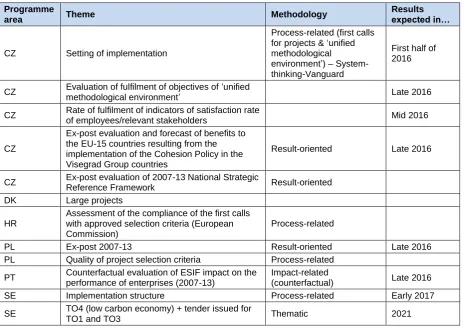
Table 1: Evaluations launched in 2014-20
Programme
area Theme Methodology
Results expected in…
CZ Setting of implementation
Process-related (first calls for projects & ‘unified methodological
environment’) – System-thinking-Vanguard
First half of 2016
CZ Evaluation of fulfilment of objectives of ‘unified methodological environment’ Late 2016
CZ Rate of fulfilment of indicators of satisfaction rate
of employees/relevant stakeholders Mid 2016
CZ
Ex-post evaluation and forecast of benefits to the EU-15 countries resulting from the implementation of the Cohesion Policy in the Visegrad Group countries
Result-oriented Late 2016
CZ Ex-post evaluation of 2007-13 National Strategic
Reference Framework Result-oriented
DK Large projects
HR
Assessment of the compliance of the first calls with approved selection criteria (European Commission)
Process-related
PL Ex-post 2007-13 Result-oriented Late 2016
PL Quality of project selection criteria Process-related
PT Counterfactual evaluation of ESIF impact on the performance of enterprises (2007-13)
Impact-related
(counterfactual) Late 2016
SE Implementation structure Process-related Early 2017
SE TO4 (low carbon economy) + tender issued for
TO1 and TO3 Thematic 2021
Table 2: Evaluations planned in 2016 (indicative selection) Programme
area Theme Methodology
NRW Assessment of new approach to competitive calls Survey of recipients, etc. FR/IDF,
FR/IDF, FR/Centre, HR
Implementation and efficiency of the OP Process-related
PT
Evaluations on the ESIF contribution to 1) knowledge transfer, cooperation and clustering and 2) administration capacity
For both:
Impact-related (2007-13), Process-related (2014-20) Theory-based evaluation SE Thematic evaluations (all remaining themes) Thematic
WAL ESF survey of training (the ‘Participants Survey’) Participant survey
Of particular note is the early launch of thematic evaluations in Sweden and launch of several parallel evaluations in the Czech Republic:
[image:25.595.67.532.439.594.2] Launch of ex-post and implementation evaluations has been particularly fast in the Czech Republic, in line with objectives set out in the evaluation plans to coordinate with reporting requirements and concentrate on process-related evaluations between 2016 and 2017.
Box 6: Completion of YEI implementation studies
In addition, four studies on the Youth Employment Initiative have been completed in Portugal, Slovenia, Sweden and Scotland. In Slovenia for instance, the study provided results both in terms of process and support accuracy. It showed that the instrument properly addressed key issues and target groups’ expectations, and led to the
reduction in ‘dead weight’ (allocation of support to businesses to employ people they would have employed
anyway).
3.2.2 Structural arrangements to ensure high quality evaluation
The YEI study in Slovenia (see Box 6) has underlined the challenge of defining a relevant indicator (namely ‘Quality of employment offers received by YEI participants’), and elaborating an accurate methodology to measure it. Across the IQ-Net programmes, one of the primary concerns has been to ensure data quality and measurability. Most programme managers are involved in the coordination between programme implementation services and public statistics offices, which will have responsibility in providing reliable data for future impact evaluations (particularly counter-factual).
Coordination will also help improve consistency and synergies that will increase capacities to evaluate, and identify lessons learned.
Coordination between administrations: Several programmes have issued national guidelines. Sweden has also set up a National thematic support organisation, which focuses on learning and knowledge development during implementation. In Wales, some restructuring has also been carried out within the Wales MA (WEFO), where a new Strategy Unit is being set up; this will incorporate the current research, monitoring and evaluation team
Coordination between evaluations. In Wales, ex-post evaluation of 2007-13 programmes will synthesise all project and programme evaluations carried out to produce key findings at priority level and make recommendations on how to undertake evaluations in future. In addition, there is a focus on supporting operations (projects) to undertake inception evaluations, expected to provide a good basis for future evaluations. In Sweden, the early launch of thematic evaluations is expected to provide valuable feedback for the future impact evaluation.
4. PROGRESS WITH NEW INSTRUMENTS
The preparation of new forms of delivery (FIs, territorial strategies) has also occupied a significant amount of MA time over the last six months, and has been demanding in terms of the adaptation required from both MAs and project applicants.
4.1 Territorial approaches
Integrated approaches are being used in all Member States. CLLD is used in all Member States, whereas Integrated Territorial Investments in most but not all (20 Member States). Most countries (22) have addressed the urban dimension, essentially through ITIs.18
During the last six months, programmes have made progress regarding the launch of their territorial strategies (CLLD, ITIs, whether involving ISUD or not). Implementation has started in certain programmes. Several timelines and a range of diverse challenges have been identified.
4.1.1 Progress in implementation
The state of play can be categorised into three broad groups:
Some programme managers are in the process of selecting territories, appraising strategies of areas already identified, or finalising the control and management system (AT, CZ, GR, HR, PT, UK - Eng).
An equal number of programmes have completed the design of the strategies, and first calls for projects are expected in the course of 2016 (AT, FL, FR, PL, PT, SI).
In fewer areas, project selection has started: calls for projects/proposals have been launched, projects have been selected. (DK, FI, SE). Funding agreements should be the next step in these territories.
Regarding CLLDs, progress ranges from strategy assessment and selection to strategies already being approved.
Generally, the launch of calls for projects should range from late 2015 until early 2017 among IQ-Net programmes. Building capacity appears to be an important focus in the meantime. Guidelines have been published during the last six months (CZ, GR, UK - Eng). Coordination networks have also been launched with a view to easing the launch of the territorial approach (GR, SI).
4.1.2 Challenges in implementation
Where calls have been launched, the number of applications is below expected levels. This resonates with the delays faced by programmes involved in the preparation stage. Both underline the complexity of ITIs for fund managers and potential applicants, regardless of previous experiences in domestic territorial policies. ISUD is also a new theme which cannot rely on as much existing
knowledge as others. The main obstacles identified by programme managers to a faster take-up of the instrument include complexity, the challenges of cooperation and a lack of flexibility:
Territorial projects aim to generate bigger and more complicated projects, involving a larger number of actors, which can be a challenge.
More restrictive State aid rules also add challenges to ITIs where local projects are being developed without awareness of the new State aid requirements.
In parallel, the designation of Intermediates Bodies (IBs) raises the question of local capacities and experience with European fund management (UK - Eng), but also in terms of territorial cooperation.
In Nordrhein-Westfalen, the required articulation between MAs and IBs conflicts with the domestic institutional framework. According to the federal constitution, there is no hierarchical relationship between the federal, Land and local authority levels. This does not fit well with the ITI/ISUD approach which requires a local authority to be an Intermediate Body (i.e. subordinate) to a Land-level MA, with which it has a contractual relationship. This is not possible under in German domestic law – nor is it possible e.g. for a local authority to be subject to Land-level financial controls.
In the Czech Republic, the EC requires deeper commitment of IBs in the selection process, whereas the local actors do not deem it relevant, and the IBs (cities) do not want to be further involved (see also Management and Control Systems). A similar reluctance of cities to engage was observed in Denmark through delays in response and a low level of applications for the management of SUD projects.
Some programme managers have also identified a risk of rivalry and fragmentation between local governments. On the other hand, it seems that some have used that opportunity to develop coordination with other authorities.
Box 7: Slovenia, management of ITIs
In Slovenia, a public call for projects in 11 municipalities is foreseen in 2016, all areas working together under a common urban authority: the Slovenian Association of Municipalities, ZMOS, which is in charge of project
selection. Mutualisation is seen to offer the possibility of economies of scale and efficiency despite the low levels of funding allocated to each strategy.
Programme managers have also been critical about a lack of flexibility of the territorial approach under the new regulation:
Thematic diversity in ISUD is sometimes seen as an unnecessary constraint (e.g. the Commission is insisting that each ISUD must cover two TOs – even though the EU regulation simply says that each ISUD needs to consider different dimensions) that is not in line with local interests.
4.2 Financial instruments
4.2.1 Progress in implementation
There is slow progress with implementing financial instruments (FIs). Only one IQ-Net programme had an operational FI in March 2015. The OÖ HightechFonds (Oberösterreich, AT), launched in July 2015 at the MA’s own risk and avoiding the use of State aid, has so far made two commitments with a total value of €450,000. Due to the early start, however, the fund managers have already been obliged to carry out an internal audit to check whether the 2015 funding agreements were carried out correctly. However, several programme managers anticipate launching FIs quite soon. In Wales, a new ERDF-funded SME fund (JEREMIE 2) has been entrusted to Finance Wales, and the procurement process for a fund manager has been launched, while in Scotland, procurement for fund managers for the new SME Holding Fund (management of which has been entrusted to Scottish Government) is underway. In England, the British Business Bank has been entrusted with management of the ERDF-funded Northern Powerhouse Investment Fund and Midlands Engine Investment Fund (both offering SME support) and is preparing to launch the fund manager procurement process. In Nordrhein-Westfalen, the NRW Bank has been entrusted with management of the new Urban Development FI. Considerable progress has also been made in Portugal, where funding agreements have been signed with the OPs on enterprise-related FIs, and in Slovakia, where funding agreements have been signed by four MAs with Fund of Funds managers, with a further two in the process of being finalised.
Many programme managers are still finalising implementation options for FIs. In Pomorskie, for example, the MA hopes to have a final decision by the third quarter of 2016, using either EIB or BGK (the National Development Bank) or a combination of both to manage FIs under four OP Priority Axes. A new OP for participation in the EU SME Initiative is being prepared in Finland, following discontinuation of the Innovative Cities (INKA) programme, for which approximately 10 percent of ERDF resources had been earmarked (€40 million). These funds will now be used to participate in the EU SME Initiative. In Sweden, discussions are ongoing regarding a new national green fund to promote the transition to a low-carbon economy, and a new Fund of Funds to support private venture capital funds nationwide (to operate alongside the eight regional venture capital funds).
4.2.2 Challenges in implementation
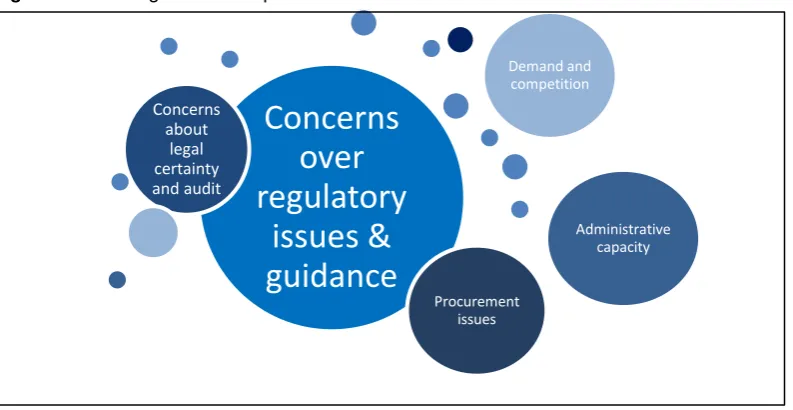
Figure 3: Challenges to FIs implementation
In terms of challenges to implementation of FIs, the most frequently identified barrier to FI implementation has been the regulatory provisions themselves. In 2007-13, the process of setting up FIs was protracted and difficult for both MAs using FIs for the first time and MAs with previous experience. The regulatory provisions – designed for grants – were inadequate for FIs and additional guidance was developed over the course of the perdio through successive COCOF notes. The 2014-20 regulations contain much more detail on FIs. However, navigating the new provisions has again been extremely challenging. While there are many Delegated and Implementing Acts, MAs feel there is still not enough detail on certain topics. This has led to concerns about legal certainty and the implications for audit. Changes to State aid regulations are also seen as unhelpful.
Responding to the challenges faced by MAs in applying the regulations, the Commission has been producing a series of guidance notes – however these have taken a long time to prepare and be approved – some MAs have delayed implementation while other have taken a ‘leap in the dark’. Selection of fund managers and financial intermediaries has been a major issue, with more than a few MAs would have preferred a competitive procedure rather than the need for procurement. The complexity can exacerbate the difficulty in finding consensus among different stakeholders on the most appropriate implementation option. Delays have meant that ex-ante assessments may need to be updated – even before FIs have been launched.
Looking ahead, there are concerns about the environment in which FIs are operating – that demand for FIs may suffer due to improved liquidity on private markets, and that there may be potential rivalries and tensions with other sources of funds in the increasingly complex FI landscape (especially where these may not be affected by State aid and procurement issues). There are fears that delays have adversely affected interest from fund managers and financial intermediaries. Lack of administrative capacity is another anticipated challenge to FI implementation – with new regulatory provisions, even previous experience may not help, e.g. where it is not possible to apply the previous model.
Concerns
over
regulatory
issues &
guidance
Concerns about
legal certainty and audit
Procurement issues
5. FINALISATION AND CLOSURE OF THE 2007-13 PROGRAMMES
5.1 Payments
[image:31.595.65.530.181.239.2]As the financial absorption rate approaches 90 percent, the rate of increase is slowing in the EU28 (see Table 3).
Table 3: Average payment rate and increase
Nov-May 2014 May-Oct 2014 Oct-May 2015 May-Oct 2015 Oct-May 2016 EU28 average
(%) 68.2 (EU28) 73.2 (EU28) 81.9 (EU28) 87.3 (EU28) 90.2 (EU28)
Increase (%) 8.8 5.0 8.9 5.4 3.3
Source: EPRC calculations from Commission data. Note that data for 2014, 2015 and 2016 include Croatia.
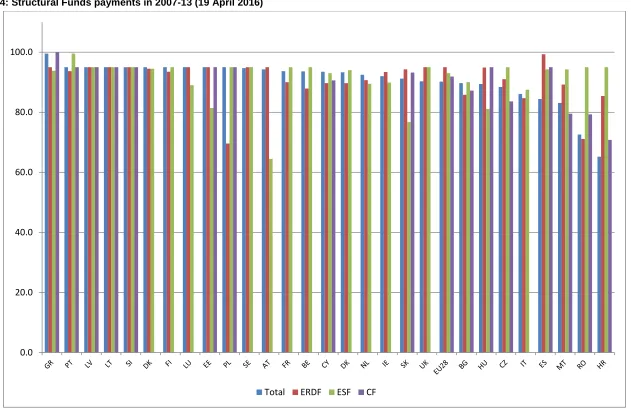
Figure 4 shows that there continue to be marked differences in the rate of absorption between Member States and Funds:
The highest overall payment rates can be found in Greece (99.5 percent) and a group of eight countries that has reached 95 percent (DK, EE, FI, LT, LU, LV, PL, PT, SI).
All but eight countries have reached a payment rate of 90 percent, which is the EU28 overall average (90.2 percent).
Figure 4: Structural Funds payments in 2007-13 (19 April 2016)
Source: Commission data from 19 April 2016 on Commission disbursements to Member States.
Note: Data for Italy are certified expenses as of 31 December 2015 from national source. Available at: http://www.opencoesione.gov.it/opendata/#spesa-title 0.0
20.0 40.0 60.0 80.0 100.0
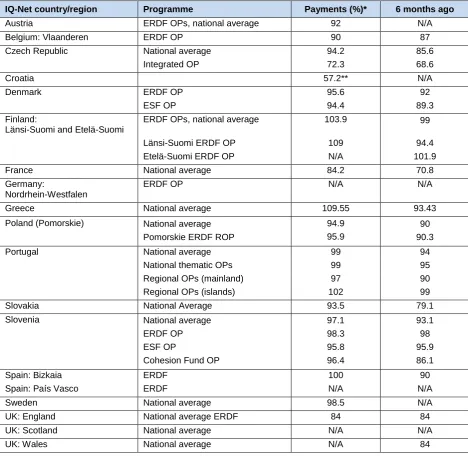
Payment rates in IQ-Net countries and programmes have continued to increase over the last six months (see Table 4) Almost in all instances, the increase has been above the average rate reported for EU28 (three percent).
Table 4: Financial progress in IQ-Net programmes
IQ-Net country/region Programme Payments (%)* 6 months ago
Austria ERDF OPs, national average 92 N/A
Belgium: Vlaanderen ERDF OP 90 87
Czech Republic National average 94.2 85.6
Integrated OP 72.3 68.6
Croatia 57.2** N/A
Denmark ERDF OP 95.6 92
ESF OP 94.4 89.3
Finland:
Länsi-Suomi and Etelä-Suomi
ERDF OPs, national average 103.9 99
Länsi-Suomi ERDF OP 109 94.4
Etelä-Suomi ERDF OP N/A 101.9
France National average 84.2 70.8
Germany:
Nordrhein-Westfalen
ERDF OP N/A N/A
Greece National average 109.55 93.43
Poland (Pomorskie) National average Pomorskie ERDF ROP
94.9 95.9
90 90.3
Portugal National average 99 94
National thematic OPs 99 95
Regional OPs (mainland) 97 90
Regional OPs (islands) 102 99
Slovakia National Average 93.5 79.1
Slovenia National average
ERDF OP ESF OP
Cohesion Fund OP
97.1 98.3 95.8 96.4 93.1 98 95.9 86.1 Spain: Bizkaia
Spain: País Vasco
ERDF ERDF 100 N/A 90 N/A
Sweden National average 98.5 N/A
UK: England National average ERDF 84 84
UK: Scotland National average N/A N/A
UK: Wales National average N/A 84
Source: ERPC fieldwork. Notes: (*) Dates for payment figures range from November 2015 until March 2016. (**) Data from 31 December 2015.
In line with concerns expressed during the previous IQ-Net cycle, several programmes are expected to undergo changes in order to achieve 100 percent of fund absorption. The Commission’s approval has been granted in some, and remains pending in others.