Effect of alignment in trans-tibial sockets.
The effect of alignment perturbations in a trans-tibial prosthesis user; a pilot study.
Anna Courtney, BSc1, Michael S. Orendurff, PhD2 & Arjan Buis, PhD1 1. Biomedical Engineering, University of Strathclyde, Glasgow, UK
2. Orthocare Innovations, Seattle, Washington, USA
Funding Body & Affiliated Centre;
Biomedical Engineering, University of Strathclyde, Glasgow, UK
Abbreviations;
2
Abstract
Objective: A recurring complication voiced by trans-tibial prosthetic limb users is ‘poor socket fit’ with painful residuum-socket interfaces, a consequence of excess pressure. This is attributable to both poor socket fit and poor socket alignment, however, their interaction has not been quantified. Through evaluation of kinetic data this study aimed to articulate an interaction uniting socket design, alignment and interface pressures (IPs). Results will help refine future studies, which will help determine if sockets can be designed, fitted and aligned to maximise mobility whilst minimising injurious forces.
Design/Methods: IPs were recorded throughout ambulation in one user with ‘optimal (reference) alignment’ followed by five malalignments in a patellar tendon-bearing (PTB) and a hydrocast socket.
Results: Marked differences in pressure distribution were discovered when equating the PTB against the hydrocast socket and when comparing IPs from reference to offset alignment. PTB sockets were established more sensitive to alignment perturbations than hydrocast sockets. A complex interaction was found, with the most prominent finding demonstrating the requisite for attainment of optimal alignment: a translational alignment error of 10mm can increase maximum peak pressures by 227 percent (x̄ =17.5%).
Conclusion: Refinements for future trials have been established, as has the necessity for future research regarding socket design, alignment and IPs.
Abstract Word Count: 200
Key Words: alignment, distribution, measurement, perturbations, pressure, prostheses, trans-tibial.
Journal of Rehabilitation Medicine.
Corresponding Authors address and email;
Dr. Arjan Buis
Biomedical Engineering University of Strathclyde
3
Introduction
Research shows that the number of primary prosthetic referrals to UK centres is on the increase, with around 70 percent of these being trans-tibial level(1). Of those amputees who ambulate with prostheses, there are numerous complications they can encounter which impede their ability to remain successful users. A recurring complication is ‘poor socket fit’ with pain at the residuum-socket interface, resulting from areas of high pressure(2).
Problematical areas of high pressure are not simply owed to poor socket fit but to a
combination of poor socket fit and poor socket alignment. Therefore, both must be optimal in order to deem a socket a ‘good fit’(3). Despite Radcliffe’s citation that socket interface
pressures (IPs) are a result of various factors (some of the most significant being socket fit, alignment and residuum position with regards to the ground reaction force (GRF))(4), their interaction has not yet been quantified. Therefore, currently, there is no consensus detailing how to achieve and quantitatively confirm a ‘good socket fit’.
Alignment is defined as the spatial relationship between the socket and the other components of a prosthesis and is a two-step procedure consisting of static superseded by dynamic alignment(5). Possible consequences of high pressure can be: ambulatory discomfort, skin lesions, gait deviations, increased energy expenditure, a reduction in activity and ultimately non-compliance(2, 5-6). Therefore, due to prevalent reductions in activity, lower-limb amputees have an increased predisposition towards developing co-morbidities such as obesity and cardiovascular disease(3). It is consequently of utmost importance, as voiced by users’ themselves(7), to achieve better fitting sockets with increased comfort and performance, to minimise development of above risks.
This pilot study aimed to augment present-day knowledge by documenting the effect and articulating an interaction between socket design, alignment and IPs in one user using two conceptual dissimilar socket designs over five alignment perturbations. The eventual aim is to utilise this study’s findings to refine full-scale clinical trials to determine if sockets can be designed, fitted and aligned to maximise users’ mobility while minimising IPs.
Methods: Ethics
Strathclyde University Ethics Committee granted ethical approval prior to participant contact.
Participant
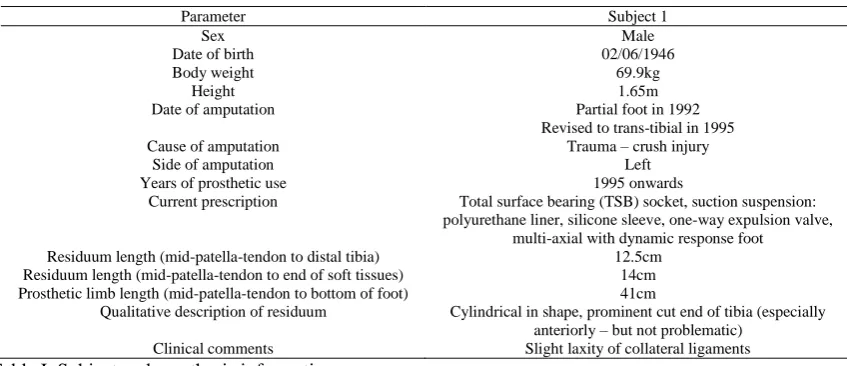
The participant was an active user with no residuum problems (Table I).
Parameter Subject 1
Sex Male
Date of birth 02/06/1946
Body weight 69.9kg
Height 1.65m
Date of amputation Partial foot in 1992
Revised to trans-tibial in 1995
Cause of amputation Trauma – crush injury
Side of amputation Left
Years of prosthetic use 1995 onwards
Current prescription Total surface bearing (TSB) socket, suction suspension: polyurethane liner, silicone sleeve, one-way expulsion valve,
multi-axial with dynamic response foot Residuum length (mid-patella-tendon to distal tibia) 12.5cm
Residuum length (mid-patella-tendon to end of soft tissues) 14cm Prosthetic limb length (mid-patella-tendon to bottom of foot) 41cm
Qualitative description of residuum Cylindrical in shape, prominent cut end of tibia (especially anteriorly – but not problematic)
[image:3.595.77.501.571.754.2]4
[image:4.595.106.234.370.561.2]Instrumentation Prosthesis
Figure-Table II highlights key information regarding used prostheses. Bench and dynamic alignment were performed until participant comfortable and Prosthetist satisfied. The prosthesis was then deemed optimally aligned. This ‘optimal alignment’ will now be denoted as ‘reference alignment’.
PTB Hydrocast
Casted and fitted by Chief investigator, a certified Prosthetist Chief investigator, a certified Prosthetist
Material Thermoplastic Thermoplastic
Foot SACH SACH
[image:4.595.240.486.378.557.2]Suspension Supracondylar Pin and lock
Table II. Information regarding prosthesis used in study.
Pressure Measurement Device
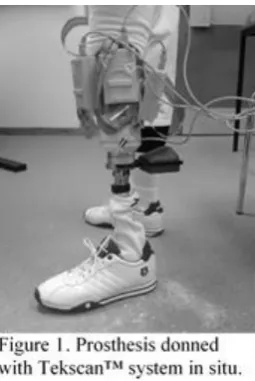
The Tekscan™ (Tekscan, Inc: Boston) system entails pressure sensors, scanning electronics and software that record dynamic pressures at the residuum-socket interface. Four Tekscan™ transducer arrangements were incorporated into both sockets without overlap (anterior, lateral, medial, and posterior), each consisting of 96 individual sensors (producing a total sensing area of 62,000mm2) (Figures 1-2). Known issues of sensor drift and calibration error were corrected by using a unique in-situ air bladder calibration system within the socket that has been previously described(2).Alignment Offset Device.
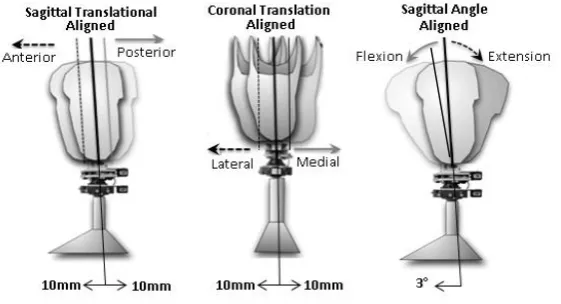
Alignment offset was documented using the Compas™ System (comprising a Smart Pyramid™, a Compas™ Master Unit and software) (Orthocare Innovations: Mountlake Terrace, WA, USA). The Smart Pyramid™ was mounted distal to the socket and incorporated electric moment measuring sensors. The Master Unit attached into the Smart Pyramid™ when data acquisition was required. The Master Unit connected to a host computer, the user ambulated and concomitantly data was collected.
Protocol/Procedure Resulting in Data Collection
5
a randomised order and the participant was blinded to chosen perturbations. Data used for analysis arose from central steps to decrease inaccuracies.
Data Analysis
Tekscan™ software was utilised to gather data from the sensors. Graphs and tables were then produced in Microsoft Excel to analyse these data.
Produced data represented mean pressures acting over 96 individual sensors. Consequently, peak pressures within the sensors were masked. Maximum pressures were chosen as the variable of interest since they have the greatest potential to impair tissue viability. Through use of Tekscan™ software these localities of peak pressure within each sensor were highlighted.
Results
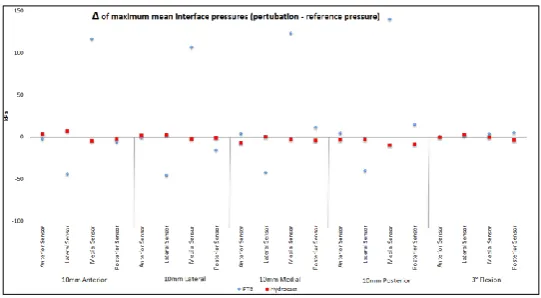
[image:5.595.150.431.129.281.2]Figures 4/5 demonstrate the variant of the mean pressure acting on the medial sensors throughout a stance phase in both socket designs following the specific alignment perturbation. The majority of produced graphs for all four sensors follow a dual-peaked wave-form pattern (represented in Figures 4/5 for the medial sensors). Figures 6/7 graphically highlight the numerical change (delta, ∆) in IP for each alignment perturbation in each socket design. Figure 8 represents average IP changes following translational and then angular alignment perturbations (when compared to ‘reference alignment’). Using biomechanical principles, Table III explores the theoretical socket reaction moments and localities of maximum peak pressures following each perturbation, then the anatomical location of peak pressures on the residuum. Graphical representations of these localities are in Table IV. Figure 9 represents the threshold used to demonstrate pressure gradient.
6
[image:6.595.162.406.70.224.2]
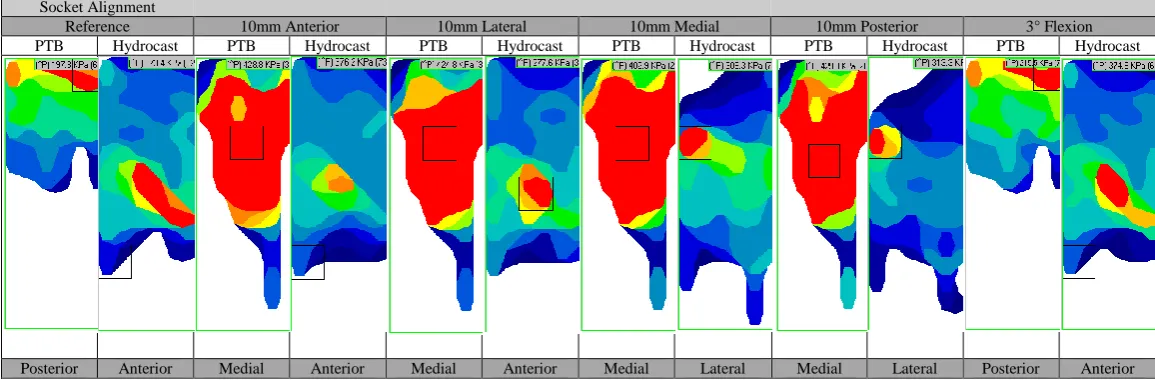
Table IV. Graphical localities of peak sensor pressures in both socket designs following alignment perturbations. Images run proximal to distal and left to right.
Socket Alignment
Reference 10mm Anterior 10mm Lateral 10mm Medial 10mm Posterior 3° Flexion
PTB Hydrocast PTB Hydrocast PTB Hydrocast PTB Hydrocast PTB Hydrocast PTB Hydrocast
[image:6.595.160.404.279.432.2]Posterior Anterior Medial Anterior Medial Anterior Medial Lateral Medial Lateral Posterior Anterior Figure 2. Residual limb-socket mean interface pressures at
reference alignment and at an offset of 10mm posterior in PTB socket.
[image:6.595.8.586.514.704.2]7
Table III. Expected socket reaction moments and maximum peak pressures following each alignment perturbation versus found localities.
Discussion
This case study examined the change in socket IPs during alignment perturbations in two types of transtibial sockets. The results show a general bimodal pressure pattern across the gait cycle, similar to previous published work(2). This pattern is similar to the vertical GRF pattern, suggesting that most pressure transmitted to the residuum is associated with axial loading in stance. Pronounced differences in pressure magnitude and distribution were discovered when comparing the PTB against the hydrocast socket in the measurement of IPs from reference alignment to offset alignment.
The explored sockets utilise differing design philosophies for pressure transmission. The PTB socket applies specific loads to pressure tolerant areas whereas the hydrocast socket aims to dispense pressure uniformly through the ‘stiffest path principle’(8). It is advocated that hydrocast sockets have a greater ability to generate “ideal” pressure distribution beside a reduction of internal shear(2, 8).
The most prominent and anticipated finding was that altering alignment did alter socket IPs (Figures 4/5). Whilst it would have been desirable to carry out hypothesis testing and statistical analysis, this was not possible with a single participant.
When analysing pressure magnitude differences with alignment perturbations, it was evident the socket designs experienced dissimilar alterations. This was explored through numerical and graphical analysis of the difference (Figures 6-7). Based on our measurements this might indicate that socket design alters IP distribution.
Perturbation Theoretical external socket reaction
moment
Theoretical areas of increased
pressure
Socket Design
Discovered area of peak pressure from results
Does the theory agree with the finding? Reference Adduction moment
Medially-proximally and laterally-distally
PTB Popliteal fossa No
Hydro- cast
Anteriorly-distally; ‘kick-point’
No 10mm Anterior Increased knee
flexion moment
Anteriorly-distally and
posteriorly-proximally
PTB Medially No
Hydro -cast
Anteriorly-distally;
‘kick-point’ Yes
10mm Lateral Increased adduction moment
Laterally-distally and
medially-proximally
PTB Medially from mid to proximal knee level
Yes Hydro
-cast
Anteriorly-distally;
‘kick-point’ No
10mm Medial Increased abduction moment
Laterally-proximally and medially-distally
PTB Medially at the mid-knee region
Yes - Relative Hydro
-cast
Laterally-proximally (region of fibular head)
Yes 10mm Posterior Increased knee
extension moment
Posteriorly-distally and
anteriorly-proximally.
PTB Medially at the mid-knee level
No Hydro
-cast
Laterally-proximally (region of fibular head)
No 3° Flexion Increased knee
flexion moment
Anteriorly-distally and
posterior-proximally
PTB Popliteal fossa Yes
Hydro -cast
Anteriorly-distally; ‘kick-point’
8
[image:8.595.140.411.106.255.2]Figures 6-8 highlight an increased range of IP change for PTB over hydrocast sockets. This is clinically relevant as this proposes that PTB sockets appear more sensitive to alignment perturbations than hydrocast sockets – suggesting attainment of optimal alignment in PTB
[image:8.595.138.409.301.452.2]Figure 6. Change (∆ = perturbation pressure – reference pressure) of maximum mean interface pressures with alignment perturbations.
Figure 7. Change (∆ = perturbation pressure – reference pressure) of maximum peak interface pressure with alignment perturbations.
[image:8.595.139.403.499.661.2]9
sockets is absolutely crucial to ensure optimal pressure distribution whereas hydrocast sockets may hold greater flexibility for error.
When alignment is altered the line of action of the GRF also changes which can modify socket reaction moments (anterior-posterior (AP) and/or medial-lateral (ML)). This positional change of the GRF should theoretically be identical regardless of socket design. As identical alignment perturbations did not cause identical alterations in IPs when comparing both socket designs, it can be established IPs are not solely dependent on one individual factor (GRF) but instead upon a combination of numerous factors. However, to confirm this, the relationship of the GRF and the socket would need to be recorded. Due to the limitations of this study, this was not possible. Nevertheless, it is possible to analyse localities of maximum peak pressures (hence internal residual bony movement) and determine if they lie in accordance with expected socket reaction moments following the performed alignment perturbation. Tables III and IV demonstrate that not all pressure profiles comply with the theoretical principles Radcliffe cited on sole calculation of the position of the GRF with regards to the socket(4).
While still assessing Tables III and IV it is also evident that regions of high pressure appear over bony prominences in the hydrocast socket, whereas in the PTB socket they appear over intentionally loaded areas. One must also consider the presence of a distal umbrella in the hydrocast socket. These umbrellas may theoretically increase pressure distally, which may be a factor in explaining why peak pressures are often highlighted distal-anteriorly in the hydrocast socket. One would need a larger sample size to see if this is characteristic of the ‘kick-point’ of the tibia, or due to the umbrella. If this is due to the ‘kick-point’, this lies in accordance with the theoretical principles of each design. Results show that regardless of alignment, maximum mean and peak pressures were most commonly recorded in the PTB socket.
Figures 6/7 also show that alignment perturbations had greatest, and localised, effect on ML IPs. Medial IPs generally increased with all perturbations while lateral pressures generally decreased. These findings introduce the supposition that sagittal plane perturbations alter coronal plane pressures (ML) to a larger degree than sagittal pressures (AP) - not the foreseen prognosis. This is clinically relevant as it proves that alignment should be assessed in all planes before attempting to correct an error in one (with current clinical practice, this should be done through use of a laser at bench alignment).
Through utilisation of the threshold scale (Figure 9), the diagrams in Table IV show recorded pressure gradients. Steep pressure gradients produce greater levels of shear stress(2). Shear stress poses the greatest risk of tissue damage(9) and should therefore be minimised in order to maximise socket efficiency. Table IV illustrates that the PTB socket appears to have a larger surface area experiencing high pressure, however, hydrocast pressures appear to have steeper gradients. This suggests hydrocast sockets experience increased shear which is contrary to primary objectives of hydrocast socket design(8). In order to draw final conclusions from this study, pressure gradients from all four transducer arrangements would need to be fully analysed, or shear recorded.
This pilot study therefore found no constant factor of change in IPs for the reference alignment against the malaligned sockets when comparing the socket designs for this one individual. The results of another study may support this idea that data may be ‘uniquely systematic’ for each individual(10). This paper suggested that the non-adaptive person may have a linear relationship
10
with alignment whereas the adaptive person may have a sigmoid alignment-pressure relationship. Consequently, the individual results of this study have shown the importance of attaining a biomechanically correct alignment by highlighting that translational perturbations of merely 10mm can increase mean and peak pressures by 183% and 227% respectively (Figure6-7) (x̄ =11.3 and 17.5% respectively). 10mm lies within the scope of error demonstrated during numerous alignments by the same Prosthetist treating one user(5), suggesting this magnitude of error is common in clinic. By showing a complex interaction between IPs and alignment, this pilot study has begun to highlight the absolute necessity for development of an objective method to analyse prosthetic fit and evaluation, in order to reduce subjective clinical bias.
This therefore suggests that a repeated measures design is essential; with a large enough ‘n’ to define the different sub-populations of individuals or socket types that are sensitive to alignment changes, alongside allowing for hypothesis testing.
There is a lack of literature regarding socket design versus alignment IP interaction and thus, further studies are required to draw definitive conclusions. Recommendations for future research would include utilising a larger ‘n’, assessing a larger number of perturbations, utilising the Compas™ system to record socket reaction moments throughout stance and proximal/distal division of transducer arrangements. This study measured orthogonal pressure at the residuum-socket interface and utilised pressure gradient analysis to assess shear. Transducers capable of concurrently measuring orthogonal pressure and shear stress would improve accuracy. Utilising a larger ‘n’ whilst additionally recording gait speed could improve accuracy of results, as varying cadence can alter the ankle moment and could therefore affect socket reaction moments and ultimately interface pressures. Additionally, the need to ascertain an accurate maximally clinically recommend ‘safe’ IP needs reassessed.
Although no clear link uniting socket design, alignment and IPs has been recognized, the idea that people may be unique, or adapt in unique ways, to alignment perturbations in different socket designs has been highlighted. The clinical relevance and vast necessity for additional research in this area has been shown.
Data attained from results of future multi-centre clinical trials will allow for statistical analysis. It is hoped by eventually elucidating the relationship between socket design, alignment and IPs, it will become apparent what constitutes optimal socket fit. Herein lies true potential to ease attainment of better fitting sockets (i.e. improved fit and alignment) - advantageous to the clinician (reducing the time and related costs of producing well-fitting sockets) and the user (achieving comfort and ideally, increasing activity).
11
References
1. National Amputee Statistical Database. The Amputee Stastistical Database for
the United Kingdom 2005/06; Edinburgh (UK): Information Services Division: NHSScotland; 2007.
2. Dumbleton T, Buis AWP, McFadyen A, McHugh BF, McKay G, Murray KD, et
al. Dynamic interface pressure distributions of two transtibial socket concepts. Journal of Rehabiliation Research & Development 2009; 46: 405-416.
3. Gailey R, Allen K, Castles J, Kucharik J, Roeder M. Review of secondary
physical conditions associated with lower-limb amputation and long-term prosthesis use. J Rehabil Res Dev 2008; 45: 15-29.
4. Radcliffe CW. The patellar-tendon-bearing below-knee prosthesis. Eberhart HD,
Verne Thompson I, James F, editors. Berkeley: Berkeley, Biomechanics Laboratory, Dept. of Engineering, University of California; 1961.
5. Zahedi MS, Spence WD, Solomonidis SE, Paul JP. Alignment of lower-limb
prostheses. Journal of rehabilitation research and development 1986; 23: 2-19. 6. Zhang M, Roberts VC. The effect of shear forces externally applied to skin surface on underlying tissues. Journal of biomedical engineering 1993;15: 451-456.
7. Pezzin LE, Dillingham TR, Mackenzie EJ, Ephraim P, Rossbach P. Use and
satisfaction with prosthetic limb devices and related services. Archives of physical medicine and rehabilitation 2004; 85: 723-729.
8. Klasson B. Prosthetic Socket Fit; Implications of basic engineering principles. Located at: 94 912 Advanced prosthetic science Glasgow. 2006; 56.
9. Sanders JE, Jacobsen AK, Fergason JR. Effects of fluid insert volume changes
on socket pressures and shear stresses: Case studies from two trans-tibial amputee subjects. Prosthetics And Orthotics International 2006; 30: 257-269.