Copyright © 1977 American Society for Microbiology Printed in U.S.A.
Junin
Virus
Structural Proteins
Z. M. DE MARTINEZ SEGOVIA* AND M. I. DE MITRI
Divisi6nBioquimica, Departamento de Virus, Instituto Nacional de Microbiologia 'Carlos G. Malbrdn," Velez
Sarsfteld
563,BuenosAires,Argentina
Received for publication 30 August 1976
Polyacrylamide gel electrophoresis ofpurified Junin virus revealed six
dis-tinct structural polypeptides, two major and four minor ones. Four of these
polypeptides appearedtobe covalently linked with carbohydrate. The molecular
weights of the six proteins, estimated by coelectrophoresis with marker proteins, ranged from 25,000 to 91,000. One of the two major components (number 3) was identified as a nucleoprotein and had a molecular weight of 64,000. It was the
most prominent protein and was nonglycosylated. The other major protein
(number 5), with a molecular weight of 38,000, was a glucoprotein and a
componentof the viral envelope. The location on the virion of three additional
glycopeptides with molecular weights of 91,000, 72,000, and 52,000, together with
aprotein with a molecularweightof 25,000, was not welldefined.
There is a remarkable unifornity in the mor- coldamino acids reduced to one-eighth of the
regu-phologyand nucleic acid composition of differ- lar level. (Cells were incubated with radioactive
entarenaviruses: virusparticles are round and precursorsafter day3postinfection.) To label viral
pleomorphic and have ribosome-like granules carbohydrates, radioactive glucosamine (1 ,uCi/ml)
in varying amounts (9). Lymphocytic chorio- was added to the medium 48h
postinfection.
meningitis, Pichinde, and Junin viruses share Virus
purification.
Topurify releasedvirus, thecommeingbit
.
'
.
.
.
infected fluidscollected fromdays4, 5,and 6 postin-commonbiochemical properties: all contain sin- fectionwere pooled and centrifuged at 1,500 x g togle-strand RNA and consist of fourmajor dis- remove cells and cell debris. The virus was then
cernible componentsand three minorones (1, 2, pelleted by ultracentrifugationat 100,000 x g for 3
6). Withregard to the amount of virion polypep- h. A virus pellet was then suspended in 0.05 M
tide in these arenaviruses, onthe other hand, sodiumborate buffer(pH7.2)-0.25Msucrose(1mlof
there are some discrepancies: Pichinde has four bufferper500 ml oftheoriginal volume).Aftersonic
polypeptides (8), and six werereported for
lym-
treatment for 2minat 10 kc/sin a Raytheonoscilla-phocytic choriomeningitis virus (7). tor, theresuspended material wasbanded in a
dou-The purpose of this report istodescribe the bleMsodium borate buffercushionconsistingof 50(pHand 20%7.2)andcentrifugedsucrose in0.05for
results obtained by studying the Junin virus 3 h at 40,000 rpm ina Spinco
SW50
rotor. Thevirus-polypeptides tofindouttheirnumber, molecu- containing band, located at the
interphase,
wasre-lar weight, and structural identity. covered from the gradient and rebanded
isopycni-MATERIALS AND METHODS
cally
in apreformed
25to 65% lineardensity
gra-dient ofsucrosefor 7 hunder similar conditions of Virus, cells,and medium. The procedurefor the centrifugation. Twenty 0.25-ml fractions were col-preparation ofmedia, cells, stock virus pool, and lected by bottompuncture of the tube. In each sam-virustitrationhas been described previously (5). ple, the infectious virus titer and theradioactivity Infection of cells andlabelingof virus. Twenty- weredetermined. These samples could be stored at four-hourmonolayers ofBHK-21 cells in Roux bot- -70°C for long periodswithout loss of infectivity. tles or inroller flasks (100ml) were infected with This procedure recovered30% of theoriginal virus stock virusat amultiplicityof infectionof approxi- infectivity.In some instances,infectivitypeak frac-mately 3 50% lethal doses (LD50) per ml percell. tionsfrom thefirstsucrosegradientwere pooled and After 3 h ofadsorptionat 37°C, the inoculumwas diluted with 0.05 M sodium borate buffer (pH 7.2), removed and the cells were washed with 0.01 M and a1.5-ml amount of this suspension was layered phosphate-buffered saline,pH 7.2, fed with 40 or 100 into a discontinuous gradient containing 0.5 ml of mlof maintenance medium, and incubated at 37°C. 40%, 1.3 ml of 30%, and 1.3 ml of 25%(wt/wt) CsCl in
Each 24-h monolayerwaswashed withphosphate- thesamebuffer. Thegradientwascentrifugedfor90
buffered saline, and new medium wasadded. The minat 40,000 rpm in a Spinco SW50 rotor.
infected fluids were collected daily from days 4 to 6 Polyacrylamide gel electrophoresis. The gradient postinfection.Forisotopiclabelingof viralprotein,1 fractions, chosen becauseof the coincidence of maxi-,uCi of 14C-or3H-labeled aminoacid mixture per ml mumradioactivity andinfectivity, werecentrifuged was added to the medium with a concentration of at40,000 rpmfor 3 h in aSpinco SW50rotor. The
579
on November 10, 2019 by guest
http://jvi.asm.org/
resultingpellet was dissolved in a solution contain- 16 ing 1%(wt/vol) sodium dodecyl sulfate (SDS) and 1% 15 (vol/vol)2-mercaptoethanol according tothe
proce-dure ofMaizel (4). After heating at 100°C for 1 min 14
-the sample was applied directly to -the gel in a vol-
13/
ume ofapproximately 200
,l,
with5 mgof bromo-1ff
phenol
blue asthetracking
dye
and 10% sucrose. 212 l8Electrophoresis was carried out in a 13-cmcylindri- x11
cal gel for 30 min at 40 V and for an additional 6 h at i7;
90 V.The running buffer was 0.1 M phosphate with 6o
0.1% SDS. After electrophoresis, the gels were re- X9 X -6!E
moved from the tube.Samplesthat did not contain N
radioactive protein werestainedfor 2 h in 1% amido " -50
Schwarz in 7%(vol/vol)aceticacid and destainedby a 7 l diffusionfor 48 hwith several changes of acetic acid. C
Gels containingradioactive protein were frozen and I 6 4
fractionated into 2-mm slices. The slicesweretrans-
S-|1
5 ferred to countingvials,and each one was dissolved Kwith 0.5 ml of 100 volumes ofhydrogen peroxide '' V\
du-ingovernight incubation at 600C. Then 4.5 ml of 3 2
toluene-based scintillation fluid was added, and
2-samples were counted in a Tri-Carb scintillation 1
spectrometer. In all experiments 10% gels were 1
used. 0
Standardproteins fordetermination of molecu- 1 2 3 4 5 6 7 8 9 1O larweight. Thefollowingproteins, purchasedfrom
traction
numberMannResearchLaboratories, wereused as markers FIG. 1. Step gradient purification of "4C-amino
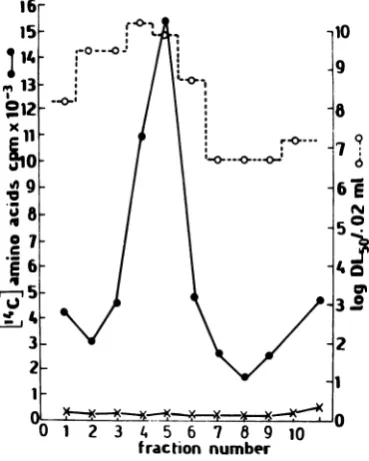
for molecular weight determination: catalase, acid-labeled Junin virus. Concentrated virus (1 ml) 94,000; bovinealbumin, 68,000; ovalbumin, 45,000; was layered on top of a double cushion consisting of trypsin, 23,800; andhemoglobin, 16,000. 50 and 20%sucrose in 0.01 M sodium borate buffer (pH 7.2). The virus was centrifuged in a Spinco RESULTS SW50rotor at 40,000 rpm at4°C for 3 h. Fractions
Virus purification. WhenBHK-21cells were were collected from the bottom of the tube and
ana-infectedata m ,of. ...infection of3LD, lyzed for infectivity (0) and acid-insoluble
radioac-pieectel
at
a mulip
licity
3I
on
OI J..r
tivity (@).Purifiedfluidsfromlabeledmock-infected
per cell, maximum virus titers of 10-8 LD50 per cells weremixedwith infected, unlabeled fluids and0.02mlwereconsistentlyobtainedondays4, 5, centrifuged under identical conditions (x).
and 6 postinfection. Junin virus was
concen-trated and purified from the cell-free medium Electrophoresis pattern of proteins from
asdescribedabove.Figure1showsthepurifica- unfractionated Junin virus. Figure 2 (upper
tion of Junin virus labeled with a "4C-amino panel) shows a photograph and densitometer
acid mixture in a double-cushion gradient. profiles of Junin virus proteins subjected to
Fractions were analyzed for both infectivity polyacrylamide electrophoresis after the gel
and radioactivity. The infective viruswas dis- was stained with amido Schwarz. Purified
tributed in abroad zone of the gradient, indi- preparations of virus reproducibly yielded six
cating heterogeneity ofsize. Maximum infec- bands, which have been designated
numeri-tivitybandedat aslightlygreaterdensitythan callyfrom theorigin. Twobands,3and5, were
maximum radioactivity. Similar results were staineddensely. Thewidth of band5indicates
reported by Carteretal. (2) andwereobtained that thiscomponent isheterogeneousin
molec-inourlaboratory whenvirus waslabeled with ular size. Minor additional
low-molecular-[3H]uridine(1).This displacement could be due weightpolypeptides werefrequently present.
tothepresenceof defectiveinterferingparticles To obtainmore detailed infornation on the
at the peak of maximum radioactivity. When Junin virus polypeptides, an analysis was
labeled mock-infected BHK cells were mixed made withradioactively labeled viruses. There
with unlabeled infected fluids and processed was agood correspondencebetweenthepattern
under identicalconditions,noradioactivitywas ofpolypeptides instainedgels and thepattern
foundinanyof the gradientfractions. obtained withviruslabeled with"4C-aminoacid
Asecondstepofpurificationwasachievedby mixtures (Fig. 2, lower panel). Also, six
pro-isopycnic density gradient centrifugation. At teins werepresent, two in large amounts
(pro-thisstage, therecoveryofinfectivitywas near teins 3 and 5). Protein 3 was the most
promi-30%that of theoriginal fluids. Titers ofapprox- nent. A variable amount of polypeptides of
imately loll to 1012
LD,O/ml
were usually ob- lowermolecular weight was detected indiffer-tained. entpreparations.
on November 10, 2019 by guest
http://jvi.asm.org/
[image:2.501.275.460.67.298.2]VOL. 21, 1977 581
12 3 4 5 6 SDS-containing polyacrylamide gel,
polypep-tides are separated largely on the basis of
mo-lecular size, the distance migrated being
lin-early related to thelog of the molecularweight.
The corresponding slope and the intercepts were obtained by the least-squares method, us-ing protein markers of known molecular
weight. By interpolating in the resulting
straight
line, the molecularweight
of eachpol-ypeptide was deternined.
The weighted mean of the molecular weight
dw of each Junin viruspolypeptide from three
in-dependent experiments was found to be 91,000,
3 71,000, 64,000, 52,000, 38,000, and 25,000,
re-ffi spectively, with a percentage of error never
2 1 2 5 6
higher
than6%(legend
ofFig.
2).1111J l
Glycoproteins
of Junin virus. Todeterminewhich Junin virus proteins contained
carbohy-6 l drates, the virus was labeled with 3H-amino
o l acids, purified as described in Materials and
x l Methods, mixed with purified virus labeled
E 1 Z ^ with[14C]glucosamine,and subjected to
electro-10 Al j Iphoresis in polyacrylamide gel. The most
prom-inent protein (peak 3) was apparently free from
14C label
(Fig.
3). Fourpolypeptides
wereiden-i I , . .
10 20 30 40 so 3
fraction number
FIG. 2. Analytical polyacrylamide gel electro- 20
-pherograms of dissociated proteins of Junin virus. 1 2 4 5 6
Purified virions were disrupted with SDS and 2- |
mercaptoethanol and subjected to electrophoresis for I I 1 1 6 hat 90 V as described in Materials and Methods.
Upperpanel shows a photograph ofa gel stained with
1 %amido Schwarzand, directly above, its densitom- X IS- x
etertracing. Lowerpanel shows an electropherogram E E
ofpolypeptides ofpurifiedJunin virus grown in BHK 1o cells incubated with '4C-labeled amino acids. After
electrophoresis, the gels were frozen andsliced,and , c
the radioactivity of each slice was determined. The 10- _ mE
position of each of the six viral polypeptides is indi- *
cated by arrows. The virus-specific proteins have E 0i
been assigned numbers from 1 to 6. In this and i subsequent gel patterns, the origin is on the left and l
the anode on the right.Proteinstandards, specified 220
inMaterials and Methods, were co-electrophoresed in
order to determine the molecular weight of the six 6 differentpolypeptides. The weighted mean ofthe
mo-lecularweight of each polypeptide from three inde- i
pendent experiments was found to be: protein 1,
91,450 4,208; protein 2,71,680 +3,418;protein 3, -0-0-0---64,233 ±3,129;protein 4,52,456±2,658;protein5, 1a020 30 40 50 38,315 +2,089;andprotein 6, 25,477 + 1,548.
fraction
numberFIG. 3. Analytical SDS-polyacrylamide gel
elec-Estimation of molecular weights. The mo- trophoresis of the structural proteins of Junin virus,
lecularweightsof theviralproteinsweredeter- labeled with
[f4C]glucosamine
and 3H-amino acids.mined by the method ofShapiroet al. (10) b Theprocedurewasthesame asthatdescribedin the mined by the method of Shapiro et al. (10) by legend of Fig. 2. After electrophoresis, the gel was
comparing theirelectrophoreticmobilities with frozen and sliced, and the radioactivity of both
the migration ofaseries ofproteins of known ['4C]glucosamine (0) and 3H-labeled amino acids
molecular weights. By electrophoresis in an (O)wasdetermined.
on November 10, 2019 by guest
http://jvi.asm.org/
[image:3.501.47.235.56.356.2] [image:3.501.252.440.329.581.2]tified asglycoproteins (peaks 1, 2, 4, and 5). The large amount of protein was solubilized and
largest glycoprotein peak corresponded to pro- could be detected in the lighter region of the
tein 5. Occasionally this glycoprotein was dis- gradient along with a significant amount of
tributed in two adjacent bands. The heteroge- [3H]uridine. We can assume that in our
experi-neous material labeled with glucosamine that mental conditions the detergent treatment had
wasseen near theanode could represent glyco- altered the virion integrity, that someparticles
lipids. had been broken, but that nevertheless some
FractionationofJunin virus with Triton X- fairly large structures remained intact. In
100. To relate the polypeptides observed in these structures, one or more polypeptides
re-acrylamide gels to structural virus components, mainedassociated with virus RNA.
purified virus labeled with a 14C-amino acid Figure5 (upperpanel) shows the radioactive
mixture and [3H]uridine were disrupted with profile of these polypeptidesonpolyacrylamide
Triton X-100 to a finalconcentration of 2% in gelelectrophoresis, and this profile was
super-thepresenceofdithiothreitolandNaCl,accord- imposedon the pattern obtained with the
un-ing to the procedure of Emerson and Wagner treated virus. From this figure, we can
con-(3). After 30 min at 37°C, theinfectivity of the clude that protein 5 was quantitatively
ex-virus sample wascompletelyabolished. tracted from the virion. When a double label
This treated virusbehaveddifferentlyince- was used (3H-labeled amino acids and
sium chloride density gradient than did the
untreatedone. Mostof the
[3H]RNA
andsome 314C-labeled proteins remained associated in a I
particle which, in turn, was displaced toward
X0
rX2
4 5 6 _50,the denser zone ofthe gradient. A relatively o I| I
2
0.~~~~~~~~~~~~~~~
15 5
2250e
30
A
10 ..r
~50-
6010.r
frjCT,On
B b0Electropherograms of0 0 the Junin0viruspr
30LJFIG. 4. Sedimentation in a cesium chloride gra- teins isolated afterTriton treatment. Fractions 7 and dientoTrtntetdaduntreatedcontrol virions. 8, from a CsClgradient similar to theone'shown in Purified virus labeled simultaneously with Fig. 4B, andfractionl11 (Fig. 4A) wereprepared for [3H]uridine (O---O) and '4(2-labeled amino acids electrophoresis on 10% acrylamide gels as described
(-)wastreated with TritonX-IOOasdescribed in the in Materials and Methods. The profiles obtained
text. Virustreated with sodium borate buffer under from thecontrol(0---0)and Triton-treated prepa-the sameconditionsservedas a control. Thetreated rations (0 0) were superimposed and appear in
virions were rebanded in a discontinuous cesium the top panel. The profiles obtained with a virus
chloride gradient as indicated in Materials and labeled with['4C]glucosamine (-@*) and 3H-la-Methods. Fractions were collected, and the radioac- beled amino acid mixture (0 0) and processed
tivityofeach wasdetermined. (A) Control virus; (B) with Triton X-100 under identical conditions are
Triton-treatedvirus, shown in the lower panel.
on November 10, 2019 by guest
http://jvi.asm.org/
[image:4.501.270.453.169.534.2] [image:4.501.69.249.308.546.2]['4C]glucosamine), analysis of the treated virus of the virus and remain inseparable by any of
gave identical results. The major glycoprotein the methods described. If this is the case, it
was entirely solubilized, but the remaining should be possible to detect this by producing
three glycoproteins were still present (Fig. 5, radioactively labeled cell membrane fragments
lowerpanel). The most prominent nonglycosyl- from mock-infected BHK cells, mixing them
atedprotein remained in thedetergent-treated with unlabeled virus, andpurifying the virus.
viruswith the same electrophoretic mobility. We have seenthat no labeled virus was found
DISCUSSION inthe
first
step
ofpurification
(Fig.
1),
indicat-ing that it is unlikely that cellular
contami-The results of the present study demonstrate nantscontributesignificantly to the viral
poly-that Junin virus is composed of at least six peptide pattern observed. Even if
contamina-polypeptides, twomajor and four minor ones. tionwere ruled out, we wonder how many of
The most prominent polypeptide, with a molec- theproteinsresolvedhereare virusgene
prod-ular weight of 64,000, remains in the detergent- ucts or cell gene products. It is very possible
treated virus with the same electrophoretic mo- thatribosomal proteins are responsible for the
bility. We can assume that this protein,cosedi- smallproteinsfound in theregion
oflow-molec-menting with Junin virusRNA, is the nucleo- ular-weightpolypeptides.
protein of the virion. The second prominent
polypeptide, withamolecularweight of34,000, ACKNOWLEDGMENTS
isanenvelope glycoprotein accessibletodeter- This workwassupportedinpart by grants from
Funda-gentextraction. Recent workinthislaboratory ci6nEmilio Ocampo, ConsejoNacional de Investigaciones
has suggested that this protein is involved in CientificasCienciayTecnicayTecnicas(grant60586-75), andSecretariade
(grant6655/74).
eliciting neutralizing antibodles (B.Crestaand We thank Liliana Gonzalez, NildaTasc6n, and Paula
Z. M. Segovia, unpublished data). The biologi- Padulaforexcellent technicalassistance.
cal activities and the location of the four
poly-peptides have not yet been identified. Since LITERATURE CITED
glycoproteins are verypossibly structural com- 1. Afton,M.C.,0.Grau,Z.Martinez Segovia, and M. T.
ponentsof theenvelope, itseemsclearthat,in France Fernandez. 1976. RNA composition of Junin
ourhands, Triton X-100disrupts, butdoesnot virus. J. Virol. 18:833-838.
2. Carter, M. F., N. Biswal, and W. E. Rawls. 1973.
entirelyremove, theenvelope. We have,onthe Characterization of nucleic acidof Pichinde virus.J.
other hand, observed that a nonglycosylated Virol. 11:61-68.
protein is often extracted by Triton X-100, an 3. Emerson, S. V.,and R. R. Wagner.1972. Dissociation
observation also made by Emerson and Wagner andreconstitution of thetranscriptase andtemplate
y
,.,. ... . ,activities of vesicular stomatitis B and T virions. J.
(3) working with vesicular stomatitisvirus. It Virol. 10:297-309.
remainstobeseenwhether thesepolypeptides 4. Maizel, J. V. 1969. Acrylamide gel electrophoresis of
arelocatedwithin orbelow the lipid envelope. proteins and nucleic acids,p. 334-362. In K. Habel
The availability ofa method that completely and N. P.Salzman (ed.),Fundamental techniques in
removesthemembrane
should...
allow ustoavirology.
Academic PressInc.,New York.removes the membrane should allow us to ac- 5. Martinez Segovia, Z. M., M. I.DeMitri, and S.
Bender-quire clear-cut inforrnationonthis issue. sky. 1974. Nutritionalrequirements for Junin virus
The molecular weights of the six proteins production inBHK culturedcells. ActaPhysiol. Lat.
total 344,000. The single-strand Junin virus Am. 24:656-661.
RNA,ithmolcula weihtof3.74x 10, (1, 6.Pedersen,I. R. 1971.Lymphocyticchoriomeningitis vi-RNA, with amolecular weight of 3.74 x 10⁶ (1), Pei-I-usRNAs. Nature(London)New Biol.234:112-114.
cancode for differentpolypeptides withatotal 7. Pedersen,I. R. 1973.LCMvirus:itspurificationand its
molecular weight of3.74 x 105.Thismeansthat chemical andphysical properties,p.13-23. InF.
Leh-thecombinedmolecularweightsof Junin virus man-Grube (ed.), Lymphocytic choriomeningitis
vi-proteins
wo.ld
require approximately 92% of rusand other arenaviruses.Springer-Verlag,Berlin. proteins WOUld require approximately 92% Of 8. Ramos, B. A., R. J. Courtney, and W. E.Rawls.1972.the coding capacity of the virus genome. It is Structural proteins of Pichinde virus. J. Virol.
conceivable that theglycoprotein withamolec- 10:661-667.
ularweight of
91,000
could be an aggregationof 9. Rowe, J., J. Murphy, G. H. Bergold, I. Casals, I.Hotchin,K. M.Johnson, F.Lehmann-Grube, C.A.
two ormorepolypeptides, and moreover, some Mims, E. Traub, and P. A. Webb. 1970.
Arenavi-polypeptidesthatfrequentlyappearinthepro- ruses:proposedname for anewly definedvirusgroup.
file could represent cellular membraneproteins J.Virol.5:651-652.
purifying togetherwith the virus. Itmightbe 10. Shapiro, A. L.,MolecularweightE.estimation ofVinuela, and J. V.polypeptideMaizel. 1967.chainsby
supposed thatcellular membrane constituents electrophoresis in SDS-polyacrylamide gels.
Bio-could share all of thephysiochemical properties chem.Biophys.Res.Commun. 28:815-820.
on November 10, 2019 by guest
http://jvi.asm.org/