BORANG PENGESAHAN STATUS TESIS* JUDUL : TRAINING MANAGEMENT SYSTEM
SESI PENGAJIAN : 200712008
Saya HASNITA BINTI I-QKIM
Mengaku membenarkan tesis (PSMISarjanafDoktor Falsafah) ini di simpan di Perpustakaan Fakulti Teknologi Maklumat dan Komunikasi dengan syarat-syarat kegunaan seperti berikut :
1. Tesis dan projek adalah hakmilik Universiti teknikal Malaysia Melaka 2. Perpustakaan Fakulti Teknologi Maklumat dan Komunikasi dibenarkan
membuat salinan untuk tujuan pengajian sahaja.
3. Perpustakaan Fakulti Teknologi Maklumat dan Komunikasi dibenarkan membuat salinan tesis ini sebagai bahan pertukaran antara institusi pengajian tinggi.
4. **Sila tandakan (/)
SULIT (Mengandungi maklumat yang berdarjah keselamatan atau kepentingan Malaysia seperti yang termaktub di dalam AKTA RAHSIA RASMI 1972)
TERHAD (Mengandungi maklumat TERHAD yang telah ditentukan oleh organisasihadan di mana penyelidikan dijalankan)
TIDAK TERHAD
(TANDATANGAN PENULIS) (TANDATANGAN PENYELIA)
Alamat tetap : 143 Kg. Alor Ganu Mukim Titi Gajah
PN. NURAZLINA MD. SANUSI Nama Penyelia
06200 Kepala Batas Kedah
Tarikh :
/
.= oo8 Tarikh: 3 ' ' / ~ / @ 4I '
CATATAN :
*
Tesis dimaksudkan sebagai Laporan Akhir Projek Sarjana Muda (PSM)TRAINING MANAGEMENT SYSTEM
HASNITA BINTI HALIM
This report is submitted in partial fulfillment of the requirements for the Bachelor of Computer Science (Software Engineering)
FACULTY OF INFORMATION AND COMMUNICATION TECHNOLOGY UNIVERSITY TEKNIKAL MALAYSIA MELAKA
DECLARATION
I hereby declare that this project report entitled TRAINING MANAGEMENT SYSTEM
is written by me and is my own effort and that no part has been plagiarized without citations.
STUDENT Date : I ~ ~ ! L D O ( :
I I
(HASNITA BINTI HALIM)
SUPERVISOR : Date :
ACKNOWLEDGEMENTS
With the name Allah s.w.t with pronunciation praise to God, because give me opportunity to complete the Project Sarjana Muda (PSM) to complement degree process
in University Technical Malaysia Melaka.
I want to say as high as thanks appreciation to my supervisor project, Puan Nurazlina bt. Mad Sanusi because much help, provide guidance and knowledge to me from early until
finish and achieve the objective project. Without your helping, this project is unable was
walking with successfully.
As high as vote of thanks also to my family because already give a lot support and
impetus in achieve this project. Without prayer and hope from family, I would not stand
at now. Thanks for always stay near me during difficult, easy and any situation.
From this project wake, I wish to record thanks to anyone that had helped me to launch
this project. Vote of thanks also to friends has vested much support, ideal and assistance.
ABSTRACT
ABSTRAK
TABLE OF CONTENTS CHAPTER CHAPTER I CHAPTER 11 SUBJECT DECLARATION ACKNOWLEDGEMENT ABSTRACT ABSTARK
TABLE OF CONTENTS LIST OF TABLES LIST OF FIGURES
LIST OF ABBREVIATIONS
INTRODUCTION 1.1 Project Background
1.2 Problem statement(s)
1.3 Objective
1.4 Scope
1.5 Project Significance
1.6 Expected Output
1.7 Conclusion
LITERATURE REVIEW AND PROJECT METHODOLOGY
2.1 Introduction
2.2 Facts and Findings
2.2.1 Domain
2.2.2 Existing System
vii
2.2.3 Technique
2.3 Project Methodology
2.4 Project Requirements
2.4.1 Software Requirement
2.4.2 Hardware Requirement
2.4.3 Other Requirement
2.5 Project Schedule and Milestones
2.6 Conclusion
CHAPTER ANAZ,YSIS In 3.1 Introduction
3.2 Problem Analysis
3.3 Requirement Analysis
3.3.1 Data Requirement
3.3.2 Functional Requirement
3.3.3 Non-functional Requirement
3.3.4 Other Requirement
3.4 Conclusion
CHAPTER DESIGN
IV
4.1 Introduction4.2 High-level Design
4.2.1 System Architecture
4.2.2 User Interface Design
4.2.2.1 Navigation Design
4.2.2.2 Input Design
4.2.2.3 Output Design
4.2.3 Database Design
4.2.3.1 Conceptual and Logical
Database Design
4.3 Detailed Design
4.3.1 Software Specification
4.4 Conclusion
CHAPTER IMPLEMENTATION V 5.1 Introduction
5.2 Software Development Environment Setup
5.3 Software Configuration Management
5.3.1 Configuration Environment Setup
5.3.2 Version Control Procedure
5.4 Implementation Status
5.5 Conclusion
CHAPTER TESTING
IV 6.1 Introduction
6.2 Test Plan
6.2.1 Test User
6.2.2 Test Environment
6.2.3 Test Schedule
6.3 Test Strategy
6.3.1 Classes of tests
6.4 Test Design
6.4.1 Test Description
6.5 Test Results and Analysis
6.6 Conclusion
CHAPTER PROJECT CONCLUSION
VII
7.1 Observation on Weaknesses and Strengths7.2 Proposition for Improvement
7.3 Contribution
7.4 Conclusion
REFERENCES APPENDICES
A. Gantt Chart
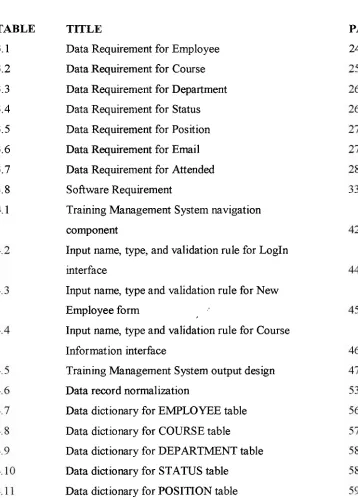
LIST OF TABLES
TABLE
3.1
3.2
3 . 3
3.4 3.5 3.6 3.7 3.8 4.1 TITLE
Data Requirement for Employee Data Requirement for Course Data Requirement for Department Data Requirement for Status Data Requirement for Position Data Requirement for Ernail Data Requirement for Attended Software Requirement
Training Management System navigation component
Input name, type, and validation rule for LogIn interface
Input name, type and validation rule for New Employee form
Input name, type and validation rule for Course Information interface
Training Management System output design Data record normalization
Data dictionary for EMPLOYEE table Data dictionary for COURSE table Data dictionary for DEPARTMENT table Data dictionary for STATUS table
Data dictionary for POSITION table
PAGE
[image:10.550.81.439.208.712.2]Data dictionary for EMAE table Data dictionary for ATTENDED table Training Management System numbering the product version
Database Module LogIn Module
Human Resource Module Employee Module Supervisor Module
Department Manager Module Personal Computer Configuration Test Schedule
Department Manager login function Supervisor login function
Human Resource login hnction Employee login function Employee Info function
Search function
Unit test for Department Manager login - TEST-TMS-001
Unit test for Supervisor login - TEST-TMS-002 Unit test for Human Resource,4ogin - TEST-TMS-003 Unit test for Employee login - TEST-TMS-004 Unit test for insert new employee - TEST-TMS-005
LIST OF FIGURES DIAGRAM 2.1 3.1 3.2 3.3 3.4 3.5 3.6 TITLE Iterative Model
Step to construct
Context Diagram Current System
Level 0 DFD Current System
Context Diagram
Diagram 0 DFD
Diagram 1 DFD shows detail of the
Employee Id process
Diagram 2 DFD shows detail of the New
Employee process
Diagram 3 DFD shows detail of the New
Course process
Diagram 4 DFD shows detail of the Employee
Notification process
System Architecture between the parts of
a Training Management System
Interface design Main Page Training
Management System
Interface design for User LogIn
Navigation design Training Management System
Input design for LogIn interface
Input design for new employee
Input design for Course form
Training Management System Entity Relationship Diagram
A dependency diagram first normal form (1NF)
Second Normal Form (2NF) conversion result Third Normal Form (3NF) conversion result Sample screen for SignIn
Sample screen for New Employee Sample screen for New Course
xiii
LIST OF ABBREVIATONS
BSOs -
DBMS
DDL
-
DFD
-
ERD GUI PC
SDLC
-
TMS
TSOs
-
WWW
-
Business System Option Database Management System Data Definition Language Data Flow Diagram
Entity Relationship Diagram Graphic User Interface Personal Computer
CHAPTER I
INTRODUCTION
1.1 Project Background
The term training refers to the acquisition of knowledge, skills, and competencies as a result of the practical skills and knowledge that relate to specific useful competencies. In addition to the basic training required for a trade, occupation or profession, observers of the training recognise today the need to continue training to maintain, upgrade and update skills throughout working life. People within many professions and occupations may refer to this sort of training as professional development.
This Training Management System project is a system will be use in Human Resource Department and it suitable for every organization to manage and plan a staff schedule for training.
Nowadays, there are many courses for employee to improve their knowledge. The manual system (file) has many lacks. One of lack is waste a time to a clerk or employee when want to check the course, who will attend the course, and others. So, it makes a few times to get the data. This problem can solve when using the Training Management System.
The Human Resource Department can insert a new course, date, place and company' name which offered course. The Human Resource will send notification to employee via email if the employee already one year serves and confirmed. The employee will receive the email notification the hyperlink attached in the mail and apply it. The application will route to supervisor for first approval. If approved, application will go to the second level which is respective Department Manager.
The Training Management System will develop using ASP Script and SQL database. Microsoft Visual Web Developer 2005 is using for develop an interface design.
1.2 Problem Statement(s)
Currently, all the training record is save in manual record (file). This file can access by anybody or anyone. Unfortunately, the record can open or edit by invalid user. By a system, the access will limit. Choice right employee to attend the course is difficult and need more time to find it because there are a few requirements. The requirement is the employee must one year serve and confirmed.
Notice company board is an arena to inform the employee about the course offered for them. The employees need to fill up the form application to apply the courses. Sometimes the notice is not realized, edit by somebody, and anything bad or invalid information. This procedure is not suitable for the current technology. Some of them can escape without attend any course.
Different training has different number of staff to attend the training. It pretty hard with using the present method to make sure employee quantity attendance fixed.
13 Objective
The objective that has to be achieving when the system has completed:
To safety record documentation and right employee choice.
To access the course information, the user must login first and the system will open according user position in database.
Via staff email (individual), Human Resource Department can send notification about the training information that offered to hisfher. After that, can apply it if desire. This notification is very definite than older version (notice board).
To analyze number of staff need to be sent for training on one course.
One course has limited trainee to attend. The Training Management System can count the quantity of approval from supervisor and make sure the approval is not overfYow.
1.4 Scope
This system is specific for staff. There are a few module involve in this system, the module are:
1. Human Resource Module
Human Resource Clerk will insert a course, date, place, and company' name which offered course. The data will be display and can access by employee.
The Human Resource will send notification to employee via email if the employee already one year serves and confirmed.
ii. Employee Module
Employee can get information about the course via email fkom Human Resource, and then apply it.
iii. Supervisor Module
The supervisor will receive course form or notification from employee for approve.
The notification had approved will send to respective Department
Manager for second approval.
iv. Department Manager Module
The department will receive course form or notification from supervisor for approve.
The notification had approved will send to Human Resource Department.
1.5 Project Significance
The benefit from the project will be gain by Human Resource Department and organization. The clerk is an easy to know the employee that must attend the course and then send notification to them. The Training Management System will also save cost the organization and employee schedule is more manageable than manual.
1.6 Expected Output
From the Training Management System, the expected outputs are as follows:- List of emails that send from Human Resource Department, Employee, Supervisor and Department Manager.
List schedule for training and staff had involved.
1.7 Conclusion
CHAPTER I1
LITERATURE REVIEW AND PROJECT METHODOLOGY
2.1 Introduction
This chapter focus on literature review and project methodology. Literature review gives a detailed description about what has been published on a topic by scholars, researches, references, case study and other finding that relate to this project. A project methodology is defined as the analysis of the principles of methods, rules, and a particular procedure or set of procedures. Project methodology produces a clear overview about the system development. The project requirements such as software, hardware and other related required identified.
Software Development Life Cycle (SDLC) methodology had used in project development. SDLC helps the system to finish every phase, activity and task quickly and efficiently. It provides sufficient process disciplines to deliver the quality required for the project success. The better approach for applying a methodology is to manage risk therefore Iterative Model were applied as a SDLC model.
2.2 Facts and Findings
Facts and finding is a component of the communication process which presents its own special set of problems and opportunities in developing system to increase the constructiveness requirement. The basic of facts and finding is a clear summarization of reading, survey and analyzing different types of resources. The resources are books, journal, case studies and other materials. It depict how is the current system used.
In today's rapidly changing social and business environment, course and developing employees is a key lever in moving organizations forward. However, many organizations have failed to capitalize on the benefits of learning. Yet, in all too many cases, organizations continue to reap little benefit fkom their course budgets.
skills will become outdated more quickly because the pace of change is much more rapid than it was 20 even 10 years ago.
An outstanding human resources system is one of the important competitive factors in modern enterprises. Employee course is a kquently used method for promoting the working capabilities for better human resources. Employee course programs cultivate personnel capabilities for enterprise operation. The course effect can be dramatically enhanced if cumculum is well designed and arranged. However, arranging curriculum is a difficult and lengthy task which enterprises traditionally devote a large amount of human and material resources to. The improved the process by proposing an optimal curriculum arrangement model in maintenance personnel course programs, and utilizing genetic algorithms as solution procedures. An adaptive computer aided course system for maintenance representative course was also developed to facilitate personnel course.
Course is too an area where dissatisfaction is often found. It can also be expensive, so it is particularly discouraging if users find it irrelevant, confusing or untimely.
Whether in the interest of satisfjling an IS0 9001 or other standard or ensuring that employees are doing their jobs in the most efficient way possible, the starting point for course is identifying which employees are in need of what course. It's crucial that the course be need-appropriate. Putting employees through course just to be able to say (or document) that makes little sense financially or educationally.
"course" perspective. So, one of objective Training Management System (software project) to change the behaviour of trainees so that they can perform required tasks more
effectively.
2.2.1 Domain
Nothing
2.2.2 Existing System
There are several software systems that have been building to help employee for improve their skill and knowledge. These sub topics are shown some software that has been implemented.
2.2.2.1 SMART Training Management Software System
The SMART Training Management Software System is the easy way to ensure all your employees have received adequate training, licenses and certifications. SMART Training Management Software is a training management system that enables Health and Safety and Training Managers to set up requirements for each job category and view each employee's training records individually to ensure all required classes have been completed and are current and up-to-date.