SUPERVISOR DECLARATION
“ I declare that had read this thesis and in my opinion this work is adequate from scope and quality aspect for award of Bachelor Degree of Mechanical Engineering(Design & Innovation)”
Signature:...
Name:...
A STUDY OF MAINTENANCE DESIGN SYSTEM FOR
INDUSTRIAL PUMP
AMIRUDDIN BIN OMAR
A thesis submitted in fulfilment of the requirements for the award of
the degree of Bachelor of Mechanical Engineering(Design and Innovation)
Fakulti Kejuruteraan Mekanikal
Universiti Teknikal Malaysia Melaka
ii
DECLARATION
“ I declared that all the material presented in the thesis entitle A STUDY OF
MAINTENANCE DESIGN SYSTEM FOR INDUSTRIAL PUMP to be the
effort of my own research. Any material that is not of my effort has been stated clearly”
Signature;...
Name:...
iii
iv
ACKNOWLEDGEMENTS
First of all, the author wishes to acknowledge and express his greatest gratitude to the best responsible and supportive supervisor Pn Asriana Bte Ibrahim, who had continuous gave the encouragement, brilliant guidance and advice throughout this whole study. Her invaluable suggestion had developed and grown up my experience and my skills in engineering field.
Besides the author likes to appreciate and wishes many thanks to Mr Ramli as an executive of Maintenance Department of Daibochi Plastic and Packaging Sdn Bhd who had permitted the author to conduct this study in Daibochi and also Mr Sirun as a technician of Daibochi who has given cooperation to give the information and data that relevant to complete this study.
Lastly, the author would like to express his utmost gratitude towards all his friends and family that have been provided morale support and encouragement along in this study process.
v
ABSTRACT
vi
ABSTRAK
vii
TABLE OF CONTENTS
TITLE PAGE
DECLARATION II
ACKNOWLEDGEMENTS IV
ABSTRACT V
ABSTRAK VI
TABLE OF CONTENTS VII
LIST OF TABLES XII
LIST OF FIGURES XIII
LIST OF SYMBOLS XV
LIST OF APPENDICES XVI
CHAPTER I
INTRODUCTION
1.0 INTRODUCTION 1
1.1 PROJECTBACKGROUND 1
1.2 OBJECTIVE 2
1.3 SCOPE 2
1.4 PROBLEMSTATEMENTS 3
viii
TITLE PAGE
CHAPTER II
LITERATURE REVIEW
2.1 INTRODUCTIONTOMAINTENANCE 6
2.2 MAINTENANCEOBJECTIVE 8
2.3 TYPESOFMAINTENANCE 8
2.3.1 Reactive Maintenance 9
2.3.2 Preventive Maintenance 10
2.3.3 Predictive Maintenance 10
2.3.4 Reliability Centered Maintenance(RCM) 11
2.4 METALIZINGPROCESS 12
2.5 TYPESOFTHEVACUUMPUMPINMETALIZINGPROCESS 14
2.5.1 Booster Pump 14
2.5.2 Rotating Pump (Piston Pump) 17
2.5.3 Diffusion Pump 21
2.6 PROBLEMSOFPUMPS 25
2.6.1 Cavitation 25
2.6.2 Other Problem Could Be In the Pump Its Self 26
2.7 WEIGHTEDDECISIONMATRIX 26
2.8 MEASUREMENTOFOPTIMALTIMETOOVERHAUL 27
2.9 VIBRATION 28
2.10 GRAPHPERFORMANCEOFPUMP 30
2.10.1 The System Curve 30
2.10.2 Pump Performance Curve 31
2.10.3 Selection Of Pump 32
2.11 GRAPHPERFORMANCEOFMACHINE 33
2.12 OVERALLEQUIPMENTEFFECTIVENESS(OEE) 33
2.13 PROGRAMMABLELOGICCONTROLLER 35
2.14 MATLABPROGAMMING 36
2.15 CONTROLLINGDCMOTOR 37
ix
TITLE PAGE
2.15.2 Speed 38
2.16 PREVIOUSSTUDY 39
2.16.1 Selection & Optimization Of Mine Pumping Systems(1983) 40 2.16.2 Optimization For Maintenance, Reliability And Operations 41 2.16.3 Pump Scheduling: Representation & Multiple Objectives 41 2.16.4 Genetic Algorithms In Pump Scheduling 42 2.16.5 Pump Scheduling Optimization 42
2.16.6 Summary of Previous Study 43
2.17 CONCLUSION 45
CHAPTER III
COMPANY BACKGROUND
3.1 INTRODUCTION 46
3.2 HISTORYOFDAIBOCHI 46
3.3 ORGANISATIONSTRUCTURE 47
3.4 DAIBOCHIPHILOSPHY 49
3.5 MACHINECAPABILITIES 50
3.6 QUALITY 51
3.7 CORPORATESOCIALRESPONSIBILITY 51
3.8 TYPEOFPRODUCT 51
3.9 PRODUCTIONPROCESS 52
3.10 EXISTINGMAINTENANCESYSTEM 54
3.11 CONCLUSION 55
CHAPTER IV
METHODOLOGY
4.1 INTRODUCTION 56
x
TITLE PAGE
4.3 WEIGHTEDDECISIONMATRIX 57
4.4 OBTAININGOPTIMALTIMEFOROVERHAUL 59
4.5 VIBRATION 59
4.5.1 Apparatus 60
4.5.2 Vibration analysis experiment 60
4.6 GRAPHPERFORMANCEBASEDONO.D. 60
4.7 PERFORMANCEOFMACHINE 61
4.8 OVERALLEQUIPMENTEFFICIENCY(OEE) 61
4.9 CONCLUSION 61
CHAPTER V
MAINTENANCE SYSTEM DESIGN
5.1 INTRODUCTION 64
5.2 SCOPEOFDESIGN 65
5.3 EXTERNALSYSTEMDESIGN 65
5.4 INTERNALSYSTEMDESIGN 68
5.4.1 Model Generation 68
5.4.2 Generation of pulses 69
5.5 CONCLUSION 72
CHAPTER VI
SYSTEM EVALUATION AND DISCUSSION 73
6.1 INTRODUCTION 73
6.2 VIBRATION 74
6.3 PERFORMANCEOFROTATINGPUMPBASEDONO.D. 88
6.4 PERFORMANCEOFMACHINE 92
6.5 OEEOFPRODUCTION 95
6.6 OVERALLEQUIPMENTEFFIENCY(OEE)OFPUMP 97
6.7 DISCUSSION 97
xi
TITLE PAGE
CHAPTER VII
CONCLUSIONS AND RECOMMENDATION
7.1 INTRODUCTION 99
7.2 SUMMARYOFTHESTUDY 99
7.3 FINDINGS 100
7.4 COSTMANAGEMENT 100
7.5 RECOMMENDATIONS 101
7.6 CONCLUSIONS 101
REFERENCES 102
xii
LIST OF TABLES
NO TITLE PAGE
xiii
LIST OF FIGURES
NO TITLE PAGE
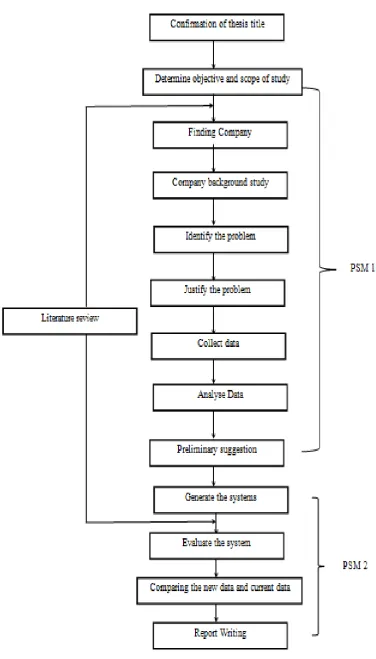
1.1 Flow chart 4
xiv
NO TITLE PAGE
xv
LIST OF SYMBOLS
h = system head(m)
dh = static head(m)
hl = head loss
mA = miliampere
RM = ringgit malaysia
km = motor constant
ø (t) = actual rotor position(ø)
ø0 = location of the coil(ø)
Ij(t) = current in the coil(A) emf = the electrotive force (N)
R = resistance (ohm)
xvi
LIST OF APPENDICES
TITLE PAGE
APPENDIX A (Gantt Chart for PSM) 103
APPENDIX B (Booster Pump description) 106
APPENDIX C (Rotating Pump description) 109
APPENDIX D (Data for pump performance based on O.D. 120
(Data for time of machine operation)
CHAPTER I
INTRODUCTION
1.0 INTRODUCTION
Project Sarjana Muda (PSM) or Final Year Project is an academic and scientific research that related with programs at Faculty and compulsory for every final year students as to fulfil the requirements before being awarded the degree. The title of this study is A Study of Maintenance Design System for Industrial Pump. This chapter will be discussed about the objectives and scopes of the study that have been conducted. Following this, the methodology of accomplishing the study will be placed in the end of this chapter
1.1 PROJECT BACKGROUND
Pumps is a kinetic device used to move fluids which is transport fluids and liquids through piping systems that come from one reservoir or tank to a different reservoir or tank. This pump also considered to be roto-dynamic pumps because they operate via a revolving rotary impeller. A centrifugal pump is one of the simplest pieces of equipment in any process plant.
2
hydraulic energy of the handling fluid to get it to a required place or height by the centrifugal force of the impeller blade.
This project is the cooperation of industrial plants “Daibochi Plastic and Packaging Industry Bhd” maintenance department. The case study is about determination of optimal time to maintain the industrial pump and the type pump to research is vacuum pump. In this research, the method to determine the problem and solving are described. Suitable mechanical testing will be done on this experiment to determine the performance.
1.2 OBJECTIVE
The objectives of the study are:
i. To determine the main problem occurred of the vacuum pump in Metalizing process,
ii. To suggest the optimal time to maintain using the suggestion system iii. To analyze the effectiveness of the suggestion system.
1.3 SCOPE
The scopes of this project are as follows;
i. Conducting research and literature review on the existing journals, books and other related sources.
ii. The study is conducted at Daibochi Plastic and Packaging Industry Bhd, Ayer Keroh, Melaka.
iii. Testing the efficiency of the pump when using different of O.D.in metalizing process.
3
1.4 PROBLEM STATEMENTS
At the beginning of the study, confirmation of the thesis title has been done first before determination of objectives and scopes. The objective is a guideline to make sure all the analysis of the study will not be out of scope and it must been done before obtaining the approval from a suitable company. After finding a company, several observations are made to understand overall operation of the company including the type of products, process flow of products and other related information. Maintenance is the most important thing in industry. Without proper maintenance schedule it will affect overall system of the machine. There are many types of the pump that had been used in the industry. Vacuum pump is the types that had been used in the metalizing process in the industry. Without proper schedule maintenance it will affect the performance and efficiency of the pump. Due to this problem it will directly affect the cost and time production for the company.
4
5
1.5 CONCLUSION
CHAPTER II
LITERATURE REVIEW
2.1 INTRODUCTION TO MAINTENANCE
Maintenance is a knowledge representation approach to efficient handling of inferred information that is explicitly stored. Reason maintenance distinguishes between base facts, which can be defeated and derived facts. As such it differs from belief revision which, in its basic form, assumes that all facts are equally important. Reason maintenance was originally developed as a technique for implementing problem solvers. It encompasses a variety of techniques that share a common architecture: two components - a reasoner and a reason maintenance system - communicate with each other via an interface.
The reasoner uses the reason maintenance system to record its inferences and justifications of ("reasons" for) the inferences. The reasoner also informs the reason maintenance system which are the currently valid base facts (assumptions). The reason maintenance system uses the information to compute the truth value of the stored derived facts and to restore consistency if an inconsistency is derived.
7
It is also termed as a belief revision system, a truth maintenance system maintains consistency between old believed knowledge and current believed knowledge in the knowledge base (kb) through revision. If the current believed statements contradict the knowledge in kb, then the kb is updated with the new knowledge. It may happen that the same data will again come into existence, and the previous knowledge will be required in kb. If the previous data is not present, it is required for new inference. But if the previous knowledge was in the kb, then no retracing of the same knowledge was needed. Hence the use of tms to avoid such retracing; it keeps track of the contradictory data with the help of a dependency record. This record reflects the retractions and additions which makes the inference engine (ie) aware of its current belief set.
Each statement having at least one valid justification is made a part of the current belief set. When a contradiction is found, the statements responsible for the contradiction are identified and an appropriate is retraced. This results the addition of new statements to the kb. This process is called dependency-directed backtracking.
The tms maintain the records in the form of a dependency network. The nodes in the network are one of the entries in the kb (a premise, antecedent, or inference rule etc.) Each arc of the network represents the inference steps from which the node was derived.
A premise is a fundamental belief which is assumed to be always true. They do not need justifications. Considering premises are base from which justifications for all other nodes will be stated.
There are two types of justification for each node. They are:
i. Support List [SL]