ANDROID CAR
SITI RUKAINI BINTI ABDULLAH
This Report Is Submitted In Partial Fulfillment of Requirement for the Bachelor Degree of Electronic Engineering (Telecommunication Electronics) with Honors
Faculty of Electronic and Computer Engineering Universiti Teknikal Malaysia Melaka
iii
DECLARATION
“I declare that this report “Android Car” is the result of my own research except as cited in the references”.
Signature : ……….
Author : SITI RUKAINI BINTI ABDULLAH
iv
“I hereby declare that I have read this report, entitled “Android Car” and it fulfills the requirements of the scope and quality for the Bachelor of Electronic Engineering
(Telecommunication Electronic) with Honours.”
Signature : ………...
Supervisor’s Name : MOHAMMAD HARRIS BIN MISRAN
v
Special Dedicate:
To my beloved family for their genuine love, prayers and encouragement. Then to my supervisor
who guide and give moral support me and to all my friends for your help and support throughout
vi
ACKNOWLEDGEMENT
Praised be to Allah for his blessings and giving us the strength for completing this report. However, it would not have been possible without the kind support and help of many individuals and organizations. I would like to extend my sincere thanks to all of them.
I am highly indebted to Mr. Mohammad Harris Bin Misran for their guidance and constant supervision as well as for providing necessary information regarding the project and also for their support in completing the project. I would like to express my gratitude towards my parents and member of 4 BENT students for their kind co-operation and encouragement which help me in completion of this project.
vii
ABSTRACT
viii
ABSTRAK
ix
TABLE OF CONTENT
CHAPTER TITLE PAGE
PROJECT TITLE i
DECLARATION iii
DEDICATION v
ACKNOWLEDGEMENT vi
ABSTRACT vii
ABSTRAK viii
TABLE OF CONTENTS ix
LIST OF TABLE vii
LIST OF FIGURE x
1 INTRODUCTION 1
1.1 Background 1
1.2 Objectives 3
1.3 Project Statement 4
1.4 Project Scope 4
1.5 Project Overview 5
1.6 Thesis Structure 5
2 LITERATURE REVIEW 6
2.1 Overview 6
x
2.1.2 SRV-1 Blackfin 7
2.1.3 The Wi-Fi enabled mobile robot 8 2.1.4 Toy Car Hack - "Synthetic Rodent Development" 9
2.1.5 Monstro 10
2.1.6 X.RHex 11
2.2. Car Platform 11
2.2.1 Wheeled car 12
2.2.2 Tracked Car 13 2.2.3 Legs Robots 13
2.3 Car Controlling Devices 15
2.3.1 Radio Frequency (RF) 15
2.3.2 Wi-Fi 16
2.3.3 Frequency Band 17
2.4 Communication 17
2.4.1 Android Phone 17 2.4.2 Phone Selection 18
2.4.3 Samsung Wonder 18
2.4.4 Samsung Galaxy S II 18
2.4.5 Samsung Galaxy Ace 18
2.4.6 Samsung Galaxy SIII 19
2.5 Hardware Design 19
2.5.1 WiFi Module 19
2.5.2 Serial Port 20
2.5.3 PIC16F88 21
2.5.4 LD111733V Voltage Reglator 22
2.5.5 Relay 12V 22
2.5.6 4Mhz Crystal 24
2.6 Software Design 25
2.6.1 Basic for Android 25
2.6.2 Installing the Tools 25 2.6.3 Advantages of Basic for Android 26
xi
2.7 Proton Ide 26
2.8 Proteus 7.8 27
3 METHODOLOGY 28
3.1 Introduction 28
3.2 Project Implementation 28
3.3 Differential Drive 34
3.4 PIC works 35
3.5 Product Description 36
3.6 Process Trace Circuit to the Board 37
3.7 Circuit Making Process to the Board PCB 37
3.8 Etching Process 37
3.9 Process Punch to PCB 38
3.10 Design 39
3.10.1 Board Dimension 39
3.10.2 Equipment and Facility 39
4 RESULT AND DISCUSSION 40
4.1 Introduction 40
4.2 Connection Result 41
4.2.1 Create new AVD 41
4.2.2 writing the first Basic4android program 45
4.2.3 Tracking the log with Log Cat 47
4.2.4 Coding for android application interface using
Basic for Android 47
xii
4 CONCLUSION 61
5.1 Conclusion 61
5.2 Recommendation 62
xiii
LIST OF TABLES
TABLE NO. TITLE PAGE
2.1 Advantages and Disadvantages of wheeled car 12
2.2 Advantages and Disadvantages of tracked car 13
2.3 Advantages and Disadvantages of legs robots 14
2.4 Advantages and Disadvantages of radio frequency (RF) 15
2.5 Advantages and Disadvantages of Wi-Fi 16
2.6 Network Standards 17
2.7 RN-XV (RN-171) name of the pin 20
2.8 PIC16F88 (18 pin) for Parameter 21
3.1 A summary movement of the car 35
4.0 Motor for Direction 58
xiv
LIST OF FIGURE
FIGURE NO. TITLE PAGE
2.1 RoboExplorer 6
2.2 Surveyor SRV-1 Blackfin 7
2.3 The Wi-Fi enabled mobile robot 8
2.4 Toy Car Hack 9
2.5 Monstro 10
2.6 X-RHex 11
2.7 Wheeled mobile car 12
2.8 Tracked car 13
2.9 Legs mobile robots 13
2.10 Radio Frequency (RF) 15
2.11 Wi-Fi router 16
2.12 RN-XV (RN-171) 19
2.13 RN-XV (RN-171) name of the pin 20
2.14 PIC16F88 (18 pin) 21
2.15 Sample of voltage regulator 22
2.16 Sample of Relay 22
2.17 Outline of Relay 23
2.18 Examples of 4 MHz Crystal 24
2.20 Layout of 4 MHz crystal 25
3.1 Flow Chart for PSM 1 29
xv
3.3 Flowchart of Wi-Fi Modules 32
3.4 Flowchart of the PIC 33
3.5 Basic sketch of the car 34
3.6 Types movement of the car 34
3.7 Delay for data or commands 35
3.8 Product Features 36
3.9 Equipment on the PCB 39
4.1 Run AVD Manager 41
4.2 Manage AVDs 42
4.3 Choose HVGA 42
4.4 Start the emulator 43
4.5 Emulator 43
4.6 Emulator is ready 44
4.7 Lock screen 44
4.8 Code for "Hello world" 45
4.9 Set package name 45
4.10 Compile completed successfully 46
4.11 Emulator for the hello world 46
4.12 Log Cat 47
4.13 Coding for android application interface using
Basic for Android 48
4.14 Android application interface 50
4.15 Android application interface in smart-phone 50
4.16 Coding for PIC16F88 using Proton Ide 51
4.17 Proton Ide in process compiler 52
4.18 Proton Ide in process compiler 52
4.19 Proton Ide in process compile Successful 53
4.20 Results Success for PIC16F88 using Proton Ide 53
4.21 Printed Circuit Board (PCB) and PCB Layout 54
4.22 soldered the component 54
xvi
4.24 Android Car 54
4.25 Overall Circuit using Proteus 55
4.26 Power Supply Circuit 56
4.27 Crystal Oscillator Circuit 56
4.28 Connector for motor control and connector for the circuit
in Wi-Fi 57
4.29 Reset, Direction and Movement for the motor 57
4.30 Motor Driver Circuit for direction 58
4.31 Motor Driver Circuit for movement 59
4.32 Wi-Fi modules types RN-XV (RN-171) 60
CHAPTER I
INTRODUCTION
1.1 Background
RF or radio frequency is an oscillation rate in a range of between 3 kHz to 300 GHz, corresponding to the frequency of the radio waves and the alternating currents carrying radio signals. RF usually refers to electrical oscillations. Electric currents which oscillate at radio frequencies have special properties that are not shared by alternating current or direct current of lower frequencies. Although radio frequency (or RF) is a rate of oscillation, the term itself is also used as a synonym for wireless radio communication.
In the last decade Smart Phones have increased exponentially in not only popularity, but also technical design. Software of the integrated systems on these handheld devices is under constant development, but is often limited by the increasing demand for compact size. Many current technologies exist that enable smart-phones to use a Wi-Fi connection to control a multitude of end devices. From Wi-Fi modules software to RC cars, smart-phones can control many external technologies when part of a Wi-Fi network.
2
Usually Toy Car is controlled through a remote using an RF link which is subject to attenuation, noise and has a very limited range as well.
This project features an Android Car that uses WiFi 802.15.4 standard for its control signals through TCP/IP protocol, which has flow control. This enables uninterrupted and reliable transmission of control signal to the Android Car. WiFi support high data rates which enables good quality for transmission from the Android Car to the smart-phone. Android Car can be controlled through any smart-phone wirelessly through a WiFi module using smart-phone.
Controlling a smart-phone by hand and finger motions alone is more intuitive than using both hands to control the smart-phone. To be able to control the car with one hand, forward throttle was mapped to index finger motions while reverse throttle was mapped to a pushbutton located on the thumb. Turning was mapped to hand motions to take advantage of the hand’s natural ability to roll left and right.
This Android Car is capable of moving with speed of 12Km/h up to a distance of 200m from the controlling smart-phone. It has rechargeable batteries which can support 1.5 hours of full operation. WiFi link enables the use of access points between the robot and the smart-phone thus the operating range can be increased several times. It is applicable is areas like blocked tunnels, pipe lines and enemy zones which are not reachable due to high risk level, blockage or because of our physical limitations.
In the ever changing, ever progressing age that we live in today, more and more tasks back then handled by humans are now replaced with toy car. Though some may think those toy cars are slowly becoming a threat to humans especially when it comes to jobs, some toy car are designed to ease a person’s life. The toy car commonly used to defuse a bomb, enter into rubble could save a humans life which is more important compared to a mere job. Therefore, this project was chosen.
3
having to be in a close range of the Android Car. This will provide a safe atmosphere for the controller in which if the condition of the location is deemed hazardous such as in places with land mines or with high radiation.
The basic idea of this project is to have an Android Car that will be able to scout an area without having to put its controller in jeopardy. Its tasks are also simple which is just to go into a certain terrain and provide its controller with shots and images of that area. With that in mind, the robot developed is as simple as it gets, with the basic function of Wi-Fi controller, live image feed and mobility. With the accomplishment of these three criteria, the robot will be able to conduct its intended duty.
1.2 Objectives
There are three main objectives in pursuing the accomplishment of this project:
i. To study on smart-phone application using android:
Respond to navigation commands triggered through a smart-phone using Android touchscreen smart phone in performing
ii. To control Android Car using Wi-Fi communication: Maintain continuous wireless connectivity of smartphone
iii. To create a unified technical solution:
4
1.3 Problem Statement
i. Previous mobile car used Radio Frequency (RF) that had problem on transmission frequency, such as low data rate and the frequency sometimes can be shared to other frequency devices.
ii. Utilize a commercially available smart phone (for example an Android phone) to command and control the Android Car. These capabilities are applicable to multiple scenarios including military missions, police surveillance and search and rescue activities. The prototype should be developed and demonstrated using commercially available products.
iii. The range of Android Car has limits, depends to the Wi-Fi in android devices that been use.
1.4 Project Scope
5
1.5 Project Overview
This project has been divided into three parts: Smart-phone (transmitter), a car model (receiver) and software (c programming language). The smart-phone is interfaced to a transmitter on the car model by using a wifi modules connection. This car is consisting of 2-channel transmitter such as left, right, forward and reverse. This action can be control by use c programming language on smart-phone to the car compare to remote control. The smart-phone is able to control the car as well as the conventional remote control car to the system.
1.6 Thesis Structure
This thesis consists of 5 chapters. CHAPTER 1 explains about overview of project, problem statement, objective, project scope, methodology and outline thesis.
CHAPTER 2 will describe the theory about android car and the literature review in regarding the previous similar project on android car. It will explain about the concept of the components that are used in the project.
CHAPTER 3 includes the project methodology. It will explain how the project is organized and the flow of process in completing this project. Also in this topic discusses the methodology of the system, circuit design, software design and the hardware design.
CHAPTER 4 will be discussing about the result obtained in this project and a discussion about the result. This chapter also discuss about the experimental result, expected performance and performance limit that can be archive.
CHAPTER II
LITERATURE REVIEW
2.1 Overview
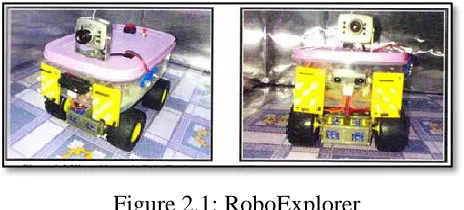
This chapter reviews about previous system that has been developed and has similarities with the remote control of a moving vehicle. This topic will also discuss about the component that will be used in developing this systems. To design a suitable Android Cart that reasonable for the application, from combination of several toy acr that available nowadays. This is several robot that a guideline to design the Android Car
[image:22.612.216.448.548.653.2]2.1.1 Examples of Mobile Robot
Figure 2.1: RoboExplorer
7
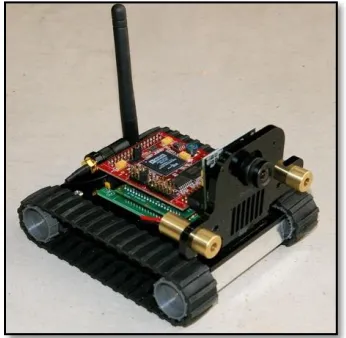
2.1.2 SRV-1 Blackfin
[image:23.612.246.419.102.271.2]
Figure 2.2: Surveyor SRV-1 Blackfin
8
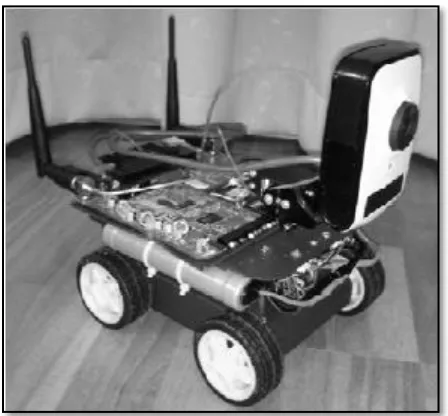
[image:24.612.220.444.109.317.2]2.1.3 The Wi-Fi enabled mobile robot
Figure 2.3: The Wi-Fi enabled mobile robot