Submitted13 November 2016 Accepted 14 July 2017 Published18 August 2017
Corresponding author Donald T. Warren,
Academic editor Ann Hedrick
Additional Information and Declarations can be found on page 10
DOI10.7717/peerj.3652
Copyright 2017 Warren et al.
Distributed under
Creative Commons CC-BY 4.0
OPEN ACCESS
Extended exposure to elevated temperature
affects escape response behaviour in coral
reef fishes
Donald T. Warren1,2, Jennifer M. Donelson2,3and Mark I. McCormick1,2
1Department of Marine Biology and Aquaculture, James Cook University, Townsville, Queensland, Australia 2ARC Centre of Excellence for Coral Reef Studies, James Cook University, Townsville, Queensland, Australia 3School of Life Sciences, University of Technology Sydney, Sydney, New South Wales, Australia
ABSTRACT
The threat of predation, and the prey’s response, are important drivers of community dynamics. Yet environmental temperature can have a significant effect on predation avoidance techniques such as fast-start performance observed in marine fishes. While it is known that temperature increases can influence performance and behaviour in the short-term, little is known about how species respond to extended exposure during development. We produced a startle response in two species of damselfish, the lemon
damselPomacentrus moluccensis,and the Ambon damselfishPomacentrus amboinensis,
by the repeated use of a drop stimulus. We show that the length of thermal exposure of juveniles to elevated temperature significantly affects this escape responses.Short-term (4d) exposure to warmer temperature affected directionality and responsiveness for
both species. After long-term (90d) exposure, onlyP. moluccensisshowed beneficial
plasticity, with directionality returning to control levels. Responsiveness also decreased in both species, possibly to compensate for higher temperatures. There was no effect of temperature or length of exposure on latency to react, maximum swimming speed, or escape distance suggesting that the physical ability to escape was maintained. Evidence suggests that elevated temperature may impact some fish species through its effect on the behavioural responses while under threat rather than having a direct influence on their physical ability to perform an effective escape response.
SubjectsAnimal Behavior, Ecology, Marine Biology
Keywords Temperature, Fast-start response, Climate change, Coral reef fish, Predator–prey
INTRODUCTION
Predator–prey interactions are one of the key drivers structuring communities (Lima
& Dill, 1990). Predation pressure can alter prey morphology, regulate population size, and control biodiversity (Sih et al., 1985). Similarly, antipredator responses of prey reduce the efficacy of predators and enhance survival. Factors that influence predator attack success or prey escape performance may alter the outcome of these interactions, potentially causing a cascade of trophic effects. Increased temperature has already
been shown to affect antipredator responses in terrestrial ectotherms (Cury de Barros
affect key ecological processes can be useful when predicting the composition of future communities.
Rising environmental temperatures can substantially impact the behaviour and
locomotor performance components of escape responses in fish (Domenici, 2010). Previous
studies have shown that temperature can influence locomotor performance through physiological mechanisms like muscle performance (Johnston, Fleming & Crockford, 1990) and enzyme activity (Johnson & Bennett, 1995). Additionally, temperature can affect
behavioural components of escape responses, including responsiveness (Preuss & Faber,
2003) and directionality (Szabo et al., 2008). The effect of environmental temperature will depend on both the level of thermal change compared to the normal thermal conditions,
and the length of time thermal change is experienced (Munday, McCormick & Nilsson,
2012). With sufficient exposure time, plasticity can occur resulting in changes to the
phenotype, which potentially reduce the negative impacts of rising temperature (Angilletta, 2009). Exposure during the early stages of life is believed to unlock greater plasticity in traits (West-Eberhard, 2003), and this has been found to be true for coral reef fishes (Donelson et al., 2011). While many studies have investigated the effects of short-term exposure to elevated temperatures in adult fishes, to date few studies have examined how juvenile fishes respond to long-term exposure to near-future temperature increases.
The interaction between a predator and its prey is an intricate sequence that, at its
end, leads to a predator striking at a prey and the prey being captured or escaping (Lima
& Dill, 1990). Many amphibians and fishes undertake a C-start escape response to a startling stimulus (Bullock, 1984) involving a sudden acceleration away from the direction of the perceived threat (Domenici & Blake, 1997). C-start responses are controlled by
two large neurons called Mauthner cells, one for each lateral half of the body (Eaton,
Bombardieri & Meyer, 1977). When a stimulus is detected, the corresponding Mauthner cell triggers the escape response resulting in a rapid contraction of white muscle fibres. At first, the fish bends into a C-shape (stage 1), then contralateral contraction releases this tension which propels the fish to flee the stimulus in the opposite direction (stage 2) (Eaton, Bombardieri & Meyer, 1977). The initiation of C-starts are neurally controlled
with maximum performance believed to be limited by muscle power output (Wakeling
& Johnston, 1998). However, fish rarely perform at their maximal limits (Webb, 1986) and modulation of performance during an escape response has been shown to occur in different behavioural contexts, showing there is potential for optimisation (Korn & Faber, 2005;Domenici, 2010;Ramasamy, Allan & McCormick, 2015). This supports the economic model that individuals balance the energetic cost of escaping with the threat of predation (Ydenberc & Dill, 1986). How long-term exposure to elevated temperature can alter behavioural components of an escape response is still unknown.
The present study examines whether short-term or long-term exposure to elevated temperature regimes affect the fast-start escape response in two tropical damselfishes. Using a repeatable drop stimulus (i.e., a stimulus that was consistently replicated), we compared
escape responses of juveniles from current-day controls (29◦C) to individuals exposed
indication of thermal sensitivity and (2) how short-term exposure differed to long-term exposure at elevated temperature as an indication of plasticity. The inclusion of two species was to explore the species-specific effect that temperature had on escape responses.
METHODS
Ethics statement and collecting permits
All work reported herein was conducted under permits from James Cook University Animal Ethics Committee (A2079), the Great Barrier Reef Marine Park Authority (G10/33239.1), and Queensland Fisheries (170251).
Study species, collection, and holding facilities
To examine how short-term and long-term exposure to elevated temperatures influences
escape performance, two reef fish species were used (the Lemon damselfish,Pomacentrus
moluccensis, and the Ambon damselfish,Pomacentrus amboinensis). These species have been
used in past studies on escape performance (Allan et al., 2013) and behaviour (McCormick
& Weaver, 2012) making them familiar study species. These species co-occur across the Indo-Pacific from the southern Great Barrier Reef up to Indonesia and Japan (Allen, 1991). Like many reef fish, these species undergo embryonic development during a pelagic larval phase. After 3–4 weeks, larvae make their final metamorphosis and recruit back to the reef to join the adult population. Both species settle to the reef at similar ages, though standard length ofP. amboinensis, tends to be slightly larger (McCormick & Weaver, 2012). Here, thermal plasticity is ecologically important as individuals often settle to reefs with thermal regimes different to what they experienced as larvae. Recently settled recruits (aged 1–2 months) were collected from the Cairns region (−16◦780S, 146◦260E) of the Great Barrier Reef, Australia in January 2014. At this latitude, these species do not mature for at least one year, making our individuals immature juveniles. Therefore, gender was not observed as it is not relevant at this age. Once mature, individuals will sex-change depending on social structure (Fishelson, 1998).
Fish were transported back to a closed system holding facilities at the Marine and Aquaculture Research Facilities Unit (MARFU), James Cook University, Townsville. Fish were housed in densities of three of varying sizes (e.g., one big, medium, and small) in 40 litre replicate tanks. This sizing order helped formed a natural hierarchy within tanks and reduced within tank fighting. Tanks were randomly allocated into one of three
temperatures: 29.0◦C (current-day summer average for the collection region; control;
(AIMS, 2014), 30.0 ◦C, or 31.0◦C (projected 50 and 100 year future temperatures;Collins et al., 2013). Holding tank temperatures were computer monitored via Innotech Genesis II controller V5 temperature system capable of controlling random fluctuation less than
0.1◦C for the system. The system was continuously supervised by the in-house staff
and a closely related species of damselfish (Donelson et al., 2011). A 4d period was chosen for our short-term exposure treatment to observe the effects of increased temperature without causing a thermal stress response (Gardiner, Munday & Nilsson, 2010). No thermal benefit
in plasticity has been shown to occur inP. moluccensisfor up to 22 days of exposure to
similar elevated temperatures supporting our 4d treatment would not be confounded by reversible plasticity (Nilsson, Östlund-Nilsson & Munday, 2010). Temperature variation
and photoperiod followed natural diurnal cycle for the collection region,±0.6◦C around
the mean and 12:12 h respectively (AIMS, 2014). Food quantity was not controlled for and
all fish were given a high performance commercial fish pellet (NRD 0.5–0.8 mm; Primo Aquaculture, QLD, Australia) once or twice daily to satiation. Excess food was removed and tanks were cleaned via a vacuum siphon weekly or as needed.
Experimental design
The escape performance of fishes was quantified using a repeatable drop stimulus (i.e., a stimulus with mechanical release that could be replicated consistently). Thermal sensitivity
to elevated temperature (aim 1) was measured by exposing individuals to either 30 or 31◦C
for a 4d period. To explore the extent of thermal plasticity (aim 2), separate treatments
were held at either 30 or 31◦C for 90d. The control treatment remained at 29◦C for the
entirety of the experiment. In total, there were 10 treatments: two short-term exposures, two long-term, one control, and repeated for each species. Holding tank temperatures were raised 1◦C/day to reduce the effect of heat shock (Gardiner, Munday & Nilsson, 2010). To control for any effect of time spent in captivity, the 4d treatments were first held at control temperature, then exposed to their randomly assigned temperature four days before the end of the long-term duration. This allowed all fish to finish temperature treatments at the same time.
Experimental procedure
After the exposure period, individuals were measured (standard length, x±SD;
P. amboinensis n=58, 30.57±5.79 mm,P. moluccensis n=83, 28.08±3.59 mm) and
tested for escape performance the following day. Treatments of P. amboinensis were
significantly larger thanP. moluccensis(F1,131=9.52,p=0.002), however there were no differences across treatments for each species. Escape performance was tested in a circular arena (30 cm diameter) filled to a depth of 10 cm to reduce movement in the vertical plane and illuminated with fluorescent lighting strips. Water temperature of the arena reflected the treatment temperature that fish were held in. Water temperature was monitored with a C20 Comark thermometer (Comark Corporation, Norfolk, UK). Temperature was maintained with a glass bar heater (Aqua One, 300 W) and air stone for aeration. Complete water exchanges were conducted every 10 min or after 3 fish. The walls and top had opaque covers to prevent outside disturbance. To elicit an escape response, a startling stimulus consisting of a weight with a tapered end was released through a tube suspended
above the centre of the arena. The suspended tube stopped ∼1 cm above the water’s
just the water’s surface when released, preventing collision with the individual. To start a trial, fish were placed into a central habituation ring (10 cm diameter) via a water filled sample jar and given a one-minute habituation period. Following the habituation period, the central ring was gently raised and the stimulus weight was released, striking the water in an attempt to elicit an escape response. If a C-start was performed, no further attempts were conducted and the fish was returned to its holding tank. If no reaction was observed, fish were replaced into the habituation ring for another minute and the second attempt was conducted. Fish were given three attempts to perform a C-start before being recorded as ‘‘no reaction’’. The escape response was recorded using a high-speed camera (Casio Exilim Ex-F1; 600 fps) directed at a 45◦angled mirror placed beneath the testing tank.
Response variables
Response variables were measured using the fish’s centre of mass (∼35% SL from the snout;
Webb, 1976) and tracked using ImageJ software (v1.48) with the manual tracking plugin. We chose our variables as they have been used in previous study as a good indicator of escape ability (Walker et al., 2005). Only stages 1 and 2 of the C-start, described as directional changes in the anterior part of the body (Domenici & Blake, 1997) were quantified.
Non-locomotor
(a) Responsiveness: proportions of fish that responded with a ‘‘C-start’’ or ‘‘no C-start’’. No C-start was subdivided into ‘‘avoid’’ to the stimulus by swimming away but not performing a desired C-start and ‘‘no reaction’’ to the stimulus.
(b) Directionality: left and right side were split anteroposteriorly from directly above the fish. Directionality was determined by whether the head turned ‘‘away’’ or ‘‘toward’’ the side the stimulus occurred during stage 1 of the response.
(c) Response latency (ms): time between the stimulus onset and first movement of the individual.
Locomotor
(d) Escape distance (mm): distance travelled during the response to the end of stage 2.
(e) Maximum swim speed (body lengths s−1): maximum velocity achieved at any time
during the escape response.
Data analysis
Statistical analyses were performed using IBM SPSS statistics (v23.0.0.2). Proximity of fish
to the stimulus at the onset and body size can affect escape responses (Webb, 1976). The
central habituation ring helped reduce differences in starting proximity to stimulus and the remaining distances of fish to the stimulus did not differ among treatments (one-way
ANOVAF4,110=0.959,P=0.433). Maximum swim speed (m s−1) was converted to body
length s−1to control for any effect of size. Control temperature did not consist of two
exposure combinations like the elevated temperatures, therefore a full-factorial 3 ×2
individual to elicit a C-start after the stimulus and the likelihood of that individual to turn away from the stimulus. Response latency, maximum swim speed, and escape distance were
used as dependent variables analysed separately with one-way ANOVAs (α=0.05) and
temperature treatment as the fixed factor. These analyses were repeated for both species
(replicates ranged from 7–12 forP. amboinensisand 9–19 forP. moluccensis). Preliminary
analysis of response latency, maximum swim speed, and response distance used a linear mixed effects model with holding tank as a random factor to test for a tank effect. However,
AIC values were lower for models not including random tank factor with 1AIC <2 to
models that did include random tank factor. Consequently, this term was dropped from the final model. We predicted that short-term exposure to elevated temperature would have a negative impact on escape responses. If beneficial plasticity was possible with long-term exposure, individuals exposed for 90d would exhibit improvement in performance that either approached or returned to present-day control levels.
RESULTS
There was no significance in the logistic regression model for responsiveness in
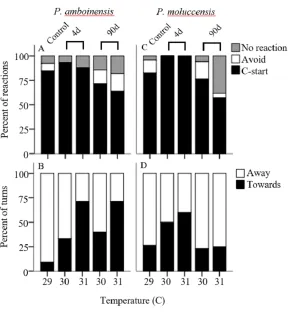
P. amboinensis (χ2(4)=4.18,p=0.38; Fig. 1A). At control, 84.62% of individuals responded with a C-start, 7.69% showed no reaction, and 7.69% displayed avoidance
behaviour. Exposure of four days to either 30 or 31 ◦C had very little effect on
responsiveness. However, for individuals that did not display a C-start, all showed no reaction to the stimulus and none displayed avoidance behaviour. After 90 days, fish
were 2.19 times less likely (71.43%) to perform a C-start at 30 ◦C and 3.14 times less
likely (63.64%) at 31◦C. Additionally, avoidance behaviour was returned (14.29%) and
divided non C-start individuals in half with those showing no reaction (14.29%). There was significance in the regression model for directionality inP. amboinensis(χ2(4)=11.23,
p=0.024; Fig. 1B). The model explained 28.70% (Nagelkerke R2) of the variance in directionality of C-starts and correctly classified 67.60% of cases. Compared to controls,
fish exposed to 30 ◦C for 4 days were 5 times more likely (33.33%) to turn towards
the stimulus and 6.67 times more likely (40%) after 90 days. At 31◦C, fish were 25
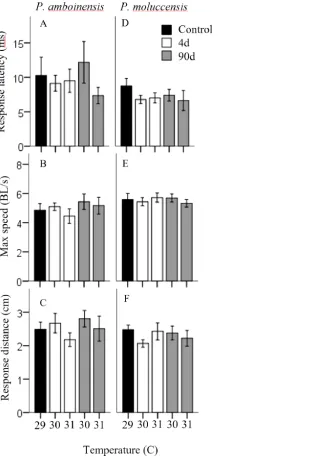
times more likely (71.43%) to turn towards the stimulus, which was the same for both exposure durations. Temperature nor exposure duration had any significant effect on response latency (F4,42=1.32,p=0.27, partial η2=0.053;Fig. 2A), maximum swim speed (F4,41=0.6,p=0.66 partialη2=0.056;Fig. 2B), or response distance (F4,42=0.65,
p=0.62, partialη2=0.058;Fig. 2C) forP. amboinensis.
For P. moluccensis, logistic regression model for responsiveness was statistically significant (χ2(4)=16.58,p=0.002;Fig. 1A). The model explained 28% (Nagelkerke
R2) of the variance in proportion of individuals that elicited a C-start and correctly classified 80% of cases. At control, 82.61% of fish displayed a C-start. Of the fish that did not C-start, most showed avoidance behaviour (13.04%) and no reaction (4.35%) least of all. Responsiveness rose to absolute (i.e., 100% of individuals performed a C-start) after
four days of exposure to either 30 or 31◦C. When 90 day exposure was compared to
Figure 1 Responsiveness and directionality to the startling stimulus.Percent of reactions represents C-start responsiveness of juvenile Pomacentrus amboinensis (A) and Pomacentrus moluccensis (C) to a drop stimulus at control, 4d or 90d exposure durations to elevated temperatures. Types of reaction are: no reaction (grey), avoidance (open), and C-start (solid). Directionality categorises only C-start individu-als by the percent of turns made byP. amboinensis(B) andP. moluccensis(D) where the first movement of head was either towards (solid) or away (open) from the stimulus.
3.55 times less likely (57.14%) at 31◦C. For individuals that did not display a C-start, there
was an increase in no reaction up to 38% at 31◦C (from 4.35% at control). There was no
significance in the regression model for directionality (χ2(4)=5.98,p=0.20;Fig. 1B). Fish
with four days of exposure to 30◦C were 2.8 times more likely (50%) to turn towards the
stimulus compared to controls and 4.2 time more likely (60%) at 31◦C. However, this was
reduced after prolonged exposure where directionality was very similar to control (23.08% and 25% for 30 and 31◦C, respectively). There was no significant effect of temperature and exposure duration on response latency (F4,60=1.23,p=0.30, partialη2=0.052;Fig. 2A), maximum swim speed (F4,60=0.19,p=0.94, partialη2=0.013;Fig. 2B), nor response distance (F4,60=0.85,p=0.49, partialη2=0.054;Fig. 2C) forP. moluccensis.
DISCUSSION
Figure 2 Measures of kinematic variables to the drop stimulus.Kinematic performance of fast startsby juvenileP. amboinensisandP. moluccensisat control (solid), 4d (open) or 90d (grey) exposure durations to elevated temperatures. Variables measured were response latency, max speed (body lengths s−1, and
es-cape distance (A, B, and C respectively forP. amboinensisand D, E, and F respectively forP. moluccensis).
change conditions (Gilman et al., 2010). Supporting our predictions, we found
short-term exposure to elevated temperature negatively impacted directionality for both species. However, there was little effect on responsiveness, response latency, maximum, swim speed,
and escape distance. After long-term exposure, directionality in P. moluccensisfollowed
our predictions by reducing the number of turns towards the stimulus and returning
to control levels. For P. moluccensis, long-term exposure also altered responsiveness
alterations in the C-start responsiveness to predators is likely to change prey survival, while the differential effects of temperature on the two closely related species suggests that future temperature elevation may affect community composition through differential survival.
The ability for prey to perceive and avoid a predatory threat is essential to survival. Directionality in escape responses is important as turning towards a stimulus would
increase exposure time to a predator (Domenici, 2010). Short-term exposure to elevated
water temperature negatively impacted directionality by increasing number of turns towards the stimulus. Previous study on goldfish also found directionality was impaired at increased temperatures compared to controls (Szabo et al., 2008). Altered directionality
may have been due to an impairment of sensorimotor control (Foreman & Eaton, 1993).
While not significant, short-term exposure to elevated temperatures increased C-start
responsiveness inP. moluccensisfrom 80% to 100%, and reduced avoidance reactions to
0% for both species. Generally, proportion of C-starts has been shown to increase with
exposure to temperature both above (Szabo et al., 2008) and below control treatments
(Preuss & Faber, 2003), suggesting responsiveness may increase with thermal stress, at either extreme. Hyperactivity under stress can be beneficial to survival, as a fish that does not react during a predator attack will most likely get eaten. However, this strategy can risk expending additional energy on a false or non-threatening stimulus.
Extended exposure to new environmental conditions can alter the physiological
and behavioural response of individuals (Angilletta, 2009). We found directionality in
P. moluccensisshowed signs of beneficial plasticity after long-term exposure by returning to
control levels.Long-term exposure may have reduced the negative impact of sensorimotor
control brought on by thermal stress. Physiological plasticity to similar temperatures
(+2◦C) in this species has also been shown to occur for aerobic metabolism (Grenchik,
Donelson & Munday, 2013) potentially demonstrating that P. moluccensiscould exhibit beneficial plasticity to future projected temperatures in a range of traits. The proportion of C-starts reduced while avoidance behaviour increased with long-term exposure in both species. Decreasing the proportion of C-starts deviates further from control levels, therefore cannot be considered beneficial. However, future sea temperature increases are
expected to exceed the thermal optimum for many reef fish (Tewksbury, Huey & Deutsch,
2008), forcing species to adopt energy saving strategies (Ydenberc & Dill, 1986). Reducing the proportion of C-starts and replacing with avoidance behaviour may help compensate for the costs of increasing thermal conditions.
2010; Grenchik, Donelson & Munday, 2013) and C-starts are high energy manoeuvres (Jayne & Lauder, 1993). If an individual’s energy budget is limited, then more resources must be allocated to the rising cost of metabolic demands and potentially leave less available for other activities such as escape behaviour (Careau et al., 2008). Thus, the behavioural modulation of reducing C-start responsiveness after long-term exposure observed, may act as a means of balancing the increasing cost of C-starts at higher temperature.
To conclude, both species showed negative effects of increased temperature after
short-term, though the impact was greater forP. amboinensis. After long-term exposure,
P. moluccensisadjusted to temperature with beneficial plasticity and energy saving strategies. These results show the C-start escape response possesses thermal plasticity and extended exposure can induce beneficial changes. The difference in response by species matches a
previous study showingP. moluccensispossessed a higher capacity for thermal plasticity in
aggressive interactions (Warren et al., 2016). Changes in escape behaviour will ultimately affect mortality rates in prey and the species-specific response suggests some will better cope with future temperatures. This study is important as it illustrates the specific contribution that elevated temperature will have on individual performance. However, comprehensive
climate change scenarios will also include responses to changes in ocean chemistry (CO2
levels and pH). Furthermore, precise measurement of escape success will require future study with only the prey, only the predator, and both exposed to elevated temperature as predators will also likely have specific responses to thermal conditions. Future studies may also consider a longitudinal approach with several populations from differing sites to consider adaptation to local thermal environments. Studies investigating the factors that influence predator–prey interactions, like this one, are crucial because these interactions determine population sizes and replenishment, leading to changes in community structure.
ACKNOWLEDGEMENTS
We thank Dave Stewart of Affordable Charters, captain of the Kalinda, and the dive volunteers for field assistance. We thank the JCU team at MARFU and Shannon McMahon for their help in the construction and maintenance of the holding facilities. We thank Katie Motson and Shannon McMahon for their aid in collecting burst responses videos.
ADDITIONAL INFORMATION AND DECLARATIONS
Funding
Grant Disclosures
The following grant information was disclosed by the authors:
Postgraduate Research Scholarship by James Cook University (DTW). University of Technology Sydney and The Ian Potter Foundation (JMD).
ARC Centre of Excellence for Coral Reef Studies and the College of Marine and Environmental Sciences at James Cook University (MIM).
Competing Interests
The authors declare there are no competing interests.
Author Contributions
• Donald T. Warren conceived and designed the experiments, performed the experiments,
analyzed the data, wrote the paper, prepared figures and/or tables, reviewed drafts of the paper.
• Jennifer M. Donelson conceived and designed the experiments, performed the
experiments, wrote the paper, reviewed drafts of the paper.
• Mark I. McCormick conceived and designed the experiments, wrote the paper, reviewed
drafts of the paper.
Animal Ethics
The following information was supplied relating to ethical approvals (i.e., approving body and any reference numbers):
All work reported herein was conducted under permits from James Cook University Animal Ethics Committee (A2079).
Field Study Permissions
The following information was supplied relating to field study approvals (i.e., approving body and any reference numbers):
Collecting permits were approved by the Great Barrier Reef Marine Park Authority (G10/33239.1) and Queensland Fisheries (170251).
Data Availability
The following information was supplied regarding data availability:
The raw data has been supplied as aSupplementary File.
Supplemental Information
Supplemental information for this article can be found online athttp://dx.doi.org/10.7717/
peerj.3652#supplemental-information.
REFERENCES
Australian Institute of Marine Science. 2014. Water temperature for Janurary 2014,
Arlington and Moores reefs. AIMS, Townville.Available athttp:// maps.aims.gov.au/
index.html?intro=false&z=4&ll=142.91883,-17.51872&l0=aims_aims:AIMS%20-%20Temperature%20Loggers,ea_World_NE2-coast-cities-reefs_Baselayer (accessed on
Allan BJM, Domenici P, McCormick MI, Watson SA, Munday PL. 2013.Elevated
CO2 affects predator–prey interactions through altered performance.PLOS ONE
8(3):e58520DOI 10.1371/journal.pone.0058520.
Allan BJM, Domenici P, Munday PL, McCormick MI. 2015.Feeling the heat: the effect of acute temperature changes on predator—prey interactions in coral reef fish.
Conservation Physiology3:1–8DOI 10.1093/conphys/cov011. Allen G. 1991.Damselfishes of the world. Melle: Mergus Publishers.
Angilletta MJ. 2009.Thermal adaptation: a theoretical and emprirical synthesis. New York: Oxford University Press.
Beddow T, Leeuwen J, Johnston I. 1995.Swimming kinematics of fast starts are altered
by temperature acclimation in the marine fish Myoxocephalus scorpius.The Journal
of Experimental Biology198:203–208.
Bullock TH. 1984. Comparative neuroethology of startle, rapid escape, and giant
fiber-mediated responses. In: Eaton RC, ed.Neural mechanisms of startle behavior. Boston:
Springer US, 1–13.
Careau V, Thomas D, Humphries MM, Réale D. 2008.Energy metabolism and animal
personality.Oikos117:641–653DOI 10.1111/j.0030-1299.2008.16513.x.
Collins M, Knutti R, Arblaster J, Dufresne J, Fichefet T, Friedlingstein P. 2013. Long-term climate change: projections, commitments and irreversibility. In: Stocker T, Qin D, Plattner G, Tognor M, Boschung J, Nauels A, Xia Y, Bev V, Midgley P, eds.
Climate change 2013: the physical science basis. contributing work to the fifth assessment report of the intergovernmental panel on climate change. Cambridge: Cambridge University Press.
Cury de Barros F, Eduardo de Carvalho J, Abe AS, Kohlsdorf T. 2010.Fight versus flight: the interaction of temperature and body size determines antipredator
be-haviour in tegu lizards.Animal Behaviour79:83–88DOI 10.1016/j.anbehav.2009.10.006.
Domenici P. 2010.Context-dependent variability in the components of fish escape
response: integrating locomotor performance and behavior.Journal of Experimental
Zoology Part A: Ecological Genetics and Physiology313 A:59–79DOI 10.1002/jez.580. Domenici P, Blake RW. 1997.The kinematics and performance of fish fast-start
swimming.The Journal of Experimental Biology200:1165–1178.
Donelson JM, Munday PL, Mccormick MI, Nilsson GE. 2011.Acclimation to predicted
ocean warming through developmental plasticity in a tropical reef fish.Global
Change Biology 17:1712–1719DOI 10.1111/j.1365-2486.2010.02339.x.
Eaton RC, Bombardieri RA, Meyer DL. 1977.The Mauthner-initiated startle response in teleost fish.The Journal of Experimental Biology66:65–81.
Fishelson L. 1998.Behaviour, socio-ecology and sexuality in damselfishes
(Pomacentri-dae).Italian Journal of Zoology65:387–398DOI 10.1080/11250009809386853.
Foreman RB, Eaton RC. 1993.The direction change concept for reticulospinal control of goldfish escape.The Journal of Neuroscience3:4101–4113.
Gardiner NM, Munday PL, Nilsson GE. 2010.Counter-gradient variation in respiratory
performance of coral reef fishes at elevated temperatures.PLOS ONE5(10):e13299
Gilman SE, Urban MC, Tewksbury J, Gilchrist GW, Holt RD. 2010.A framework for
community interactions under climate change.Trends in Ecology and Evolution
25:325–331DOI 10.1016/j.tree.2010.03.002.
Grenchik MK, Donelson JM, Munday PL. 2013.Evidence for developmental thermal
acclimation in the damselfish, Pomacentrus moluccensis.Coral Reefs32:85–90
DOI 10.1007/s00338-012-0949-1.
Jayne BC, Lauder GV. 1993.Red and white muscle activity and kinematics of the escape
response of the bluegill sunfish during swimming.Journal of Comparative Physiology
A173:495–508 DOI 10.1007/BF00193522.
Johnson T, Bennett A. 1995.The thermal acclimation of burst escape performance in fish: an integrated study of molecular and cellular physiology and organismal
performance.The Journal of Experimental Biology198:2165–75.
Johnston IA, Fleming JD, Crockford T. 1990.Thermal acclimation and muscle contrac-tile properties in cyprinid fish.American Journal of Physiology—Regulatory Integrative and Comparative Physiology259:231–236.
Korn H, Faber DS. 2005.The Mauthner cell half a century later: a neurobiological model
for decision-making?.Neuron47:13–28DOI 10.1016/j.neuron.2005.05.019.
Lima SL, Dill LM. 1990.Behavioral decisions made under the risk of predation: a review
and prospectus.Canadian Journal of Zoology68:619–640DOI 10.1139/z90-092.
McCormick MI, Weaver CJ. 2012.It pays to be pushy: intracohort interference
competi-tion between two reef fishes.PLOS ONE7(8):e42590
DOI 10.1371/journal.pone.0042590.
Munday PL, McCormick MI, Nilsson GE. 2012.Impact of global warming and rising CO2 levels on coral reef fishes: what hope for the future?.Journal of Experimental Biology215:3865–3873DOI 10.1242/jeb.074765.
Nilsson GE, Östlund-Nilsson S, Munday PL. 2010.Effects of elevated temperature on coral reef fishes: loss of hypoxia tolerance and inability to acclimate. Com-parative Biochemistry and Physiology Part A: Molecular and Integrative Physiology
156:389–393DOI 10.1016/j.cbpa.2010.03.009.
Preuss T, Faber DS. 2003.Central cellular mechanisms underlying
temperature-dependent changes in the goldfish startle-escape behavior.The Journal of
Neuro-science23:5617–5626.
Ramasamy RA, Allan BJM, McCormick MI. 2015.Plasticity of escape responses: prior
predator experience enhances escape performance in a coral reef fish.PLOS ONE
10(8):e0132790DOI 10.1371/journal.pone.0132790.
Sih A, Crowley P, Mcpeek M, Petranka J, Strohmeier K. 1985.Predation, competition,
and prey communities: a review of field experiments author.Annual Review of
Ecology and Systematics16:269–311DOI 10.1146/annurev.es.16.110185.001413. Szabo TM, Brookings T, Preuss T, Faber DS. 2008.Effects of temperature acclimation
on a central neural circuit and its behavioral output.Journal of Neurophysiology
100(6):2997–3008DOI 10.1152/jn.91033.2008.
Tewksbury JJ, Huey RB, Deutsch CA. 2008.Putting the heat on tropical animals.Science
Wakeling JM, Johnston IA. 1998.Muscle power output limits fast-start performance in
fish.The Journal of Experimental Biology201:1505–1526.
Walker JA, Ghalambor CK, Griset OL, McKenney D, Reznick DN. 2005.Do faster starts increase the probability of evading predators?Functional Ecology19:808–815
DOI 10.1111/j.1365-2435.2005.01033.x.
Warren DT, Donelson JM, McCormick MI, Ferrari MCO, Munday PL. 2016.Duration of exposure to elevated temperature affects competitive interactions in juvenile reef
fishes.PLOS ONE11:e0164505DOI 10.1371/journal.pone.0164505.
Webb PW. 1976.The effect of size on the fast-start performance of rainbow trout Salmo cairdneri, and a consideration of piscivorous predator–prey interactions.Journal of Experimental Biology 65:157–177DOI 10.1016/S1546-5098(05)23009-1.
Webb PW. 1986.Effect of body form and response threshold on the vulnerability of four species of teleost prey attacked by largemouth bass (micropterus salmoides).
Canadian Journal of Fisheries and Aquatic Sciences43:763–771DOI 10.1139/f86-094. Webb PW, Zhang HB. 1994.The relationship between responsiveness and
elusive-ness of heat-shocked goldfish (carrassius-auratus) to attacks by rainbow-trout
(Oncorhynchus-Mykiss).Canadian Journal of Zoology-Revue Canadienne De Zoologie
72:423–426DOI 10.1139/z94-059.
Weetman D, Atkinson D, Chubb J. 1998.Effects of temperature on anti-predator
behaviour in the guppy, Poecilia reticulata.Animal Behaviour55:1361–1372
DOI 10.1006/anbe.1997.0666.
West-Eberhard M. 2003.Developmental plasticity and evolution. New York: Oxford University Press.