City, University of London Institutional Repository
Citation
: Bliss, M. and Aitken, L. M. (2018). Does simulation enhance nurses' ability to
assess deteriorating patients?. Nurse Education in Practice, 28, pp. 20-26. doi:10.1016/j.nepr.2017.09.009
This is the accepted version of the paper.
This version of the publication may differ from the final published
version.
Permanent repository link:
http://openaccess.city.ac.uk/19239/Link to published version
: http://dx.doi.org/10.1016/j.nepr.2017.09.009
Copyright and reuse:
City Research Online aims to make research
outputs of City, University of London available to a wider audience.
Copyright and Moral Rights remain with the author(s) and/or copyright
holders. URLs from City Research Online may be freely distributed and
linked to.
Title
Does Simulation Enhance Nurses’ Ability to Assess Deteriorating Patients?
Authors’ names and affiliations
Maria Bliss, RN, BSc (Hons), MA
Lecturer
School of Health Science
City University
Northampton Square
London
EC1V 0HB
Telephone: 02070405742
Leanne M Aitken, RN, PhD, FACN, FAAN, FACCCN
Professor of Nursing, School of Health Sciences, City University London
Lecturer
School of Health Science
City University
Northampton Square
EC1V 0HB
Professor of Critical Care Nursing, Menzies Health Institute Queensland, Griffith University
& Intensive Care Unit, Princess Alexandra Hospital, Brisbane
Corresponding author - Maria Bliss [email protected]
Research Highlights
• The use of simulation is one method of developing the nurse's knowledge and skills of effectively identifying a deteriorating patient.
• Registered nurses reported an increase in knowledge, improved assessment skills and decision making.
• The simulated environment enhanced the learning.
• The registered nurses perceived that knowledge and skills were transferred from simulation to clinical practice when recognising the deteriorating patient.
Abstract
Recognising and responding to patient deterioration has been identified as a key skill in
nursing careto ensure that care is escalated for prompt, efficient management of the
potentially critically ill patient. Simulation is one teaching strategy that has been established
in nurse education as a method for enhancing skills.
The objective was to explore the experiences of registered nurses to ascertain whether they
perceived that simulation enhanced their skills in recognising the deteriorating patient.
An exploratory qualitative design was used. Data were collected from registered nurses using
semi-structured interviews following a professional development course where
scenario-based simulation had been used to assess the patient. Eight registered nurses were
interviewed for this study. Semi-structured interviews were conducted face to face. Verbatim
transcripts were analysed using thematic analysis to identify major themes.
Four themes were identified: knowledge, improved assessment skills in caring for the acutely
ill patient, the learning environment and decision making. The use of simulation as a strategy
was perceived by nurses to improve their own ability in identifying deteriorating patients.
The participants described how their knowledge was transferred to clinical practice, with the
overall perception that this led to improved patient care.
Introduction
The challenges associated with early recognition and response to deteriorating
patients have been acknowledged extensively (Cooper 2013; Rattray et al., 2011; Devita et
al., 2010). It has been identified that deteriorating patients often have changes in their
physiological indictors prior to deterioration. The introduction of early warning tools, such as
National Early Warning Score (Royal College of Physicians, 2015), has provided a means to
alert the nurse to altered physiolology. If a systemic assessement, interpretation of the
observations and subsequent appropriate action is achieved in a timely way, this potentially
can impact significantly on patient outcomes (DeVita et al., 2010).
Registered nurses are faced with increasing workload, demands of the job, and the
acuity of the patient on the ward (Cooper et al., 2011). It has been acknowledged that there
are concerns about whether registered nurses have the knowledge and skills to be able to
detect and respond to the acutely unwell patient (Devita et al.,2010; Askew et al., 2012;
Waddie et al., 2106). However, it has to be recognised that there could be unacceptable
consequences arising from of a lack of knowledge and skills in identifying the deteroriating
patient. It is imperative to consider the efficient and effective delivery of education necessary
for the registered nurse to provide safe care of the deteriorating patient (Jansson et al., 2013;
Kelly et al., 2014).
Simulation is a teaching method that has been used to improve clinical skills with
good evidence that it also increases confidence along with decision making skills (Stirling,
Smith & Hogg, 2012; Wolf et al., 2011). For some years simulation has been used in
undergraduate nursing programmes with positive results (Alinier et al., 2006; Cant and
environment allowing the nurse to engage in an activity that reflects clinical practice, but
without causing harm to the patient (Gaba 2007). The evidence also shows that the debrief
and feedback is a crucial part in the development of knowledge and it gives the opportunity
for the nurse to reflect on practice (Abelsson and Bisholt 2017).
There is a plethora of literature that supports simulation has a positive benefit for
patient safety (Cannon-Diehl 2009; Disher 2014; Copper et al., 2013). Most of the evidence
within the context of nursing has been specific to the development of the undergraduate
nurse; there is limited literature regarding the ongoing effectiveness of simulation to develop
knowledge acquisition for the registered nurse and the impact this has on clinical practice
(Jansson et al., 2013; Hauber et al. , 2010 ; Stirling et al., 2012). While some of the principles
of using simulation in the education of pre-registration students is applicable to the
post-registration setting, it is inappropriate to assume the same processes will be effective in
improving skills and changing practice for the registered nurse. The literature has identified
that the effectiveness of simulation-based learning for post-registration nurses is still largely
unknown (Alinier and Platt 2013), and furthermore there is limited empirical evidence to
support the overall effect simulation has on clinical practice, with regard to the transfer of
knowledge and skills clinical practice (Murray et al., 2008).
Background
Nursing is a profession that requires the registered nurse to be competent at a required
professional level (Nursing and Midwifery Council, 2015). The essential knowledge and
often the complexity of the skills require the registered nurses to be proactive in their
development to be effective practitioners. As a learning strategy, simulation allows for active
Simulation promotes creative thinking and allows the nurse to problem solve and to develop
competence in a safe environment (Garrett et al., 2010; Nagle et al. , 2009). Educational
theorists such as Knowles (1970) and Kolb (1984) identified that adult learners are interested
in problem-centred approaches where learning is derived from constructivism. They support
the notion that learning takes place for students who play an active role in learning.
Simulation has been identified as an important method of learning and one that can provide a
bridge in the transference of knowledge to practice (Hauber et al., 2010; Wolf 2011; Alinier
and Platt 2013).
Critical thinking and decision making skills are a crucial element of the registered
nurse’s role; simulation actively encourages and develops these vital skills in a safe
environment (Disher et al., 2014; Kelly et al., 2014; Jansson et al., 2013). Constructive
feedback plays an important role in the development of the nurse’s learning (Kegler, Dale,
and McCarthy 2012). Although Day (2007) views that there is a place for simulation but it is
unlikely to promote faster skills acquisition and could hinder the actual process of learning if
it takes the nurse away from the patient and the experienced mentor. There is a relationship
between knowledge acquisition and performing skills, (Liaw et al., 2011) although mastering
a skill may not mean that nurses are effective at decision making (Elfrink et al., 2010: Hauber
et al., 2010). It is the act of effective decision making that is key when escalating the
treatment of a deteroriating patient and the need for the nurse to be empowered with the
knowledge and skills (Liaw 2016). Endacott et al., (2012) noted that decision making was a
complex process and for simulation to have an influence on the timely management of the
Simulation can be a particularly effective method in enhancing the registered nurse’s
process of decision making as it can be practised in a safe environment. A safe learning
environment is viewed as a postive factor in the retention of knowledge (Cant and Copper
2009; Garrett et al., 2010). Furthermore, Merchant (2012) noted an improvement in team
working and communication skills
The positive benefits of simulation as an educational tool allow nurses to interact and
they can immerse themselves in a clinical scenario without causing harm to the patient.
Skills can be practised repeatedly and nurses can learn from their mistakes (Brown 2008;
Tiffen et al 2009). Furthermore, the simulated environment allows nurses to reflect on their
skills and knowledge and this in itself promotes learning and is viewed as a positive aspect of
simulation, the debrief playing a vital role in learning (Abelsson and Bisholt 2017).
Simulation has been reported to have a positive effect on nurses’ confidence in their
knowledge and skills which leads to improved management of the acutely ill patient (Ozekcin
et al., 2015; Stirling et al., 2012). Skills are learnt more quickly in simulation than in a
traditional classroom setting, where simulation promotes knowledge with the development of
clinical skills (Cooper et al., 2011; Garrett et al., 2010). Simulation has been shown to have
benefits over other teaching methods in some settings but the realisation of these benefits
largely depends on the context (Cant and Cooper, 2010). These benefits have not been
consistently demonstrated and there is limited evidence to support whether there are any
differences between a more traditional method of teaching and simulation (Zulkosky, 2012).
Scherer et al., (2007) found there to be no difference in knowledge and confidence for a
In summary, simulation has had many positive benefits. The evidence suggests that
the simulation environment actively encourages learning, decision making skills, confidence
and assessment skills (Kaddoura 2010; Disher et al., 2014). Simulation provides the nurse
with a safe environment to practise, where feedback is given and there is time to reflect.
Despite our knowledge of the benefits of simulation, there is limited evidence of the benefits
for the post-registration practitioners who do have knowledge and skills, but need the
exposure to practise undertaking an assessment of the patient to enhance effective decision
making regarding the deteriorating patient. The transfer of knowledge and skills to
performance in practice has been acknowledged as an area for further research, particularly
with regard to whether the knowledge gained in simulation is used in clinical practice and
hence results in safer patient care (Disher et al., 2014; Hallenbeck, 2012). The skills involved
in identifying a deteriorating patient are essential to ensure safe and efficient management of
patients.
Method Aim
The aim of the study was to explore the experience of registered nurses who had undertaken a
continuing professional development course using simulated practice as an educational
strategy to recognise the deteriorating patient.
Setting
A continuing professional development course was offered to registered nurses to develop
knowledge and skills in acute and high dependency nursing. This was an existing course
which had been in use for over five years, consisting of a simulation component. It was
develop the nurse’s skills in identifying the deteriorating patient; this was achieved through
classroom teaching, online learning and simulation. The course consisted of five study days
which were divided between classroom teaching and simulation. The classroom teaching of
three hours consisted of a mixture of lectures and seminars. The lectures and seminar
included respiratory, cardiovascular, neurological and liver/pancreas pathophysiology. Within
these subject areas common causes for patient deterioration were discussed. The
self-directed online learning included workbooks and relevant reading which gave the student the
opportunity to formatively build on and consolidate knowledge gained in the classroom or the
simulation suite. The classroom session occurred prior to the simulation sessions: for
example, cardiac pathophysiogy and haemodynamic instabilty was addressed in the
classroom followed by the simulated scenarios related to cardiovascular compromise in the
simulation suite.
The simulation sessions involved 2.5 hours per week for 4 weeks giving a total of ten
hours of simulation. The classroom and simulation sessions were taught by members of the
nursing faculty, including the researcher, with experience in acute and critical care.
Simulation offered the opportunity to bring theoretical knowledge and practical aspects
together. The aim in the simulation session was for nurses to develop their skills in the
ABCDE assessment and escalation of care of a deteriorating patient (supplementary table 1).
The ABCDE is a systematic approach based on airway, breathing, circulation, disability and
exposure to assess and treat the acutely ill patient (Resuscitation Council, 2015). High fidelity
manikins allowed nurses to interact as they would in a real situation, with visual
interpretation of respiratory rate, oxygen saturation, electrocardiogram and non-invasive
blood pressure. In addition, there was an opportunity to develop knowledge and practice in
auscultation, basic interpretation of an electrocardiogram (ECG) and relevant blood results to
Scenarios had been previously developed by the course facilitors, who had a background in
acute care nursing and were experienced in simulated practice. The scenarios had been
designed to achieve the learning objectives of the course which included the development of
knowledge and skills for the nursing management (including assessment, communication and
escalation) of the deteriorating patient. The scenarios represented patients with complex
conditions who were likely to deteriorate, such as those with respiratory failure,
hypovolaemia, septicaemia and cardiac arrhythmias. The scenarios were assessed for face
validity within the nursing faculty by lecturers with acute and critical care backgrounds for
their suitability, design characteristics and learning outcomes. The scenarios had been used in
preceeding courses, however on the commencement of each course the scenarios were
reviewed by the course facilitators to ensure ongoing relevance and currency to practice.
On the commencement of the first simulated session, nurses received an introduction to the
manikin to familiarise them with the technology and the learning environment. The nurse
would work independently or in pairs to complete the assessment and escalation plan. This
would involve the nurse performing the ABCDE assessement, interpreting the clinical
observations and implementing of treatment strategies. Appropriate patient information, such
as fluid charts, clinical observation charts, nursing records, 12 lead ECG recording and
laboratory blood test results were made available. Different scenarios were used during
simulation to allow maximum exposure to varying clinical situations and promoted
Scenario 1
Presenting Problem
A 48 year old gentleman was an emergency admission 3 days ago with acute abdominal pain and
heamatemesis. He underwent a laparotomy for perforated duodenal ulcer 2 days ago. He has had
an uncomplicated recovery.
Past Medical History
Angina for the last 4 years
High cholesterol
Hypertension
Weight 98kg.
Current condition of the patient
Your patient has had an uncomplicated recovery following his emergency admission. His
observations have been stable.
You are the nurse looking after the patient on a day shift. He calls you over as he does not feel
well.
The following documents are available to support your assessment of the patient:
• Vital signs chart
• Fluid balance chart
• Blood results
• Drug prescription chart
• 12 Lead ECG
The aim of the scenario (Table 1) was for the nurse to perform an ABCDE assessment and
from this identify that the patient was in atrial fibrillation. The nurse would recognise the need
to treat this arrythmia and would suggest strategies for management of the patient. Information
would then be communicated and escalated using the Situation, Background, Assessment and
Recommendation tool.
The simulated ABCDE assessment, interpretation of clinical findings and development of a
plan took approximately 15 to 20 minutes. This was followed by 20 to 25 minutes of
feedback and reflection during a debrief period. The debrief post-simulation took place
between the nurse, her peers, and the facilitator, and was designed to allow the nurse to
explore areas that were assessed well and areas for further development (Table 2). The
debrief occurred immediately following completion of the simulation exercise.
On completion of the five study days the participants undertook - an Objective Structured
Clinical Exmination, a summative assessment. This involved undertaking a ABCDE
1. The nurse undertaking the simulated scenario reflected on what they felt they did well and
areas for development.
2. The facilitator posed questions to draw out further discussion of clinical considerations and
made corrections where necessary.
3. Peers identified strengths and areas of uncertainty and how they thought the assessment
could be improved for the nurse.
4. The nurse and peers identified further areas for learning.
5. The facilitator summarised the main points arising from simulation and areas for further
reading and learning.
assessement on one of the high fidelity manikins, identify areas of concern and develop an
escalation plan
All simulation sessions took place in the simulation suite at a London University.
Methodology
A qualitative approach was taken to ascertain the participants’ perceptions of their ability to
assess the deteriorating patient following simulated practice. This was achieved through use
of semi-structured interviews. In-depth exploration of the participant’s views was
fundamental to establishing the role simulation had in the identification of the deteriorating
patient. It was also used to discover the participants’ perceptions of whether simulation had
enhanced their clinical reality and how this had an impact on their practice.
Sampling
All participants undertaking the professional development course were invited to participate.
There were no other inclusion or exclusion criteria and all course members could volunteer.
A total of twelve nurses from a potential twenty agreed to take part in the research. Two
participants piloted the questions and a further two declined to participate. A total of eight
nurses were interviewed. All eight nurses worked in acute medical or surgical areas or High
Data Collection Method
Semi-structured individual interviews were used to gather information. Originally ten
questions were developed but, based on the pilot study results, two additional questions were
added to gain data on the length of the time the nurse had been registered and whether they
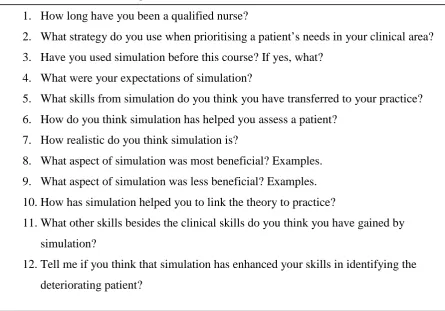
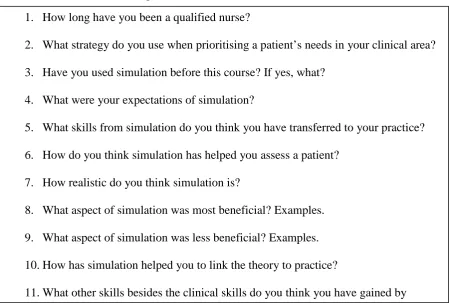
had used simulation before. Twelve questions were used to explore the perceptions of the
participants on complex matters (Table 3). All eight interviews were conducted by the
researcher at the School of Health Science; they were audio-taped and lasted approximately
45 minutes.
Implementation of the research
The interviews were held approximately six weeks following the completion of the
professional development course. This time allowed the nurses the opportunity to utilise the
knowledge and skills that they may have gained through simulation in their clinical practice
and to consider the influence that the learning experience had on their practice. 1. How long have you been a qualified nurse?
2. What strategy do you use when prioritising a patient’s needs in your clinical area?
3. Have you used simulation before this course? If yes, what?
4. What were your expectations of simulation?
5. What skills from simulation do you think you have transferred to your practice?
6. How do you think simulation has helped you assess a patient?
7. How realistic do you think simulation is?
8. What aspect of simulation was most beneficial? Examples.
9. What aspect of simulation was less beneficial? Examples.
10. How has simulation helped you to link the theory to practice?
11. What other skills besides the clinical skills do you think you have gained by
simulation?
12. Tell me if you think that simulation has enhanced your skills in identifying the
[image:15.595.63.509.312.623.2]deteriorating patient?
Data Analysis
Thematic analysis was done using the framework developed by Miles and Huberman
(1994). This framework used a process which included data reduction, data display and
conclusion drawing/verification, which lead to the identification of themes. Interviews were transcribed verbatim and then analysed. The transcribed interviews were returned to the
participants to verify if this was a true reflection.
To facilitate thematic identification, a categorisation system was used to allow for the
coding of the data. The transcripts were read and scrutinised several times by the researcher
to ensure that all the data were considered. The sentences were coded numerically and key
themes were highlighted. Line-by-line coding was done for ease of identifying information
and emerging themes. Coded transcripts allowed for a deeper level of scrutiny, allowing the
extrapolation of systematic patterns or themes which go beyond those in data reduction. On
further examination of each transcript there were similar themes that emerged from the data
collected.
Finally the eight interviews were compared with each other for emerging themes;
from this information the themes that were similar were grouped together and hence final
themes emerged. The identification of themes led to commonalities, while acknowledging
variation in the responses from the individual participants. Additionally, the results of the
analysis of each participant's interview were reviewed by an academic peer to optimise the
Ethical Issues
All participants gave informed consent prior to partaking in the study. Ethical
approval was granted by the School of Health Sciences Research Ethics Committee
(No.11-12/08).
Results and Discussion
Eight registered nurses volunteered to participate in the study including six females
and two males. All participants were working in the adult nursing field, specifically working
in an acute care setting. The eight nurses interviewed had been registered from three to
twenty three years, with a median (interquartile range) of 10 (6 – 15) years, although it was
not clarified if they had been in clinical practice for the entire time they had been registered.
Six of the eight participants had taken part in some form of simulation before.
However, out of these six only one participant had used high fidelity manikins. Four out of
the eight participants used the ABCDE framework prior to simulation, including the
participant with the least amount of clinical experience (two years). Of interest, the
participants that had been nurses for over 15 years believed their assessment of a patient was
driven by pattern recognition from previous experience rather than using the ABCDE
framework. Post simulation, seven out of the eight participants identified the ABCDE as a
framework that they would use in practice. All interviewees perceived that simulation had
enhanced their current skills in identifying a deteriorating patient; they felt that the
combination of knowledge and practice with the high fidelity manikin gave them improved
confidence and ability to assess the deteriorating patient. Participants agreed that the action of
actively participating in their learning helped to cement this knowledge for practice. Seven of
could be improved. The least beneficial aspect to simulation for three participants was
concern about being watched by their peers.
There were four main themes that emerged from the data these participants provided;
increased knowledge, improved assessment skills of the acutely ill patient, decision making,
and learning in a safe environment.
Knowledge
All participants reported that the simulation had improved their knowledge and they
perceived they could transfer both knowledge and skills to the practice environment. While
the current study was not designed to quantify that improvement, it suggested the
effectiveness of this teaching method in bridging the gap between theory and learning:
“I think the two go together, knowledge and the practise and that’s what I think is
good about simulation; it’s a bridge between the two, you are putting the knowledge into
action”. Participant N
Bridging the theory to practice has been previously identified as strength of
simulation (Garrett et al., 2010; Hauber et al., 2010; Wolf et al., 2011). Knowledge was
paramount to the participants, the manikins allowed for the deterioration of a patient in the
simulation, where the participants had to apply knowledge quickly and with justification. The
participants perceived that this way of learning bridged the theory to practice gap.
Participation in the scenarios was one of the key factors in improving the nurses’ ability to
“I feel confident that when assessing a deteriorating patient now I will be able to use the
knowledge and practice of what I have learnt in simulation”. Participant M
Improved assessment of acutely ill patients
The participants perceived that they had improved their skills in identifying an acutely
ill patient and this was paramount in answering the research question. The participants
believed that practicing the ABCDE assessment in simulation gave them a framework to
systematically identify a deteriorating patient:
“You can think back to what you have learnt when you did simulation and it acts as a
trigger when you are faced with that or a similar situation”. Participant S
The participants highlighted that they valued the ABCDE assessment practice and on
reflection this was partly due to the scenarios used in the simulation being realistic. The
realism of simulation has been acknowledged as an important factor in the retention of
information and the transfer of knowledge to practice (Alinier, Hunt, Gordon & Harwood,
2006; Cooper et al., 2011). Schön (1983) emphasises the professional importance of being
able to think on your feet and applying previous experiences. The improved assessment skills
of the nurse were a result of a combination of repetitive practise, knowledge and reflection:
“Practising the ABCDE assessment in simulation really helped me on the ward. To
begin with I went through the assessment on patients that were not acutely ill, and then I had
The participants all felt that simulation had enhanced their ability in practice to assess
and take appropriate action with an acutely ill patient.
Learning in a safe environment
All eight participants interviewed enjoyed learning in a simulated environment. The
learning environment allowed time to prioritise what skills they might need to develop and
most importantly the opportunity to make mistakes, and feel supported in this process.
Simulation offered the participants the ability to repeat skills; this has previously been noted
as not always practical in the clinical situation (Gaba, 2007; Issenburg, McGaghie, & Petrusa,
2005; Jeffries, 2008). Cannon-Diehl (2009) places great emphasis on learning without
causing harm to the patient:
“In the ward you are just expected to get on with things, there is very little time to
learn and practise anything; simulation was good as you were learning, but in a stress-free
environment”. Participant T
The simulated environment offered a non-threatening learning environment for nurses
to develop away from the clinical setting with its daily pressures (Murray et al., 2008).
Furthermore, learning in a safe environment was considered positive in retention of their
knowledge:
“Simulation relates to what you do naturally in practice but it helps to link the theory
Participants felt simulation was an active way of learning even if they were observing
others performing the scenarios. The simulated scenarios were developed to reflect clinical
practice and this has been previously recognised as paramount to the success of the learning
experience (Stirling et al., 2012):
“You have the chance to learn in an environment where you can also evaluate and
reflect; you don’t get this in practice”. Participant Q
All participants valued the opportunity to practise their assessment skills, however,
while they valued the peer support, some participants found this awkward. The challenge of
practising in front of peers has been identified by others (Garrett et al., 2010). This may be
explained by the fact that several of the nurses were more senior and felt that they should
know what to do in the simulated scenarios:
“Talking to a dummy is a strange thing to do, I didn’t feel comfortable, it didn’t seem
real to me.” Participant N
Learning in a safe environment is a key benefit in developing knowledge and practice.
The participants in this study positively acknowledged that the learning environment played a
major role in the development of knowledge, skills and decisions that they made. In relation
to the research question the learning environment contributed to their perceived ability to
Decision making
Participants believed that simulation had improved their knowledge and provided
them with a framework (the ABCDE) to accurately assess patients, interpret findings, and
take appropriate action. The participants became more confident and discerning about their
decisions:
“It helped me to speed up my management of the patient, I felt more confident in the
decisions that I made”. Participant M
Making decisions is a multi-faceted process that involves knowledge, confidence, and
critical thinking (Guhde, 2010). It was difficult to isolate decision making from knowledge,
skills, and confidence as it is a combination of all these factors that leads to an improvement
in decision making. One of the major findings from this study was that participants
demonstrated a clear understanding of how quickly a patient could deteriorate. Furthermore,
by making concise decisions and interventions the outcome of the patient’s condition may be
changed:
“It has certainly improved my decision making skills, knowledge and confidence. The
decisions you make you can act on them faster and with more confidence and certainty”.
Participant M
Although decision making was an important theme in this study, it should be noted
that the participants were all registered nurses and were not unfamiliar with making decisions
about patient care and management. However, simulation allowed them time to focus on how
Implications for Education, Practice and Research
The emerging themes in this evaluation support the position that simulation is an
effective method of teaching practicing register nurses. Further participants believed that
what they had learnt in simulation had a positive effect on their performance in clinical
practice. Nurse education needs to be responsive by using innovative methods that are tested
to facilitate the learning of nurses (Jansson et al., 2013). Simulation for these registered
nurses had an advantage over other teaching methods as the context and subject material was
relevant to their everyday practice.
The continuing education of registered nurses is paramount in providing a safe practice of
care for patients. As Cooper et al. (2011) noted, there is an increase in the number of patients
who are more acutely ill in the ward environment so registered nurses need to have the
knowledge and expertise to manage these patients.
The literature has identified a gap (Reilly & Spratt, 2007) in the transfer of knowledge to
practice. It is important that as educationalists we know the outcome of learning in the
simulated environment and how this knowledge is used in practice. It would be valuable to
consider collaboration with hospital nurses to develop simulation scenarios. This would be
an effective method not only in maintaining realistic scenarios but also to address the
effectiveness of simulation.
More research into the use of simulation and its effect on the transfer of knowledge to
practice is required to identify the specific characteristics of simulation, including the skills or
clinical contexts that are effective. While this study looked at the perceived benefits for
nurses working in acute care setting, simulation could be beneficial in other areas of nursing
Strengths and Limitations
The perceptions of the registered nurse were explored in depth to determine whether
they perceived simulation had enhanced their skills in identifying the deteriorating patient.
Participants were drawn from a range of different acute care settings. Importantly, simulation
was not considered in isolation as the time period of approximately six weeks from simulated
practice to interview allowed the nurse to return to clinical areas and experience patient
situations where there was a need to assess the patient using the ABCDE framework.
The study cohort possibly consisted of volunteers who had an interest in the research
topic and, therefore, are not a true representation of the entire course population. The
researcher was known to the participants and this could have prompted participants to answer
questions consistent with their perceptions of social desirability. The small sample size could
possibly be a limiting factor however there was sufficient guidance for replication of this
work. Furthermore, it may have been beneficial to have had more than one reviewer
undertaking thematic coding to determine the level of interrater reliability. It has to be
acknowledged that it is not possible to determine the exact contribution of simulation, as
distinct from other teaching methods used on the course, to nurses’ learning.
Conclusion
This exploratory qualitative study focused on the perceptions of the registered nurse with
regard to how simulation enhanced their ability to assess the deteriorating patient. The
participants perceived that simulation had contributed to their ability to assess the
deteriorating patient in clinical practice which has implications for the on-going education of
References
Abelsson, A., Bisholt, B. (2017) Nurse students learning acute care by simulation – Focus on
observation and debriefing. Nurse Education in Pratice. Vol24, 6–13
Alinier, G., Hunt, B., Gordon, R., & Harwood, C. (2006). Effectiveness of
intermediate-fidelity simulation training technology in undergraduate nursing education. Journal of
Advanced Nursing, 54(3), 359-369.
Alinier, G., & Platt, A., (2013 ). International overview of high-level simulation education
initiatives in relation to critical care. Nursing in Critical Care. Vol, 19(1) 42-49
Askew, T., Trotter, T. L, Vacchiano, S.,Garvey, P., Overcash, J., (2012) Avoiding failure to
rescue situations: a simulation exercise for oncology nurses. Clinical journal of oncology
nursing 16 (5), 530-532
Cant, P. R., & Cooper, S. J. (2010). Simulation-based learning in nurse education: system
review. Journal of Advanced Nursing, 66(1), 3-15.
Cannon-Diehl, M. R. (2009). Simulation in Healthcare and Nursing – State of the Science.
Critical Care Nursing Quarterly, 32(2), 128-136.
Cooper, S., Buykx, P., McConnell-Henry, T., Kinsman, L., & McDermott, S. (2011).
Simulation: can it eliminate failure to rescue? Nursing Times, 107(3), 18-20.
Cooper, S., Cant R., Porter J., Missen K., Sparkes L., McConnell-Henry T., Endacott R
(2013). "Managing patient deterioration: assessing teamwork and individual performance".
Emergency Medicine Journal, 30 (5), 377-81
Day, L. (2007). Simulation and the Teaching and Learning of Practice in Critical Care Units.
DeVita, M. A., Smith, G. B., Adam, S. K., Adams-Pizarro, I., Buist, M., Bellomo, R., …
Winters, B. (2010). “Identifying the hospitalised patient in crisis” — a consensus conference
on the afferent limb of rapid response systems. Resuscitation, 81(4), 375–382.
Disher, J., Burgum, A., Desai, A., Fallon, C., Hart, P., & Aduddell, K. (2014). The Effect of
Unit-Based Simulation on Nurses’ Identification of Deteriorating Patients. Journal for Nurses
in Professional Development, 30(1), 21-28.
Elfrink, V. L., Kirkpatrick, B., Nininger, J., & Schubert, C. (2010). Using Learning Outcomes
to Inform Teaching Practice in Human Patient Simulation. Nursing Education Perspectives,
31(2), 97-100.
Endacott, R., Scholes, J., Cooper, S., McConnell-Henry, T., Porter, J., Missen, K., Kinsman,
L., Champion, R. (2012) Identifying patient deterioration: Using simulation and reflective
interviewing to examine decision making skills in a rural; hospital. International Journal of
Nursing Studies, 49(6) 710-717
Gaba, D. M. (2007). The Future vision of simulation in health care. Stimulated Healthcare
Care, 2(2), 126-135.
Garrett, B., MacPhee, M., & Jackson,C. (2010). High-Fedelity Patient Simulation:
Considerations for Effective Learning. Nursing Education Perspectives, 31(5), 309-313.
Guhde, J. (2010). Using Online Exercises and Patient Simulation to Improve Students’
Clinical Decision-Making. Nursing Education Perspectives, 31(6), 387-389.
Hallenback, V. J. (2012). The use of high fidelity simulation for staff education/development.
Journal for Nurses in Staff Development, 28(6), 260-269.
Hauber, R. P., Cormier, E., & Whyte, J. (2010). An Exploration of the Relationship Between
Knowledge and Performance-Related Variables in High-Fedility. Nursing Education
Issenburg, S. B., McGaghie,W. C., & Petrusa, E. R. (2005). Features and uses of high-fidelity
medical simulation that leads to effective learning BEME systemic review. Medical Teacher,
27(1), 10-28.
Jansson, M., Kääriäinen, M., & Kyngäs, H. (2013). Effectiveness of Simulation-Based
Education in Critical Care Nurse’s Continuing Education: A Systematic Review. Clinical
Simulation in Nursing, 9(9), 355-360.
Jefferies, P. (2008) Getting in S.T.E.P. with simulation: Simulations take educator
preparation. Nursing Education Perspective. 29(2), 70-74
Kaddoura, A. M. (2010). New Graduate Nurses’ Perceptions of the Effects of Clinical
Simulation on Their Critical Thinking, Learning and Confidence. Journal of Continuing
Education in Nursing, 41(11), 506-516.
Kegler, A. L., Dale, B. D., & McCarthy, A. J. (2012). The use of high-fidelity simulation for
rapid response team training: A community hospital’s story. Journal for Nurses in Staff
Development, 28(2), 50-52.
Kelly, M. A., Fober, J., Conlon L., Roche, M., & Stasa, H. (2014). Empowering the
registered nurses of tomorrow: Students' perspectives of a simulation experience for
recognising and managing a deteriorating patient. Nurse Education Today, 34(5), 724–729.
Knowles, M.S.(1970). The modern practice of adult education: Andragogy versus pedagogy.
New York: Association Press.
Kolb,D A. (1984). Experiential Learning: Experience as the Source of Learning and
Development., Englewood Cliffs, N.J. Prentice-Hall Inc.
Liaw, S.Y.,Wong, L.F., Ya Ping Lim, E., Leng Ang, S.B, Mujumdar,S ., Tze Yin Ho, J.,
Zubaidah Mordiffi,S., Neo Kim Ang,E., (2016). "The effect of a web-based educational
program on nursing practice in recognising and responding to deteriorating ward patients: A
Liaw, S.Y., Scherpbier, A. Klainin-Yobas, P. and Rethans J.J. (2011). A review of
educational stragies to improve nurse’s role in recognising and responding to deteriorating
patients. International Nursing Review 58, 296-303.
Merchant, D.C. (2012). Does high-fidelity simulation improve clinical outcomes? Journal for
Nurses in Staff Development, 28(1), e1-e8.
.
Miles, M., & Huberman, A. (1994). Qualitative Data Analysis. (2nd ed.). Thousand Oaks:
Sage Publication.
Murray,C., Grant,J., Howarth, M.L., & Leigh,J,(2008) The use of simulation as a teaching
and learning approach to support practice learning. Nurse Education in Practice, 8(1) 5-8
Nagle, B. M., McHale, J. M., Alexander, G. A., & French , B.F. (2009). Incorporation
Scenarion-Based Simulation Into a Hospital Nursing Education Program. The Journal of
Continuing Education in Nursing, 40(1), 18-25.
Nursing & Midwifery Council. (2015). The Code for Nurses and Midwives. Retrieved from
http://www.nmc.org.uk/standards/code/
Ozekcin, L. R., Tuite, P., Willner, K., Hravnak, M. (2015). Simulation Education: Early
Identification of Patient Physiologic Deterioration by Acute Care Nurses. Clinical Nurse
Specialist: 29(3) 166–173
Rattray, J. E., Lauder, W., Ludwick, R., Johnstone, C., Zeller, R., Winchell, J., Myers, E., &
Smith, A. (2011). Indicators of acute deterioration in adult patients nursed in acute wards: a
Reilly, A., & Spratt, C. (2007). The perceptions of undergraduate students nurses of
high-fidelity simulation-based learning: a case report from the University of Tasmania. Nurse
Education Today, 27(6), 542-550.
Royal College of Physicians. (2015). National Early Warning Score (NEWS). Retrieved from
https://www.rcplondon.ac.uk/resources/national-early-warning-score-news
Resuscitation Council (UK). (2015). A systematic approach to the acutely ill patient (ABCDE
approach). Retrieved from
https://www.resus.org.uk/resuscitation-guidelines/a-systematic-approach-to-the-acutely-ill-patient-abcde/
Scherer, Y.k.,Bruce, S., and Runkawatt.V.( 2007) Acomparision of clinical simulation and
case study presentations on nurse practitioner students’ knowledge and confidence in
managing a cardiac event. International Journal of Nurse Education Scholarship 4 (1) 22.
Schön, D. (1983). The reflective practitioner. New York: Basic Books.
Stirling, K., Smith, G., & Hogg, G. (2012). The benefits of a ward simulation exercise asa
learning experience. British Journal of Nursing, 21(2), 116-122.
Waldie, J., Tee, S., & Day, T. (2016).Reducing avoidable deaths from failure to rescue: a
discussion paper. British Journal of Nursing, 25(16) 895-900.Retrieved from
http://0-dx.doi.org.wam.city.ac.uk/10.12968/bjon.2016.25.16.895
Wolf, L., Dion, K., Lamoureaux, E., Kenny. C., Curnin, M., Hogan, M. A., Roche, J., &
Cunnigham, H., (2011). Using Simulated Clinical scenarios to Evaluate Student Performance.
Nurse Educator, 36(3), 128-134.
Zulkosky, K.D. (2012). Simulation Use in the Classroom: Impact on Knowledge Acquisition,
Scenario 1
Presenting Problem
A 48 year old gentleman was an emergency admission 3 days ago with acute abdominal
pain and heamatemesis. He underwent a laparotomy for perforated duodenal ulcer 2 days
ago. He has had an uncomplicated recovery.
Past Medical History
Angina for the last 4 years
High cholesterol
Hypertension
Weight 98kg.
Current condition of the patient
Your patient has had an uncomplicated recovery following his emergency admission. His
observations have been stable.
You are the nurse looking after the patient on a day shift. He calls you over as he does not
feel well.
The following documents are available to support your assessment of the patient:
• Vital signs chart
• Fluid balance chart
• Blood results
• Drug prescription chart
• 12 Lead ECG
Table 2 – The Debrief Process
1. The nurse undertaking the simulated scenario reflected on what they felt they did well and
areas for development.
2. The facilitator posed questions to draw out further discussion of clinical considerations and
made corrections where necessary.
3. Peers identified strengths and areas of uncertainty and how they thought the assessment
could be improved for the nurse.
4. The nurse and peers identified further areas for learning.
5. The facilitator summarised the main points arising from simulation and areas for further
Table 3- Interview Schedule/ Questions
1. How long have you been a qualified nurse?
2. What strategy do you use when prioritising a patient’s needs in your clinical area?
3. Have you used simulation before this course? If yes, what?
4. What were your expectations of simulation?
5. What skills from simulation do you think you have transferred to your practice?
6. How do you think simulation has helped you assess a patient?
7. How realistic do you think simulation is?
8. What aspect of simulation was most beneficial? Examples.
9. What aspect of simulation was less beneficial? Examples.
10.How has simulation helped you to link the theory to practice?
11.What other skills besides the clinical skills do you think you have gained by
ABCDE assessment guide
Airway AIRWAY PATENCY
• Talks to patient
• Checks for and removes any obstruction (if appropriate)
• Uses correct suction technique
• Assesses need for airway protection
Breathing Look, listen and feel approach
• Notes any cyanosis
• Symmetrical movement of the chest and depth of breath
• Respiratory rate
• Accessory muscles
• Listen to patient’s breath sounds
• Chest Auscultation
• Percussion
• Trachea position
• Establishes pulse oximetry
• Requests Arterial Blood Gas (ABG)
• Checks SpO2 or ABG’s before administering oxygen prescription
• Assesses cough, sputum
• Requests Chest X-Ray
• Identifies the need for other respiratory support
Circulation • Assesses major pulse
• Assesses for signs of reduced tissue perfusion
• Skin: colour, temperature