The permutation class Av(4213,2143)
David Bevan
University of Strathclyde, Glasgow, Scotland
received 22ndOct. 2015,accepted 13thOct. 2016.
We determine the structure of permutations avoiding the patterns4213and2143. Each such permutation consists of the skew sum of a sequence of plane trees, together with an increasing sequence of points above and an increasing sequence of points to its left. We use this characterisation to establish the generating function enumerating these permutations. We also investigate the properties of a typical large permutation in the class and prove that if a large permutation that avoids4213and2143is chosen uniformly at random, then it is more likely than not to avoid2413as well.
Keywords:permutation class, exact enumeration, asymptotic enumeration
1
Introduction
Towards the end of his talk atPermutation Patterns 2015, Vince Vatter pointed out that four of the permutation classes avoiding two patterns of length four remaining to be enumerated are subclasses ofgeneralised grid classes. We illustrate the value of this observation by using it to determine the generating function of the classD= Av(4213,2143)and to explore the structure of permutations inD.
Breaking somewhat with tradition, we assume familiarity with the standard terminology and notation used for permutation classes. See [4] for a very brief introduction, or Vatter’s survey article [18] for a much more thorough exposition. Other overviews of the field can be found in the books by B ´ona [8] and Kitaev [14].
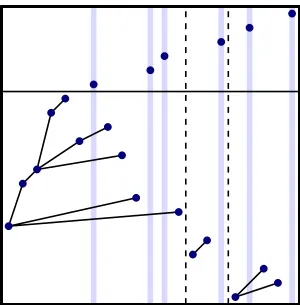
The concept of a generalised grid class was introduced by Vatter in [17, Section 2]. A gener-alised grid class is defined by a matrixM= (Mi,j), whose entries are permutation classes. The classGrid(M)consists of those permutationsσwhose plot can be partitioned into rectangular cells, one corresponding to each entry ofM, such that the subpermutation ofσconsisting of any points in the cell corresponding toMi,jis a member of the permutation classMi,j. Such a parti-tion is known as agriddingofσ. See Figure1for an illustration. With a slight abuse of notation, we tend to identify a grid class with its defining matrix.
We prove (Proposition7) thatD=Av(4213,2143)is a subclass of the generalised grid class
Av(21)
Av(21)Av(213),
ISSN 1365–8050 c2017 by the author(s) Distributed under a Creative Commons Attribution 4.0 International License
Fig. 1:The gridding of a permutation in generalised grid class Av(21)
Av(21)Av(213)
each permutation inDconsisting of the skew sum of a sequence of plane trees, with an increas-ing sequence of points above (top points) and an increasing sequence of points to its left (left points). See Figures 1and6 for illustrations. By analysing the structure of certain “canonical” griddings, we establish (Theorem9) that the generating function enumeratingDis
D(z) = (1−2z) −1+5z−7z
2+2z3+ (1−z)√1−6z+5z2
1−10z+24z2−20z3+4z4 .
We also investigate the properties of a typical large permutation in Dand determine (Corol-lary10) that, asymptotically, one fifth of the points in a permutation inDare top points, and that more than half of the permutations in D have a gridding with no left points and hence contain no occurrences of2413.
In the rest of this introductory section, we present various definitions, notation and results that we use later. In Section2, we investigate the structure ofAv(4213,2413,2143), a subclass ofDfirst studied by Bloom & Burstein [7]. Then, in Section3, we build on our analysis of this subclass to explore the structure of permutations inDand prove our main results. We conclude with some questions.
To establish generating functions, we make use of thesymbolic methodas presented in Flajolet & Sedgewick [12, Chapters I and III]. We useZto denote the atomic class consisting of a single point in a permutation, SEQ[C]to represent a possibly empty sequence of elements of Cand SEQ+[C]to represent a non-empty sequence of elements ofC.
We also use TREE[C]to denote the class of non-empty plane trees whose vertices are drawn fromC, defined by the structural equations
TREE[C] = C×SEQTREE[C]
or TREE[C] = C+TREE[C]2.
We make use of the following terminology. The uppermost (and leftmost) tree in such a skew sum is theupper tree. In each tree, the left to right maxima (the vertices in the leftmost maximal path from the root) constitute thetrunk, the uppermost point of which is itstip. Theuppermost branching pointin the trunk of a tree is the uppermost point in the trunk of degree greater than 2. To conclude this introductory section, we state three general propositions of analytic combi-natorics that we require. Recall that
znf(z)denotes the coefficient ofzninf(z). Proposition1enables us to determine the complete asymptotics of
zn
f(z)by repeated appli-cation to successive terms of the (Puiseux) expansion forf(z)around its dominant singularity, and Proposition2can be used to determine the mean and standard deviation of some parameter. Proposition 1(Flajolet & Odlyzko [11]; see [12, Theorem VI.1]). The coefficient ofzninλ(1−z/ρ)α admits for largenthe following asymptotic expansion:
znλ(1−z/ρ)α ∼ λ Γ(−α)ρ
nn−α−1
1 +
∞
X
k=1 ek nk
,
where
ek = 2k X
`=k λk,`
` Y
j=1
(α+j) and λk,` = vkt`et(1+vt)−1−1/v.
Proposition 2([12, Proposition III.2]). Suppose thatA(z,x)is the bivariate generating function for some combinatorial class, in whichzmarks size andxmarks the value of a parameterξ. Then the mean and variance ofξfor elements of sizenare given by
En[ξ] =
zn
∂xA(z,x) x=
1
zn
A(z, 1) and Vn[ξ] =
zn ∂2
xA(z,x) x=
1
zn
A(z, 1) + En(ξ) − En(ξ) 2
respectively.
Proposition3, which is a consequence of Hwang’s Quasi-powers Theorem [13], allows us to establish that a parameter is asymptotically normally distributed from the fact that itsPGF
behaves nearly like a large power of a fixed function.
Proposition 3([12, Theorem IX.12]). LetF(z,x)be a bivariate function, analytic at(0, 0)and with non-negative Taylor coefficients, and letξnbe the sequence of random variables with probability generat-ing functions
zn
F(z,x)
zn F(z, 1).
If the following conditions hold:
(i) There exist positiverandεand functionsA,BandC, analytic in(z,x) :|z|6r,|x−1|6ε , such thatF(z,x) =A(z,x) +B(z,x)C(z,x)αfor someα /∈
N0.
(ii) The equationC(z, 1) = 0 has a unique root, ρ, with|ρ| 6 r, ρis a simple root, B(ρ, 1) 6= 0, ∂zC(ρ, 1)6=0and∂xC(ρ, 1)6=0.
2
Av(4213,2413,2143)
Let us begin by considering a subclass ofD, the permutation classAv(4213,2413,2143). First, we present a characterisation of the class, which we then use to establish its generating function and determine some asymptotic properties.
This class was first investigated by Bloom & Burstein [7]. Although they don’t explicitly make use of the notion of a generalised grid class, they prove a result equivalent to our first proposi-tion.
Proposition 4([7, Lemma 1.5]). Av(4213,2413,2143)is the generalised grid classH= Av(21)
Av(213).
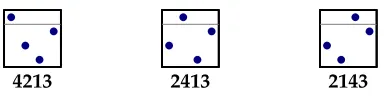
[image:4.612.196.391.249.299.2]4213 2413 2143
Fig. 2:The basis of classH
Proof:LetB={4213,2413,2143}. Suppose we have a gridding of a permutationπ∈H, and that β∈B. Inspection of Figure2shows that no more than one point of an occurrence ofβinπcan occur in the upper cell, or else it would contain a21, and neither can three or more points ofβ occur in the lower cell, or else it would contain a213. ThusHis a subclass ofAv(B).
On the other hand, supposeσis a permutation inAv(B)of lengthn, and letτbe the maximal increasing subsequence ofσof the form(k,k+1, . . . ,n−1,n)for somek6n. Note that ifk >1, then, by the maximality ofτ, the termk−1 occurs to the right ofkinσ.
We claim thatσ can be gridded inH by placing the points ofτin the upper cell, and any remaining points in the lower cell. Clearly,τavoids21. Suppose there was an occurrence of213 in the lower cell. Inspection of Figure2shows that, sinceσavoids elements ofB, the occurrence of213must occur to the left of all the points in the upper cell. However, in this case, the leftmost two points of this213together withkandk−1 would form a2143, which is impossible because σavoids2143. ThusAv(B)is a subclass ofH.
Proposition4can also be deduced from Atkinson [2, Theorem 2.2], which specifies the struc-ture of basis elements of juxtapositions of finitely based permutation classes.
Bloom & Burstein also enumerateH. We present our own proof here so that we can make use of it later when considering classD.
Proposition 5([7, Lemma 1.6]). The generating function forH=Av(4213,2413,2143)is
H(z) = 1−3z+2z
2−√1−6z+5z2
2z(2−z) .
Fig. 3:The canonical gridding of a permutation inH
σinH, and refer to the points in the top cell as thetop points. Clearly, there is a bijection between permutations inHand their canonical griddings.
The minimality of the set of top points implies that they all occur to the right of the first occurrence of a21in the lower cell. In other words, the leftmost top point must be to the right of the (tip of the) trunk of the upper tree and not adjacent to it.
We use the symbolic method to construct the class, marking top points withtfor clarity (al-though we don’t actually need an extra catalytic variable). The structural equations are as fol-lows:
P = SEQ+[Z] (1)
T = TREEZ×SEQ[tZ] (2)
U = P + SEQ+[Z]×(Z×SEQ+[T])×SEQZ×SEQ[T] (3)
H = U × SEQ[T] (4)
In (1), we usePto denote a tree consisting only of a trunk (apathtree).
In (2), we useTto denote a tree together with any top points that occur to the right of some of its vertices. In Figure3, the dashed lines illustrate how the top points are associated with the trees.
In (3), we useUto denote the upper tree, together with its top points. This is either a path tree (with no top points), or else is constructed (tip downwards) from
(i) at least one point on the trunk above the uppermost branching point,
(ii) the uppermost branching point on the trunk, rooting at least one subtree, which may have top points to the right of some of its vertices, and
Finally, in (4), the classHis constructed from the upper tree,U, and zero or moreTtrees. Translation into functional equations yields:
T(z,t) = z
(1−tz)(1−T(z,t)),
U(z,t) = z 1−z +
z 1−z ×
zT(z,t) 1−T(z,t)×
1 1−1−Tz(z,t),
H(z,t) = U(z,t) 1−T(z,t).
Solving, expanding, simplifying and rearranging gives
H(z,t) = 1− (t+2)z+2tz 2−p
1− (2t+4)z+t(t+4)z2 2z(t+1−tz) . The univariate generating function then results from settingt=1.
From the generating function, we can determine the following asymptotic behaviour.
Corollary 6. Asymptotically,|Hn| ∼ 185 q
5 π5
nn−3/2 and the number of top points in the canonical
gridding of a permutation inHnis normally distributed with mean n5 and standard deviation2
√
n 5 .
Proof:These results follow in the standard way from singularity analysis and the extraction of moments from the generating function.
The asymptotics of|Hn|results from the application of Proposition1to the first nonconstant term of the Puiseux expansion forH(z)around its dominant singularityρ= 15:
H(z) ∼ 23 − 5
√
5 9
√
1−5z + O(1−5z).
The asymptotic mean and standard deviation for the number of top points follow by the appli-cation of Propositions1and2. It is also readily verified thatH(z,t)is amenable to Proposition3. Indeed, in the notation of that proposition, we have
A(z,t) = 1− (t+2)z+2tz 2
2z(t+1−tz) ,
B(z,t) = −1 2z(t+1−tz),
C(z,t) = 1− (2t+4)z+t(t+4)z2,
and the exponentα = 1/2. The relevant conditions are then satisfied for anyr ∈ [1/5, 1)and ε ∈ (0, 1), withρ = 1/5, as expected, being the unique root ofC(z, 1) = 0 whose magnitude is at mostr. The number of top points thus exhibits a Gaussian limit distribution concentrated aroundn/5.
Av(4213) S
G = Av(21)
Av(21)Av(213) S
D = Av(4213,2143) S
H = Av(4213,2413,2143) = Av(21)
Av(213)
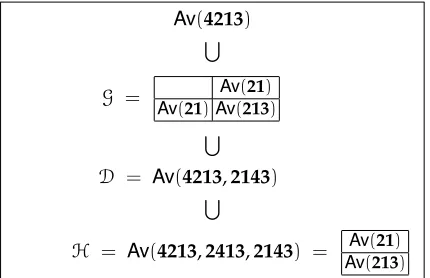
[image:7.612.185.400.112.251.2]Av(4213)is enumerated byA022558,DbyA165537, andHbyA033321.
Fig. 4:The permutation class hierarchy
3
Av(4213,2413)
Let us now turn to a consideration of the structure and enumeration of classD. In the first two propositions, we present a characterisation of the class, which we then use to enumerate the class in our main theorem. We conclude by determining some asymptotic properties.
Proposition 7. The classD= Av(4213,2143)is a subclass ofG = Av(21)
Av(21)Av(213) , which is itself a subclass ofAv(4213).
These class inclusions are illustrated in Figure4.
Proof:Supposeσis a permutation inDof lengthn, and letτbe the maximal increasing subse-quence ofσof the form(k,k+1, . . . ,n−1,n)for somek6n. Ifk >1, then, by the maximality ofτ, the termk−1 occurs to the right ofkinσ. Now let λbe the maximal increasing prefix (σ1, . . . ,σj)of(σ1, . . . ,σk−1). Ifσj+1< k, then, by the maximality ofλ, we haveσj+1< σj.
We claim thatσcan be gridded inGby placing the points ofτin the upper right cell, the points ofλin the lower left cell, and any remaining points in the lower right cell. Clearly, bothτandλ avoid21. Suppose there was an occurrence of213in the lower right cell. The pointkcan’t occur to the left of the213, since that would form a4213. Thusk−1 occurs to the right ofk,σj+1< k, and thusσj+1< σj. But that is impossible, because the pointsσj,σj+1,kandk−1 would form a2143.
On the other hand, we claim that there is no gridding ofπ = 4213inG. From Proposition4, we know that such a gridding would require at least one point in the lower left cell. Moreover, only the first point ofπcan occur in that cell without creating a21there. But, if the lower left cell were to contain only the first point ofπ, then its remaining points would form a213in the lower right cell.
use of the concept of a top or left pointsplitting(part of) a tree in the lower right cell. A top point splits (part of) a tree if it occurs to the right of its leftmost point and to the left of its rightmost point. Analogously, a left point splits (part of) a tree if it occurs above its lowermost point and below its uppermost point. Splitting is illustrated in the figures by pale stripes.
Proposition 8. A gridding of a permutation inGavoids2143if and only if
(a) no left point splits a tree below its uppermost non-trunk vertex, and (b) if a left point splits a tree, then no top point splits its trunk.
Proof:If a left point`splits a tree below its uppermost non-trunk vertex, then`and the root, tip and uppermost non-trunk vertex of the tree form a2143. Similarly, if a left point`splits a tree and a top pointtsplits its trunk, then`, the root of the tree,tand the tip of the tree form a2143.
[image:8.612.227.356.273.329.2]Γ1 Γ2
Fig. 5:The two griddings of2143inG
On the other hand, there are only two griddings of2143inG, which we denoteΓ1 andΓ2 as shown in Figure5. A gridding of a permutation inGcan only contain an occurrence ofΓ1if the left point ofΓ1splits a tree below its uppermost non-trunk vertex. If a gridding of a permutation inGcontains an occurrence ofΓ2but no occurrence ofΓ1, then the left point ofΓ2splits a single edge in the trunk of a tree and the top point ofΓ2splits the same edge.
We are now in a position to enumerateD.
Theorem 9. The generating function forD=Av(4213,2143)is
D(z) =
(1−2z)−1+5z−7z2+2z3+ (1−z)√1−6z+5z2
1−10z+24z2−20z3+4z4 .
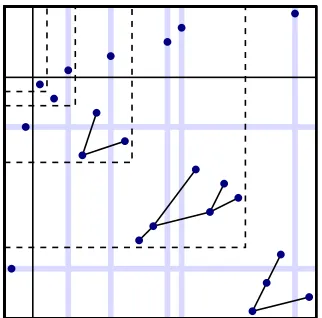
Proof:For each permutationσinD, we consider the gridding ofσinGin which the number of left points is minimal, with the remaining points canonically gridded (as a gridding inH) in the two cells at the right. See Figure6for an illustration. We call this thecanonicalgridding ofσin
G. Clearly, there is a bijection between permutations inDand their canonical griddings inG. The minimality of the set of left points implies that the uppermost left point is the first point in an occurrence of2413. Since the leftmost top point occurs to the right of a21in the lower left cell, this2413must be gridded as in Figure7. This is the case if and only if the uppermost left point splits a tree and this tree is not the upper tree.
Fig. 6:The canonical gridding inGof a permutation inD
Fig. 7:The canonical gridding of2413inG
(a) No left point splits a tree below its uppermost non-trunk vertex. (b) If a left point splits a tree, then no top point splits its trunk.
(c) The uppermost left point splits a tree and this tree is not the upper tree.
(d) The leftmost top point occurs to the right of the (tip of the) trunk of the upper tree and not adjacent to it.
Let us consider the set of permutations inDcontaining2413(i.e. those whose griddings have at least one left point).
As in the proof of Proposition5, we use the symbolic method to construct this set, reusing the definitions ofP,TandUin (1)–(3) in the proof of Proposition5. We mark left points with` and top points with tfor clarity (although, again, we don’t actually need any extra catalytic variables for the enumeration). In Figure6, the dashed lines illustrate how top and left points are associated with the trees.
The structural equations are as follows:
L = Z×SEQZ×SEQ[`Z] (5)
Q = (L−P)×SEQ[tZ] (6)
S = Q + Q×SEQ+[T]×SEQZ×SEQ[T]
(7)
D \ H = U × SEQ[T] × S × SEQSEQ[`Z]×(T+S)
[image:9.612.272.310.310.350.2]In (5), we useLto denote a path tree together with any left points that split it.
In (6), we useQto denote a path tree split by at least one left point, together with any top points that occur to its right. By constraint (b), a path tree may not be split by both left and top points.
In (7), we useSto denote a tree split by at least one left point, together with any top points that occur to the right of some of its vertices. By constraint (b), these top points must occur to the right of its tip.
An element ofSis either a path tree split by at least one left point, or else is constructed (tip downwards) from
(i) the trunk above the uppermost branching point, split by at least one left point, which may have top points to the right of the tip,
(ii) at least one subtree rooted at the the uppermost branching point on the trunk, which may have top points to the right of some of its vertices, and
(iii) any points on the trunk below the uppermost branching point, each possibly rooting a subtree that may have top points to the right of some of its vertices.
Finally, in (8), the set of canonical griddings of permutations inD whose griddings have at least one left point is constructed, starting at the upper left, from
(i) the upper tree, which, by constraint (c), is never split by a left point, (ii) zero or moreTtrees, which are not split by a left point,
(iii) aStree, split by the uppermost left point,
(iv) zero or moreTorStrees, each possibly with left points above it, and (v) zero or more left points below the lowermost tree.
Translation into functional equations yields:
L(z,t,`) = z 1−1−z` z,
Q(z,t,`) = L(z,t,`) − z 1−z
1
1−tz,
S(z,t,`) = Q(z,t,`) + Q(z,t,`)T(z,t) 1−T(z,t) ×
1 1−1−Tz(z,t),
D(z,t,`) −H(z,t) = U(z,t) 1−T(z,t)×
S(z,t,`)
1− 1−1` z T(z,t) +S(z,t,`)× 1 1−`z.
Solving, expanding, simplifying and rearranging yields a (very complicated) algebraic expres-sion forD(z,t,`). The univariate generating function then results from settingt= 1 and`= 1 and simplifying.
Corollary 10. The following properties hold in the limit:
(i) Asymptotically,|Dn| ∼12160 q
5 π5
nn−3/2, so the probability that a random large permutation
avoid-ing4213and2143also avoids2413tends to121 216 >
1 2.
(ii) The number of left points in the canonical gridding of a permutation inD has asymptotic mean 175
132 ≈1.326and standard deviation
√
74795
132 ≈2.072.
(iii) The number of top points in the canonical gridding of a permutation inDnis normally distributed with meann
5 and standard deviation 2√n
5 .
Proof:For part (i), the asymptotics of|Dn|results from the application of Proposition1to the first nonconstant term of the Puiseux expansion forD(z)around its dominant singularityρ= 15:
D(z) ∼ 119 − 129
√
5 121
√
1−5z + O(1−5z).
Note that, although the denominator of the expression forD(z)has a real root whose value is 1
4 5+ √
5−p22+10√5
≈0.143922<1/5, this value is also a root of the numerator.
The ratio|Hn|/|Dn|gives the proportion of permutations inDavoiding2413. The asymptotic limit of this ratio is121216.
For part (ii), substitutingt=1 and simplifying yields
D(z, 1,`) =
(1−z−z`)P1(z,`) − (1−z`)(1−`+z`+z`2) √
1−6z+5z2
2zP2(z,`)
,
where
P1(z,`) = (1−`) − z(3−3`−2`2) + z2(2−4`−7`2−`3)
+ z3(2`+9`2+3`3) − z4(2`2+2`3),
P2(z,`) = (2−3`) − z(3−5`−8`2) + z2(1−3`−15`2−7`3)
+ z3(`+8`2+9`3+2`4) − z4(`2+2`3+`4).
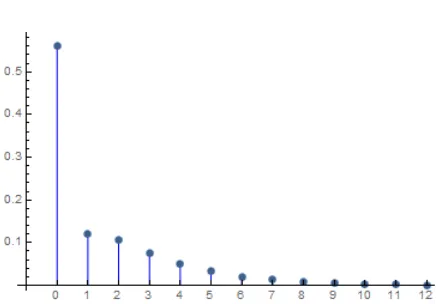
The asymptotic mean and standard deviation for the number of left points follow by the appli-cation of Propositions1and2. The limiting distribution is illustrated in Figure8.
For part (iii), , substituting`=1 and simplifying yields
D(z,t, 1) =
(1−2z)P3(z,t) − (1−z)(1+t−2tz) p
1− (2t+4)z+t(t+4)z2
2P4(z,t)
,
where
P3(z,t) = (1−2z)(1−tz) (1+t)(1−3z) +2tz2,
P4(z,t) = −1 + (7+3t+t2)z − (14+14t+6t2)z2 + (9+22t+13t2)z3
Fig. 8:The asymptotic distribution of the number of left points in the canonical gridding of a permutation in classD
The asymptotic mean and standard deviation for the number of left points follow by the appli-cation of Propositions1and2.
AlthoughD(z,t, 1)can easily be expressed in the formA(z,t) +B(z,t)pC(z,t), when this is done, bothA(z, 1)andB(z, 1)have singularities atz≈0.143922< 15. Thus, Proposition3is not applicable and can’t be used to deduce an asymptotic Gaussian distribution.
However, it is not difficult to rearrange the functional equations to show thatD=D(z,t, 1)is a solution of the following system of polynomial equations,
R1 = 1 + zR1
R2 = 1 + ztR2
T = zR2 + T2
R3 = 1 + T R3
R4 = 1 + zR3R4
S = z3R21R2(1+T R3R4) + zR1S
R5 = 1 + R1(T+S)R5
D = zR1R3(1+zT R3R4)(1+R1SR5),
in whichT = T(z,t)andS = S(z,t, 1). The significance of this particular reformulation is that each polynomial has positive coefficients. This allows us to apply a variant of the limiting distri-bution version of the Drmota–Lalley–Woods Theorem [10], which states that, under very general conditions, a parameter of a combinatorial class satisfying such a system of equations exhibits a Gaussian limit law (see also [12, Proposition IX.17 and subsequent discussion]).
The first twelve terms of the sequence|Dn|are 1, 2, 6, 22, 88, 366, 1556, 6720, 29396, 129996, 580276, 2611290. More values can be found atA165537in OEIS [16].
4
Questions
The somewhat unexpected result that more than half of the permutations inAv(4213,2143)are, in fact, members ofAv(4213,2413,2143), is a consequence of the fact that|Hn|/|Dn|has a positive limit asntends to infinity. This phenomenon deserves further investigation, as does the weaker property that the growth rates ofHandDare equal: gr(H) =gr(D).
Question 11. When is lim n→∞
Avn(B∪{β})
Avn(B)
positive?
Question 12. When do we havegr Av(B∪{β})=gr Avn(B)
?
We conclude with the observation which initiated this investigation. SupposeK={S1, . . . ,Sk} is a finite collection of permutation classes. We say that another permutation class C is K -griddableif there is a finite matrixMeach entry of which is one of theSi, such thatCis a subset of the generalised grid classGrid(M). Vatter gave the following characterisation of the property of beingK-griddable.
Proposition 13(Vatter [17, Theorem 3.1]). The permutation classCisK-griddable if and only if it does not contain arbitrarily long sums or skew sums of basis elements of members ofK, that is, if there exists a constantmso thatCdoes not containβ1⊕. . .⊕βmorβ1 . . . βmfor any sequenceβ1, . . . ,βm of basis elements of members ofK.
Consequently, three of the permutation classes avoiding two patterns of length four that were still waiting to be enumerated when this paper was first written (see [19]) are subclasses of a generalised grid class.
• Av(4312,3214)is{Av(12),Av(321)}-griddable.
• Av(4231,3214)is{Av(12),Av(321)}-griddable. • Av(4132,3214)is{Av(132),Av(321)}-griddable.
Miner [15] has subsequently derived the generating functions for these classes, using techniques very similar to those used here.
Acknowledgements
The author is grateful to Cyril Banderier for pointing him in the right direction concerning prov-ing the Gaussian limit law for top points inD. Michael Albert’sPermLabsoftware [1] was helpful for visualising the structure of permutations in classD.Mathematica[20] was used for algebraic manipulation.
References
[1] Michael Albert. PermLab: Software for permutation patterns.www.cs.otago.ac.nz/PermLab, 2012.
[2] M. D. Atkinson. Restricted permutations.Discrete Math., 195:27–38, 1999.
[3] Cyril Banderier and Michael Drmota. Formulae and asymptotics for coefficients of algebraic func-tions.Combin. Probab. Comput., 24(1):1–53, 2015.
[4] David Bevan. Permutation patterns: basic definitions and notation.arXiv:1506.06673, 2015.
[5] David Bevan. Permutations avoiding 1324 and patterns in Łukasiewicz paths. J. London Math. Soc., 92(1):105–122, 2015.
[6] David Bevan. The permutation classes Av(1234,2341) and Av(1243,2314). Australasian J. Combin., 64(1):3–20, 2016.
[7] Jonathan Bloom and Alexander Burstein. Egge triples and unbalanced Wilf-equivalence.Australasian J. Combin., 64(1):232–251, 2016.
[8] Mikl ´os B ´ona. Combinatorics of Permutations. Discrete Mathematics and its Applications. CRC Press, second edition, 2012.
[9] Mireille Bousquet-M´elou and Steve Butler. Forest-like permutations.Ann. Comb., 11:335–354, 2007.
[10] Michael Drmota. Systems of functional equations. Random Structures Algorithms, 10(1–2):103–124, 1997.
[11] Philippe Flajolet and Andrew Odlyzko. Singularity analysis of generating functions.SIAM J. Discrete Math., 3(2):216–240, 1990.
[12] Philippe Flajolet and Robert Sedgewick.Analytic Combinatorics. Cambridge University Press, 2009.
[13] H.-K. Hwang. On convergence rates in the central limit theorems for combinatorial structures. Euro-pean J. Combin., 19(3):329–343, 1998.
[14] Sergey Kitaev.Patterns in Permutations and Words. Springer, 2011.
[15] Sam Miner. Enumeration of several two-by-four classes.Preprint.arXiv:1610.01908, 2016.
[16] The OEIS Foundation Inc. The On-Line Encyclopedia of Integer Sequences. Published electronically athttps://oeis.org.
[17] Vincent Vatter. Small permutation classes.Proc. London Math. Soc., 103(5):879–921, 2011.
[18] Vincent Vatter. Permutation classes. In Mikl ´os B ´ona, editor,The Handbook of Enumerative Combinatorics. CRC Press, 2015.
[19] Wikipedia. Enumerations of specific permutation classes. http://en.wikipedia.org/wiki/Enumera tions of specific permutation classes.