City, University of London Institutional Repository
Citation
:
Piyathasanan, B., Mathies, C., Patterson, P. and de Ruyter, K. (2017).Continued Value Creation in Crowdsourcing from Creative Process Engagement. Journal of Services Marketing, doi: 10.1108/JSM-02-2017-0044
This is the accepted version of the paper.
This version of the publication may differ from the final published
version.
Permanent repository link: http://openaccess.city.ac.uk/18159/
Link to published version
:
http://dx.doi.org/10.1108/JSM-02-2017-0044Copyright and reuse:
City Research Online aims to make research
outputs of City, University of London available to a wider audience.
Copyright and Moral Rights remain with the author(s) and/or copyright
holders. URLs from City Research Online may be freely distributed and
linked to.
City Research Online: http://openaccess.city.ac.uk/ [email protected]
Journal of Services Marketing
Continued Value Creation in Crowdsourcing from Creative Process Engagement
Journal: Journal of Services Marketing
Manuscript ID JSM-02-2017-0044.R3
Manuscript Type: Article
Keywords:
Crowdsourcing, Creative process engagement, Value creation,
Disconfirmation of Expectation, Need for recognition, Honeymoon hangover effect
Journal of Services Marketing
1
CONTINUED VALUE CREATION IN CROWDSOURING FROM
CREATIVE PROCESS ENGAGEMENT
Abstract
• Purpose
Crowdsourcing delivers creative ideas for the issuing firm, but participants’
engagement in the creative process also creates additional benefits to firms and participating customers. To investigate if these spill-over values endure over time, this study uses data from two time points, i.e. at submission and after announcement of the contest winners, to investigate the relationship between the degree of a participant’s creative process engagement (CPE) and value creation from a crowdsourcing contest, and how these perceptions of value change over time.
• Design/methodology/approach
Data was collected from 154 participants in a crowdsourcing contest at two time points with an online survey: at submission, and after receiving feedback (in term of rankings, rewards, and comments) from the community. Partial Least Square (PLS) path modelling was used to estimate both main and moderating effects.
• Findings
CPE increases the perceived value of customers (social and epistemic value) and firms alike (knowledge-sharing intention and customer loyalty), though all but epistemic value decrease over time. Disconfirmation of expectations and need for recognition moderate these effects.
• Originality/value
This paper is the first longitudinal study that helps understanding the effect of CPE on value creation from crowdsourcing across time. It also uses the theoretical lens of the honeymoon hangover effect to explain how perceived value changes. The resulting insights into the role of customer engagement in crowdsourcing contests and subsequent value creation will be beneficial to the growing research stream on consumer value co-creation and user innovation.
Keywords: Crowdsourcing, Creative process engagement, Value creation,
Disconfirmation of expectation, Need for recognition 2
Journal of Services Marketing
2
Introduction
Crowdsourcing is a problem-solving and production platform that enhances customer
engagement and value creation (Yang et al., 2008) by using the collective intelligence of
networked communities (Piller, 2008). Crowdsourcing tasks range from simple to highly
complex. Leading firms such as Coca Cola, DELL, and P&G have outsourced complex tasks
which demanded a higher level of cognitive capability, and required more effort in the
problem-solving process, than a typical crowdsourcing activity (Dontcheva et al., 2011, Howe,
2009, Poetz and Schreier, 2012). For example, Cisco launched a billion-dollar global idea
competition named Cisco I-Prize, calling for innovative ideas on technologies and markets to
help Cisco widen its business scope. In 2010, Cisco invited entrepreneurs, innovators, students
and technologists to submit new business ideas. The winning team earned $250,000. More than
2,900 participants from 156 countries submitted 824 ideas to the contest (Roth, 2012).
Crowdsourcing plays an important role in service innovation (Ye and Kankanhalli,
2013, Mladenow et al., 2014, Ordanini and Parasuraman, 2011). The aim is to obtain
authentic, innovative ideas and solutions of crowds that are believed to be of a professional
calibre (Poetz and Schreier, 2012), though additional value from engaging in a crowdsourcing
contest might be equally attractive (Piyathasanan et al., 2013) and independent from the
quality of ideas generated. Value creation is considered an important manifestation of
customer engagement behaviour (Kumar et al., 2010, Dong et al., 2008, Hollebeek, 2013,
Hollebeek et al., 2016). Customer engagement and relationships researchers urge
organisations to co-create value with their customers through a wider range of marketing
activities (Venkatesan, 2017). In a crowdsourcing context, creative performance is the direct
benefit of creative process engagement (CPE) (Bakker and Demerouti, 2008, Sapp, 1995,
Mace and Ward, 2002), yet firms may also enjoy additional value from customer engagement 2
Journal of Services Marketing
3
over time, a notion recently acknowledged in the customer engagement literature (Pansari
and Kumar, 2017). Customers may for example contribute to a firm’s value by offering their
knowledge (such as in creative crowdsourcing), but also through product purchases, other
loyal behaviours and indirect ripple effects from customer engagement. Recent empirical
evidence shows that customers’ CPE in a crowdsourcing task can create other types of value
for both firms and participants, such as customer loyalty (firm value), and epistemic value
(customer value) (Piyathasanan et al., 2013, Djelassi and Decoopman, 2013). Indeed,
customer value creation is a likely outcome of customer engagement. Such value creation is
important, as many large firms are encountering challenges in monitoring and appraising
whether crowdsourced solutions lead to competitive, sustainable advantages (Jones et al.,
2013). Firms would benefit from a clearer understanding of how CPE can facilitate value
creation in the first place, and how to sustain it over time.
To explain the challenge, the paper turns to the (dis)confirmation of expectation
paradigm commonly used in the customer satisfaction literature. Since “crowdsourcing
initiatives hinge on individuals’ willingness to participate in these projects and their
motivation to contribute valuable insight and ideas” (Füller et al., 2012, p. 137), they are
typically organized as a competition or contest. A contest creates expectations for
participants about the ranking of their submissions and associated monetary and
non-monetary rewards. Only a few winning participants receive extrinsic recognition and rewards
from the contest. The winners’ expectations are seemingly met, if not exceeded, resulting in
perceived value from their participation and engagement in the crowdsourcing contest, and
thus subsequent satisfaction with their engagement. However, most participants are likely to
experience disappointment, leading to lower value perceptions and subsequent
dissatisfaction. 2
Journal of Services Marketing
4
Accordingly, this paper aims to examine:
1. the association between customer engagement in a crowdsourcing contest, and
the resulting value creation for customers and/or the firm beyond the time of
submission;
2. the extent to which customer perceived value and firm value shifts between the
time of submission, and once participants learn of how well they fared in the
crowdsourcing contest;
3. the extent to which participants’ disconfirmed expectations and their need for
recognition moderate the association between customer engagement, and
perceived firm and customer value following the announcement of the
crowdsourcing results.
The study offers two specific contributions to the literature. First, it serves as an
initial effort to investigate if and how the value created from customer engagement in
crowdsourcing (operationalised as creative process engagement [CPE]) changes over time.
Previous studies suggest that CPE creates value beyond the creative submission, but it is
unclear how this value endures or changes over time (Piyathasanan et al., 2013, Djelassi and
Decoopman, 2013). This study uses longitudinal data, collected at completion of the contest
(Time 1) and announcement of winners and rankings (Time 2), and applies the lens of the
honeymoon-hangover effect (Collins and Coltrane 1995), which indicates that perceptions of
satisfaction (and associated value) may initially be inflated in a new relationship, but
deteriorates over time.
The study also empirically examines under which conditions the CPE-value link
varies, as a function of a participant’s disconfirmed expectations and need for recognition. In 2
Journal of Services Marketing
5
other words, the study not only shows ‘what’ drives customer and firm value, but also
‘when’,i.e., under what conditions. The disconfirmation of expectations paradigm emphasises
the pivotal role of expectations in the creation of customer satisfaction (Oliver, 1980).
Beltramini and Evans (1988) found that employee’s expectations in a sales contest (i.e., “I
expect to win”) were positively correlated with job satisfaction and performance; an effect that
might be equally applicable in a crowdsourcing context, where participants invest time and
effort and expect a good result. The need for recognition has previously been identified as an
important driver of customer engagement and contribution in crowdsourcing (Djelassi and
Decoopman, 2013, Brabham, 2008), because social appreciation and feedback from other
people (e.g., peers and judges), or from an activity that they engage in, leads to positive
subsequent behaviour (such as long-lived, highly-engaged participants) and value
perceptions (Sawhney et al., 2005).
Conceptual development
We build on creativity theory, which establishes CPE as a central tenet (e.g., Gilson
and Shalley, 2004, Zhang and Bartol, 2010a), and customer satisfaction research (Oliver, 1980,
McKinney et al., 2002) to develop a model to explain value creation and continuance. The
conceptual model is depicted in Figure 1. Value creation for the customer and the firm after
the announcement of winners and rankings (Time 2) is a function of CPE at the time of
submission (Time 1). Value creation from CPE beyond participation in the contest can be
explained by disconfirmation of expectation and need for recognition. In the subsequent
section, the study reviews existing literature in creativity and customer behaviour that is
relevant to the main conceptual building blocks of the model.
- Insert Figure 1 here – 2
Journal of Services Marketing
6
Creative (problem-solving) process engagement (CPE)
In a crowdsourcing contest (i.e., a creative advertising idea generation) that is
considered complex and involves extended effort in creative problem-solving processes
(Gilhooly et al., 2007), creativity is instrumental. Any type of engagement requires
involvement and participation in a focal object (Brodie et al., 2011). Engagement in the
creative process differs from ordinary involvement with a non-creative task, though it is
comparable in that it refers to positive attachment to an activity consistent with the
individual’s values (Zaichkowsky, 1985). As with other forms of customer engagement, the
creative process entails stronger cognitive and affective commitment, by spending time and
effort, to generate ideas or solutions over time (Mollen and Wilson, 2010, Gilson et al.,
2005). Creative process engagement (CPE) is thus introduced as the main construct to capture
participants’ engagement with the crowdsourcing contest until idea submission, and consists
of three crucial aspects: problem identification, information search and idea generation
(Reiter-Palmon and Illies, 2004, Zhang and Bartol, 2010a).
CPE and value creation
Customer engagement creates value (Dong et al., 2008, Brodie et al., 2011), an
effect which also extends to CPE where value creation is either direct or indirect: besides the
direct benefit of a usable creative solution, firms may enjoy additional effects from CPE
beyond Time 1 (e.g., enhancing firm-customer relationships and social interactions), as may
participating customers.
Firms often use online communities and social networks to host crowdsourcing
contests, as these platforms fulfil the human needs for social interaction and facilitate a sense 2
Journal of Services Marketing
7
of self-fulfilment (McInnerney and Roberts, 2004). Understanding why and how individuals
engage in specific media to satisfy their needs helps identify two customer value perceptions
relevant to crowdsourcing: social value and epistemic value (Nambisan and Baron, 2009). CPE
is therefore expected to result in social value (e.g., firm-customer relationship and reciprocity)
and epistemic value (e.g., satisfy or arouse curiosity, and self-fulfilment) for participating
customers (Jackson, 2002, Greaves and Farbus, 2006, Kozinets et al., 2008).
Social value arises where individuals perceive a sense of community and friendship
through interaction with others (Reidpath et al., 2005), an effect well documented in studies
on online collaborative communities (e.g., Chung and Buhalis, 2008). Collaborative
crowdsourcing platforms enable participation and social interaction with others (Brabham,
2009) due to embedded socialising functions (e.g., websites, web-board, online communities
and Facebook) (Leimeister et al., 2009, Schenk and Guittard, 2011). Accordingly, a higher
degree of CPE in a crowdsourcing contest should enhance the participant’s perceived social
value beyond Time 1:
Hypothesis 1: The higher the CPE at submission (Time 1), the more social value is
created after receiving feedback (Time 2).
Epistemic value, or self-fulfilment, is created if an individual is satisfied with his/her
aroused curiosity, fulfilled knowledge, and/or improved skills (Sheth et al., 1991). Epistemic
value is an important outcome for various crowdsourcing types, such as Wikipedia and
crowdfunding (Fallis, 2008), because the challenge of tackling creative problems arouses
curiosity. Participants may then satisfy their curiosity by engaging in the creative process to
solve these problems; CPE should thus enhance epistemic value perceptions (Hars and Ou,
2002). 2
Journal of Services Marketing
8
Hypothesis 2: The higher the CPE at submission (Time 1), the more epistemic value
is created after receiving feedback (Time 2).
Customer value perceptions are a key predictor of subsequent behaviours such as
loyalty, satisfaction, intention to recommend and re-purchase (Fornell et al., 1996,
Sirdeshmukh et al., 2002, Cronin et al., 2000). For example, customers stay loyal to a firm if
they perceive greater value than they expect to obtain from competitors (Bitner and Hubbert,
1994). Similarly, McDougall and Levesque (2000) suggest that perceived value leads to less
brand switching and greater customer loyalty.
For firms hosting crowdsourcing contests, knowledge-sharing intentions and customer
loyalty are critical outcomes of customer value perceptions, above and beyond the quality of
the creative submissions. Knowledge-sharing intention is the willingness to collaborate and
contribute relevant knowledge and ideas to the firm (Desouza and Awazu, 2005), for example
by participating in future crowdsourcing contests. The customer engagement literature also
establishes how customers' voluntary contributions, such as offering their knowledge, skill
and creativity, create firm value (Harmeling et al., 2017, Hollebeek et al., 2014). Customer
loyalty captures the intention to continue a good relationship with a firm, through positive
word-of-mouth and repurchasing (Dick and Basu, 1994). The link between social and epistemic
value perceptions, behavioural intentions and customer loyalty is well established in online
marketing research (see e.g., Cheng et al., 2009, Gruen et al., 2006). Bitner et al. (2008) argue
that service firms can achieve loyalty through memorable and meaningful experiences, as
simply providing a superior core service no longer guarantees loyalty. Creative crowdsourcing
and resultant customer value may constitute such an experience. We thus posit that social and
epistemic value, as components of consumers’ overall perceived value from crowdsourcing 2
Journal of Services Marketing
9
after receiving feedback (Time 2), would equally lead to knowledge-sharing intention and
customer loyalty in a crowdsourcing context.
Hypothesis 3: Social value perception is positively related to (a) knowledge-sharing
intention and (b) customer loyalty.
Hypothesis 4: Epistemic value perception is positively related to (a)
knowledge-sharing intention and (b) customer loyalty.
Honeymoon-hangover effect and a change in value creation over time.
To explain how value created in a crowdsourcing contest may change over time, we
tap into a phenomenon known as the ‘honeymoon-hangover effect’ in social psychology. The
honeymoon effect is “a positive initial effect on satisfaction or performance attributed to
conditions that are most favourable at the early stages of a new relationship or venture, in
comparison to conditions encountered as the relationship or venture continues” (Dacko, 2007,
p.255). Just like in marital satisfaction during the honeymoon period (Easterlin, 2003),
novelty, anticipation, excitement, harmony, or similar positive factors, may be at play
(Collins and Coltrane, 1995, Dacko, 2007).
However, the honeymoon effect is temporary because satisfaction with
collaborative relationships may change over time, often due to unfavourable situational
factors or events such as unexpected feedback, unfulfilled expectations or misunderstanding
(McEvoy et al., 2005, Dacko, 2007). The announcement of contest winners and feedback to
all participants is a discrete unexpected event. The resulting honeymoon-hangover effect has
been observed in various areas, such as the attendance rate and use of new sport facilities, the 2
Journal of Services Marketing
10
adoption of information technology, and new employment in an organization (Fichman and
Kemerer, 2012, Boswell et al., 2005, McEvoy et al., 2005). For example, early in the IT
development cycle, innovative technologies typically enjoy a honeymoon effect as there is
widespread adoption from an immature market, then the rate of adoption drops over time
(Fichman and Kemerer, 2012).
We examine the value creation from CPE in a crowdsourcing contest through the
honeymoon-hangover effect, because customers’ value perceptions at the time of submitting
their solution (Time 1) might change once they receive the contest results, such as rewards,
ranking and feedback from peers and judges about their creative performance (Time 2). That
is, while initial value perceptions tend to be particularly positive, we predict a decline over
time. Except for the few winners of the contest, participants may be disappointed with the
unexpected feedback and unmet expectation, resulting in a decrease of value perceptions
from Time 1 to Time 2.
Hypothesis 5: When participants receive feedback (Time 2), their perceptions of (a)
social value; and (b) epistemic value will be lower than at Time 1.
Hypothesis 5: When participants receive feedback (Time 2), firm’s value from (c)
knowledge-sharing intention; and (d) customer loyalty, will be lower than at
Time 1.
Disconfirmation of expectation paradigm
In how far the CPE-value link is subject to a honeymoon-hangover effect obviously
depends on the presence and valence of unexpected feedback, i.e. the (positive or negative)
disconfirmation of participants’ expectations. Based on the disconfirmation of expectation
paradigm, customer satisfaction depends on the consistency between an individual’s initial 2
Journal of Services Marketing
11
performance expectations and perceived performance (e.g., Oliver, 1980, Patterson, 1993).
Customers are satisfied when they experience positive disconfirmation, i.e. when perceived
performance exceeds prior expectations, and conversely dissatisfied when experiencing
negative disconfirmation (e.g., Oliver, 1980, Patterson et al., 1996). Note that customers may
be satisfied with poor performance if prior expectations are relative low. For example,
participants who receive a low ranking from a crowdsourcing contest may in fact be satisfied
with the feedback because they did not expect much. We thus argue that the association
between CPE and social and epistemic value is stronger when a participant’s expectation
about their ranking and rewards from the contest are exceeded. Such an interaction effect
would also predict a weaker link when a participant’s creative performance ranking is lower
than they initially expected.
Hypothesis 6: The impact of CPE at Time 1 on (a) social value and (b) epistemic
value at Time 2 will be stronger under conditions of a positive (rather than
negative) disconfirmation of expectation.
Need for recognition
The positive effect of CPE on value creation may further increase for participants
with a high need for recognition. This stable personality trait relates to “the need to have
one’s self, one’s works, and other things associated with one’s self, known and approved by
others” (Schaffer, 1953, p. 1). Member of any community tend to satisfy their need for
recognition by seeking feedback, praise, acceptance, respect, or attention from other members
such as peers, supervisors and judges (Busch et al., 2008). Whenever recognised and praised
for an accomplishment by others, an individuals’ satisfaction and enthusiasm to perform
better on the task or to have more social contact will increase (Hill, 1987, Brabham, 2008).
The positive effect of CPE on value creation is thus likely to be stronger for participants with 2
Journal of Services Marketing
12
a high need for recognition. Receiving feedback or rewards can reinforce an individuals’
perception as a valued contributor to the task (Taylor et al., 1984). For example, in their
investigation of innovation creation by online basketball communities, Fuller et al. (2007)
reported that designers, who are driven by the need for recognition and feedback from a
knowledgeable audience, contributed significant time and effort to designing basketball shoes,
and sharing their work with the online community. In turn, the designers expected to further
improve and fulfil their knowledge and skills from their contributions. Nambisan and Baron’s
(2009) study of customer participation and value co-creation activities found that need for
recognition may moderate the impact of interactions in a virtual customer environment (e.g.,
online discussion forums) on future participation behaviour. Accordingly, based on earlier
discussion, it is proposed that:
Hypothesis 7: The impact of CPE at Time 1 on (a) social value and (b) epistemic
value at Time 2 will be stronger under conditions of a higher (rather than
lower) need for recognition.
Methodology
Research setting and participants
Data was collected from participants in a creative crowdsourcing contest, conducted
by a leading national restaurant chain in Thailand with over 350 restaurants, annual sales
exceeding US$200 million, and annual marketing spend of about US$ 8 million. The contest
called for ‘new creative advertising ideas’ that may be used for the firm’s marketing
communication campaign in the following year; it was announced via the firm’s official
Facebook page, which had more than 100,000 followers. 2
Journal of Services Marketing
13
Potential contributors could register to participate in the crowdsourcing task via the
firm’s official microsite, which linked into the firm’s website and Facebook. The microsite was
used for registration, discussion, submission of creative ideas, and data collection. The contest
duration was 75 days. 250 participants submitted a total of 212 advertising ideas either
individually or as a part of a team. First- and second-place winners received a MacBook Pro
and iPad, respectively. Entries ranked third to tenth received a gift voucher worth $100 and a
certificate. All submitted ideas were rated by three subject-matter experts in the field of
advertising and marketing communication.
Online questionnaires were used in both Time 1 (i.e., upon submitting their
advertising ideas but before receiving any feedback) and Time 2 (i.e., after participants
received feedback in the form of ranking and/or rewards). The questionnaires were pre-tested
with 30 respondents, prior to the launch of the crowdsourcing contest, only requiring minor
revisions to improve overall understanding and content. When crowdsourcing participants
(N=250) submitted their advertising ideas (see examples of submitted ideas in Appendix D),
they were asked to participate in the study, and received a link to the Time 1 online
questionnaire. To minimise response bias, respondents were clearly informed that their
personal information was confidential and secure, and their responses would not affect their
contest results (Nestor and Schutt, 2011). Respondents were not forewarned about the Time 2
data collection, to minimize bias in responding to the second questionnaire (Churchill and
Iacobucci, 2009). Total valid responses at Time 1 were 219 (87.6% response rate). One
month after the closing date for idea submission, each participant received the ranking of
their submission from the judges, and any rewards. They were then immediately contacted by
telephone and email to seek cooperation and received a link to the Time 2 online
questionnaire. Two telephone follow-ups were undertaken after one and two weeks if no 2
Journal of Services Marketing
14
response was received, leading to a total of 154 valid responses (70% of respondents from
Time 1). For each data collection, respondents received a $5 incentive.
Measurement development
In both Time 1 and Time 2, the study used the same measurement to capture value
perception, including social value, epistemic value, knowledge-sharing intention and customer
loyalty. Scales were adapted from prior relevant studies that exhibited strong construct
reliability and validity, with minor wording modifications to fit the research context. All
measures, except disconfirmation of expectation, used a seven-point Likert scale, ranging from
“strongly disagree” to “strongly agree.” Social and epistemic value were each captured with
four items from Mathwick et al. (2008) and Sheth et al. (1991). Knowledge-sharing intention
was measured by three items adapted from Kumar et al. (2010), and seven indicators measuring
customer loyalty were drawn from Zeithaml et al. (1996). Cronbach’s alphas and composite
reliability for all constructs exceeded 0.70.
At Time 1, we also measured CPE with 11 items from Zhang and Bartol (2010), to
capture the three dimensions of problem identification, information searching, and idea
generation, and need for recognition with five items based on Hars and Ou (2002) and Wasko
and Faraj (2005). Demographic data (gender, age, education) were also collected, and we asked
questions related to the crowdsourcing task in this study (for example, time spent on the task
and perception of task complexity) and patronage behaviour (frequency, recency).
At Time 2, all value perceptions were measured again with the same scales as in Time
1. In addition, disconfirmation of expectations was measured as the perceived gap between
expectation and performance (McKinney et al., 2002), on a five point “Much worse than
expected” to “Much better than expected” scale (Oliver, 1980). 2
Journal of Services Marketing
15
Control variables
We included individual/team submission and prior relevant creative experience as
control variables, operationalized as dichotomous variables and measured at Time 1, though
little evidence supports the view that they influence customers’ perceived value in
crowdsourcing. Inclusion of these control variables is designed to provide a more robust test
of the hypotheses.
Analysis and Results
Data analysis
Partial Least Square (PLS) path modelling was used to estimate both main and
interaction effects. PLS path modelling method was most suited to our research because it is
more robust when a study has a relatively small sample size (Green and Ryans, 1990); when
a multivariate normal distribution cannot be assured and variables are highly skewed (Cassel
et al., 1999); and to estimate a complex model including second-order constructs with many
latent and manifest indicators (Venaik et al., 2005). To examine potential changes in value
perceptions at Time 1 and Time 2, paired-sample T-tests were used to examine differences
between the means for the two sets of scores from the same group of participants (Coakes and
Steed, 2007).
Half of the respondents (53.2%) were female, and most (89.0%) held at least a
bachelor’s degree. The average age was 26.7 years (SD = 9.8 years), and average patronage
was 8.5 years (SD = 5.1 years). Respondents visited a branch of the restaurant chain on
average 1.87 times a month. Almost half of them (46.8%) had relevant previous creative
experience, and about one quarter (26.0%) participated in this crowdsourcing task as a team
of two or three. 2
Journal of Services Marketing
16
Measurement Model: Validity and reliability
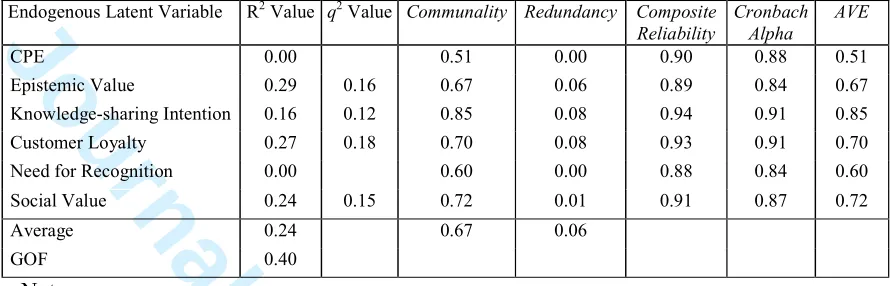
Internal reliability was established, as composite reliability (see Table 1) for all
multi-item constructs ranged from .88 to .94 and thus exceeded the recommended threshold
value of .70 (Hair et al., 2011). The average variance extracted (AVE) was used to establish
adequate convergent and discriminant validity (Fornell and Larcker, 1981). As seen in Table
1, the AVEs for all multi-item constructs range from .51 to .85, and thus meet the proposed
.50 rule-of-thumb (Bagozzi and Yi, 1988). The square root of each AVE (presented on the
diagonal in Table 2) is higher than the inter-correlations of the focal construct and any other
construct (presented off the diagonal) in the model, suggesting adequate discriminant and
convergent validity.
-
Insert Table 1 here -As reported in Table 1, the R-squares of each inner latent construct ranged from .16 to
.29, indicating weak to moderate values (Chin, 1998). Further, the global criterion for
goodness-of-fit (GoF) describes the structural model’s quality. Tenenhaus et al. (2005)
suggested that the GoF 0 ≤ ≤ 1 can be assessed by “the geometric mean of the average
communality and the average R-squares (for endogenous constructs):
= × .” The GOF value of .40 indicates large effect sizes (Wetzels et al.,
2009).
-
Insert Table 2 here -A PLS analysis was also conducted to determine whether interaction was present
between the hypothesized moderator variables and the predictor variable. Correlation 2
Journal of Services Marketing
17
between the two moderators (i.e., disconfirmation of expectation and need for recognition)
were also checked. The findings reveal that while disconfirmation of expectation is a pure
moderator variable, need for recognition is a quasi-moderator variable because it has a
moderate correlation with CPE (r = 0.56). Further, we also examined multi-collinearity issues
of the structural model by assessing a set of predictors of knowledge-sharing intention and
customer loyalty. The tolerance values and VIF values were above .20 and below the 5
threshold respectively, i.e. multi-collinearity among the predictor constructs is not present
(Hair, 2011).
Next, we examined the q2 value, obtained by using the blindfolding procedure in SmartPLS. As seen in Table 1, all q2 value of all endogenous latent constructs were larger than zero, indicating the model’s predictive relevance (Hair et al., 2011). Further, the
PLS-SEM model’s results were evaluated and assessed. The ƒ2 effect size indicated a level of
construct relevance in explaining selected endogenous latent constructs. Results of 0.02, 0.15,
and 0.35 were indicated - a small, medium, and large ƒ2 and q2 effect size respectively (Hair et al., 2014). As seen in Table 3, social and epistemic value has a small ƒ2 effect size in explaining
R2 value of knowledge-sharing intention. Additionally, while epistemic value has a small ƒ2
effect size in explaining R2 value of customer loyalty, social value has a medium ƒ2 effect size.
-
Insert Table 3 here -Results
We conducted a paired-samples t-test to examine the extent to which consumer
perceived value and firm value shifts across two time periods (Time 1 and Time 2). As seen
in Table 4, all mean values of customer perceived value in Time 1 were higher than those in
Time 2. The findings indicated that, after completion of a crowdsourcing contest, once 2
Journal of Services Marketing
18
participants were made aware of how well they fared in the contest, and whether or not they
received an extrinsic reward, their social value perceptions, knowledge-sharing intention and
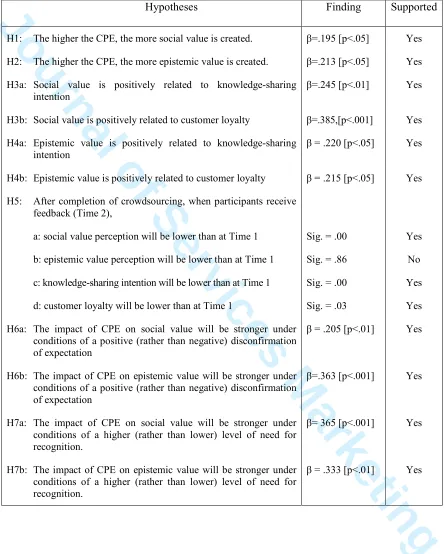
customer loyalty decreased (p< .05). However, their epistemic value perception did not
change over time. Hence, H5a, H5c, and H5d are supported, whereas H5b is rejected.
-
Insert Table 4 here -The structural model estimation results (Figure 2) show that all hypothesised
relationships were statistically significant (Table 5). The findings revealed that CPE drives
customers’ perceptions of social value (H1: β = .195 [p<.05]; R2 = 24.5%) and epistemic
value (H2: β = .213 [p<.05]; R2 = 29.3%). The results also suggested that knowledge-sharing
intention can be explained by social value (H3a: β = .245 [p<.01]) and epistemic value (H4a:
β = .220 [p<.05]), as can customer loyalty (R2 = 26.8%; H3b: β = .385 [p<.001]; H4b: β =
.215 [p<.05]).
-
Insert Figure 2 here -With regard to the moderating hypotheses, we calculated interaction terms by
multiplying the mean-centred indicators CPE as the predictor and each moderator (i.e.,
disconfirmation of expectation and need for recognition) (Chin et al., 2003). The beta values
of all moderator path coefficients were statistically significant. Both disconfirmation of
expectation and need for recognition exhibited positive moderating effects on social value
(H6a: β = .205 [p<.01]; H7a: β = .365 [p<.001]) and epistemic value (H6b: β = .363 [p<.001];
H7b: β = .333 [p<.01]). Finally, the individual/team submission and prior creative experience
control variables were not significant. 2
Journal of Services Marketing
19
Discussion and implications
Key findings
The empirical evidence summarised in Table 5 presented a number of interesting
findings. Firstly, CPE indeed drives customers’ social and epistemic value. This customer
value also converts into positive customer behaviours that create value for the crowdsourcing
host firm, namely knowledge-sharing intentions and loyalty. Extending on previous research,
firms thus receive extra value from investing resources in a crowdsourcing contest, in
addition to the quality of creative submissions. Value creation emerges both at the submission
stage and the announcement of winners. These findings contribute to current social
networking research, by illustrating a continuum of value creation over time from customer
engagement.
-
Insert Table 5 here -However, all value decreased over time, except epistemic value, a phenomenon
which can be explained by the honeymoon–hangover effect. When submitting a creative
solution to a crowdsourcing contest (i.e., Time 1), it is likely that participants perceive
inflated satisfaction and accompanying sense of value creation, facilitated by the excitement
of new relationships with the firm and other contest participants (Collins and Coltrane, 1995).
During this time, participants may see engagement in the creative process as a means to
socialise with others, reach self-fulfilment and satisfy their aroused curiosity. That is, initial
value perceptions at the time of submission tend to be particularly positive.
However, after the announcement of winners, when each participant receives
feedback (i.e., Time 2), customers’ expectations play an important role in determining 2
Journal of Services Marketing
20
subsequent perceived value. Participants who received an unexpectedly disappointing
ranking below their expectations perceive less social value, which also reduces their
intention to share knowledge with firms in future contests, as well as their brand loyalty.
Interestingly, this dissatisfaction does not affect epistemic value perception. It seems that
epistemic value tends to be stable, and it transfers across to Time 2. The empirical results
show that need for recognition and positive disconfirmation of expectation indeed strengthen
the impact of CPE on customer social and epistemic value perceptions beyond the submission
stage.
Theoretical implications
Existing research in customer engagement and value creation (Venkatesan, 2017,
Harmeling et al., 2017, Hollebeek et al., 2014) highlights the need to understand and evaluate
customer engagement and its contribution to a firm’s marketing activities. Our longitudinal
study answers this call and empirically examines the effect of engagement with a specific
marketing activity – a creative crowdsourcing contest - on perceived value for customer and
firm. Overall, our study makes three important contributions to the growing research stream
on consumer co-creation and user innovation. First, crowdsourcing researchers have focused
on examining an association between motivation (intrinsic and extrinsic) and quality of ideas
(as crowdsourcing outcome) in order to understand how customers engage in crowdsourcing
and how they create value (e.g., Kaufmann et al., 2011, Leimeister et al., 2009). However,
since the quality of crowdsourcing ideas is often disappointing, it is important to know
whether engagement in crowdsourcing creates value to participants and firms regardless.
With the exception of few studies measuring customer value (e.g., Djelassi and Decoopman,
2013), previous research has mostly speculated about the emergence and transition of value
creation from customer engagement in crowdsourcing. The longitudinal design of our study 2
Journal of Services Marketing
21
showed that value is indeed created, and continues beyond idea submission, laying the
foundation for future research.
Second, the findings provide empirical support for the honeymoon-hangover effect
(Collins and Coltrane, 1995) in crowdsourcing, in that perceived customer and firm value
decline over time. That is, firms enjoyed the honeymoon effect (customers perceived an initial
higher value from the task) for a short period of time. Once participants received feedback from
the contest (in our study, about a month after the closing date for idea submission), the
hangover effect was activated (i.e., customers perceived less value).
Third, the need for recognition and disconfirmation of expectations moderate the
link between CPE and value creation. While prior research has only focused on ‘what’ drives
value creation, this study enhances the existing crowdsourcing literature by breaking ground
in understanding ‘when’ (i.e., under what condition) customer and firm value occurs. Our
study supports Nambisan and Baron’s (2009) call for considering customer psychological
variables that may moderate the impact of customer interaction in value co-creation activities
on customer behaviors. Further, there is consistent empirical support for the disconfirmation
of expectations in various contexts, and the present study also supports the proposition that
initial expectations and perceived performance (i.e., feedback and rewards from judges)
interact to explain customer value creation in a crowdsourcing context.
Managerial implications
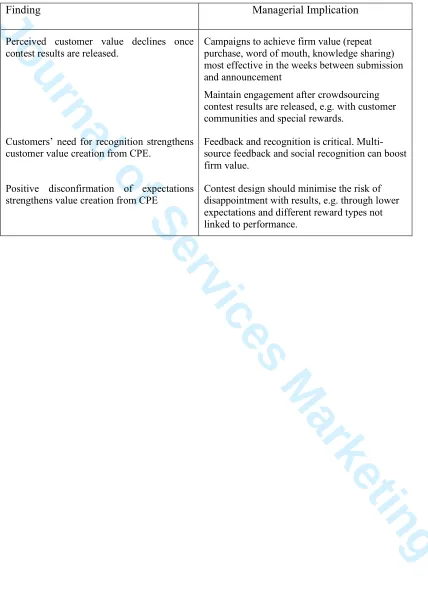
There are two core managerial contributions from this study, as summarised in Table
6. First, given the declining value once the contest results are released, managers should
focus on converting customers’ value from participating in the crowdsourcing contest into
firm value in the weeks between submission and announcement of winners. Doorn et al. 2
Journal of Services Marketing
22
(2010) suggest several avenues to further stimulate engagement, such as through customer
communities and special rewards that might be equally beneficial to sustain the creation of
firm value in crowdsourcing. Indeed, online brand communities can create strong customer
engagement (Brodie et al., 2013).
-
Insert Table 6 here -Second, crowdsourcing contests can be designed to take advantage of the role that
need for recognition and the disconfirmation of expectation play in the CPE-value creation
link. Feedback plays a central role, because engagement in crowdsourcing “can […] give rise
to feelings of being exploited and/or cheated if the crowdsourcing practices are perceived as
excessive, not credible or unfair” (Djelassi and Decoopman, 2013, p.688). Recognition in
terms of appraisal, social recognition, rewards and feedback from others results in positive
subsequent behaviour (Jawahar, 2006), and it can be a catalyst for satisfying the need for
recognition of participants. This could be in the form of clear, performance-based feedback
from judges, or a multi-source feedback system that collects performance evaluation from
more than one source (e.g., using crowd voting, which allows online customers and
participants to vote for their favourite submitted ideas). Multi-source feedback can satisfy the
need for recognition, as well as fulfil participants’ self-improvement (i.e., epistemic value
perception) because (a) it helps participants better understand how they are viewed by others,
and (b) it suggests areas for development and performance improvement (London and
Smither, 1995).
To benefit from the value-boosting effect of positive disconfirmation, the contest
should be set up in a way that maximizes positive disconfirmation, and avoids negative
disconfirmation, by lowering participants’ expectations. For example, after participants 2
Journal of Services Marketing
23
submit their creative ideas, firms could emphasize the prestigious and competitive nature of
the contest, and the large volume of submitted ideas. Only a few winners receive positive
feedback and rewards, though recognition and rewards are crucial for driving engagement
and satisfaction. Hence, firms may employ a combination of rewards (intrinsic and extrinsic)
for a crowdsourcing contest, to motivate and satisfy participants’ expectations, resulting in
satisfaction (Chou, 2013). Types of rewards could include ‘fixed action rewards’ (participants
will receive when they complete a certain task), ‘random rewards’ (each participant has the
chance to receive a gift from the contest), and ‘top 100-submitted-ideas rewards’.
Limitations and Concluding Remarks
While this research offers insights into the drivers of value creation and its changes
over time, it is not without limitations. The first limitation is the nature of the study context,
where a firm outsourced a complex task to crowds. Hence generalization of the results to
other contexts might be limited to complex, rather than to easy tasks, where participants solve
a generic routine task, such as a short text translation, with relatively low CPE.
Second, the scope of the study was limited to one product (fast-food), though future
research could look at other product or service types. Third, given the scope of the study,
there are several other customer-related variables which may further explain the nature of
value creation from crowdsourcing. Potential moderator variables to be explored in future
research are social identity and perceived organizational support.
Whereas we collected data from participants at two different times, future research
may investigate changes in value creation in more than a single time lag, or may examine the
transition of value creation across more than one crowdsourcing project hosted by a firm.
Similarly, other drivers unrelated to the crowdsourcing contest might account for changes in 2
Journal of Services Marketing
24
value between Time 1 and Time 2, such as an unpleasant customer experience when visiting
the restaurant, negative word of mouth or general publicity, or unwelcome firm activities
such as price or product changes. Last, if marketers can understand the duration of the
honeymoon-hangover effect on value creation in a crowdsourcing context, firms can know
when to intervene and put in place effective avoidance strategies (e.g., launching a new
activity, providing personal feedback, or motivating with tangible or intangible rewards).
However, duration was not considered here, though points out a promising direction for future
research to investigate the duration of the honeymoon-hangover effect in a crowdsourcing
context.
In summary, our study makes three main contributions. First, we show that customer
engagement drives customer and firm value following the announcement of crowdsourcing
results, beyond the creative submission. Second, we established that except for epistemic
value, all crowdsourcing value suffers to some extent from a honeymoon-hangover effect.
Once participants were aware of their performance, social value perception,
knowledge-sharing intention and customer loyalty decreased over time.
Last, the relationship between customer engagement and firm and customer value is
contingent on disconfirmation of expectations, and the need for recognition. When a
participant’s expectation about their ranking and rewards from the contest are exceeded,
and/or when a participant’s need for recognition is high, the links between CPE and customer
value are strengthened. The findings should inspire future researchers to better understand the
nature of value creation in various crowdsourcing contexts. 2
Journal of Services Marketing
25
Journal of Services Marketing
26
References
BAGOZZI, R. P. & YI, Y. 1988. On the evaluation of structural equation models. Journal of the Academy of Marketing Science, 16, 74-94.
BAKKER, A. B. & DEMEROUTI, E. 2008. Towards a model of work engagement. Career development international, 13, 209-223.
BELTRAMINI, R. F. & EVANS, K. R. 1988. Salesperson motivation to perform and job satisfaction: a sales contest participant perspective. Journal of Personal Selling & Sales Management, 8, 35-42.
BITNER, M. J. & HUBBERT, A. R. 1994. Encounter satisfaction versus overall satisfaction versus quality. Service Quality: New Directions in Theory and Practice. London: Sage Publications.
BITNER, M. J., OSTROM, A. L. & MORGAN, F. N. 2008. Service Blueprinting: A Practical Technique for Service Innovation. California Management Review, 50, 66-94.
BOSWELL, W. R., BOUDREAU, J. W. & TICHY, J. 2005. The relationship between employee job change and job satisfaction: the honeymoon-hangover effect. Journal of Applied Psychology, 90, 882.
BRABHAM, D. C. 2008. Moving the crowd at iStockphoto: The composition of the crowd and motivations for participation in a crowdsourcing application. First Monday, 13, 1-22.
BRABHAM, D. C. 2009. Crowdsourcing the public participation process for planning projects. Planning Theory, 8, 242.
BRABHAM, D. C. 2010. Moving the crowd at Threadless. Information, Communication & Society, 13, 1122-1145.
BRODIE, R. J., HOLLEBEEK, L. D., JURIĆ, B. & ILIĆ, A. 2011. Customer Engagement. Journal of Service Research, 14, 252-271.
BRODIE, R. J., ILIC, A., JURIC, B. & HOLLEBEEK, L. 2013. Consumer engagement in a virtual brand community: An exploratory analysis. Journal of Business Research, 66,
105-114.
BUSCH, P., VENKITACHALAM, K. & RICHARDS, D. 2008. Generational differences in soft knowledge situations: Status, need for recognition, workplace commitment and idealism. Knowledge and Process Management, 15, 45-58.
CASSEL, C., HACKL, P. & WESTLUND, A. H. 1999. Robustness of partial least-squares method for estimating latent variable quality structures. Journal of Applied Statistics, 26, 435-446.
CHENG, J. M.-S., WANG, E. S.-T., LIN, J. Y.-C. & VIVEK, S. D. 2009. Why do customers utilize the internet as a retailing platform?: A view from consumer perceived value. Asia Pacific Journal of Marketing and Logistics, 21, 144-160.
CHIN, W. W. 1998. The partial least squares approach to structural equation modeling. Modern methods for business research. London.
CHIN, W. W., MARCOLIN, B. L. & NEWSTED, P. R. 2003. A partial least squares latent variable modeling approach for measuring interaction effects: Results from a Monte Carlo simulation study and an electronic-mail emotion/adoption study. Information Systems Research, 14, 189-217.
CHOU, Y. 2013. The Six Contextual Types of Rewards in Gamification. Available:
http://www.yukaichou.com/marketing-gamification/six-context-types-rewards-gamification [Accessed 8 April 2014].
CHUNG, J. Y. & BUHALIS, D. 2008. Information needs in online social networks. Information Technology & Tourism, 10, 267-281.
Journal of Services Marketing
27
CHURCHILL, G. A. & IACOBUCCI, D. 2009. Marketing research: methodological foundations, Cengage Learning.
CLAPP, C. M. & HAKES, J. K. 2005. How long a honeymoon? The effect of new stadiums on attendance in Major League Baseball. Journal of Sports Economics, 6, 237-263. COAKES, S. & STEED, L. 2007. SPSS Version 14 for Windows: Analysis without Anguish.
Wiley. Australia.
COLLINS, R. & COLTRANE, S. 1995. Sociology of marriage and the family: Gender, love, and property. Nelson-Hall (Chicago).
CRONIN, J. J., BRADY, M. K. & HULT, G. T. M. 2000. Assessing the effects of quality, value, and customer satisfaction on consumer behavioral intentions in service environments. Journal of Retailing, 76, 193-218.
DACKO, S. 2007. The Advanced Dictionary of Marketing: Putting Theory to Use: Putting Theory to Use, Oxford University Press.
DESOUZA, K. C. & AWAZU, Y. 2005. What do they know? (customer knowledge management). Business Strategy Review, 16, 41-45.
DICK, A. S. & BASU, K. 1994. Customer loyalty: toward an integrated conceptual framework. Journal of the academy of marketing science, 22, 99-113.
DJELASSI, S. & DECOOPMAN, I. 2013. Customers' participation in product development through crowdsourcing: Issues and implications. Industrial Marketing Management, 42, 683-692.
DONG, B., EVANS, K. R. & ZOU, S. 2008. The effects of customer participation in co-created service recovery. Journal of the Academy of Marketing Science, 36, 123-137. DONTCHEVA, M., GERBER, E. & LEWIS, S. 2011. Crowdsourcing and Creativity.
DOORN, J. V., LEMON, K. N., MITTAL, V., NASS, S., PICK, D., PIRNER, P. & VERHOEF, P. C. 2010. Customer Engagement Behavior: Theoretical Foundations and Research Directions. Journal of Service Research, 13, 253-266.
EASTERLIN, R. A. 2003. Explaining happiness. Proceedings of the National Academy of Sciences, 100, 11176-11183.
FALLIS, D. 2008. Toward an epistemology of Wikipedia. Journal of the American Society for Information Science and Technology, 59, 1662-1674.
FICHMAN, R. G. & KEMERER, C. F. 2012. Adoption of software engineering process innovations: The case of object-orientation.
FORNELL, C., JOHNSON, M. D., ANDERSON, E. W., CHA, J. & BRYANT, B. E. 1996. The American customer satisfaction index: nature, purpose, and findings. Journal of Marketing, 7-18.
FORNELL, C. & LARCKER, D. F. 1981. Evaluating Structural Equation Model with Unobservable Variables and Measurement Error. Journal of Marketing Research, 18. FÜLLER, J., HUTTER, K. & FRIES, M. 2012. Crowdsourcing for Goodness Sake: Impact of
Incentive Preference on Contribution Behavior for Social Innovation. Advances in International Marketing, 23, 137-159.
FULLER, J., JAWECKI, G. & MUHLBACHER, H. 2007. Innovation creation by online basketball communities. Journal of Business Research, 60, 60-71.
GILHOOLY, K., FIORATOU, E., ANTHONY, S. & WYNN, V. 2007. Divergent thinking: Strategies and executive involvement in generating novel uses for familiar objects. British Journal of Psychology, 98, 611-625.
GILSON, L. L., MATHIEU, J. E., SHALLEY, C. E. & RUDDY, T. M. 2005. Creativity and standardization: complementary or conflicting drivers of team effectiveness? Academy of Management Journal, 48, 521-531.
Journal of Services Marketing
28
GILSON, L. L. & SHALLEY, C. E. 2004. A little creativity goes a long way: An examination of teams’ engagement in creative processes. Journal of Management, 30,
453.
GREAVES, C. J. & FARBUS, L. 2006. Effects of creative and social activity on the health and well-being of socially isolated older people: outcomes from a multi-method observational study. The Journal of the Royal Society for the Promotion of Health, 126, 134-142.
GREEN, D. H. & RYANS, A. B. 1990. Entry strategies and market performance Causal modeling of a business simulation. Journal of Product Innovation Management, 7,
45-58.
GRUEN, T. W., OSMONBEKOV, T. & CZAPLEWSKI, A. J. 2006. eWOM: The impact of customer-to-customer online know-how exchange on customer value and loyalty. Journal of Business research, 59, 449-456.
HAIR, J. F., HULT, G. T. M., RINGLE, C. M. & SARSTEDT, M. 2014. A Primer on Partial Least Squares Structural Equation Modeling (PLS-SEM), SAGE Publications, Inc. HAIR, J. F., RINGLE, C. M. & SARSTEDT, M. 2011. PLS-SEM: Indeed a silver bullet.
Journal of Marketing Theory and Practice, 19, 139-152.
HARMELING, C. M., MOFFETT, J. W., ARNOLD, M. J. & CARLSON, B. D. 2017. Toward a theory of customer engagement marketing. Journal of the Academy of Marketing Science, 45, 312-335.
HARS, A. & OU, S. 2002. Working for free? Motivations for participating in open-source projects. International Journal of Electronic Commerce, 6, 25-40.
HILL, C. A. 1987. Affiliation motivation: People who need people… but in different ways. Journal of Personality and Social Psychology, 52, 1008.
HOLLEBEEK, L. D. 2013. The customer engagement/value interface: An exploratory investigation. Australasian Marketing Journal (AMJ), 21, 17-24.
HOLLEBEEK, L. D., GLYNN, M. S., BRODIE, R. J., HOLLEBEEK, L., GLYNN, M. & BRODIE, R. 2014. Consumer Brand Engagement in Social Media: Conceptualization, Scale Development and Validation. Journal of Interactive Marketing, 2, 149-165. HOLLEBEEK, L. D., SRIVASTAVA, R. K. & CHEN, T. 2016. S-D logic–informed
customer engagement: integrative framework, revised fundamental propositions, and application to CRM. Journal of the Academy of Marketing Science, 1-25.
HOWE, J. 2009. Crowdsourcing: How the power of the crowd is driving the future of business, Crown Business.
JACKSON, N. 2002. Guide for busy academics: Nurturing creativity. LTSN Generic Centre. JAWAHAR, I. 2006. Correlates of satisfaction with performance appraisal feedback. Journal
of Labor Research, 27, 213-236.
JONES, P., COMFORT, D. & HILLIER, D. 2013. Crowdsourcing corporate sustainability strategies. International Journal of Business and Globalisation, 10, 345-356.
KAUFMANN, N., SCHULZE, T. & VEIT, D. More than fun and money. worker motivation in crowdsourcing–a study on mechanical turk. Proceedings of the Seventeenth Americas Conference on Information Systems, 2011. 1-11.
KOZINETS, R. V., HEMETSBERGER, A. & SCHAU, H. J. 2008. The wisdom of consumer crowds: Collective innovation in the age of online community. Journal of Macromarketing, 28, 339-354.
KUMAR, V., AKSOY, L., DONKERS, B., VENKATESAN, R., WIESEL, T. & TILLMANNS, S. 2010. Undervalued or Overvalued Customers: Capturing Total Customer Engagement Value. Journal of Service Research, 13, 297.
Journal of Services Marketing
29
LEIMEISTER, J. M., HUBER, M., BRETSCHNEIDER, U. & KRCMAR, H. 2009. Leveraging crowdsourcing: activation-supporting components for IT-based ideas competition. Journal of management information systems, 26, 197-224.
LONDON, M. & SMITHER, J. W. 1995. Can multi-source feedback change perceptions of goal accomplishment, self-evaluations, and performance-related outcomes? Theory-based applications and directions for research. Personnel Psychology.
MACE, M.-A. & WARD, T. 2002. Modeling the creative process: A grounded theory analysis of creativity in the domain of art making. Creativity Research Journal, 14,
179-192.
MATHWICK, C., WIERTZ, C. & RUYTER, K. D. 2008. Social capital production in a virtual P3 community. Journal of Consumer Research, 34, 832-849.
MCDOUGALL, G. H. & LEVESQUE, T. 2000. Customer satisfaction with services: putting perceived value into the equation. Journal of services marketing, 14, 392-410.
MCEVOY, C. D., NAGEL, M. S., DESCHRIVER, T. D. & BROWN, M. T. 2005. Facility age and attendance in Major League Baseball. Sport Management Review, 8, 19-41. MCINNERNEY, J. M. & ROBERTS, T. S. 2004. Online learning: Social interaction and the
creation of a sense of community. Educational Technology & Society, 7, 73-81. MCKINNEY, V., YOON, K. & ZAHEDI, F. M. 2002. The measurement of web-customer
satisfaction: an expectation and disconfirmation approach. Information Systems Research, 13, 296-315.
MLADENOW, A., BAUER, C. & STRAUSS, C. 2014. Social Crowd Integration in New Product Development: Crowdsourcing Communities Nourish the Open Innovation Paradigm. Global Journal of Flexible Systems Management, 1-10.
MOLLEN, A. & WILSON, H. 2010. Engagement, telepresence and interactivity in online consumer experience: Reconciling scholastic and managerial perspectives. Journal of Business Research, 63, 919-925.
NAMBISAN, S. & BARON, R. A. 2009. Virtual Customer Environments: Testing a Model of Voluntary Participation in Value Co creation Activities. Journal of Product Innovation Management, 26, 388-406.
NESTOR, P. G. & SCHUTT, R. K. 2011. Research Methods in Psychology: Investigating Human Behavior, SAGE Publications.
OLIVER, R. L. 1980. A cognitive model of the antecedents and consequences of satisfaction decisions. Journal of Marketing Research, 460-469.
ORDANINI, A. & PARASURAMAN, A. 2011. Service Innovation Viewed Through a Service-Dominant Logic Lens: A Conceptual Framework and Empirical Analysis. Journal of Service Research, 14, 3-23.
PANSARI, A. & KUMAR, V. 2017. Customer engagement: the construct, antecedents, and consequences. Journal of the Academy of Marketing Science, 45, 294-311.
PATTERSON, P. G. 1993. Expectations and product performance as determinants of satisfaction for a high‐involvement purchase. Psychology & Marketing, 10, 449-465. PATTERSON, P. G., JOHNSON, L. W. & SPRENG, R. A. 1996. Modeling the determinants
of customer satisfaction for business-to-business professional services. Journal of the academy of marketing science, 25, 4-17.
PILLER, F. T. 2008. Interactive value creation with users and customers. Leading Open Innovation. Munich: Peter-Pribilla-Foundation.
PIYATHASANAN, B., MATHIES, C., PATTERSON, P. & DE RUYTER, K. 2013. The Value of Crowdsourcing: Antecedents and Value Creation of Creative Process Engagement. ANZMAC 2013. Auckland, New Zealand.
Journal of Services Marketing
30
POETZ, M. K. & SCHREIER, M. 2012. The value of crowdsourcing: can users really compete with professionals in generating new product ideas? Journal of Product Innovation Management, 29, 245-256.
REIDPATH, D. D., CHAN, K. Y., GIFFORD, S. M. & ALLOTEY, P. 2005. ‘He hath the French pox’: stigma, social value and social exclusion. Sociology of health & illness, 27, 468-489.
REITER-PALMON, R. & ILLIES, J. J. 2004. Leadership and creativity: Understanding leadership from a creative problem-solving perspective. The Leadership Quarterly, 15, 55-77.
ROTH, Y. 2012. Companies increasingly use crowdsourcing strategicaly: Cisco’s I-Prize. Available: http://yannigroth.com/2012/10/08/companies-increasingly-use-crowdsourcing-strategicaly-ciscos-i-prize/ [Accessed March 4, 2014].
SAPP, D. D. 1995. Creative Problem‐Solving in Art: A Model for Idea Inception and Image Development. The Journal of Creative Behavior, 29, 173-185.
SAWHNEY, M., VERONA, G. & PRANDELLI, E. 2005. Collaborating to create: The Internet as a platform for customer engagement in product innovation. Journal of Interactive Marketing, 19, 4-17.
SCHAFFER, R. H. 1953. Job satisfaction as related to need satisfaction in work. Psychological monographs: General and Applied, 67, 1.
SCHENK, E. & GUITTARD, C. 2011. Towards a characterization of crowdsourcing practices. Journal of Innovation Economics, 93-107.
SHETH, J. N., NEWMAN, B. I. & GROSS, B. L. 1991. Why we buy what we buy: a theory of consumption values. Journal of Business Research, 22, 159-170.
SIRDESHMUKH, D., SINGH, J. & SABOL, B. 2002. Consumer trust, value, and loyalty in relational exchanges. Journal of Marketing, 66, 15-37.
TAYLOR, M. S., FISHER, C. D. & ILGEN, D. R. 1984. Individual's reactions to performance feedback in organizations: A control theory perspective. In: ROWLAND, K. M. & FERRIS, G. R. (eds.) Research in Personnel and Human Resources Management. Greenwich, CT: JAI Press.
TENENHAUS, M., VINZI, V. E., CHATELIN, Y.-M. & LAURO, C. 2005. PLS path modeling. Computational Statistics & Data Analysis, 48, 159-205.
VENAIK, S., MIDGLEY, D. F. & DEVINNEY, T. M. 2005. Dual paths to performance: the impact of global pressures on MNC subsidiary conduct and performance. Journal of International Business Studies, 36, 655-675.
VENKATESAN, R. 2017. Executing on a customer engagement strategy. Journal of the Academy of Marketing Science, 3, 289-293.
WASKO, M. & FARAJ, S. 2005. Why should I share? Examining social capital and knowledge contribution in electronic networks of practice. MIS Quarterly, 29, 35-57. WETZELS, M., ODEKERKEN-SCHRODER, G. & VAN OPPEN, C. 2009. Using PLS path
modeling for assessing hierarchical construct models: guidelines and empirical illustration. Management Information Systems Quarterly, 33, 11.
YANG, J., ADAMIC, L. A. & ACKERMAN, M. S. Crowdsourcing and knowledge sharing: strategic user behavior on taskcn. Proceedings of the 9th ACM conference on Electronic commerce, 2008. ACM, 246-255.
YE, H. & KANKANHALLI, A. 2013. Leveraging Crowdsourcing for Organizational Value Co-Creation. Communications of the Association for Information Systems, 33, 13. ZAICHKOWSKY, J. L. 1985. Measuring the involvement construct. Journal of Consumer
Research, 341-352.
ZEITHAML, V. A., BERRY, L. L. & PARASURAMAN, A. 1996. The behavioral consequences of service quality. Journal of Marketing, 60, 31-46.
Journal of Services Marketing
31
ZHANG, X. & BARTOL, K. M. 2010a. The influence of creative process engagement on employee creative performance and overall job performance: A curvilinear assessment.[doi: 10.1037/a0020173]. Journal of Applied Psychology.