City, University of London Institutional Repository
Citation
: Constantin, A., He, Y. ORCID: 0000-0002-0787-8380 and Lukas, A. (2019).
Counting string theory standard models. Physics Letters, Section B: Nuclear, Elementary
Particle and High-Energy Physics, 792, pp. 258-262. doi: 10.1016/j.physletb.2019.03.048
This is the published version of the paper.
This version of the publication may differ from the final published
version.
Permanent repository link:
http://openaccess.city.ac.uk/22130/
Link to published version
: http://dx.doi.org/10.1016/j.physletb.2019.03.048
Copyright and reuse:
City Research Online aims to make research
outputs of City, University of London available to a wider audience.
Copyright and Moral Rights remain with the author(s) and/or copyright
holders. URLs from City Research Online may be freely distributed and
linked to.
City Research Online:
http://openaccess.city.ac.uk/
[email protected]
Contents lists available atScienceDirect
Physics
Letters
B
www.elsevier.com/locate/physletb
Counting
string
theory
standard
models
Andrei Constantin
a,
b,
Yang-Hui He
c,
d,
e,
∗
,
Andre Lukas
faPembrokeCollege,OxfordUniversity,OX11DW,Oxford,UK bMansfieldCollege,OxfordUniversity,OX13TF,Oxford,UK cMertonCollege,UniversityofOxford,OX14JD,UK
dDepartmentofMathematics,City,UniversityofLondon,EC1V0HB,UK eSchoolofPhysics,NanKaiUniversity,Tianjin,300071,China
fRudolfPeierlsCentreforTheoreticalPhysics,OxfordUniversity,1KebleRoad,Oxford,OX13NP,UK
a
r
t
i
c
l
e
i
n
f
o
a
b
s
t
r
a
c
t
Articlehistory:
Received13December2018
Receivedinrevisedform22March2019 Accepted25March2019
Availableonline28March2019 Editor:M.Cvetiˇc
We derive an approximate analytic relation between the number of consistent heterotic Calabi-Yau compactifications of string theory with the exact charged matter content of the standard model of particlephysicsandthetopologicaldataoftheinternalmanifold:theformerscalingexponentiallywith the numberofKähler parameters.Thisisdonebyanestimateofthenumber ofsolutionstoasetof Diophantineequationsrepresentingconstraintssatisfiedbyanyconsistentheteroticstringvacuumwith threechiralmasslessfamilies,andhasbeencomputationallychecked toholdforcompleteintersection Calabi-Yauthreefolds(CICYs)withuptosevenKählerparameters.WhenextrapolatedtotheentireCICY list,therelationgives∼1023 stringtheorystandardmodels;fortheclassofCalabi-Yauhypersurfacesin
toricvarieties,itgives∼10723standardmodels.
©2019TheAuthors.PublishedbyElsevierB.V.ThisisanopenaccessarticleundertheCCBYlicense (http://creativecommons.org/licenses/by/4.0/).FundedbySCOAP3.
1. Introductionandsummary
It isgenerallybelievedthat string compactifications that have theexactchargedmatter contentofthestandard modelof parti-clephysics (andnoother chargedmatter exceptmoduli)are few in number. The purpose of this letter is to show that, although
such compactifications maybe rare andhard tofind, their
num-berissubstantial.Admittedly,thisbiashascomeinthepastfrom thedifficultytoconstructphenomenologicallyviable compactifica-tions.However,sincethebirthofstringphenomenologyinRef. [1], fromtheadventofthefirst standard-likestringmodel[2],tothe first exact particle spectrum directly derived from a string com-pactification[3–6],tothefirstresult[7] fromalgorithmicheterotic compactification [8], until the comprehensive computer scan of Refs. [9–11,15], as well asthe various statisticalperspectives on the heterotic landscape [12,38] (cf. [13] in Type II and beyond [14]),therehasbeenmuchprogress.
Whileitcanbespecifiedatdifferentlevelsofsophistication,for thisletter a “string standard model” is a modelwith a massless
spectrum which is exactly that of the minimally
supersymmet-*
Correspondingauthor.E-mailaddresses:[email protected](A. Constantin),
[email protected](Y.-H. He),[email protected](A. Lukas).
ric standard model(MSSM),plus anynumber ofmassless modes
(modulifields)
uncharged
underthestandardmodelgaugegroup. The general strategy of heterotic string phenomenology is to considerasmooth,compactCalabi-Yauthreefold(CY),say X,with a non-trivial fundamental group,together witha holomorphic, (poly-)stable vector bundle V over X, typically with structure group SU
(
5)
or SU(4)
. Subsequently, a-Wilson line can break theGrandUnifiedTheory(GUT)group,typically
SU
(
5)
orS O(10)
, totheMSSMgroupandthe -equivariantcohomologyofV
aswell asitsappropriatetensorpowerscorrespondtotheMSSMparticles. From analgorithmic pointofview,onecan (1)takemanifolds˜
X from existing databases, mostof which are simply connected,
then search for discrete, freely acting symmetry groups
on X
˜
,and consider the quotient X
˜
X/ with fundamental group;
(2) construct and classify families of
-equivariant bundles V
on X,ensurestability,andthencomputetherelevantcohomology groups; and(3)scan through theresultsto lookforexact MSSM
particle content. Much of these can be implemented on a
com-puter.
The most extensively used databases of manifolds are the
Complete IntersectionCalabi-Yau three-folds(CICYs)embedded in products of projective spaces of around 8000 manifolds [16,17] as well as the Kreuzer-Skarke (KS) dataset of Calabi-Yau hyper-surfaces embedded in around half-billion four-dimensional toric varieties[18–20] (the actualnumberofCalabi-Yau willvastly
ex-https://doi.org/10.1016/j.physletb.2019.03.048
ceedthisnumberbecauseoftriangulationsanda recentestimate wasmadein[21]).Thecomprehensivescanof[11] wasperformed
onCICYmanifoldswitha numberofKählerparameterslessthan
h1,1
(X
)
=
6 andvectorbundlesconstructedfromsumoflinebun-dles.A totalofabout35
,
000 SU(
5)
heterotic linebundle models werefound, allwiththerightfield contentto inducelow-energy standard-likemodels.It is obviously important to have a count of MSSM models
expectedwithin string theory.While oursis still a relatively un-refinednotion ofthestandard model,even countingatthislevel isnoteasysinceitrequiresinformationonallvectorbundlesand theircohomologyonCYswhichisnot availableinanysystematic form.An exceptiontothisruleistheclassofvectorbundlesthat splitintoasumoflinebundles.Holomorphiclinebundlesare clas-sifiedbytheir first Chernclass,whichcan be expressedinterms of
h
1,1(
X)integers.Assuch,linebundlescanbeenumerated.Moreover,thereisenoughevidencethatindicatestheexistence ofanalytic formulaefortheranksoflinebundle valued cohomol-ogygroups in terms ofthe line bundle integers [23–26]. Finally, linebundlesumsofferanaccessiblewindowintothemodulispace ofnon-abelianbundles[26–28]:ifalinebundlesumcorresponds toastandard-likemodel,thenusuallyitcanbedeformedinto non-abelianbundlesthatalsoleadtostandard-likemodels.
Ourmodelbuildingexperienceforsuch(rankfive)linebundle modelsonCICYs suggeststhata significantnumber ofconsistent
models with the correct chiral asymmetry will descend to
stan-dardmodelsafterdividingby thefreelyactingdiscretesymmetry
group
. Moreover, by far the most frequent symmetry is
Z
2.Thissuggeststhatanindicationofthenumberofstandardmodels shouldbeprovidedbycountingtheconsistentupstairslinebundle modelswithchiralasymmetry6,relevantfor
Z
2symmetries.Westartouranalysisby outliningtheconstraintsonthe
com-pactificationdatathat guarantee an exactMSSM spectrum. Fora
fixed manifold, most of these constraints take the form of
Dio-phantineequationsandinequalities,wheretheunknownvariables arethelinebundleintegers. FortheclassofCICYmanifoldswith lessthansixKählerparametersthissystemwassolvedinRef. [11] byexplicitlycheckingeverypossiblelinebundlesum.Weaugment thisdatasetoflinebundlemodelswithresultsfor7 newmanifolds with
h
1,1(X
)
=
6,
7.Thesescanssuggest asimple rule: thenumberofline bundle
models increases roughly by an order of magnitude with every
incrementof h1,1
(X
)
by one. However, it is difficult to test thisrelationforlarger values of
h
1,1(X)
due tocomputer limitations.Instead,we estimate thenumber ofsolutions tothe Diophantine systemofconstraintsusingaresultfromthemathematical litera-ture[29].Forthistohold, we definea boundon thelinebundle integersintermsoftopologicaldataofthemanifold.
Finally,we comeback totheempiricaldatasetoflinebundles andcorrelatethenumberofsolutions not onlywith
h
1,1(X)
, butalsowithanumberoftopologicalinvariants,constructedfromthe intersectionformandthesecond Chernclass oftheCYmanifold, that displaylittle variation withincreasing h1,1
(X)
. Extrapolatingthemulti-linearregressiontothemaximalvalueof
h
1,1(
X)foundintheCICYdataset,weestimateatotalof
N
CICY1023linebundlemodels(weowetheexpression“amoleofmodels”toTristan Hüb-sch)while forthe manifoldsintheKreuzer-Skarkelistwe expect NKS
10723 linebundlemodels.Acknowledgments.WearegratefultoK. DienesandT. Hübschfor
valuable commentson the draft. AC andAL wouldlike to thank
the Mainz Institute for Theoretical Physics for hospitality during partofthecompletionofthisproject.ALispartiallysupportedby theEPSRCnetworkgrantEP/N007158/1.YHHthanksSTFCforgrant ST/J00037X/1.
2. CountinglinebundleMSSMs
The models of interest for our count have an exact MSSM
particle contentandare constructed fromheterotic compactifica-tionsonasmooth,compactCalabi-YauthreefoldsX endowedwith slope-zero, poly-stable direct sums of linebundles. Leth denote thePicardnumberof X,
h
:=
h1,1(X)
,andchooseanintegralbasisof H2
(X
)
denotedby{
Ji
}
,wherei
=
1,
. . . ,
h.Inthisbasis,letthesecond Chern classof X be
c
2,i and thetriple intersectionnum-bersbe
d
i jk=
X Ji
∧
Jj∧
Jk.LinebundlesL→
X withfirstChernclass
c
1(L)
=
kiJiaredenotedbyL
=
O
X(
k)
.ThereaderisreferredtoSec. 4ofRef. [11] forfurtherdetailsontheconstraints. First, we focus on SU(5
)
bundles V for thefollowing reason. From a group theoretic point ofview [22], thereare many waystobreaktheGUTgroup totheMSSMgroup usinganappropriate
discreteWilsonline,forexample,theexactMSSMspectrumof[4] was achieved witha
Z
3×
Z
3 Wilson linefroman S O(10)
GUTgroup.However,CYmanifolds X
˜
withalargefreelyactingdiscrete symmetry groupare quite rare.This canbe seen, forinstance, fromthecomplete classificationoffreely-acting[33] and residual [34,35] symmetriesonallCICYs,orfromtheKSdatasetof hyper-surfacesintoricFanofourfolds[30,32].
Therefore, generically, it is expectedthat Calabi-Yau manifolds withasmallfundamentalgroup
π
1(X
)
,shouldfarexceedinnum-ber thosewithalarge
π
1(
X)(thisshould becontrasted withtherelative paucity ofCalabi-Yau manifoldsof smallHodge numbers [36,37,39]). The smallest possible
π
1(X
)
that breaks the SU(
5)
GUT group to the Standard Model gauge group is
=
Z
2 andthis setup is expected to dominate. Now, in SU
(
5)
(commutant of the SU(
5)
of the bundle in E8) GUTs, the 10 representationcorresponds entirely to anti-families which we desire to be ab-sent. Under the branching of E8 to SU
(
5)
, this corresponds tothe condition that h2
(
X, V)
=
0, so that stability (implying that h0(X,
V)
=
h3(X
, V
)
=
0) in conjunctionwiththe index theoremgives
−
3|
| =
ind(
V)
=
3
i=0
hi
(
X,
V)
= −
h1(
X,
V) .
(1)Thus,weimposeind
(V
)
= −
h1(X,
V)
= −
6.Insummary,the countingproblemcan thenbe formulated as
follows:
PROBLEM:Whatisthenumber
N
=
N(h,
c2,i,
di jk)
ofrankfivelinebundle sums V
= ⊕
5a=1La, where La=
O
X(
ka)
satisfying thefol-lowingconstraints:
E8embedding: c1
(V
)
=
5a=1
ki
a
=
! 0 foralli
=
1,
. . . ,
h;Anomaly cancellation:
c2,i(V
)
= −
1 2di jk
a
kajkka
!
≤
c2,ifor alli=
. . . ,
h;
Supersymmetry/Zero Slope: thereisacommonsolutiont
i tothevanishingslopes
μ(
La)
=
di jkkiat jatka
=
! 0 fora=
1, . . . ,
5suchthat J
=
tiJi∈
interioroftheKahlercone; Particle generations: thechiralasymmetryissix,i.e.ind
(
V)
=
1 6di jka
Table 1
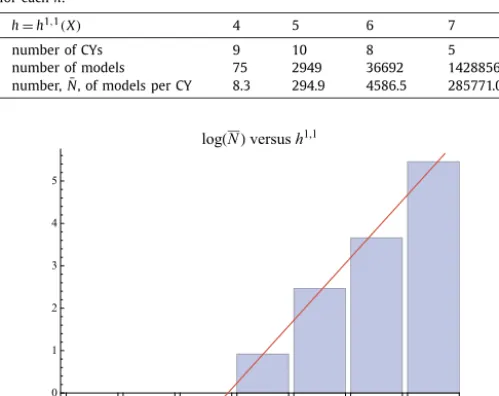
NumberofmodelsfoundinacomputerscanforfavourableCICYswith4≤h≤7 foreachh.
h=h1,1(X) 4 5 6 7
number of CYs 9 10 8 5
[image:4.612.34.284.97.295.2]number of models 75 2949 36692 1428856 number,N¯, of models per CY 8.3 294.9 4586.5 285771.0
Fig. 1.ThelogarithmofN¯,theaveragenumberofmodelsperCY,asafunctionof
h=h1,1(X),takenfromthedatainTable1.Theredlineisalinearfittothedata.
Weemphasizethat
N
isafunctionoftheprescribedHodge num-berh
,thesecondChernclassc
2,i,aswellasthetripleintersectionnumbers
d
i jk of X.2.1. Preliminary count
Forthe subset offavourable CICYswith h
≤
6,the number N wasdeterminedbythecomputerscan[11] andwehaveextended thisscantoincludemanifoldsforh
1,1(X
)
=
7 aswellassomenon-favourablemanifold for
h
1,1≤
7 whichwerepreviouslydiscarded.Thecumulativeandaveragenumberofmodelsfoundforeach
Pi-cardnumber
h
issummarisedinTable1.Notetherearenoviable modelsforh
=
1,
2,
3 sincethesupersymmetry(slopezero) condi-tionsaretooconstrainingforthosecases.Asimpleapproachistoassumethatthemaindependenceof
N
isonh
,andtoneglectthepossibleeffectsofc
2,i andd
i jk.Theav-eragenumber,N
¯
= ¯
N(h)
ofmodelsperCYasafunctionofh
,taken fromthelastrowofTable1,hasbeenplotted(logarithmically)in Fig.1.Alinear fitto thisdata(which corresponds to thered linein Fig.1)leadsto
log
(
N¯
(
h))
−
5.
0+
1.
5h.
(2)The largest known Picard number ofany CYthreefold is
h
max=
491,whichappears within theKS dataset,andthe largestvalue within theCICYlist is
h
CICY=
19. Using(2) toboldly extrapolatetothosevalueswefind
¯
N
(
hCICY)
1023,
N¯
(
hmax)
10721.
(3)Clearly,thesenumbersarequitedramatic,evenifwerestrict our-selvestotheCICYs.Thepredictednumberofstandardmodelseven withinthissetissignificantlylargerthancanbecurrentlystored,
let alone found by a scan. However, the method so far is quite
crude andtheextrapolation tolarge
h
adventurous.Tosee some oftheproblems,considerFig.2whichshowsthenumberof mod-elsasafunction ofh
foreach CICY,ratherthan theaverageover allCICYswiththesameh
,asinFig.1.Thevariation withingiven hcanbeseentobeconsiderable- clearindicationthatthereisa strongdependenceofN
onc
2,i andd
i jk,inadditiontoh.Fig. 2.ThelogarithmofN,thenumberofmodelsforeachoftheCICYmanifolds,as afunctionofh=h1,1(X).
2.2. Some theoretical considerations
While the computer scan gives a finite number of models in
eachcase,itisactuallynoteasytoprovethat
N
isfinite.A succinct argument was presented in Ref. [15] based on the moduli space metricGi j
= −
3κi j
κ
−
3 2
κiκ
jκ
2,
(4)where
κ
=
di jktitjtk,κi
=
di jktjtkandκi j
=
di jktk,witht
ibeingtheKählermoduli.We notethattheslopezeroconditionscanbe ex-pressedas
κi
kia
=
0 sothat0
≤
a
kTaGka
= −
3κ
di jka
kiakajtk
=
6κ
tic
2,i(V
)
≤
6κ
tic
2,i
(
T X)
≤
6κ
|
t| |
c2,i(
T X)
|
.
(5)Then, introducing the scale-invariant modified metric G
˜
=
6κ|t|G,wegetthebound
a
kaTG
˜
ka≤ |
c2,i(T X)
|
.
(6)This by itself does unfortunatelynot bound the vectorska since
themetricG
˜
mightbecomesingularattheboundaryoftheKähler cone.However,ifwerequirethatwestayina“physical”regionof theKählerconewhereallcurve volumestobegreaterthan1(so that thesupergravityapproximationisvalid)andthevolumeκ
isbounded fromabove (sothat we are not de-compactifying)then
theeigenvaluesofG
˜
areboundedfrombelowbyastrictlypositive number.Eq. (6) then impliesthat thelength
a|
ka|
2 isboundedfromaboveand,hence,thatthereisonlyafinitenumberofpossible in-tegervectorska.Morequantitative statementsdepend verymuch
onthespecificexamplebutwhatcanbesaidisthatthelengthof thekvectorsisboundedbyaradius Rwhichroughlyscalesas
R
∼
c2
d
1/2,
(7)where
c
2andd
aretypicalvaluesofc
2,iandd
i jk.Apartfromtheslopezeroconditionstheconstraintsontheline bundlescanbewrittenasasystemofDiophantineequations
5
a=1
kai
=
! 0,
−
1 2di jka
kajkka
=
! c2,i,
16di jk
a
Fig. 3.ThelogarithmofNfromthecomputerscanofCICYsversusthe“theoretical” upperboundxth,asdefinedinEq. (9).
for i
=
1,
. . . ,
h. Here we have replaced the inequality in the anomalyconditionwithanequality,assumingthatthebulkofthe contributioncomesfromlinebundleswiththelargestallowedin-tegers. We can homogenise these equations (by introducing one
additionalcoordinate)andthink ofthemasaset ofequationsin
P
n,wheren
=
5h.Assumingtheyprovideacompleteintersection, Z,itsdimensionisgivenbym
=
n−
2h−
1=
3h−
1.Ref. [29] providesan upper bound forthe numberofrational points NZ
(B)
within aboxofsize B (wherethe sizeismeasuredbythemaximumnorm)on Z whichisgivenby NZ
(B)
Bm.Us-ingtheaboveradius
R
asanupperboundfor BwefindN
R3h−1∼
c2
d
(3h−1)/2=:
xth.
(9)The comparisonbetween thisupper bound and the resultsfrom
thecomputerscanonCICYmanifoldsisshowninFig.3.Withall thedatapointswell belowtheredlineitis clearthat Eq. (9) in-deedprovides anupper boundbutit isequallyobviousthat this upperboundisratherweak. Therearea numberofpossible rea-sonsforthis. First,the resultof Ref. [29] isonlyan upperbound (which, in addition, counts rational rather than integer points). Second, theradius R fromEq. (7) is a crude estimate andis, by itself,onlyanupperboundonthesize
B
oftheboxconsideredin Ref. [29].2.3. A more sophisticated count
Ourcount in §2.1,based on considering only thedependence of
N
onthePicardnumberh
isclearlysomewhatunrefined,while the theoretical upper bound xth from §2.2 is clearly too weakto allow for a meaningful extrapolation to larger values of h. In thissubsection, we seeka moresophisticated equation for N as afunction of
h
, c2,i anddi jk,drawing inspirationfromthe abovediscussions.
Thereis an obviousdifficulty ofwritingdown even an ansatz
for N asa function of c2,i and di jk: both of thesequantities are
basis-dependent (ona choice ofintegral basis Ji for H2
(X
)
), butN clearly cannot depend on such a choice of basis. This means
weshouldthinkaboutbasis-independentquantitieswhichcanbe constructedfrom
c
2,iandd
i jk.Unfortunately,bothquantitieshave“allindicesdown”sothere isnoinvariant whichcan be obtainedby a simplecontractionof indices, given that the only available metric, G from Eq. (4), is
moduli-dependent.Thisproblemhasbeenencountered before,in
[image:5.612.64.269.68.212.2]thecontextofpracticalapplicationsofWall’stheorem,anda solu-tionhasbeenproposedinRef. [17],p. 174.
Fig. 4.ThelogarithmofNfromthecomputerscanofCICYsversusthequantityxin Eq. (12),wheretheconstantsAiandBihavebeendeterminedtoprovidethebest
fit.
From the intersection form
λ(
α
,
β,
γ
)
:=
Xα
∧
β
∧
γ
∈
Z
≥0,completely symmetric in
α
,
β,
γ
,the following invariantscan be constructed:1
=
gcd{
λ(α, β,
γ
)
|
α, β,
γ
∈
H2(
X,
Z)
}
2
=
gcd{
λ(α, β, β)
|
α, β
∈
H2(
X,
Z)
}
3
=
gcd{
λ(α,α,α)
|
α
∈
H2(
X,
Z)
}
.
(10)Furthermore,combiningtheintersectionformand
c
2=
c2(T X)
wecan define the form
(
α
,
β,
γ
,
δ)
=
(λ(
α
,
β,
γ
)c
2(δ)
+
3permutations
)
whichgivesrisetotheinvariants4
=
gcd{
(α, β,
γ
, δ)
|
α, β,
γ
, δ
∈
H2(
X,
Z)
}
5
=
gcd{
(α, β,
γ
,
γ
)
|
α, β,
γ
∈
H2(
X,
Z)
}
6
=
gcd{
(α, β, β, β)
|
α, β
∈
H2(
X,Z)
}
7
=
gcd{
(α,
α,
α,
α)
|
α
∈
H2(
X,Z)
}
.
(11)Ref. [17] alsoprovides apractical wayofcomputingthese invari-ants whichinvolvesa scanover onlyafinite subsetof H2
(X
,
Z
)
, sothattheycanbeworkedoutfromd
i jkandc
2,i.Combiningtheapproachesof§2.1and§2.2andusinginvariants
i=1,...,7 aplausibleansatzfor
x
:=
logN isx
=
7
i=1
(
Ai+
Bih)
log i,
(12)where
A
iandB
iareconstantstobedeterminedbyregression.Us-ingthedatafromtheCICYscan,togetherwiththeHodgenumbers handtheinvariants
i foreach CICYinvolved,the bestfitvalues
of Aiand
B
iare(
Ai)(
12.
2,
0,
11.
6,
−
3.
5,
−
11.
7,
1.
6,
1.
8)
(
Bi)(
−
2.
3,
0,
−
1.
9,
0.
9,
2.
0,
−
0.
7,
0.
2) .
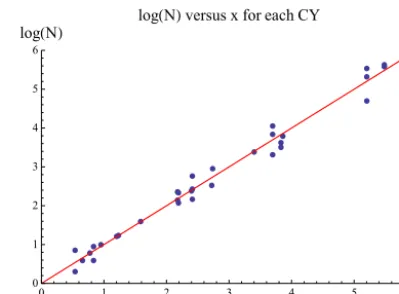
(13)The comparisonofthisfitwiththe dataisprovided inFig. 4.
Each point corresponds to a CICY with x is the value computed
fromtheRHSof Eq. (12),using thevaluesin(13) for Ai, Bi and
log
(N
)
isthevalueofstandardmodels onthisCICYfoundbythe computerscan.Theredlineisthediagonal,log(N)
=
x,which rep-resentsa perfect fit.It seems from Eq(13) that x dependsmost heavily on 1,3,5 as the corresponding coefficients dominate inmagnitude. Examining these, we see that they essentially come
Itturnsoutthattheinvariants
ishowrelativelylittlevariation
with increasing Picard number h. If we insert typical values for thesequantities,together with
h
CICY=
19 andh
max=
491 intotheabovefitresulttheextrapolatednumbersbecome
N
(
hCICY)
1023,
N(
hmax)
10723,
(14)whichisnottoofarawayfromtheearlierresult (3).
3. Conclusions
ThefitillustratedinFig.4looksratherconvincingandwe be-lievethat an extrapolationto large h
=
h1,1 istrustworthy (sincethe invariants i show little variation relative to h), as long as
the underlyingmodel-building assumptions continue to be satis-fiedforlarge
h
.WebelievethatthisisthecasefortheCICYdataset and,hence,thenumberof1023standardmodelswithinthisset shouldbetakenseriously.The extrapolation to hmax
=
491, the maximal known PicardnumberofanyCY,ismorequestionable.Someofthemodel
build-ingassumptionsmadeherehavenotyetbeencheckedfortheKS
set,andthereareevenindicationsthat theymaynotbe satisfied. First, it is not clear that the KS set contains manifolds that
ad-mit freely-acting symmetries with the same frequency as CICYs.
Theonlysystematiccheckscarriedoutforlow
h
1,1 wherethefre-quencyofsymmetriesislowerthantheCICYs [30].Noinformation isavailableforlarge
h
1,1 yet.AnothergenericfeatureofCICYmodelsisthefrequentabsence oflarge numbers of vector-like pairs, so that checking the index was sufficient toguarantee thecorrect spectrumfora significant fractionofthemodels.Itisnot clearthat thisfeaturepersists for constructionsbasedon other CYmanifolds.Infact, theresultsof Ref. [31] suggest that the presence of phenomenologically prob-lematicnumbersofvector-likepairsmightbeagenericfeatureof someother CYconstructions. Again,nodefinitestatement onthis isavailablefortheKSset.
In summary,the number of
10723 standard models fortheextrapolation to h1,1
=
491 should be viewed with considerablecaution.However, theextrapolationto
h
1,1=
19,the maximalPi-cardnumberintheCICYsethastobetakenseriouslyandleadsto
1023standardmodels.Eventhisnumber,almostcertainlyacon-servative lower bound, is frighteningly large and beyond current computerstorageandsystematicsearch.
References
[1]P.Candelas,G.Horowitz,A.Strominger,E.Witten,Nucl.Phys.B258(1985)46.
[2]B.Greene,K.Kirklin,P.Miron,G.Ross,Phys.Lett.B180(1986)69.
[3]V.Braun,Y.H.He,B.A.Ovrut, T.Pantev,Phys.Lett.B618(2005)252,arXiv: hep-th/0501070.
[4]V.Braun,Y.H.He,B.A.Ovrut,T.Pantev,J. HighEnergyPhys.0605(2006)043, arXiv:hep-th/0512177.
[5]V.Bouchard,R.Donagi,Phys.Lett.B633(2006)783,arXiv:hep-th/0512149.
[6]V.Braun,Y.H.He, B.A.Ovrut,J. High EnergyPhys. 0606(2006)032,arXiv: hep-th/0602073.
[7]L.B.Anderson,J.Gray,Y.H.He,A.Lukas,J. HighEnergyPhys.1002(2010)054, arXiv:0911.1569 [hep-th].
[8]L.B.Anderson,Y.H.He,A.Lukas,J. HighEnergyPhys.0707(2007)049,arXiv: hep-th/0702210.
[9]L.B.Anderson,J.Gray,A.Lukas,E.Palti,Phys.Rev.D84(2011)106005,arXiv: 1106.4804 [hep-th].
[10]L.B.Anderson,J.Gray,A.Lukas,E.Palti,J. HighEnergyPhys.1206(2012)113, arXiv:1202.1757 [hep-th];
L.B.Anderson,J.Gray,A.Lukas,E.Palti,PoSCORFU2011(2011)096.
[11]L.B.Anderson,A.Constantin,J. Gray,A.Lukas,E.Palti,J. HighEnergyPhys. 1401(2014)047,arXiv:1307.4787 [hep-th].
[12]K.R.Dienes,Phys.Rev.D 73(2006)106010,arXiv:hep-th/0602286;
K.R.Dienes,M.Lennek,D.Senechal,V.Wasnik,Phys.Rev.D75(2007)126005, arXiv:0704.1320 [hep-th];
K.R.Dienes,M.Lennek,Phys.Rev.D75(2007)026008,arXiv:hep-th/0610319.
[13]F.Gmeiner,R.Blumenhagen,G.Honecker,D.Lust,T.Weigand,J. HighEnergy Phys.0601(2006)004,arXiv:hep-th/0510170.
[14]M.R.Douglas,J. HighEnergyPhys.0305(2003)046,arXiv:hep-th/0303194.
[15]A.Constantin,A.Lukas,C.Mishra,J. HighEnergyPhys.1603(2016)173,arXiv: 1509.02729 [hep-th].
[16]P.Candelas,A.M.Dale,C.A.Lutken,R.Schimmrigk,Nucl.Phys.B298(1988) 493;
P.Candelas,C.A.Lutken,R.Schimmrigk,Manifolds,Nucl.Phys.B306(1988) 113;
M.Gagnon,Q.Ho-Kim,Mod.Phys.Lett. A9(1994)2235.
[17]T.Hübsch,Calabi-YauManifolds,WorldScientific,1992.
[18]A.C.Avram,M.Kreuzer,M.Mandelberg,H.Skarke,Nucl.Phys.B505(1997) 625,arXiv:hep-th/9703003;
M.Kreuzer,H.Skarke,Adv.Theor.Math.Phys. 4(2002)1209,arXiv:hep-th/ 0002240.
[19]M.Kreuzer, H.Skarke, Comput. Phys.Commun.157(2004)87, arXiv:math/ 0204356;
A.P.Braun,J.Knapp,E.Scheidegger,H.Skarke,N.O.Walliser,arXiv:1205.4147.
[20]R.Altman,J.Gray,Y.H.He,V.Jejjala,B.D.Nelson,J. HighEnergyPhys.1502 (2015)158,arXiv:1411.1418 [hep-th].
[21]R.Altman,J.Carifio,J.Halverson,B.D.Nelson,arXiv:1811.06490 [hep-th].
[22]R.Slansky,Phys.Rep.79(1981)1.
[23]A.Constantin,A.Lukas,arXiv:1808.09992.
[24]D.Klaewer,L.Schlechter,arXiv:1809.02547 [hep-th].
[25]A.Constantin,arXiv:1808.09993 [hep-th].
[26]E.I.Buchbinder,A.Constantin,A.Lukas,J. HighEnergyPhys.1403(2014)025, arXiv:1311.1941 [hep-th].
[27]E.I.Buchbinder,A.Constantin,A.Lukas,J. HighEnergyPhys.1406(2014)100, arXiv:1404.2767 [hep-th].
[28]E.I.Buchbinder, A.Constantin,A. Lukas,Phys. Lett. B748(2015) 251–254, arXiv:1409.2412 [hep-th].
[29]T.D.Browning,D.R.Heath-Brown,P.Salberger,arXiv:math/0410117.
[30]A.Braun,A.Lukas,C.Sun,Commun.Math.Phys.360 (3)(2018)935,arXiv: 1704.07812.
[31]A.P.Braun,C.R.Brodie,A.Lukas,J. HighEnergyPhys.1804(2018)087,arXiv: 1706.07688.
[32]Y.H.He,S.J.Lee,A.Lukas,C.Sun,J. HighEnergyPhys.1406(2014)077,arXiv: 1309.0223 [hep-th].
[33]V.Braun,J. HighEnergyPhys.1104(2011)005,arXiv:1003.3235 [hep-th].
[34]A.Lukas,C.Mishra,arXiv:1708.08943.
[35]P.Candelas,C. Mishra,Fortschr.Phys.66(2018) 1800017,arXiv:1709.01081 [hep-th].
[36]P.Candelas,A.Constantin,C.Mishra,Fortschr.Phys.66(2018)1800029,arXiv: 1602.06303 [hep-th].
[37]P.Candelas,R.Davies,Fortschr.Phys.58(2010)383,arXiv:0809.4681 [hep-th]; P.Candelas,A.Constantin,Fortschr.Phys.60(2012)345–369,arXiv:1010.1878; P.Candelas,A.Constantin,C.Mishra,Fortschr.Phys.64 (6–7)(2016)463,arXiv: 1511.01103.
[38]P.Candelas,X.delaOssa,Y.H.He,B.Szendroi,Adv.Theor.Math.Phys.12 (2) (2008)429,arXiv:0706.3134.