Peridynamics Review
Ali Javilia,∗, Rico Morasataa, Erkan Oterkusb, Selda Oterkusb
aDepartment of Mechanical Engineering, Bilkent University, 06800 Ankara, Turkey
bDepartment of Naval Architecture, Ocean and Marine Engineering, University of Strathclyde, Glasgow, United Kingdom
Abstract
Peridynamics (PD) is a novel continuum mechanics theory established by Stewart Silling in 2000 [1]. The roots of
PD can be traced back to the early works of Gabrio Piola according to dell'Isola et al. [2]. PD has been attractive to researchers as it is a nonlocal formulation in an integral form; unlike the local differential form of classical continuum
mechanics. Although the method is still in its infancy, the literature on PD is fairly rich and extensive. The prolific
growth in PD applications has led to a tremendous number of contributions in various disciplines. This manuscript
aims to provide a concise description of the peridynamic theory together with a review of its major applications and
related studies in different fields to date. Moreover, we succinctly highlight some lines of research that are yet to be
investigated.
Keywords: Peridynamics, Continuum mechanics, Fracture, Damage, Nonlocal elasticity
1. Introduction
The analysis of material behavior due to various types of loading and boundary conditions may be carried out at different length scales. At the nanoscale, often Molecular Dynamics (MD) is used to analyze the behavior of
atoms and molecules. However, simulation time, integration algorithms and the required computational power are
limiting factors to the method’s capabilities. On the other hand, at the macroscale, the behavior of a body is usually
analyzed using the Classical Continuum Mechanics (CCM) formalism. In CCM, a body is assumed to be a continuum
surrounded within its boundary for which the balance laws must be satisfied locally. Traction ton the surface of a
material point can be expressed ast=σ·nwhereσis a stress tensor andnrepresents the unit normal of the surface cut
the traction is acting on. Local conservation of linear and angular momentum can be expressed asρ(x) ¨u(x,t)=divσ+
b(x,t) andσ =σt, respectively, whereρ, ¨uandbcorrespond to the density, acceleration and body force associated
with the material pointx, respectively. For the past two centuries, these balance equations have been successfully used
∗Corresponding author.
Email addresses:[email protected](Ali Javili),[email protected](Rico Morasata),
to solve many problems in solid mechanics. Despite the fact that these equations are well established, they encounter
difficulties when discontinuities such as cracks are present within the body since mathematically, the divergence term
yields singular values. Various approaches such as Linear Elastic Fracture Mechanics (LEFM) [3, 4] and Cohesive Zone Model (CZM) [5, 6] have been proposed to overcome these issues. The cohesive zone model dates back to the
[image:2.595.63.531.214.362.2]seminal works of Barenblatt [5, 7] and Dudgale [6] and has subsequently been extended in [8–11] among others.
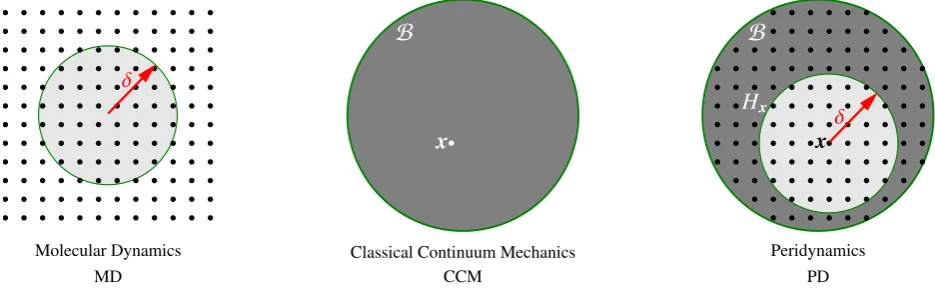
Figure 1: Comparison of MD, CCM and PD. MD (left) analyzes the interactions between discrete entities, i.e., atoms and molecules. These local interactions are governed by the cutoffradiusδ. On the other hand, CCM (center) and PD (right) are formulations defined over a continuum body B. The latter is subdivided into points with a finite volume. In CCM, the state of a point is only influenced by its immediate neighbors. However, in PD, a material pointxinteracts with other material points within a neighborhoodHxdelimited by the horizonδ. PD is similar to CCM in the sense that it is still a continuum formulation and also, is similar to MD in the sense that it is nonlocal and borrows certain notions of MD such as the cutoffradiusδor interactions between points.
PD belongs to the class of nonlocal continuum mechanics formulations. Etymologically the term “peridynamics”
is derived from two Greek wordsπερ´ι(“per´ı-” around) andδυναµη´ (“d´ynami” force). In PD, a continuum is
subdi-vided into material points occupying volume in space. The core of the peridynamic formulation is that the behavior of
each material point is governed by its interaction with other material points located within its neighborhood. In other words, the peridynamic theory is about the interaction forces between material points within a given neighborhood.
In contrast to CCM, the governing equation of PD is an integro-differential equation which makes it suitable for
prob-lems involving discontinuities in the body. Figure 1 highlights the similarities and dissimilarities among MD, CCM
and PD schematically.
There are other continuum formulations such as nonlocal elasticity and strain-gradient theories. Although both
are nonlocal formulations, nonlocal elasticity and PD are fundamentally different. Eringen’s nonlocal elasticity theory
assumes that the stress state at a point depends on the strain state at that point as well as the strain states of all the
points within the body [12]. Moreover, the balance of linear momentum is expressed in terms of the divergence of the
stress tensor as in the CCM formulation. In contrast, PD precludes spatial derivatives and does not explicitly involve stress and strain. Figure 2 shows that there has been an increasing interest in PD as a novel continuum mechanics
The main purpose of this paper is to expound the peridynamic theory to researchers of various backgrounds. The
main differences between the classical continuum mechanics formulation and the peridynamic theory are highlighted,
an overview of the related contributions and applications of PD is presented and the challenges and new perspectives in the development of PD are discussed. Though the peridynamic theory has been formally established by Silling
in 2000 [1], dell'Isola et al. [2] claim that Gabrio Piola is the pioneer of higher-gradient and nonlocal continuum
models, including PD. They showed that the fundamental ideas behind PD were already presented in Piola’s works,
who derived nonlocal continuum theories and higher-gradient formulations by means of the virtual work principle.
dell'Isola and coworkers indicated that Piola’s works have remained obscure and have been overlooked despite of their
potentials. On the other hand, there are strong connections yet differences between the peridynamic theory and particle
systems [13, 14]. As pointed out by Fried [13], “The starting point of peridynamic theory is a continuum level field
equation imposing linear-momentum balance with the essential difference being that the conventional term involving
the divergence of the stress is replaced by a nonlocal term in which an integral operator is applied to the displacement
field. This operator determines not only the range over which material points interact but also the nature of allowed interactions. Peridynamic theory therefore mixes kinematics, kinetics and constitutive equations from the outset. It
seems likely that the conceptual basis for particle mechanics can be adapted to provide an alternative formulation of
peridynamic theory in which these ingredients are treated separately”.
0 20 40 60 80 100 120 140 160
2000 2002 2004 2006 2008 2010 2012 2014 2016
number of citations of [1] per year
[image:3.595.112.491.437.634.2]year
Figure 2: Number of citations of [1] per year versus year from its birth (2000) till today. The fitted curve is an exponential function and the points represent the data obtained from SCOPUS.
It is worth mentioning that various continuum models in relation to PD have been developed such as a 1D elastic
continuum model with long-range forces [15], modified beam and plate equations [16, 17], coupling of local and
misconceptions regarding the notions of particles and long-range forces in the peridynamic theory in [1] from an
atom-istic perspective. In a related work, Drapaca and Sivaloganathan [22] introduced a new nonlocal continuum model
based on fractional derivatives, which encompasses both classical continuum mechanics and nonlocal formulations such as PD.
3.8 Material failure Damage Fracture Fatigue 3.2 Multifield problems Heat transfer
Diffusion
Electronics General coupling 3.12 Geomechanics 3.10 Composites 3.13 Wave dispersion 3.6 Constitutive models 3.9 Impact problems 3.3
Complex flow problems 3.1 Static problems 3.11 Biology 3.14 Particle systems 3.7 Numerical techniques Meshfree methods
Finite element method 3.4
Multiscale problems
3.5 Idealized structures
applications, related contributions and coupling to other fields
[image:4.595.67.532.188.448.2]E X T E N T O F P E R I D Y N A M I C S
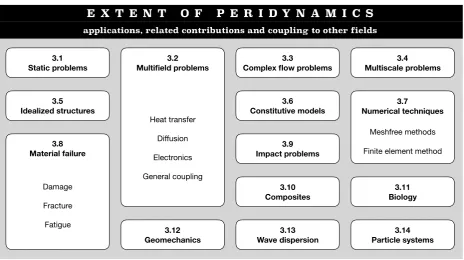
Figure 3: Extent of peridynamic theory to date. Section 3 elaborates on each field together with a review of the topic and important contributions.
This manuscript is organized as follows. Section 2 elaborates on the fundamentals of peridynamics in terms of its
governing equation and balance laws. Section 3 discusses related contributions and various applications of PD to a
plethora of problems as found in the literature to date, gathered in Fig. 3. Section 4 concludes this work and provides
further outlook indicating potential research trends regarding PD. Eventually, a brief guideline for the numerical
implementation of PD is given in the Appendix.
2. Fundamentals of peridynamics
The peridynamic formulation is based on the interactions within the neighborhoodHx with the distanceδof a
material point atxas shown in Fig. 1. There are two main categories of peridynamic formulation asbond-based PD
andstate-based PD. The latter is further divided into two types ofordinary state-based PDandnon-ordinary
state-based PD. Obviously, all these variants must satisfy the conservation laws. Throughout this section, the fundamentals
in a similar fashion.
2.1. Bond-based PD
The peridynamic equation can be understood as an integral expression of the linear momentum balance in CCM.
The equation of motion of a material point in an elastic material can be expressed as
ρ(x) ¨u(x,t)=
Z
Hx
f(u0−u,x0−x) dV0+b(x,t), (1)
where f(u0−u,x0−x) is a pairwise force density vector function anduis the displacement of the material point at
x. The term “bond” refers to the interaction between the material points atxandx0. The bond-based PD relies on the
assumption of pairwise interactions in which the force density vectors exerted by the material points on one another
are equal in magnitude and parallel to the relative position vector in the deformed state. The integral equation (1) is
always valid regardless of discontinuities. It can be seen that in Eq. (1), the divergence of the stress tensor in the local
form is replaced by the integral of the force density over the neighborhoodHxthereby f contains all the constitutive
properties of the material. For instance, for a linear elastic isotropic solid fcan be expressed as
f(u0−u,x0−x)=csy
0−y
|y0−y|, (2)
wherey=x+uis the position of the material point in the deformed configuration,cdenotes the bond constant ands
is the bond stretch defined as
s=|y
0−y| − |x0−x|
|x0−x| . (3)
The bond constantcis the peridynamic material parameter and can be expressed in terms of the material constants of
CCM. These relations can be established by considering a common parameter used in both approaches. For instance,
for a linear isotropic material, the bond constant reads
c=12E
πδ4 , (4)
whereδis the horizon andEis the elastic modulus in CCM. Note that there is only one peridynamic parameter used
in the original (bond-based PD) formulation as opposed to two independent Lam´e parameters of CCM for isotropic
material behavior. In other words, it is not possible to freely define a Poisson’s ratio since the peridynamic
problems, see the original work of Poisson [23] and the more recent study [24], among others. The constraints on
material parameters for the bond-based PD are derived in [25].
2.2. State-based PD
The original bond-based peridynamic formulation suffers from a limitation on material constants since it assumes
that the peridynamic forces between two material points are of equal magnitude and opposite directions. This issue has
been addressed by means of a generalized formulation referred to asstate-based PD[26]. The core of the formulation
is a mathematical object calledstatewhich, to some extent, operates like a mapping. State is basically an array which stores information about a parameter of peridynamic bonds associated with a particular material point. For instance,
a force state stores the PD forces pertaining to a bond. State-based PD is such that the response of a material point
depends on the deformation of all the material points within its horizon. Based on these new assumptions, the equation
of motion of a material point can be written as
ρ(x) ¨u(x,t)=
Z
Hx
{T(x,t)hx0−xi −T(x0,t)hx−x0i}dV0+b(x,t), (5)
whereTh·irepresents the force state.
The state-based PD can be further categorized intoordinaryornon-ordinarystate-based PD. LetMdenote a vector
state such thatMhx−x0iis a unit vector pointing from the deformed position ofxtoward the deformed position ofx0.
If a material has a property such that for any deformation there exists a scalar statetsuch thatT =tM, the material
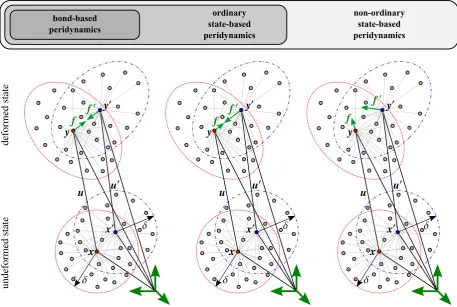
is calledordinaryandnon-ordinaryotherwise, see Fig. 4. In the ordinary state-based PD formulation, although the
peridynamic forces between two material points can have different magnitudes, their directions are assumed to be
along the bond direction. For instance, for a linear elastic isotropic material, the force state is given by
T(x,t)hx0−xi= 2adδ
|x0−x|θ(x,t)+bs
! y0−y
|y0−y|, (6)
wherea,banddare peridynamic parameters andθ(x,t) is the peridynamic dilatation term. This assumption can be
disregarded in the non-ordinary state-based PD by allowing peridynamic forces in arbitrary directions. By doing so,
it is essential to explicitly ensure the conservation of angular momentum since it is no longer fulfilled a priori, in contrast to the bond-based and ordinary state-based formulations. Therefore, for the non-ordinary state-based PD, the
following relationship must hold
Z
Hx
bond-based peridynamics
ordinary state-based peridynamics
[image:7.595.68.526.111.418.2]non-ordinary state-based peridynamics
Figure 4: Illustration of the bond-based (left), ordinary state-based (center) and non-ordinary state-based peridynamic formulations (right). The red and blue points represent two material points, each having its own horizon, represented by the red and blue circle respectively. Each material point interacts with the ones in its horizon, as shown by the grey dashed lines. The difference between the three formulations lies in the magnitude and direction of the interaction forces (green arrows) between the materials points. Bond-based PD can be understood as a particular case of ordinary state-based PD. Similarly, ordinary state-based PD can be understood as a special case of non-ordinary state-based PD.
Furthermore, in what is referred to as thecorrespondence model[26], the force density vector can be related to
stress as
T(x,t)hx0−xi=whx0−xiP K-1(x0−x) (8)
withPbeing the Piola1stress tensor andKis the shape tensor defined as
K=
Z
Hx
whx0−xi(Xhx0−xi ⊗Xhx0−xi) dV0, (9)
whereXis the position state which contains the relative position of material points associated with a particular bond
and thewstate contains the influence function information that defines the strength of interactions. The
correspon-1The term Piola stress is adopted instead of the more commonly used first Piola-Kirchhoffstress. Nonetheless, it seems that the termPiola stressis more appropriate for this stress measure. Recall,Pis essentially thePiola transformof the Cauchy stress and ties perfectly to thePiola
dence material model is such that the peridynamic constitutive model iscalibrated to yield the same results as the
classical model for a given homogeneous deformation. More precisely, the two models are correspondent when the
peridynamic and classical strain energy density functions are equal under affine deformations. The deformation
gra-dientFcan be approximated in the peridynamic framework as
F=
R Hxw
hx0−xi(Yhx0−xi ⊗Xhx0−xi) dV0 R
Hxw
hx0−xi(Xhx0−xi ⊗Xhx0−xi) dV0, (10)
whereY is the deformation state containing the relative position of material points in the deformed configuration.
As the most general peridynamic formulation, the non-ordinary state-based PD is a practical approach for a variety of problems. However, as Tupek and Radovitzky [28] demonstrated, the formulation of the nonlocal deformation
gradient tensor allows unphysical deformation modes including material collapse, matter inter-penetration at
discon-tinuities and zero-energy modes. The latter occur as a result of a weak coupling between a material point and its
family [29]. To overcome these limitations, Tupek and Radovitzky [28] proposed anextended constitutive
correspon-dence formulationby defining a nonlocal peridynamic strain tensor based on alternative strain measures. To control
zero-energy modes, Breitenfeld et al. [29] investigated different techniques which consist of adding another term to
Eq. (8). Recently, Silling [30] studied the causes of zero-energy mode instability in a meshfree discretization and
established a general criterion for material stability in PD.
2.3. PD as a paradigm of continuum mechanics
Since the seminal work of Silling [1], the peridynamic formulation has been of great interest among researchers.
Notably, Silling and Lehoucq [31] and Madenci and Oterkus [25] carried out an extensive study of the balance laws,
applications and implementations of the peridynamic formulation. Moreover, Ostoja-Starzewski et al. [32]
analyti-cally showed the restrictions imposed by the second law of thermodynamics on the pairwise forces for the bond-based PD and the force states for the state-based PD. Recently, Bobaru et al. [33] elaborated on mathematical, numerical and
computational issues of PD, along with applications such as dynamic fracture. Aguiar and Fosdick [34] proposed a
quadratic free energy function for a simple linear elastic peridynamic material model which accounts for bond stretch
and relative bond angles; the model also depends on four material constants, two of which were correlated to elastic
constants from classical elasticity in the limit of small horizon. In addition, the authors indicated that their model
satisfies the angular momentum balance and is a nonordinary material model. Mitchell et al. [35] proposed an
im-proved version of the ordinary state-based peridynamic formulation referred to asposition-aware linear solid(PALS)
constitutive model which employs two influence functions in order to address surface effects, i.e., the problems due
multipliers and calibrated at each material point, hence the name “position aware”.
For computational efficiency and improved accuracy, variants of the traditional peridynamic formulations have
been developed. According to Ren et al. [36], the horizons’ radii are kept constant in traditional PD to prevent the loss of accuracy in the results, due to spurious wave reflections and ghost forces between material points. They
intro-duced thedual-horizon concept[37] in which the discretization of the domain is analogous to that of the FEM or the
finite volume method (dense node distribution in critical regions and coarse distribution elsewhere), thereby reducing
the computational cost. In addition to theconstant horizonin the traditional formulation and thedual-horizonPD,
Silling et al. [38] presented avariable horizonin a peridynamic medium with constant bulk properties. They
inves-tigated the anomalies induced by ghost forces and concluded that these irregularities can be minimized by making
the horizon a smoothly-varying function. Recently, Queiruga and Moridis [39] investigated the accuracy and
conver-gence properties of state-based peridynamic laws including deformation gradient-based model [26] and dilation-based
models [40, 41] with different influence functions for 2D static problems. They observed that the convergence of the
dilation state-based models is restricted to specific constant-strain problems and that the deformation gradient model exhibits a linear convergence rate but is unstable. They also noted that convergence is guaranteed with a cubic
influ-ence function. Ganzenm¨uller et al. [42] proposed an improvement to the Prototype Microbrittle Model (PMB) model;
a linear-elastic, bond-based peridynamic model with brittle failure. They validated the modified model by analyzing
wave propagation in a bar with nonuniform particle discretization and investigated crack propagation in a patch with
initial crack. Their results were quantitatively in good agreement with the analytical solutions.
The presence of the length scale parameterδin the peridynamic formulation makes it suitable for analyzing
mate-rial behavior at the microscale as well as the macroscale. Notably, PD has been used to analyze nano-indentation [43]
and failure of graphene sheets [44], nanoscale friction and wear properties of amorphous carbon films [45].
Chowd-hury et al. [46] developed a 3D state-based micropolar peridynamic model with an additional length scale parameter. They also derived a 1D homogenized micropolar peridynamic beam model. The authors concluded that the
incorpo-ration of micropolar effects improves the prediction capabilities of the model and that dimensionally-reduced models
significantly reduce computational overhead. Note, when applying a continuum model at the nanoscale, the
under-lying assumptions of field theories no longer hold. Nonetheless, such continuum models can be used as numerical
estimates to approximate the homogenized material response. Obviously, at the nanoscale discrete models such as
molecular dynamics are more appropriate and physically acceptable.
Various studies have attempted to establish the connection between PD and classical elasticity. To correlate CCM
with PD, Lehoucq and Silling [47] established the notion of peridynamic stress tensor, which is not explicitly present
models. In the proposed approach, the material properties are derived at different length scales. Silling indicated that,
unlike the rescaling approach [49], the coarsening method accounts for material rearrangement at the small scale in
response to the deformation at the large scale. An interesting study was presented by Madenci et al. [50] in which they introduced a peridynamic differential operator that can recast local differential equations into their nonlocal form.
The authors demonstrated the robustness and capability of the proposed operator by solving challenging differential
equations. Bellido et al. [51] demonstrated that hyperelasticity is theΓ-limit of the peridynamic macroelastic
en-ergy of deformation; the latter being a double integral of the pairwise potential function evaluated over the domain.
Seleson et al. [52] analyzed the connections between nearest-neighbor discretizations of PD equilibrium equations,
by means of nodal-based quadratures, and finite difference discretizations of the classical Navier–Cauchy equation of
static elasticity. They concluded that the PD equations reduce to their classical discrete counterparts under appropriate
choices of quadrature weights. Rahman and Foster [53] developed a statistical mechanics framework for the
peridy-namic theory of solids, which incorporated MD within a PD model. Another topic of interest in the development of
PD models is the investigation of nonlinearities in the peridynamic formulation, as described in [54, 55]. Liu and Hong [56] derived the micromoduli of discretized peridynamic models in 1D and 3D. An important consideration in
the peridynamic formulation is the handling of boundary conditions, see in particular [57–60].
3. Extent of peridynamics
Since the peridynamic formulation can inherently account for discontinuities in the displacement field, PD has
been predominantly used for the solution of fracture and damage problems. However, its extent is not restricted
to fracture mechanics. This section attempts to present a concise categorization of the PD applications and related
contributions in the literature gathered in Fig. 3. Obviously, some categories may overlap.
3.1. Static problems
PD has been applied to various static and quasistatic problems. For instance, Dayal and Bhattacharya [61] applied
the peridynamic theory to study martensitic phase transformations. They conducted both quasistatic and dynamic
analyses of phase boundaries and observed that for the quasistatic responses, the accuracy of the results is highly
dependent on the choice of numerical method as well as the incremental load step. Huang et al. [62] presented an
ex-tended bond-based peridynamic formulation to investigate the quasistatic response and crack propagation in cantilever
beams. Mikata [63] made a significant contribution by investigating analytical solutions of peristatic and peridynamic
problems for 1D infinite rod. Furthermore, Zaccariotto et al. [64] applied PD for the solution of static equilibrium problems and static crack propagation problems using an implicit Newton-Raphson method. Also, Buryachenko [65]
3.2. Multifield problems
To solve complex problems encountered in practice, coupled formulations involving PD have been developed for
the analysis of thermal, chemical, diffusion and electrical problems as well as porous flow. In particular, see the
pioneering work of Gerstle et al. [66] and the more recent work of Oterkus et al. [57] among others.
3.2.1. Heat transfer
The classical heat transfer equations are not applicable to bodies with emerging discontinuities since they involve
temperature gradients. This issue motivated Bobaru and Duangpanya [67] to present a peridynamic formulation for
1D transient heat conduction. They also analyzed the convergence to the classical solution in the limit of vanishing
horizon, which was then extended to multiple dimensions [68]. Also, Oterkus et al. [57] derived a generalized
state-based peridynamic heat transfer model state-based on the Lagrangian formalism and demonstrated its advantage in handling
discontinuities. To account for the effects of thermal state on the deformation of a body, fully-coupled peridynamic
thermomechanics were presented in [69]. An important study was carried out by Chen et al. [70] in which, by means of the one-point quadrature, they investigated the effect of the kernel choice on peridynamic solutions for transient
heat and mass diffusion. The authors underlined that the one-point quadrature converges to the classical solution in
the limit of vanishing horizon.
3.2.2. Diffusion
Considering the major issues caused by moisture in different applications, Diyaroglu et al. [71] used a peridynamic
model based on the wetness approach to predict moisture concentration and diffusion. Oterkus et al. [57] derived a
generalized state-based peridynamic thermal diffusion model which can also be adapted to account for concentration.
For various benchmark problems, the results from the model were in good agreement with the analytical solutions.
Furthermore, PD provides a suitable platform to study nonlocal diffusion arising in several disciplines such as biology,
image processing and particle systems, see [72] among others.
3.2.3. Electronics
Device failure due to thermal stresses is a major concern regarding electronic packages. This failure mode stems
from the mismatch of material properties at interfaces as well as the presence of geometric discontinuities. In that
context, the peridynamic formulation has been applied to investigate crack propagation in multi-layer thin-film
struc-tures [73]. Thermomechanical modeling of microelectronic packages has been addressed in [74]. Another crucial
issue regarding electronic components is their potential moisture absorption, leading to degradation whereby the
3.2.4. General coupling techniques
In order to accurately simulate coupled processes, various formulations can be merged into a single framework.
In particular, the peridynamic formulation has been coupled with different numerical methods. For instance, PD has
been implemented within a coupling framework to investigate soil dynamics applicable to geomaterials exhibiting
inelastic behavior under high-pressure loads or soil fragmentation due to high strain rates under explosion-induced
shock waves. Since soil is essentially a medium in which various particles such as sand and rocks are assembled,
con-ventional FEMs are not suitable to capture the complex dynamic interactions. To address the technical difficulties in
the simulation of explosion-induced fragmentation, coupled PD-Smoothed Particle Hydrodynamics (SPH) formula-tions have been developed [75, 76]. PD has also been applied in the context of electrothermomechanics for instance to
model dielectric breakdown in solids [77]. The works of Prakash et al. [78] illustrate the application of
electromechan-ical PD to study composite materials. Specifelectromechan-ically, the coupled framework was used to investigate conductivity and
piezoresistivity of carbon nanotube reinforced polymer composites and to carry out damage sensing in nanocomposite
bonded explosive materials. PD-FEM coupling is an approach aimed to take advantage of both methods [79–82]. The
interest in PD can also be understood from the coupling of PD with other formulations like classical elasticity [83],
poroelasticity [41, 84], MD [85, 86], finite point method [87] as well as damage models [88].
3.3. Complex flow problems
The governing equations of transport phenomena are typically convection-diffusion equations. However, in some
natural systems such as porous media, anomalous diffusion occurs. The work of Katiyar et al. [89] presented a
state-based PD formulation to simulate the convective transport of a single-phase flow of a fluid in heterogeneous porous
media. Motivated by the problem of dessication cracking due to the soil’s variable moisture content, Jabakhanji and
Mohtar [90] proposed a peridynamic model for transient moisture flow in unsaturated, heterogeneous and anisotropic soils.
It is worth mentioning that Silling et al. [91] proposed an Eulerian peridynamic model for compressible fluids. The
bond forces are dependent only on the positions of the material points in the deformed configuration in contrast to the
Lagrangian formulation in the classical PD. The proposed model was used to analyze problems involving very large
deformations. The authors reported that the behavior of soft materials such as gels can be modeled via a framework
combining Lagrangian and Eulerian peridynamic models.
3.4. Multiscale problems
There exists a wide range of phenomena and processes whose characterization requires a simultaneous and
complex materials such as biomaterials, crystalline materials, polymers and composite materials. Various numerical
techniques have been developed to perform multiscale modeling and simulation, amongst them PD is of particular
interest here. Askari et al. [92] demonstrated that PD is a viable multiscale material model, suitable for length scales ranging from nano-scale to macro-scale. One of the early applications of PD to multiscale modeling is found in [49],
in which adaptive refinement for 1D, later extended to 2D [93], was introduced. It has been shown that the
peri-dynamic horizonδis essentially alength scale. Bobaru et al. [94] addressed the natural connections between PD
and multiscale modeling. Alali and Lipton [95] developed a two-scale evolution equation based on the peridynamic
formulation to study the dynamics of heterogeneous media.
The determination of material properties across different length scales is often carried out by means of an
atomistic-to-continuum coupling approach. As indicated in [86], the transition from the microscale to the macroscale is
chal-lenging since the coupling must be consistent. In that regard, multiscale computational models were developed based
on an MD-PD coupling [85, 86, 96]. Talebi et al. [97] introduced an open-source, multiscale modeling software for
failure simulation in solids named PERMIX which has an interface to LAMMPS [98]. Besides, Du et al. [99] imple-mented the two-scale convergence model to study the homogenization of the nonlocal convection-diffusion equation
and the state-based PD for heterogeneous media. Xu et al. [100] developed a two-dimensional multiscale
implementa-tion of finite element discretizaimplementa-tion of nonlocal models, see also [101]. It is noted that PD has been used for mesoscale
fracture analysis in aggregate materials, specifically in multiphase cementitious composites [102]. Shelke et al. [103]
addressed the multiscale estimation of damage in composite materials by means of a nonlocal elastic kernel. For more
details on application of PD in the context of multiscale modeling, see [104] among others.
3.5. Idealized structures
The behavior of engineering structures under different loadings and constraints can be sufficiently described by
imposing suitable conditions on PDEs of classical continuum mechanics resulting in simple models such as the Euler–
Bernoulli beam equation, Timoshenko beam equation and the thin plate equation. Generally, the numerical simulation
and design of complex engineering structures involve a combination ofidealizedstructural elements such as beams,
bars, shells, plates and membranes. The advancement of the peridynamic theory has brought a new perspective in
con-tinuum mechanics as it recovers the reformulation of established PDEs governing the behavior of idealized structural elements. The pioneering work by Silling and Bobaru [105] presented the peridynamic equations for membranes and
fibers used to investigate membrane failure and large deformations in fibers. Later, Diyaroglu et al. [106] derived the
PD equations for a Timoshenko beam and Mindlin plate that could account for transverse shear deformations. A
See [107, 108] for peridynamic models for beams, [109] for thin plates, [110–113] for fiber networks and [114] for
shells, among others.
It is a very challenging task to determine material properties at the microscale and nanoscale, essentially due to the scale effect. In that context, Celik et al. [115] carried out the mechanical characterization of Nickel nanowires via
experimental procedures and numerical simulations using FEM and PD, to determine their elastic modulus and yield
stress. Also, Reddy et al. [16] presented modified beam and plate theories based on gradient elasticity theories, which
account for size effects and geometric nonlinearity. Moreover, they proposed a discrete PD formulation as an
alterna-tive to the classical PD whereby the advantages of the discrete PD approach were highlighted. An interesting study
by Li et al. [116] presented a peridynamic model for the nonlinear static analysis of truss and tensegrity structures. To
understand the relationship between microstructure and mechanical behavior, Le et al. [117] used a state-based PD to
analyze the stress distribution in round wires under uniaxial tensile load and investigated the effects of defects on the
properties of the wires.
3.6. Constitutive models
Different materials can be categorized based on their constitutive behavior such as elasticity, plasticity and
vis-coelasticity. For the examples of elasticity in PD see the bond-based model proposed by Silling [1], the ordinary
state-based model proposed by Silling et al. [26], the non-ordinary state-based model proposed by Aguiar and
Fos-dick [34] and the higher gradient expansion for linear isotropic peridynamic materials proposed by Silhavy [118], among others. Foster et al. [119] incorporated a viscoplasticity model within the state-based peridynamic framework.
The first peridynamic crystal plasticity model was implemented by Sun and Sundararaghavan [120]. Besides, Madenci
and Oterkus [59] developed ordinary state-based PD constitutive relations for plastic deformation based on von-Mises
yield criteria with isotropic hardening. Viscoelastic material models have been incorporated within the peridynamic
framework to simulate the response of viscoelastic materials under point loads [121] as well as mechanical and thermal
loads [122].
3.7. Numerical techniques
The governing equations of physical phenomena are often solved numerically, essentially due to the complexities
of the formulations such as strong coupling, nonlinearity and complex geometries. With proper refinement, numerical
methods usually yield approximate solutions with sufficiently high accuracy. For engineering analyses, the finite
element method and meshfree methods are among the most common approaches. This section briefly reviews the
3.7.1. Meshfree methods
Even though mesh-based approximation techniques such as FEM are widely used in many applications, there are
cases in which they may not be well suited. These include complex three-dimensional geometries, domains with
discontinuities and transient fluid flow through porous media [41]. It is known that a highly distorted mesh results in
large errors and constant remeshing is impractical. The meshfree methods preclude the use of predefined mesh for
the domain discretization but instead, a set of nodes are scattered over the domain and its boundaries, see [123, 124]
among others. The peridynamic approach bears certain similarities to the meshfree method in the sense that the
domain must be discretized into a set of points and not elements.
Silling and Askari [125] elaborated on the numerical implementation of the PD governing equation namely the
meshfree discretization, the integration procedures and the boundary conditions. The discretized formulation was
then applied to case studies involving dynamic crack growth. Bessa et al. [126] made a significant contribution by
establishing a connection between the original state-based peridynamic formulation with other meshfree methods.
Furthermore, the authors introduced the Reproducing Kernel Particle Method so as to overcome certain limitations
of the original formulation. Regarding the comparison of PD and other meshfree methods, Ganzenm¨uller et al. [127]
investigated the similarities between the meshfree discretizations of PD and SPH. Yaghoobi and Chopeza [128]
pre-sented a meshfree method based on the non-ordinary state-based PD to analyze fiber reinforced concrete structures.
An interesting study by O' Grady and Foster [129] presented a meshfree implementation of a state-based peridynamic model to analyze the bending and failure of shells, thereby rotational springs are introduced between pairs of
peridy-namic bonds. Seleson and Littlewood [130] investigated the accuracy and convergence of meshfree static peridyperidy-namic
simulations.
3.7.2. Finite element methods
The finite element method is one of the most important numerical methods in computational mechanics. To
opti-mize computational efficiency and accuracy, the concurrent implementation of FEM and PD has been investigated. A
significant contribution by Macek and Silling [131] described the implementation of PD within a FE code, in which
the peridynamic bonds were represented by truss elements. Chen and Gunzburger [132] developed continuous and
discontinuous Galerkin FEM for the peridynamic model, by means of a variational formulation. In order to reduce the
computational cost in peridynamic computations, Wang and Tian [133] proposed a fast Galerkin method with efficient
matrix assembly and storage for a peridynamic model. Later, their proposed model was extended by Liu et al. [134]
to higher-order discretizations andhpadaptivity. Interesting studies were presented by Du et al. [135, 136] in which an adaptive FEM was developed for nonlocal diffusion equations and peridynamic models by establishing a
volumetrically-constrained problems associated with some linear nonlocal diffusion and nonlocal peridynamic
opera-tors.
A potentially useful and practical technique is the integration of PD within an established FE framework, such as commercial softwares. In that context, Beckmann et al. [138] investigated the damage of a 2D bi-material strip due
to thermal loading by means of an implicit FE implementation of PD in AbaqusR. It is worth mentioning the work
of Schweitzer and Wu [139], who studied the discretization of the Particle Unity Method, a generalized FEM, with
embedded PD enrichment.
Owing to its relative simplicity, attempts have been made to reformulate FEM to tackle challenging problems such
as fatigue and damage. Reddy and Srinivasa [140] presented displacement-based finite element models for
hyperelas-tic materials. It was demonstrated that the magnitude of the discretized nodal forces can be expressed in terms of the
axial strains along the element edges. The nodal force expressions were then compared with the bond force in PD.
Based on this work, Khodabakhshi et al. [141] introduced a nonlocal framework known as graph-based FE to study
fracture in brittle materials. It was shown that fracture problems can be solved using FEM if the classical formula-tion is reformulated into truss-like models, thereby preserving the simplicity of the FEM. Recently, Ren et al. [142]
investigated the dynamic fracture process in a 3D elastic solid, based on a discontinuous Galerkin method of the
bond-based PD. Aiming to design a numerical framework for the failure analysis of new corrosion-resistant
mate-rials, De Meo and Oterkus [143] presented FE implementation of a peridynamic pitting corrosion damage model.
Gerstle et al. [144, 145] presented a finite element peridynamic model to analyze the structural behavior of concrete
structures. Very recently, PD modeling of diffusion using FE analysis was discussed in detail by [146] whereby the
accuracy and capability of this approach is demonstrated through several benchmark problems. See [147–156] for
further contributions dealing with PD and finite element techniques.
3.8. Material failure
In order to prevent safety risks and casualties, significant effort is put into the investigation and prediction of
fail-ure. From the perspective of computational simulation, the eXtended Finite Element Method (XFEM) [157, 158] has
been introduced as an extension of the conventional FEM to capture discontinuities. On the other hand, PD
inher-ently provides a suitable framework to predict material failure. Comparisons of PD, XFEM and CZM are presented
in [159].
In the context of PD, failure can be categorized depending on the material characteristics and the type of PD
formulation used. For instance, for brittle materials such as glass or PMMA and if the bond-based peridynamic formulation is utilized, the failure can depend on a critical stretch parameter. For each step of a peridynamic analysis,
broken and their forces reduce to zero such that the associated material points will no longer interact with each other.
The critical stretch parameter has a direct connection to Griffith’s failure criterion [3] based on the critical energy
release rate. According to the peridynamic theory, a crack emerges when the bonds within a certain region are broken. The local damage state of a material point is quantified as the ratio of the number of broken interactions to the original
number interactions associated with it. A novel energy-based failure criterion was proposed by Foster et al. [160]
for a rate-dependent plastic material model within PD. Material failure is often categorized into damage, fracture and
fatigue discussed in the remainder of this section. Obviously, the three categories are not mutually exclusive. For
instance, low-cycle fatigue can be related to crack propagation and fracture.2
3.8.1. Damage
Considering that experimental tests for damage investigation may not be cost effective, numerical techniques have
been developed to provide qualitative as well as quantitative prediction of structural damage. A crucial process used
to assess the damage state of a structure during its service life is Structural Health Monitoring (SHM). Ibrahim [162] assessed the recent advances of Structural Life Assessment (SLA) and explained the differences between SLA and
SHM in PD. To accurately simulate the material degradation involving discontinuities, Han et al. [88] introduced an
adaptive coupling of local continuum damage mechanics and PD. PD has been used for damage prediction in different
classes of materials including composite materials [163, 164] and layered heterogeneous materials [165]. Emmrich
and Puhst [166] applied PD to investigate the conditions for the existence and uniqueness of solutions in the case of
damage. Considerable effort has been dedicated to the study of damage due to pitting corrosion; a form of localized
corrosion generally in the form of cavities. De Meo et al. [167] presented for the first time a numerical multiphysics
peridynamic framework for the modeling of adsorbed-hydrogen stress-corrosion cracking, based on the
adsorption-induced decohesion mechanism. More recently, De Meo and Oterkus [143] implemented a PD-based pitting corrosion damage model in a commercial FE software, see also [168, 169]. Recently, Jiang et al. [170] applied the peridynamic
theory to analyze micro breakage in cemented carbide cutting tool.
3.8.2. Fracture
Peridynamics has proven to be powerful strategy to capture various types of fracture in materials due to its
integro-differential nature with no spatial derivatives. Taking advantage of the peridynamic formulation, Kilic and
Madenci [171] predicted crack growth patterns in quenched glass plates. Ha et al. [172] used a bond-based PD to
characterize dynamic brittle fracture. In a related work, Shi [173] simulated crack propagation in brittle glasses by
means of a modified Lennard–Jones potential. Liu and Hong [174] used discretized PD and parallel computing to
study brittle and ductile solids. The first study on dynamic fracture using PD has been presented by Silling [175],
for further developments see [138, 176–183] among others. In that context, Shojaei et al. [87] coupled finite point method to PD in order to study dynamic fracture. Recently, Madenci et al. [184] predicted crack propagation in
isotropic materials under complex loading conditions. Dynamic fracture has also been studied with PD for various
types of structures such as polymers [185], fiber networks [186], concrete structures [187], anisotropic materials [188–
190], functionally graded materials [191], polycrystalline materials [192] as well as geomaterials [62, 193–196]. It is
worth mentioning that Evangelatos and Spanos [197] presented the application of PD tostochastic fracture modeling,
with a novel spatial discretization of the peridynamic equation.
3.8.3. Fatigue
Hu and Madenci [198] presented a fatigue damage model to predict damage in laminates under cyclic loading. The
performed numerical simulations were found to be consistent with the experimental fatigue data. Crack nucleation
and growth was also investigated in [199] using a peridynamic fatigue model. Zhang et al. [190] developed a
PD-based fatigue crack model to analyze fatigue cracking in two-phase composite materials. Their numerical results were consistent with the experimental data.
3.9. Impact problems
Silling and Askari [200] pioneered the study on impact by means of PD. The numerical code EMU was used to
implement the bond-based PD and solve a set of case studies. Then, using EMU, Demmie and Silling [201] considered
the problem of extreme loadings of structures. Their work was extended by Oterkus et al. [202] by presenting an
impact damage assessment of building components. The peridynamic theory has been used to study impact damage
in composite materials [203], layered glass systems [204, 205] and ceramic materials [206]. Recently, Liu et al. [207] studied impact damage in a beam with an offset notch. Lee et al. [208] presented a modeling framework for the
interaction of peridynamic domain and conventional finite elements, in order to effectively analyze impact problem
and damage thereof. In a related work, Kosteski et al. [209] introduced the lattice discrete element method to model the
impact test of PMMA specimens. It is noted that Demmie and Ostoja-Starzewski [210] elaborated on a computational
stochastic PD model which was used to study impact loading in geological materials. See also [211–214] for further
contributions on impact and damage using PD.
3.10. Composites
Composite materials are used in several applications due to their high strength-to-weight ratio, fatigue resistance
a huge effort is dedicated towards the development of effective computational models for prediction of composites
behavior. Regarding the application of PD in composites, Silling [215] demonstrated that nonlocality arises in a
ho-mogenized microscale model for layered composites when a smoothed displacement field is chosen. Furthermore, he derived a peridynamic model in which the length scale is dependent on both the geometry and constituent
proper-ties. Buryachenko [216] presented a generalization of the general integral equations of micromechanics using a
ther-moperistatic formulation to obtain the effective properties of composite materials. To study the response of composite
laminates over a wide range of impacting velocities, Sun and Huang [203] presented a PD rate-dependent constitutive
model combining the prototype microelastic brittle (PMB) model and the viscoelastic Kelvin–Voigt model. They also
introduced a new interlayer bond to describe interlayer interactions. Their simulations compared the impact resistance
of composite laminates with that of isotropic plates. Kilic et al. [217] showed that PD is applicable to damage
predic-tion in laminated composites and claimed that homogenizapredic-tion would compromise the failure predicpredic-tion. In a related
work, Hu et al. [218] proposed a homogenization-based peridynamic model for fiber-reinforced composite laminates.
Their results were in agreement with the analytical data for their benchmark problem. The effectiveness of PD in
terms of damage prediction in composite laminates has also been demonstrated in [164, 188, 198, 219, 220].
Askari et al. [163] made a noteworthy contribution by proposing a hybrid continuum/peridynamic model to
ana-lyze the degradation of laminated composites termed asmorphing coupling approach. They indicated that the coupling
occurs at the level of the constitutive model in attempts to mitigate the computational cost due to the nonlocal nature
of PD. Due to their inhomogeneous nature, composite materials exhibit various failure modes such as matrix cracking,
delamination and fiber kinking. Hu et al. [221] proposed a peridynamic model to investigate delamination growth in
composite laminates. Diyaroglu et al. [222] predicted the damage behavior of composites subjected to shock loading.
Sadowski and Pankowski [223] developed peridynamic models to investigate nanoindentation of ceramic composites.
The failure analysis of concrete structures and cementitious composites using PD can be found in [102, 224, 225]. Given the current trends towards nanomaterials, nanocomposites are an innovative class of materials with various
industrial applications. Recently, studies have been conducted to estimate their macroscopic properties using the
peridynamic theory. For instance, Duzzi et al. [226] used the bond-based PD formulation to estimate the effective
Young’s modulus as a function of the filling fraction and observed good agreement of their model with experimental
data. Han et al. [227] proposed a classical continuum model as well as a hybrid local/nonlocal PD-based model to
determine the effective properties of CNT polymer composites using homogenization and concluded that the hybrid
model is more effective in capturing local inhomogeneities. Also, Decklever and Spanos [228] proposed a stochastic
nonlocal model based on Monte Carlo simulation and the bond-based PD formulation to evaluate the properties of
mechanical properties and providing a realistic simulation of quasistatic fracture.
3.11. Biology
The peridynamic theory has been successfully applied to study various problems related to living tissues. Deng
et al. [229] investigated microcrack propagation and healing processes in cortical bone by means of a nonlocal
multi-scale field theory with a generalized form of PD. Taylor et al. [230] used PD to model rupture in biomembranes and
investigated the transition between two types of floral and fractal spontaneous rupture. The work of Perr´e et al. [231]
addressed the prediction of wood properties based on its cellular structure, by means of meshfree methods and image-based representation.
An interesting approach was implemented by Lejeune and Linder [232] where the dual-horizon PD framework
was extended to capture biological growth by changing the interaction distance and force law between particles. With
this framework, the authors note that PD is a particularly convenient approach for modeling biological systems on the
cellular scale where each node represents a biological cell. The authors focused on using the framework to capture
multiscale emergent behavior driven by mechanical interactions. Recently, Lejeune and Linder used PD to investigate
the effect of cell division angle on population morphology [233], the buildup of residual stresses in growing
monolay-ers and spheroids [234] and also, the influence of cell shrinkage during cell death on population morphology [235].
Beyond this body of initial studies, which focuses on small populations of growing, proliferating, and dying cells, PD
is a promising tool for modeling biological materials on the subcellular, cellular and histological scales because PD readily captures nonlocal forces inherent to many biological systems. Furthermore, complex biological phenomena
such as buckling and folding of tissues [236, 237] due to growth are yet to be investigated by PD.
3.12. Geomechanics
Geomaterials are susceptible to crack due to fluid pressure. A type of fracture occurring in oil and gas extraction is
hydraulic fracturing, also known asfracking, where fracture is induced in the rock formation to release natural gas and
oil. Various numerical methods have been developed to study these phenomena, among which of particular interest
here is PD. For instance, Hattori et al. [238] examined various numerical methods, among which PD, to analyze
hydraulic fracking in shale rocks. For further details on hydraulic fracturing in the context of PD, see [41, 239–242]
among others.
Lai et al. [243] derived the U-pperidynamic formulations for fluid-saturated geomaterials and simulated their
fragmentation under impulse loads. TheU-pformulations are equations that describe the behavior of saturated
ge-omaterials, expressed in terms of the displacementU and pore fluid pressure p. In the context of renewable
of accurately modeling the multi-physics phenomena involved, namely thermal stresses and hydraulic fracture. As
pointed out by Fan and Li [76], several engineering applications require an understanding of the soil response to
blast loads. The problem of soil fragmentation under explosive loads was simulated using a PD/SPH coupling
ap-proach in [75, 76]. Moreover, the peridynamic theory has been implemented to investigate crack behavior in rock
materials [193, 194, 245].
3.13. Wave dispersion
The peridynamic formulation has the interesting property that elastic wave dispersion occurs if long-range forces are present and that the peridynamic horizonδinfluences the amount of dispersion. The wave dispersion characteristic
of PD was reported by Zingales [246] combining the concepts of lattice dynamics, PD and the Kr¨oner–Eringen
nonlocal model to investigate wave propagation in 1D elastic solids, see also [247]. A mathematical study of nonlinear
peridynamic wave equations was presented in [248]. Various numerical techniques [249–251] have been developed
to analyze wave propagation in PD. Silling [252] analyzed the propagation of solitary, nondispersive waves in a
nonlinear peridynamic solid. In a related study, Vogler et al. [253] investigated the effect of the microstructure on the
planar wave propagation in layered, particulate composite and granular materials. To reduce the wave dispersion in
PD, Wildman and Gazonas [254] presented a hybrid method. Also, wave propagation in the context of PD has been
studied in other classes of materials such as graphene [255], carbon nanotube [256] and brittle materials [206].
3.14. Particle systems
The nature of the peridynamic equation (1) is particularly interesting in the sense that its discretized form is, to
some extent, similar to MD. In that regard, Parks et al. [257] incorporated PD within the MD simulator LAMMPS.
The authors pointed out that this approach enhanced the capabilities of the MD code towards performing simulations
at larger time and length scales. Rahman and Foster [53] incorporated Langevin dynamics in the peridynamic for-mulation through the fluctuation-dissipation principle. The authors stated that this approach resolved the ambiguity
regarding the role of temperature in a peridynamic system. Within the context of statistical mechanics, they showed
that a homogenized peridynamic model satisfies the conservation laws of continuum mechanics (mass, momentum
and energy). Dai et al. [258] elaborated on the similarity between the state-based PD and the reproducing kernel
particle method and applied these techniques to solve dynamic problems in a multiresolution continuum. For further
4. Concluding remarks
The primary objective of this manuscript is to provide a basic understanding of the peridynamic theory and its main
applications to date. Since its formal establishment, the peridynamic theory has found its way to several disciplines
collected in Fig. 3. Despite its infancy, the method has been successfully applied to various challenging problems.
Given its advantage in handling discontinuities, in contrast to classical continuum mechanics, the peridynamic theory
has been of great interest in the scientific community. Since the inherent nonlocality in PD induces high computational
cost, further development of the method is required to boost its capabilities. Even though PD has been of particular interest to capture fracture, it has motivated other formulations such as dealing with Large Eddy Simulations [260].
As previously discussed, PD has been applied to simulate flows in porous media and is yet to be extended to turbulent
flow analysis. Recently, Motsch and Tadmor [261] presented a mathematical analysis of self-organized dynamics,
an instance of which is peridynamic elasticity. Fried [13] and Fosdick [14] have elegantly formulated the mechanics
of particle systems which could lead to an alternative PD formulation. Beyond the initial studies in the context of
biological applications, which focus on small populations of growing, proliferating, and dying cells, PD is a promising
tool for modeling biological materials on the subcellular, cellular and histological scales because it readily captures
nonlocal forces inherent to many biological systems.
In summary, this manuscript provides a brief explanation of the peridynamic theory and an extensive account of the literature on the subject. Due to its integro-differential form, the peridynamic theory proves to be a promising
alter-native to classical continuum mechanics when dealing with discontinuities and nonlocalities. This generic framework
is broadly applicable to improve our understanding of the material behavior with a large variety of applications.
Note, the main objective of this manuscript is to provide a brief overview of the literature on peridynamics to date
and to categorize them respectively. This should not imply that the authors want to necessarily promote peridynamics
nor we believe that peridynamics is an ultimate theory to understand and explain every possible phenomena. On the
contrary, we regard peridynamics as a continuum theory suffering from and taking advantages of most underlying
assumptions of continuum mechanics. One may even claim that possibly peridynamics, as the whole continuum
mechanics, could become obsolete, as discrete Lagrangian models could prove more appropriate and predictive of
material behavior. In our opinion, both discrete and continuum approaches have certain advantages and disadvantages and perhaps their utility must be separately assessed only based on the problem of interest.
Appendix A. Numerical implementation
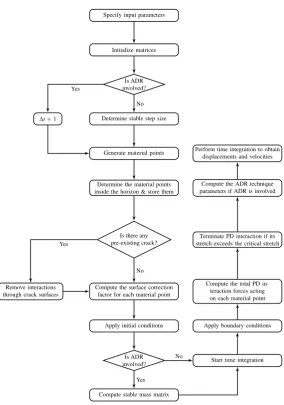
A typical solution procedure for PD is described by Madenci and Oterkus [25], among others. The peridynamic
implementation of PD is given in Fig. A.5.
computations, MPI, OpenMP and/or GPU based approaches can be used. Another important aspect of PD is the
application of boundary conditions. Boundary conditions shall be applied to volumes rather than points, lines or
surfaces. Utilization of fictitious regions is a common practical approach. This will also eliminate the possibility of lack of interactions for the material points close to the surfaces, otherwise these points should be corrected by means
of a surface correction factor.
Specify input parameters
Initialize matrices
Is ADR involved?
Determine stable step size
t=1
Generate material points
Determine the material points inside the horizon & store them
Is there any pre-existing crack?
Compute the surface correction factor for each material point Remove interactions
through crack surfaces
Apply initial conditions
Is ADR involved?
Compute stable mass matrix
Start time integration Apply boundary conditions
Compute the total PD in-teraction forces acting on each material point Terminate PD interaction if its stretch exceeds the critical stretch
Compute the ADR technique parameters if ADR is involved Perform time integration to obtain
[image:23.595.156.441.135.541.2]displacements and velocities Yes No Yes No Yes No
Figure 6: General PD implementation flowchart
Computational PD codes have been developed at Sandia National Laboratories, namely Peridigm [448] and the parallel MD code LAMMPS [266]. The numerical implementation of PD is described in [61].
28
Figure A.5: General PD implementation flowchart. ADR stands for Adaptive Dynamic Relaxation.
The solution domain is discretized into a finite number of volumes, each represented by a point located at its
center. The peridynamic equation of motion in integral form for elasticity can then be expressed in terms of a finite
summation of the form
ρ(xk) ¨u(xk,t)= N X
j=1
f(uj−uk,xj−xk)Vj+b(xk,t), (A.1)
whereN is the number of points inside the horizon of material pointk. Correction procedures such as volume and
As pointed out by Ganzenm¨uller et al. [42], “Within the context of mesh-free methods, Peridynamics can be
classified as a Total-Lagrangian collocation method with nodal integration.”. Usually, the domain is discretized into
a uniform grid of material points, see also [161]. The idea of adaptive grid refinement was first introduced by Bo-baru et al. [49] to analyze the response of a 1D peridynamic bar. Henke and Shanbhag [262] investigated irregular
meshes, specifically centroidal Voronoi tessellation, for peridynamic discretization. They observed that careful
place-ment of quadrature points seems to eliminate mesh sensitivity without significant increase in computational cost.
Freimanis and Paeglitis [263] studiedδconvergence (material point spacingh is constant but horizon size varies)
and observed that the maximum accuracy is reached whenδ=3hand higher horizon sizes compromise the solution
accuracy.
Peridynamic implementation in commercial finite element software still uses meshfree discretization although
it employs mass point elements to represent the material points and truss or spring elements for peridynamic
inter-actions [131]. This type of implementation also allows utilization of efficient solvers of commercial finite element
software which can significantly reduce the computational time. Computational codes to deal with PD have been developed at Sandia National Laboratories. In particular, Peridigm [264] and the parallel MD code LAMMPS [98]
shall be mentioned. It is noted that peridynamic equations are intrinsically compatible for parallel programming
ap-plications. The numerical implementation of PD is described in [25] wherein samples codes for numerous benchmark
problems are given as well.
The discretization of the governing equations yields a matrix system. Brothers et al. [265] investigated different
methods for an efficient construction of the tangent stiffness matrix within Peridigm: forward difference, central
dif-ference and automatic differentiation. The tangent stiffness matrix is mainly required for implicit time integration [39]
in dynamic problems. Although explicit integration scheme is more straightforward to implement and requires less
storage, it is only conditionally stable hence mainly suitable for short-duration analysis. For static problems, the adaptive dynamic relaxation is a common technique which artificially drives the system to reach the steady-state
con-dition by introducing an artificial damping [25, 266]. Kilic and Madenci [161] used a volume integration scheme over
hexagonal subdomains into which Gaussian integration points were placed. Yu et al. [267] proposed a new adaptive
integration method with systematic domain categorization for various geometries. To address the problem of
inter-secting regions (cell neighborhood and neighbor cells) in the standard meshfree approach, Seleson [268] proposed
one-point quadrature algorithms to improve the accuracy of integration of 2D peridynamic models. Gu et al. [269]
used the Galerkin finite element to discretize a microelastic peridynamic material model within a finite bar. To
accel-erate the convergence of the iterative solver, they utilized fast circulant preconditioners.
formulation of the peridynamic equations does not lead to natural boundary conditions, which are traction boundary
conditions in the classical theory. Therefore, body forces are prescribed through a layer of finite thickness at the
material boundary. On the other hand, displacement and velocity boundary conditions are enforced via a fictitious boundary layer of depth at least equal to the horizon [25, 131].
References
[1] S. A. Silling, Reformulation of elasticity theory for discontinuities and long-range forces, Journal of the Mechanics and Physics of Solids
48 (1) (2000) 175–209.
[2] F. dell’Isola, A. D. Corte, R. Esposito, L. Russo, Some cases of unrecognized transmission of scientific knowledge : From Antiquity to Gabrio Piola’s peridynamics and generalized continuum theories, Advanced Structured Materials 42 (2016) 77–128.
[3] A. Griffith, The phenomena of rupture and flow in solids, Philosophical Transactions of the Royal Society of London A: Mathematical,
Physical and Engineering Sciences 221 (582-593) (1921) 163–198.
[4] G. A. Francfort, J.-J. Marigo, Revisiting brittle fracture as an energy minimization problem, Journal of the Mechanics and Physics of Solids
46 (8) (1998) 1319–1342.
[5] G. I. Barenblatt, The formation of equilibrium cracks during brittle fracture: General ideas and hypotheses, Applied Mathematics and Mechanics 23 (3) (1959) 622–636.
[6] D. Dugdale, Yielding of steel sheets containing slits, Journal of the Mechanics and Physics of Solids 8 (2) (1960) 100–104.
[7] G. I. Barenblatt, The mathematical theory of equilibrium cracks in brittle fracture, Advances in Applied Mechanics 7 (1962) 55–129. [8] A. Needleman, A continuum model for void nucleation by inclusion debonding, Journal of Applied Mechanics 54 (1987) 525–531.
[9] G. Alfano, M. A. Crisfield, Finite element interface models for the delamination analysis of laminated composites: Mechanical and
compu-tational issues, International Journal for Numerical Methods in Engineering 50 (7) (2001) 1701–1736.
[10] T. C. Gasser, G. A. Holzapfel, Geometrically non-linear and consistently linearized embedded strong discontinuity models for 3D problems
with an application to the dissection analysis of soft biological tissues, Computer Methods in Applied Mechanics and Engineering 192
(47-48) (2003) 5059–5098.
[11] K. Park, G. H. Paulino, Cohesive zone models : A critical review of traction-separation relationships across fracture surfaces, Applied
Mechanics Reviews 64 (6) (2013) 060802.
[12] A. C. Eringen, Nonlocal continuum field theories, Springer, 2002.
[13] E. Fried, New insights into the classical mechanics of particle systems, Discrete and Continuous Dynamical Systems 28 (4) (2010) 1469–
1504.
[14] R. Fosdick, A causality approach to particle dynamics for systems, Archive for Rational Mechanics and Analysis 207 (2013) 247–302. [15] G. Failla, A. Santini, M. Zingales, Solution strategies for 1D elastic continuum with long-range interactions: Smooth and fractional decay,
Mechanics Research Communications 37 (1) (2010) 13–21.
[16] J. N. Reddy, A. Srinivasa, A. Arbind, P. Khodabakhshi, On gradient elasticity and discrete peridynamics with applications to beams and plates, Advanced Materials Research 745 (2013) 145–154.
[17] J. N. Reddy, A. R. Srinivasa, Non-linear theories of beams and plates accounting for moderate rotations and material length scales,
Interna-tional Journal of Non-Linear Mechanics 66 (2014) 43–53.
[18] G. Lubineau, Y. Azdoud, F. Han, C. Rey, A. Askari, A morphing strategy to couple non-local to local continuum mechanics, Journal of the
![Figure 2: Number of citations of [1] per year versus year from its birth (2000) till today](https://thumb-us.123doks.com/thumbv2/123dok_us/1387917.91947/3.595.112.491.437.634/figure-number-citations-year-versus-year-birth-today.webp)