promoting access to White Rose research papers
White Rose Research Online
[email protected]
Universities of Leeds, Sheffield and York
http://eprints.whiterose.ac.uk/
White Rose Research Online URL for this paper:
Conference paper
Lau, LMS, Neagle, R, Bajanki, S, Dimitrova, V and Boyle, R (2010)
What is the
Real Problem? Using Corpus Data to Tailor a Community Environment for
Dissertation Writing.
In: Lynch, C, Ashley, DK, Mitrovic, T, Dimitrova, V, Pinkwart,
N and Aleven, V, (eds.) Proceedings of the 4th International Workshop on
Intelligent Tutoring Systems and Ill-Defined domains held at the 10th
Community Environment for Dissertation Writing
Lydia Lau, Royce Neagle, Sirisha Bajanki, Vania Dimitrova, and Roger Boyle School of Computing, University of Leeds, UK
{ L.M.S.Lau, R.J.Neagle, S.Bajanki, V.G.Dimitrova, R.D.Boyle }@leeds.ac.uk
Abstract. Training in soft skills is becoming paramount in today’s educational and societal climate, and receives increasing attention in the area of intelligent learning environments for ill-defined domains. We present a study that analyses written feedback given to undergraduate students by tutors at a key stage of dissertation preparation. This allows us to identify key problems students are facing and to understand how these problems are articulated and addressed by tutors. The results of the study are applied to tailor an existing social semantic web environment (AWESOME Dissertation) to address the needs of a particular community for dissertation writing in Computing.
Keywords: dissertation writing, semantic wikis, social computing, scaffolding.
1
Introduction
Dissertation writing, which is a major challenge faced by most students in higher education, is an example of soft skill training as the process requires the learners to explore, interpret, communicate, and manage their own work and progress during a sustained period of time. A fundamental step in developing such intelligent learning environments for ill-defined domains is to articulate what problems learners are facing and how to shape the learning environment to effectively address these problems.
Although intelligent technological solutions for writing development have been built, they focus mainly on discrete aspects of the dissertation process, for example argumentation or research methods [1,2]. An earlier attempt has been made in developing the AWESOME Dissertation Environment (ADE) which exploits social computing to provide holistic support throughout the dissertation process [3]. The intention was to make ADE a generic platform for any students writing a dissertation.
2 Lydia Lau, Royce Neagle, Sirisha Bajanki, Vania Dimitrova, and Roger Boyle School of Computing, University of Leeds, UK
community where understanding and interpretation of domain-specific vocabulary and concepts can be shared.
This paper presents a domain-specific study on the use of ADE for Computing. On one hand, we analysed how some dissertation writing problems were handled in the current practice of tutors giving written feedback to final year students at a key stage of dissertation preparation. In parallel, we tailored an initial AWESOME-Computing instance by (a) integrating examples of previous dissertations; and (b) seeding the environment with content that corresponds to some typical problems and tutor feedback. We developed example scenarios of students and tutors interacting with the AWESOME Computing environment to simulate the process of social scaffolding which enables further ‘tailoring’ as the ADE evolves with use.
2
The AWESOME project
The platform for the study is a novel community environment ‘AWESOME Dissertation Environment (ADE)’ which uses semantic wikis to implement the pedagogical approach of ‘social scaffolding’. It uses MediaWiki1 and its extension
Semantic Media Wiki (Krötzsch et al., 2007) which provides more user-friendly interface to create and query semantic content. The ADE was developed within an interdisciplinary UK research project called AWESOME (Academic Writing Empowered by Social Online Mediated Environments) which involved the universities of Leeds, Coventry and Bangor2. The environment was instantiated and
trialled in several domains: Education, Fashion and Design, Philosophy and Religious Studies, and an Academic Writing Centre.
The ADE architecture consists of a core ontology which supports semantic mark-ups for
• a scaffold in the form of main stages of dissertation writing process; for examples:
getting an overview of dissertation, choosing a topic, adopting an appropriate research methodology, literature review, writing up, and project management;
• some common issues associated to each of these stages; for example: for choosing
a topic, students need to think about if the topic “has a research question” or “is appropriate for the discipline”;
• personal contributions in terms of related top tips, or examples of good writings.
As part of the tailoring process, a separate emerging ontology is built during content creation for additional community driven scaffolds. Features are also provided for users to link content between community and personal spaces. Readers are referred to [4] for a more detailed description of the ADE architecture.
Following both the encouraging feedback from the trial instantiations and the challenges faced in deploying the environment in practice in earlier studies, we conducted a systematic approach in understanding the disparity between generic and
1 http://www.mediawiki.org
domain specific vocabulary when adapting the ADE to dissertation writing in Computing.
3
Dissertation Writing Problems Faced by Computing Students
The final year project (or dissertation) is a hallmark of most Computing and Informatics programmes worldwide [5]. Common to many other programmes is the difficulty experienced by Computing students in recording their work: the write-up represents a challenge they have often not encountered earlier in their studies and usually represents the primary (or sole) artifact that is used for assessment.
In our School of Computing, there is an established practice for every dissertation student to prepare a mid-project report under the guidance of the tutor. It is typically 10 pages long, containing background research and progress to date. This mid-project report will be commented on by another academic member of staff (i.e. ‘assessor’) to provide early written feedback to the student, with no marks given. This collection of assessor feedback forms is potentially a good resource for us to identify common problems and the feedback given to the students as a comparison with the scaffold/core ontology to be provided by the tailored ADE.
A systematic analysis was conducted on a set of 63 authentic feedback forms from 2008 with the aim to identify any common early problem indicators flagged up by the assessors to the students, the suggestions they made and the language used.
3.1 Procedure
1) Content analysis on twenty mid-project report feedback forms was conducted independently by four staff members (as coders), three of whom had considerable experience in assessing and supervising dissertations. Initially, each coder chose his/her own way to annotate the categories of the problem and the associated issues, with the broad understanding of the need to relate the annotation to the final dissertation marking scheme as the student/tutor may use it to judge the impact of the feedback on the work. The marking scheme consisted of: ‘Understanding the problem’, ‘Produce a solution’, ‘Evaluate the solution’, ‘Write up’ and ‘Reflection’.
2) For each issue extracted from the assessor’s feedback, the following were recorded: a) the problem as cited, b) the solution as cited, c) annotation to capture the general category that represented the problem and solution (e.g. write-up), and d) annotation to capture the issue category associated to the general category (e.g. scientific style, referencing).
4 Lydia Lau, Royce Neagle, Sirisha Bajanki, Vania Dimitrova, and Roger Boyle School of Computing, University of Leeds, UK
4) The updated list of annotations (or taxonomy) was then used by the coders to analyse the remaining feedback forms as in step (2) above.
3.2 Results and Analysis
A total of 250 issues were identified from the 63 feedback forms. Some feedback were positive encouragements reinforcing what were done correctly; but most were constructive feedback for further improvements. Following is an example of a feedback which was classified as “evaluation” for generic category and “criteria” for issue category:
• issue cited: “Your evaluation criteria need work”;
• problem cited associated to this issue: “what were put in the report were subjective .. and unconvincing”;
• solution cited associated to the issue: “focus groups won't help unless the users have a real task they are trying to achieve”.
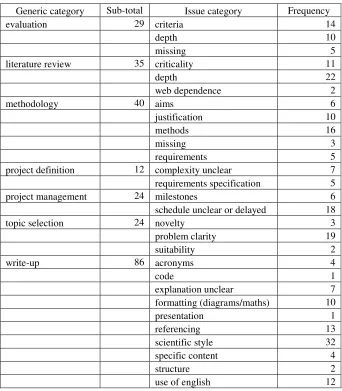
Table 1 summarises the taxonomy emerged from the analysis and the frequency of each being raised as an issue. It is clear that ‘write-up’ was most problematic as it was highlighted 86 times and with a wide range of issues being commented on. ‘Methodology’ came second by being mentioned 40 times.
For a specific issue category, such as ‘scientific style’, a range of comments can be found. For examples: “no evidence of three prototypes claimed to be produced ... no pointer to the corpus generated”, "it is important to clearly identify what you have created/developed yourself, and what you have 'inherited' from others", and “there should be more x-referencing”. Quite often, these comments represent a range of ‘take-for-granted’ common knowledge by academics experienced in scientific writing, but the concept of which has not been grasped properly by the students concern.
Here is another example of a common feedback which students are often at lost on remedial actions: "there is a lack of critical analysis on the literature read". Tutors found themselves needing to stress on this issue repeatedly, despite classes were run to discuss ‘literature review’ every year.
3.3 Implications
Table 1. Taxonomy for Dissertation Writing Issues for Computing Students
Generic category Sub-total Issue category Frequency evaluation 29 criteria 14
depth 10
missing 5
literature review 35 criticality 11
depth 22
web dependence 2
methodology 40 aims 6
justification 10
methods 16
missing 3
requirements 5
project definition 12 complexity unclear 7 requirements specification 5 project management 24 milestones 6 schedule unclear or delayed 18 topic selection 24 novelty 3
problem clarity 19
suitability 2
write-up 86 acronyms 4
code 1
explanation unclear 7 formatting (diagrams/maths) 10
presentation 1
referencing 13
scientific style 32
specific content 4
structure 2
use of english 12
6 Lydia Lau, Royce Neagle, Sirisha
School of Computing, University of Leeds, UK
channeling and focusing these activities and a ‘public platform’ for the sharing of experience.
4
AWESOME
We suggest that “learning by example” is of great value, but more than that, open discussion by peers and
arise would be of most help. Thus, a
dissertations exhibiting fragments of annotated good practice, which allowed the student to add her own annotations
4.1 Tuning and Seeding
The first step to tailor the generic ADE for Computing previous dissertations. Although these diss
website, there was no facility AWESOME-computing enabled to a dissertation in a wiki fashion (see the example to be pulled into other
Fig. 1. Comments and tips linked to a pr
Lydia Lau, Royce Neagle, Sirisha Bajanki, Vania Dimitrova, and Roger Boyle School of Computing, University of Leeds, UK
channeling and focusing these activities and a ‘public platform’ for the sharing of
AWESOME-Computing
We suggest that “learning by example” is of great value, but more than that, open n by peers and staff of favourable and unfavourable examples as the issues
would be of most help. Thus, a semantic wiki framework in which earlier s exhibiting fragments of annotated good practice, which allowed the student to add her own annotations or questions may be productive.
Tuning and Seeding
The first step to tailor the generic ADE for Computing was by adding links to previous dissertations. Although these dissertations were available online on a
there was no facility to comment on specific good practice or exa computing enabled this by allowing students or tutors to add comments to a dissertation in a wiki fashion (see Fig. 1). Additional semantic markups enab the example to be pulled into other appropriate wiki pages on specific issues.
Comments and tips linked to a previous dissertation for writeup
Dimitrova, and Roger Boyle
channeling and focusing these activities and a ‘public platform’ for the sharing of
We suggest that “learning by example” is of great value, but more than that, open
as the issues
iki framework in which earlier s exhibiting fragments of annotated good practice, which allowed the
s by adding links to ertations were available online on a ecific good practice or examples. this by allowing students or tutors to add comments 1). Additional semantic markups enabled
s.
Secondly, we scaffolded and seeded the environment with content for some anticipated problems and tutor feedback (see Fig. 2 for an example).
Fig. 2. Having problems relating to ‘critical writing’?
4.2 Scenarios for Further Seeding of Content
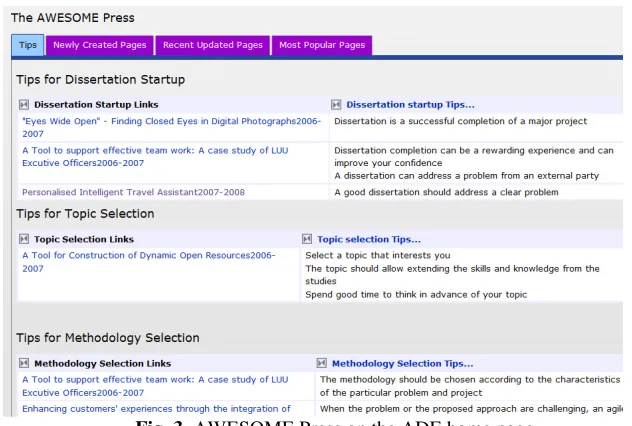
To provide some useful initial content, a number of scenarios were developed based on real experiences by some tutors. These scenarios were then ‘walked through’ to populate the ADE with authentic content. Fig. 3 showed an example of the end result of this seeding process, which appears on the home page.
[image:8.595.136.452.440.653.2]8 Lydia Lau, Royce Neagle, Sirisha Bajanki, Vania Dimitrova, and Roger Boyle School of Computing, University of Leeds, UK
5
Conclusion
This paper presented an empirical study into the problems faced by a group of Computing students in their dissertation writing by analysing a set of 63 feedback forms on their mid-project reports. The top three problems were: (i) writing not in the expected scientific style, (ii) lack of depth in literature review and (iii) lacking problem clarity. Although classes were held every year to prepare students in tackling these issues, experience showed that many students still struggled to fully understand their relevance when taught.
AWESOME-computing, based on semantic wiki technology, was proposed as a solution to provide complementary support for students to get further assistance in a social context when the issues arisen. We believe in the pedagogical approaches of ‘scaffolding’ and ‘learning by example’. We learned from previous trials that a well-seeded environment is vital for the success of the system launch. Hence, specific scenarios were design to seed a scaffolded environment with real examples and feedback.
References
1. McLaren, B.M., Scheuer, O., De Laat, M., Hever, R., De Groot, R., Rose, C.P. : Using Machine Learning Techniques to Analyse and Support Mediation of Student E-discussions. In:Proceedings of AIED07, pp.331--338, IOS Press (2007) 2. O’Rourke, S.T., Calvo, R.A.: Analysing Semantic Flow in Academic Writing. In:
Frontiers in Artificial Intelligence and Applications; Vol. 200; Proceeding of the 2009 conference on Artificial Intelligence in Education, pp.173--180, IOS Press (2009)
3. Dimitrova, V., Lau, L., Le Bek, A.: Sharing of Community Practice through Semantics: A Case Study in Academic Writing. In: Sixth Int'l Workshop on Ontologies and Semantic Web for E-Learning, in conjunction with Int. Conf. on Intelligent Tutoring Systems - ITS'08, pp.30--39 (2008)
4. Bajanki, S., Kaufhold, K., Le Bek, A., Dimitrova, V., Lau, L., O'Rourke, R., Walker, A.: Use of Semantics to Build an Academic Writing Community Environment. In: Proceedings of AIED09, pp.357—364, IOS Press (2009) 5. Fincher, S., Petrie, M., Clark, M.: Computer Science Project Work: Principles and
Pragmatics, Springer (2001)
6. Ganobcsik-Williams, L. (ed.): Teaching Academic Writing in UK Higher Education, Palgrave (2006)
7. Lea, M., Stierer, B. (eds.) : Student Writing in Higher Education: New Contexts, OU Press (2000)