This text was adapted by The Saylor Foundation under a Creative
Commons Attribution-NonCommercial-ShareAlike 3.0 License without
Preface
This book is designed to help you internalize the basics of money and banking. There is a little math,
some graphs, and some sophisticated vocabulary, but nothing terribly difficult, if you put your brain
to it. The text’s most important goal is to get you to think for yourselves. To fulfill that goal, each
section begins with one or more questions, called Learning Objectives, and ends with Key Takeaways
that provide short answers to the questions and smartly summarize the section in a few bullet points.
Most sections also contain a sidebar called Stop and Think. Rather than ask you to simply repeat
information given in the chapter discussion, the Stop and Think sidebars require that you apply what
you (should have) learned in the chapter to a novel situation. You won’t get them all correct, but that
isn’t the point. The point is to stretch your brain. Where appropriate, the book also drills you on
specific skills, like calculating bond prices. Key terms and chapter-level objectives also help you to
navigate and master the subject matter. The book is deliberately short and right to the point. If you
hunger for more, read one or more of the books listed in the Suggested Reading section at the end of
each chapter. Keep in mind, however, that the goal is to internalize, not to memorize. Allow this book
Chapter 1
Money, Banking, and Your World
C H A P T E R O B J E C T I V E S
By the end of this chapter, students should be able to:
1. Describe how ignorance of the principles of money and banking has injured the lives of everyday people.
2. Describe how understanding the principles of money and banking has enhanced the lives of everyday
people.
1.1 Dreams Dashed
L E A R N I N G O B J E C T I V E
1. How can ignorance of the principles of money and banking destroy your dreams?
At 28, Ben is in his prime. Although tall, dark, and handsome enough to be a movie star, Ben’s real passion is culinary, not thespian. Nothing pleases him more than applying what he learned earning his degrees in hospitality and nutrition to prepare delicious yet healthy appetizers, entrees, and desserts for restaurant-goers. He chafes, therefore, when the owner of the restaurant for which he works forces him to use cheaper, but less nutritional, ingredients in his recipes. Ben wants to be his own boss and thinks he sees a demand for his style of tasty, healthy cuisine. Trouble is, Ben, like most people, came from humble roots. He doesn’t have enough money to start his own restaurant, and he’s having difficulty borrowing what he needs because of some youthful indiscretions concerning money. If Ben is right, and he can obtain financing, his restaurant could become a chain that might revolutionize America’s eating habits, rendering Eric Schlosser’s exposé of the U.S. retail food industry, Fast Food Nation (2001),[1] as obsolete as The Jungle (1901),[2] Upton Sinclair’s infamous description of the disgusting side of the early
meatpacking industry. If Ben can get some financial help but is wrong about Americans preferring natural ingredients to hydrogenized this and polysaturated that, he will have wasted his time and his financial backers may lose some money. If he cannot obtain financing, however, the world will never know whether his idea was a good one or not. Ben’s a good guy, so he probably won’t turn to drugs and crime but his life will be less fulfilling, and Americans less healthy, if he never has a chance to pursue his dream.
Rob and Barb had a more modest dream of a nice house in a good location with many conveniences, a low crime rate, and a decent public school system. They found a suitable home, had their offer accepted, and obtained a conventional thirty-year mortgage. But they too discovered that their ignorance of the financial system came with a price when they had difficulty selling their old house. They put it up for sale just as the Federal Reserve,[3] America’s central bank (monetary authority), decided to raise the interest rate because the economy, including the housing market, was too hot (growing too quickly), portending a higher price level across the economy (inflation). Higher interest meant it was more expensive to borrow money to buy a house (or anything else for that matter). To compensate, buyers decreased the amount they were willing to offer and in some cases stopped looking for a new home entirely. Unable to pay the mortgage on both houses, Rob and Barb eventually sold their old house for much less than they had hoped. The plasma TV, new carpeting, playground set in the yard, sit-down mower, and other goods they planned to buy
evaporated. That may have been good for the economy by keeping inflation in check, but Rob and Barb, like Rose, Joe, and Ben, wished they knew more about the economics of money, banking, and interest rates.
Samantha too wished that she knew more about the financial system, particularly foreign exchange. Sam, as her friends called her, had grown up in Indiana, where she developed a vague sense that people in other countries use money that is somehow different from the U.S. dollar. But she never gave the matter much thought, until she spent a year in France as an exchange student. With only $15,000 in her budget, she knew that things would be tight. As the dollar depreciated (lost value) vis-à-vis France’s currency, the euro, she found that she had to pay more and more dollars to buy each euro. Poor Sam ran through her budget in six months. Unable to obtain employment in France,she returned home embittered, her conversational French still vibrating with her Indiana twang.
Jorge would have been a rich man today if his father had not invested his inheritance in U.S.
for it, prices rise and inflation ensues. When inflation increases, so too do nominal interest rates. And when interest rates rise, the prices of bonds (and many other types of assets that pay fixed sums) fall. Jorge’s father didn’t lack intelligence, and he wasn’t even atypical. Many people, even some otherwise well-educated ones, do not understand the basics of money, banking, and finance. And they and their
loved ones pay for it, sometimes dearly.
Madison knows that all too well. Her grandparents didn’t understand the importance of portfolio diversification (the tried-and-true rule that you shouldn’t put all of your eggs in one basket), so they invested their entire life savings in a single company, Enron.[4] They lost everything (except their Social Security checks)[5] after that bloated behemoth went bankrupt in December 2001. Instead of lavishing her with gifts, Madison’s grandparents drained resources away from their granddaughter by constantly seeking handouts from Madison’s parents. When the grandparents died—without life insurance, yet another misstep—Madison’s parents had to pay big bucks for their “final expenses.”[6]
Stop and Think Box
History textbooks often portray the American Revolution as a rebellion against unjust taxation, but the colonists of British North America had other, more important grievances. For example, British imperial policies set in London made it difficult for the colonists to control the supply of money or interest rates. When money became scarce, as it often did, interest rates increased dramatically, which in turn caused the value of colonists’ homes, farms, and other real estate to decrease quickly and steeply. As a
consequence, many lost their property in court proceedings and some even ended up in special debtors’ prisons. Why do history books fail to discuss this important monetary cause of the American Revolution?
Most historians, like many people, generally do not fully understand the principles of money and banking.
K E Y T A K E A W A Y
People who understand the principles of money and banking are more likely to lead happy, successful,
fulfilling lives than those who remain ignorant about them.
[1]
[2]http://sinclair.thefreelibrary.com/Jungle;http://sunsite.berkeley.edu/Literature/Sinclair/TheJungle/
[3]http://www.federalreserve.gov/
[4]www.riskglossary.com/link/enron.htm
[5]www.ssa.gov/
1.2
Hope Springs
L E A R N I N G O B J E C T I V E
1. How can knowledge of the principles of money and banking help you to achieve your dreams?
Of course, sometimes things go right, especially when one knows what one is doing. Henry
Kaufman, [1] who as a young Jewish boy fled Nazi persecution in the 1930s, is now a billionaire
because he understood what made interest rates (and as we’ll see, by extension, the prices of all sorts
of financial instruments) rise and fall. A little later, another immigrant from Central Europe, George
Soros, made a large fortune correctly predicting changes in exchange rates.[2] Millions of other
individuals have improved their lot in life (though most not as much as Kaufman and Soros!) by making astute life decisions informed by knowledge of the economics of money and banking. Your instructor and I cannot guarantee you riches and fame, but we can assure you that, if you read this book
carefully, attend class dutifully, and study hard, your life will be the better for it.
The study of money and banking can be a daunting one for students. Seemingly familiar terms here
take on new meanings. Derivatives refer not to calculus (though calculus helps to calculate their value) but to financial instruments for trading risks. Interest is not necessarily interesting; stocks are
not alive nor are they holding places for criminals; zeroes can be quite valuable; CDs don’t contain
music; yield curves are sometimes straight lines; and the principal is a sum of money or an owner,
not the administrative head of a high school. In finance, unlike in retail or publishing, returns are a
good thing. Military-style acronyms and jargon also abound: 4X, A/I, Basel II, B.I.G., CAMELS, CRA,
DIDMCA, FIRREA, GDP, IMF, LIBOR, m, NASDAQ, NCD, NOW, OTS, r, SOX, TIPS, TRAPS, and on
and on. [3]
People who learn this strange new language and who learn to think like a banker (or other type of
financier) will be rewarded many times over in their personal lives, business careers, and civic
life. They will make better personal decisions, run their businesses or departments more efficiently, and
be better-informed citizens. Whether they seek to climb the corporate ladder or start their own companies, they will discover that interest, inflation, and foreign exchange rates are as important to
to be lucrative and fulfilling. Some, eager for a challenging and rewarding career, will try to start
their own banks from scratch. And they will be able to do so, provided they are good enough to pass muster with investors and with government regulators charged with keeping the financial system,
one of the most important sectors of the economy, safe and sound.
One last thing. This book is about Western financial systems, not Islamic ones. Islamic finance
performs the same functions as Western finance but tries to do so in a way that is sharia-compliant,
or, in other words, a way that accords with the teachings of the Quran and its modern interpreters,
who frown upon interest. To learn more about Islamic finance, which is currently growing and
developing very rapidly, you can refer to one of the books listed in Suggested Readings.
Stop and Think Box
Gaining regulatory approval for a new bank has become so treacherous that consulting firms specializing in helping potential incorporators to navigate regulator-infested waters have arisen and some, like Nubank,[4] have thrived. Why are regulations so stringent, especially for new banks? Why do people
bother to form new banks if it is so difficult?
Banking is such a complex and important part of the economy that the government cannot allow anyone to do it. For similar reasons, it cannot allow just anyone to perform surgery or fly a commercial airliner. People run the regulatory gauntlet because establishing a new bank can be extremely profitable and exciting.
K E Y T A K E A W A Y
Not everyone will, or can, grow as wealthy as Henry Kaufman, George Soros, and other storied financiers,
but everyone can improve their lives by understanding the financial system and their roles in it.
[1]www.theglobalist.com/AuthorBiography.aspx?AuthorId=126
1.3
Suggested Browsing
Financial Literacy Foundation:
http://www.finliteracy.org/
The FLF “is a nonprofit organization created to address the growing problem of financial illiteracy among young consumers.” Similar organizations include the Community Foundation for Financial Literacy (http://www.thecommunityfoundation-ffl.org) and the Institute for Financial Literacy
(http://www.financiallit.org/).
Museum of American Finance:
http://www.moaf.org/index
1.4
Suggested Reading
Ayub, Muhammed. Understanding Islamic Finance. Hoboken, NJ: John Wiley and Sons, 2008.
El-Gamal, Mahmoud. Islamic Finance: Law, Economics, and Practice. New York: Cambridge
University Press, 2008.
Kaufman, Henry. On Money and Markets: A Wall Street Memoir. New York: McGraw Hill, 2001.
Chapter 2
The Financial System
C H A P T E R O B J E C T I V E S
By the end of this chapter, students should be able to:
1. Critique cultural stereotypes of financiers.
2. Describe the financial system and the work that it performs.
3. Define asymmetric information and sketch the problems that it causes.
4. List the major types of financial markets and describe what distinguishes them.
5. List the major types of financial instruments or securities and describe what distinguishes them.
6. List the major types of intermediaries and describe what distinguishes them.
7. Describe and explain the most important trade-offs facing investors.
8. Describe and explain borrowers’ major concerns.
2.1
Evil and Brilliant Financiers?
L E A R N I N G O B J E C T I V E
1. Are bankers, insurers, and other financiers innately good or evil?
Ever notice that movies and books tend to portray financiers as evil and powerful monsters, bent on
destroying all that decent folks hold dear for the sake of a fast buck? In his best-selling 1987
novel Bonfire of the Vanities, [1] for example, Tom Wolfe depicts Wall Street bond trader Sherman
McCoy (played by Tom Hanks in the movie version) [2] as a slimy “Master of the Universe”: rich,
powerful, and a complete butthead. Bashing finance is not a passing fad; you may recall the unsavory
Shylock character from Shakespeare’s play The Merchant of Venice. [3] And who could forget Danny
DeVito [4] as the arrogant little donut-scarfing “Larry the Liquidator” juxtaposed against the adorable
old factory owner Andrew Jorgenson (played by Gregory Peck) [5] in Other People’s Money. [6] Even the
Christmas classic It’s a Wonderful Life [7] contains at best a dual message. In the film, viewers learn
that George Bailey, the lovable president of the local building and loan association (a type of
community bank) played by Jimmy Stewart, saved Bedford Falls from the clutches of a character
portrayed by Lionel Barrymore, actress Drew Barrymore’s grand-uncle, the ancient and evil financier
Henry F. Potter. (No relation to Harry, I’m sure.) That’s hardly a ringing endorsement of finance. [8]
Truth be told, some financiers have done bad things. Then again, so have members of every
occupational, geographical, racial, religious, and ethnic group on the planet. But most people, most of
the time, are pretty decent, so we should not malign entire groups for the misdeeds of a few, especially when the group as a whole benefits others. Financiers and the financial systems they inhabit benefit many people in wealthier countries. The financial system does so much good for the economy, in
fact, that some people believe that financiers are brilliant rocket scientists or at least “the smartest
guys in the room.” [9] This positive stereotype, however, is as flawed as the negative one. While some
investment bankers, insurance actuaries, and other fancy financiers could have worked for NASA,
astrophysics. Financiers, like politicians, religious leaders, and, yes, college professors, have made
colossal mistakes in the past and will undoubtedly do so again in the future.
So rather than lean on stereotypes, this chapter will help you to form your own view of the financial
system. In the process, it will review the entire system. It’s well worth your time and effort to read this
chapter carefully because it contains a lot of descriptive information and definitions that will help you later in the text.
K E Y T A K E A W A Y S
Financiers are not innately good or evil but rather, like other people, can be either, or can even be both
simultaneously.
While some financiers are brilliant, they are not infallible, and fancy math does not reality make.
Rather than follow prevalent stereotypes, students should form their own views of the financial system.
This important chapter will help students to do that, while also bringing them up to speed on key terms
and concepts that will be used throughout the book.
[1]www.amazon.com/Bonfire-Vanities-Tom-Wolfe/dp/0553275976
[2]www.imdb.com/title/tt0099165/
[3]http://www.bibliomania.com/0/6/3/1050/frameset.html
[4]www.imdb.com/name/nm0000362/
[5]www.imdb.com/name/nm0000060/
[6]www.imdb.com/title/tt0102609/
[7]www.nndb.com/films/309/000033210/
[8]video.google.com/videoplay?docid=4820768732160163488&pr=goog-sl
2.2
Financial Systems
L E A R N I N G O B J E C T I V E
1. What is a financial system and why do we need one?
A financial system is a densely interconnected network of financial intermediaries, facilitators, and markets that serves three major purposes: allocating capital, sharing risks, and facilitating
intertemporal trade. That sounds mundane, even boring, but it isn’t once you understand how
important it is to human welfare. The material progress and technological breakthroughs of the last
two centuries, ranging from steam engines, cotton gins, and telegraphs, to automobiles, airplanes,
and telephones, to computers, DNA splicing, and cell phones, would not have been possible without
the financial system. Efficiently linking borrowers to lenders is the system’s main function.
Borrowers include inventors, entrepreneurs, and other economic agents, like domestic households,
governments, established businesses, and foreigners, with potentially profitable business ideas
(positive net present value projects) but limited financial resources (expenditures > revenues).
Lenders or savers include domestic households, businesses, governments, and foreigners with excess
funds (revenues > expenditures). The financial system also helps to link risk-averse entities called
hedgers to risk-loving ones known as speculators. As Figure 2.1 "“The financial system at work for
you”?" illustrates, you are probably already deeply imbedded in the financial system as both a
borrower and as a saver.
Occasionally, people and companies, especially small businesses or ones that sell into rapidly
growing markets, have enough wealth (a stock) and income (a flow) to implement their ideas without
outside help by plowing back profits (aka internal finance). Most of the time, however, people and firms
with good ideas do not have the savings or cash needed to draw up blueprints, create prototypes, lease office or production space, pay employees, obtain permits and licenses, or suffer the myriad risks of bringing a new or improved good to market. Without savings, a rich uncle or close friend, or some other form of external finance, people remain wannabe entrepreneurs and companies cannot complete their projects. That should concern you because the world is a poorer place for it. [1]
Why do we need a financial system? Why can’t individuals and companies simply borrow from other
individuals and companies when they need to? Lending, like supplying many other types of goods, is
most efficiently and cheaply conducted by specialists, companies that do only one thing (or a couple of related activities) very well because they have much practice doing it and because they tap economies of scale. The fixed costs of making loans—advertising for borrowers, buying and maintaining
costs, to drive them toward insignificance, lenders have to do quite a volume of business. Little guys
usually just can’t be profitable. This is not to say, however, that bigger is always better, only that to be
efficient financial companies must exceed minimum efficient scale.
K E Y T A K E A W A Y S
The financial system is a dense network of interrelated markets and intermediaries that allocates capital
and shares risks by linking savers to spenders, investors to entrepreneurs, lenders to borrowers, and the
risk-averse to risk-takers.
It also increases gains from trade by providing payment services and facilitating intertemporal trade.
A financial system is necessary because few businesses can rely on internal finance alone.
Specialized financial firms that have achieved minimum efficient scale are better at connecting investors
to entrepreneurs than nonfinancial individuals and companies.
2.3
Asymmetric Information: The Real Evil
L E A R N I N G O B J E C T I V E
1. What is asymmetric information, what problems does it cause, and what can mitigate it?
Finance also suffers from a peculiar problem that is not easily overcome by just anybody. Undoubtedly, you’ve already encountered the concept of opportunity costs, the nasty fact that to obtain X you must
give up Y, that you can’t have your cake and eat it too. You may not have heard of asymmetric
information, another nasty fact that makes life much more complicated. Likescarcity, asymmetric information inheres in nature, the devil incarnate. That is but a slight exaggeration. When a seller
(borrower, a seller of securities) knows more than a buyer (lender or investor, a buyer of securities),
only trouble can result. Like the devil in Dante’s Inferno, [1] this devil has two big ugly
heads, adverse selection, which raises Cain before a contract is signed, and moral hazard, which entails sinning after contract consummation. (Later, we’ll learn about a third head, the
principal-agency problem, a special type of moral hazard.)
Due to adverse selection, the fact that the riskiest borrowers are the ones who most strongly desire
loans, lenders attract sundry rogues, knaves, thieves, and ne’er-do-wells, like pollen-laden flowers
attract bees (Natty Light [2] attracts frat boys?). If they are unaware of that selection bias, lenders will
find themselves burned so often that they will prefer to keep their savings under their mattresses rather than risk lending it. Unless recognized and effectively countered, moral hazard will lead to the same suboptimal outcome. After a loan has been made, even good borrowers sometimes turn into thieves
because they realize that they can gamble with other people’s money. So instead of setting up a nice little ice cream shop with the loan as they promised, a disturbing number decide instead to try to get
rich quick by taking a quick trip to Vegas or Atlantic City [3] for some potentially lucrative fun at the
blackjack table. If they lose, they think it is no biggie because it wasn’t their money.
One of the major functions of the financial system is to tangle with those devilish information
asymmetries. It never kills asymmetry, but it usually reduces its influence enough to let businesses
and other borrowers obtain funds cheaply enough to allow them to grow, become more efficient,
finance, financial systems make it possible for entrepreneurs and other firms to test their ideas in the marketplace. They do so by eliminating, or at least reducing, two major constraints
on liquidity and capital, or the need for short-term cash and long-term dedicated funds. They reduce those constraints in two major ways: directly (though often with the aid of facilitators) viamarkets and indirectly via intermediaries. Another way to think about that is to realize that the financial system makes it easy to trade intertemporally, or across time. Instead of immediately paying for supplies
with cash, companies can use the financial system to acquire what they need today and pay for it
tomorrow, next week, next month, or next year, giving them time to produce and distribute their
products.
Stop and Think Box
You might think that you would never stoop so low as to take advantage of a lender or insurer. That may be true, but financial institutions are not worried about you per se; they are worried about the typical reaction to asymmetric information. Besides, you may not be as pristine as you think. Have you ever done any of the following?
Stolen anything from work?
Taken a longer break than allowed?
Deliberately slowed down at work?
Cheated on a paper or exam?
Lied to a friend or parent?
If so, you have taken advantage (or merely tried to, if you were caught) of asymmetric information.
K E Y T A K E A W A Y S
Asymmetric information occurs when one party knows more about an economic transaction or asset than
the other party does.
Financial systems help to reduce the problems associated with both adverse selection and moral hazard.
[1]http://www.fullbooks.com/Dante-s-Inferno.html
[2]www.urbandictionary.com/define.php?term=natty+light
2.4
Financial Markets
L E A R N I N G O B J E C T I V E
1. In what ways can financial markets and instruments be grouped?
Financial markets come in a variety of flavors to accommodate the wide array of financial instruments or securities that have been found beneficial to both borrowers and lenders over the years. Primary markets are where newly created (issued) instruments are sold for the first time. Most securities are
negotiable. In other words, they can be sold to other investors at will in what are called secondary
markets. Stock exchanges, or secondary markets for ownership stakes in corporations called stocks
(aka shares or equities), are the most well-known type, but there are also secondary markets for debt,
including bonds (evidences of sums owed, IOUs), mortgages, and derivatives and other instruments. Not all secondary markets are organized as exchanges, centralized locations, like the New York Stock
Exchange or the Chicago Board of Trade, for the sale of securities. Some are over-the-counter (OTC)
markets run by dealers connected via various telecom devices (first by post and semaphore [flag signals], then by telegraph, then telephone, and now computer). Completely electronic stock markets
have gained much ground in recent years. [1]
Money markets are used to trade instruments with less than a year to maturity (repayment of principal). Examples include the markets for T-bills (Treasury bills or short-term government bonds), commercial paper (short-term corporate bonds), banker’s acceptances (guaranteed bank
funds, like a cashier’s check), negotiable certificates of deposit (large-denomination negotiable CDs,
called NCDs), Fed funds (overnight loans of reserves between banks), call loans (overnight loans on
the collateral of stock), repurchase agreements (short-term loans on the collateral of T-bills), and
foreign exchange (currencies of other countries).
Securities with a year or more to maturity trade in capital markets. Some capital market instruments, called perpetuities, never mature or fall due. Equities (ownership claims on the assets and income of
estate collateral), corporate bonds, government bonds, and commercial and consumer loans, have fixed maturities ranging from a year to several hundred years, though most capital market
instruments issued today have maturities of thirty years or less. Figure 2.3 "Types of financial
markets" briefly summarizes the differences between various types of financial markets.
Figure 2.3 Types of financial markets
Derivatives contracts trade in a third type of financial market. Derivatives allow investors to spread and share a wide variety of risks, from changes in interest rates and stock market indices [2] to
undesirable weather conditions [3](too sunny for farmers, too rainy for amusement parks, too cold for
orange growers, too hot for ski resorts). Financial derivatives are in some ways even more
complicated than the derivatives in calculus, so they are usually discussed in detail only in more
specialized or advanced courses. (Here is a spot where your instructor might provide custom
content.)
Some call financial markets “direct finance,” though most admit the term is a misnomer because the functioning of the markets is usually aided by one or more market facilitators, including brokers, dealers, brokerages, and investment banks. Brokers facilitate secondary markets by linking sellers to buyers of securities in exchange for a fee or a commission, a percentage of the sale price. Dealers
“make a market” by continuously buying and selling securities, profiting from the spread, or the
difference between the sale and purchase prices. (For example, a dealer might buy a certain type of
brokering and dealing and usually also providing their clients with advice and information.
Investment banks facilitate primary markets by underwriting stock and bond offerings, including
initial public offerings (IPOs) of stocks, and by arranging direct placements of bonds. Sometimes investment banks act merely as brokers, introducing securities issuers to investors, usually
institutional investors like the financial intermediaries discussed below. Sometimes they act as
dealers, buying the securities themselves for later (hopefully soon!) resale to investors. And
sometimes they provide advice, usually regarding mergers and acquisitions. Investment banks took a beating during the financial crisis that began in 2007. Most of the major ones went bankrupt or
merged with large commercial banks. Early reports of the death of investment banking turned out to
be premature, but the sector is depressed at present; two large ones and numerous small ones, niche
players called boutiques, remain. [4]
Stop and Think Box
In eighteenth-century Pennsylvania and Maryland, people could buy real estate, especially in urban areas, on so-called ground rent, in which they obtained clear title and ownership of the land (and any buildings or other improvements on it) in exchange for the promise to pay some percentage (usually 6) of the purchase price forever. What portion of the financial system did ground rents (some of which are still being paid) inhabit? How else might ground rents be described?
Ground rents were a form of market or direct finance. They were financial instruments or, more specifically, perpetual mortgages akin to interest-only loans.
Financial markets are increasingly international in scope. Integration of transatlantic financial markets began early in the nineteenth century and accelerated after the mid-nineteenth-century
introduction of the transoceanic telegraph systems. The process reversed early in the twentieth
century due to World Wars I and II and the cold war; the demise of the gold standard; [5] and the rise
of the Bretton Woods [6] system of fixed exchange rates, discretionary monetary policy, and capital
reversed course once again. Today, governments, corporations, and other securities issuers
(borrowers) can sell bonds, called foreign bonds, in a foreign country denominated in that foreign
country’s currency. (For example, the Mexican government can sell dollar-denominated bonds in
U.S. markets.) Issuers can also sell Eurobonds or Eurocurrencies, bonds issued (created and sold) in
foreign countries but denominated in the home country’s currency. (For example, U.S. companies
can sell dollar-denominated bonds in London and U.S. dollars can be deposited in non-U.S. banks.
Note that the term Euro has nothing to do with the euro, the currency of the European Union, but
rather means “outside.” A Euro loan, therefore, would be a loan denominated in euro but made in
London, New York, Tokyo, or Perth.) It is now also quite easy to invest in foreign stock
exchanges, [7] many of which have grown in size and importance in the last few years, even if they
struggled through the panic of 2008.
Stop and Think Box
To purchase the Louisiana Territory from Napoleon in 1803, the U.S. government sold long-term, dollar-denominated bonds in Europe. What portion of the financial system did those bonds inhabit? Be as specific as possible.
Those government bonds were Eurobonds because the U.S. government issued them overseas but denominated them in U.S. dollars.
K E Y T A K E A W A Y S
Financial markets can be categorized or grouped by issuance (primary vs. secondary markets), type of
instrument (stock, bond, derivative), or market organization (exchange or OTC).
Financial instruments can be grouped by time to maturity (money vs. capital) or type of obligation (stock,
bond, derivative).
[1] “Stock Exchanges: The Battle of the Bourses,” The Economist (31 May 2008), 77–79.
[2]quote.yahoo.com/m1?u
[4] “American Finance: And Then There Were None. What the death of the investment bank means for Wall
Street,” The Economist (27 September 2008), 85–86.
[5]videoplayer.thestreet.com/?clipId=1373_10370203&channel=Market+Strategy&cm_ven=&cm_cat=&cm_ite=&
puc=&ts= 1185544781203&bt=NS&bp=WIN&bst=NS&biec=false&format=flash&bitrate=300
[6]economics.about.com/od/foreigntrade/a/bretton_woods.htm
2.5
Financial Intermediaries
L E A R N I N G O B J E C T I V E
1. In what ways can financial intermediaries be classified?
Like financial markets, financial intermediaries are highly specialized. Sometimes called the indirect
method of finance, intermediaries, like markets, link investors/lenders/savers to
borrowers/entrepreneurs/spenders but do so in an ingenious way, by transforming assets. Unlike facilitators, which, as we have seen, merely broker or buy and sell the same securities, intermediaries
buy and sell instruments with different risk, return, and/or liquidity characteristics. The easiest example to understand is that of a bank that sells relatively low risk (which is to say, safe), low
return, and highly liquid liabilities, called demand deposits, to investors called depositors and buys the relatively risky, high return, and nonliquid securities of borrowers in the form of loans,
mortgages, and/or bonds. Note, too, that investor–depositors own claims on the bank itself rather
than on the bank’s borrowers.
Financial intermediaries are sometimes categorized according to the type of asset transformations they undertake. As noted above, depository institutions, including commercial banks, savings banks, and credit unions, issue short-term deposits and buy long-term securities. Traditionally, commercial
banks specialized in issuing demand, transaction, or checking deposits and making loans to
businesses. Savings banks issued time or savings deposits and made mortgage loans to households
and businesses, while credit unions issued time deposits and made consumer loans. (Finance
companies also specialize in consumer loans but are not considered depository institutions because
they raise funds by selling commercial paper, bonds, and equities rather than by issuing deposits.)
Due to deregulation, though, the lines between different types of depository institutions have blurred in recent years. Ownership structure, charter terms, and regulatory agencies now represent the easiest way to distinguish between different types of depository institutions. Almost all commercial and
many savings banks are joint-stock corporations. In other words, stockholders own them. Some
savings banks and all credit unions are mutual corporations and hence are owned by those who have
Insurance companies are also divided between mutual and joint-stock corporations. They issue
contracts or policies that mature or come due should some contingency occur, which is a mechanism for spreading and sharing risks. Term life insurance policies pay off if the insured dies within the
contract period, while life annuities pay off if the insured is still alive. Health insurance pays when an
insured needs medical assistance. Property or casualty insurance, such as fire or automobile
insurance, comes due in the event of a loss, like a fire or an accident. Liability insurance pays off
when someone is sued for a tort (damages). Insurers invest policyholder premiums in stocks,
corporate and government bonds, and various money market instruments, depending on the nature
of the contingencies they insure against. Life insurance companies, for example, invest in
longer-term assets than automobile or health insurers because, on average, life insurance claims occur much
later than property or health claims. (In the parlance of insurance industry insiders, life insurance
has a much longer “tail” than property insurance.)
The third major type of intermediary is the investment company, a category that includes pension and government retirement funds, which transform corporate bonds and stocks into annuities, and mutual funds and money market mutual funds, which transform diverse portfolios of capital and money market instruments, respectively, into nonnegotiable but easily redeemable “shares.”
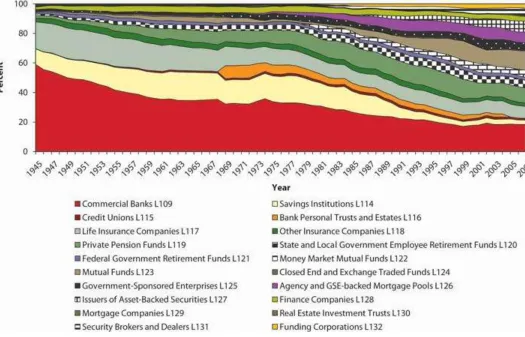
As Figure 2.4 "Share of total U.S. financial assets, year-end, 1945–2007" shows, the relative
importance of commercial banks and life insurance companies has waned since World War II due to the proliferation of additional investment options. As Figure 2.5 "Assets of financial intermediaries, selected years, 1945–2005" shows, their decline is relative only; the assets of all major types of
intermediaries have grown rapidly over the last six decades. The figures are in current dollars, or
dollars not adjusted for inflation, and the U.S. economy has grown significantly since the war, in no
small part due to the financial system. Nevertheless, as shown in Figure 2.6 "Financial assets to gross
domestic product (GDP), 1945–2007", the assets of financial intermediaries have grown steadily as a
Figure 2.6 Financial assets to gross domestic product (GDP), 1945–2007
Financial markets have exhibited similar growth. For example, the Dow Jones Industrial Average (DJIA), [1] a mechanism for tracking the prices of the shares of the nation’s most important
corporations, grew from less than 200 at the end of World War II to just shy of 700 when John F.
Kennedy took office in 1961, to around 1,000 when Ronald Reagan became president twenty years
later, to over 3,200 in 1992 and over 10,000 by 1999. [2] Trading volumes on the New York Stock
Exchange [3] and the NASDAQ [4] have likewise soared. In 1945, daily trading volumes rarely exceeded
2 million shares. By 1975, 10 million shares was considered a slow day. By 2005, over 1 billion shares
were regularly traded each day.
K E Y T A K E A W A Y
Financial intermediaries, including depository institutions (commercial banks, savings banks, credit
unions) and insurers (life, health, property and casualty), can be grouped by the composition of their
balance sheets (nature of their assets and liabilities and the asset transformations they undertake) or
[1]www.djindexes.com/mdsidx/index.cfm?event=showAverages
[2]www.measuringworth.org/DJA/
[3]www.nyse.com/
2.6
Competition Between Markets and Intermediaries
L E A R N I N G O B J E C T I V E
1. What trade-offs do investors face? How do borrowers decide whether to use financial markets or
intermediaries to obtain the funds they need?
Why do investors (savers) sometimes choose to invest in intermediaries rather than directly in
financial markets? Why do borrowers sometimes choose to reduce their liquidity and capital
constraints via intermediaries and sometimes via markets? Markets and intermediaries often fulfill
the same needs, though in different ways. Borrowers/securities issuers typically choose the alternative
with the lowest overall cost, while investors/savers choose to invest in the markets or intermediaries that provide them with the risk-return-liquidity trade-off that best suits them.
Risk is a bad thing, while return and liquidity are good things. Therefore, every saver wants to invest in riskless, easily saleable investments that generate high returns. Of course, such opportunities
occur infrequently because investors bid up their prices, thus reducing their returns. (As we’ll see
in Chapter 4 "Interest Rates", the higher the price of an investment, the lower its return,
ceteris paribus.) To keep returns high, some investors will be willing to give up some liquidity or to take on more risk. For example, they might buy securities not backed by collateral (assets like
buildings, businesses, or safe financial instruments like T-bills that the borrower promises to forfeit
in case of default). As a result of the competition between investors, and between borrowers, the financial system offers instruments with a wide variety of characteristics, ranging from highly liquid,
very safe, but low-return T-bills and demand deposits, to risk, liquidity,
medium-return mortgages, to risky but potentially lucrative and easily sold derivatives like put options and
foreign exchange futures contracts.
Investors care about more than risk, return, and liquidity, but generally other considerations are secondary. For example, investors will pay more for investments with fixed redemption dates rather than ones that can be called (repaid) at the borrower’s option because fixed redemption dates reduce
environmentally or socially conscious companies and countries and less for those issued by dirty,
rude ones.
Stop and Think Box
In the fall of 2006, interest rates on conventional thirty-year home mortgages without a prepayment penalty were about 6.5 percent per year. But mortgages with otherwise identical terms that contained a prepayment penalty for the first seven years of the loan could be had for 6.25 percent per year. Why was that the case?
In addition to risk, return, and liquidity, investors are concerned about the uncertainty of repayment terms. They are willing to receive a lower return (ceteris paribus, of course) in exchange for a guarantee that a loan will not be repaid for a significant period of time.
As noted above, borrowers also compete with each other for the lowest cost methods of meeting their
external financing needs. Obviously, borrowers want to pay as little for funds as possible and would
like nothing better than to borrow huge sums forever, unconditionally, and at zero interest. Nobody
wants to lend on those terms, though, so borrowers compete with each other for funds by offering
investors higher returns, less risk, or more liquid instruments. They use whichever part of the
financial system, markets or intermediaries, offers them the best deal. A company may sell commercial paper in the money market rather than obtain a bank loan, for example, if it is large enough and
well-known enough to interest enough investors and market facilitators. A smaller, newer company,
though, may find that a bank loan is much easier and cheaper to obtain.
K E Y T A K E A W A Y S
Investors primarily trade off among risk, return, and liquidity, and to a lesser extent they also value the
certainty of redemption terms.
2.7
Regulation
L E A R N I N G O B J E C T I V E
1. What are the major goals of financial regulation?
Like investors, borrowers are concerned about the total net costs (all costs plus all benefits) of different types of finance. One big consideration is government and self-regulation. Compared to most other parts of modern capitalist economies, the financial system is relatively heavily regulated. Regulators like the Securities and Exchange Commission (SEC, which oversees exchanges and OTC markets),
the New York Stock Exchange (NYSE, which oversees itself), and the Commodities Futures Trading
Commission (CFTC, which oversees futures market exchanges) monitor and regulate financial
markets. Other regulators, including the Office of the Comptroller of the Currency (which oversees
federally chartered commercial banks), the Federal Deposit Insurance Corporation (FDIC, which
oversees almost all depositories), and sundry state banking and insurance commissions, monitor
financial intermediaries. Companies that wish to avoid direct regulatory scrutiny due to its high cost
tend to use intermediaries rather than markets. For example, instead of selling shares to the public,
which would require following the many rules of the SEC and the NYSE (or other exchange or OTC
market), a company might decide that it would be cheaper to obtain a long-term bank loan or sell
bonds to life insurers, mutual funds, and other institutional investors in a direct placement.
Regulators serve four major functions. First, they try to reduce asymmetric information by
encouraging transparency. That usually means requiring both financial markets and intermediaries to disclose accurate information to investors in a clear and timely manner. A second and closely
related goal is to protect consumers from scammers, shysters, and assorted other grifters. Third, they
strive to promote financial system competition and efficiency by ensuring that the entry and exit of
firms is as easy and cheap as possible, consistent with their first two goals. For example, new banks
can form but only after their incorporators (founders) and initial executives have been carefully
screened. Insurance companies can go out of business (exit) but only after they have made adequate
Finally, regulators also try to ensure the soundness of the financial system by acting as
a lender of last resort, mandating deposit insurance, and limiting competition through restrictions on entry and interest rates. The first two forms of regulation are generally not controversial, although many believe that the lender of last resort function should not be combined with
atoo big to fail (TBTF) policy. Limiting competition is a highly controversial means of ensuring safety because it extends privileges to existing institutions over new ones. Little surprise, then, that the
regulated companies themselves are often the strongest supporters of that type of regulation!
Stop and Think Box
For decades, the Federal Reserve capped the interest rates that banks could pay on checking deposits at zero and the interest rates that they could pay on time or savings deposits at around 6 percent per year. What was the intended economic effect of those restrictions? Why didn’t existing banks lobby for their repeal until the Great Inflation of the 1970s?
The restrictions were put in place to limit competition among banks, allowing them to be profitable without assuming too much risk. Existing banks were more than happy to reap relatively riskless profits until inflation exceeded the interest rates that they could legally pay. At that point, disintermediation was rampant. In other words, many people pulled their money out of banks and put them directly into the market, via money market and stock and bond mutual funds.
K E Y T A K E A W A Y S
Regulators attempt to maximize macroeconomic stability and transparency and to minimize investor risk
and loss.
2.8
Suggested Reading
Anonymous, Finance for Managers. Cambridge: Harvard Business School Press, 2002.
Barth, James, Gerard Caprio, and Ross Levine. Rethinking Bank Regulation: Till Angels Govern. New
York: Cambridge University Press, 2008.
Bebczuk, Ricardo. Asymmetric Information in Financial Markets: Introduction and Applications. New
York: Cambridge University Press, 2003.
Fabozzi, Frank. The Handbook of Financial Instruments. Hoboken, NJ: John Wiley and Sons, 2002.
Ferguson, Niall. The Ascent of Money: A Financial History of the World. New York: Penguin Press,
2008.
Landier, Augustin, and Vinay Nair. Investing for Change: Profit from Responsible Investment. New
York: Oxford University Press, 2008.
Chapter 3
Money
C H A P T E R O B J E C T I V E S
By the end of this chapter, students should be able to:
1. Define money.
2. Describe the work or economic functions that money performs.
3. Define barter and explain why it is economically inefficient.
4. Explain why some forms of commodity money are better than others.
5. Explain why representative money and credit money supplanted commodity money.
3.1
Of Love, Money, and Transactional Efficiency
L E A R N I N G O B J E C T I V E
1. What is money and what economic functions does it perform?
Like love, money is ubiquitous, yet few of us feel that we have enough of either. As abstract concepts,
money and love are both slippery, yet most of us believe that we know them when we see
them. Despite those similarities, mixing money and love can be dangerous. The love of money is said to
be one of the seven deadly sins; the money of love, despite its hoariness, is illegal in many
jurisdictions in the United States and abroad.
Jest and wordplay aside, money is, perhaps, the most important invention of all time. Like the other
major contenders for the title, indoor plumbing, internal combustion engines, computers, and other
modern gadgets of too recent origin to consider; the wheel, which needs no introduction; the hearth,
a pit for controlling fire; and the atlatl, a spear thrower similar in concept to a lacrosse stick, money
is a force multiplier. In other words, it allows its users to complete much more work in a given
amount of time than nonusers can possibly do, just as the wheel let porters move more stuff, the
hearth helped cooks prepare more food, and the atlatl allowed hunters (warriors) to kill more prey
(enemies).
What work does money do? It facilitates trade by making it easier to buy and sell goods compared to
barter, the exchange of one nonmoney good for another. (If you’ve ever traded baseball cards, clothes, beers, phone numbers, homework assignments, or any other nonmoney goods, you’ve engaged in
barter.) This is no minor matter because trade is the one thing that makes us human. As that great
eighteenth-century Scottish economist Adam Smith (and others) pointed out, no other animal trades
with nonrelatives of the same species. The inherent predisposition to trade may explain why humans
have relatively large brains and relatively small digestive tracts. Trade certainly explains why humans
have more material comforts by far than any other species on the planet. Each trade that is fairly
consummated enriches both the buyer and the seller. The good feeling people get when they buy
that wealth makes people happy. Although sometimes used synonymously with wealth in everyday
speech, money is actually a special form of wealth.)
Imagine what life would be like without money. Suppose you try to fill up your automobile’s gasoline tank, or take mass transit to school, or acquire any good, without using money (or credit, money’s
close cousin). How would you do it? You would have to find something that the seller desired. That
could take a long time and quite possibly forever. If you don’t believe me, go to any Craigslist
posting, [1] where you will find listings like the one below. It’s a fun diversion, but what would this
person think is a “fair” trade? A lava lamp and a Grateful Dead poster? Would she give you a ball of
yarn in change?
Date: 2006-11-30, 2:37 PM EST
Hello Craigslisters,
I recently moved to NYC and I have no use for the six items pictured below. Starting from the upper left going clockwise, I have: a working desk lamp, a hardcover copy of the NY Times best-selling book The Historian, an unused leather-bound photo album, a giant bouncy-ball that lights up when it bounces, a pair of goofy sunglasses, and a hand-made tribal mask from Mexico.
Make me any offer for any or all of the items, and if it’s fair, we’ll trade.
Answer: Only if you have a lot of time to waste.
In the lingo of economists, by serving as a means or medium of exchange,money eliminates one of the
major difficulties of barter, fulfilling this mutual or double coincidence of wants. And it does it quite well as it zips across the country and the entire globe.
Another serious difficulty with barter helps us to see the second major type of work that money does.
Suppose that the gas station attendant or bus driver wanted chewing gum and you had some.
number of traded goods because each has a money price, the good’s cost in terms of the unit of account. In a barter economy, by contrast, the number of prices equals the number of pairs of goods. So, for example, an economy with just 1,000 goods (a very poor economy indeed) would require 499,500
different prices! Little wonder, then, that barter economies, when they exist, usually produce only
ten or so tradable goods, which means about forty-five different prices, each good paired with nine
others. By serving as a unit of account, a measuring rod of economic value, money makes price
determination much easier.
The unit of account function of money is more abstract than its work as a medium of exchange and
hence is less well understood, but that does not mean that it is less important. To be an effective force
multiplier, money has to eliminate both of barter’s biggest deficiencies. In other words, it has to end the double coincidence of wants problem and reduce the number of prices, ideally to one per good. It
does the former by acting as a medium of exchange, something that people acquire not for its own
sake but to trade away to another person for something of use. The latter it does by serving as a unit
of account, as a way of reckoning value. When functioning as a unit of account, money helps us to
answer the question, How much is that worth? much like inches help us to answer, How long is that?
or degrees Fahrenheit or Celsius help us to ascertain, What is the temperature of that? By helping us
to reckon value, money allows us to easily and quickly compare the economic value of unlike things,
to compare apples and oranges, both literally and figuratively.
Stop and Think Box
After the demise of the Soviet Union, inflation reigned supreme as the Russian ruble lost more and more of its value each day. Rubles remained a medium of exchange, but in many places in Russia, prices and debts began to be denominated in “bucks.” What were bucks and why did they arise?
Money also works as a store of value and as a standard of deferred compensation. By store of value,
economists mean that money can store purchasing power over time. Of course, many other assets—
real estate, financial securities, precious metals and gems—perform precisely the same
function.Storing value, therefore, is not exclusively a trait of money. By standard of deferred
compensation, economists mean that money can be used to denominate a debt, an obligation to
make a payment in the future.
To help you to see the different functions of money, consider the following transaction:
Customer: How much for a gallon of gasoline? (A)
Attendant: $2.99 (A)
Customer: Great, fill ’er up. (A)
Attendant: Will that be cash (E), check (E), debit (E), or credit (D)?
In the places labeled (A), money is working as a unit of account. The customer is trying to reckon the
value of the gasoline, information that the attendant quickly encapsulates by quoting a money price.
The customer just as quickly decides that she would rather have the gasoline than the money, or
more precisely the other goods that the money could acquire, and requests the trade. The attendant
responds by inquiring which medium of exchange (E) the customer wishes to use to pay for the good.
Cash refers to physical currency, like Federal Reserve notes or Treasury coins. Check refers to a paper order for the transfer of money from a bank account. Debit refers to an electronicorder for a
transfer from a bank account or a prepaid declining balance debit card. Credit entails the
prearranged transfer of funds from the customer’s creditor, a bank or other lender, in exchange for a
small service fee from the gas station [2] and the customer’s promise to repay the lender (and perhaps
interest and a yearly fee). In the case of the credit transaction, money is working as a standard of
deferred payment (D) because the customer promises to repay the lender the value of the gas at some
Of course, conversations like the one above rarely occur today. Except in New Jersey and a few other
places, people pump their own gas; stations post their prices on big signs for all to see; and in
addition to dispensing the product, gas pumps handle credit and debit (and sometimes cash)
purchases with ease. Money makes all that possible, saving humanity untold hours of waste over the
trillions of exchanges completed each year.
K E Y T A K E A W A Y S
Barter entails the exchange of one good for another. It is inefficient because it requires satisfaction of the
double coincidence of wants (party one must have what party two desires, and vice versa) and pricing
problems (the number of prices of goods equals the number of possible pairs).
Perhaps the most important invention of all time, money is anything that reduces the transaction costs of
barter, anything that is commonly accepted as payment or in exchange.
Money serves as a medium of exchange (physical means of payment), unit of account (measure of
economic value), store of value (method of storing said value over time), and standard of deferred
payment (basis upon which debts are repaid).
[1]http://newyork.craigslist.org/about/sites.html
[2] Gas stations and other vendors sometimes charge higher prices for credit than for cash sales to compensate
them for the transaction fee charged by the credit card companies. Most have given up such policies, however,
due to competition for customers who found it convenient to charge purchases at a time before debit cards were
widespread and many merchants refused to accept checks due to the high moral hazard. (Too many “bounced,” or
3.2
Better to Have Had Money and Lost It Than to Have Never
Had Money at All
L E A R N I N G O B J E C T I V E
1. What usually happens when money is absent in an economy?
To further appreciate money’s importance, consider what happens when it is absent—universal
distress, followed quickly by money’s reintroduction or reinvention! After World War I, for example, the German government created too much money too quickly. Hyperinflation, a very rapid rise in the
prices of all goods, ensued. Prices increased so fast that workers insisted on being paid twice daily so
they could run, not walk, to the nearest store to buy food before their hard-earned wages became
worthless. Before the hyperinflation, it was said that you could buy a wheelbarrow full of food with a
purse full of cash. During the hyperinflation, you needed a wheelbarrow full of cash to purchase a
purse full of food. At the end of the debacle, you kept the wheelbarrow at home lest your most
valuable asset, the wheelbarrow, be stolen! At the end of the crisis, the German economy was on a
barter basis, but only briefly before currency reforms stopped the inflation and restored a money
economy.
Stop and Think Box
During its most recent financial crisis, in 2001–2002, Argentina faced a severe shortage of its money, called pesos. Private firms responded by setting up giant flea markets where goods were priced and paid for using the firm’s notes, which in most instances were called creditós. The creditós could be used in subsequent flea markets run by the issuing firm but not in markets run by other firms. Creditós had very limited circulation outside the flea markets. As soon as the peso crisis passed, the firms stopped running flea markets and no longer honored the creditós they had issued. What happened in Argentina?
In prisons, prisoner-of-war camps, and other settings where money is unavailable, inmates quickly
learn the inadequacies of barter firsthand and adopt the best available commodity as money—a medium of exchange; unit of account; a store of value; and even, to the limited extent that credit is
available in such circumstances, a standard of deferred payment. Packs of cigarettes often emerge as
the commodity money of choice. (Talk about one’s fortune going up in smoke!) There are good economic reasons for this preference. Although not perfect, cigarettes are a serviceable medium of
exchange. First and foremost, sealed packs of cigarettes are easily authenticated because it would be
extremely difficult to counterfeit or adulterate them, especially under prison conditions. Although
they differ somewhat from brand to brand, they are also relatively uniform in quality. If you gave up
a bar of soap for two packs, you could rest relatively well assured that you were not being cheated.
Second, cigarette packs are divisible, into twenty individual cigarettes, or “loosies,” without giving up
much of their ease of authentication. (A loosie is easier to adulterate than a sealed pack, say, by
replacing the tobacco with sawdust, but is still not easy.) Divisibility is important because supply and
demand might well dictate an equilibrium price that includes a fraction of a pack, just as it often
leads to prices that are a fraction of a dollar ($), yen (¥), euro (€), or pound (£). Individual cigarettes
are also somewhat divisible but only when filterless or when consumed. One might, for instance, sell
a good blanket for four packs, two loosies, and five drags or puffs.
Cigarettes also have relatively high value-to-weight and value-to-bulk ratios. In other words, they are
relatively valuable given their size and weight. That portability is, of course, important to their
function as a medium of exchange. Although they eventually go stale and can be ruined if smashed or
drenched in water, sealed cigarettes packs are durable enough to also serve as an intermediate term
store of value. The elasticity of the supply of cigarette packs is volatile, however, because smokers
find it difficult to quit smoking, no matter the price and the fact that the quantity of packs in
circulation depends on shipments from the outside world. In modern prisons, this is less of a
problem, but in prisoner-of-war (POW) camps, sudden gluts caused the prices of goods
(noncigarettes) to soar (that is, the value of cigarettes plummeted), only to be followed by long
periods of deflation (lower prices for noncigarettes) as the supply of cigarettes dried up and each
K E Y T A K E A W A Y S
Where money is absent, an available commodity with the best combination of ease of authentication,
uniformity, divisibility, durability, portability, and elasticity of supply may emerge as money.
3.3
A Short History of Moolah
L E A R N I N G O B J E C T I V E
1. What characteristics does a good medium of exchange possess?
Figure 3.1 Cowrie money from early China
http://www.joelscoins.com
Much stranger commodities than cigarettes have served as money over the ages, and for the most
part served well. As storied economist John Kenneth Galbraith once claimed, “More than most
things, an understanding of money requires an appreciation of its history,” so a brief history lesson is
in order here. [1] As Figure 3.1 "Cowrie money from early China" suggests, various types of live
animals, parts of dead animals, grains, metals, rocks, and shells have been money at one time and
place or another. [2]
We generally find that, as with the case of prison inmates, early societies used available commodities
that had the best combination of ease of authentication, uniformity, divisibility, durability, portability, and elasticity of supply. Hay (grassy livestock feed) rarely emerges as money because it is too easy to adulterate with weeds; its low value-to-bulk renders its portability very low due to the trouble and
expense of transporting it; and until it is properly baled and stored, a rainstorm can ruin it. Tobacco,
by contrast, has served as a commodity money because it is more uniform, durable, portable, and
easily authenticated than hay. In colonial Virginia, tobacco was turned into a form of
in safe warehouses, and issued paper receipts for it. The receipts, shown in Figure 3.2 "Reproduction
of eighteenth-century tobacco transfer note", rather than the tobacco itself, served as an extremely
uniform, durable, divisible, portable, and easily authenticated medium of exchange.
Figure 3.2 Reproduction of eighteenth-century tobacco transfer note
Courtesy: The Colonial Williamsburg Foundation.
Diamonds, rubies, and other rare gems seldom become money because they arenot uniform in quality
and are difficult to authenticate. One needs expensive specialized training and equipment to value them properly. (See Figure 3.3 "Is it real?" for an example.) Gold, by contrast, has often served as
money because, as an element (symbol = Au; atomic number = 79), [3] it is perfectly uniform in its
pure form. It is also easily divisible; relatively highly portable for a commodity; and, though soft for a
metal, quite durable. Gold can be adulterated by mixing it with cheaper metals. Even when coined, it
can be clipped, sweated, or otherwise adulterated. Relatively easy ways of authenticating gold and
other precious metals in their bullion (bar or brick) and coin forms exist, however. [4] Gold’s elasticity
of supply, traditionally quite low due to its rarity, is its biggest shortcoming. Money must be scarce,
meaning that free goods like air and water (where plentiful) will not work as money, but it need not be rare, and in fact, the best forms of money are not rare.
rationality, however, they ought to peek into their wallets and purses, where they may discover, if
they haven’t already used it on tuition, books, and entertainment, that they possess some greenish
pieces of paper, called Federal Reserve notes, the use value of which is nearly nil. [5] True, those notes
are fiat money. In other words, they appear to enjoy the advantage of legal tender status. The face of
the notes makes clear that they are “legal tender for all debts, public and private.” That means that it
is illegal to refuse them. That little note on the notes notwithstanding, it is clear [6] that people today
accept Federal Reserve notes for the same reason that people in the past accepted clamshells, beads,
or other low use-value items because they know that they can turn around and successfully exchange
them for goods. In fact, many economists define money as anything commonly accepted in exchange.
(So Ron Paul dollars are not money!) [7]
K E Y T A K E A W A Y S
The best medium of exchange combines ease of authentication, uniformity, divisibility, durability,
portability, and elasticity of supply.
Gold is not necessarily the best type of money because its supply is relatively inelastic.
Declaring a medium of exchange as legal tender may help that medium of exchange to circulate, but
simply knowing that something is readily accepted in exchange can work just as well.
[1]www.johnkennethgalbraith.com/
[2]www.pbs.org/newshour/on2/money/timeline_ns4.html;http://www.ex.ac.uk/~RDavies/arian/amser/chrono.ht
ml
[3]http://www.webelements.com
[4] If you look through the Gunston Hall probate inventory database here:
http://www.gunstonhall.org/probate/index.html, you’ll discover that a large percentage of households in
Maryland and Virginia in the late eighteenth and early nineteenth centuries owned a set of money scales. People
regularly weighed coins to authenticate them and determine their real value.
[5] In the past, paper money that lost its value in exchange was used as wallpaper; thumb paper (to keep grimy
pr