A STUDY TO ASSESS THE EFFECTIVENESS OF
PLANNED TEACHING PROGRAMME ON KNOWLEDGE
REGARDING HUMAN RIGHTS OF MENTALLY ILL AMONG
COLLEGE STUDENTS IN SAKTHI COLLEGE OF ARTS AND
SCIENCE FOR WOMEN AT ODDANCHATRAM
A DISSERTATION SUBMITTED TO
THE TAMILNADU DR. M.G.R. MEDICAL UNIVERSITY,
CHENNAI.
IN PARTIAL FULFILMENT OF THE REQUIREMENTS FOR
THE DEGREE OF MASTER OFSCIENCE IN NURSING
A STUDY TO ASSESS THE EFFECTIVENESS OF
PLANNED TEACHING PROGRAMME ON KNOWLEDGE
REGARDING HUMAN RIGHTS OF MENTALLY ILL AMONG
COLLEGE STUDENTS IN SAKTHI COLLEGE OF ARTS AND
SCIENCE FOR WOMEN AT ODDANCHATRAM
Mrs. CHARLET CATHERINE.A
A DISSERTATION SUBMITTED TO
THE TAMILNADU DR. M.G.R. MEDICAL UNIVERSITY,
CHENNAI.
IN PARTIAL FULFILMENT OF THE REQUIREMENTS FOR
THE DEGREE OF MASTER OFSCIENCE IN NURSING
CERTIFIED BONAFIDE WORK DONE BY
Mrs. CHARLET CATHERINE.A
SAKTHI COLLEGE OF NURSING
ODDANCHATHRAM
DINDIGUL
INTERNAL EXAMINER
EXTERNAL EXAMINER
CERTIFICATE
This is a bonafide work of Mrs. CHARLET CATHERINE. A,
M.Sc (N) II year student from Sakthi College of Nursing, Dindigul,
Tamilnadu, India, submitted in partial fulfilment for the Degree of Master
of Science in Nursing under the Tamilnadu Dr. M.G.R. Medical
University, Chennai.
Signature of the principal ___________________________________
Prof. Mrs. JANAHI DEVI.V. M.Sc (N)
A STUDY TO ASSESS THE EFFECTIVENESS OF PLANNED
TEACHING PROGRAMME ON KNOWLEDGE REGARDING
HUMAN RIGHTS OF MENTALLY ILL AMONG COLLEGE
STUDENTS IN SAKTHI COLLEGE OF ARTS AND SCIENCE
FOR WOMEN AT ODDANCHATRAM
1.
RESEARCH GUIDE :__________________________________ Prof. Mrs. V. JANAHI DEVI, M.Sc (N)., PrincipalSakthi College of Nursing Oddanchatram, Dindigul (D.T)
2.
SUBJECT GUIDE :______________________________________Asso. Prof. Mrs. R. SATHYA SRI, M.Sc (N)., HOD, Mental Health Nursing
Sakthi College of Nursing Oddanchatram, Dindigul (D.T)
3.
MEDICAL EXPERT : _____________________________________ Dr. Mr. S. SAMUEL GUNASEKHARAN, M.D., D.P.M., F.C.I.P., F.I.C.A.,ENDORSEMENT BY THE SUBJECT GUIDE AND HOD
This is to certify that the dissertation entitled
“
A Study To Assess
The Effectiveness Of Planned Teaching Programme On Knowledge
Regarding Human Rights Of Mentally Ill Among College Students In
Sakthi College Of Arts And Science for women At Oddanchatram
”
is a bonafide research work done by
Mrs. Charlet Catherine.A. in
partial fullfilment of the requirement for the degree of Master of Science
in Nursing (Psychiatric Nursing)
Seal and Signature of the subject guide and HOD
Asso. Prof. Mrs. R. SATHYA SRI, M.Sc (N)., HOD, Mental Health Nursing
Sakthi College of Nursing Oddanchatram,
ACKNOWLEDGEMENT
“Thanks to God for his indescribable gift”
It is my greatest privilege to extend my sincere thanks to all the people mentioned below who have helped me a lot in making my project a great success.
The Lord Almighty is praised for uttering profusely his blessing and guidance me throughout my endeavour and sustained me during the hour of need.
I am substantially thankful to our Chairman Dr. K. Vembanan, M.B.B.S, M.S, and I express my deep gratitude and heartfelt thanks to our Vice-Chairman Dr. Gokila Vembanan, M.B.B.S, D.G.O., for their blessing encouragement and dedication for academic excellence and giving formidable opportunity to finish my project peacefully.
It is my bounden duty to express my heartiest gratitude to Prof. V. Janahi Devi, M.Sc (N), Principle, Sakthi College of Nursing, for her constant enthusiastic support, warmth inspiration, and encouragement and gave innovative ideas to incorporate in this project.
I proudly express my deep whole heartfelt thanks to my Subject guide and HOD
I convey my deep indebtedness to our Co-ordinator, Asso. Prof. Mrs. Ganga Eswari, M.Sc.,(N), for her constant encouragement throughout the entire course of study also to complete the study successfully.
I extended my whole hearted thanks to all Faculty members of Sakthi College of Nursing for their continuous encouragement, guidance and suggestions for this study.
I profusely thank all Mental health Nursing Experts who validated the content and tool, which helped to incorporate their views in this project, especially Dr. Mrs. Jancy Reachel daicy, M.Sc (N), PhD, HOD, CSI Jeyaraj Annapakiam College of Nursing, Pasumalai, Madurai.
I am thankful to Mrs.Poongodi, M.Lib.Sc, librarian, Sakthi College of Nursing and special thanks to Miss. Lakshmi Priya, Computer Operator, Sakthi College of Nursing, Oddanchatram for their support.
I wish to communicate my extradinary credit to Mr. Mani, Biostatistician for his well-timed and opportune aid and backing in statistical analysis and presentation of data.
My special heartfelt thanks to all the participants of college students in Sakthi college of Arts and Science for their co-operation throughout the study.
My sincere thankful to whose editing this manuscript and suggestions for precise sense of language were decisive towards the completion of this research study.
for their constant and continous support, timely help, and encouragement to complete this project as a very successive one.
I extend my warmest gratitude to my husband Mr. D. Jeba Kumar and my lovable daughter Baby.J. Joy Prasanna, she missed my love and care during the course of the study.
I express my heartful thanks to my loveable mother Mrs. A. Hemala Ranjini for her constant and continuous support, timely help, prayer and encouragement to complete this project as a very successive one.
ABSTRACT
A study was conducted "to assess the effectiveness of ‘planned teaching programme’ on improving the knowledge regarding rights of mentally ill among college students in Sakthi College of arts and science at Oddanchatram
The objectives of the study were,
To assess the pre – test level of knowledge regarding rights of mentally ill among college students in Sakthi College of arts and science at Oddanchatram To compare the pre – test and post - test level of knowledge regarding rights of mentally ill among college students in Sakthi College of arts and science at Oddanchatram
To assess the effectiveness of ‘planned teaching programme’ on improving the knowledge regarding rights of mentally ill among college students in Sakthi College of arts and science at Oddanchatram
To find out the association between pre-test level of knowledge regarding rights of mentally ill among college students with selected demographic variables in Sakthi College of arts and science at Oddanchatram
The research design was adopted for this study is a Quasi –experimental design (One group pre-test post-test design). [The study adopted pre test, intervention and post test].
In this study the researcher administers planned teaching programme on knowledge regarding rights of mentally ill among college students in Sakthi College of arts and science at Oddanchatram.
The basis assumption of the theory is the college students has to improve the knowledge regarding rights of mentally ill and finally validating that the need for help was met.
The sample size consists of 30 students those who are studied in second year B.Sc (Physics) at Sakthi College of arts and science for women at Oddanchatram. Pre test data was collected by researcher using modified questionnaires on 1st day. College students received intervention of ‘Planned teaching programme regarding rights of mentally ill’ on 2nd day. Post test was conducted by the researcher for using the same questionnaires on the 3rd day.
The Finding shows that, among 30 samples, 27 (73.33%) samples belonged to the Age Group 18 years, whereas only 1 (73.3%) of the sample belonged to the age group of 20 years and above.
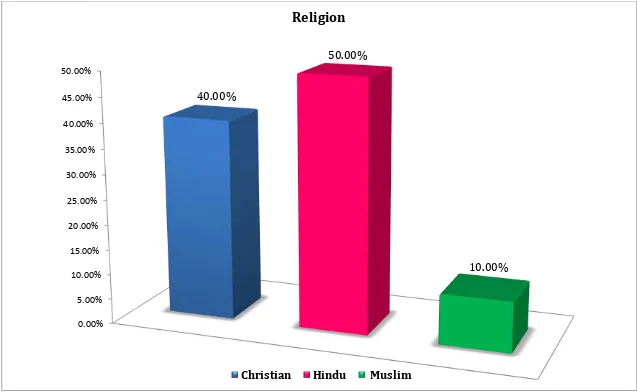
Regarding Religion majority15 (50%) samples belonged to the Hindu Religion, whereas only 3 (10%) of the samples belonged to the Muslim religion.
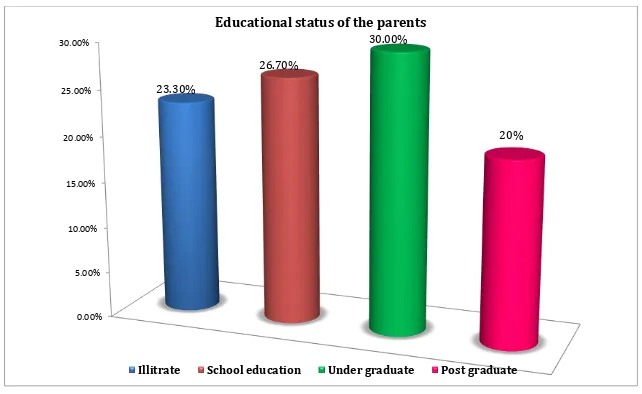
Regarding Educational Status of the parents, majority 9(30%).of the samples belongs to the undergraduate degree and 6 (20%) of the samples belongs to post graduate.
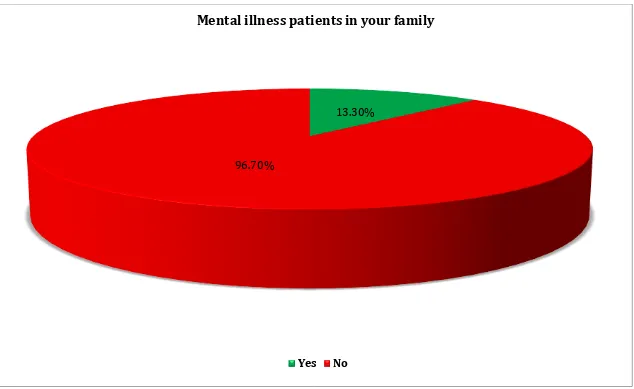
Regarding any mental ill patients in her family, 26 (86.7%).of the samples say “No” and 4 (13.3%) says “Yes”.
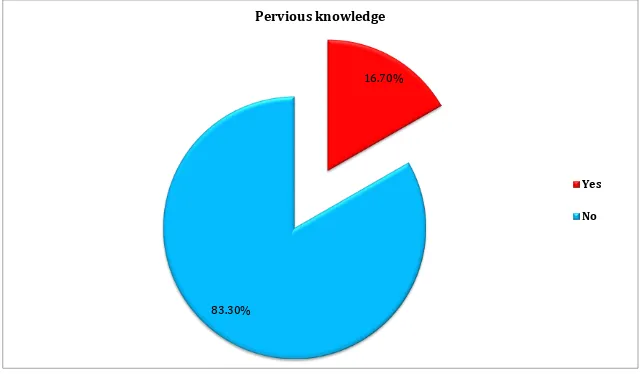
Regarding Previous knowledge about rights mentally ill patients, 25 (83.3%) samples say that, “No” and 5 (16.6%) of them says that, “Yes”.
The findings shows that in pre test scores on the level of Level of Knowledge 17 (56.67%) of them had No Knowledge, 9 (30%) of them had Low Knowledge, and 4 (13.33%) of them had Moderate Knowledge respectively.
Whereas post test scores on the level of Level of Knowledge 3 (10%) of them had Low Knowledge, 9(30%) of them had Moderate Knowledge and 18 (60%) of them had High Knowledge respectively.
This finding reveals that, after the planned teaching programme the level of knowledge regarding rights of mentally ill among college students were improved in post test than pre test.
The finding shows that the pre test calculated value was 2.1 and the tablatde’t’ value is 1.699, which was significant at P< 0.05.
Hence H1 is accepted. It can be concluded that ‘planned teaching programme
was effective in improving the knowledge level among college students.
TABLE OF CONTENTS
CHAPTER
CONTENTS
PAGE
NUMBER
I
II
III
INTRODUCTION
Need for the study
Statement of the problem
Objectives of the study
Hypothesis
Assumption
Operational definition
Delimitation
Project outcome
REVIEW OF LITERATURE
RESEARCH METHODOLOGY
Research approach
Research design
Research setting
Sample / Sample size
Sampling technique
Sample criteria
Research tool
IV
V
VI
Description of instrument
Validity and Reliability of the tool
Pilot study
Data collection procedure
Plan for data analysis
Protection of human rights
DATA ANALYSIS AND
INTERPRETATION
DISCUSSION
SUMMARY AND RECOMMENDATIONS
Summary
Implication
Limitations
Recommendations
REFERENCES
Book reference
Journal reference
Net reference
LIST OF TABLES
TABLE
NO
TITLE
PAGE
NO
1
Frequency and percentage distribution of college
Students in Sakthi College of arts and science
according to their demographic data.
32
2
Frequency and percentage for level of
Knowledge regarding rights of mentally ill
among College students in Sakthi College of Arts
and Science at Oddanchatram.
41
3
Mean, SD and
‘
t
’
value on level of Knowledge
regarding rights of mentally ill among college
students
43
LIST OF FIGURES
FIGURE
TITLE
PAGE NO
1
Conceptual frame work based on kings goal
attainment theory
22
2
Schematic representation of methodology
26
3- 9
Distribution of demographic variables
among college students
34-40
10
Distribution of per test and post test level of
knowledge among college students
LIST OF APPENDICES
S.NO
TITLE
PAGE NO
1
Permission Letter (format)
i
2
Permission Letter
ii
3
Letter Seeking Expert Opinion And Content
Validity (format)
iii
4
Certificate Of Content Validity (format)
iv
5
List of expertise
v
6
Certificate Of Content Validity-i
vii
7
Certificate of Content Validity-ii
viii
8
Certificate of Content Validity-iii
ix
9
Certificate of Content Validity-iv
x
10
Certificate of English Editing
xi
11
Certificate of Tamil Editing
xii
12
Certificate of Ethical Clearance
xiii
13
Demographic Data and tool (English)
xiv
1
CHAPTER
–
I
INTRODUCTION
“All human beings are born free and equal in dignity and rights”
-The universal declaration of human rights.
Universal Declaration Of Human Rights states that “Everyone has the right to a standard of living adequate for the health and wellbeing of himself and of his family
including food, clothing, housing, and medical care and necessary social services and the
right to security in the event of unemployment, sickness, disability, widowhood, old age,
or other lack of livelihood in circumstances beyond his control”.
Everyone has the basic Human Rights including those who are mentally ill.
Mentally ill patients are one of the most vulnerable groups in society, it is the
responsibility of the Health care providers specially those working in psychiatric setup to
protect their human rights. In order to do so the health personnel mainly the psychiatric
nurse must be aware of human rights of mentally ill patients. Incidence of violation of
Rights Mentally Ill patients can be avoided if the nurse becomes aware of them.
There is now increasing awareness of rights in our democratic set up which
results in an increase in litigation. Civil rights movements and consumer protection
councils are gaining more and more importance in our day-to-day life.
The purpose of the laws to protect society from the presence of mentally ill
persons who have become or might become a danger or nuisance to others, to protect
2
regulate responsibility for maintenance charges of psychiatric nursing homes, provide
facilities for establishing guardianship or custodial of mentally ill persons who are
incapable of managing their own affairs, to provide for the establishment of central
authority and state authorities for mental health services, to regulate the powers of the
Government for establishing, licensing and controlling psychiatric hospitals and
psychiatric nursing homes for mentally ill persons and to provide legal aid to mentally ill
persons to state expense in certain cases.
Today, legal rights of those with mental disorders and ethical health care practices
of mental health providers are ongoing concerns for psychiatric- mental health nurses.
People with psychiatric problems are vulnerable to mistreatment and abuse;
consequently, laws have been passed that guarantee them legal protection. Hence mental
health professionals should have a better understanding to the medico-legal aspects of
3 NEED FOR THE STUDY
According to the World Health Organization report in 2014 some 450 million
people suffer from mental or behavior disorders in world.
In the world, the prevalence of psychiatric disorder is 58.2 per thousand, which
means that in India, there are about 5.7 crore people suffering from some sort of
psychiatric disturbances.
About 1.5 crore people suffer from severe mental disorders, besides 12,000
patients in government mental hospitals in the country.
According to Mrs. Sreevani in her textbook, the incidence of mental disorder
may increase in future due to the following causes:
Increasing number of nuclear families
Decreasing number of the elderly people living along with families
Increase incidence of substance abuse
Industrialization and urbanization.
In many hospitals in India, there are anecdotal reports of violations of human
rights of the persons with mental illness. The dignity of persons with mental illness is not
respected in mental health institutions itself. Sometimes they are found in conditions
which are deplorable for example being kept naked or in dirty and old clothes. They are
placed in unhygienic conditions & sometimes women were found in dreadful condition,
sometimes parts of their bodies could be seen through ill fitting clothes. They were not
provided with the necessary clothes to protect personal dignity and items to maintain
4
According to Sreevani the nursing implications for protecting patients Human
Rights are:
To protect patients Human Rights the nurse should be aware of these rights in
the first place
She should ensure that ward procedures and policies should not violate
patients’ rights.
Discussing these rights with the mental health team and including these rights
in the nursing care plan should be a part of her responsibility in protecting the
patients’ rights.
In India after the development of a National Mental Health Policy, The Mental
Health Act of 1987, and the establishment of the National Human Rights Commission in
1994 there is greater awareness about mental health issues including Human Rights in
India.
According to National Human Rights commission report 2013, there are two
types of mental health hospitals. “The first type, do not deserve to be called as mental health hospitals. They are ‘dumping grounds’ of mentally ill”. The living conditions in many of these settings are deplorable and violate an individual’s right to be treated humanely and live a life of dignity. The second type “provide basic minimal provisions of food and shelter”. Both these type violate rights of mental ill patients.
As per the WHO country profiles, 2013, India devotes less than 1 % of its health
budget to mental health as compared to 10 % to 18 % in other countries. This in turn
5
nurses per one lakh populations is only 0.4 %. This calls for training of general
population to meet the mental health needs of the country.
Mr. Dileep Kumar, Nursing advisor to govt. of India, in his article entitled
‘Human Rights and Nurses Role’, has focused on the values embodied in the code of ethics developed by INC. He also encouraged nurses to discuss and deliberate on
following issues.
1. How do nurses strive individually and collectively to promote protection of
human rights, identify human rights violations and their impact on health
2. How nurses can advocate for the rights of their patients and ethical decision
making process
3. What are the issues to be included in the curriculum with regard to Human Rights
Therefore the investigator decided to take up a study to assess the knowledge of
6 STATEMENT OF THE PROBLEM
“A study to assess the effectiveness of planned teaching programme on knowledge regarding human rights of mentally ill among college students in Sakthi
College of arts and science”.
OBJECTIVES OF THE STUDY
1. To assess the pre-test knowledge level regarding human rights of mentally ill
among college students in Sakthi College of arts and science.
2. To assess the effectiveness of planned teaching programme on knowledge
regarding Human Rights of Mentally Ill among college students in Sakthi College
of arts and science.
3. To compare the Pre-test and post-test knowledge level regarding Human Rights of
Mentally Ill among college students in Sakthi College of arts and science.
4. To determine the association between certain demographic variables and
knowledge regarding Rights of Mentally Ill among college students in Sakthi
College of arts and science.
HYPOTHESIS
H1: The mean Pre-test level of knowledge regarding Human Rights of Mentally
Ill among college students in Sakthi College of arts and science.
H2: There will be a significant association between pre-test level knowledge
regarding Human rights of mentally ill among college students in Sakthi College of arts
7
H3: The mean post-test level of knowledge regarding Human Rights of Mentally
Ill among college students in Sakthi College of arts and science.
H4: There will be a significant association between pre test and post test level of
knowledge regarding Human Rights of Mentally Ill among college students in Sakthi
College of arts and science
OPERATIONAL DEFINITIONS
Human Rights: In this study it refers to rights of mentally ill as defined and listed by
WHO and National Mental Health Act 1987.
Knowledge: It refers to the awareness regarding Human Rights of Mentally Ill which
will be measured using a standardized questionnaire
Mentally Ill: It refers to any individuals admitted to hospital or in the community who
has lost his capacity for rational thinking, appropriate expression of emotions and
behaviour.
Planned teaching programme: It refers to teaching plan containing information
regarding rights of mentally ill patients as per WHO and National Mental Health Act
1987 recommendations.
College Students: It refers to students studying under graduate degree programme in
8 ASSUMPTIONS
College students with knowledge of Human Rights of Mentally Ill will be able to protect the human rights of the mentally ill.
Students will give free and frank responses to the questions.
Planned teaching programme will effective on improving knowledge regarding the human rights of mentally ill among college students.
DELIMITATIONS
College students who are studying in Sakthi College of arts and science
Students who are willing to participate
Students who are studying in physics department. PROJECTED OUT COME:
The finding of the study would help to identify the knowledge on human rights of mentally ill among college students at Sakthi College of arts and science.
The study will assess the effectiveness of planned teaching programme in improving the level of knowledge on human rights of mentally ill among college
students at Sakthi College of arts and science
The planned teaching programme will help them to improve the knowledge regarding human rights of mentally ill among college students in Sakthi College
9
CHAPTER
–
II
REVIEW OF LITERATURE
Review of literature is defined as “broad comprehensive, in depth, systematic and critical review of scholarly publication, unpublished scholarly print materials, and
audiovisual materials and personal communications. Review of literature refers to an
extensive, exhaustive and systematic examination of publication relevant to research
project. One of the most satisfying aspects of the literature review is the contribution it
makes to new knowledge, insight, and general scholarship of the researchers”.
A descriptive study was conducted to assess the knowledge among 30 staff nurses
regarding human rights and ethical responsibilities in field of psychiatric nursing at
selected psychiatric centre of Jaipur, Rajasthan. The findings of the study revealed that
majority (90%) of the nurses possess moderate level of knowledge and 10 % of nurses’ possessed high-level knowledge and none of nurses possessed low level knowledge. The
mean score obtained in the legal area was 25.1±3.1 whereas that obtained in the ethical
area was 13.9 ± 2.7. This indicates knowledge deficit in both human rights and ethical
area and there was no significant association found between the knowledge with the
demographic variables.
A descriptive study was conducted in District Mental Health Centre &Hospital
and Community Mental Health Centre & Hospital Ludhiana and Amritsar among 52 staff
nurses to assess the awareness of human rights of mentally ill. The study concluded that
the mean awareness score of the subjects regarding the human rights of mentally ill was
10
good level of awareness, whereas more than one third (36.54%) belonged to average
level and only one subject (01.92%) had poor level of awareness.
A qualitative study was conducted to assess the nurses and physicians educational
needs in seclusion and restrain practices among 22 nurses and 5 psychiatrists. The results
showed that the participants recognized a need for on-ward and problem based education
and infrastructural and managerial support and concluded that future educational
programs should bring together written clinical guidelines, education on ethical and legal
issues, and the staff’s support.
A quasi experimental study was conducted to assess the effectiveness of
computer assisted planned teaching programme on legal rights of mentally ill among staff
nurses working in selected hospitals at Chhattisgarh among 60 staff nurses. The study
concluded that maximum increase in knowledge in the area of legal terms from 45.15%
to 90.15% followed by legal responsibilities in psychiatric nursing from 58.15% to 88%.
The minimum increase in knowledge is in the area of legal safeguards in nursing practice
from 60.4% to 81.20% and the planned teaching was found to be effective in enhancing
the knowledge of staff nurses on legal rights of mentally ill.
A pre experimental study was conducted to assess the knowledge and attitude of
GNM students towards human rights of mentally ill among 60 student nurses posted in
Lokopriya Gopinath Bordoloi Regional Institute of Mental Health, Assam. The study
concluded that the knowledge score of mean 13.4 with median 13 standard deviation 1.78
and attitude score with 26.8 and median 27 having standard deviation 2.86.
Review of literature will be done on the following aspects.
11 2) Relation between human rights and health.
3) Human Rights of mentally ill patients
4) Public knowledge regarding human rights of mentally ill.
5) Health workers (Health care personnel’s) knowledge regarding human rights of mentally ill
6) Mental Health personnel’s knowledge regarding human rights of mentally ill. 7) Nursing students knowledge regarding Human Rights of mentally ill
1. General information related to Human Rights
The United Nations has defined Human Rights as “those rights which are inherent in our nature and without which we cannot live as human beings”.
According to protection Human Rights Act 1993 “The rights relating to life, liberty, equality and dignity of the individual is guaranteed by the constitution of India or
embodied in the international covenants and enforceable by courts of India.
2. Relation between human rights and health.
According to Mann et al, “Neglected Diseases: a human rights analysis”. Health and human right are connected in a number of ways.
A. Health care be adversely affected by human rights abuses and violations, such as
torture, slavery, forced labour, violence, and harmful traditional practices.
B. The design and/or implementation of public health policies and programmes can
result either in the promotion or violation of human rights.
C. Vulnerability to, and the impact of, ill health can be reduced by taking steps to
12
Human rights having a particularly close relationship with health include the
rights to health, non-discrimination, privacy, water, education, information, food and the
right to enjoy the benefit of scientific progress and its applications.
Mann deliberated that in public health the emergence of new understandings and
the clarification of new problems often proceed through a rediscovery phase in which the
issue is simultaneously veiled and intuitively evident. This is true, not only of the health
and human rights connection more generally but more specifically of the relationship
between dignity and health. Considerations of dignity were in the forefront of Mann’s thinking at the time of his death and underlay his view that human rights would become a
“civilizational achievement” only through “a transformation of consciousness”.
3. Human Rights of mentally ill patients
Chapter VIII of the Mental Health Act of 1987 contains a very novel and explicit
provision of protection of Human Rights of mentally ill persons. Section 81 provides that
1. No mentally ill persons shall be subjected during treatment to any indignity
weather physical or mental or cruelty
2. No mentally ill person under treatment shall be used for the purpose of research
unless
a) Such research is of direct benefit to him for the purpose of diagnosis or
treatment or
b) Such persons being a voluntary patients has given his consent in writing or
13
give valid consent on his behalf, has given his consent in writing for such
research.
3. Subject to any rules made in this behalf under Section 94 for the purpose of
preventing vexatious or defamatory. Communication or Communications
pre-judicial to the treatment of mentally ill persons, no letter or other communications
sent by or to a mentally ill person under treatment shall be intercepted, detained or
destroyed. The doctrine of informed consent is partially recognized under the
Mental Health Act 1987, when a patient voluntarily admits himself in the hospital
or accepts treatment without any admission.
According to WHO report of 2013 mental health policy and programmes should
promote the following rights.
a) Equality and non discrimination
b) The right to privacy
c) Individual autonomy
d) Physical integrity
e) The right to information
f) Participation and freedom of religions, assembly and movement.
According to quality assurance in mental health team of national human rights
commission India which was created to study the conditions of mental health hospitals in
2014, the following aspects were listed.
1. The right to be treated humanely and with respect for the inherent dignity of
the person.
14 3. Right to bodily integrity and appearance
4. Right to privacy
5. Right to be protected from cruelty and involuntary servitude
6. Right to appropriate treatment and rehabilitation.
7. right to be respected
8. Right to protection against exploitation or discrimination and a right to
protection against abuse or degrading treatment.
9. Right to community and family life once improved rather than a life of
incarceration.
10.Right to refuse treatment.
In one of the judgment related to care of the mentally ill, the supreme court of
India (Supreme Court Legal Aid Committee V. State of Madhya Pradesh, 1994, 3 S.C.C
27) condemned the uncivilized practice of chaining the inmates of psychiatric hospitals.
The court noted that just being mentally ill or insane does not imply that the person has
lost his human rights. The patient’s right to freedom of movement cannot be restricted by an uncivilized manner like chaining.
In response to this, and many other similar judgments discussed earlier, every
instance of the violation of the fundamental rights of the mentally ill institutionalized in
mental hospitals or otherwise, can be corrected by the courts in light of the above
decision of the Supreme Court.
Harding opines that concept of dynamic link between health and human rights
15
can be analyzed using the human rights/health paradigm to define their origin and nature
and to provide a basis for action.
The so called “vital link” between health and human rights is now widely recognized. A WHO consultation report and newly launched WHO newsletter and a
special issue of the international journal “Health and human rights” on the occasion of the 50th anniversary of the Universal Declaration, all reinforce the impression that health and
human rights have become inseparable.
Sharma in his article “Human rights of mental patients in India: a global perspective” conclude as follows:
Human rights issues are important in the context of mental health because of two
basic ideas, unique to the global protection of rights.
1. Human rights are the only source of law that legitimizes international security
of mental health policies and practices within a sovereign country
2. Persons possess human rights simply because of their humanity. Accordingly,
human rights law provides fundamental protections without qualification or
exception.
He also viewed that mental health and human rights can be connected in three
distinct ways by viewing these two fields together.
Mental health policy affects human rights.
16
The positive promotion of mental health and human rights is mutually
reinforcing and improves the quality of life.
As such mental health and human rights are complementary approaches to the
betterment of human beings.
4. Public knowledge regarding human rights of mentally ill
A descriptive study conducted by Basakaraja et al. on knowledge regarding rights
of mentally ill among caregivers attending Madugiri camp which is one of the satellite
camps of NIMHANS, conducted on a monthly basis reveals that the caregivers have
inadequate knowledge and they suggest that it is the role of the nurse to educate the
caregivers regarding the rights of mentally ill persons.
Another descriptive study conducted by Santhi, found that majority of the
caregivers of mentally ill has inadequate knowledge. The recommendation made is that
nurses are in unique position to educate the caregivers on human rights and ensuring that
methodologies for right protection included in the unit policies procedures practice of
institutions dealing with the mentally ill.
A descriptive study was conducted by Padmavathi, to explore the attitude of the
rural community towards the rights of the mentally ill at Kolar district found that
unfavourable attitude was seen in 50%, Favourable attitude was seen in 24% & most
favourable attitude was seen in 26%.
It is notable that all above mentioned studies were conducted in India and in all
above mentioned studies, it is clear that public have inadequate knowledge regarding
17
5. Health workers (Health care personnel’s) knowledge regarding human rights of mentally ill
A study conducted by Vijayarani, et., al. To assess the knowledge regarding rights
of mentally ill among Ayurvedic interns, in a selected Ayurvedic medical college.
Bangalore, Karnataka, reveals that among 30 samples, majority of the participants i.e.25
were not aware of the rights of mentally ill persons and only 2 of them are having highly
adequate level of knowledge.
A study was conducted by George, in selected general hospitals of Mangalore
city. The findings revealed that a majority of the nurses 72.80 %, were having moderately
adequate knowledge, 19.5 % of the nurses were having adequate knowledge and 7.68 %
were having in adequate knowledge.
It is notable that all above mentioned studies were conducted in India and in all
above mentioned studies, health workers too not having adequate knowledge regarding
human rights of mentally ill.
6. Mental health personnel’s knowledge regarding human rights of mentally ill A descriptive study was conducted by Vijaya Kumar, titled “A study to assess the knowledge and attitude towards importance of human rights among health care team
members working in mental health department in Narayana General Hospital, Nellore.” Revealed that the nearly 40 % of health care team members have adequate level of
knowledge and about 75 % of the health care team members had favourable attitude
towards practicing patient care by giving importance to human rights among health care
18
A study conducted by Sharma et.al, entitled “awareness regarding human rights of mentally ill among nurses at selected hospitals in north India 2015 by using purposive
sampling techniques”. They found the maximum number of 98.08 % of subjects had good (61.54 %) and average (36.54 %) level of awareness. The maximum violation
practices were regarding seclusion of mentally ill followed by forceful administration of
medication and mechanical restraining of the mentally ill. The relationship between
awareness of subjects regarding human rights of mentally ill and selected social
demographic characteristics was found statistically significant.
A quasy –experimental study was conducted Mathew, titled “A study to assess the effectiveness of computer assisted planned teaching programme on legal rights of
mentally ill among staff nurses working in selected hospitals at Chhattisgarh” conclude that the plan teaching was found to be effective in enhancing the knowledge of staff
nurses on legal rights of mentally ill.
In all above mentioned study suggests that nurses who are working in hospitals
have positive attitude and awareness about human rights of mentally ill patients.
7. Nursing students knowledge regarding Human Rights of mentally ill
A descriptive study was conducted by Ahmed et.al, “A study to assess the knowledge and attitude of GNM students towards Human rights of mentally ill persons”. The pilot study result of the proposed study assess has shown that the GNM students of
one particular nursing school have satisfactory knowledge and attitude towards mentally
ill. There is no correlation between knowledge and attitude of the students which
19
A study was conducted by Shaher et. al., in Jordan by title “Attitudes of Jordanian nursing students towards mental illness: the effect of teaching and contact on attitudes
change” results showed that
(1) Nursing students were found to have positive attitudes towards mental illness
in four scales,
(2) No significant differences were found between students' attitudes towards
mental illness and demographics,
(3) There was a significant difference in attitudes towards the mental illness
between students who have previous contact with mental patients and those who did not,
and
(4) Students' attitudes towards mental illness were changed positively in all scales
after taking the course.
This above study doesn’t focus on human rights but it shows the attitude of nursing students towards the mentally ill.
A study done by Vijaya lakshmi et. al, “A study to assess attitudes of student nurses about the rights of hospitalized psychiatric patients among nursing students of
college of nursing NIMHANS”, revealed that nursing students have favourable attitude in the cluster Information on illness. The findings of association shows that the level of
attitudes was not associated with the age, gender and back ground of nursing students.
All above mentioned studies shows that nursing students have favourable attitude
20 CONCEPTUAL FRAMEWORK
Polit and Hungler (2013) state that “the conceptual frame work is inter related concepts or abstractions that are assembled together in some rationale scheme by virtue
relevance to a common thing”. This is the device that helps to stimulate research knowleledge.
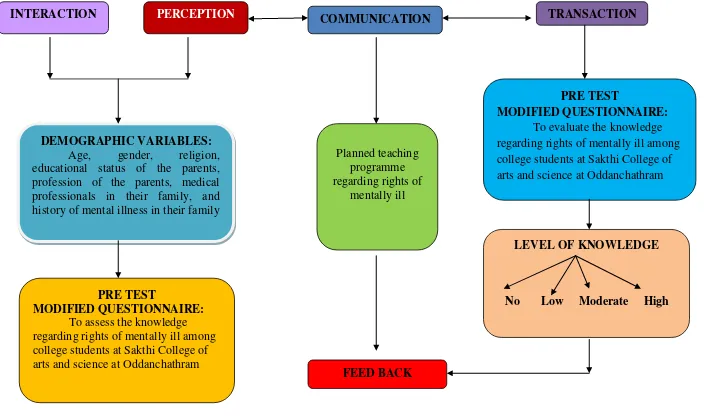
CONCEPTS KING’S GOAL ATTAINMENT THEORY
King’s goal attainment theory is based on the concepts of communication-perception- reaction, and communication- transaction-feedback.
Perception and Interaction
King’s describes perception as a process in which data is obtained, through the sense and from memory are organized, interaction King’s defines interaction as a process of perception and communication between person and environment and between a person
and person or as the acts of two or more persons in mutual presence. In this study the
researcher develops the demographic variable and modified questionnaires.
Communication
King’s describe communication as a person providing information directly or indirectly to another person. And the other person receives this information and processes
it. In this study the researcher administers planned teaching programme on knowledge
regarding rights of mentally ill among college students in Sakthi College of arts and
21 Transaction
Transaction is defined as observable refers to goal directed human behaviours. In
this study the gaining of adequate knowledge regarding rights of mentally ill among
college students in Sakthi College of arts and science at Oddanchathram.
Feedback
Feedback is the outcome of the goals desired by the interacting components. The
outcome may be either adequate or inadequate gaining of knowledge regarding rights of
mentally ill among college students in Sakthi College of arts and science at
Oddanchathram. If there is inadequate gain in knowledge, it leads to rearrangement for
planned teaching programme regarding rights of mentally ill among college students in
22
INTERACTION PERCEPTION
DEMOGRAPHIC VARIABLES: Age, gender, religion, educational status of the parents, profession of the parents, medical professionals in their family, and history of mental illness in their family
COMMUNICATION
Planned teaching programme regarding rights of
mentally ill
TRANSACTION
PRE TEST
MODIFIED QUESTIONNAIRE: To evaluate the knowledge regarding rights of mentally ill among college students at Sakthi College of arts and science at Oddanchathram
FEED BACK PRE TEST
MODIFIED QUESTIONNAIRE: To assess the knowledge regarding rights of mentally ill among college students at Sakthi College of arts and science at Oddanchathram
LEVEL OF KNOWLEDGE
[image:41.792.52.756.84.500.2]No Low Moderate High
23
CHAPTER – III
RESEARCH METHODOLOGY
The Methodology of research indicates the general pattern of organizing, the procedure
for gathering valid and reliable data for the problem under investigation.
(Polit and Beck, 2010)
Methodology is the systematic, theoretical analysis of the methods applied to a
field of study. Typically, it encompasses concepts such as paradigm, theoretical model,
phases and quantitative or quantitative techniques. A methodology does no set out to
provide solutions – it is, therefore, not the same as a method.
This chapter deals with the research approach, research design, variable under the
study, setting of the study, population of the study, sample size, description of the
interventions, development and description of the tool, validity and reliability of the tool,
pilot study, procedure for data collection and statistical analysis.
Research approach
The investigator adopted an Experimental approach, because the aim of the
researcher was to assess the effectiveness of planned teaching programme in improving
the level of knowledge among college students.
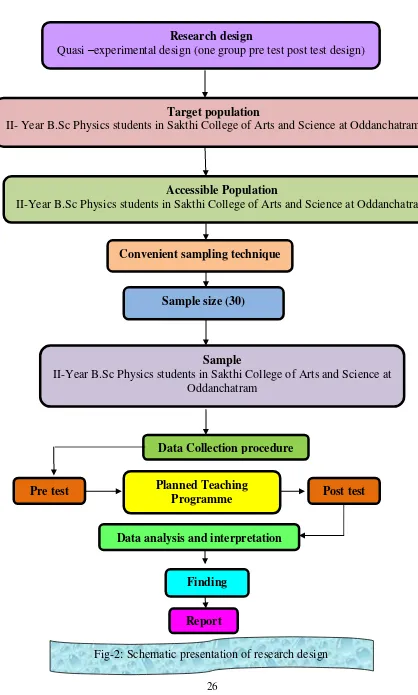
Research design
The research design used for this study was a Quasi experimental design (one
24 Setting
The study was conducted in the Sakthi College of arts and science for women at
Oddanchatram
Population
In this study the target population was second year arts student. The accessible
population was II-Year B.Sc Physics students in Sakthi College at Oddanchatram.
Sampling Technique
The sampling procedure was convenient sampling technique.
Sample
Second Year-B.Sc Physics Students in Sakthi College of arts and science as a
sample in this study. 30 students were selected as samples during the study
Sample size and sample technique:
Convenient sampling Technique was used to select samples that were present in
second year B.Sc Physics students in Sakthi College of arts and science during the period
of study.
Variables
Independent variable: Planned teaching program
25 Schematic presentation of research study design:
Group Pre-test Intervention Post-test
B.Sc II year Physics
students
Day 1 Day 2 Day 3
Assess the
knowledge
regarding Human
rights of mental
illness
Planned Teaching
programme
Evaluate the
knowledge
regarding Human
rights of mental
illness
Day-1: Pre-test: Pre assessment of knowledge regarding human rights of mentally ill.
Day -2: intervention: Planned teaching programme.
Day -3: Post test: evaluate the knowledge regarding human rights of mentally ill.
Inclusion criteria for sampling
Students those who are studying II-Year B.Sc Physics
Students who are willing to participate in the study
Students those who are having low level of knowledge Exclusion criteria for sampling
Students who are not available on the day of data collection
26
Research design
Quasi –experimental design (one group pre test post test design)
Target population
II- Year B.Sc Physics students in Sakthi College of Arts and Science at Oddanchatram
Accessible Population
II-Year B.Sc Physics students in Sakthi College of Arts and Science at Oddanchatram
Convenient sampling technique
Sample size (30)
Sample
II-Year B.Sc Physics students in Sakthi College of Arts and Science at Oddanchatram
Data Collection procedure
Planned Teaching Programme
Pre test Post test
Data analysis and interpretation
Finding
[image:45.612.112.530.51.746.2]Report
27 DESCRIPTION OF THE TOOL
Section –A
It consisted of demographic variables of the II-Year B.Sc Physics students which
included, age, gender, religion, educational status of the parents, profession of the
parents, medical professionals in their family, and history of mental illness in their family
Section –B
It consists of Modified questionnaires for assessing the knowledge regarding
rights of mentally ill. The questioner had totally 30 questions, each correct answer carry 1
mark.
Scoring pattern is:
1-5 = No knowledge
6-10 = Low level of knowledge
11-15 = Moderate level of knowledge
16-20 = High level of knowledge
TESTING OF THE TOOL
Reliability:
Reliability is the degree of consistency or dependability with which instrument
measures the attribute is designed to measure.
28 Validity:
Validity is the degree to which an instrument measures what is intended to
measure.
The validity of tool obtained from the experts in the field of psychiatric nursing
and psychiatric medicine. The suggestions and advices given by experts were considered
and corrected.
PILOT STUDY
The preliminary form used for the pilot study contained 5 items. For the pilot
study, students were selected from Sakthi College of Arts and Science at Oddanchatram.
Proper instructions were given. The subjects were asked to respond to all the statements
and no time limit was imposed. During the time of assessing the level of knowledge the
investigator gave proper assistance and directions whenever and wherever necessary.
Data collection method
After getting the permission from the concerned authorities, researcher will
explain the purpose of the study to the students. After obtaining informed consent from
the students, pre-test will be conducted by using of modified questionnaire to assess the
student’s knowledge on human rights of mentally illness. After planned teaching programme post-test will be conducted using the same tool.
Data Analysis Plan
The data being collected through student knowledge scale will be carefully
29
Frequency and percentage analysis used to describe the demographic
characteristics of variables.
Mean, mean difference, standard deviation of knowledge score and ‘t’ value of knowledge score of B.Sc II-Year Physics students before and after the planned teaching
programme.
Paired t-test will be carried out to assess the pre and post-test to assess the level of
knowledge among second year B.Sc Physics students.
Chi square analysis will be used to determine the association between
demographical variables with knowledge among second year B.Sc Physics students in
Sakthi College of arts and science.
PROTECTION FOR HUMAN RIGHTS
A formal consent was obtained from the respondents of the study (second year
B.Sc Physics students) before planned teaching schedule. The investigator explained
objectives, purpose and goal of the study to the concern college principals, and students
30 CHAPTER-IV
DATA ANALYSIS AND INTERPRETATION
All meanings, we know depend on the key of interpretation.
-George Eliot
The process of evaluating data using analytical and logical reasoning to examine
each component of the data provided. This form of analysis is just one of the many steps
that must be completed when conducting a research experiment. Data from various
sources is gathered, reviewed, and hen analysis method, some of which include data
mining, text analytics, business intelligence and data visualizations.
Analysis is a process of organizing and synthesizing data so as to answer research
questions and test hypothesis. (Poilt and Beck, 2010)
This chapter describes analysis and interpretation of data collected to
evaluate the effectiveness of planned teaching programme on knowledge regarding
human rights of mentally ill among college students in Sakthi College of arts and
science” at Dindigul district. The collected data was organized, analyzed and tabulated by using descriptive and inferential statistics.
These data’s were represented as follows.
Objective-I: To assess the pre-test and post test knowledge level regarding human rights
of mentally ill among college students in Sakthi College of arts and science.
Objective-II: : To compare the Pre-test and post-test knowledge level regarding Human
31
Objective-III: To assess the effectiveness of planned teaching programme on knowledge
regarding Human Rights of Mentally Ill among college students in Sakthi College of arts
and science.
Objective-IV: To determine the association between certain demographic variables and
knowledge regarding Rights of Mentally Ill among college students in Sakthi College of
32
Data on demographic variables of the College students in Sakthi College of arts and
[image:51.612.101.550.206.714.2]science
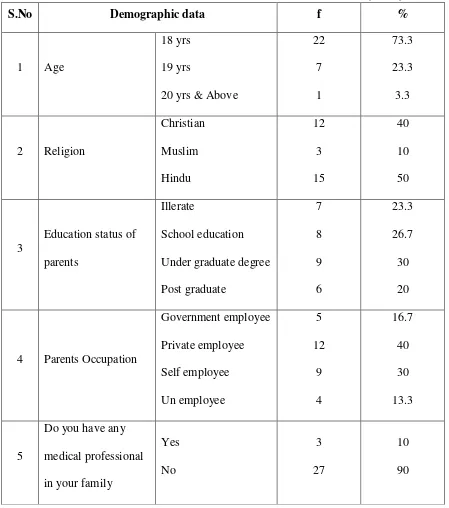
Table-1: Frequency and percentage distribution of college Students in Sakthi College of
arts and science according to their demographic data.
(N=30)
S.No Demographic data f %
1 Age
18 yrs
19 yrs
20 yrs & Above
22 7 1 73.3 23.3 3.3
2 Religion
Christian Muslim Hindu 12 3 15 40 10 50 3
Education status of
parents
Illerate
School education
Under graduate degree
Post graduate 7 8 9 6 23.3 26.7 30 20
4 Parents Occupation
Government employee Private employee Self employee Un employee 5 12 9 4 16.7 40 30 13.3 5
Do you have any
medical professional
in your family
33 6
Do you have any
mental ill patients in
your family Yes No 4 29 13.3 96.7 7 Previous knowledge
about rights of
mentally ill patients
Yes No 5 25 16.7 83.3
The above table shows that among 30 samples, 27 (73.33%) samples belonged to
the Age Group 18 years, whereas only 1 (73.3%) of the sample belonged to the age
group of 20 years and above.
Regarding Religion majority15 (50%) samples belonged to the Hindu Religion,
whereas only 3 (10%) of the samples belonged to the Muslim religion.
Regarding Educational Status of the parents majority 9(30%).of the samples
belongs to the undergraduate degree and 6 (20%) of the samples belongs to post graduate.
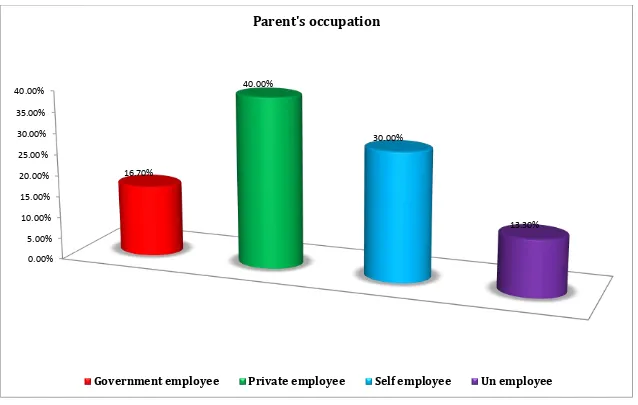
Regarding to the parents occupation majority is12 (40%) of the samples belongs
to the private employee and 4 (13.3%) of the samples belongs to unemployed.
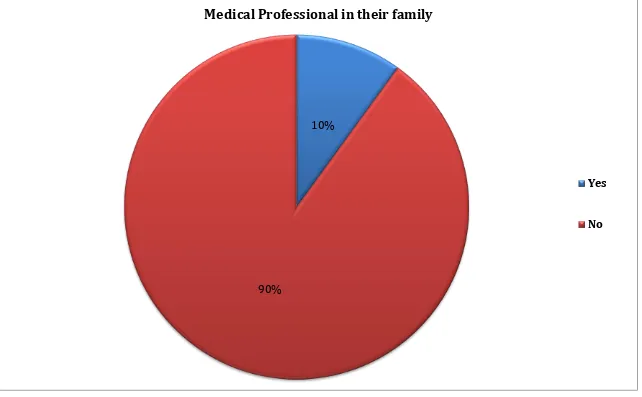
Regarding any medical professionals majority 27 (90%) of the samples are say
“No” and 3 (10%) of them says “Yes”.
Regarding any mental ill patients in her family, 26 (86.7%).of the samples say
“No” and 4 (13.3%) says “Yes”.
Regarding Previous knowledge about rights mentally ill patients, 25 (83.3%)
34
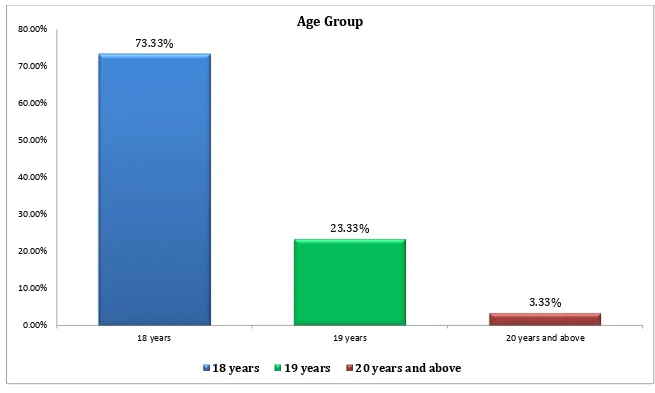
Figure 3: Distribution of college students according to their age group 73.33%
23.33%
3.33%
0.00% 10.00% 20.00% 30.00% 40.00% 50.00% 60.00% 70.00% 80.00%
18 years 19 years 20 years and above
Age Group
35
Figure 4: Distribution of college students according to their Religion. 0.00%
5.00% 10.00% 15.00% 20.00% 25.00% 30.00% 35.00% 40.00% 45.00% 50.00%
40.00%
50.00%
10.00%
Religion
36
Figure 5: Distribution of first year B.Sc (N) students according to their Medium studied in higher secondary school. 0.00%
5.00% 10.00% 15.00% 20.00% 25.00% 30.00%
23.30%
26.70%
30.00%
20%
Educational status of the parents
37
Figure 6: Distribution of college students according to their Parent’s occupation. 0.00%
5.00% 10.00% 15.00% 20.00% 25.00% 30.00% 35.00% 40.00%
16.70%
40.00%
30.00%
13.30%
Parent's occupation
38
Figure 7: Distribution of college students according to Medical professionals in their family. 10%
90%
Medical Professional in their family
Yes
39
Figure 8: Distribution of college students according to Mental illness patients in their family. 13.30%
96.70%
Mental illness patients in your family
40
Figure 9: Distribution of college students according to their Previous knowledge regarding rights of mentally ill. 16.70%
83.30%
Pervious knowledge
41
Data on pre test and post test level of Knowledge regarding rights of mentally ill
among college students in Sakthi College of Arts and Science at Oddanchatram
Table- 2: Frequency and percentage for level of Knowledge regarding rights of
mentally ill among College students in Sakthi College of Arts and Science at
Oddanchatram.
Level of Knowledge score
Pre test Post test
f % f %
No Knowledge (1-5) 17 56.67 0 0
Low Knowledge (6-10) 9 30 3 10
Moderate Knowledge (11-15) 4 13.33 9 30
High Knowledge (16-20) 0 0 18 60
Total 30 100% 30 100%
The above table shows that in pre test scores on the level of Level of Knowledge
17 (56.67%) of them had No Knowledge, 9 (30%) of them had Low Knowledge, and 4
(13.33%) of them had Moderate Knowledge respectively.
Whereas post test scores on the level of Level of Knowledge 3 (10%) of them had
Low Knowledge, 9(30%) of them had Moderate Knowledge and 18 (60%) of them had
High Knowledge respectively.
This finding reveals that, after the planned teaching programme the level of
knowledge regarding rights of mentally ill among college students were improved in post
[image:60.612.131.516.200.401.2]42
Figure 10: Level of Knowledge regarding rights of mentally ill among college students in Pre and Post test 0%
10% 20% 30% 40% 50% 60% 70%
Pre test Post test
57%
0.00% 30%
10.00% 13%
30%
0.00%
60%
Pre test and post test level of knowledge score
43
Date of effectiveness of planned teaching programme on level of Knowledge
regarding rights of mentally ill among college students
Table -3.Mean, SD and ‘t’ value on level of Knowledge regarding rights of mentally ill among college students
(N=30)
Domain
Pre-test Post – test Mean
difference ‘t’- value
Tablated
value
Mean SD Mean SD
Knowledge
score
5.83 3.57 15.5 3.35 9.67 2.1
S
1.699
*S= significant (df=29)
The above table shows that the pre test calculated value was 2.1 and the tablated
’t’ value is 1.699, which was significant at P< 0.05.
Hence H1 is accepted. It can be concluded that ‘planned teaching programme was
44
Data on association between the pre test level of knowledge regarding rights
[image:63.612.98.550.178.714.2]of mentally ill among college students and their demographic variables.
Table: 4 – Frequency percentage distribution of Chi-square
(N= 30) Demographic variables No Knowledge Low Knowledge Moderate Knowledge High Knowledge 2 - value P- value
f % f % f %
1. Age
a) 18-19 years
b) 20-21 years
c) 22and above
13 3 1 43.3 10 3.3 7 2 0 23.3 6.6 0 2 2 0 6.6 6.6 0 0 0 0 0 0 0 2.57 NS 9.49 2. Religion a) Christian b) Muslim c) Hindu 5 2 10 16.6 6.6 33.3 5 1 3 16.6 3.3 10 2 0 2 6.6 0 6.6 0 0 0 0 0 0 2.35 NS 9.49 3. Education
status of parents
a) Illerate
b) School
education
c) Under
graduate
45 4.Parents Occupation a) Government b) Private c) Self
d) Un employee 0 5 8 4 0 16.6 26.6 13.3 2 6 1 0 6.6 20 3.3 0 3 1 0 0 10 10 0 0 0 0 0 0 0 0 0 0 20.4 S 12.59 5.Any medical professional in your family a) Yes b) No 0 17 0 56.7 2 7 6.6 23.3 1 3 3.3 10 0 0 0 0 13.42 S 9.49
6.Any mental ill
patients in your
family a) Yes b) No 1 16 3.3 53.3 1 8 3.3 26.6 2 2 6.6 6.6 0 0 0 0 4.38 NS 5.99 7.Previous knowledge
regarding rights of
mentally ill a) Yes b) No 0 17 0 56.7 2 7 6.6 23.3 2 2 6.6 6.6 0 0 0 0 6.51 S 5.99
46
In this table shows that, there was statistically significant association between the
level of knowledge regarding rights of mentally ill among college students and their
demographic variables like parents occupation, medical professionals in their family,
mentally ill patients in their family and previous knowledge regarding rights of mentally
ill.
And above table shows that, there was not statistically significant association
between the level of knowledge regarding rights of mentally ill among college students
and their demographic variables like age group, religion, and educational status of the
47
CHAPTER
–
V
DISCUSSION
This study was conducted to assess the effectiveness of ‘planned teaching programme’ on improving the knowledge regarding rights of mentally ill among college students in Sakthi College of arts and science at Oddanchatram.
The discussion was based on the objectives specified in this study.
To assess the Pre-test data on demographic variables of the College students in
Sakthi College of arts and science
The Finding shows that, among 30 samples, 27 (73.33%) samples belonged to the
Age Group 18 years, whereas only 1 (73.3%) of the sample belonged to the age group of
20 years and above.
Regarding Religion majority15 (50%) samples belonged to the Hindu Religion,
whereas only 3 (10%) of the samples belonged to the Muslim religion.
Regarding Educational Status about of the parents majority 9(30%).of the
samples belongs to the undergraduate degree and 6 (20%) of the samples belongs to post
graduate.
Regarding to the parents occupation majority is12 (40%) of the samples belongs
to the private employee and 4 (13.3%) of the samples belongs to unemployed.
Regarding any medical professionals majority 27 (90%) of the samples are say
“No” and 3 (10%) of them says “Yes”.
Regarding any mental ill patients in her family, 26 (86.7%).of the samples say
48
Regarding Previous knowledge about rights mentally ill patients, 25 (83.3%)
samples say that, “No” and 5 (16.6%) of them says that, “Yes”.
To compare the Pre-test and post-test knowledge level regarding Human Rights of
Mentally Ill among college students in Sakthi College of arts and science.
The findings shows that in pre test scores on the level of Level of Knowledge 17
(56.67%) of them had No Knowledge, 9 (30%) of them had Low Knowledge, and 4
(13.33%) of them had Moderate Knowledge respectively.
Whereas post test scores on the level of Level of Knowledge 3 (10%) of them had
Low Knowledge, 9(30%) of them had Moderate Knowledge and 18 (60%) of them had
High Knowledge respectively.
This finding reveals that, after the planned teaching programme the level of
knowledge regarding rights of mentally ill among college students were improved in post
test than pre test.
A descriptive study was conducted to assess the knowledge among 30 staff
nurses regarding human rights and ethical responsibilities in field of psychiatric nursing
at selected psychiatric centre of Jaipur, Rajasthan. The findings of the study revealed that
majority (90%) of the nurses possess moderate level of knowledge and 10 % of nurses’ possessed high-level knowledge and none of nurses possessed low level knowledge.
An explorative Survey was conducted among 30 nurses working in selected
ayurveda medical college and Hospital, Bangalore to assess the knowledge regarding
49
were not aware of rights of mentally ill persons and only 2(6.7%) of them are having
highly adequate knowledge. An awareness programme was conducted to improve the
existing level of knowledge.
To assess the effectiveness of planned teaching programme on knowledge regarding
Human Rights of Mentally Ill among college students in Sakthi College of arts and
science.
The finding shows that the pre test calculated value was 2.1 and the tablatde’t’ value is 1.699, which was significant at P< 0.05.
Hence H1 is accepted. It can be concluded that ‘planned teaching programme’ was
effective in improving the knowledge level among college students.
A study conducted by Sharma et.al. entitled “awareness regarding human rights of mentally ill among nurses at selected hospitals in north India 2009 by using purposive
sampling techniques”. They found the maximum number of 98.08 % of subjects had good (61.54 %) and average (36.54 %) level of awareness. The maximum violation
practices were regarding seclusion of mentally ill followed by forceful administration of
medication and mechanical restraining of the mentally ill. The relationship between
awareness of subjects regarding human rights of mentally ill and selected social
demographic characteristics was found statistically significant.
Another descriptive study conducted by Santhi, found that majority of the
caregivers of mentally ill have inadequate knowledge. The recommendation made is that
50
methodologies for right protection included in the unit policies procedures practice of
institutions dealing with the mentally ill.
To determine the association between certain demographic variables and knowledge
regarding