Mapping Learning Outcomes and Assignment
Tasks for SPIDER Activities
doi:10.3991/ijet.v6iS2.1649
A.A. Kist and Lyn Brodie
University of Southern Queensland, Toowoomba, Australia
Abstract—Modern engineering programs have to address rapidly changing technical content and have to enable stu-dents to develop transferable skills such as critical evalua-tion, communication skills and lifelong learning. This paper introduces a combined learning and assessment activity that provides students with opportunities to develop and practice their soft skills, but also extends their theoretical knowledge base. Key tasks included self directed inquiry, oral and written communication as well as peer assessment. To facili-tate the SPIDER activities (Select, Prepare and Investigate, Discuss, Evaluate, Reflect), a software tool has been imple-mented in the learning management system Moodle. Evi-dence shows increased student engagement and better learning outcomes for both transferable as well as technical skills. The study focuses on generalising the relationship between learning outcomes and assignment tasks as well as activities that drive these tasks. Trail results inform the approach. Staff evaluations and their views of assignments and intended learning outcomes also supported this analy-sis.
Index Terms—Transferable Skills, Technical Writing, Pres-entation, Peer-Assessment, Distance Education.
I. INTRODUCTION
Engineering cohorts are becoming more diverse and in-clude, for example, mature age students and students from diverse social and educational backgrounds. This effect is elevated at the University of Southern Queensland (USQ), a small regional university, where approximately 76% of the cohort are distance education students. These students are located off campus and access learning materials in a variety of formats including printed material and elec-tronic content. To address transferable and technical skills in an equitable manner between on-campus and off-campus students is difficult as distance students have limited opportunities to engage with lecturers and their peers. The cohort is also very diverse. On one extreme are young digital natives [1], on the other extreme are mature edge students with a wealth of professional experience [2]. Computer literacy does not follow this classification [3]; however, practical skills and motivation generally follow the age boundary.
This paper reports on an assignment structure that is supported by a custom implementation in the Learning Management System (LMS) Moodle [4] and focuses on the issues outlined above. The strategy has been named SPIDER: Select, Prepare and Investigate, Discuss, Evalu-ate, Reflect as it centres around these activities. The over-arching goal is twofold, to engage students in assessment tasks and to encourage teachers to use a formal process to linking learning outcomes to learning activities and as-sessment.
The assessment tool incorporates a number of features including, topic selection, content preparation, investigat-ing and research, discussions and peer evaluation and reflection. These key tasks have been widely acknowl-edged as activities with positive learning outcomes. For example, benefits of self and peer assessment include improved motivation and ownership, critiquing, evalua-tion skills and lifelong learning [5]. For graduates to de-velop lifelong learning skills, they must also become adept at objectively assessing their own learning [6]. The initial assessment structure [7] has evolved into a compre-hensive learning model. To support this assessment, a prototype has been developed and trialled in a number of third and fourth year courses. Perception and learning outcomes were evaluated by student surveys, academic results and interviews with students. The evidence shows that this approach not only improves off-campus student engagement, but also learning outcomes. This includes both, soft skills and technical competencies.
Comments by staff have suggested that this integrated activity and assessment structure would be useful in other courses ranging from first to fourth year and across disci-pline majors. The overall approach remains consistent but individual requirements vary between courses. The aim of this work is to evaluate the transferability of this learning approach, extend the technical results and place the initial results on a firm scholarly and research footing. A new technical implementation and further development work was necessary to seamlessly integrate the activity with the learning management system. A formal evaluation of learning outcomes and their relationship to tasks, sup-ported by these tools were undertaken to make the system more accessible for other academics.
This serves two purposes; it helps with rigorous re-quirements analysis of the system, but also increases staff awareness of alternative learning and assessment strate-gies and of implementing a more scholarly approach to assessment in general. This evaluation results in a matrix that correlates intended learning outcomes with assign-ment task. In turn, this information is used to identify specific assignment flow charts and structures. There is clear evidence that SPIDER assignments enhance learning outcomes and the approach is transferable to a multitude of settings. It leads to more efficient assessment of student learning and most importantly it helps to drive student learning.
actual and potential assessments. General observations and future directions are outlined in Section VI.
II. THEORETICAL FRAMEWORK
To make sure that students gain the intended graduate attributes and achieve the prescribed learning outcomes it is important that the learning activities and assessment tasks are linked. To close the learning cycle and ensure that competencies are met, constructive alignment [8] has been a strong focus of educationalists but also engineering bodies. [9] introduces a generalised pedagogical model in the context of electronic tools that highlights the relation-ships between outcomes and tasks.
The model centres around five nodes: graduate attrib-ute, learning objectives, learning activities, assessment tasks, assessment criteria and standards. The authors sug-gest that course development can start in any of the five nodes and then more iteratively through the process and they acknowledge that the model is general and omits a number of linkages which are not included. This paper uses the model as a starting point to engage lecturer in a process of developing assessments that follow a formal process.
In this particular case the focus is on a predefined as-sessment tool that includes a number of components that naturally lead to a specific set of learning outcomes that are constructively aligned with the subject/course objec-tives. The aim is to integrate learning and assessment tasks as it is difficult to engage student with learning ac-tivities if they are not directly rewarded with marks. Lit-erature suggests e.g. [10, 11] that this lack of engagement and focus on grades impacts significantly on student learning with only surface learning occurring rather than the deep learning.
Therefore this work suggests a simplified four node model that combines learning activity and assessment task. Figure 1 depicts a graphical representation. Graduate attributes are expanded to specify learning objectives. These objectives are achieved though learning activities that also form part of the assessment. The measure is based on criteria and standards that demonstrate the at-tainment of graduate attributes. The authors believe that this presents a more suitable approach to capture the pur-pose of the SPIDER tool.
The benefits of the individual components that are em-ployed by SPIDER have been widely acknowledged in the literature. Key references are summarised below.
Rubrics are systematic scoring methods that use pre-determined criteria to measure student learning for grad-ing assessment. [12] suggests that this enables a more objective and consistent assessment of student work. Marking rubrics also clarify grading criteria and demys-tify the marking process. Students’ self-judgement is fostered. Practical suggestions, examples, guidelines and principles of effective rubrics use are provided by [13].
[image:2.595.309.538.72.254.2]Potential benefits of self and peer assessment are ac-knowledged by the research community, e.g. [14, 15]. Concrete benefits include improved motivation and own-ership, critiquing and evaluation skills. [14] highlights that graduates that are expected to develop as lifelong learners, must be able to objectively asses their own learning. [12] enforces this view by that suggesting that greater empha-sis should be placed on technology-supported tools and techniques to assess context based learning; rather than
Figure 1. Interactive pedagogical model (adapted from [9]).
disempowering learners with strict summative assess-ments. [5] adds that peer assessment also improved ‘soft skills’ and [15] proposes that student assessment of other students’ work has potential learning benefits by encour-aging student autonomy and higher order thinking skills.
Students need to become ‘reflective practitioners’ able to critically reflect on their own professional practice [16-18] which in turn contributes to their life-long learning skills. The need for these skills will only increase in the future as the acquisition of knowledge and skill cannot be restricted to any particular phase of education and much continue throughout professional life [19].
Independent of the benefits of individual activities, di-versified learning opportunities will be beneficial to all students as variation theory suggests e.g. [20]. The follow-ing section describes the initial motivation for this project and the methodology that has been used to undertake it.
III. MOTIVATION AND METHODOLOGY
The initial focus of this approach was a third year in-troductory course into computer systems and communica-tion protocols. The course is offered to undergraduates in their final years and postgraduate master by coursework students. The goal of the course is to provide a basic in-troduction into computer systems and the Internet. A number of reasons have motivated the introduction of this new assessment structure that led to the development of the SPIDER tool.
As suggested above, there is an increasing focus on ge-neric skills, graduate attributes and constructive align-ment. This need for new skills is also motivated by chang-ing and diverse student cohorts. For an increaschang-ing number of students the Internet is becoming a key source, often the main source of information. Therefore is essential for students to acquire and practise critical thinking skills to assess and evaluate this information. The course content in many areas of engineering is rapidly changing and including alternative learning opportunities can assist with the currency of the teaching material and foster independ-ent inquiry. This also helps to provide up-to-date study materials to distance students.
commitments as to when the assignment has to be done. The SPIDER approach can be used to give more choices in assessment topics as well as assessment due dates. This effort also encourages students to work outside their com-fort zone and to try new things. Last, but not least, the engagement of distance students with the course and sub-ject material is an important driver for the new assignment and learning approach. The overall aim is to foster student engagement, provide tools for lifelong and reflective learning and naturally teach the relevant technical content.
To address these issues a comprehensive new assign-ment structure was devised [7] that include individual student reports and presentations as well as peer assess-ment. As there were no electronic tools available to sup-port the new assessment strategy, a prototype was devel-oped. This was a web-based solution using a php/mysql environment. This was necessary as the number of peer assessments surpassed 1,400 in a course with about 70 active students. This volume would have been impossible to handle manually. The assignment and the tool were tested in four classes in 2009 and 2010. The impact has been assessed by a number of surveys, student interviews and analysis of examination results.
These trials informed the design and the specification for the SPIDER tool. To expand the scope, a workshop with academic staff at the Faculty of Engineering and Surveying and follow up interviews was held. The key aims were to identify additional requirements of the tool and to explore linkage between activities and learning outcomes. The workshop sought to encourage academics to think about, and clearly define, the assessment strate-gies in a variety of undergraduate courses. It highlighted the fact that many academics do not use assessment as a learning tool and have not rigorously made all the links between graduate attributes, learning objective, learning activities and assessment criteria. For example many aca-demics, whilst having carefully planned assessment activi-ties and assessment criteria have not clearly link them back to graduate attributes. Others have clear and precise learning objectives, but again have not sort to rigorously align these with graduate attributes. The workshop high-lighted these weaknesses and the SPIDER tool assisted in replanning assessment activities and learning objectives.
IV. THE SPIDERTOOL
The SPIDER tool has been implemented as an assign-ment type in the Learning Manageassign-ment System (LMS) Moodle [4]. It is based on the workshop module and it is able to support assignments that can address a number of learning outcomes. It consists of multiple assessment components that are based on marking rubrics, including self assessment, peer assessment, marker assessment and moderation. The tool supports multiple submissions per assignment, e.g. reports and presentations. Results are presented with a comprehensive statistical analysis. The tool also includes a reflection component that allows stu-dents to comment on their final results. This was included to force students to revisit assignment feedback and reflect on the assessor’s comments in an attempted to close the learning cycle.
One of the key differences to similar other tools is the possibility to have individual deadlines for each student submission. This allows this tool to be used for seminar style classes where students present different topics in different weeks. It can also be used to assess non
elec-tronic work such as art pieces or performances. For par-ticular assignments, the various components of the tool can be individually activated or deactivated. This leads to a number of potential assignment workflows. Example flow charts of assignment strategies are discussed in Sec-tion V.
To decide which components are suitable for what learning outcomes, a decision matrix has been devised. Table 1 shows matches between components of the SPIDER tool and individual learning outcomes these activities foster. Topic section offers student the opportu-nity to select an area and topics can have different dead-lines. Background research is a self directed inquiry task and undertaken offline. Presentations and reports are also prepared offline and summarise the findings of the re-search activity. On campus students give their presenta-tions in class, external students’ record their presentation and upload it to the system. Student submissions are self assessed. The system supports group as well as individual submissions; however, self assessments are always activi-ties that are undertaken by an individual. A key compo-nent is the peer assessment that requires students to mark the submissions of other students. The final reflection task gives students the opportunity to comment on their results. Table 1 also includes numbers that refer to Engineers Australia graduate attributes and ABET Criteria that are listed in Table 2. Most attributes are addressed by the individual learning activity tasks. However, to a large extend more specific reference to learning outcomes and graduate attributes will depend on the actual assignment, i.e. specifications that include the subject specific content and deliverables.
V. ASSESSMENT WORKFLOWS
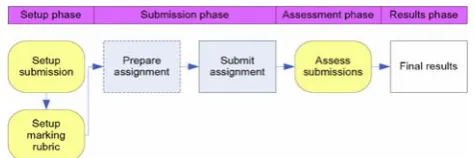
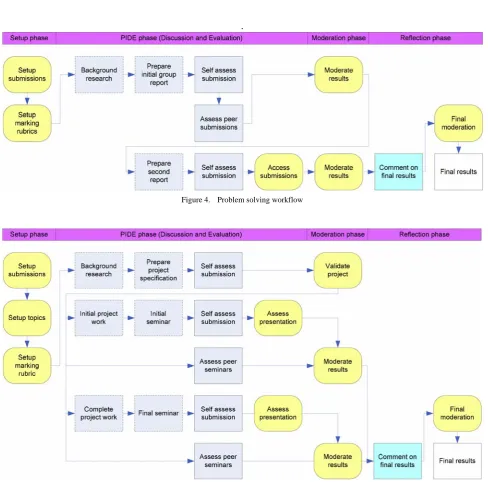
This section introduces four sample assessment work-flows that highlight the capability of the tool. Rounded boxes (yellow) indicate tasks that are undertaken by lec-turers, square boxes (blue) show tasks that are done by students. Boxes with dashed borders indicate offline ac-tivities. The flow charts include actual as well as future workflows: Chart C has been used numerous times. It is envisaged that Chart A and C will be used in Semester 1 2011. Chart D describes an application that is currently not used.
A. Simple Assignment
[image:3.595.304.542.672.751.2]The first example, depicted in Figure 2, shows a simple assignment workflow that largely replicates a traditional assessment strategy. Students submit assignments and these are subsequently marked by lecturers. The only difference is that it uses an online marking rubric for the assessment. The simple workflow can be extended by student self assessment, peer assessment and a reflection phase at the end to address further learning outcomes and students engage. The following examples show more complex structures.
TABLE 1
MAPPING SPIDER COMPONENTS AND LEARNING OUTCOMES. (# Engineers Australia Graduate Attribute number;
+ ABET Criteria 2008-2009)
Component Learning Outcomes Attributes Graduate
Topic Selection
Critical evaluation
Self awareness of prior knowledge and skills
Ability to identify personal learn-ing goals #1, #10 +(a), +(i) Background Research Technical Critical evaluation #4, #3 +(e), +(b) Presentation Preparation Technical Communication skills #3, #2 +(b), +(g) Give
Presen-tation Communication skills
#2 +(g) Report Preparation Technical Communication skills
#2, #3, #5 +(g), +(b),+(c) Self As-sessment (individual) Technical
Self awareness of knowledge and skills
Awareness of own strengths and weaknesses #10 +(i) Self As-sessment (group submission)
Self awareness of knowledge and skills
Awareness of own strengths and weaknesses
Critical evaluation
#6, #10, #3 +(d), +(i),
+(b)
Peer As-sessment
Self awareness of knowledge and skills
Awareness of own strengths and weaknesses
Critical evaluation
#9, #3, #10 +(f), +(b),
+(i)
Reflection
Self awareness of knowledge and skills
Awareness of own strengths and weaknesses
Critical evaluation
#10, #3 +(i), +(b)
TABLE 2
COMPARISON OF GRADUATE ATTRIBUTES FROM ENGINEERS
AUSTRALIA AND ABET[21]
Engineers Australia ABET Criteria 2008–2009
1. Ability to apply knowledge of basic science and engi-neering fundamentals
(a) An ability to apply knowledge of mathematics, science, and engineering
(k) An ability to use the tech-niques, skills, and modern neering tools necessary for engi-neering practice
2. Ability to communicate effectively, not only with engineers but also with the community at large
(g) An ability to communicate effectively
3. In–depth technical compe-tence in at least one engi-neering discipline
(b) An ability to design and conduct experiments, as well as to analyze and interpret data 4. Ability to undertake
prob-lem identification, formula-tion and soluformula-tion
(e) An ability to identify, formu-late, and solve engineering prob-lems
5. Ability to utilise a systems approach to design and op-erational performance
(c) An ability to design a system, component, or process to meet desired needs within realistic constraints such as economic, environmental, social, political, ethical, health and safety, manu-facturability, and sustainability 6. Ability to function
effec-tively as an individual and in multi–disciplinary and multi–cultural teams, with the capacity to be a leader or manager as well as an ef-fective team member
(d) An ability to function in multidisciplinary teams
7. Understanding of the social, cultural, global and envi-ronmental responsibilities of the professional engineer, and the need for sustainable development
(h) The broad education neces-sary to understand the impact of engineering solutions in a global, economic, environmental, and societal context
8. Understanding of the prin-ciples of sustainable design and development
(j) A knowledge of contemporary issues
9. Understanding of profes-sional and ethical responsi-bilities and commitment to them
(f) An understanding of profes-sional and ethical responsibility
10. Expectation of the need to undertake lifelong learning, and capacity to do so
Figure 3. SPIDER workflow
.
[image:5.595.57.544.78.491.2]Figure 4. Problem solving workflow
[image:5.595.55.544.258.740.2]B. SPIDER
The original application of the assessment structure was an introductory computer systems and communication networks course as discussed above. The main assessment item consists of a report, a presentation and peer assess-ment of 20 peer submissions. The tasks account for 10%, 10% and 8% of the final marks, respectively. One of the key differences between a traditional workflow and this structure are individual topics and deadlines for students. Figure 3 depicts the complete workflow for this assign-ment. The two bars on top show the phases of the online tool and how they match the SPIDER approach of Select, Prepare and Investigate, Discuss, Evaluate, Reflect.
The lecturer configures the tool during the setup phase. Submissions are added; in this case, reports and presenta-tions. Topics and their respective deadlines are config-ured. Marking rubrics are defined, for both, reports and presentations. The tool is changed into the selection phase. During this phase students select one of the topics. The next phase of the tool covers the major part of the activi-ties. Students undertake the background research and prepare presentations and reports. External students record their presentation, on campus student present their find-ings in class. Both, report and presentation are uploaded.
Students self assess their submissions and submissions are also peer assessed. After the topic selection is com-pleted, a given number of topics (e.g. 20) are randomly assigned to each participation student. Throughout the semester, the student has to assess those assignments as they become available. Once all topics have been pre-sented and marked, the tool is moved into the moderation phase. The lecturer gets an extensive overview of all the results that relate to the assessment item. At this point the marks can be adjusted and bonus or penal marks can be added or deducted. In the final reflection phase, students have the opportunity to comment on their results and the lecturer can adapt the results in response to comments.
C. Problem Solving
The Faculty of Engineering and Surveying at USQ has four courses which utilise a Problem Based Learning (PBL) paradigm [22]. All students are allocated to teams [23] and via electronic communication media undertake, as a team, finding solutions to a number of open ended contextual problems. The assessment in each of the courses vary in accordance with the specific course learn-ing objectives but the underlinlearn-ing approach of the assess-ment structure is that students undertake an assignassess-ment task, receive feedback and then submit an updated version of the assignment. Details of this assessment method are described in [24]. However due to increasing student enrolments, undertaking peer assessment (individual and team) is administratively unmanageable. In addition there is significant evidence to support the advantages to student learning of self and peer assessment and it is believed that this should be expanded to other assessment items in the course.
It is envisaged that the SPIDER tool will be used in S1 2011. Figure 4 depicts a flowchart for problem solving courses. The initial setup phase is similar to the previous two examples. Submissions in this case are group assign-ments. All team members self assess the common submis-sion. Students from other groups, peer assess the initial submission and the peer assessment is moderated. Groups prepare and submit a second assignment that has been
modified based on the feedback. The second submission is again self assessed and assessed by markers. During the reflection phase, students have the opportunity to com-ment on their final results.
D. Professional Practice
Many engineering programs include a final year cap-stone project. In the Faculty of Engineering and Surveying at USQ students undertake a two semester research pro-ject. As part of the formal project milestones, students have to complete a number of deliverables including a project specification, project appreciation, initial project seminar, project conference presentation and the final project dissertation. Figure 5 depicts the proposed flow chat which shows a process that gives students multiple additional learning opportunities. Students have to submit a number of deliverables; hover, they have also the oppor-tunity to comment on the work of others.
The initial project seminar and final project conference presentation offer ideal opportunities to engage the whole student cohort in the assessment process. Currently stu-dents must attend presentations and student presentations are assessed by an academic staff member. However the student audience is not attentive and an ideal learning opportunity is being missed. Providing as well as receiv-ing feedback can be a powerful learnreceiv-ing tool as well as a necessary professional skill. A similar structure could also be used for postgraduate research seminars.
VI. OBSERVATIONS AND FURTHER DIRECTIONS
The tool offers great flexibility to design engaging learning activities that are assessable at the same time. One issue is the complexity of the tool. Initially academics will require support to use the SPIDER tool to its full extent. Current activities focus on ways how the tool and the methodology could be further simplified. This paper is an initial attempt to address this issue.
SPIDER is fully integrated in Moodle 2, the current USQ Learning Management System. There are no direct technological barriers specific to the tool. Especially from a student perspective, required actions are listed on the screen and have to be completed to proceed.
There has been extensive evaluation of the trial imple-mentation; however, the trials were limited to two courses only. It will be interesting to investigate if the outcomes are directly transferable to the new tool and what the stu-dent’s perception will be.
Academic staff must also be willing to engage in the process of critically reviewing and changing assessment practices.[25] notes that rarely do academic staff act on issues covered in professional development workshops and seminars and for successful outcomes a “one-to-one collaborative, mentoring relationship” between developer and academic should be encouraged. The SPIDER project offers an ideal opportunity for the development of schol-arly knowledge of assessment and changing assessment practices in a practical and constructive environment.
VII. CONCLUSIONS
Previous work has shown that this assignment structure helps with student engagement and student learning; the SPIDER tool is a implementation in Moodle 2.0 that can be readily used by others for a variety of assessment strategies. The tool provides a number of important step-ping stones to encourage a scholarly approach to assess-ment. Firstly it explicitly links graduate attributes, learn-ing outcomes, learnlearn-ing activities and assessment criteria. This may require the academic to revisit both the learning objectives of the course and current assessment practices placing these in an appropriate scholarly and theoretical framework. It is envisaged that the completed tool will be made available to the wider Moodle community.
Refocusing from testing or evaluating to a constructive assessment culture has well defined and evidenced links to improved student learning. Further development and rig-orous evaluation of the SPIDER tool is required but initial data suggests that it offers many advantages in supporting changing assessment strategies and enhanced student engagement and learning.
REFERENCES
[1] Bennett, S., K. Maton, and L. Kervin, The ‘digital natives’ debate: A critical review of the evidence. British Journal of Educational Technology, 2008. 39(5): p. 775-786. doi:10.1111/j.1467-8535.2007.00793.x
[2] Brodie, L. and M. Porter, Transitions to first year Engineering - diversity as an asset. Studies in Learning, Evaluation, Innovation and Development, 2009. 6(2): p. 1-15.
[3] Kennedy, G., et al. The net generation are not big users of Web 2.0 technologies: Preliminary findings. in Proceedings of ICT: Providing choices for learners and learning. 2007. Singapore. [4] 2010, in Open Source Course Management System for Online
Learning. 2010.
[5] Cassidy, S., Developing employability skills: peer assessment in higher education. Education + Training, 2006. 48(7).
[6] Williams, P., Assessing context-based learning: not only rigorous but also relevant. International Journal of Engineering Education, 2008. 33(4).
[7] Kist, A.A. Trialling an Assignment Structure that Develops Generic Competencies and Enriches Subject Understanding. in
20th Australiasian Assossiation for Engineering Education Conference. 2009. Adelaide: University of Adelaide.
[8] Biggs, J. and C. Tang, Teaching for Quality Learning at University. 2007: The Society for Research in Higher Education Open University Press, McGraw-Hill Education.
[9] Jolly, L. and J. Humphries. Using an electronic tool to encourage pedagogical change. in 14 Annual Conference for Australiasian Association for Engineering Education. 2003. Melbourne. [10] Frankland, S., et al., Aligning Assessment with Learning and
Teaching in Enhancing Teaching and Learning through Assessment, S. Frankland, Editor. 2007, The Hong Kong Polytechnic University: Hong Kong. p. 64-85. doi:10.1007/978-1-4020-6226-1
[11] Boud, D., Enhancing learning through self assessment. 1995, London: Kogan Page.
[12] Brodie, L. and P. Gibbings, Comparison of PBL Assessment Rubrics, in Research in Engineering Education Symposium, L.M.R. Hadgraft, Editor. 2009, The University of Melbourne: Cairns, QLD, Australia.
[13] Tierney, R. and M. Simon, What’s still wrong with rubrics: Focusing on the consistency of performance criteria across scale levels [Electronic Version]. Practical Assessment, Research & Evaluation 9 (2), 2004.
[14] Brown, S., C. Rust, and G. Gibbs, Strategies for Diversifying Assessment in Higher Education. . 1994: Oxford Brookes University: Oxford Centre for Staff Development.
[15] Bostock, S., Student Peer Assessment. 2000, Keele University, Learning Technology, Documents.
[16] Schon, D., Educating the Reflective Practitioner. 1987, San Francisco: Jossey-Bass.
[17] Schon, D., The Reflective Practitioner. 1983, New York: Basic Books.
[18] Falchikov, N. and B. D., Student self assessment in higher education: a meta-analysis. . Review of Educational Research, 1989: p. 395-430.
[19] Sambell, K. and L. McDowell, The value of self and peer assessment to the developing lifelong learner, in Improving student learning - improving students as learners C. Rust, Editor. 1998, Oxford Centre for Staff and Learning Development: Oxford, UK. p. 56-66.
[20] Pang, M., Two Faces of Variation: On continuity in the
phenomenographic movement. Scandinavian Journal of
Educational Research, 2003. 47(2).
[21] Brodie, L.M., Problem Based Learning for teams working in virtual space, in Faculty of Engineering and Surveying. 2010, University of Southern Queensland: Toowoomba, QLD. p. 314. [22] Brodie, L., eProblem Based Learning – Problem Based Learning
using virtual teams. European of Engineering Education, 2009.
34(6): p. 497-509. doi:10.1080/03043790902943868
[23] Brodie, L. and M. Porter, Engaging distance and on-campus students in Problem Based Learning. European Journal of Engineering Education, 2008. 33(4): p. 433-443. doi:10.1080/ 03043790802253574
[24] Gibbings, P. and L. Brodie, Assessment Strategy for an Engineering Problem Solving Course. International Journal of Engineering Education, 2008. 24(1, Part II): p. 153-161.
[25] Robbie, D. and D. Weaver. Mentoring through scholarship-based academic development projects. in Ascilite 2009. 2009. Auckland, New Zealand.
[26] Birenbaum, M., Assessment 2000: towards a pluralistic approach to assessment, in Alternatives in assessment of achievements, learning processes and prior knowledge., in Evaluation in education and human services, M. Birenbaum and F.J.R.C. Dochy, Editors. 1996, Kluwer Academic Publishers: Boston, MA. p. 3-29.
[27] Struyven, K., F. Dochy, and S. Janssens. Students' perceptions about assessment in higher education: a review. in Joint Northumbria/ Earli SIG Assessment and Evaluation Conference: Learning communities and assessment cultures. 2002. University of Northumbria at Newcastle.
ACKNOWLEDGMENT
The authors would like to thank the Australian Digital Futures Institute that supported the development with in-kind contributions. In particular Cynthia Wong and Bron-wyn Chandler played an important part in this project. This work has been funded by a USQ Associate Learning and Teaching Fellowship and the Engineering Education Research Group at the Faculty of Engineering and Survey-ing, USQ.
AUTHORS
A. A. Kist is with the Faculty of Engineering and
sci-entific articles and one patent. He is a member of the Telecommunication Society of Australia and Engineers Australia; and he is a senior member of the Institute of Electrical and Electronics Engineers (IEEE).
Lyn Brodie is an Associate Professor in the Faculty of
Engineering and Surveying. Her research interests include engineering education, Problem Based Learning, assess-ment and the first year experience. She is a board and founding member of the USQ Teaching Academy and Director of the Faculty Engineering Education Research Group. Lyn was the academic team leader for the teaching team which successfully designed a strand of PBL courses
for the faculty. Her work has been recognised through several awards including a University Award for Design and Delivery of Teaching Materials, Carrick Institute Citation and Australian University Teaching Award for Innovation in Curricula Learning and Teaching, USQ Associate Learning and Teaching Fellowships for curricu-lum and assessment development and recognition from the Australian Association of Engineering Educators for in-novation in curricula.
![Figure 1. Interactive pedagogical model (adapted from [9]).](https://thumb-us.123doks.com/thumbv2/123dok_us/172737.47642/2.595.309.538.72.254/figure-interactive-pedagogical-model-adapted-from.webp)