ESMC-2012
8
th
European
Solid Mechanics Conference
Institute of Biomechanics
Graz University of Technology
Austria
July 9-13, 2012
PROGRAMME
Edited by:
Gerhard A. Holzapfel
Graz University of Technology, Austria
&
Royal Institute of Technology, Sweden
Ray W. Ogden
University of Aberdeen, UK
&
116
10:35 Extension of Koiter's Linear Shell Theory to Materials Exhibiting Arbitrary Symmetry
David J. Steigmann
10:55 A One-Field Formulation of Elasto-Plastic Shells with Fracture Applications
Gauthier Becker, Ludovic Noels
11:15 Deformations of Transversely Accreted Plates
Sergey Alexandrovich Lychev 11:35 A Vekua-Type Thick Shells' Theory
Sergey Igorevich Zhavoronok
11:55 C1 Continuous Finite Element Approximation for Modeling Finite Deformations ofKirchhoff-Love Shells as Material .
Yury M. Vetyukov
MS-36.3 Refined Theories of Plates and Shells Thursday, 14:15 - 15:45
Casineum Chair: H. Altenbach, E. Ivanova
14:15 A Modified Energy Method for the Buckling of Thin Plates in Tension
Xiang Liu, Ciprian Coman
14:33 Effect of ‘Static Resonance’ in Cylindrical Shells with Periodical Geometrical.
Imperfections
Maksym Kolesnikov, Vasily L. Krasovsky, Ruediger Schmidt
14:51 On the Unsymmetrical Wrinkling of Heterogeneous Circular and Annular Plates
Eva Voronkova, Svetlana Bauer, Anders Eriksson
15:09 On the Stability of the Cylindrical Shell under the Axial Compression with Use of Non-Classical Theories of Shells
Andrei Ermakov
15:27 Theory of Micropolar Orthotropic Elastic Thin Shells
A.J. Farmanyan, Samvel Hovhannes Sargsyan
MS-36.4 Refined Theories of Plates and Shells Thursday, 16:00 - 18:00
Casineum Chair: G. Dhondt, E. Pruchnicki
16:00 Efficient High-Fidelity Multiphysics Modeling of Composite Plates Using the Variational.
Asymptotic Method (Keynote)
Wenbin Yu, Chang-Yong Lee, Dewey H. Hodges
16:35 Automatic Expansion of Shell Elements into 3D by Use of Expandable Rigid Bodies
Guido Dominique Dhondt
16:52 Nonlinear Stability Analysis of Functionally Graded Shells Using the Invariant-BasedTriangular Finite Element .
Stanislav Levyakov, V.V. Kuznetsov 17:09 Enhanced FGM Shell Finite Elements
174
GS-MM.10, 150 Elguedj, Thomas GS-MM.1, 147 Elsheikh, Ahmed MS-41.1, 125 Elsibai, Khaled A.GS-CM.1, 133 Emmerich, Heike
MS-35.1, 113 Engert, Andrea R.
MS-27.1, 98 Eom, Kilho
PS, 162 Epler, E.
MS-19.6, 82 Eremeyev, Victor A.
MS-40.1, 123 MS-36.5, 117 Eriksson, Anders
MS-36.3, 116
Eriksson, Thomas S.E. MS-6.2, 54 MS-6.2, 54 Ermakov, Andrei MS-36.3, 116 Erofeyev, Vladimir Ivanovich MS-33.2, 110 MS-33.2, 110 Eskandari, Morteza GS-SM.7, 158 Espin, M.J. MS-2.3, 47
Espíndola da Silva, Danielle Mariano GS-CoM.8, 140 Estevez, Rafael GS-MM.16, 153 MS-15.2, 71 MS-26.1, 96 Estrin, Yuri GS-MM.11, 150 Evans, H.P. GS-MP.2, 154 Evard, Margarita E.
MS-37.1, 118 Eyckens, Philip MS-21.2, 85 F Facheris, Giacomo GS-CoM.9, 140 GS-CoM.10, 140 Faciu, Cristian MS-35.1, 113 Fahlbusch, Nina-Carolin GS-MM.17, 153 Falach, Lior MS-31.4, 106 MS-31.5, 107 Falcone, Jean-Luc MS-24.4, 93 Falk, V. MS-16.2, 72 Falkinger, Georg MS-14.2, 69 Fall, Abdoulaye MS-22.2, 87 Fang, Chung PS, 162 Fang, Daining GS-MM.5, 148 Farahnak Langroudi, Mojtaba MS-17.8, 76 Farine, Marc MS-18.3, 78 Farmanyan, A.J. MS-36.3, 116
Fastl, Thomas E. GS-CoM.1, 138 Favata, Antonino
MS-36.5, 117 Favier, Denis M.
MS-31.3, 106 MS-37.2, 118 MS-37.2, 119 Favier, Véronique GS-MM.1, 147 Favino, Marco MS-16.1, 72 Favre, Jean-Pierre GS-CoM.7, 139 MS-5.2, 51 Fedele, Roberto MS-9.5, 60 Fedeliński, Piotr
GS-CoM.11, 141 Federico, Salvatore MS-31.5, 107 MS-8.1, 58 MS-6.1, 54 MS-16.1, 72 Fenz, Wolfgang GS-CoM.1, 137 Ferdowsi, Behrooz MS-22.5, 89
Ferguson, Stephen J. GS-CM.9, 136 Fernandes, A.A.
MS-3.2, 48 GS-EM.3, 145 Fernandes, Paulo Rui
MS-16.1, 72 MS-16.1, 72
On the stability of the cylindrical shell under the axial compression with
use of nonclassical theories of shells
A.M. Ermakov†
†Department of Theoretical and Applied Mechanics, Saint Petersburg State University,
Universitetsky prospekt 28, 198504 Peterhof, Sankt Petersburg, Russia Khopesh [email protected]
ABSTRACT
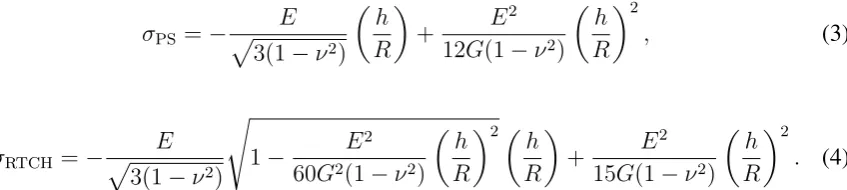
The problem of stability of the cylindrical shell under the axial compression by means of new nonclassical shell theories is studied. To solve it the local approach [1] is used. According to it the buckling deflection is sought in the form of a doubly periodic function of curvilinear coordinates. The comparison of well-known solutions obtained with the use of classical shell theories of Kirchhoff-Love (KL) and Timoshenko-Reissner (TR) with the results of improved nonclassical shell theories of Rodionova-Titaev-Chernykh (RTCH) [3] and Paliy-Spiro (PS)[4] is done.
The improved iterative RTCH theory is based on the following hypotheses: 1) transverse tan-gential and normal stresses are distributed on shell’s thickness according to quadratic and cubic laws respectively; 2) tangential and normal components of the displacement vector are distributed on the shell thickness according to quadratic and cubic laws respectively. This theory allows taking into account turns of fibers, their deviation and change of their length.
The Paliy-Spiro shells theory is a theory of shells of moderate thickness which assumes the following hypotheses: 1) straight fibers of the shell which are perpendicular to its middle surface before deformation remain also straight after deformation; 2) cosine of the slope angle of these fibers to the middle surface of the deformed shell is equal to the averaged angle of transverse shear.
For the PS and RTCH theory of anisotropic shells of moderate thickness the stability equations were developed with linearization of nonlinear equilibrium equations.
Thus the results obtained with the use of PS theory are similar to the TR theory results. This is only the factor of the second coefficient of asymptotical expansion by small parameter h/R makes the results different. And the results which were obtained with the use of RTCH theory include the members of asymptotical expansion of higher order.
σKL =−
E √
3(1−ν2) (
h R
)
, (1)
σTR=−
E √
3(1−ν2) (
h R
)
+ E
2
10G(1−ν2) (
h R
)2
σPS=−
E √
3(1−ν2) (
h R
)
+ E
2
12G(1−ν2) (
h R
)2
, (3)
σRTCH=−
E √
3(1−ν2) √
1− E
2
60G2(1−ν2) (
h R
)2(
h R
)
+ E
2
15G(1−ν2) (
h R
)2
. (4)
The comparison of analytical results with numerical results which were obtained with the use of three–dimensional theory by the FEM code Ansys 11 is also done. As an example, the model of a steel tube under the influence of the axial compression is studied. The three– dimensional 20–nodes elements Solid186 were used. During mesh contraction the splitting of the thickness which consisted of five elements was applied. The value of critical load for tubes studied which length ranged from 1.5 to 3 diameters of medial surface was practically consistent. The modulus of cross section shear was equal toG=E/(2(1 +ν)).
h/R 0.025 0.05 0.1 0.133 0.162 KL 0.01532 0.03103 0.0637 0.08069 0.09814 TR 0.01513 0.03028 0.06054 0.07561 0.09063 PS 0.01516 0.03041 0.06107 0.07646 0.09188 RTCH 0.01519 0.03053 0.06155 0.07722 0.09297 Ansys 0.01445 0.02875 0.055 0.0595 0.0635
[image:6.595.86.510.122.217.2]Table 1:Specified coefficients for the elasticity tensors of some materials in a decoupled form.
Table 1 shows dimensionless values of critical loadσ0/Efor different ratios of tube thickness
to the radius of its medial surface. As one can see in the table, as shell thickness increases the values if critical load obtained with the use of shell theories differ more from the results of three-dimensional theory.
References
[1] P.E. Tovstik, Stability of a transversally isotropic cylindrical shell under axial compres-sion.J. Mechanics of Solids44:552-564, 2009.
[2] S. A. Ambarcumian, The Theory of Anisotropy Shells. The state publishing of physics and mathematics literature, Moscow, 1961 (in Russian) 446p
[3] V.A. Rodionova, B.F. Titaev and K.F. Chernykh, Applied Theory of Anisotropic Plates and Shells. St. Peterburg University Press, St. Petersburg, 1996. (in Russian).