Research and Information Service
Research Paper
Research and Information Service briefings are compiled for the benefit of MLAs and their support staff. Authors are available to
7
thFebruary 2013
Caroline Perry and Barbara Love
Rural schools
NIAR 574-12
This Research Paper considers rural schools in Northern Ireland and explores the
evidence on issues affecting rural schools, the implications of rural school closures
and approaches in other jurisdictions.
Key Points
Over half of NI’s primaries and a fifth of post-primaries are situated in rural areas;
Data from the school viability audits show that rural schools were significantly more likely to be identified as evidencing ‘stress’ than their urban counterparts; rural schools were significantly more likely to face enrolment stress;
The Common Funding review recommended removal of the small school support factor and the designation of strategically important small schools;
Guidance from DARD states that rural proofing should be carried out at the outset of policy development;
Two members of staff from the Department of Education had undertaken rural proofing training while no staff from the ELBs or CCMS had done so;
Challenges faced by rural schools can include financial issues, challenges around delivering a broad curriculum and difficulties in attracting principals;
Other jurisdictions have introduced measures in regard to rural schools, for example, in England there is a presumption against rural school closure while in the Republic of Ireland amalgamation of small schools has been recommended;
Approaches to education in rural and remote areas include online learning in Alaska and federations of schools in England and Wales to increase capacity;
The literature highlights a number of potential implications of closing rural schools, such as implications for finance, transportation and the community;
A number of areas could be given further consideration, including: o The extent to which there has been rural proofing for area planning; o The definitions used by the Department for rural schools;
o The extent to which area plans meet the Rural White Paper commitment to
‘explore innovative and creative solutions… through area-based planning’;
o Approaches to ensuring that rural schools can provide a broad curriculum and to encouraging principals to take up positions in such schools;
o Approaches in other jurisdictions, for example, the legislative requirements around rural school closures in Scotland and England and the review of small schools in the Republic of Ireland;
o The potential implications of rural school closures; and
NIAR 574-12 Research Paper
Executive Summary
Introduction
Over half of Northern Ireland’s primary schools and a fifth of post-primary schools are situated in rural areas. This paper looks at the Northern Ireland context, including an analysis of the viability audits, and considers the evidence on issues affecting small rural schools, approaches in other jurisdictions and the potential implications of school closures.
Northern Ireland context: Viability audits, funding review and rural policy
The viability audits aimed to identify schools ‘evidencing stress’ in terms of enrolment; quality of education and financial viability.
Using this latter definition and testing the viability audit data for statistical significance, rural schools were found to be significantly more likely to evidence stress than their urban counterparts at both primary and post-primary. Rural schools were significantly more likely to face enrolment stress than urban schools, which in turn were significantly more likely to experience financial and educational stress.
Review of the Common Funding Scheme
The recommendations of the review of the Common Funding Scheme, if implemented, are likely to have implications for many small rural schools. These include the removal of the small schools support factor; development of a Small Schools Policy that would define criteria for strategically important small schools; and the provision of funding for such schools outside of the Common Funding Formula.
Rural policy
Rural proofing is the process by which major policies and strategies are examined to determine whether they have a differential impact on rural areas, and where
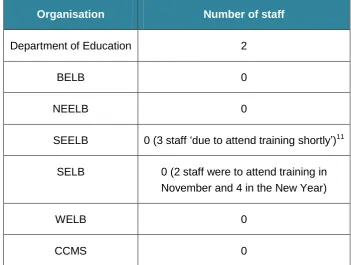
appropriate, changes are made to take account of particular rural circumstances. Guidance from the Department of Agriculture and Rural Development states that departments should carry out rural proofing at the outset of policy development. It also offers rural proofing training to officials. Uptake of the training is as follows:
Rural definitions
The viability audits used the definition within the Sustainable Schools policy of urban areas comprising Belfast and Derry/ Londonderry and all other areas regarded as rural.
NIAR 574-12 Research Paper
Northern Ireland Assembly, Research and Information Service 4
Two members of staff from the Department of Education undertook the training;
No staff at the ELBs or CCMS had undertaken the training, however two of the ELBs advised that some staff members were due to attend.
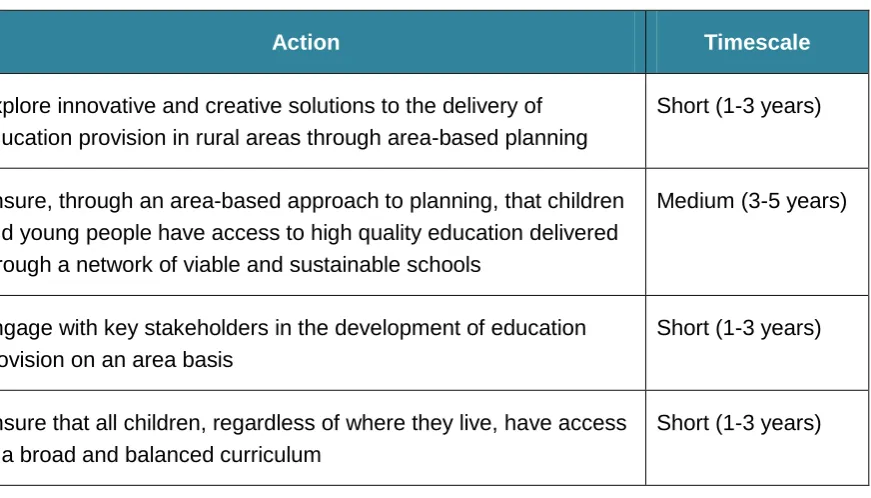
The Rural White Paper Action Plan launched in June 2012 included a number of actions for the Department. These included exploring “innovative and creative solutions
to the delivery of education provision in rural areas through area-based planning.”
Issues affecting rural schools
The literature highlights a number of challenges that can be faced by small rural schools. These include:
Financial issues: smaller schools tend to cost more per pupil;
Educational experience: potential challenges may include offering a broad
curriculum at post-primary and opportunities for professional development;
Attracting teachers and principals: research has identified a decline in the
number of applications for leadership posts, particularly to small rural primaries.
Rural schools in other jurisdictions
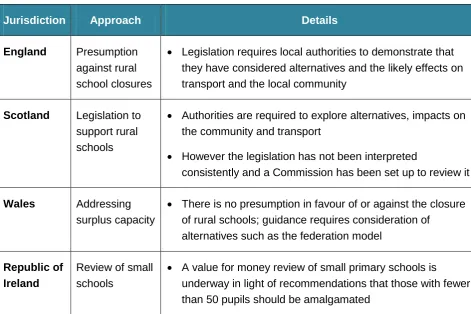
[image:6.595.66.538.451.765.2]Other jurisdictions have introduced a range of measures and legislation relating to rural schools. Key features of the jurisdictions are outlined in Table 1.
Table 1: Key approaches to rural schools in other jurisdictions
Jurisdiction Approach Details
England Presumption
against rural school closures
Legislation requires local authorities to demonstrate that they have considered alternatives and the likely effects on transport and the local community
Scotland Legislation to
support rural schools
Authorities are required to explore alternatives, impacts on the community and transport
However the legislation has not been interpreted
consistently and a Commission has been set up to review it
Wales Addressing
surplus capacity
There is no presumption in favour of or against the closure of rural schools; guidance requires consideration of
alternatives such as the federation model
Republic of Ireland
Review of small schools
A value for money review of small primary schools is
The literature also highlights international approaches in rural and remote areas. These include online lessons in Alaska and Canada and virtual communities of teachers in Spain aiming to provide opportunities for sharing good practice. In England and Wales the federation model is becoming increasingly common, whereby one school combines with others with joint leadership and governance arrangements. This approach is often used to increase capacity among schools facing closure.
Implications of closing rural schools
The research highlights a number of potential implications of rural school closures. These include:
Financial implications: research in Wales has highlighted potential savings
from closures to delegated budgets; however it notes that there are likely to be other financial implications, such as transportation and redundancy payments;
Impact on pupils: concerns around the impact on pupils have been
highlighted, although research on school closures suggests that such concerns are often not realised in practice;
Impact on transportation: some areas have a wide dispersal of population
and closures could result in children having to travel longer distances;
Impact on the community: rural schools are often viewed as part of the fabric
of the community. Other indirect impacts could include influencing where families choose to live and the availability of community meeting space.
Conclusion
A number of areas could be given further consideration, including:
The extent to which rural proofing has been carried out around area planning;
The definitions used by the Department for rural schools;
The extent to which area plans meet the Rural White Paper commitment to
‘explore innovative and creative solutions… through area-based planning’;
Potential approaches to ensuring that rural schools are able to provide a broad curriculum and to encouraging principals to take up positions in such schools;
Approaches in other jurisdictions, for example, the legislative requirements around rural school closures in Scotland and England and the review of small schools in the Republic of Ireland;
The potential implications of rural school closures (for example implications for pupils, staff, funding and transportation);
NIAR 574-12 Research Paper
Contents
Key Points ... 1
Executive Summary ... 3
Contents 1 Introduction ... 9
2 Northern Ireland context ... 9
3 Issues affecting rural schools ... 14
4 Rural schools in other jurisdictions ... 15
5 Implications of closing rural schools ... 20
6 Approaches to education in rural and remote areas... 22
1
Introduction
Rural schools are often viewed as being a key part of their local community. However, concerns have been raised about their sustainability in the longer-term in light of the viability audits and area planning.
This paper considers rural schools in Northern Ireland, and provides an overview of rural schools identified as ‘evidencing stress’ in the recent viability audits. It also explores the evidence on the issues affecting small rural schools, approaches to rural education in other jurisdictions and the potential implications of school closures.
2
Northern Ireland context
Over half (55%) of Northern Ireland’s primary schools are situated in rural areas, together with 20% of post-primary schools.1
Viability audits
The Education and Library Boards (ELBs), together with the Council for Catholic Maintained Schools (CCMS), published viability audits of all schools in February 2012. The aim was to contribute to strategic planning by identifying schools evidencing ‘stress’ in relation to sustainable enrolment levels; delivery of quality education; and financial viability.
Using this latter definition, the following analyses provide an overview of information from the viability audits on the number of schools in rural and urban areas deemed to be ‘evidencing stress’ in one or more areas.
Schools ‘evidencing stress’
Testing the data for statistical significance shows that rural schools were significantly more likely to be identified as evidencing stress than urban schools. This was true for
1
Department of Education: School level data [online] Available at: http://www.deni.gov.uk/index/facts-and-figures- new/education-statistics/32_statistics_and_research-numbersofschoolsandpupils_pg/32_statistics_and_research-schoolleveldata_pg.htm
Rural definitions
The viability audits used the definition within the Sustainable Schools policy of urban areas comprising Belfast and Derry/ Londonderry and all other areas as rural.
NIAR 574-12 Research Paper
Northern Ireland Assembly, Research and Information Service 10 each of the four ELBs with both rural and urban schools, and at both primary and post-primary level.2
Areas of ‘stress’
Amongst those experiencing stress, rural schools were significantly more likely to experience enrolment stress than urban schools at both primary and post-primary level. Urban schools were significantly more likely to experience financial stress and
[image:12.595.147.481.247.719.2]educational stress than rural schools.
Figure 1: Areas of ‘stress’ identified in the viability audits for rural and urban primary schools
2
All schools in the Belfast Education and Library Board are deemed to be urban 76.8%
5.0% 3.6%
9.3% 4.6% 0.4% 0.4%
Areas of 'stress' faced by rural primary schools
Enrolment only
Financial only
Educational only
Enrolment and Financial
Enrolment and Educational
Financial and Educational
Enrolment, educational and financial
45.8%
12.5% 22.9%
8.3%
8.3%
1.0% 1.0%
Areas of 'stress' faced by urban primary schools
Enrolment only
Financial only
Educational only
Enrolment and Financial
Enrolment and Educational
Financial and Educational
Figure 2: Areas of ‘stress’ identified in the viability audits for rural and urban post-primary schools
Review of the Common Funding Scheme
The findings and recommendations of the Independent Review of the Common Funding Scheme may have implications for rural schools here. It stated that the significant additional support for all small schools, together with the relatively low funding for pupils from disadvantaged backgrounds, contravenes departmental objectives.3
3
Independent Review of the Common Funding Scheme (2013) Bangor: Department of Education 52.5%
15.0% 0.0%
25.0%
0.0% 2.5%
5.0%
Areas of 'stress' faced by rural post-primary
schools
Enrolment only
Financial only
Educational only
Enrolment and Financial
Enrolment and Educational
Financial and Educational
Enrolment, educational and financial
23.5%
21.8%
16.0% 12.6%
12.6%
1.7% 11.8%
Areas of 'stress' faced by urban post-primary
schools
Enrolment only
Financial only
Educational only
Enrolment and Financial
Enrolment and Educational
Financial and Educational
NIAR 574-12 Research Paper
Northern Ireland Assembly, Research and Information Service 12 The Panel noted that additional funding for small schools leads to reduced resources for distribution to other schools. However, it emphasised that some small schools serving isolated communities are essential, and will require additional funding.4
The report states that if the proposals for a new funding approach are implemented, schools with enrolments below 105 pupils will need additional funding from outside the Formula to remain viable, dependent on designation of small school status.5
Under the proposed formula primary schools with fewer than 105 pupils would lose an average of £24,554, compared to a loss of £8,685 for schools with 105-199 pupils, and a gain of £41,668 for schools with 300-499 pupils.6 In 2011/12 a total of 297 primaries had an enrolment of fewer than 105 pupils (35% of primaries).7
Rural proofing
Rural proofing is the process by which major policies and strategies are examined to determine whether they have a differential impact on rural areas and, where
appropriate, changes are made to take account of particular rural circumstances.8
4
Independent Review of the Common Funding Scheme (2013) Bangor: Department of Education
5
As above 6
Independent Review of the Common Funding Scheme (2013) Bangor: Department of Education
7
Department of Education (2012) School Level Data 2011/12 [online] Available at: http://www.deni.gov.uk/index/facts-and- figures-new/education-statistics/32_statistics_and_research-numbersofschoolsandpupils_pg/32_statistics_and_research-schoolleveldata_pg/statistics_and_research-school_enrolment_1112.htm
8 Department of Agriculture and Rural Development: Rural Proofing Support and Guidance [online] Available at:
http://www.dardni.gov.uk/index/rural-development/rural_proofing_.htm
Recommendations from the Review of the Common Funding Scheme
The review set out a number of recommendations with particular relevance for rural schools, including the following:
Small school support factors should be removed from the Formula
A Small Schools Policy must be developed as a matter of urgency – this
should define the circumstances in which a small school is required, including consideration of travelling times and community need
Strategically important small schools should be funded outside the Formula
Sites offering post-16 provision should be of sufficient size to offer a broad range of opportunity to pupils within the site, with collaboration generally limited to more specialist provision (in the longer-term)
Guidance from the Department of Agriculture and Rural Development (DARD) states that Government departments must rural proof from the outset:9
“As agreed by the Executive, you must begin the process of rural proofing at the outset of your policy development or policy review.”
[image:15.595.124.476.253.518.2]DARD offers rural proofing training to officials involved policy-making. The training involves a half day course to help staff undertake effective rural proofing of policies.10 The following table provides an overview of the total number of staff at the Department and at the relevant arms-length bodies who have undertaken the training.
Table 2: Number of staff who have undertaken DARD’s rural proofing training
Organisation Number of staff
Department of Education 2
BELB 0
NEELB 0
SEELB 0 (3 staff ‘due to attend training shortly’)11 SELB 0 (2 staff were to attend training in
November and 4 in the New Year)
WELB 0
CCMS 0
Source: Information provided by organisations, September/ October 2012
Rural White Paper Action Plan
The Rural White Paper Action Plan launched in June 2012 included a number of actions to support rural education for which the Department of Education is the lead Department. A number of key examples are outlined in the following table. 12
9
Department of Agriculture and Rural Development (2011) Thinking Rural: The Essential Guide to Rural Proofing Belfast: DARD
10
As above
11 One member of staff had previously attended training with the Rural Community Network 12
NIAR 574-12 Research Paper
[image:16.595.95.531.91.340.2]Northern Ireland Assembly, Research and Information Service 14
Table 3: Examples of DE actions within the Rural White Paper Action Plan
Action Timescale
Explore innovative and creative solutions to the delivery of education provision in rural areas through area-based planning
Short (1-3 years)
Ensure, through an area-based approach to planning, that children and young people have access to high quality education delivered through a network of viable and sustainable schools
Medium (3-5 years)
Engage with key stakeholders in the development of education provision on an area basis
Short (1-3 years)
Ensure that all children, regardless of where they live, have access to a broad and balanced curriculum
Short (1-3 years)
3
Issues affecting rural schools
The following paragraphs highlight some of the key issues that can affect small rural schools.
Financial issues
Small schools tend to be more expensive to run, on a per pupil basis, than their larger counterparts. There is significant variation in per pupil funding at primary level in Northern Ireland (ranging from £2,442 to £14,632 per pupil), and the Independent Review of the Common Funding Scheme attributes this discrepancy in large part to the small school protection factors within the funding Formula.13
The Review notes that 299 of the 300 primary schools that receive the highest per capita funding in NI have fewer than 100 pupils. There is a similar trend at post-primary, although the range is smaller (from £3,815 to £6,204 per pupil).14
Educational experience
The Bain Review in 2006 emphasised that school sustainability is about the quality of the educational experience provided to children and the value for money that that experience represents. It highlighted potential difficulties for small schools, including:15
The demands of preparing a programme for classes with mixed age groups;
13
Independent Review of the Common Funding Scheme (2013) Bangor: Department of Education
14As above 15
Difficulties in securing substitute cover for teachers;
Higher administrative burden on teachers leaving them less time for the preparation of lessons; and
Financial pressures and uncertainty.
Other evidence indicates that small rural primary schools frequently provide a high quality curricular offering and educational experience. However, small post-primaries may face more challenges in providing breadth of subject choice.16
Teachers in more remote rural schools may experience difficulties in accessing professional development opportunities, and may experience a degree of professional isolation and reduced peer support.17
Attracting teachers and principals
Some rural schools face challenges in attracting appropriately qualified staff to teaching positions.18 A 2009 report highlighted concerns around the declining number of
applicants for leadership posts in Northern Ireland, ‘particularly for small rural primary
schools’.19 These concerns are in line with international trends.20
Concerns have also been raised around the capacity of teaching principals to manage their dual role in small primary schools here. Research has found that over three quarters (78%) of primary teachers surveyed in 2009 stated that combining teaching and leadership roles would act as an important or very important disincentive to applying for a leadership position.21
However, while other research recognises the challenges around the role of the teaching principal, the benefits are also highlighted. For example, many headteachers enjoy the teaching aspect of their role, and it can serve to promote the principal’s credibility among their staff.22
4
Rural schools in other jurisdictions
This section provides an overview of approaches to rural school sustainability in England, Scotland, Wales and the Republic of Ireland.
16
Times Educational Supplement (2013) Rural schools report leaked [online] Available at:
http://www.tes.co.uk/article.aspx?storycode=6313518
17 Wildy, H. and Clarke, S. (2012) “Leading a small remote school: In the face of a culture of acceptance”
International Journal of Primary, Elementary and Early Years Education Vol. 40, Issue 1
18
As above
19
PwC (2009) School Leadership Matters Bangor: Department of Education
20
Schleicher, A. (2012) Preparing Teachers and Developing School Leaders for the 21st Century: Lessons from around the world OECD Publishing
21 PwC (2009) School Leadership Matters Bangor: Department of Education 22
NIAR 574-12 Research Paper
Northern Ireland Assembly, Research and Information Service 16
England: Presumption against rural school closures
The Government has emphasised the role of rural schools in supporting the viability of rural communities. In 1998 a presumption against the closure of rural schools was introduced, strengthened through 2004 guidance requiring authorities to provide evidence that they have considered other factors (such as transport implications).23 The Education and Inspections Act 2006 set out additional requirements around the closure of rural schools. In regard to rural primary schools, the legislation requires the relevant body to demonstrate that they have considered the following factors in developing their proposals;24
The likely effect on the local community;
The availability and cost of transport to other schools;
Any increase in the use of motor vehicles which is likely to result and the likely effects of any such increase; and
Any alternatives to the discontinuance of the school.
These requirements indicate that the case for closing a rural school must be carefully considered and based on evidence of the potential impacts.
Scotland: legislation to support rural schools
The guidance on schools in Scotland does not outline specific criteria for school
sustainability. However, it does illustrate a number of possible reasons that may prompt a local authority to close a school. These include:25
The school roll (which ‘may have fallen below what is optimal in terms of educational opportunity, choice, flexibility and social interactions for pupils’);
Significant under-occupancy of the school buildings;
Condition of the school buildings (which may be below acceptable standards and beyond economic repair);
Potential for a ‘significant release of resources, capital or revenue’ that would benefit the community.
2010 School closure legislation
In 2008 the Scottish Government launched a consultation on proposals for changes to legislation around school closures.26 Subsequently, the Schools (Consultation)
23
Rural Development Sub-Committee (2008) Inquiry into the Reorganisation of Schools in Rural Wales Cardiff: National Assembly for Wales
24
The Education and Inspections Act 2006 [online] Available at: http://www.legislation.gov.uk/ukpga/2006/40/contents
25
School closure guidance [online] Available at: http://www.scotland.gov.uk/Topics/Education/Schools/Buildings/guidance
(Scotland) Act 2010 introduced changes aiming to protect schools in rural areas, by requiring local authorities to explore:27
Any viable alternative to closure;
The likely effect on the local community if the school were to close; and
The likely effect of travelling arrangements occasioned by the closure. The legislation required councils to prepare an educational benefits statement on the proposal to close a school and consult with a wider range of stakeholders over a longer period of time.28
The Scottish Government also reports that this legislation has been interpreted differently by local authorities and Government. As a result, a Commission on the Delivery of Rural Education has been established.
Wales: addressing surplus capacity
Recent figures suggest that there are over 95,000 unfilled school places (18% of total pupil number) across Wales.29 The situation is complicated by the fact that pupil numbers are falling in post-primary schools but increasing in primary schools.30
27
School reorganisation proposals [online] Available at:
http://www.scotland.gov.uk/Topics/Education/Schools/Buildings/changestoschoolestate
28 Murtagh, C. (2011) “Seeking Closure”
Holyrood , 30th May 2011 pp.34-35
Commission on the Delivery of Rural Education
The Commission was announced in July 2011 and is tasked with examining both how the delivery of rural education can maximise the attainment of young people in rural areas, and the link between rural education and communities.
To allow the Commission to undertake its work a moratorium on school closures ran for a year until June 2012.1 The Commission’s report has not yet been released. However, the Times Educational Supplement Scotland recently reported on a leaked copy of the draft report, stating that it includes the following points:
The legislation giving rural schools extra protection means that larger, urban schools are disproportionately affected by the current financial squeeze;
A national maximum should be set for the amount of travel time for children;
Rural schools may be more viable if they offer pre-school services;
Small primaries generally do not have difficulties in delivering the curriculum, although small post-primaries may struggle to offer breadth of subjects.
NIAR 574-12 Research Paper
Northern Ireland Assembly, Research and Information Service 18 Criteria for sustainability
Guidance from the Welsh Assembly Government states that where there are deemed to be excessive numbers of surplus school places, local authorities should make proposals for school reorganisation: particularly where there are individual schools that:31
Have ‘significant’ levels of excess places. ‘Significant’ surplus is defined as 25% or more of a school’s capacity, and at least 30 unfilled places;
Require significant investment; or
Have a catchment area that is unlikely to make the school sustainable in the future in terms of pupil numbers.
Dealing with surplus places
The guidance states that local authorities should make sure that an appropriate number of schools are retained within an area, but that there should be no more than 10% surplus places across a local authority. There is no presumption in favour of or against the closure of any type of school. The guidance sets out a number of additional matters that must be considered when considering closure, including: 32
The effect on journeys to school;
Whether savings can be made or services provided cost effectively to the community by using school premises for another purpose;
Any capital investment that would be required to bring premises up to a
suitable standard for the delivery of the curriculum;
Whether alternatives such as a federation or multi-site school would be more appropriate;
Whether the school provides education of a good standard compared with others that might be alternative schools.
With regard to proposals to close schools with a designated religious character, the guidance states that the implications for the balance of provision in schools must be taken into account. It notes that proposals must be dealt with in a sensitive manner and that they should reflect the balance of demand, where possible.33
29
School organisation and pupil place planning [online] Available at: http://www.wlga.gov.uk/english/school-organisation-and-pupil-place-planning/
30
Estyn (2012) How do surplus places affect the resources available for expenditure on improving outcomes for pupils? Cardiff: Estyn
31
Welsh Assembly Government (2009) School organisation proposals Cardiff: Department for Children, Education, Lifelong Learning and Skills
32
As above
33 Welsh Assembly Government (2009) School organisation proposals Cardiff: Department for Children, Education, Lifelong
Republic of Ireland: review of small schools and attempts to protect them
Irish schools are currently experiencing a period of demographic growth which is expected to continue over the short- to medium- term.34
The sector has a high proportion of primary schools in relation to the population, and a high proportion of small primary schools. This is in part due to the low population densities in some areas and a historical trend of declining enrolments throughout the 1990s.35 Almost half of all schools enrol fewer than 100 pupils. Current plans to rationalise the system focus on primary school size.36
Review of small schools
The 2009 McCarthy Report of the Special Group on Public Service Numbers and Expenditure Programmes made a series of recommendations for reducing spending. Among the recommendations was rationalisation of the schools estate, in particular the amalgamation of primary schools with fewer than 50 pupils, with the purpose of
reducing staff numbers.37
A value for money review of small primary schools with fewer than 50 pupils was subsequently launched by the Department of Education and Skills aiming to assess the value for money of such schools.38 The report is yet to be published and no interim findings are available.39
Potential new category of ‘isolated schools’
In Minister’s Questions in May 2012, Ruairí Quinn TD stated that it would be likely that rural schools in most isolated communities would remain. He stated that the review of small schools could result in a new category of schools being included: that of “isolated schools” (the other category would be simply “schools”). However, this is yet to be decided.40
Attempt to bring forward legislation on the protection of schools
Luke “Ming” Flanagan TD introduced the Education (Amendment) (Protection of
Schools) Bill in 2012 in an attempt to protect schools which are of such importance that their closure would result in a harmful impact upon a community or area. Such schools were deemed to include those providing education to: 41
34
Department of Education and Skills Small Primary Schools Value for Money Review 35
Walsh (2010) Strategic Spatial Planning and the Provision of Schools: A Case Study of Cross-Sectoral Policy Coordination in the Dublin City Region Maynooth: National Institute for Regional and Spatial Awareness
36
Department of Education and Skills Small Primary Schools Value for Money Review 37
Special Group on Public Service Numbers and Expenditure Programmes (2009) Volume 1 Report Dublin: Government Publications
38
Department of Education and Skills Small Primary Schools Value for Money Review 39
Information provided by the Department of Education and Skills, December 2012
40
Houses of the Oireachtas: Other Questions - Pupil-Teacher Ratios Thursday, 24 May 2012 [online] Available at:
http://debates.oireachtas.ie/dail/2012/05/24/00029.asp
41 Education (Amendment) (Protection of Schools) Bill 2012 [online] Available at:
NIAR 574-12 Research Paper
Northern Ireland Assembly, Research and Information Service 20
A geographical, cultural, religious or non-denominational community;
A recognised Gaeltacht area; or
An offshore island.
The Government opposed the Bill, with Deputy Ciarán Cannon stating that it ‘would
keep schools open even when there are not enough pupils to sustain them’ and that it ignored ‘basic realities about the state of the economy’. A majority of TDs voted against the Bill at its second stage.42
5
Implications of closing rural schools
Financial implications
Estyn, the schools inspectorate in Wales, reports that excess capacity ties up resources which could be used more effectively to support teaching and learning. Its recent report calculated the potential savings of closing a school in Wales, based on analyses of the average cost of a surplus place and the average savings of school closures.43
Table 4: Potential savings from closing a school in Wales (delegated budgets)
Phase Potential savings
Primary £63,500 plus £260 for each surplus place removed
Post-primary £113,000 plus £510 for each surplus place removed
Source: Estyn (2012) How do surplus places affect the resources available for expenditure on improving outcomes for pupils?
It is important to note that these figures only include savings from delegated school budgets, and that there are likely to be other financial implications. For example, home-to-school transport costs may increase, and a school closure is likely to involve one-off costs such as severance packages for staff.44
The report highlights that capital receipts from the sale of schools buildings may not always be as great as expected, particularly as some schools are situated in areas unattractive to developers, and that there may be additional costs in terms of demolition or security for such buildings.
42
Education (Amendment) (Protection of Schools) Bill 2012: Second Stage [Private Members] [online] Available at:
http://debates.oireachtas.ie/dail/2012/07/03/00023.asp
43
Estyn (2012) How do surplus places affect the resources available for expenditure on improving outcomes for pupils? Cardiff: Estyn
44 Estyn (2012) How do surplus places affect the resources available for expenditure on improving outcomes for pupils? Cardiff:
However, costs from central budgets for areas such as school improvement, maintenance and catering may decrease. The report concludes that the potential savings from school reorganisation should be considered on a case-by-case basis, and that any such strategy should have school improvement at its core, rather than simply a
‘resource management exercise that is separate from the interests of learners’.45
Impact on pupils
A Welsh Assembly Sub-Committee on Rural Development found that there is no evidence that when small schools close and pupils transfer to larger schools, that standards decline. Their inquiry also pointed to a range of potential benefits for children such as increased opportunities for children to participate in activities. It found no demand from parents or pupils at new schools to return to the previous provision.46 A 2008 report by the Rural Development Council here included interviews with a range of stakeholders affected by school amalgamations. Before amalgamation, the report identified a range of anxieties, such as the effects on children, community and staff. However, most reported that the majority of their worries had not been realised. Indeed, respondents pointed to benefits including improved resources, facilities and teaching capacity.47
Impact on pastoral care
School ethos and provision for pastoral care have been highlighted as particular strengths of many smaller schools. Indeed, research suggests that the potential implications for pastoral care are a key concern around school reorganisation, particularly where it involves moving to larger schools.48
Impact on staff
A study in Norway of schools facing closure in sparsely populated areas considered the implications of this. The survey found strong resistance to the closures among
principals and staff and a sense of frustration in many cases. Other implications related to long-term planning, creativity and use of resources.49
Impact on transportation
A key challenge around the closure or amalgamation of schools relates to home-to-school transport. Some rural areas have a wide dispersal of population and inadequate
45
As above
46
Rural Development Sub-Committee (2008) Inquiry into the Reorganisation of Schools in Rural Wales Cardiff: National Assembly for Wales
47
Rural Development Council (2008) Striking the Balance: Toward a Vision and Principles for Education in Rural Northern Ireland: A Rural Proofing Study
48
Rural Development Council (2008) Striking the Balance: Toward a Vision and Principles for Education in Rural Northern Ireland: A Rural Proofing Study
NIAR 574-12 Research Paper
Northern Ireland Assembly, Research and Information Service 22 transport provision, and the closure of some schools may result in children having to travel longer distances to school.
It has also been reported that disadvantaged children can be disproportionately affected by transportation issues, as they may be more reliant on the school bus and that this may have implications for their ability to take part in after-school activities.50
Impact on the community and indirect impacts
Rural schools are often viewed as being embedded in their local community. The Rural Development Council’s rural proofing study found that the relationship between the school and the sense of community is not clear cut. However, the findings suggest that interactions between a newly amalgamated school and the community may be reduced in comparison to the relationship with the previous school.51
Other research highlights a range of potential indirect impacts of rural school closure, including influencing where families choose to live, property values and the pace of development. It may also have an impact on the availability of community meeting space where schools currently provide this outside of school hours.52
6
Approaches to education in rural and remote areas
This section considers schools in remote and isolated areas internationally, and approaches undertaken to address some of the issues affecting rural schools outlined in the previous section.
England: federated schools
England has over 600 schools with federation arrangements whereby one school combines with others with joint leadership and governance arrangements. A survey by Ofsted found that schools federate for a variety of reasons, namely in the following cases:53
Small schools in danger of closure federating to increase capacity and
protect the quality of education;
High performing schools approached by the local authority to federate with a
school causing concern; and
Federations of schools across different phases in an effort to strengthen the
overall education of pupils in the community.
50
Rural Development Council (2008) Striking the Balance: Toward a Vision and Principles for Education in Rural Northern Ireland: A Rural Proofing Study
51
As above
52 Lytton, M. (2011) Have all the costs of closing a school been considered? Paris: OECD 53
The Ofsted report found that federations that had been established to improve capacity across schools were successful in ‘broadening and enriching the curriculum and care,
guidance and support,’ and in supporting good educational outcomes. The report also found that federations shared a greater pool of resources and expertise.54
In all federations visited, both educational provision and outcomes had shown improvement, with the federated model as a contributory factor to the improvement.55 Other research supports these findings, and also highlights the increased opportunities for professional development, and potential for economies of scale to be realised.56 Federations are also a feature of education in Wales.
Alaska: video-teleconferencing
The Kodiak Island Borough School District of Alaska includes many schools that are only accessible by school or boat. A programme of distance video learning has been implemented based on a model whereby one teacher is on each side of the camera to ensure in-school support for students.57
This approach means that students can take a range of new subjects taught by highly qualified teachers based within the district but not necessarily on site. The programme has resulted in an increase in college-readiness scores.58
Canada: web-based distance education
A study of rural education in Newfoundland and Labrador, Canada, stated that a policy of school closure and consolidation had been implemented for much of the 20th
century, but that most of the schools remaining in remote rural areas could not be closed due to their isolated location.59
One of the features of many such schools across Canada is a heavy reliance on web-based distance education for post-primary education where teacher numbers are reduced or where there are difficulties in recruiting specialist teachers.60
This approach has been found to work well with motivated and independent learners; however it has not been effective with many students, for example those who lack motivation or self-direction. The study suggests that pupils require more school-based support.61
54
As above
55
Ofsted (2011) Leadership of more than one school: An evaluation of the impact of federated schools Manchester: Ofsted
56
Chapman, C. et al. (2011) A study of the impact of school federation on student outcomes Nottingham: National College
57 Gordon, D. (2011) “Remote learning: technology in rural schools” in
THE Journal, October 2011 pp. 18-24
58 Gordon, D. (2011) “Remote learning: technology in rural schools” in
THE Journal, October 2011 pp. 18-24
59 Mulcahy, D. (2009) “Rural and Remote Schools: a reality in search of a policy”
in International Symposium for Innovation in Rural Education 2009 NSW Australia: University of New England
60 As above 61
NIAR 574-12 Research Paper
Northern Ireland Assembly, Research and Information Service 24 Greek islands: educational webcasts in composite classes
In a number of isolated Greek islands small primary schools with composite classes use learning webcasts to address the challenges around multi-grade schooling. In particular, the webcasts aim to address the ‘free time’ of students who finish their work more quickly than expected or where the teachers needs more time to work with another class. A small-scale study found that the webcasts were useful, that students enjoyed watching them and stayed silent.62
Spain: virtual communities for professional development
A project in Spain involved the development of communities of rural teachers. The Network Multigrade Education (NEMED) was a network of rural schools across nine European countries, aiming to bring multi-grade schooling to the forefront. A ‘Virtual Rural School’ was set up within the programme, allowing e-learning and opportunities to share best practice and experiences and reduce teacher isolation. A study found that teachers appreciated the opportunity to be connected with others and to undertake collaborative work.63
7
Conclusion
This paper has found that rural schools are significantly more likely than urban schools to be identified as evidencing ‘stress’ at both primary and post-primary in the viability audits. A number of areas could be given further consideration, including:
The definitions used by the Department and its arms-length bodies for rural schools;
The extent to which a rural proofing process has been carried out around area planning, including taking account of the particular circumstances of rural schools and the potential impact of rural school closures;
The extent to which the area plans meet the Rural White Paper Action Plan commitment to ‘explore innovative and creative solutions to the delivery of
education provision in rural areas through the area-based planning approach’;
Potential approaches to ensuring that rural schools are able to provide a broad and balanced curriculum and to encouraging teachers and principals to take up positions in such schools;
62 Giannakos, M.N. and Vlamos, P. (2012) “Using educational webcasts in small multigrade schools of isolated islands”
International Journal of Education and Development using Information and Communication Technology Vol 8, Issue 2, pp. 131-141
63 Barajas, M. et al. (2007) Creating virtual learning communities of rural schools teachers. Proceedings of the 2007
Approaches in other jurisdictions, for example, the legislative requirements around rural school closures in Scotland and England and the review of small schools in the Republic of Ireland;
The potential implications of rural school closures (for example implications for pupils, staff, funding and transportation);