ESCalate Themed Funding: Work Based Learning Grant Project
Final Report
Date submitted 11 January 2012
Project Title Work-based Learning Pedagogies and Academic Development Project Leader Prof Carol Costley
Institution Middlesex University
Partners 1. Sue Graham, Academic Registry, Northumbria University
Pauline Armsby, Westminster Exchange, University of Westminster 2.
Ruth Helyer, Business School, Teesside University 3.
Jon Talbot, Professional Development Unit, University of Chester 4.
Work Based Learning
Pedagogies
and
Academic Development
Carol Costley and Mehmetali Dikerdem
A Research Project funded by HEA Subject
Centre Education ESCalate 2011
Steering group: Carol Costley, Mehmet Dikerdem, Irem Inceoglu, Kerry Harman, Dave Hill, Carole Davis, Spyros Themelis, (all Middlesex University) and Jocelyn Wishart (HEA)
Acknowledgements
Interviewees: Denise Meakin, Chester University; Fusun Dedezade, Middlesex University; Kevin Ions, Teesside University; Pauline Armsby, University of Westminster; Peter Taylor, Middlesex University; Molly Bellamy, Middlesex
University; Sue Graham, Northumbria University; Ruth Helyer, Teesside University; Zina Ioannou, Middlesex University; Tracey White, Middlesex University; Jonathan Garnett, Middlesex University; Garth Rhodes, Northumbria University; David Major, Chester University; Dave Perrin, Chester University; Ann Minton, Derby University (phone interview); Peter Bryant Middlesex University, (pilot interview).
Contributors: Irem Inceoglu, Research Assistant for the duration of the project; Natasha Shukla (conducted some of the interviews).
Thanks to Kate Maguire for being a critical friend, proof reader and for construction of summaries.
Special acknowledgement to Paula Nottingham, Middlesex University.
Paula Nottingham’s PhD thesis, ‘An exploration of how differing perspectives of Work Based Learning within Higher Education influences the pedagogies adopted’ (Birkbeck College),was being developed at the same time as this research was being undertaken giving us the opportunity to share some overlapping issues. Paula’s research produced important data and conclusions that have brought about valuable outcomes with significance and value for the wider field of WBL in HE It has produced some unique and purposeful perspectives on WBL pedagogies, for
example, the categorisation of WBL pedagogies into three areas of learner centred, discipline-centred and employer-centred which present a useful and relevant conceptual frame for understanding the complex and diverse area of WBL.
The thesis is timely in that government initiatives and academic theorising of the topic have reached a point when universities are re-evaluating their position in relation to economic imperatives and their academic offer to society in changing times. As pointed out in the conclusion, WBL has been identified as one of the ways forward. This work offers some perspectives that can inform future pedagogies in WBL.
Contents
2. Background and aims
3. Methodology
4. Results
a. Learning strategies
i. Accreditation [APEL]
ii. Planning [Learning agreements/contracts]
iii. Practitioner-led projects
iv. Research methodology
v. Reflection/reflexivity
b. Workplace mentors, tutors and assessors
c. The implications of practices for the more facilitative role of the adviser
d. An approach to issues of ethics in WBL that prioritise values and utility
e. Critique of WBL
5. Project Outputs
a. Curriculum guide
b. Public dissemination
c. Excel listing of over 750 references to WBL literature relating to pedagogy with annotated bibliography
6. Appendices
a. Poster
b. Example of Adviser Reflection
1.
Executive Summary
This research project team examined the pedagogical practices of tutors working on Work Based Learning (WBL) programmes in HE in England and Wales and carried out an in depth review of the literature on related pedagogies. The findings specify essential knowledges and abilities a tutor should have who is engaged with WBL in HEI and offers a practical and informed response to a potential barrier to the successful delivery of WBL due to a lack of adequately prepared staff to act as advisers. It presents an in depth and annotated literature review on related pedagogies and its findings contribute to the current debates and issues.
Through asking and finding out what WBL pedagogies are and what the rationale underpinning work-based learning strategies might be, it takes up the challenge of more traditional knowledge transmission pedagogies in HE and puts forward a reasoned argument for WBL’s academically sound pedagogies, such as the epistemology of practice, and its increasingly pivotal role in the future direction of HE. This is a direction which needs to manage growing complexity through the pursuit of new knowledge, widening participation and collaborating across disciplines and across different domains of professional practice. It requires being proactively engaged with the private and public sectors, professional bodies and various institutions. Most importantly it has to be able to offer purposeful and relevant pedagogies, successful delivery and assessment that continue to raise standards through emphasis on learner centred learning and transdisciplinarity; on learning technologies including accreditation of prior learning, learning agreements, projects, critical reflection, reflexivity and relevance; and on ensuring the availability of
advisers who have the knowledge and characteristics to be experts in the epistemology of practice and in learning conversations.
This report will support practitioners and students of WBL in the development and articulation of their practice through the shared insights, conceptual frameworks and ideas which are contained in this work.
2.
Background and aims
This project, undertaken over a 12 month period, January - December 2011, was funded by Education Subject Centre advancing learning and teaching in education
(ESCalate), part of the Higher Education Academy (HEA) and was run by Middlesex University, Institute for Work Based Learning Research Centre.
The research was designed to examine the pedagogical practices of tutors working on Work Based Learning (WBL) programmes in HE in England and Wales. Interview data was taken from a geographical spread of Universities that have significant WBL programmes, modules or courses.
The research question guiding this study was formulated as:
What are the pedagogies and what is the rationale underpinning work-based learning strategies?
The project aims were:
• to contribute to the emerging literature on pedagogies
• to address a potential barrier to the successful delivery of programmes in HE, which is the availability of adequately prepared staff to act as advisers.
The research aimed to specify a number of essential knowledges and abilities a tutor should have through a survey of the practices of experiences of learning and
advising in HEIs.
WBL has been a growing part of HE provision in the UK and internationally. With roots in adult education, vocational lifelong learning within HE, placement learning, accreditation of non-certificated learning and the prominence increasingly attached to reflection as a pedagogical tool, conceived as some combination of these elements, WBL has increasingly informed higher education practices since the 1990s. There are key surveys which trace the evolution of informed higher education pedagogies and practices which also account for their emergence and increasing currency over the past 20 years. (Brennan and Little 1996, Portwood and Costley 2000, Boud and Solomon 2001, Brennan 2005, O’Connor 2005, Chaney et al 2005, Nixon et al 2006, Brennan et al 2006). Over this period the factors influencing government higher education policies, favouring workplace related HE pedagogies, have been varied. On the macro-economic level, successive governments have urged the university sector to engage more fully with workforce development to enhance Britain’s competitiveness in the global market order. At the sectoral level, successive Labour governments supported the possibilities offered for widening participation, especially for non-traditional students and mature learners by providing part-time and other flexible routes. In the higher education institutional level, this chimed with liberal theories of learner centred pedagogies which privileged independent and situated learning modes through the application of flexible negotiated learning in `fields of study’.
In the ensuing years, this has been shown to provide benefits in terms of engaging with employers (HEFCE 2007) and widening participation particularly among adult learners who would not otherwise engage with HE and in many cases lack formal entry qualifications for study at the relevant level (Stephenson and Saxton 2005,
Nixon et al 2008). Successful implementation depends on staff being able to act as
facilitators, advisers and expert resources, as opposed to working in a more
traditional academic role as discipline-bounded experts (Boud 2001). In many cases it requires a re-evaluation of the traditional and established `knowledge transmission role’ of the academic into a combination of roles including coaching, mentoring and formative assessment which recognises the significance of learning that takes place outside the university. Universities engaging in WBL programmes, modules and/or courses therefore work closely with employers, communities, professional bodies and other stakeholders on course development, design and assessment as explained by
Respondent 1
WORKING WITH organisations
“We've got modules and we have a preferred route through the programme following certain modules, but we don't have to follow that … we go into the organisation and say, 'What's going on here? What's going on in the
organisation? And how can we fit what we're doing into what you're trying to
do or are doing?' and it's really difficult to explain how you do it, you just 'do' it, you know? It's about having a really good understanding of each other's approaches and coming to an agreement about how you're actually going to meet each other's needs in order to meet the workplace targets, objectives and needs and also the academic attainment that students have to meet, and I suppose our modules are designed in such a way that they have generic outcomes, we also develop specific outcomes though for the individual and the organisation as well, so it's an iterative approach, again, it's about looking at something and drilling down and down and down and devising a product that actually meets the needs” (March 2011).
Work-based programmes typically employ different structures, approaches and processes from those used in subject-based academic programmes (Costley et al
2010
,
Helyer 2010). The shared characteristics of these programmes usually includeat least one or more of the following curriculum elements:
•
accreditation of certificated or experiential learning•
learning agreements including employers as well as learners•
location of learning in the workplace or `work’ as the subject of learning•
workplace or professional practice related `applied’ projectsThe ‘curriculum,’ although often structured around template and project modules, is largely created by the student from their work activities and agendas, often involving three-way negotiation between student, university and employer. It will typically be grounded in and defined by a context rather than a subject-area or academic
discipline. Prior learning claims are generally assessed against the student’s overall learning aims, as expressed in a learning agreement or contract, rather than against a predefined field of study. Assessment draws on workplace activity and analysis and reflection upon it and often uses generic criteria in conjunction with the student’s own learning objectives.
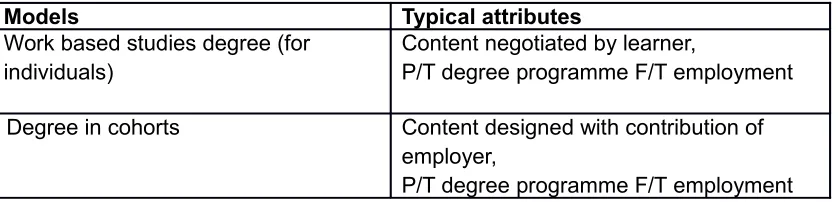
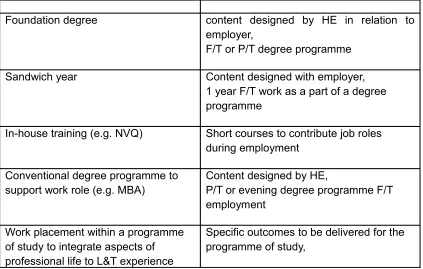
[image:7.595.90.509.690.791.2]WBL can occur in variety of forms and in many contexts (Brennan and Little 2006). Higher education programmes implement different models ranging from a degree in work based studies to work placements within a subject-based degree programme. Different models of WBL are defined on the table below showing variables that relate to ownership of the content of the learning experience.
Table 1 Different models of WBL
Models Typical attributes
Work based studies degree (for individuals)
Content negotiated by learner,
P/T degree programme F/T employment
Degree in cohorts Content designed with contribution of
employer,
Foundation degree content designed by HE in relation to employer,
F/T or P/T degree programme
Sandwich year Content designed with employer,
1 year F/T work as a part of a degree programme
In-house training (e.g. NVQ) Short courses to contribute job roles during employment
Conventional degree programme to support work role (e.g. MBA)
Content designed by HE,
P/T or evening degree programme F/T employment
Work placement within a programme of study to integrate aspects of professional life to L&T experience
Specific outcomes to be delivered for the programme of study,
This project aims to illuminate the pedagogical practices associated with WBL and contribute to an emerging literature on pedagogies (e.g. Boud and Costley 2007; Rhodes and Shiel 2007). This also responds to the call from Costley, Abukari and Little (2008) for further research on strategies to support a growing number of WBL tutors. Key outcomes of the project are recommendations to guide the induction of staff as tutors and advisers and a complete set of references of WBL pedagogical literature to date. The report extends the work of Boud and Costley (2007) which identified features of advising on projects. It aims to address a potential barrier to the successful delivery of WBL programmes in HE which is the lack of supply of
adequately prepared staff to act as WBL advisers (Brennan and Little 2006).
The features of advising on WBL projects identified by Boud and Costley (2007) provided the starting point for the interviews and collection of data for the above purposes. Data has been collected from programmes which demonstrated the following characteristics: learner-managed; learner-focused; academics or work-place tutors acting as adviser rather than as supervisor; negotiation of learning expectations; acknowledgment of the importance of context, and making active judgements.
[image:8.595.85.508.57.326.2]Below are some of the differences between the delivery of the more traditional `knowledge transmission’ pedagogies and the most commonly deployed WBL ones. The table below, although focused on work-based projects, has wider implications for WBL practices and draws together some of the salient points.
Table 2 The advisory role in WBL projects and non – WBL projects: some frequently found differences
WBL non- WBL
Three-way relationship: often mediated between student, adviser, work supervisor
Direct two-way relationship: student and adviser
Commonly involves parties other than the student, adviser and work supervisor
Less common to involve parties other than the student and adviser
Multi-mode contact Typically face-to-face
Negotiation of topic and process May be unilateral
Plan negotiated at start Plan is more often emergent
Formalised three-way learning agreement Formalised learning agreement not common
May be assessed by practitioner Occasionally assessed by practitioners (depends on context of project in course)
Products highly varied, but typically include reflective component
Products conventional academic output: reports, etc, may not include reflective component
Learner is an insider and expert in subject area/context
Supervisor expert in subject area/topic
Adviser expert in frameworks/levels of achievement
Framework/level of achievement pre-defined for student
Adviser expert in epistemology of practice (including linking knowledge)
‘Supervisor’ expert in epistemology of discipline
Adviser and learner have distinct areas of expertise
‘Supervisor’ and learner often in relationship of authoritative power
From: Boud, D., and Costley, C. (2007). From project supervision to advising: new conceptions of the practice. Innovations in Education and Teaching International, 44(2), 119-130.
In fact some of the shifts in academic practice occasioned by frameworks were noted during the interviews conducted for this research:
Respondent 1
“I don't see myself as the font of all knowledge or the 'guru' of knowledge. More often than not the student has the subject expertise, so my role is to help them think about how to articulate that expertise into academic learning, and most students need the support on the academic side of their work, the writing and the presenting of an essay and how to reference correctly and how to conduct a literature search, how to review literature and critique it. That's perhaps an area that a lot of students aren't so familiar with but they are experts in the workplace” (April 2011).
McIver Nottingham 2011states that
“ [WBL] actually changes the teacher’s position, in that instead of you being the font of all knowledge and transmitter of the curriculum, you become a facilitator that enables learners to negotiate and respond to that curriculum in a way that’s appropriate to them and in a way that meets the needs of the outside agency… .
Another similar approach: Respondent 4
“So I would say that the pedagogical basis, because the approach we take is very much a kind of constructivist approach to learning and of self-direction and negotiation and reflection and all of those things, there's a big onus on the learner that the more they put into it the more they will get out of the process, I suppose. So the tutor's role is to support, guide and advise them on their journey...” (March 2011)
A very recent and comprehensive analysis undertaken by Paula McIver Nottingham (2011) presents a typology of work-based learning perspectives in the higher
education system consequent upon pedagogical inflections and indeed differences in the delivery of these programmes. She differentiates between:
•
Discipline centred•
Learner-centred•
Employer centredperspectives in delivering work-based programmes in the higher education sector.
The discipline-centred perspective focuses on programmes delivered as part of a subject-based discipline and are usually aligned to a disciplinary area. These are to be found especially in the disciplinary areas of health, engineering and education. Curriculum design is more linked to competencies and skills in the workplace through placement and sandwich courses where professional mentors support learning which essentially remains close to the transmission of knowledge models.
In the learner-centred approach, the work-based learning programme is not
specifically located in an academic discipline but uses the workplace as the principal context for learning. The emphasis is on a transdisciplinary framework for knowledge
generation, which identifies the generic properties of work and professional practice as the site of education. Central to this strand of WBL pedagogic practice is the tripartite negotiated learning agreement providing, in some cases, a customised or `flexible’ curriculum. This approach will typically be grounded in and defined by a context rather than a subject-area or academic discipline. Prior learning claims are generally assessed against the student’s overall learning aims, as expressed in a learning agreement or contract, rather than against a predefined field of study. Assessment draws on workplace activity and analysis and reflection upon it, and often uses generic criteria in conjunction with the students’ own learning objectives Assessment and accreditation are based on generic learning outcomes which make this approach more suitable for mature learners with considerable experiential learning. Given the latter condition, learner-centred learning can be seen to support the widening participation initiatives taken by successive New Labour administrations (1997-2010).
Another form or inflection taken in higher education according to McIver Nottingham (2011) is the employer-centred one underpinned, post-Leitch (2006), in workforce development priorities and closer links between universities and the private sector world of business. In this model, disciplinary knowledge is combined with more business oriented approaches with emphasis on capability based learning using past experience. This relates to the other perspectives and `contextualises’ or re-purposes these within a workforce development agenda taking in private sector management techniques and discourses in the delivery of the programmes.
The following was suggested by respondent 3:
So the way it normally works is, working with the employer to identify what they want, that's identifying their needs, putting together a bespoke
programme around set principles, modules, bringing the learners together, identifying their own particular needs and then we have a module, so most students do a learning contract which sets out what they are going to do and how they're going to do it. In terms of the learning, we have a module, all students do this, it's called 'academic recognition of continuing professional development', and basically what we are saying is that most people are doing CPD but they don't draw that CPD together and reflect on it.” ( March 2011).
McIver Nottingham (2011) however notes that there are subtle and interesting differentiations in the practitioners’ roles involved in the three models of delivery which she specifies. In the discipline-centred perspectives, the practitioner tends to be tied to a particular discipline and is positioned firmly within the university. In some disciplines, notably in health, the role of the professional mentor with strong
affiliations to a professional body could also be quite prominent. In the case of the
learner-centred approaches, the practitioners often start in disciplines but then move on to more generic versions taking on the role of an adviser who is an expert in pedagogy and epistemology of learning rather than disciplinary knowledge. The original discipline could be deployed for structuring learning rather than to develop content-based curricula. The roles of the practitioners in the employer-led
experience that equips them for a `recontextualisation’ of existing HE pedagogy into the workplace. The practice tends to mirror business-related activity, frequently criss-crossing the disciplinary boundaries and those of the work situation.
These developments have prompted a series of reflections on the novel and possibly changing functions of practitioners who design and deliver programmes as well as acting as advocates of this pedagogy within higher education institutions. These often involve dynamic and evolving relationships between peers, in which learners bring specialist knowledge and expertise from their professional contexts and the academics’ function evolves into mainly one of knowledge of university quality assurance criteria, knowledge of academic processes and deep understandings of WBL pedagogies, especially the learning epistemologies involved.
3.
Methodology
‘What are the pedagogies and what is the rationale underpinning work-based learning strategies?’
In order to answer this research question in an analytical way, an interpretive approach was adapted to guide the collection and analysis of data in the project. During the months of March and April 2011 fourteen semi-structured interviews with WBL academics in various partner institutions were conducted. The interviews were designed as semi-structured in order to open up the space for the interviewees’ interpretation and conceptualisation of their experience. The questions were
designed to interrogate the personal journey of the interviewee as an academic and his/her engagement with their pedagogical practice/s, through collecting descriptive accounts and exploring the effectiveness and limitations of various strategies in terms of student learning experience and completion of awards (Table 1 above). The interviewees were selected in relation to their expertise in the field and to represent a range of universities that are known to have expertise in the field; Middlesex
University, University of Northumbria, Teesside University, University of Chester, University of Derby and Westminster University. The interviews were transcribed.
The interviews and programme documents were analysed in order to map the key teaching, learning and assessment strategies in use in WBL programmes and to examine similarities and differences across universities and WBL programmes. This contributes to providing a better understanding of WBL practices across a broad cross section of universities and programmes in the UK.
The methodology enabled the collection of in depth data from the relatively few experts who have engaged with large groups of work based learners since WBL became a significant approach in UK universities. The analysis of the interview data using the above themes as a starting point provided a more nuanced understanding of the significant elements of learning and teaching associated with WBL practice. The enhanced understanding of WBL pedagogies gained from the project guides the development of a WBL Adviser’s module and associated resources for incorporation in Academic Development programmes in HE. (See Section 5).
Another way of collecting data was in the form of organising interactive workshops within various conferences. One of the workshops was conducted during the
Research in Learning and Teaching Conference on 13th May 2011. This workshop
accommodated colleagues from both the WBL Institute and other schools including the School of Health and Social Sciences and the School of Arts and Education. Throughout the workshop an overview of the project was presented which was then followed by an exercise relating colleagues’ experiences to the frame of the project. At the end, the feedback was written on a flipchart to be analysed. In addition to that, another workshop was organised within the Universities Association for Lifelong Learning WBL network conference on 28th-29th June in Cardiff. The participants of
this workshop were WBL experts from various UK universities.
While collecting data in relation to documents and interviews, the open nature of sources was checked and confirmed with the participants. Because of ethical
concerns, data that were not consented to by the participant institutions were neither discussed nor included in the analysis.
WBL is a field of study that cuts across subject disciplines therefore there is a wide range of generic literature on WBL as well as some subject discipline-related literature, especially in the field of health and social care. The literature published in subject discipline areas has a synergy with the generic concepts that epitomise the field of WBL e.g. experiential learning, learning contracts, work-based projects and reflective practice. In relation to that, the interviews conducted with WBL tutors also demonstrate that there are some broad themes emerging which are likely to form the key pedagogical practices that relate to WBL.
This project also draws from the literature review of Costley, Abukari and Little (2008) that provides a contextual explanation of WBL with its academic focus taken from high-level practical knowledge and learning in a work-based context. The recognition of knowledge that emanates from work as a source of learning (Eraut et al 1998; Boud and Garrick 1999) positions students in their particular situated context rather than in disciplinary knowledge (though they may also draw on disciplinary
knowledge). An analysis of the literature includes conceptual perspectives and findings in relation to key underpinning pedagogic issues. The conceptual
perspectives are based on analysis of the literature and researchers’ understanding of the views.
4.
Results
a. Learning strategies
Both the literature review and the interviews conducted suggest that there are
several kinds of learning technologies that are typical of WBL practices and that there are broad philosophical approaches to the role of delivery that differentiates these from the more conventional teacher-student relationships. A generally agreed common denominator suggested by various surveys (Helyer 2010, Garnett et al 2009, Boud and Lee 2009, Boud and Costley 2007, Rhodes and Shiel 2007) suggests that typical strategies involve variations of the following:
i) Accreditation [APEL]
ii) Planning [Learning agreements/contracts]
iii) Practitioner-led projects
iv)Research methodology
v) Reflection/reflexivity
i) Accreditation [APEL]
Accreditation of prior experiential learning (APEL) refers to formal accreditation of learning that counts (or has potential to count) towards the programme itself
(Barkatoolah 2000). APEL provides a facility for allowing accumulated experience in work and life to be recognised within higher education and thus provides a significant entry point into higher education. As a generic educational tool, accreditation of previous learning has been around in various forms since the late 1980s under the auspices of the Council for National Academic Awards which stipulated that:
`appropriate learning at higher education level, wherever it occurs, provided it can be assessed, can be given credit towards and academic award’ (Garnett et al 2004 cited in Helyer 2010). The increasing acknowledgement of so-called `uncertified learning’ in higher education, especially in post-1992 institutions, corresponded with the growth of WBL pathways and the former’s consequent elective affinity with WBL programmes.
As Workman writes (in Garnett and Young 2008:78):
APEL is recognised quite widely for entry into higher education, and in some cases provides advanced standing against a given university level award, thus providing the opportunity to shorten formal programmes of study where prior learning is counted as significant…[At Middlesex University for example] Accreditation of learning from outside MU is allowed up to two thirds (66%) of an academic award, depending on programme requirements or on core modules which may limit the amount of APEL that can be used
This also marked a significant shift from a `deficit’ model of education with its pre-occupation with that which needs to be known, to one which acknowledges and gives university-level credit to experiential and professional knowledge. In discipline-based taught courses, specific credit usually represents exemption or advanced standing
given when there is an acceptable match between an applicant’s credentialised prior learning and the requirements of the course usually specified in terms of university entry regulations and academic subject bench-marks. WBL pedagogies facilitate the implementation of more flexible programmes which may include learner-negotiated credit-based awards. More relaxed rules can be applied to where credit can be granted, provided that this learning is relevant to the proposed award and provides a basis on which the individual learner’s programme can be built. One of the key tools in achieving these aims is the use of appropriate levels of systematic reflection on practice and portfolio building which has been extensively used in the past in discipline-based programmes such as nursing and teacher training.
Where WBL is conceptualised as a field of study in its own right, for example in programmes of work-based studies, professional studies or modules of WBL that have generic assessment criteria, Garnett (1998) has argued that the idea of specific credit should be replaced by one of focused credit, where prior learning becomes both the starting point and an integral part of the individual WBL programme.This approach to prior learning is more appropriate to the negotiated or transdisciplinary model of learner-centred WBL (Boud 2001).
In WBL practice, informed by transdisciplinary approaches, there is a trend to use the APEL claim as part of the development process itself (Armsby et al 2006; Walsh 2006; Lester 2006). The APEL process can enable work-based learners to become ‘map-makers’ rather than ‘map-readers’ (Lester 1999), providing them with the
capacities of evaluating past learning in relation to future goals and bringing about an element of self-discovery and self-evaluation, particularly in relation to organising ideas and planning future learning.
Accrediting experiential learning is a process which can greatly enhance
opportunities for work-based learners, provided that the expertise in advising and assessing that is required for APEL is present at the HEI. In that context, the internal structure and processes of the universities could affect the way the accreditation is undertaken i.e. some universities have separate accreditation boards and some include accreditation intheir examination boards.
As Costley and Armsby put it,
“whichever way it is done, there has to be an understanding of accreditation processes from the key colleagues involved. APEL also requires expertise in assessment of the claims and related appropriate quality assurance
processes which again should be no more exacting than conventional assessment procedures but does require knowledge of APEL processes” (2008: 9).
Similar views are expressed by a number of respondents interviewed for this report:
“I think that the flexibility negotiated learning brings to the curriculum, I think the opportunities for APEL and manipulation of credits and curriculum to create a coherent whole in terms of created programme is wonderful, and I think that's one of the most positive things I've ever come across in higher education. I think the ability to gain academic credit for what you've learnt genuinely hands on in the workplace and to negotiate a curriculum towards a negotiated award title that's relevant to you is wondrous” (April 2011).
Respondent 5
“I'd like to see more use of APL, because I think we miss a trick there. We do use APL but I think we could use more of it, do it better... I think people perceive it as too complicated to do and it's easier just to put the learners through the learning...The APL is a perception of people that it's difficult and complicated as a process and maybe we need to do a bit more communication around how it works and how it could be done. Actually it could save the academics a lot of time and effort if they do it in a useful way, it means they haven't got to go through a great long process if they can APL them in here then they haven't got to deliver all of this over here” (March 2011)
Respondent 7
“...[T]he rest of the University don't particularly like APEL, don’t respect it, and other institutions perhaps don't see it outside of WBL of course, but it's a very valuable things for students. So I think perhaps if we could change our APEL regulations and amend them so we don't have to assess students' written work so much but we can look at the evidence they've collected, providing it's congruent with the level they are studying, so they're not just emptying their filing cabinet with a load of pieces of paper that don't mean anything, and we're talking about artefacts that they've written themselves” (April 2011).
The acknowledgement of APEL further bolsters learner-centred WBL to investigate further the possibilities afforded by the production of knowledge situated outside the academy. This could be used to `translate’ the learning created in the workplace into comparable academic frameworks with the framing of knowledge becoming common to both the university and the workplace. Portwood (1993) has argued that this could also lead to a more `transformative’ approach where the learning outcomes from the workplace could induce organisational change as well as learner enhancement.
ii) Planning [Learning agreements/contracts]
Learning agreements or contracts have been used in UK HE since 1970s and broadly they refer to “a formal written agreement between a learner and a supervisor which details what is to be learnt, the resources and strategies available to assist in learning it, what will be produced as evidence of the learning having occurred and how that product will be assessed” (Anderson et al 1998:163).
In WBL contexts, learning contracts may be employed to support work towards predetermined outcomes such as the requirements of a syllabus or competence
specification. Osborne et al (1998) describe this type of programme as being particularly valuable in more open curricula where the programme (or a significant part of it) is built around the experience, context and work focus or aspirations of the learner. In the learner-centred versions of WBL, learning contracts or agreements with organisations were used in the design of the curriculum and these aspects of the tuition were negotiated with the learner. Boud, Solomon and Symes (2001) have referred to the partnership where the learner/employee takes on an explicit role in the workplace and that position is supported by the manager/employer role and the academic/academy role. This `tripartite’ pedagogy breaks down barriers to learning by workplace professionals by structuring a learning framework and formalising the acceptance that knowledge operates outside the university as an alternative content in HE practice. The new roles for workplace participants are characterised by
negotiation and learning contracts, extending the current HE practices to encompass a wider sphere of influence outside the academy.
Respondent 8 stated in this context :
“We've got modules and we have a preferred route through the programme following certain modules, but we don't have to follow that. Those modules follow that process of reflective practice and so we work to those kind of design principles, those curriculum principles of critical reflection, but we go into the organisation and say, 'What's going on here? What's going on in the organisation? And how can we fit what we're doing into what you're trying to do or are doing?' and it's really difficult to explain how you do it, you just 'do' it, you know?” ( March 2011)
Respondent 4 had a more cautious view :
“[The learning contract] symbolically addresses stakeholder needs, for better and worse, at a superficial level that's what it's supposed to be doing” ( April 2011)
Respondent 8 stated that:
“[T]hey have a learning agreement which is updated every year, and that was set up on the document to be a three way relationship, so ideally there'd be us, the company and the student. But more often than not they don't want to tell their employer, for whatever reason, so we could never have it as a compulsory thing, and your employer must be involved because if they were studying to move on or whatever, and it was on an evening if they were paying their own fees, you can't make them tell their employer...” (April 2011)
And further,
interesting but within a rigorous framework that makes sure that it is HE but in the best way” (April 2011).
Learner characteristics and participation in framing these agreements are also important in so far as whether higher education processes change the relationship of the employee with the organisation or affects how the academy manages
interdisciplinary learning and knowledge. These could also involve changes in the role of the academic from practitioner of a certain discipline to one of a facilitator for workplace learning within an organisation.
Respondent 2
“The main amount of work would be done through the WBL framework, which provides a kind of box of, like a shower framework if you like that Schools can work with employers to fill in whatever way the employer wants, so it might be that they want some specific taught modules as part of that and then when there's a whole raft of generic WBL modules that the curriculum design team can pull off the shelf and put into their programme, so it's kind of pre
approved and then they put things in the way that meets the need of the employer, depending on whether they want just a short certificate or a full Degree or Masters Degree, depending on what level they want, and then once they've done that, that goes through an approval process through the School, but there is a panel which I would be on or one of my colleagues would be on, to check that it meets all the criteria” ( March 2011).
As WBL has developed it has also changed the role of the academic to more of an
“adviser expert in the epistemology of practice (including linking knowledge) as opposed to the supervisor expert in the epistemology of a discipline” (Boud and Costley 2007).
Respondent 6
“I suppose the tutor and the learner [has the control over curriculum], oh and the employer, it's a three way thing. At different points in different ways, they have control. At the end of the day, the University controls the entire thing because they own the award, it's their award, and they say what happens in terms of times and deadlines and assessments and some of those key planks of any academic programme are determined by the University. But having said that, it would be done in conjunction with, the design will have been done with the employer to make sure that it's what they want, but the ownership rests with the University” (March 2011).
The new roles for workplace participants increasingly involve negotiation and learning contracts, extending the current HE practices to encompass professional practice and workplace activities.
Respondent 3
“It’s [curriculum] a partnership. Ultimately we have control over the quality assurance and the rigour. Ultimately we are the standard people. When I develop a programme I develop it in conjunction with the employer so they’ll talk to me, I interpret their needs and they say yes that’s good or let’s try this and we
develop a curriculum like that. From that second, right the way through ... we are continually reviewing it and developing it, continually seeking feedback from the learners, continually looking at our own practice, we’re always developing it. So in that respect we’ve got joint ownership because we listen to everybody’s views on it” ( March 2011).
iii) Practitioner-led projects
Work-based projects are a central feature of work-based learning programmes at university level (Garnett 2005; Boud and Tennant 2006; Walsh 2006; Boud and Costley 2007; Rhodes and Shiel 2007). Unlike the majority of projects within taught programmes, WBL projects tend to be practitioner-led and typically emerge out of real workplace issues with which the learner is involved; they may be projects that learners are already undertaking or have decided to undertake (Armsby and Costley 2000; Graham and Smith 2002), or in some cases activities that are already
complete but can be used as the basis for reflection and further learning (Lester 2007; Chisholm and Davis 2007). The scale of projects involved range from small investigations that can be accommodated in a single module, to major pieces of work that form the basis of doctorates and result in significant organisational or
professional change.
In WBL programmes, projects are frequently negotiated between tutor, learner and employer using a learning agreement format (Nixon et al 2006; Stephenson and Saxton 2005). Armsby and Costley (2000) comment that there is often a need to develop learners’ “critical awareness of research issues and practical competence in applying them”, which can involve both fine-tuning existing abilities learned as a practitioner (such as co-operation, critique, reflexivity, pragmatism and flexibility) as well as developing new methodologically related capability.
The ongoing relationship between learner and tutor is typically more advisory than supervisory (Boud and Costley 2007), while Moore (2007) adds that this may include providing opportunities to i) construct meaning and new knowledge from practice ii) to inspire and support learners to cope with change and ethical dilemmas and iii) to encourage them to make best use of workplace resources and networking
opportunities.
WBL projects typically take the following forms or their combinations:
•
Research into one’s own professional practice with the aim of enhancement or improvement of this through becoming a change agent•
Related to the above, and often using action research methodologies, the management of change or introduction of an innovation•
Research with the aim of diffusing some innovation to a particular community of practitioners, including contributions to the theoretical underpinnings of a particular professional practice.Respondent 4
“And then their project is a yearlong project and is basically they are the project. It's the write up of their kind of journey for that process, going through. Because originally we used to be able to do it in a year then we went through a period of time when they were putting more and more in terms of the teacher training side and trying to make it as natural as possible meant that they were doing it in the second year when they're out at schools but no one was finishing it off because there were too many pressures there. So now we've managed to squeeze it back into a year by making it as natural to the process as possible. And WBL here are very flexible in terms of, normally people would do programme planning, RAL, and then later would do their project. Well they're doing them all side by side so… They are flexible enough to accommodate things going simultaneously” (April 2011)
Respondent 6
“With the independent work based projects there's presentations and reports, but we're beginning to start looking at other ways of presenting those things in the traditional standard, giving an OHP presentation and typewritten report, because things like using posters instead, to report back what they are doing, so a variety of techniques, videos, as long as the student can actually meet the outcomes of the module.” (March 2011).
Stan Lester (2011) has shown that the workplace has become an acknowledged site of knowledge production that can have equal validity with academic and other research-oriented contexts. Investigating practice-based doctoral work (these projects have the same resonance as the lower level WBL projects in that they are research and development projects undertaken by work-based learners) that is based on research and development in the workplace, he demonstrates that real life projects concerned with development and change rather than explicitly with research can be, given intellectual rigour and critical reflection, a powerful source of new knowledge.
The findings from [this] study suggest that there are a number of activity-types that can give rise to workplace knowledge...They can be represented as (A) practice as research...where knowledge is produced from taking a researching approach to the activities that are primarily intended to create development or change; (B) research within practice...where a distinct research activity takes place alongside and closely connected to practice; and (C) research for practice...where research is pursued outside of the immediate practice environment but with the intention of informing it. (p.10)
One of the acknowledged strengths of WBL pedagogies is precisely this focus on workplace or professional practice projects which are frequently designed for real life and real time effects, impact and transformation as well as new knowledge
production. The work-based project usually involves a subject-specialist and a specialist or a tutor with both sets of expertise who works side by side with the work-based learner.
iv) Research Methodology
WBL at university level generally includes some form of workplace or practitioner research, which may take the form of a distinct project or investigation, or be an expansion of an activity that an established practitioner is undertaking in the normal course of his or her work (Costley 2007). From the university’s viewpoint this activity is normally conceptualised as ‘research’, whereas from the practitioner’s perspective it may be regarded also as research, or principally as development, or again as practice activity wherein the research dimension is secondary (Lester 2004, Doncaster and Lester 2002).
The methodologies used in work-based or practitioner research are not specifically different to those that might be used in conventional academic research in similar contexts, although there is an understandable tendency to use action-based methods as well as multiple methodologies (Jarvis 1999). Costley and Armsby (2007) list soft systems methodology, case study, ethnography, action research, action learning, and co-operative and appreciative enquiry as widely used approaches.
The nature of the work-based project leads to an approach to research and development as an insider in a work situation which provides the opportunity for developing a real project at work using higher education expertise in research and critical thinking (Costley et al 2010). There are many aspects to a work-based project that differ from a more conventional project, for example, the researcher is an insider and needs to negotiate a range of ethical issues from an insider perspective such as the subjects of the research and role conflict, access to information etc, and the project will usually have tangible outcomes that seek to make changes in a work situation so the project dissemination often includes strategies for organisational change which can directly impact on participants in the research.
Bellamy (2008) discusses the way in which undergraduate ‘worker-researchers’ negotiate their research approach and their research positionality, both in relation to their own place in the workplace hierarchy and in relation to their alignment with the research ‘stakeholders’; so, for example, a worker-researcher may be aligned with management in achieving organisational objectives and assume a managerial positionality, or may be aligned with a disenfranchised group (pupils in a
school/patients in a hospital) and assume a positionality of empowerment. Bellamy argues that it is through this negotiation of a research positionality that the worker-researcher may best achieve reflexivity.
Respondent 4
As mentioned earlier, In the more learner-centred versions of delivery, the function of the adviser increasingly becomes that of an adviser expert in the epistemology of practice including links with knowledge. One of the main functions of the advisory role is to enable the learner to combine her or his `positionality’ within an organisation or within a professional context and the learner’s `ontological’ stance with the
epistemologies appropriate for empirically based research and development tasks required by the work-based project activity.
The specificity of work-based or workplace research is the unique position of the learner as both an `insider’ worker but with sufficient critical distance of the `outsider’ researcher. One of the main functions of the adviser is to enable the learner to critically engage with this dual role and reflect upon the research process itself in a way which will make the choice of methodologies, methods and data collection tools both transparent and relevant to the project activity types involved. The WBL adviser is there to ensure that reflection on practice and theorising this from a `critical stance’ meet the appropriate levels of higher education bench marking and does not merely reproduce the technical requirements of the work situation. Also, again as indicated above, where specialist knowledge is required, subject specific consultants can be introduced to help the learner negotiate real time and real world issues and
problems. In the more discipline and employer oriented versions of WBL pedagogies these functions can be united in the person of the academic or alternatively in the workplace professional mentor.
Respondent 9
“I think you don’t have to have detailed knowledge of the area you’re facilitating. I’ve got a doctorate [student] at the moment which is one on food hygiene and I know nothing about food hygiene but I’m looking at the WBL abilities that they have, and I am hoping the other examiner will have the food hygiene bit. It does depend on what sort of WBL you’re facilitating. If it’s negotiated WBL, then you need to know about methodologies because you need to be able to talk to the person about the various approaches that are available. You don’t need to know in depth about every single methodology but you do need to know enough about how data is collected in practice based situations. And how robust that data might be, given the circumstances and the situations that the people are in and the things they’re trying to achieve. How much is enough data? I think what we’re trying to do in negotiated WBL is make people’s projects better. They’re doing projects they would do anyway, but they’re doing them better than they would’ve done because we’re providing them with sort of like consultancy to do improved and better work in their work places; so knowledge of that sort of thing is very useful” (April 2011).
v) Reflection/reflexivity
Ideas of knowledge being derived from practitioners reflecting on practice have been developed by Schön (1984). The literature that has grown around Schön’s formulations argues that what is embodied as knowledge is revealed through reflection and
deliberation either in action or after action.
Reflection can also construct shared understandings amid confusing and conflicting conceptions and interpretations of work and context. Groups learn to observe and experiment with their own collective tacit understandings and established
in-action. Action is called upon to bring the individual’s and group's mental models, often untested and unexamined, into consciousness. It is a form of ‘reflection-in-action’, which attempts to discover how and what was contributed to an unexpected or expected outcome, taking into account the interplay between theory and practice. For example,
Respondent 7
“The key [characteristics of ] to me are recognising the workplace as a site of knowledge and understanding that the workplace is a site of learning and how to reflect on that knowledge in learning in order to change practice, or in order to understand what you're doing to make it better, to understand your development. There are huge aspects there of appreciative enquiry and the students that come to us quite often say, 'I've never written an academic essay, I don't think I'm capable of doing this', and yet when we go through the first module with them, the self review module, reflective module, it's very clear that they've got a huge amount of experience and a huge amount of skill, and yet they've never thought that they have had, they've always
thought that academia is out of their reach, and so this is a brilliant course for the people like that” (April 2011).
The work of Boud (2006, 2010) specifically focuses on the relevance of reflection to learning that occurs in the workplace. Boud has been writing on reflection and the formal WBL of professional courses since 1998 when he pointed out that if the challenging nature of reflection is poorly understood by teachers and just equated with thinking, it may become “domesticated” and fail to lead to real questioning of experience by students. He also argues that course developers need to recognise that reflective activities must be used flexibly, since the social and cultural context in which they occur will influence the kinds of reflection that are possible.
In, Productive Reflection at Work (2006), Boud and colleagues focus on reflection and informal learning at work and develop earlier ideas about the importance of social context. They suggest a new role for reflection in the context of organisational productivity. Opportunities for informal and collective reflection are created by the current trends towards organisational de-layering and devolving of management responsibilities to teams in the effort to remain sustainable. Conditions for effective collaborative reflection are discussed, such as the need for the workplace to be structurally designed to support reflective learning and also, in contrast, that un-designed, informal spaces are also made available, where group reflection through spontaneous dialogue can occur. An ethical dimension to reflection is also stressed, with discussion of the development of capacity for reflection as a means for the workforce to make sense of work and, by giving it meaning, contribute to
organisational sustainability and excellence. These ideas are reinforced by many of the respondents, for example,
Respondent 6
Moon (2004), building on her earlier work in this area, provides a ‘handbook’ of reflective activities that can be incorporated into formal educational programmes. This practical focus is preceded by a discussion of reflection as an aspect of
experiential learning. It is this that makes the book relevant to work based learning. She argues that both reflection and experiential learning are relatively unmediated by teachers (in the sense that they do not rely on a formal taught curriculum), and thus their value extends beyond formal learning into the kinds of self-managed continuing professional development that may occur in the workplace.
Fook (2006, 2010) offers a definition of reflection that highlights its relation to social context: “the ability to understand the social dimensions and political functions of experience and meaning making and the ability to apply this understanding in working in social contexts”. This position clearly aligns with Boud’s work and
confirms there is now a new focus on reflection as a collective activity. Respondent 5 below articulates the wide range of reflection expected from work-based learners.
Respondent 5
“we're assessing the articulation of their knowledge, their articulation of their reflective skill, their critical reflection, their critical analysis, their
understanding of self and their context, their synthesis of a range of ideas, theories, and their engagement with published sources, and public
discourses rather than just referring to what level, have they engaged with them, have they argued with them?” ( April 2011).
Divergent conceptions of reflection make it difficult to research and develop the concept systematically and this in turn can reduce the contribution that studies of reflection can make to theories of work based learning.
Kolb’s experiential learning cycle (1984), with its ‘reflective observation’ stage, and Schön’s notion of the reflective practitioner (1987) were the most frequently drawn on texts.
Respondents noted that reflection is not an add-on to enhance learning by helping practitioners make meaning out of experience, but key to structuring continuous professional development. A lack of understanding about what reflection is can lead to it being required of learners too early in their learning. It is not sufficient for learners to be told about the value of reflection if they are unable to turn this knowledge into practice. Practitioners and course developers need to support the growth of learners’ capabilities to reflect.
Respondents provided examples of how reflection can be embedded in WBL programmes using group rather than individual activities.
The use of reflection as a pedagogic tool remains a contested yet important area of pedagogical consideration in WBL. Papers that explore this, by describing the embedding of reflective activities in WBL programmes of study, also illustrated the range of discipline areas in which it is deployed. Graham et al (2006), along with Nikolou-Walker and Garnett (2004), provide details of the use of reflection in generic work-based programmes and concurs with many of the respondents
.
Respondent 7
“ Students are asked to do some form or reflective commentary on their CPD, they have to demonstrate to us what CPD they've done and they've got to demonstrate that by providing evidence of what they've done, and the amount of time they've undertaken, it might be a portfolio with a reflective element to it, and we can use different tools there; it might be a single reflective
summary or it could be using a learning journal or it could be a critical log or it could be a combination of all of those things” (March 2011).
Respondent 2
“ The modules follow the process of reflective practice and so we work to those kind of design principles, those curriculum principles of critical reflection, ” (March 2011).
There have been more developments in thinking about reflective practices that are critical of education processes that focus solely on the individual and their reflection of self. In Bradbury et al’s (2010) Beyond Reflective Practice: New Approaches to Professional Lifelong Learning, a strong critique is made of some current practices. Beyond reflection would be critical reflexive practice that incorporates the social context of reflection – both its relevance to organisational learning and its practical educational use in group settings.
There is a lack of consensus about reflection and of theorising about it which is likely to affect the effectiveness of its application. Since reflection is now applied widely in WBL, these are both important considerations for future work in the area.
b. Workplace mentors, tutors and assessors
It is fairly common to find mentors and even tutors and assessors taking part in the learning and teaching of WBL as they are often key in pedagogical approaches to WBL; what perspectives might there be about more employer/ professional influence on pedagogy?
One of the sample universities organises a specific award (‘Supporting WBL’ 60 credits at Level 6) for their partner tutors who are based in organisations and contribute to the learning and teaching on their accredited programmes . The respondent (15) states that the best people that academics can learn from are the partner tutors. However because the partner tutors do not have such in depth pedagogical understanding or experience in HE teaching, there is a need to build up their confidence.
participate, learning from each other, sharing experience and ideas, engaging with peer support from the trainers thus providing a virtual community of practice developed on-line and by e-mail. They develop a portfolio in which they reflect on each session and activity and say what they learned- discussion, recommendations, what action will be taken next. A summary reflection is written at the end.
This respondent found that timing needs to be flexible for the workplace tutors. The curriculum is based on FHEQ subject benchmarks and needs to be fit for purpose.
c. The implications of practices for the more facilitative role of the adviser
Both as an outcome of the literature review and the interviews conducted confirmed that the WBL academics require characteristics in relation to their pedagogical practices. It has repeatedly occurred during the interviews that the academics would consider themselves as facilitators instead of teachers and they acknowledge the experiential learning and expertise of the learner whom they are guiding.
Respondent 1:
“A facilitator, a coach, in a coaching environment so what I encourage the student to do is ask questions of themselves and to come up with the answers for themselves. I don't see myself as the font of all knowledge or the 'guru' of knowledge. More often than not the student is the subject expertise, so my role is to help them think about how to articulate that expertise into academic learning, and most students need the support on the academic side of their work, the writing and the presenting of an essay and how to reference correctly and how to conduct a literature search, how to review literature and critique it. That's perhaps an area that a lot of students aren't so familiar with but they are experts in the workplace” ( April 2011)
Respondent 4
“I would say that the pedagogical basis, because the approach we take is very much a kind of constructivist approach to learning and of self-direction and negotiation and reflection and all of those things, there's a big onus on the learner that the more they put into it the more they will get out of the process, I suppose. So the tutor's role is to support, guide and advise them on their journey... at the start would be to explain the whole process and methodology and how it all works, to make sure they understand that you are their first point of contact for queries etc. and any questions, make sure that you've got clear communication channels and how the thing is set up, depending upon… Some of the courses, the way we run it is we have group sessions every so often that everybody attends, others it's much more individual or it's done as an online thing. To help them to identify the scope of any work based project, what they are going to do, is a key part of the tutor's role, advise them on how they're going to go about it, developing the methodology” (March 2011)
Respondent 2
“I wouldn't describe them as pedagogical relationships. I would describe them as 'andragogical' relationships in the sense that they are adult learners in the workplace...” (April 2011).
The features specific to WBL mean that academics involved in work-based
programmes have a role that differs from that of most subject-based tutors in several ways. They need to act as facilitators, advisers and expert resources rather more than as teachers and be familiar with using the processes and technologies associated with WBL.
Respondent 4
“[I consider myself] as a facilitator. We do stand up and talk to groups, teach, but obviously it's about working with either individuals or groups of learners to develop their learning, learning programmes, and then working with them to work through those” (March 2011).
The constituents of the conceptual knowledge and skill base needed for advising in WBL includes knowledge of work and context, learning consultancy,
transdisciplinarity, enquiry, reflexivity and reviewing, and WBL learning strategies.
These factors create significant differences in the requirements for inducting WBL tutors and those for inducting other academic staff, and require a culture-change for existing staff who become involved in WBL programmes.
A better understanding of the pedagogical practices in use in WBL programmes, the underlying rationale/s for these practices and how these practices are similar to/differ from more traditional academic programmes will provide the basis for the
development of guidelines and resources for new and existing HE staff working in the field of WBL. Recent on going research at the Institute for Work Based Learning into doctoral level academic advisers reflecting on their own practices produced similar thinking on co creation of knowledge, transdisciplinarity and learning conversations between student and adviser. An example of one such reflection is included in Appendix b demonstrating the usefulness such a reflection exercise might have on the inducting of WBL advisers.
The findings in the analysis of the interviews show that WBL requires a reflective and evaluative approach which involves analytic and theoretical reasoning. Advisers need knowledge of reflective practice, for example Schon (1976); reflexivity about one’s own learning; and the effects of personal learning history (one’s own and others’) on current conceptualisation and practice. These kinds of abilities involve strategies and practices for noticing, recording, interpreting and representing development of peer learning strategies (face-to-face and electronic to support learning and aid reflection). They involve knowledge of self-assessment frameworks; forms of documenting and presenting learning outcomes; levels and standards of achievement; and ways of operationalising them and relating them to learning outcomes.
The change in role of the academic adviser has not occurred solely because of new contexts but because of a growing awareness of the contributions that academic advisers can make. Part of the change in role includes a shift from dependence on single supervision to accessing wider and distributed sources of support. As such there has been a decentring of the role of adviser, but there is still a fundamental role that has more emphasis on the total environment in which the learner is engaged and the holistic nature of their learning experiences. To this end advisers need to have the awareness of a range of working contexts and cultures and ensure that their advisees have the preparation, resources and self-monitoring strategies they need. Advisory practices also vary greatly from the minimal, ie initial meeting and final marking of the completed product, to the extended, ie regular meetings throughout the period.
A work-based epistemology is the basis for the field of work-based learning in higher education. This includes a framework of values that does not encourage conformity to rigid systems or to restrict the individual’s freedom to represent working knowledge in relation to the context within which it is understood. Advisers are able to utilise the provision in higher education that can interrupt dominant value systems and practices by making available conceptual and cognitive tools that both question and provide alternatives. A framework of reflexive practice and a genealogy of work for example, serves to contextualise the contingent and discursive nature of work. Advisers, in their teams and in the dissemination of their practice need to continually challenge their own practices and judgements.
The adviser is not a passive agent and can work alongside the student to develop rather than divert students’ understanding. WBL provides the possibilities to build on existing abilities and involve the active deployment and development of critical and reflective abilities initiated whilst doing work. Learners can be enabled to start their academic study from a position of current understanding, they represent themselves and their own learning, and take responsibility for the knowledge content and how it is formulated. The process can be confirmatory to a sense of self and be personally and professionally developmental. It is only by continuous consciousness-raising of the range of possibilities and contexts of learning that we can attempt to articulate a good design of the process.
It is not only a change in the specific tasks that advisers must perform or knowledge they need to have that is changing; power relationships within the student/ adviser dynamic in all kinds of WBL have long been an important concept. The power dynamic between adviser and student becomes more balanced, or perhaps less imbalanced when each offers expertise about the shaping of the work. Advisers who are use